
零跑汽车

Search documents
【重磅深度】乘用车电动化复盘:拥抱变化
东吴汽车黄细里团队· 2026-01-07 12:21
Investment Highlights - The automotive market began to show an upward trend in 2020 despite the pandemic, primarily due to a year-on-year increase in industry sales and a significant turning point in the penetration rate of new energy vehicles (NEVs), which led to a notable increase in the market share of domestic brands [2][26] - The core turning point for NEV penetration was driven by the localization of Tesla, with the Model 3 quickly becoming a best-seller, and improvements in the economic viability of the supply chain leading to a diverse supply [2][36] Historical Index Trends - In May 2021, the electric vehicle logic remained strong with a penetration rate of about 10%, and demand did not weaken despite a chip shortage that began in early 2021. The market anticipated a gradual easing of supply issues by July-August [3][45] - By May 2022, the penetration rate had increased to approximately 25%, with the resumption of production in lockdown areas and the implementation of tax reduction policies, which contributed to an upward trend in the index [3][48] - In February 2024, a shift in supply-demand dynamics occurred, leading to a price war initiated by Tesla's significant price cuts. The market began to rebound, with BYD's price reduction strategy proving effective [4][51] Profitability and Valuation Changes - The profitability of the automotive sector under the NEV trend has not significantly improved compared to the traditional fuel vehicle era, as selling NEVs has not altered the industry's business model, which remains rooted in manufacturing logic [5][56] - The valuation center for the automotive sector has shifted upward, with the price-to-sales (PS) ratio moving from a maximum of 2x during the fuel vehicle era to a current center of 1x, driven by increased market share and high-end breakthroughs of domestic brands [5][57] Competitive Factors in the NEV Era - The competition among automotive companies is characterized by a focus on hard power in the early stages, with soft power becoming more relevant later. The core competitive factors have evolved through different phases, including supply chain integration, electric vehicle technology, and marketing capabilities [6][60] - The first phase (2021-2022) emphasized supply chain advantages, while the second phase (2023) shifted towards electric vehicle technology and product definition capabilities, leading to a price war [6][60] - By 2025, the growth rate of NEV penetration is expected to slow down, with the main competitive logic focusing on imitating and surpassing leading NEV companies [7][60] Stock Performance Review - A review of stock performance from 2020 to 2025 indicates that early in the NEV development phase, the market had high expectations for leading companies from the previous cycle, while later periods required identifying emerging players based on changing competitive factors [8][20] - Notable stock performances include Seres as a tenfold stock, Jianghuai with an eightfold increase, and BYD with a fivefold increase, highlighting the importance of recognizing industry trends and selecting the best-performing stocks [8][20]




多家车企公布2026销量目标:“双新”政策调整延续下传统车企审慎、新势力乐观
Xin Lang Cai Jing· 2026-01-07 11:36
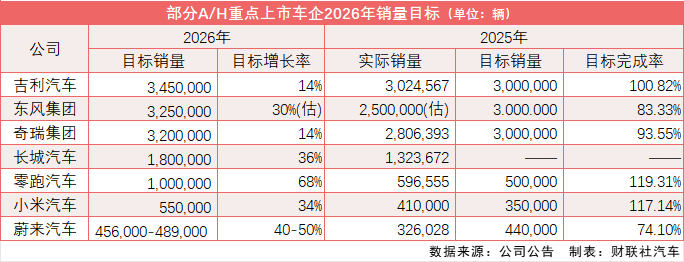
Core Viewpoint - The implementation of the half-price purchase tax policy for new energy vehicles and the adjustment of the "two new" subsidy policies have introduced new variables for the domestic automotive market in 2026, leading to divergent sales targets among various automakers [1] Group 1: Traditional Automakers - Geely has set the highest sales target for 2026 at 3.45 million units, with a growth rate of 14%, including 2.75 million for the Geely brand, 300,000 for Zeekr, and 400,000 for Lynk & Co [2] - Dongfeng Group aims for a total sales target of 3.25 million units in 2026, with an estimated growth rate of over 30%, including 1.7 million for new energy vehicles, representing a 63% increase [3] - Chery Group has set a sales target of 3.2 million units for 2026, reflecting a 14% increase from 2025, with its five brands aiming for a total of 3 million units [3] - Great Wall Motors has lowered its 2026 sales target from 2.49 million to 1.8 million units, indicating a 36% growth from the previous year, while maintaining its net profit target [4] Group 2: New Energy Vehicle Startups - Leap Motor has set an ambitious sales target of 1 million units for 2026, following a record of 597,000 units sold in 2025, which is a 103.1% increase [5] - Xiaomi Auto aims for a sales target of 550,000 units in 2026, representing a 34% increase from the previous year, with new models expected to launch [5] - NIO has set a sales target of 456,000 to 489,000 units for 2026, with a growth rate of 40-50%, following a total of 326,000 units sold in 2025 [5] Group 3: Market Outlook - The automotive market is expected to experience a "front low and back high" trend in 2026, with overall growth driven by supportive national policies, countering previous expectations of negative growth [6] - The new policies, including the early implementation of replacement subsidies, are anticipated to positively impact market growth and consumer upgrades [6]





一周一刻钟,大事快评(W139):补贴政策受益分析;小鹏、零跑、长城销量解读
Shenwan Hongyuan Securities· 2026-01-07 10:29
Investment Rating - The report maintains an "Overweight" rating for the automotive industry, indicating a positive outlook compared to the overall market performance [10]. Core Insights - The 2026 new energy vehicle (NEV) purchase tax subsidy policy has shifted from a flat-rate model to a tiered proportional subsidy, resulting in a slight decrease in per-vehicle subsidy amounts. Companies with a higher proportion of low-end models, such as Geely and BYD, will experience a more significant subsidy reduction, while high-end brands will be less affected [2][3]. - The adjustment in subsidy policy is expected to reshape the sales structure of NEVs in 2026, with a decline in demand for low-end models and a relative advantage for mid-to-high-end models [2]. Summary by Relevant Sections Subsidy Policy Analysis - The new subsidy policy will lead to a 19% reduction for Geely and a 14% reduction for BYD, while companies like Xiaopeng, Great Wall, and Leap Motor will see a smaller impact of around 10% due to their higher proportion of mid-to-high-end models [2]. - The demand for A0 and A00 level low-end models, which previously relied heavily on subsidies, is expected to decrease significantly [2]. Sales Analysis of Key Companies - Xiaopeng Motors delivered nearly 430,000 vehicles in 2025, a 126% year-on-year increase. However, the average selling price (ASP) dropped from approximately 190,000 yuan in 2024 to 160,000 yuan in the first half of 2025 due to changes in product mix [3]. - Leap Motor achieved a delivery volume of 597,000 vehicles in 2025, doubling from 290,000 in 2024. The company plans to launch two high-end models in 2026 and aims for a sales target of 1 million vehicles [4]. - Great Wall Motors sold 1.32 million vehicles in 2025, with a 7% year-on-year growth. The company has set a sales target of 1.8 million vehicles for 2026, reflecting a 40% increase [5]. Investment Recommendations - The report suggests focusing on new energy vehicle companies with advantages in AI and robotics, such as Xiaopeng, NIO, and Li Auto, as well as component manufacturers like Yinchuan, Fuda, and Shuanghuan, which are expected to benefit from the new subsidy policies [6].
信宸资本旗下Intramco与零跑汽车达成业务合作
Xin Lang Cai Jing· 2026-01-07 10:19
Group 1 - The core point of the article is that Intramco Europe B.V., a subsidiary of CITIC Capital Holdings, has entered into a business collaboration with Leap Motor to supply charging products for Leap Motor's future electric vehicles produced in Europe [1] Group 2 - The partnership signifies a strategic move for both companies in the electric vehicle market, enhancing the supply chain for EV charging solutions [1] - This collaboration may position Intramco to leverage the growing demand for electric vehicles in Europe, aligning with industry trends towards sustainable transportation [1]
信宸资本旗下企业Intramco与零跑汽车达成业务合作
Xin Lang Cai Jing· 2026-01-07 09:57
Core Viewpoint - Intramco, a charging product enterprise under Xincheng Capital, has formed a business partnership with Leap Motor (stock code: 9863.HK) to supply charging products for the electric vehicles produced at Leap Motor's European factory, supporting its expansion into the European market [1] Group 1: Company Collaboration - Intramco's charging products will be utilized in the electric vehicles manufactured at Leap Motor's European facility [1] - This partnership is a significant part of Leap Motor's local production strategy in Europe [1] Group 2: Strategic Investment - Xincheng Capital has been a strategic investor in Intramco since 2021, holding a controlling stake [1] - The company has been actively promoting the optimization of Intramco's supply chain and product updates [1] Group 3: Manufacturing Strategy - Xincheng Capital has led the establishment of a local production base in Europe for Intramco [1] - This initiative aims to create a "China-Europe dual-core" manufacturing system [1]
中国车企CES秀肌肉
Hua Er Jie Jian Wen· 2026-01-07 09:56
Core Insights - Chinese automakers are redefining the future of the automotive industry at CES, shifting focus from hardware to AI models and advanced driving architectures [1] - The competition is now centered around software capabilities and supply chain integration, marking a significant transition from manufacturing to standard-setting [1][11] Group 1: Technological Advancements - Geely introduced its "Universal AI 2.0" system, featuring the World Action Model (WAM), which enhances the vehicle's intelligence through a layered design [2] - WAM allows for a complete intelligent feedback loop, enabling continuous evolution in automotive intelligence [2] - Geely's strategy has led to a 20%-30% reduction in project numbers while enhancing quality, indicating a focus on efficiency [3] Group 2: Strategic Integration - Geely's brands, including Zeekr and Lynk & Co, have unified their driving software under the "G-ASD" system, promoting technology sharing across models [3] - This integration allows for rapid deployment of advanced technologies, such as the Thor-U chip, across different vehicle brands [3] - Great Wall Motors is pursuing a dual strategy of mechanical and intelligent advancements, showcasing its Hi4-Z hybrid architecture to address consumer concerns about range and energy consumption [4] Group 3: Supply Chain and Market Positioning - Chinese supply chain companies are demonstrating their production capabilities, with Leap Motor showcasing its aggressive electronic architecture strategy [5] - Black Sesame Intelligence presented its A2000 autonomous driving chip, targeting the L2+/L3 market, while other companies displayed advancements in lidar technology [6] - The automotive industry is expected to undergo significant changes, with a shift from funding and qualifications to AI model integration as the new entry barrier [7] Group 4: Future Industry Dynamics - The high costs associated with advanced driving technologies are leading to a consolidation trend, where only a few major players will dominate the market [9] - Companies unable to develop large models or afford high-performance chips may face significant challenges, leading to potential market exits [9] - The transition from "software-defined vehicles" to "AI-defined vehicles" will fundamentally alter the automotive business model, emphasizing AI capabilities over traditional hardware metrics [10][11]
一周一刻钟,大事快评(W139):补贴政策受益分析,小鹏、零跑、长城销量解读
Shenwan Hongyuan Securities· 2026-01-07 09:13
Investment Rating - The industry investment rating is "Overweight" indicating that the industry is expected to outperform the overall market [12]. Core Insights - The 2026 new energy vehicle purchase tax subsidy policy has shifted from a "one-size-fits-all" model to a tiered proportional subsidy, resulting in a slight decrease in per-vehicle subsidy amounts. Companies with a higher proportion of low-end models, such as Geely and BYD, will experience a more significant subsidy reduction, while high-end brands are largely unaffected [2][3]. - The adjustment in subsidy policy is expected to significantly reshape the sales structure of new energy vehicles in 2026, with demand for low-end models likely to decline, benefiting mid-to-high-end models and companies with higher average selling prices (ASP) [3]. Summary by Sections Subsidy Policy Analysis - The 2026 subsidy policy will lead to a reduction in subsidies for companies with a higher share of low-end models, with Geely facing a 19% reduction and BYD a 14% reduction. In contrast, companies like Xiaopeng, Great Wall, and Leap Motor will see a reduction of around 10% due to their higher proportion of mid-to-high-end models [3][4]. Sales Analysis of Key Companies - **Xiaopeng Motors**: Projected delivery volume for 2025 is approximately 430,000 units, a 126% increase year-on-year. December deliveries were 37,500 units, showing a decline due to subsidy reductions. The ASP is expected to drop from nearly 190,000 yuan in 2024 to 160,000 yuan in the first half of 2025. Xiaopeng plans to launch seven dual-power models in 2026, which are expected to benefit from the policy changes [4][5]. - **Leap Motor**: Expected to deliver 597,000 units in 2025, doubling from 290,000 units in 2024. The growth is driven by new models and overseas market expansion. Despite the introduction of lower-priced models, Leap Motor has maintained its gross margin due to effective cost control. The 2026 sales target is set at 1 million units [5][6]. - **Great Wall Motors**: Anticipated sales for 2025 are 1.32 million units, a 7% increase. The company has optimized its internal structure, with new models compensating for declines in older models. The sales target for 2026 is set at 1.8 million units, reflecting a 40% year-on-year growth expectation [6]. Investment Recommendations - The report suggests focusing on new energy vehicle companies that have advantages in AI and robotics, such as Xiaopeng, NIO, and Li Auto, as well as key Tier 1 suppliers. It also recommends second-hand car companies and component manufacturers with low valuations and growth potential, such as Yinchuan, Fuda, and others [2][6].
港股收盘 | 三大指数终结三连涨 医药与有色金属板块逆势走强
Xin Lang Cai Jing· 2026-01-07 08:49
Market Overview - The Hong Kong stock market indices experienced a collective adjustment, with the Hang Seng Index down by 0.94% to 26,458.95 points, the Hang Seng Tech Index down by 1.49% to 5,738.52 points, and the National Enterprises Index down by 1.14% to 9,138.75 points, ending a three-day upward trend [1] - Market sentiment is overly pessimistic, as indicated by a low turnover rate of 0.21% for the Hang Seng Index and a volatility index of 18.98, both at low percentiles for the year [1] Sector Performance Pharmaceuticals - Pharmaceutical stocks showed strong performance, particularly CRO and CDMO related stocks, with notable gains: Kelaiying up 8.92%, Tigermed up 8.88%, and WuXi Biologics up 5.92% [3][4] - The CRO and CDMO sectors are experiencing positive changes driven by both domestic and international demand, with an improving investment environment expected as overseas interest rate cuts begin in Q4 2024 [5] Metals - The metals sector, particularly nickel-related stocks, saw significant gains, with Lihua Resources up 4.92%, Rusal up 4.91%, and Jinke Permanent Magnet up 3.65% [6][7] - The price movements are influenced by Indonesia's announced reduction in nickel production, cutting its 2026 output target from 379 million tons in 2025 to 250 million tons, a decrease of 34% [6] Coal - Coal stocks also performed well, with Shougang Resources up 5.98%, China Qinfa up 5.92%, and Yanzhou Coal up 5.86% [9][10] - The coal industry is seeing an optimization in demand structure, with a projected annual electricity demand growth of about 5% over the next five years, supported by new manufacturing and digital computing needs [11] Automotive - Automotive stocks faced downward pressure, with BYD down 3.93%, NIO down 3.34%, and Xpeng down 2.19% [12][13] - Concerns stem from policy changes and weak demand, with predictions of a 7% decline in China's automotive market sales in 2026, marking the first annual negative growth since 2020 [12] Technology - Technology and internet stocks also underperformed, with Tencent Music down 5.50%, Alibaba down 3.25%, and Bilibili down 1.59% [15] - New regulatory measures aimed at strengthening oversight in the live-streaming e-commerce sector are impacting market sentiment [15] Individual Stock Movements - Nanhua Futures saw a rise of 5.07% as it is set to be included in the Hong Kong Stock Connect on January 19 [16] - ASMPT increased by 6.16%, driven by expectations of accelerated growth in the semiconductor industry due to a storage supercycle, with global storage market growth projected at 39.4% in 2026 [17]




零跑汽车成立凌旗汽车销售服务公司,注册资本200万
Zhong Guo Neng Yuan Wang· 2026-01-07 07:33
Core Viewpoint - A new company, Hangzhou Lingqi Automobile Sales Service Co., Ltd., has been established, focusing on the sales and services of new energy vehicles and related operations [1] Company Summary - The legal representative of the new company is Xu Qi [1] - The registered capital of the company is 2 million RMB [1] - The company is wholly owned by Lingpao Automobile Trading Co., Ltd., a subsidiary of Leap Motor [1] Business Scope - The business operations include the sale of new energy vehicles, automobile sales, and rental services for small micro passenger vehicles [1] - The company also engages in the sale of new energy vehicle accessories and operates electric vehicle charging infrastructure [1] - Additionally, it involves retail of computer software, hardware, and auxiliary equipment [1]
小米汽车明年拟推4款新车,包含2款增程|36氪独家
3 6 Ke· 2026-01-07 07:13
Core Insights - Xiaomi plans to launch four new car models in 2026, including the revamped SU7, SU7 Executive version, a five-seat range-extended SUV, and a seven-seat range-extended SUV [1][2] - The seven-seat range-extended SUV, codenamed "Kunlun," aims to compete in the family market with a large battery providing a pure electric range of 400-500 kilometers [2][4] - Xiaomi has achieved significant sales milestones, delivering over 500,000 vehicles within a short time frame, and aims to penetrate the mainstream family market with its new SUV offerings [9][10] Product Strategy - The new range-extended SUVs are designed to address the needs of family users, focusing on space, energy efficiency, and smart features [4][10] - The market for range-extended SUVs is growing rapidly, with over 15 new models expected to launch in China by 2025, indicating strong competition [5][6] - Xiaomi's entry into this segment is seen as a strategic move to diversify its product line and enhance its market presence [10][11] Competitive Landscape - Xiaomi will face established competitors like Li Auto and Aito, which have already built strong brand recognition among family users [11] - The company has previously disrupted the electric vehicle market by breaking Tesla's dominance, indicating its potential to challenge existing players in the family car segment [11] - The introduction of new models marks a shift in Xiaomi's strategy from rapid product launches to a more systematic approach to competition, focusing on comprehensive capabilities across the supply chain and customer service [11]