格力电器

Search documents
广东21市组团揽才,瞄准AI、低空经济、生物医药人才
Xin Lang Cai Jing· 2025-12-31 04:53
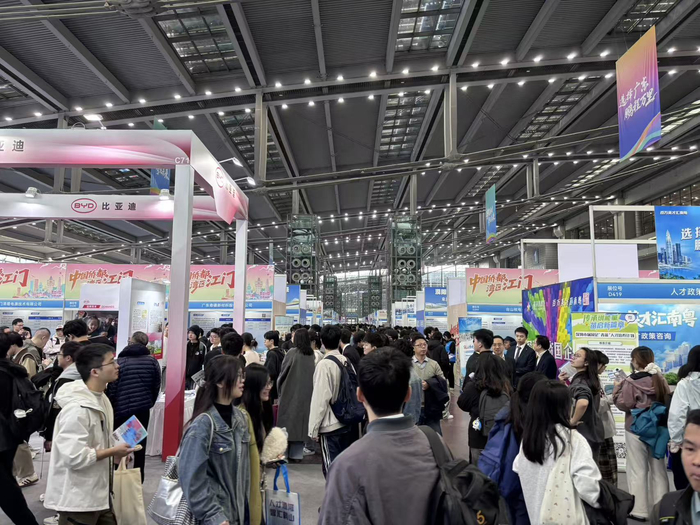
Core Viewpoint - The "Million Talents Gather in Guangdong" autumn recruitment fair reflects a shift in Guangdong's focus from merely pursuing wealth to seeking sustainable development, with significant participation from both job seekers and employers [1][2]. Group 1: Recruitment Fair Overview - The recruitment fair held in Shenzhen on December 27-28 featured 1,825 key employers offering over 65,000 job positions, attracting nearly 150,000 job seekers from more than 1,700 universities [1][2]. - This event marked a collaborative effort among major companies, including BYD, Gree, and Tencent, to recruit talent across the entire supply chain, showcasing a comprehensive demand for various roles in research, manufacturing, and operations [2]. Group 2: Talent Attraction Initiatives - Guangdong has launched a series of talent recruitment initiatives throughout the year, aiming to attract 1 million graduates to stay and develop in the region within a year [2][4]. - As of November, over 5,000 recruitment events have been held under the "Million Talents Gather in Guangdong" initiative, reaching over 10 million graduates, with more than 1.1 million choosing to work in Guangdong [4]. Group 3: Industry-Specific Job Demand - The recruitment fair highlighted a strong demand for talent in sectors such as artificial intelligence, robotics, low-altitude economy, and biomedicine, indicating a vibrant job market [4][5]. - Companies emphasized the need for candidates with English communication skills and AI-related expertise, reflecting the growing integration of AI across various industries [5]. Group 4: Regional Talent Dynamics - Shenzhen's appeal to talent is driven by its strong industrial empowerment and a conducive learning environment, fostering personal and professional growth [7][8]. - The city has evolved into a "people-driven" metropolis, with its development heavily reliant on attracting high-quality talent, particularly in cutting-edge fields like AI [8][10]. Group 5: International Collaboration and Opportunities - The recruitment fair included an "APEC Talent Connection Service Zone," aimed at attracting foreign and returning talents, leveraging the upcoming APEC summit in Shenzhen to enhance international business engagement [13]. - This initiative underscores the importance of talent in driving regional competitiveness and sustaining opportunities in Guangdong [13].


星巴克缩减在美城市门店布局|首席资讯日报
首席商业评论· 2025-12-31 04:14
Group 1 - Starbucks is closing approximately 400 underperforming urban stores in the U.S. and shifting investments towards renovating stores and drive-through locations in suburban areas to adapt to changes in customer traffic and cost pressures [2] - Gree Electric is monitoring the price trends of key raw materials and has implemented digital management for inventory and demand, along with flexible reserve strategies and regular futures hedging to mitigate adverse impacts from price volatility [3] - Multiple jewelry brands have significantly reduced their gold jewelry prices, with Chow Sang Sang pricing at 1353 yuan per gram, indicating a market adjustment [4] Group 2 - Barclays Bank reports that UK consumers have reduced card spending for the first time in five years, with a 0.2% year-on-year decline compared to a 1.6% increase last year [5] - Zhipu plans to globally issue 37,419,500 H-shares at a price of 116.20 HKD per share, with trading expected to commence on January 8, 2026 [6] - Pop Mart has begun selling products at half price, with second-hand platforms showing significant price drops for Labubu items, indicating a cooling market for trendy toys [7][8] Group 3 - Huawei's rotating chairman Meng Wanzhou emphasizes the start of a new journey in the intelligent era, highlighting the importance of innovation and self-criticism in navigating future uncertainties [9] - Spring Airlines and Juneyao Airlines announced plans to purchase a total of 55 Airbus A320 aircraft, with a transaction value exceeding 82 billion USD (approximately 574.48 billion yuan) [10] - EVE Energy's Hong Kong IPO application has expired after six months, with CITIC Securities as the sole sponsor [11] Group 4 - The Financial Accounting Standards Board (FASB) will explore cryptocurrency-related issues in 2026, including whether certain cryptocurrencies can be classified as cash equivalents [12] - Samsung Electronics is reportedly supplying automotive chips for BMW's electric vehicles, marking a significant expansion in its automotive component offerings [13] - Concerns arose regarding the production of a sofa sold during a live stream by a prominent host, with Gujia Home clarifying that the products are manufactured in its own factories [14]





2025年度消费&商业热词出炉:“超级供应链”入选十大热词
Sou Hu Wang· 2025-12-31 03:55
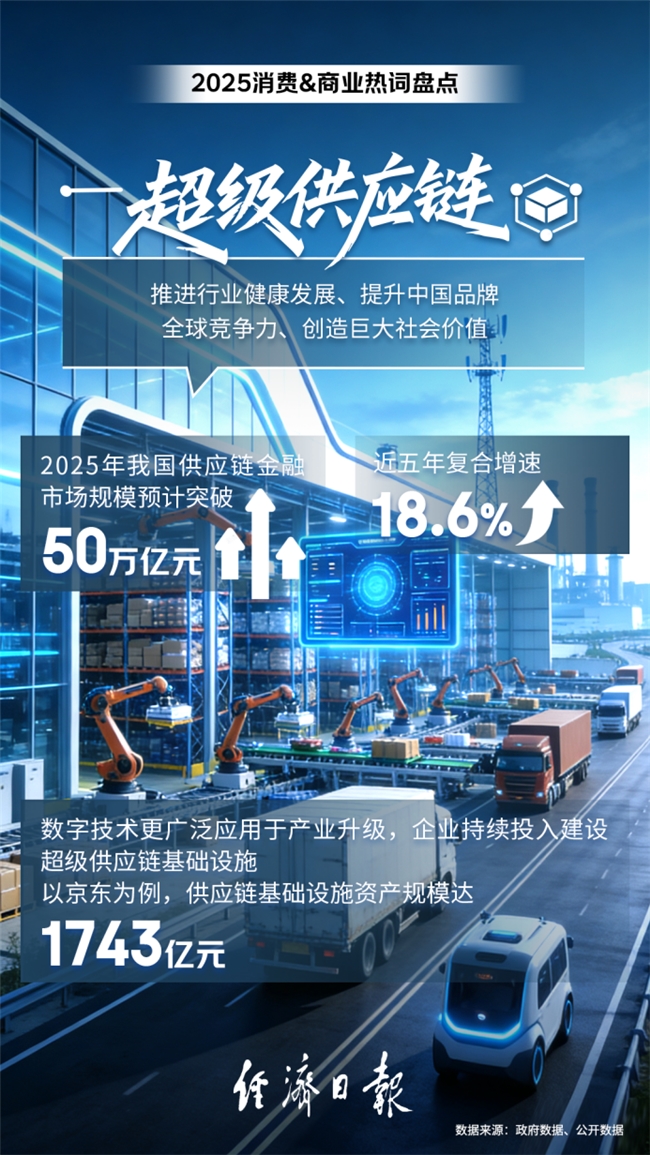
Core Insights - The article outlines ten key consumption and business trends for 2025, including "AI," "robotics," "food delivery wars," "super supply chains," "cultural tourism integration," "weight management," "event economy," "emotional health," "silver economy," and "cross-industry collaboration" [1][5]. Super Supply Chain - The strategic value of supply chains is increasingly recognized, with a reported 5.1% year-on-year growth in national freight turnover in the first half of 2025, indicating improved operational efficiency [3]. - The supply chain finance market in China has surpassed 50 trillion yuan, with a compound annual growth rate of 18.6% from 2019 to 2025, stabilizing the funding chains of over 30 million small and micro enterprises [3]. - Companies like JD.com are investing heavily in supply chain infrastructure, with assets reaching 174.3 billion yuan, showcasing the effectiveness of super supply chains in enhancing efficiency and service optimization [3][4]. AI - AI technology is deeply integrated into industrial upgrades and consumer quality improvements, with a significant increase in AI-related product searches on JD.com, growing over 100 times year-on-year [8][9]. - The government aims for over 70% application rate of new-generation intelligent agents by 2027, driving AI's role in everyday consumer products [8]. Robotics - The robotics industry in China saw a revenue growth of 27.8% in the first half of 2025, maintaining its position as the largest industrial robot application market globally [12]. - The search volume for robotics-related products on JD.com exceeded 80 million, indicating a shift from novelty to practical tools in daily life [12]. Food Delivery Wars - The food delivery market has evolved into a competitive landscape dominated by Meituan, Taobao Flash Purchase, and JD Delivery, with high brand recognition rates [15][16]. - Consumer focus has shifted from price to service quality, delivery speed, and overall experience, prompting platforms to enhance their service capabilities [16]. Cultural Tourism Integration - Cultural tourism is evolving towards immersive experiences, with the market expected to grow from 431.4 billion yuan in 2024 to 697.2 billion yuan by 2027, reflecting a compound annual growth rate of 18.9% [18]. - Consumers are increasingly seeking experiences that connect them with local culture, as evidenced by significant growth in sales of products featuring local cultural elements [18]. Event Economy - The event economy is driving consumption across various sectors, with key events in 2025 generating over 16 billion yuan in consumer spending [21][22]. - The popularity of sports events is fostering a culture of regular participation in physical activities, contributing to a shift towards sustained consumer engagement [22]. Weight Management - Weight management is transitioning from a focus on weight loss to holistic health, with a significant increase in related product searches and sales on JD.com [24]. - The launch of specialized online services for weight management reflects a growing consumer interest in health-oriented solutions [24]. Emotional Health - Emotional health is becoming a mainstream concern, with a surge in demand for psychological services and products, as indicated by a dramatic increase in related searches on JD.com [26][27]. - The government's initiatives to enhance mental health services are contributing to the normalization of emotional health discussions in public discourse [26]. Silver Economy - The silver economy is expanding rapidly, with a reported 76% increase in silver-related products on JD.com from 2020, highlighting the growing market for elder care and lifestyle products [29][30]. - The government is actively promoting initiatives to enhance the quality of life for the elderly, further driving growth in this sector [29]. Cross-Industry Collaboration - Cross-industry collaboration is emerging as a key strategy for innovation, with various IPs collaborating to create new consumer experiences and expand market reach [31][34]. - The integration of cultural heritage and modern consumer demands is fostering new business models that enhance consumer engagement and satisfaction [34].

国补625亿狂撒!全民换手机家电白送钱?
Sou Hu Cai Jing· 2025-12-31 03:43
Group 1 - The government is providing substantial subsidies for the replacement of household appliances and digital devices, with up to 1,500 yuan for high-end air conditioners and 500 yuan for smartphones priced under 6,000 yuan [2][4] - A total of 625 billion yuan in special long-term bonds has been allocated to stimulate consumer spending during the New Year and Spring Festival, encouraging consumers to upgrade their appliances and devices [4] - The initiative aims to boost domestic demand, stabilize the economy, accelerate the elimination of outdated production capacity, and support the domestic smart terminal industry, benefiting companies like Huawei, Xiaomi, Gree, and Midea [4] Group 2 - The program is described as a "national asset renewal plan," indicating a strategic approach to enhance consumer spending while promoting green and low-carbon transitions [4] - Consumers are advised to be cautious about potential price increases by retailers and the availability of subsidy quotas, highlighting the need for vigilance in the market [4] - The government-led "consumption carnival" is set to begin in early 2026, suggesting a significant opportunity for consumers to take advantage of these subsidies [4]
从“跟随”到“引领”解码格力电器制造的突围与坚守
Huan Qiu Wang Zi Xun· 2025-12-31 03:33
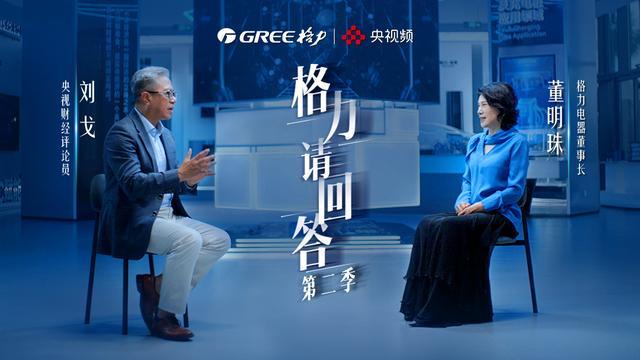
Group 1 - The core viewpoint of the news is that Gree Electric's second season of the program "Gree Electric Please Answer" has gained significant attention, with nearly 240 million exposures online, showcasing the company's commitment to high-end manufacturing and technological innovation in the context of China's transition from "Made in China" to "Intelligent Manufacturing" [2] - The program highlights Gree Electric's 30 years of experience in the manufacturing industry, focusing on various products such as central air conditioning, refrigerators, chips, and washing machines, providing a model for high-end manufacturing breakthroughs in China [2] Group 2 - Gree Electric has made significant strides in breaking monopolies and building research barriers, particularly in the central air conditioning sector, where it expanded its R&D team from hundreds to nearly 20,000 people since 2012, establishing 16 research institutes and 1411 laboratories [3] - The company has developed its own magnetic levitation and air suspension compressors, improving energy efficiency by over 30% and reliability compared to foreign brands, successfully entering national landmarks like the Beijing Daxing Airport [3] Group 3 - Gree Electric has been proactive in addressing global energy challenges since 2012 by developing a "solar-storage-air" integrated system, which can operate independently from the city power grid, saving 15 million kWh annually on a single line of the Shenzhen Metro and achieving 37% energy savings at Shanghai Airport [5] - The company emphasizes quality control with a "ten-year free repair" policy, supported by a fully automated production line that can produce an air conditioner every 15 seconds, utilizing 5G and AI technology for comprehensive quality assurance [8] Group 4 - Gree Electric has innovated a "non-blowing air" air conditioner that maintains cooling and heating efficiency while achieving 15% energy savings, and an AI energy-saving chip that enhances dynamic efficiency by 13.6%, providing a practical experience of "only two kWh overnight" [11][13] - The company has successfully expanded its product range by leveraging core component R&D, with its refrigerator production line utilizing self-designed automation and advanced insulation technology, allowing for extended preservation of food and medical supplies [15][19] Group 5 - Gree Electric's washing machine factory has adapted air conditioning heat pump technology to create a unique heat pump washing machine, which saves 60% energy and 30% time during low-temperature drying, while also providing steam care for high-end garments [19][21] - As the only white goods manufacturer with chip production capabilities, Gree Electric has achieved mass production of silicon carbide chips and established a smart factory for chip design, marking a significant transition from "manufacturing products" to "manufacturing factories" [23][25] Group 6 - Gree Electric's commitment to self-research and innovation is evident in its approach to maintaining control over the entire supply chain, avoiding OEM practices, and focusing on quality in every aspect of production, which reflects the company's responsibility and commitment to high-quality development in Chinese manufacturing [25][27] - The company's journey from breaking technological monopolies to setting industry standards illustrates the importance of meticulous attention to detail in manufacturing and the necessity of self-innovation to gain core influence in the market [27]
家电数码补贴15% 2026年国家补贴上线淘宝天猫
Huan Qiu Wang· 2025-12-31 03:07
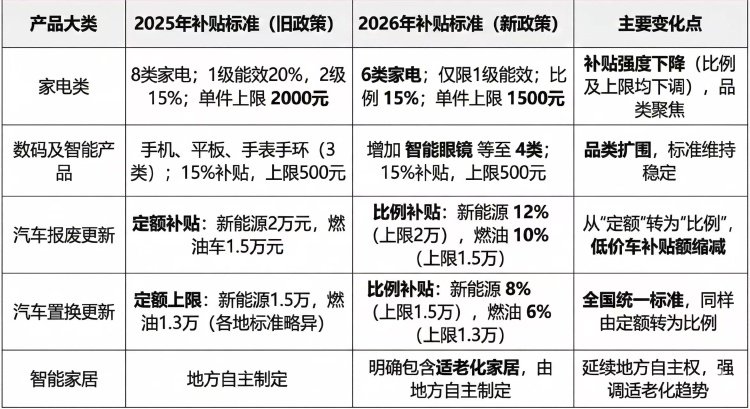
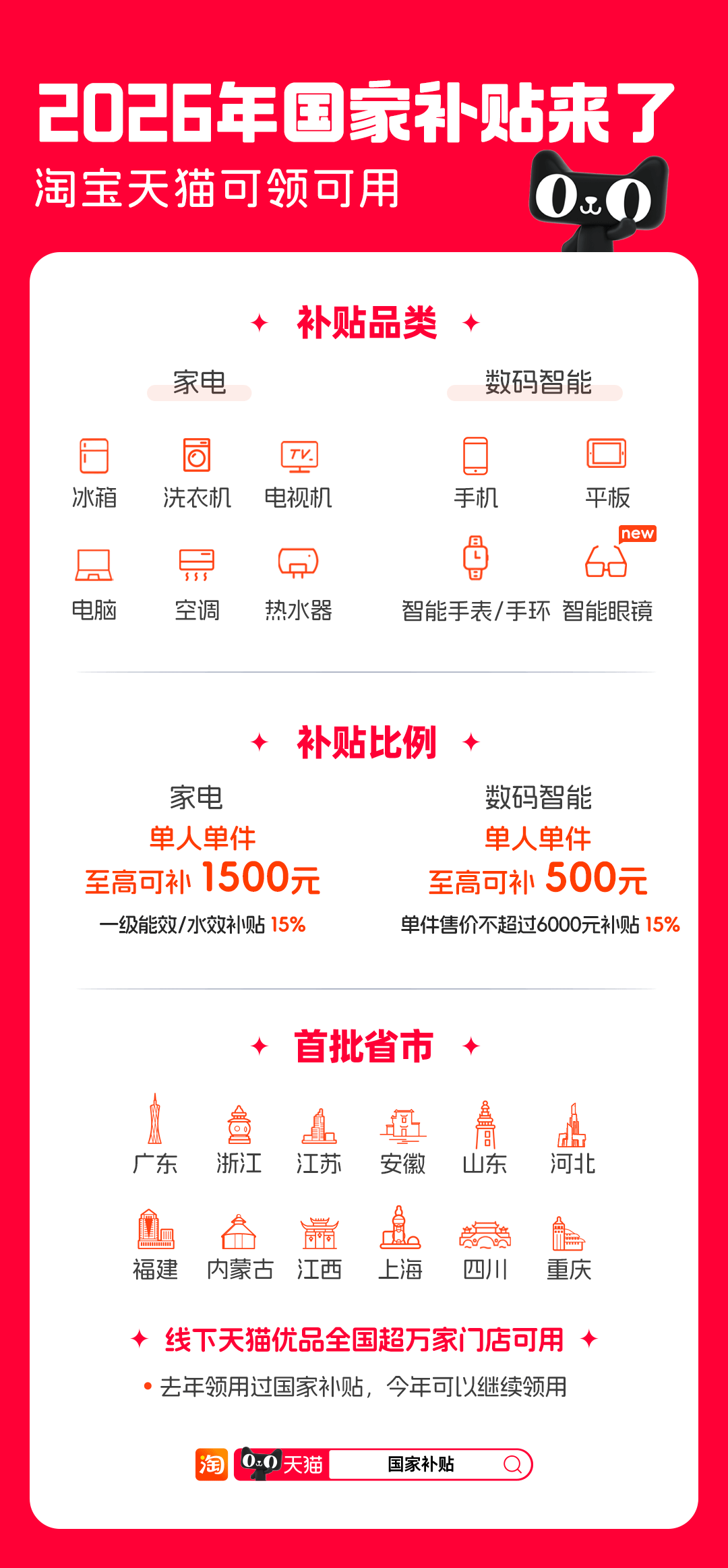
Core Viewpoint - A new round of national subsidies has been officially launched, effective from January 1, 2026, covering ten categories of products including refrigerators, washing machines, televisions, air conditioners, computers, water heaters, mobile phones, tablets, smartwatches, and smart glasses, with smart glasses being a newly added category [1][4]. Group 1: National Subsidy Details - The national subsidy rate is set at 15%, with a maximum subsidy of 1500 yuan for energy-efficient appliances and 500 yuan for digital and smart products priced under 6000 yuan [1]. - The subsidy program is available on platforms like Taobao and Tmall, with over 10,000 offline Tmall stores nationwide participating [4]. Group 2: Promotional Activities - From January 1 to 3, Tmall is collaborating with brands like Haier, Midea, Huawei, and Siemens to host a "National Subsidy Renewal Season" event, offering additional discounts of up to 90% and extra consumption vouchers worth 950 yuan [4]. - The promotion allows consumers to purchase home appliances at prices as low as 50% after applying the national subsidy and additional discounts [8]. Group 3: Product Pricing and Discounts - Specific products and their original and discounted prices include: - Gree air conditioner originally priced at 4799 yuan, discounted to 4.1 times lower after subsidies [8]. - Haier refrigerator originally priced at 11999 yuan, available at 50% off after discounts [8]. - Vivo X300 Pro originally priced at 5299 yuan, with a subsidy saving of 500 yuan [8]. - Thunderbird smart glasses Air 4 Pro originally priced at 1888 yuan, eligible for additional discounts [8]. Group 4: Market Reach and Consumer Engagement - By 2025, over 3000 product categories and more than 10,000 brands will be available under the national subsidy program on Taobao and Tmall, attracting an average of over 150 million daily visits to the subsidy section [8].




2026年国补来了 1月1日起上淘宝天猫领取,家电数码补贴15%
Jin Rong Jie Zi Xun· 2025-12-31 02:42
积极响应国补以旧换新增量政策,给消费者更大力度让利,1月1日至3日,天猫联合海尔、美的、华 为、西门子等上千个品牌,举办"国补焕新季"活动,超级立减9折起,在国家补贴基础上,消费者额外 可领950元国补焕新季消费券,多重优惠叠加,家电低至5折。 2026年第一个好消息来了,新一轮的国家补贴正式开启,1月1日起,上淘宝天猫领取马上可用。同时, 线下天猫优品全国超万家门店全面承接2026年国补。 最新政策显示,2026年国补覆盖品类为:冰箱、洗衣机、电视、空调、电脑、热水器、手机、平板、智 能手表手环、智能眼镜10大品类;其中,智能眼镜为2026年国补新增品类。国补力度上,统一调整为补 贴15%,一级能效/水效家电补贴上限1500元,数码和智能产品(单件销售价格不超过6000元)补贴上 限500元。 目前,广东、浙江、江苏、安徽、福建、内蒙古、江西、上海、四川、山东、河北、重庆等省市国补率 先上线淘宝天猫,消费者在淘宝首页「国补」频道或者搜索「国家补贴」即可领用。天猫线上线下全面 承接2026年国补,线下天猫优品全国超万家门店也支持领用国家补贴。 据悉,2025年超3000多个品类,1万多个品牌,50万款商品,在 ...
2026年家电以旧换新政策出台,有望提振家电消费景气
Guotou Securities· 2025-12-31 02:04
Investment Rating - The report assigns an "A" rating for the investment in major appliance companies such as Midea Group, Haier Smart Home, and Gree Electric Appliances, indicating a "Buy" recommendation with target prices of 94.68, 31.81, and 50.60 CNY respectively [4]. Core Insights - The 2026 appliance replacement policy is expected to boost consumer demand for home appliances, focusing on energy-efficient products and providing subsidies of 15% of the product price, capped at 1500 CNY per item [1][2]. - The 2026 policy has optimized the subsidy scope, reducing the number of supported appliance categories from eight to six, and lowering the subsidy rate from 20% to 15% for high-efficiency products [2][11]. - The first batch of funding for the 2026 policy amounts to 625 billion CNY, a 23% decrease from the previous year's 810 billion CNY, indicating a potential decline in total subsidy funds for the year [2][12]. Summary by Sections Policy Changes - The 2026 policy focuses on six categories: refrigerators, washing machines, televisions, air conditioners, computers, and water heaters, excluding other appliances like stoves and microwaves [2][11]. - The subsidy for high-efficiency products is now set at 15% of the sales price, with a cap of 1500 CNY per item, and consumers can only receive one subsidy per product category [2][11]. Market Impact - The 2025 replacement policy effectively stimulated appliance consumption, with retail sales of home appliances increasing by 14.8% year-on-year from January to November 2025, and over 12.84 million units replaced [3]. - The introduction of the 2026 policy is expected to improve domestic appliance sales, despite some pressure on consumption due to earlier demand release and high base effects [3][9]. Investment Recommendations - The report suggests focusing on three investment themes: 1. High-quality white goods companies with strong cash flow and high dividend yields, such as Midea Group and Haier Smart Home [9]. 2. Companies with strong global capabilities, particularly in emerging markets where appliance penetration is low [9]. 3. Technology-driven appliance companies that are expanding into new business areas, leveraging AI and robotics to enhance product offerings [9].
制冷设备行业2026年度投资策略:产业并购活跃,布局全球化与前沿冷却技术
Donghai Securities· 2025-12-31 01:46
1. Report Industry Investment Rating The provided content does not include the report industry investment rating. 2. Core Views - The Chinese refrigeration and air - conditioning equipment industry is at a critical turning point. The domestic household market is in a stable development stage dominated by stock replacement demand, and growth is driven by the improvement of energy - efficiency standards. The report analyzes structural growth opportunities and long - term evolution trends by benchmarking overseas leading companies [2]. - Overseas expansion should focus on local in - depth development and value extension of the industrial chain. It is a systematic project, and mergers and acquisitions are strategic choices. Chinese enterprises are moving from the initial stage of "Made in China, Sold Globally" to the new stage of globalization of "brand, technology, and management" [2]. - The commercial refrigeration field, especially the data center refrigeration track, is a short - term growth highlight. The capital expenditure of overseas HVAC giants is directed towards data center infrastructure, and there is a market for high - end refrigeration solutions due to the need to improve energy efficiency and reduce PUE [2]. - Investment suggestions: In the household refrigeration equipment field, pay attention to industry leaders such as Midea Group; in the special - purpose refrigeration equipment field, focus on companies like Invic and Shenling Environment; for upstream components, pay attention to Hanzhong Precision Machinery, Binglun Environment, and Sanhua Intelligent Control [2]. 3. Summary by Relevant Catalog 3.1 Traditional Refrigeration Equipment Overview - **Global Refrigeration and Air - Conditioning Market**: The global refrigeration and air - conditioning market has shown steady growth. From 2018 to 2024, the global air - conditioner sales increased from 232.5 million units to 261.2 million units, with a compound annual growth rate of 2.0%. The proportion of household air - conditioners in 2024 was 73.7%, and the central air - conditioning market grew faster, with a compound annual growth rate of 4.0% from 2018 to 2024. It is predicted that by 2028, the global air - conditioner sales will reach 293.3 million units, with a compound annual growth rate of 2.9% from 2024 to 2028. Asia, North America, and Europe are important regional markets, and China is the largest single air - conditioning market [22]. - **Household Air - Conditioning**: In the 2024 cold year, China's household air - conditioner production accounted for 80.8% of the global total. Many domestic enterprises are increasing overseas layout. In the 2024 cold year, overseas production capacity increased by nearly 7 million units. In the 2025 cold year, domestic household air - conditioner exports were about 99.29 million units, a year - on - year increase of 16.7%, with the highest export proportion to Asia [28]. - **Central Air - Conditioning and Chiller Units**: There are various types of central air - conditioning and chiller units. The export of screw and centrifugal chiller units for data centers is strong. The Asian market has a large - scale demand and is gradually recovering, while the North American market has a prominent growth rate due to its small base. The domestic market is waiting to stabilize, and leading enterprises are strengthening their competitive advantages [33]. 3.2 Household Market: Domestic Sales Review and Challenges for Leading Companies - **Price Wars and Market Competition**: After several price wars, the concentration of the domestic household refrigeration and air - conditioning market has increased. The competition has evolved from scale and price to technology, product, channel, service, and ecosystem. In 2025, the domestic sales volume of household air - conditioners increased by 8.7% year - on - year, but the growth driven by policies and climate is difficult to sustain. The long - term driving force is stock replacement and structural upgrading [35][36]. - **Energy - Efficiency Upgrade**: China has introduced multiple air - conditioner energy - efficiency standards, which have promoted the transformation from fixed - frequency to variable - frequency air - conditioners. Leading enterprises have advantages in technology and industrial layout for energy - efficiency improvement [39]. - **Challenges for Leading Companies**: In 2024 - 2025, a new round of price wars occurred. Xiaomi's entry has challenged the traditional hardware - profit model. Leading companies are facing challenges in terms of efficiency and sustainable profit growth. They are promoting digital reform, channel and logistics innovation to enhance competitiveness [40][43][44]. 3.3 Overseas Expansion of Domestic Enterprises - **Difficulties and Solutions**: There are differences in regional usage habits overseas. The US market has high access barriers, and the European market has low air - conditioner penetration and high energy - efficiency requirements. Overseas acquisitions are an important way to enter the market. Chinese enterprises are accelerating overseas production capacity construction in Southeast Asia and other regions [52][54]. - **Southeast Asian Market**: Exports to ASEAN are on an upward trend. In 2024, China's cumulative exports of white goods to ASEAN reached $14.87 billion, a year - on - year increase of 19.8%. The demand in the ASEAN market is driven by urbanization and industrialization [63]. 3.4 Overview of Overseas Representative Enterprises' Operations - **Business Models and Strategies**: Overseas HVAC representative enterprises have different business models and strategies. Johnson Controls has transformed from an equipment manufacturer to a builder of smart building ecosystems; Trane Technologies has upgraded its services and transformed its strategy; Daikin has acquired relevant enterprises to supplement its data center refrigeration business [73][82]. - **Performance of Leading Enterprises**: Leading international enterprises such as Trane Technologies, Johnson Controls, Carrier Global, and Vertiv have shown different performance. They are all focusing on high - growth areas such as data center refrigeration [83][86][87][88]. 3.5 Commercial Market: Pay Attention to Refrigeration Demand in Data Centers - **Demand for Data Center Refrigeration**: The development of AI and other industries is expected to drive the construction of data centers. The demand for data center capacity is expected to increase at a compound average growth rate of 19% from 2023 to 2030. Reducing the energy consumption of refrigeration equipment is crucial for the green and low - carbon development of data centers [94]. - **Refrigeration Technologies**: There are various data center refrigeration technologies, including water - cooled, air - cooled, indirect evaporation cooling, "glacier" phase - change cooling, and liquid cooling. Liquid cooling has advantages in energy consumption, and the development of liquid - cooling technology is a trend [96][104]. - **Investment Suggestions**: Enterprises in different segments are recommended, including traditional HVAC enterprises such as Midea Group, precision temperature - control equipment enterprises such as Invic, special - purpose air - conditioner manufacturers such as Shenling Environment, and upstream component enterprises such as Hanzhong Precision Machinery, Binglun Environment, and Sanhua Intelligent Control [112][113].
2026国补来了!汽车消费补贴由“定额”改为“按比例”
Mei Ri Jing Ji Xin Wen· 2025-12-31 01:42
Group 1 - The core viewpoint of the news is the announcement of the 2026 national subsidy policy, which includes subsidies for smart products like AR glasses and emphasizes the importance of expanding domestic demand as a key task for the upcoming year [1][2] - The new subsidy policy for automobiles shifts from a fixed amount to a proportional subsidy, with electric vehicle scrappage subsidies set at 12% of the vehicle price (up to 20,000) and fuel vehicle scrappage subsidies at 8% (up to 15,000) [1][3] - The focus on expanding domestic demand is framed as a strategic deployment to address external shocks and enhance domestic circulation, highlighting the growth potential of discretionary consumption sectors such as retail, new energy vehicles, and smart home appliances [1][2] Group 2 - The optional consumption ETF primarily covers sectors closely related to service consumption and the unified market, with significant weightings in automobiles (46%) and home appliances (34%) [2] - The top ten weighted stocks in the optional consumption ETF include major companies such as Midea Group, BYD, Gree Electric, and Haier Smart Home, indicating a strong representation of leading firms in the consumer sector [2]