
福耀玻璃

Search documents
高位成立难回本 东方品质消费一年基金不到5年亏6成
Zhong Guo Jing Ji Wang· 2026-02-05 08:09
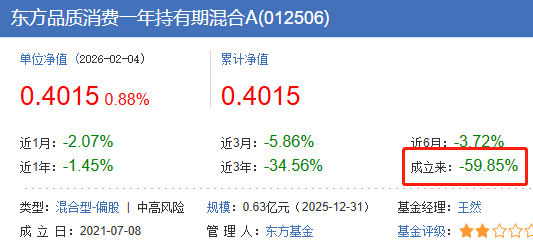
Core Insights - The article discusses the performance of actively managed equity funds established in 2021, revealing that over 50% of these funds are currently at a loss, with significant declines in value for many [1] Fund Performance Summary - A total of 667 actively managed equity funds established in 2021 were analyzed, with approximately 362 funds showing negative returns since inception, representing over 54% of the sample [1] - Among these, 86 funds have experienced declines of over 30%, and 34 funds have seen declines exceeding 40% [1] - The "Oriental Quality Consumption One-Year Holding Period Mixed Fund," established in July 2021, has recorded a cumulative decline of approximately 60.6%, making it one of the worst performers in the sample [1][3] Specific Fund Data - The "Oriental Quality Consumption One-Year Holding Period Mixed Fund A" has a current net value of 0.4015, with a cumulative return of -59.85% since its inception [2] - The fund's performance over the past year shows a decline of -1.45%, and over three years, it has decreased by -34.56% [2] - The fund's top ten holdings include major companies such as Yili Group, Midea Group, and Tencent Holdings, but it has consistently underperformed compared to its peers and the CSI 300 index [3][4] Comparative Performance Analysis - In 2025, the fund's annual return was -0.53%, while the average return for similar funds was 33.12%, and the CSI 300 index returned 17.66% [4] - The fund's ranking among peers has been poor, with significant drops in its position over the years, indicating a consistent underperformance [4][6]

汽车行业:如何看待原材料成本上涨对乘用车车企的影响?
GF SECURITIES· 2026-02-05 07:28
Investment Rating - The industry investment rating is "Buy" [2] Core Viewpoints - The report discusses the impact of rising raw material costs on passenger car manufacturers, particularly focusing on the effects of copper, aluminum, and lithium prices on vehicle production costs [5][8][11][14] - It highlights that the cost increase for electric vehicles (EVs) and plug-in hybrid electric vehicles (PHEVs) is significantly influenced by the prices of copper and lithium, with estimated cost increases of approximately 2,300 RMB for EVs and 1,600 RMB for PHEVs due to copper price hikes, and 3,200 RMB for EVs and 1,500 RMB for PHEVs due to lithium price increases [5][11] - The report quantifies the cost impact on various manufacturers, indicating that companies like Chery, Geely, and Great Wall Motors experience relatively smaller increases in average vehicle costs due to their sales structure and the types of vehicles they produce [15][17] - It outlines five strategies that manufacturers can employ to mitigate the impact of rising raw material costs, including cost reductions through enhanced features, annual cost reductions, technological advancements, scale effects, and structural adjustments [22][23] Summary by Sections Section 1: Impact of Raw Material Price Increases - The report estimates that the increase in copper prices will raise the production costs of fuel vehicles, EVs, and PHEVs by approximately 800 RMB, 2,300 RMB, and 1,600 RMB respectively, while aluminum price increases will add about 700 RMB, 900 RMB, and 900 RMB to the respective vehicle types [5][8] - Lithium price increases are projected to raise costs by 3,200 RMB for EVs and 1,500 RMB for PHEVs, assuming a price of 160,000 RMB per ton [11][14] Section 2: Cost Pressure by Manufacturer - The report analyzes the cost pressure on manufacturers based on their sales structure, concluding that companies like Chery, Geely, and Great Wall Motors face smaller increases in average vehicle costs due to their diverse product lines and sales strategies [15][17] Section 3: Strategies to Mitigate Cost Increases - Manufacturers are expected to implement various strategies to counteract the impact of rising raw material costs, including: 1. Enhancing features while maintaining competitive pricing 2. Achieving annual cost reductions of around 2% 3. Utilizing technological advancements to lower costs 4. Leveraging scale effects to dilute fixed costs 5. Adjusting product structures to focus on higher-end models and exports [22][23] Section 4: Investment Recommendations - The report suggests a "shelf-style" investment approach, recommending attention to various companies within the passenger vehicle chain, including Geely, BYD, Chery, and others for potential investment opportunities [25]
深圳写字楼市场报告2025年第四季度
莱坊· 2026-02-05 07:25
Investment Rating - The report indicates a cautious recovery in the Shenzhen Grade-A office market, with a focus on owner-occupiers driving the investment activity [7][24][26]. Core Insights - The Shenzhen Grade-A office market is experiencing a dual mode of "net absorption recovery under continuous rental pressure," with net absorption reaching 163,123 square meters in Q4 2025, the highest quarterly level for the year [5][18]. - The average effective rent has decreased to RMB 145.6 per square meter per month, reflecting a 1.9% quarter-on-quarter decline, although the rate of decline has slowed compared to previous quarters [5][12]. - The overall transaction volume for the year reached RMB 8.67 billion, indicating a robust recovery from a low valuation base [26]. Supply and Demand Summary - The total supply is expected to exceed 1.04 million square meters, with significant new projects in Qianhai and Shenzhen Headquarters Base [6][23]. - The market is characterized by a temporary interruption in supply due to project delays, leading to a net absorption of 314,000 square meters for the year, which is at the lower end of the past decade's range [18]. - The demand is primarily driven by the TMT sector (47.9%) and financial services (25.9%), with relocation transactions dominating at 54.2% of total activity [19][21][22]. Rental Trends - The average net effective rent for Grade-A offices has shown a continuous decline, with landlords shifting pricing strategies towards targeted incentives to attract tenants [12][15]. - The rental decline has been more pronounced in secondary markets, with Qianhai and Bao'an experiencing the largest decreases of 3.4% and 3.2% respectively [13][17]. - The rental trends indicate a potential for volatility but overall weakness, with future stability dependent on a shift from relocation-driven demand to more sustainable expansion-driven leasing [15][22]. Investment Market Overview - The investment market remains cautious, with owner-occupiers leading the activity, as evidenced by a notable transaction where Fuyao Technology acquired the entire Runrong Building for approximately RMB 710 million [24][25]. - The overall sentiment in the investment market is defensive, with a focus on price discounts and uncertainties in rental structures and cash flows [25].
福建“豪门”,打响继承之战
创业家· 2026-02-04 10:35
Core Viewpoint - The article discusses the generational transition in family businesses, particularly among Fujian entrepreneurs, highlighting the challenges faced by the second generation as they take over their family enterprises amidst a changing economic landscape and societal expectations [5][8]. Group 1: Succession Battles - The transition of leadership is becoming a reality among Fujian private enterprises, with notable examples including Xu Yangyang taking over Dali Group and Cao Hui succeeding his father at Fuyao Group [7][8]. - The second generation faces dual pressures from familial expectations and societal reputation, often leading to comparisons with their predecessors [5][9]. - The traditional method of succession in Fujian remains focused on blood relations, with the eldest son often seen as the most suitable successor [9][11]. Group 2: Individual Case Studies - Xu Yangyang's journey at Dali Group began with her education and gradual rise through the ranks, ultimately leading to her role as president after her father's retirement [16][23]. - Cao Hui's path to leadership at Fuyao Group involved significant preparation, including international education and hands-on experience in the family business [12][26]. - Xu Lianjie of Hengan Group faced challenges in finding a successor, as his sons initially showed little interest in the family business, but eventually, his eldest son Xu Qingliu took over [13][16]. Group 3: Business Performance and Challenges - Dali Group's revenue peaked at 22.294 billion yuan in 2021 but has since declined, with 2023 revenue reported at 18.86 billion yuan [22][24]. - Hengan Group's paper towel business aims for significant growth, with Xu Qingliu setting ambitious targets despite industry challenges [26]. - Fuyao Group continues to experience growth, with a reported revenue of 21.45 billion yuan and a net profit exceeding 4.8 billion yuan in the first half of 2025 [26][27]. Group 4: Cultural and Strategic Adaptations - The article highlights the importance of adapting to changing consumer preferences, with younger generations needing to innovate beyond traditional business models [24][32]. - Fujian entrepreneurs are increasingly forming family offices to manage wealth and address succession issues, reflecting a blend of traditional and modern approaches to business continuity [30][31]. - Marriages between the second generation of Fujian entrepreneurs are seen as a strategy to strengthen business alliances and create a supportive network [28][29].


光大证券晨会速递-20260204
EBSCN· 2026-02-04 01:45
Group 1: Market Overview - The market sentiment is currently high, with over 60% of stocks in the CSI 300 index showing an upward trend, indicating a bullish outlook for the near future [2] - The momentum sentiment indicators are trending upwards, suggesting a sustained positive market environment [2] Group 2: Industry Insights - In the coal, steel, float glass, cement, and fuel refining sectors, profit sentiment is expected to decline year-on-year [3] - The inventory of breeding sows is decreasing significantly, leading to a tighter supply forecast for Q2 2026, which may support a recovery in pig prices [3] - The PMI remains stable, indicating no significant changes in the cyclical industries monitored [3] Group 3: Automotive Sector - The performance of new energy vehicles in January was weak, prompting automakers to increase purchase incentives [4] - Recommended stocks include Geely Automobile for whole vehicles and Fuyao Glass for components, alongside Top Group and Shuanglin Co. for humanoid robots [4] Group 4: Real Estate Sector - Multiple cities have initiated old housing buyback programs, accelerating the "old for new" exchange, which is expected to stabilize the housing market [5] - Notable companies recommended include China Merchants Shekou and China Jinmao, which are positioned as leading brands in the real estate sector [5] Group 5: Chemical Industry - Qicai Chemical and Huanliang Technology have established an AI laboratory to enhance product development efficiency, marking a shift from experience-driven to model-driven approaches in the chemical industry [6] - Companies like Sinopec, Wanhua Chemical, and Qicai Chemical are highlighted for their potential in leveraging AI for cost reduction and efficiency improvements [6]
猎装轿跑,迎来中国答案
3 6 Ke· 2026-02-03 16:02
Core Insights - Huawei is entering the automotive market with a focus on high-end SUV and luxury sedan segments, leveraging its successful product strategies to create a new brand, Qijing, which will launch a shooting brake model [2][12] - The shooting brake category is gaining traction in China, appealing to a younger consumer base seeking personalized and multifunctional vehicles [3][4] - The integration of electric and intelligent technologies in the shooting brake design enhances its appeal, combining elegance, practicality, and safety [6][10] Industry Trends - The automotive market is experiencing intense competition, with brands like Tesla leading the charge in offering low-interest financing, prompting a price war among various manufacturers [3] - The shift towards shooting brakes represents a departure from traditional SUV and sedan markets, as consumers seek unique designs and functionalities that reflect their lifestyles [4][11] - The rise of "self-pleasing consumption" indicates a change in consumer behavior, where vehicles are seen as extensions of personal taste rather than mere transportation [6][11] Product Development - Qijing's first model, a shooting brake, is designed with a focus on aesthetics and functionality, aiming to balance beauty and practicality [4][10] - The vehicle features a length of over 5 meters, width of nearly 2 meters, and height of approximately 1.5 meters, showcasing a sleek and low-profile design [8] - Advanced electric vehicle platforms allow for better space utilization and performance, enhancing the driving experience [10][15] Technological Integration - The Qijing model will incorporate Huawei's comprehensive solutions, including intelligent driving and smart cockpit technologies, aiming to meet high-end market standards [14][15] - The vehicle is equipped with hardware for Level 3 conditional autonomous driving, positioning it to be among the first to offer this capability once regulations permit [15] - The collaboration with top-tier suppliers ensures high-quality components, enhancing the overall product offering [14]

猎装轿跑,迎来中国答案
36氪· 2026-02-03 15:55
Core Viewpoint - Huawei is entering the high-end SUV and hunting coupe markets, leveraging its successful product strategy to create a new brand, Qijing, in collaboration with GAC, focusing on the hunting coupe segment which is gaining traction among consumers [3][4][6]. Group 1: Market Trends and Consumer Insights - The hunting coupe category, inspired by European aristocratic hunting lifestyles, is resonating with the demands of China's new generation of consumers, emphasizing individuality, elegance, and practicality [5][6]. - The automotive market is at a turning point, with traditional SUV and sedan segments facing intense competition, leading to a search for new growth areas, such as the hunting coupe, which offers a unique design and functional positioning [9][10]. - The rise of the hunting coupe reflects a shift in consumer behavior, where vehicles are increasingly seen as extensions of personal taste and lifestyle rather than mere transportation tools [12][19]. Group 2: Product Development and Technological Integration - Qijing's first model, the hunting coupe, combines electric and intelligent technologies, creating a new star in the personalized automotive market [7][10]. - The integration of electric vehicle platforms allows for better design and functionality, with Qijing's hunting coupe featuring a length of over 5 meters and a width of nearly 2 meters, enhancing stability and aesthetic appeal [16][18]. - The vehicle's design and engineering leverage advanced technologies, including a high-performance electric drive system and smart features, to enhance user experience and safety [19][26]. Group 3: Competitive Landscape and Strategic Positioning - Qijing aims to replicate Huawei's successful product development and marketing strategies, utilizing a closed-loop system that integrates user-centered design and high-quality manufacturing [21][24]. - The collaboration with top-tier suppliers like CATL and Bosch ensures that Qijing's hunting coupe is equipped with premium components, positioning it competitively in the high-end market [25]. - The vehicle is designed to support L3 conditional autonomous driving, potentially making it one of the first in its class to offer this feature once regulations permit [26].

耀皮玻璃:首次覆盖报告老牌玻璃的新引擎,汽车玻璃与TCO突围-20260203
GUOTAI HAITONG SECURITIES· 2026-02-03 13:25
Investment Rating - The report assigns a "Buy" rating to the company with a target price of 10.01 CNY [5][21]. Core Insights - The company is a long-established leader in the glass industry, accelerating its transformation with a focus on automotive glass and TCO (Transparent Conductive Oxide) glass production [2][11]. - The automotive glass market is rapidly expanding, with the company achieving nationwide operational rights and accelerating new vehicle partnerships, which is expected to enhance both volume and profitability [16][24]. - The TCO glass production is nearing mass production, with the company having a leading position in online coating technology, poised to benefit from the upcoming demand surge [17][18]. Financial Summary - The company’s total revenue is projected to reach 5.588 billion CNY in 2023, with a growth forecast of 10.3% to 6.418 billion CNY by 2027 [4][18]. - Net profit is expected to recover from a loss of 125 million CNY in 2023 to a profit of 279 million CNY by 2027, reflecting a significant turnaround [4][18]. - Earnings per share (EPS) are forecasted to increase from -0.13 CNY in 2023 to 0.29 CNY in 2027 [4][18]. Company Overview - The company, established in 1983, is a Sino-British joint venture, with major shareholders including Shanghai Building Materials Group and NSG Group [23][15]. - The governance structure is stabilizing, with Shanghai Building Materials Group increasing its shareholding over the years [31][15]. - The company is focusing on upgrading its deep processing capabilities through targeted fundraising for technological improvements [30][2]. Automotive Glass Market - The automotive glass segment is projected to grow significantly, with revenue expected to reach 20.86 billion CNY in 2025, driven by increased demand for electric and smart vehicles [18][19]. - The gross margin for automotive glass is anticipated to improve from 10.25% in 2023 to 15.00% by 2027, reflecting enhanced product offerings and customer partnerships [16][18]. - The competitive landscape in the automotive glass market is limited due to high capital requirements and operational complexities, favoring established players [39][41]. TCO Glass Production - The TCO glass segment is approaching a production ramp-up, with significant demand expected from downstream clients in the 2025-2027 period [17][18]. - The company’s acquisition of Dalian Yao Pi has improved its online coating utilization, contributing significantly to its profitability [17][18]. - The TCO glass production is supported by advancements in coating technology and resource availability, positioning the company favorably for future growth [17][18].

海优新材20260202
2026-02-03 02:05
Summary of Haiyou New Materials Conference Call Industry and Company Overview - **Company**: Haiyou New Materials - **Industry**: Space photovoltaic packaging materials and automotive information films - **Market Potential**: The global solar wing market could reach between 1.35 trillion to 3.5 trillion RMB, with the film segment estimated at around 270 billion RMB. Long-term market potential could reach 5 trillion RMB [2][4][12]. Core Insights and Arguments - **Space Photovoltaic Development**: The company is strategically positioned in the space photovoltaic sector, with key products including CPM and POE films. The market is expected to grow significantly as satellite launches increase, with SpaceX's recent application for 1 million satellites indicating a vast potential market [4][5]. - **Dual Growth Strategy**: The company is leveraging both photovoltaic and automotive sectors to create a second growth curve. In the photovoltaic sector, it is optimizing capacity and focusing on core customers, while in the automotive sector, it has entered industrialization and secured orders from major car manufacturers [2][6]. - **Financial Performance**: In the first half of 2026, the company reported revenues of 870 million RMB, a nearly 60% decline year-on-year. Cumulative losses for the first three quarters were approximately 211 million RMB, although losses are narrowing. The company anticipates a turnaround in 2026, with profits expected to exceed 200 million RMB by 2027, corresponding to a valuation of 22 times earnings [7][17]. Additional Important Insights - **Technological Advancements**: The company is focusing on lightweight and efficient solar wing technologies, which have seen a 50% reduction in weight and over 30% improvement in efficiency. These advancements are crucial for applications in low-power to high-power scenarios [10]. - **Market Trends**: The demand for space computing is driving the need for solar energy, with AI's growing computational needs further emphasizing the importance of solar power in space applications [8][9]. - **Automotive Information Films**: The company has made significant progress in the automotive sector, with a diverse product range including PDLC smart dimming films. The market for these films is projected to reach 18 billion RMB by 2030, with a penetration rate of 20% in passenger vehicles [13][15]. - **Future Growth Areas**: The company is also exploring new products in the ground photovoltaic sector and other emerging fields, including high-end architectural smart dimming films and AI/VR applications [16]. Conclusion - **Investment Outlook**: The company is positioned to benefit from the space energy revolution and has a promising outlook for growth in both the space photovoltaic and automotive information film markets. A recommendation rating is given based on the anticipated future growth potential [18].

汽车周报:重点公司Q4业绩强兑现,特斯拉再次强调AI转型-20260202
Shenwan Hongyuan Securities· 2026-02-02 14:31
《关注业绩支撑的白马反弹,科技与通胀 共振——2026/1/19-2026/1/25 汽车周 报》 2026/01/27 证券分析师 戴文杰 A0230522100006 daiwj@swsresearch.com 联系人 朱傅哲 A0230524080008 zhufz@swsresearch.com 请务必仔细阅读正文之后的各项信息披露与声明 本研究报告仅通过邮件提供给 博时基金 博时基金管理有限公司(researchreport@bosera.com) 使用。1 行 2026 年 02 月 02 日 重点公司 Q4 业绩强兑现,特斯拉 再次强调 AI 转型 看好 ——2026/1/26-2026/2/1 汽车周报 本期投资提示: 行 业 及 产 业 证 券 研 究 报 告 业 研 究 / 行 业 点 评 汽车 ⚫ 观点:①特斯拉业绩会强调 AI 应用方向转型(机器人、智能驾驶、Robotaxi 等), optimus V3 市场预期持续强化,关注机器人产业链估值弹性,恒勃、银轮、隆盛、拓 普、三花等。②部分重点公司业绩预告符合预期,继续建议关注有业绩支撑的白马机 会,尤其是在权重指数中的企业,包括宇通客 ...
