华润啤酒

Search documents
华润啤酒上半年营收239.42亿元,白酒业务营收7.81亿元
Qi Lu Wan Bao· 2025-08-20 02:47
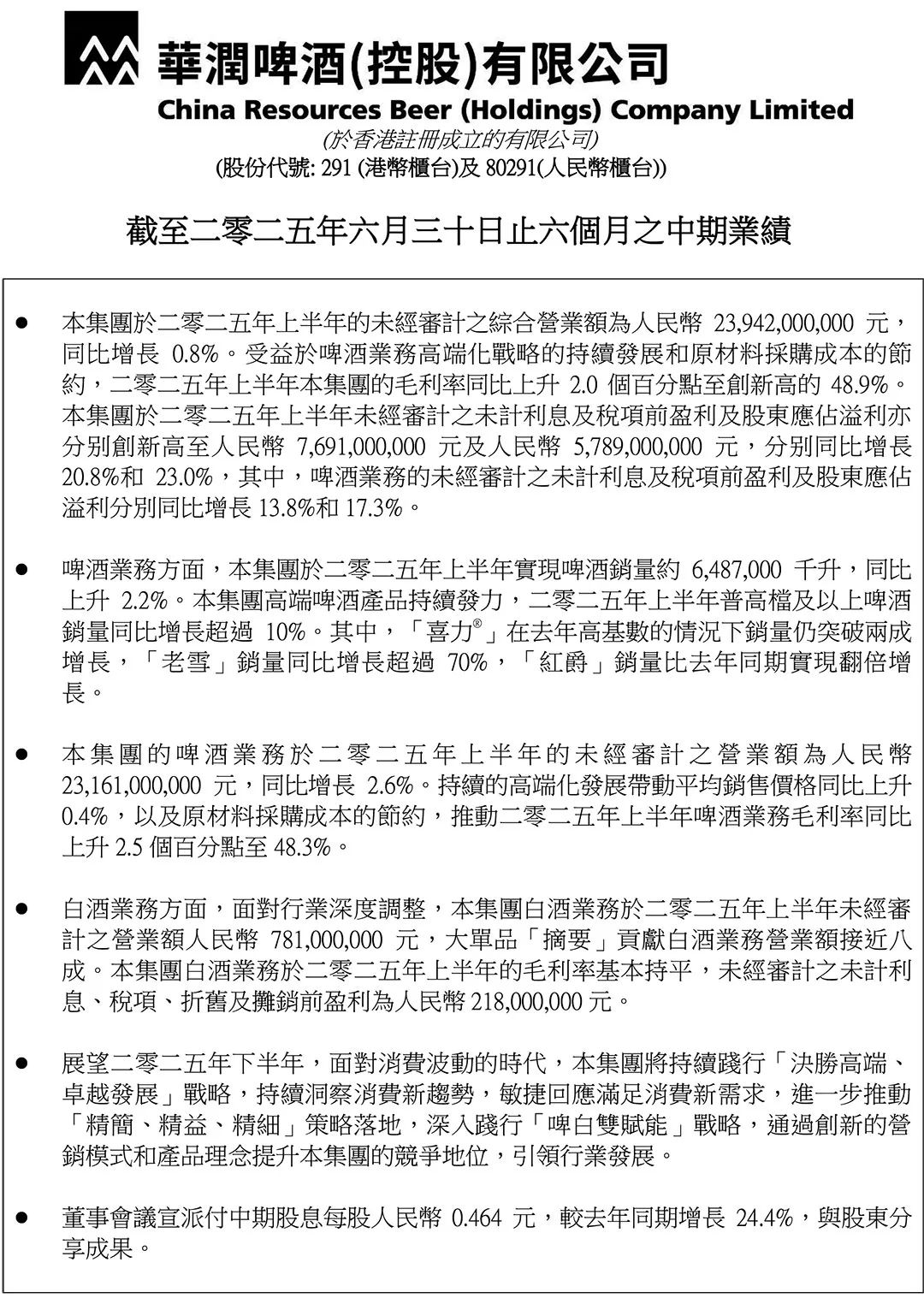
Core Insights - China Resources Beer (00291.HK) reported a comprehensive revenue of RMB 23.942 billion for the first half of 2025, representing a year-on-year growth of 0.8% [1][4] - The company's profit before interest and tax increased by 20.8% to RMB 7.691 billion, while the profit attributable to shareholders rose by 23.0% to RMB 5.789 billion [1][4] - The board declared an interim dividend of RMB 0.464 per share, up 24.4% from the previous year [1][4] Beer Business Performance - Beer sales reached 6.487 million kiloliters, marking a 2.2% increase year-on-year [1][4] - Sales of premium and above beer grew by over 10%, with key brands performing exceptionally: "Heineken" sales increased by over 20%, "Snow" by over 70%, and "Red Duke" sales doubled [1][4] - The average selling price of beer rose by 0.4%, and the gross margin for the beer business improved by 2.5 percentage points to 48.3% due to cost optimization in raw material procurement [1][4] Baijiu Business Performance - The baijiu business reported an unaudited revenue of RMB 781 million, with the major product "Abstract" contributing nearly 80% of this revenue [1][4] - The gross margin for the baijiu business remained stable, with profit before interest, tax, depreciation, and amortization at RMB 218 million [1][4] Future Outlook - For the second half of 2025, the company plans to continue its strategy of "winning high-end and excellent development," focusing on consumer trends and agile responses to new demands [2][4] - The company aims to implement a "streamlined, lean, and refined" strategy and enhance its competitive position through innovative marketing and product concepts [2][4]


港股异动丨啤酒股逆势上涨 业绩利好发酵华润啤酒续涨超2%
Ge Long Hui· 2025-08-20 02:25
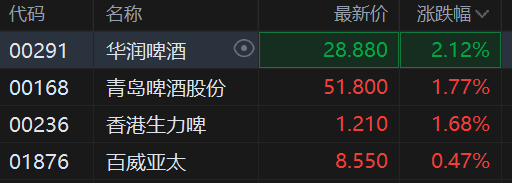
Group 1 - The core viewpoint of the article highlights the resilience of Hong Kong beer stocks, particularly the continued rise of China Resources Beer, which saw a 2.12% increase following a previous day’s surge of over 6% [1] - China Resources Beer announced a revenue of 23.942 billion RMB for the first half of 2025, reflecting a year-on-year increase of 0.8%, while net profit reached a record high of 5.789 billion RMB, up 23% [1] - Nomura's research report indicates that China Resources Beer's overall performance in the first half of the year was stable, with revenue growth of 1%, sales up by 2.2%, and an average price increase of 0.4%, demonstrating the effectiveness of its premiumization strategy [1] Group 2 - The China Alcoholic Drinks Association reports that the craft beer market in China surpassed 80 billion RMB in 2024, with a year-on-year growth rate exceeding 30% [1] - Products incorporating Chinese innovative elements have increased their market share from 5% to 18%, becoming a significant driver of industry growth [1]
中金:维持华润啤酒跑赢行业评级 目标价32.4港元
Zhi Tong Cai Jing· 2025-08-20 02:24
Group 1 - The core viewpoint of the report maintains the 2025/26 core net profit estimates for China Resources Beer at 5.31/5.75 billion HKD, with a target price of 32.4 HKD, indicating a 15% upside potential from the current stock price [1] - The beer segment's performance in 1H25 slightly exceeded expectations, with revenue of 23.94 billion HKD, a year-on-year increase of 0.8%, and core EBIT of 7.11 billion HKD, a year-on-year increase of 11.3% [2] - The beer business outperformed the overall industry, benefiting from a decrease in raw material costs, with a year-on-year decline in ton cost of 4.2% and an increase in gross margin by 2.5 percentage points to 48.3% [3] Group 2 - The white liquor business faced greater pressure than market expectations, with a revenue decline of 34% in 1H25 and EBITDA down by 47.2% [4] - The company plans to launch products priced between 100-300 HKD to strengthen the brand and adjust the pricing system to ensure channel profitability [4] - The outlook for the beer business in the second half of the year remains stable, with expectations of maintaining low growth in both sales volume and ton price, while the gross margin is projected to increase by over 1 percentage point [4]
中金:维持华润啤酒(00291)跑赢行业评级 目标价32.4港元
智通财经网· 2025-08-20 02:14
Core Viewpoint - Company maintains core net profit estimates for China Resources Beer at 5.31 billion and 5.75 billion yuan for 2025 and 2026 respectively, with a target price of 32.4 HKD, indicating a 15% upside potential from the current price [1] Group 1: Financial Performance - In 1H25, the company's revenue reached 23.94 billion yuan, a year-on-year increase of 0.8%, with core EBIT at 7.11 billion yuan, up 11.3% year-on-year [2] - Beer revenue was 23.16 billion yuan, reflecting a 2.6% year-on-year growth, with sales volume increasing by 2.2% and average selling price (ASP) rising by 0.4% [2] - The beer business slightly exceeded expectations due to improved gross margins and reduced selling expenses, leading to a core EBIT of 7.28 billion yuan, up 14% year-on-year [2][3] Group 2: Beer Business Trends - The beer business outperformed the overall industry in 1H25, with sales volume up 2.2% and ton price increasing by 0.4%, benefiting from a 4.2% decrease in ton cost and a 2.5 percentage point increase in gross margin to 48.3% [3] - The company noted a significant growth in online and instant retail channels, with GMV increasing by 40% and 50% respectively, although these channels still represent a small proportion of total sales [3] Group 3: White Spirit Business Challenges - The white spirit business faced a more significant decline than market expectations, with revenue down 34% year-on-year and EBITDA dropping by 47.2% [4] - The company plans to launch products priced between 100-300 yuan to strengthen its brand and aims to restructure its pricing system to ensure channel profitability [4] - The company anticipates that the white spirit industry will gradually release accumulated pressure in the second half of the year, which may support the healthy development of its white spirit business [4]
中泰国际每日晨讯-20250820
ZHONGTAI INTERNATIONAL SECURITIES· 2025-08-20 02:08
Market Overview - On August 19, the Hong Kong stock market showed a lack of direction for two consecutive days, with the Hang Seng Index falling by 54 points or 0.2% to close at 25,122 points. The Hang Seng Tech Index decreased by 0.7% to 5,542 points. The total market turnover reached HKD 278.2 billion, with a net inflow of HKD 18.57 billion into the Hong Kong Stock Connect, primarily into index ETFs [1] Interest Rates and Liquidity - The one-month HIBOR has risen to 2.57%, a two-month high, as the Hong Kong Monetary Authority continues to withdraw HKD liquidity. The Hong Kong-US interest rate spread has narrowed to 1.76%, leading to a strengthening of the Hong Kong dollar. The rising cost of funds in Hong Kong directly impacts corporate financing and investors' margin borrowing costs, potentially reducing the willingness to use leverage [2] - In the medium term, global liquidity is expected to ease, and if the Federal Reserve resumes preventive rate cuts in September, the one-month HIBOR may rise to around 3% before likely reversing downward [2] Automotive Sector - In the automotive sector, Li Auto (9863 HK) reported a half-year vehicle delivery volume of 221,000 units, a year-on-year increase of 155%, with revenue of CNY 24.25 billion, up 174% year-on-year. The company achieved a gross margin of 14.1%, an increase of 13 percentage points year-on-year, and a net profit of CNY 30 million, marking its first profitable half-year. The management has raised the annual sales target to 580,000-650,000 units, a year-on-year increase of 97%-121% [3] Healthcare Sector - The Hang Seng Healthcare Index fell by 1.6%, attributed to a pullback after consecutive gains. Hansoh Pharmaceutical (3692 HK) exceeded market expectations, with a year-on-year revenue increase of 14.3% and a net profit increase of 15.0%. The company's innovative drug product revenue grew rapidly, contributing to a 13.2% increase in total product sales revenue. The sales expense ratio and management expense ratio both decreased, leading to better-than-expected performance [4] Real Estate Sector - The transaction volume of new homes in 30 major cities reached 1.23 million square meters, a year-on-year decline of 15.5%, which is worse than the previous week's decline of 12.3%. The cumulative transaction volume in first-tier cities showed a slight narrowing of declines, with Beijing down 5.4%, Shanghai down 1.5%, Guangzhou up 12.4%, and Shenzhen up 6.3% [5][6] - The inventory-to-sales ratio for commodity housing in ten major cities rose to 121.5, higher than the previous year's 98.7 and the prior week's 119.0 [7] - The land transaction volume in 100 major cities fell by 66.4% year-on-year, with a total area of 7.35 million square meters [8] - Various supportive measures for the real estate market have been introduced across multiple regions, including new initiatives in Tianjin and Fuzhou [9] Policy Outlook - The National Bureau of Statistics reported disappointing figures for July, with new housing starts and completed projects down 15.2% and 29.5% year-on-year, respectively. The overall performance of the real estate market remains weak, but recent policy measures may provide some support [10][12]
港股四连跌,恒指后市续整固
Guodu Securities Hongkong· 2025-08-20 01:56
Group 1: Market Overview - The Hong Kong stock market has experienced four consecutive days of decline, with the Hang Seng Index closing at 25,122, down 53 points or 0.21% [3] - The trading volume in the market fell below 300 billion, with a total turnover of 278.218 billion [3] - Major indices in overseas markets showed mixed performance, with the Dow Jones Industrial Average slightly up by 0.02% and the Nasdaq Composite down by 1.46% [2] Group 2: Economic Indicators - The Standard Chartered Hong Kong SME Leading Business Index fell to 40.5, the lowest level since Q2 2022, indicating a decline in business confidence among local SMEs [7] - The global economic environment remains uncertain, with a cumulative decline of 15.6% in the global economy index since Q4 2022 [7] - Despite challenges, 92% of surveyed SMEs indicated they would maintain or increase investments, focusing on digital transformation projects [7] Group 3: Company-Specific Insights - China Resources Beer plans to continue its high-end development strategy, launching more personalized and differentiated products to meet diverse consumer demands [11] - Zhongguang Nuclear New Energy reported a 10.86% year-on-year decline in net profit to 164 million, primarily due to reduced electricity prices and generation in its Korean projects [12] - Chow Sang Sang expects a significant increase in profit from continuing operations, projecting a rise to 900-920 million, up from 502 million in the same period last year, driven by higher gold prices [13] Group 4: Banking Sector Outlook - JPMorgan is optimistic about the Chinese banking sector, predicting a potential increase of 15% for A-shares and 8% for H-shares in the second half of the year [9] - The bank expects improvements in income and profit growth driven by stabilized net interest margins and a moderate recovery in fee income [9] - Several bank ratings have been upgraded, including China Communications Bank and Ping An Bank, reflecting a positive outlook for the sector [9]
古装剧相对放开了,影视投资会变多吗?丨消费参考
2 1 Shi Ji Jing Ji Bao Dao· 2025-08-20 01:31
Industry Insights - The National Radio and Television Administration has implemented measures to enhance content supply for television, emphasizing the need for quality content and innovation in programming [1][2] - The new policies will allow for more flexible broadcasting measures for historical dramas, increasing the total number of episodes allowed during prime time from 15% to 30% of the annual total [2] - Historical dramas are identified as a competitive advantage for the Chinese film and television industry, with recent successes like "Ling Jiang Xian" achieving significant advertising metrics [3] Company Performance - Tencent's video platform has seen a decline in paid subscribers, dropping by 3 million to 114 million as of Q2 2025, indicating challenges in the long video content sector [4] - iQIYI reported a 9% year-on-year revenue decline to 7.19 billion yuan in Q1 2025, highlighting a trend of audience loss in long video content over the past few years [5][6] - Despite the new regulations, the overall impact on the film and television industry may be limited, although companies excelling in historical dramas could benefit [7] Market Trends - The broadcasting and television service industry reported a total revenue of 688.41 billion yuan in the first half of 2025, reflecting a year-on-year growth of 5.24% [33]
华润啤酒(00291):高端化+降本增效,2025H1业绩超预期
ZHONGTAI SECURITIES· 2025-08-20 01:22
Investment Rating - The report maintains a "Buy" rating for the company, expecting a relative performance increase of over 15% compared to the benchmark index within the next 6 to 12 months [4][9]. Core Insights - The company achieved a revenue of 239.42 billion yuan in H1 2025, representing a year-on-year growth of 0.8%. The adjusted EBITDA was 83.36 billion yuan, up 10.7% year-on-year, while the net profit attributable to shareholders reached 57.89 billion yuan, marking a 23.0% increase [5]. - The high-end product strategy continues to yield significant results, with the beer business revenue growing by 2.6% year-on-year to 231.61 billion yuan in H1 2025. The company has seen strong sales growth in premium products, with Heineken sales increasing by over 20% and Snow beer by over 70% [6][5]. - The company is actively embracing new consumption trends, launching various specialty beers and expanding online sales channels, resulting in nearly 40% growth in online business and 50% in instant retail [6]. Financial Performance Summary - Revenue projections for 2025-2027 are adjusted to 410.65 billion yuan, 419.55 billion yuan, and 427.91 billion yuan respectively, with net profits expected to be 60.77 billion yuan, 58.74 billion yuan, and 62.78 billion yuan [6]. - The company’s gross margin improved by 2.0 percentage points to 48.9% in H1 2025, driven by the implementation of cost-saving strategies [6]. - The beer segment's EBITDA margin increased by 3.4 percentage points to 35.1%, reflecting enhanced operational efficiency [6]. Earnings Forecast - The earnings per share (EPS) for 2025-2027 are projected to be 1.87 yuan, 1.81 yuan, and 1.94 yuan respectively, with corresponding P/E ratios of 15.3, 14.3, and 13.3 [6][8].
华润啤酒“半年考”:豪掷123亿,为何换不来白酒的“醇香”?
Zhong Guo Ji Jin Bao· 2025-08-20 01:20
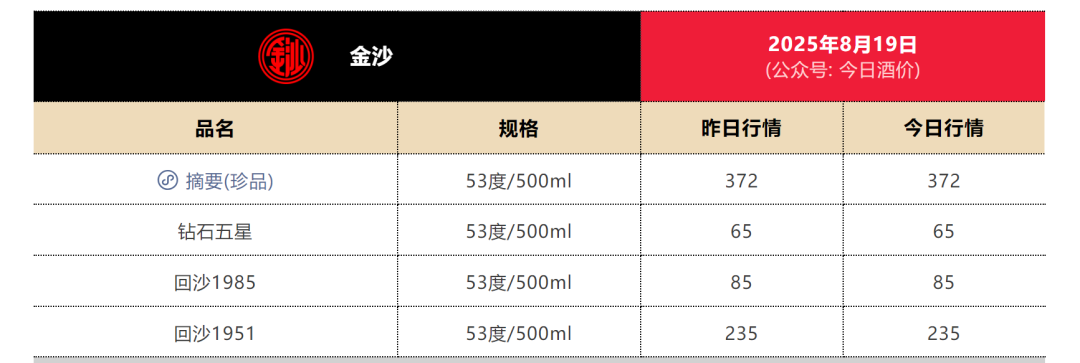
Core Insights - The acquisition of Jinsha Liquor by China Resources Beer for over 12.3 billion yuan in 2022 has faced significant scrutiny as the expected growth has not materialized [1][2] - In the first half of 2025, the revenue from the liquor business was only 7.81 billion yuan, with a pre-tax loss of 1.52 billion yuan, indicating a stark decline in performance [1][6] Financial Performance - For the first half of 2025, China Resources Beer reported a revenue increase of 0.8% to 23.942 billion yuan and a net profit increase of 23.0% to 5.789 billion yuan [1] - Jinsha Liquor's revenue for 2023 was 20.83 billion yuan, with a pre-tax profit of 1.3 billion yuan [3] - In 2024, Jinsha Liquor's revenue slightly increased by 3.7% to 21.61 billion yuan, but pre-tax profit decreased by 6.9% to 1.21 billion yuan [5] Market Challenges - The liquor business has been adversely affected by declining consumer demand and increased competition due to excessive production capacity in the sauce liquor segment [6] - The core product "Zhai Yao" has seen a significant price drop, with wholesale prices falling over 800 yuan per bottle since the beginning of the year [7] Strategic Misalignment - The attempt to replicate the fast-moving consumer goods model from the beer industry to the liquor sector has been criticized for overlooking fundamental differences in consumer behavior and market dynamics [11] - The acquisition of Jinsha Liquor and investment in other liquor companies occurred at a peak in the market, leading to challenges as the industry faced a downturn post-2021 [12] Recommendations for Future Strategy - To address the ongoing challenges, it is suggested that China Resources Beer may need to divest from consistently underperforming assets and focus on building a specialized team for Jinsha Liquor to enhance brand culture and consumer engagement [12]
华润啤酒“半年考”:豪掷123亿,为何换不来白酒的“醇香”?
中国基金报· 2025-08-20 01:13
Core Viewpoint - The acquisition of Jinsha Liquor by China Resources Beer for over 12.3 billion yuan has faced unprecedented scrutiny as the expected growth in the liquor business has not materialized, leading to disappointing financial results [2][3]. Financial Performance - In the first half of 2025, China Resources Beer reported a revenue of 23.942 billion yuan, a year-on-year increase of 0.8%, while net profit attributable to shareholders rose by 23.0% to 5.789 billion yuan [2]. - The liquor business generated a revenue of only 78.1 million yuan, with nearly 80% of this coming from the "Zhai Fu" product line, and reported a loss before interest and tax of 152 million yuan [2][8]. - Jinsha Liquor's revenue for 2023 was 208.3 million yuan, with a profit before interest and tax of 13 million yuan [7]. Acquisition Background - In 2022, China Resources Beer acquired a 55.19% stake in Jinsha Liquor for 12.3 billion yuan, marking the largest transaction in China's liquor acquisition history [5]. - The acquisition was intended to create a dual-driven strategy of "beer + liquor," aiming to tap into the more profitable and resilient liquor market [5]. Performance Decline - Post-acquisition, Jinsha Liquor's performance has not met expectations, with revenues of 87.8 million yuan, 176.7 million yuan, and 364.1 million yuan from 2019 to 2021, followed by a decline in 2024 with a revenue of 216.1 million yuan, a year-on-year increase of only 3.7% [6][9]. - In the first half of 2025, Jinsha Liquor's revenue fell by 33.9% to 78.3 million yuan, resulting in a loss before interest and tax of 152 million yuan [9]. Market Challenges - The liquor market is facing weakened consumer demand and intensified competition due to excessive production capacity, leading to disappointing investment outcomes [9]. - The introduction of a "drinking ban" policy has significantly impacted the liquor sector, particularly affecting high-end dining and business banquet scenarios [10]. Strategic Misalignment - Analysts suggest that the failure of China Resources Beer to successfully integrate its liquor business stems from a mismatch in operational models, attempting to apply fast-moving consumer goods strategies to the liquor sector, which relies more on long-term brand cultivation and targeted marketing [15]. - The acquisition of Jinsha Liquor and investment in other liquor companies occurred at a peak in the market, leading to high inventory levels and declining consumption post-2022 [15]. Future Outlook - To overcome its current challenges, China Resources Beer may need to divest from consistently underperforming assets and focus on rebuilding a professional liquor team to enhance brand culture and consumer engagement [16].