红旗连锁

Search documents
红旗连锁:永辉超市拟减持不超1%股份
Xin Lang Cai Jing· 2025-08-04 13:16
Group 1 - The core point of the article is that Yonghui Supermarket, a shareholder holding 136 million shares (9.99% of total shares), plans to reduce its stake by up to 13.6 million shares, which accounts for 1% of the company's total share capital [1] - The reduction period will start 15 trading days after the announcement of the reduction plan and will last for three months [1] - The total number of shares that can be reduced within any consecutive 90 days will not exceed 1% of the company's total share capital [1] Group 2 - The shares to be reduced are sourced from an agreement transfer [1] - The reduction price will be determined based on market prices [1]


红旗连锁(002697) - 成都红旗连锁股份有限公司关于持股5%以上股东减持股份的预披露公告
2025-08-04 13:15
证券代码:002697 证券简称:红旗连锁 公告编号:2025-023 成都红旗连锁股份有限公司 关于持股5%以上股东减持股份的预披露公告 持股 5%以上的股东永辉超市股份有限公司保证向本公司提供的信息内容真实、准 确、完整,没有虚假记载、误导性陈述或重大遗漏。 本公司及董事会全体成员保证公告内容与信息披露义务人提供的信息一致。 特别提示: 成都红旗连锁股份有限公司(以下简称"公司""本公司")于 2025 年 8 月 4 日接 到持股 5%以上股东永辉超市股份有限公司(以下简称"永辉超市")《关于计划减持成 都红旗连锁股份有限公司股份的告知函》,永辉超市拟通过集中竞价减持所持公司股份不 超过 13,600,000 股,占公司总股本比例不超过 1%。若本次减持股份计划实施期间,公司 有送股、资本公积金转增股本、配股或缩股等股份变动事项,前述预计减持股份数量上限 将作相应调整。减持期间为自本减持计划的预披露公告发布之日起 15 个交易日后的 3 个 月内,且在任意连续 90 日内通过集中竞价减持股份的总数不超过公司总股本的 1%。现将 有关情况公告如下: 一、股东的基本情况 1、股东名称:永辉超市股份有限公司 ...
低费率的的自由现金流ETF(159201)小幅调整打开低位布局窗口,契合长期投资需求
Mei Ri Jing Ji Xin Wen· 2025-08-04 06:54
8月4日午后,国证自由现金流指数小幅回调,成分股方面涨跌互现,捷佳伟创、凌云股份、欧派家居等 领涨%;南京新百、华人健康、红旗连锁等领跌。自由现金流ETF(159201)跟随指数调整,最新报价 1.05元。拉长时间看,截至2025年8月1日,自由现金流ETF近1月累计上涨2.45%,涨幅排名可比基金首 位。 方正证券认为,自由现金流是衡量企业真实盈利能力与分红潜力的前瞻性指标,高股息的长期维持必须 以高自由现金流为基础,长期具备高自由现金流的企业更能保障未来持续分红,实现对股东的稳定回 报。随着长线资金投资策略的不断迭代,自由现金流契合风险规避与收益稳定性需求,或将成为险资等 长线重要配置方向。 数据显示,截至2025年7月31日,国证自由现金流指数前十大权重股分别为上汽集团、中国海油、美的 集团、格力电器、洛阳钼业、中国铝业、厦门国贸、上海电气、正泰电器、中国动力,前十大权重股合 计占比57.66%。 自由现金流ETF(159201)紧密跟踪国证自由现金流指数,自由现金流策略弥补了传统红利策略在行业 覆盖广度和未来表现预判方面的不足,聚焦于内生增长能力,强调财务健康与可持续性,更契合追求长 期成长与资本增值 ...






“逃离”外卖大战的商家
Hu Xiu· 2025-08-04 02:39
动辄千万量级的订单、百亿级真金白银的投入,一度将这个行业推向低价争夺战的怪圈。直到7月18日,市场监管总局约谈饿了么、美团、京东三家平台 企业。8月1日,三家平台同一天发布声明,表示将规范补贴行为、反对恶性竞争、共同维护行业生态。 持续三个多月的外卖大战,终于有了些缓和的迹象。 然而,在平台尚未彻底"刹车"之前,被裹挟其中的商家,早已疲惫不堪。 从南京到广州,从寿司店到糖水铺,再到街角的柠檬茶门店,从个体商家到品牌连锁,这场看似热闹的"外卖狂欢"背后,是一笔越来越难算的账:一边是 订单暴涨、忙不过来,另一边是在补贴分摊之下的利润下滑。有人被迫涨价,有人关闭线上渠道,有人放弃堂食大店重新租小档口All in外卖…… 本文试图回到这场战争中的"个体",从商家的讲述出发,通过真实账单、应对方法和犹豫挣扎,记录这场大战带来的冲击。 两难的商家,困在补贴里 "加入外卖大战,会死得慢一点。不加入,死得快。"不少餐饮商家在聊起外卖大战时,都这样感慨。 江苏的茶饮商家王渝,几个月前就察觉出异常。他在南京加盟了一家品牌茶饮,为了提高收入,顺带着自营了一家烘焙店。年后堂食基本每天都有五六十 单,但到了四月底,线上订单开始激增,堂 ...



别看股价,看估值
Ge Long Hui· 2025-08-04 02:24
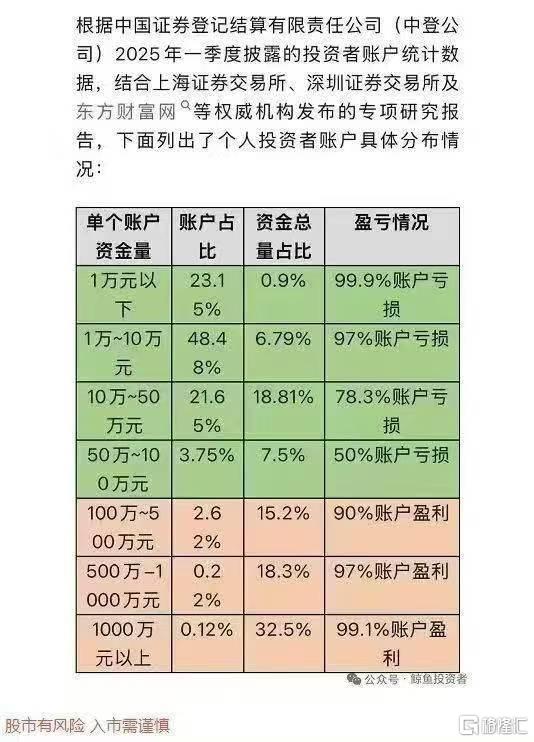
Group 1 - The core viewpoint of the news highlights a positive economic backdrop with the U.S. reaching trade agreements with the EU, Japan, and South Korea, involving a 15% tariff and significant investments into the U.S. market [1] - The U.S. stock market, particularly the S&P 500 and Nasdaq 100, has been reaching new highs, driven largely by major tech companies like Nvidia, Meta, and Microsoft, which contributed significantly to the market's gains this year [1] - The article notes that 60% of the S&P 500's gains and 50% of the Nasdaq 100's gains this year are attributed to these tech giants, raising concerns about their high forward price-to-earnings (P/E) ratios [1] Group 2 - In the A-share market, the margin financing and securities lending balance surged to 1.98 trillion, indicating a highly enthusiastic market environment with funds shifting from dividend ETFs to sectors like steel and coal [2] - The article describes a strong recovery logic in trading, with a pattern of buying on dips becoming apparent as investors share their profits in various groups [2] - The Hong Kong stock market is experiencing a rotation of funds, with new competition emerging in the food delivery sector, while some consumer stocks are showing weakness [3] Group 3 - The article discusses the performance of various account sizes in the market, revealing that a significant percentage of accounts are experiencing losses, particularly among smaller accounts, while larger accounts show a higher percentage of profitability [3] - The recent performance of pharmaceutical stocks in Hong Kong, such as CSPC Pharmaceutical Group, is highlighted, with several companies reaching year-to-date highs [3] Group 4 - The article reflects on investment strategies, emphasizing the importance of stock selection, valuation, and timing, suggesting that a simple approach can often be more effective than complex models [5][6] - It discusses the significance of valuation over technical indicators, recommending the use of historical P/E ratios for stable industries and the Shiller P/E for cyclical industries [6] - The article concludes with a perspective on investment timing, stressing that staying in the market is more crucial than trying to time market entry and exit [6]
耐用消费产业研究:中报密集披露期聚焦业绩,捕捉新消费回调见底机遇
SINOLINK SECURITIES· 2025-08-03 14:05
Group 1: Consumer Strategy and Investment Recommendations - The investment opportunities in consumer sectors are divided into new consumption and dividend+consumption dimensions. New consumption saw strong excess returns in Q2 2025, but in July, market focus shifted due to high expectations and emerging sectors like PCB and innovative drugs, leading to a significant decline in stock prices [2][8] - The next systematic allocation for both new consumption and dividend+consumption is expected around late August during the intensive disclosure period of mid-year reports, with the outcome of US-China tariffs on August 12 indicating the next consumption allocation direction [2][8] Group 2: Light Industry Manufacturing - New tobacco products are showing a steady upward trend, with HNB products reaching 5 billion units in H1 2025, a 29.5% year-on-year increase. BAT's HNB revenue is expected to accelerate in the second half of the year [16] - The home furnishing sector is stabilizing at the bottom, with weak domestic sales but potential growth for resilient soft furniture companies [17] - The paper industry is also stabilizing, with inventory trends indicating a gradual decrease, although prices remain flat due to weak downstream demand [17] Group 3: Textile and Apparel - The apparel sector is experiencing mixed results, with a 1.9% year-on-year increase in retail sales in June, influenced by various factors. Focus is recommended on unique alpha companies and those with significant advantages in sub-sectors [20] - The export sector is recovering, aided by reduced tariffs from the US, although uncertainties remain in US-China tariff negotiations [20] Group 4: Beauty and Personal Care - The beauty sector is facing a decline in retail sales, with a 2.3% year-on-year drop in June. Recommendations include focusing on leading companies with stable mid-year performance and those with significant rebound potential [21] Group 5: Home Appliances - The home appliance sector is seeing a slight decrease in production, with a total of 26.97 million units produced in August, down 4.9% year-on-year. Notably, the global TV shipment volume decreased by 1.5% in the first half of the year, with domestic brands showing growth [22][23] Group 6: Retail and E-commerce - The retail sector is under slight pressure, with supermarkets and department stores facing challenges, while e-commerce is stabilizing at the bottom. Yonghui's recent fundraising plan aims to reduce debt and improve operational efficiency [24] Group 7: Social Services - The tea beverage sector remains high in demand, benefiting from delivery subsidies, while the restaurant industry is stabilizing. The tourism sector maintains high demand, and the education sector shows resilience [25]
营收吊打星巴克!瑞幸翻身了
Ge Long Hui· 2025-08-03 10:02
Core Viewpoint - Luckin Coffee has shown remarkable recovery and growth amidst the ongoing price war in the coffee and tea industry, achieving significant revenue and profit increases in the second quarter of 2024 [1][3]. Financial Performance - In Q2 2024, Luckin Coffee's total net revenue reached 12.359 billion yuan, a year-on-year increase of 47.1%, marking the highest growth rate in the past four quarters [1]. - Operating profit surged by 61.8% year-on-year to 1.7 billion yuan [1]. - The company's stock price has doubled over the past year and increased 30 times from its lowest point in 2020 [1]. Market Dynamics - The second quarter of 2024 saw a significant price war initiated by three major delivery platforms, leading to historically low beverage prices [3]. - Despite the price war, Luckin Coffee has emerged as a strong competitor, with a gross merchandise volume (GMV) growth of 46% to 14.2 billion yuan [5]. - Self-operated store revenue accounted for 74% of total net revenue, reaching 9.14 billion yuan, a 45.6% year-on-year increase [5]. Store Expansion - Luckin Coffee opened 2,109 new stores in Q2 2024, bringing the total number of stores to 26,206 [9]. - The company has opened nearly 4,000 new stores in the first half of 2024, compared to just over 2,000 in the second half of the previous year [9]. Competitive Landscape - Compared to Starbucks, which reported a net income of 5.68 billion yuan for the same period, Luckin's performance is notably superior [10]. - The coffee market in China has seen significant changes, with Luckin Coffee surpassing Starbucks in annual revenue for the first time in 2023 [19]. Industry Trends - The boundaries between coffee and tea markets are blurring, with brands like Luckin actively introducing tea-based products to attract a broader customer base [20]. - The industry is shifting from aggressive expansion to a focus on operational efficiency and brand differentiation, as evidenced by recent changes in branding among leading tea brands [29]. Cost Challenges - Operating costs, particularly rent, have surged, with a 65% year-on-year increase in 2024, reaching 8.541 billion yuan, which poses challenges to the sustainability of the low-price strategy [23]. - The company has faced pressures to control costs while maintaining competitive pricing amidst rising operational expenses [30].

营收吊打星巴克!瑞幸翻身了
格隆汇APP· 2025-08-03 09:06
Group 1 - The core viewpoint of the article highlights that Luckin Coffee has successfully navigated the challenges posed by the fierce price wars in the coffee and tea industry, achieving significant revenue growth and market presence [2][3][8] - In Q2, Luckin Coffee reported total net revenue of 12.359 billion yuan, a year-on-year increase of 47.1%, marking the highest growth rate in the past four quarters [3][10] - The company's operating profit surged by 61.8% year-on-year to reach 1.7 billion yuan, reflecting its strong performance amidst the competitive landscape [3][10] Group 2 - Luckin Coffee's stock price has doubled over the past year, and since its lowest point in 2020, it has increased by 30 times [4][10] - The company has aggressively expanded its store count, adding 2,109 new stores in a single quarter, bringing the total to 26,206 stores by the end of Q2 [15][10] - Compared to Starbucks, which reported net revenue of 5.68 billion yuan for the same period, Luckin's performance stands out significantly [16][10] Group 3 - The article discusses the impact of the ongoing price war initiated by major delivery platforms, which has led to historically low beverage prices [9][10] - Luckin Coffee has benefited from this price war, with its gross merchandise volume (GMV) increasing by 46% year-on-year to 14.2 billion yuan [10][10] - The company has also seen a rise in same-store sales, with a 13.4% year-on-year increase in self-operated stores [10][10] Group 4 - The article notes that the coffee market in China has undergone significant changes, with Luckin Coffee surpassing Starbucks in annual revenue for the first time in 2023 [29][30] - The coffee and tea markets are increasingly converging, with brands like Luckin actively introducing tea-based products to attract a broader consumer base [31][30] - The competitive landscape is shifting towards a focus on brand differentiation and operational efficiency, as companies face rising costs and market saturation [50][51] Group 5 - The article emphasizes the challenges that Luckin Coffee and the broader beverage market will face in the future, particularly in terms of cost control and maintaining brand value [56][57] - The increase in delivery orders has created both opportunities and challenges for Luckin, as it must manage rising delivery costs while expanding its consumer base [55][56] - The need for long-term strategies to enhance brand loyalty and consumer engagement is highlighted as a critical focus for Luckin and the industry as a whole [57][56]


2025餐饮增长榜解析:慢周期里的机会点与生存法则(附有哥餐链完整榜单)
Sou Hu Cai Jing· 2025-08-02 16:13
Core Insights - The restaurant industry in 2025 is at a crossroads between "rapid expansion" and "rational cultivation," with a reported 4.3% year-on-year growth in national dining revenue from February to June 2025, indicating a shift to a "slow growth" cycle due to market saturation and intensified competition [2][25] - Despite the slow growth, brands like Mixue Ice City are rapidly expanding, adding over 10,000 stores in a year, while the coffee sector sees three brands in the top growth rankings, highlighting potential opportunities within the slow growth period [2][14] Key Data Points - The top five brands in the growth ranking added over 5,000 stores in the past year, with Mixue Ice City leading by adding 10,160 stores [4] - Coffee and tea drinks dominate the growth list with 26 brands, including 9 coffee and 17 tea brands, while other notable categories include rice noodles (11 brands), fried chicken and burgers (9 brands), and snacks (8 brands) [4] - The growth rate of the top 10 brands by new store count shows that two brands specializing in boiled beef rice noodles achieved over 90% growth [4] Growth Categories Analysis - **Coffee and Tea Drinks**: Brands like Mixue Ice City and Luckin Coffee are expanding rapidly, leveraging supply chain efficiencies to offer competitive pricing. New entrants like Grandpa Not Brewing Tea are also finding success through unique positioning [14][21] - **Snack Foods**: Brands such as Hao Xiang Lai and Zhao Yi Ming are leading the snack food segment, benefiting from direct supply chain sourcing and scale efficiencies, with Zhao Yi Ming adding 376 stores recently [16][17] - **Quick Service Restaurants**: The quick service segment is seeing rapid growth, with brands like Tasitin and Cao's Duck Neck capitalizing on standardized operations and efficient supply chains. However, traditional brands face challenges due to limited marketing and single consumption scenarios [19][21] Slow Growth Cycle Insights - The slow growth cycle presents opportunities at the intersection of supply chain efficiency and user value. Successful brands are those that enhance supply chain capabilities and differentiate through unique user value propositions [23][25] - Brands that remain stagnant often do so due to a lack of innovation and reliance on imitation rather than building competitive barriers [23][25]



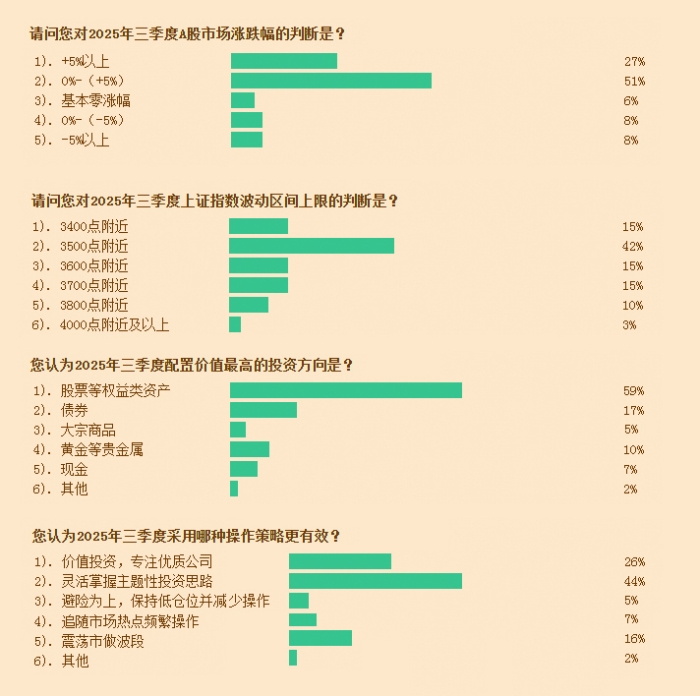
近八成投顾看涨三季度 结构性行情成主流共识——上海证券报·2025年第三季度券商营业部投资顾问调查报告
Shang Hai Zheng Quan Bao· 2025-08-01 18:50
Group 1 - The majority of investment advisors maintain a neutral to optimistic outlook on the macroeconomic situation for Q3 2025, with over 70% holding this view [22][23][24] - Nearly 80% of advisors are bullish on the A-share market for Q3, with a structural market trend expected, favoring sectors like technology, new consumption, real estate, and finance [22][28][29] - The anticipated upper limit for the Shanghai Composite Index is projected to be around 3500 points, with 42% of advisors expecting it to be near this level [4][18][29] Group 2 - Advisors suggest that the highest value for asset allocation in Q3 2025 lies in equities, with 59% favoring this category, marking a significant increase [10][35][36] - A flexible thematic investment strategy is preferred by 44% of advisors, indicating a shift towards more dynamic investment approaches [6][37] - The expectation for liquidity in Q3 is leaning towards a relaxed environment, with 57% of advisors predicting a loose or neutral liquidity stance [26][27] Group 3 - High-net-worth clients have shown a strong inclination to increase their equity positions, with 70% reporting profits in Q2 2025 and a rising willingness to add to their investments [40][41][43] - The preference for high-dividend stocks remains strong, with 36% of advisors believing these stocks have reached reasonable valuations [32][39] - The innovative pharmaceutical sector is gaining attention, with 38% of advisors viewing it positively, driven by policy optimization and valuation recovery [34]