
东鹏饮料

Search documents
食品饮料周报:贵州茅台发布分红、回购方案,积极提振信心-20251114
Tianfeng Securities· 2025-11-14 09:43
Investment Rating - Industry Rating: Outperform the market (maintained rating) [5] Core Viewpoints - The food and beverage sector experienced a decline of -0.56% from November 3 to November 7, underperforming compared to the Shanghai Composite Index (+1.08%) and the CSI 300 Index (+0.82%). The liquor segment, particularly the white liquor category, saw a decrease of -0.84%, indicating a weaker performance during this period [12][18]. - Guizhou Moutai announced a mid-term dividend plan for 2025 and a new share repurchase plan, which includes a commitment to a 30 billion yuan dividend and a 15-30 billion yuan buyback. This reflects the company's strong recognition of its own value and has positively impacted its stock price [12][18]. - The white liquor industry is currently in a sales off-season, with expectations that companies will focus on inventory reduction in Q4 2025. The Shenyin Wanguo white liquor index PE-TTM stands at 19.52X, which is considered relatively low compared to the past decade, suggesting potential recovery opportunities in the sector [12][18]. Summary by Sections Market Performance Review - From November 3 to November 7, the food and beverage sector's performance was -0.56%, with specific declines in various sub-sectors: white liquor (-0.84%), beer (-0.66%), soft drinks (-1.20%), and dairy products (-0.38%). In contrast, pre-processed foods (+2.26%) and baked goods (+1.69%) showed positive growth [18]. White Liquor Insights - The white liquor segment's performance was notably weaker than the overall food and beverage sector. Guizhou Moutai's announcements regarding dividends and share repurchases are seen as confidence-boosting measures. The current PE-TTM for the white liquor index is at a historically low level, indicating potential for recovery as consumer spending gradually improves [12][18]. Beer and General Consumer Goods - The beer sector also faced a decline of -0.66%, but there is optimism for recovery driven by upcoming consumption policies. The general consumer goods segment, particularly pre-processed and baked goods, is expected to benefit from valuation shifts and marginal changes as the restaurant sector slowly recovers [2][13]. Investment Recommendations - For the white liquor sector, three main investment lines are recommended: strong beta stocks (e.g., Jiu Gui Jiu, Shui Jing Fang), value recovery stocks (e.g., Ying Jia Gong Jiu), and strong alpha stocks (e.g., Shanxi Fen Jiu, Guizhou Moutai) [3][17]. - In the beer segment, focus on stocks with sustained growth potential and those that may benefit from cost advantages is advised [3][17].

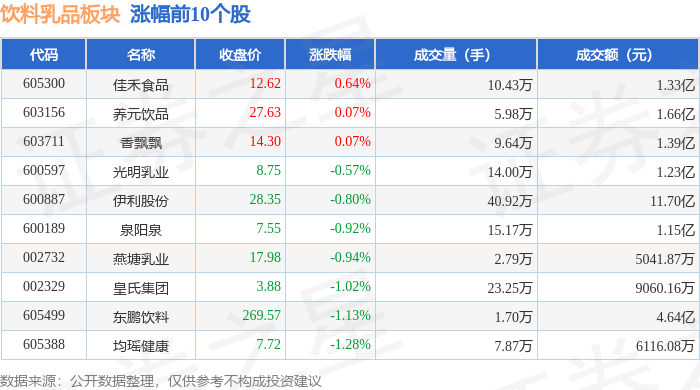
饮料乳品板块11月14日跌1.46%,欢乐家领跌,主力资金净流出5.02亿元
Zheng Xing Xing Ye Ri Bao· 2025-11-14 08:51
Core Viewpoint - The beverage and dairy sector experienced a decline of 1.46% on November 14, with the leading stock, Huanlejia, dropping significantly by 11.26% [1][2]. Market Performance - The Shanghai Composite Index closed at 3990.49, down 0.97%, while the Shenzhen Component Index closed at 13216.03, down 1.93% [1]. - Key stocks in the beverage and dairy sector showed mixed performance, with notable declines in major companies such as Yili and Guangming Dairy [1]. Stock Performance Summary - Huanlejia (300997) closed at 26.09, down 11.26% with a trading volume of 326,100 shares and a transaction value of 882 million yuan [2]. - Sanyuan (600429) closed at 6.55, down 10.03% with a trading volume of 1,676,700 shares and a transaction value of 1.136 billion yuan [2]. - Other notable declines included Qishi Dairy (920786) down 4.92% and Yiming Foods (605179) down 3.96% [2]. Capital Flow Analysis - The beverage and dairy sector saw a net outflow of 502 million yuan from institutional investors, while retail investors contributed a net inflow of 456 million yuan [2][3]. - The capital flow data indicates that major stocks like Yili and Guangming Dairy experienced significant net outflows from institutional investors [3]. Individual Stock Capital Flow - Yili (600887) had a net outflow of 34.7 million yuan from institutional investors, while retail investors contributed a net inflow of 13.1 million yuan [3]. - Other stocks like Xiangpiaopiao (603711) and Zhuangyuan Ranch (002910) showed varying capital flows, with Xiangpiaopiao experiencing a net inflow from institutional investors [3].



食品饮料行业双周报(2025、10、31-2025、11、13):10月CPI同比转正,关注需求恢复进程-20251114
Dongguan Securities· 2025-11-14 08:43
Investment Rating - The report maintains an "Overweight" rating for the food and beverage industry, expecting the industry index to outperform the market index by more than 10% in the next six months [54]. Core Insights - The October CPI turned positive year-on-year, indicating a recovery in demand, with a 0.2% increase compared to the previous month [51]. - The SW food and beverage industry index rose by 4.28% from October 31 to November 13, outperforming the CSI 300 index by approximately 4.45 percentage points [12]. - All sub-sectors within the food and beverage industry outperformed the CSI 300 index during the same period, with the pre-processed food sector showing the highest increase of 13.07% [13]. - Approximately 96% of stocks in the industry recorded positive returns, with notable gainers including Huanlejia (+76.90%) and Sanyuan Shares (+49.79%) [16]. - The overall PE (TTM) for the SW food and beverage industry is about 22.00 times, which is below the five-year average of 32 times [19]. Summary by Sections Market Review - The SW food and beverage industry index outperformed the CSI 300 index, with a rise of 4.28% from October 31 to November 13, ranking eleventh among the primary sectors [12]. - All sub-sectors outperformed the CSI 300 index, with the pre-processed food sector leading at 13.07% [13]. - About 96% of stocks in the industry achieved positive returns, with significant increases from Huanlejia, Sanyuan Shares, and Zhu Laoliu [16]. Industry Data Tracking - **Baijiu Sector**: The price of Feitian decreased to 1640 RMB/bottle, down 20 RMB from October 30, while the prices of Puwu and Guojiao 1573 remained stable [24]. - **Condiment Sector**: Prices for soybean meal and white sugar increased, while the price of glass packaging rose slightly [27]. - **Beer Sector**: The price of barley decreased to 2210 RMB/ton, while the prices of glass and aluminum increased [33]. - **Dairy Sector**: The average price of fresh milk fell to 3.02 RMB/kg, a decrease of 0.01 RMB from October 31 [38]. - **Meat Products Sector**: The average wholesale price of pork rose to 18.12 RMB/kg, an increase of 0.16 RMB from October 30 [39]. Industry News - Meituan Flash Purchase reported a 562% year-on-year increase in baijiu transaction volume on November 1 [42]. - The export value of baijiu from Zunyi increased by 551.8% from January to September [43]. - In October, the national baijiu price index fell by 0.17% month-on-month [46]. Company Announcements - Guizhou Moutai announced a share repurchase plan with a budget of 15 to 30 billion RMB [49]. - The company plans to distribute a cash dividend of 23.957 RMB per share, totaling approximately 300.01 billion RMB [50]. Weekly Industry Perspective - The report emphasizes the importance of monitoring the recovery of demand following the positive CPI in October, with a focus on the baijiu sector's performance amid weak consumption recovery [51].
CPI结构变化趋势对消费影响分析
Haitong Securities International· 2025-11-14 08:25
Investment Rating - Investment advice: Prioritize growth, supply-demand balance signals a turning point [2][12][19] Core Insights - Service CPI rises, food CPI stabilizes, future PPI increase may drive further CPI improvement, benefiting mass products first [12][19] - Economic transformation leads to a rise in service consumption, with service CPI consistently outperforming food CPI since 2012, indicating a shift from product to service consumption [4][19] - Moderate inflation is expected to promote consumption recovery, with autumn-winter related consumption anticipated to strengthen due to sudden cold weather [4][19] Summary by Sections CPI Trends - Service CPI has been consistently higher than food CPI since 2012, reflecting a structural shift in consumption patterns [4] - Service CPI is relatively stable while goods CPI is more volatile, influenced by supply-demand dynamics [4] - Non-food CPI remains stable, whereas food CPI is more volatile, primarily affected by pork prices [4] Investment Recommendations - Recommended stocks in the baijiu sector include Shanxi Xinghuacun Fen Wine Factory, Gujing Distillery, and Kweichow Moutai among others [12][19] - For beverages, Eastroc Beverage and Nongfu Spring are highlighted, with a focus on low valuation high dividends stocks like China Foods and Tingyi [12][19] - Snack and food raw material growth targets include Bailong Chuangyuan, Yankershop Food, and Three Squirrels [12][19] - Beer recommendations include Yanjing Brewery and Tsingtao Brewery [12][19] - Stable condiment companies recommended include Haitian Flavouring & Food and Yili Industrial Group [12][19]



第九届中国(深圳)公司治理高峰论坛在深圳顺利举办
Zheng Quan Ri Bao· 2025-11-13 12:08
本报讯 (记者刘晓一)11月13日,在中国公司治理研究院(以下简称"研究会")指导下,由深圳市公 司治理研究会主办,东鹏饮料(集团)股份有限公司、邮储银行西丽支行支持的第九届中国(深圳)公 司治理高峰论坛在深圳顺利举行。本次高峰论坛主题为"治理筑基市值焕新",会议紧扣强监管、防风 险、促高质量发展的主线,为湾区企业治理升级锚定方向。 论坛现场,研究会轮值会长、深圳华大基因股份有限公司副总经理、总法律顾问、董事会秘书徐茜表 示,新一轮科技革命和产业变革深入发展,全球产业链、供应链加速重构,企业面临的经营环境日趋复 杂。公司治理作为现代企业制度的核心,既是企业应对风险挑战的"压舱石",也是激发创新活力的"动 力源"。面向"十五五",要读懂中国发展时代方位、认清国内外形势深刻变化、把握未来发展战略路 径,在百年变局中把握先机,在国际竞争中赢得主动,在市场发展中占据优势。 南开大学讲席教授、研究院院长李维安发布《2025大湾区上市公司治理评价报告》。报告显示,大湾区 803家上市公司治理水平总体上较高,治理指数平均值为65.17,比全国平均水平(64.94)高出0.23。从 六大维度来看,大湾区上市公司股东治理、利益 ...
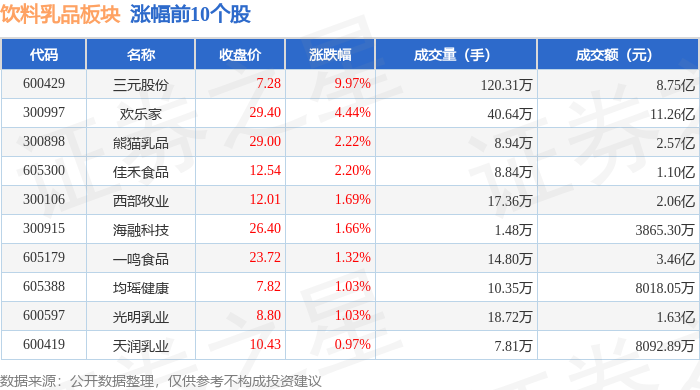
饮料乳品板块11月13日跌0.08%,东鹏饮料领跌,主力资金净流出3.89亿元
Zheng Xing Xing Ye Ri Bao· 2025-11-13 08:44
Market Overview - The beverage and dairy sector experienced a slight decline of 0.08% on November 13, with Dongpeng Beverage leading the drop [1] - The Shanghai Composite Index closed at 4029.5, up 0.73%, while the Shenzhen Component Index closed at 13476.52, up 1.78% [1] Stock Performance - Notable gainers in the beverage and dairy sector included: - Sanyuan Foods (600429) with a closing price of 7.28, up 9.97% [1] - Huanlejia (300997) at 29.40, up 4.44% [1] - Panda Dairy (300898) at 29.00, up 2.22% [1] - Dongpeng Beverage (605499) saw a decline of 2.35%, closing at 272.65 [2] Trading Volume and Capital Flow - The beverage and dairy sector recorded a net outflow of 389 million yuan from institutional investors, while retail investors saw a net inflow of 390 million yuan [2] - The trading volume for Sanyuan Foods reached 1.2031 million shares, while Huanlejia had a trading volume of 406,400 shares [1][2] Individual Stock Capital Flow - Huanlejia had a net inflow of 16.0031 million yuan from institutional investors, while it faced a net outflow of 15.1679 million yuan from speculative funds [3] - Panda Dairy experienced a net inflow of 13.6274 million yuan from institutional investors, with a net outflow of 14.8995 million yuan from speculative funds [3] - Light Dairy (600597) had a net outflow of 1.3279 million yuan from institutional investors, but a net inflow of 19.4394 million yuan from retail investors [3]
消费有望迎来轮动补涨!消费ETF(159928)翻红冲击两连阳!港股通消费50ETF(159268)获资金净流入超4600万元!机构:关注消费板块胜率和赔率
Sou Hu Cai Jing· 2025-11-13 06:45
Group 1: Market Performance - The consumer sector is experiencing a rebound, with the Consumer ETF (159928) rising by 0.47% and achieving a trading volume exceeding 660 million yuan [1] - The Hong Kong Stock Connect Consumer 50 ETF (159268) also saw a slight increase of 0.2%, with trading volume surpassing 126 million yuan, indicating strong capital inflow [2] - Notable stocks include Samsonite, which surged over 17% with a 11% year-on-year profit growth and a gross margin increase to 59.6% [4] Group 2: Economic Indicators - The core CPI, excluding food and energy, rose by 1.2% year-on-year in October, marking the sixth consecutive month of growth, which has drawn attention to the recovery of consumer spending [5] - The government plans to continue implementing measures to boost consumption, including financial subsidies for personal consumption loans and support for key sectors like elderly care and childcare [15] Group 3: Valuation and Investment Opportunities - The Consumer ETF (159928) has a TTM price-to-earnings ratio of 20.55, which is at the 7.45% percentile over the past decade, indicating it is cheaper than 92% of the historical time frame [5] - Despite a strong performance in technology and cyclical sectors, the consumer sector has shown relatively weaker growth of only 10.85% year-to-date, suggesting potential for catch-up [8] Group 4: Sector Analysis - The consumer sector is expected to see a rotation and rebound, with specific segments like healthcare, aviation, home appliances, personal care, and non-white liquor showing strong earnings growth while remaining at historically low valuations [12] - The new consumption trends are driven by the Z generation, with sectors like trendy toys and jewelry expected to grow due to changing consumer preferences and technological integration [16][17] Group 5: Company Innovations - Anta Group has launched the first AI design model in the sports goods industry, which has already generated over 2.5 billion yuan in orders, indicating a significant boost in sales conversion rates [18] - Upbeauty Co. has introduced a new baby care brand, expanding its IP strategy to capture the growing demand in the baby personal care market [19]

2025年第45周:食品饮料行业周度市场观察
艾瑞咨询· 2025-11-13 00:05
Industry Environment - Japan's consumer market thrives on high-frequency innovation, evolving from imitation to user-driven innovation since the 1980s, with companies establishing consumer research centers to deeply explore needs [3][4] - The "medicinal food" industry in China has surpassed 370 billion yuan, with a total industry valuation exceeding 2 trillion yuan, driven by health awareness and policy support [5] - The plant-based protein beverage market is facing pressure, but leading companies are preparing for peak seasons with channel expansion and new product promotions [6] Beverage Market Trends - HPP cold brew tea, combining high-pressure cold sterilization with cold brewing, is gaining popularity among young consumers, despite its higher cost and niche market status [7] - The beverage market is witnessing a return of sugary drinks, with brands like Yuanqi Forest and Wahaha launching new sugary products, reflecting consumer preferences for taste and pleasure [8] - The bottled water market is shifting from price competition to value competition, with companies like Nongfu Spring and China Resources leading through product innovation and channel transformation [9][10] Brand Dynamics - Mondelez International reported a 5.9% revenue growth in Q3 2025, but faced profit margin pressures due to rising costs and declining consumer confidence in emerging markets like China [20] - Xu Fu Ji's Meilu energy biscuits have rapidly gained popularity in the sports nutrition market, leveraging event sponsorships and targeted marketing strategies [21] - Coca-Cola's Q3 2025 revenue reached $12.455 billion, driven by price increases and strong sales of sugar-free products, despite a slight decline in the Chinese market [22] Plant-Based and Health Trends - Yangyuan Beverage is enhancing its leadership in the plant-based protein beverage sector through product innovation and channel restructuring [23] - The low-sugar trend is becoming mainstream, with brands like Holleyou launching new products that balance health and taste [25] - Mengniu's milk powder business has achieved double-digit growth by focusing on emotional marketing and channel optimization to meet diverse consumer needs [26] Emerging Opportunities - The plant milk market is projected to exceed 100 billion yuan by 2025, with B2B channels becoming crucial for growth [14] - The sports drink segment is rapidly growing, with brands like Magic leveraging product upgrades and sports marketing to strengthen their market position [33] - The electrolyte drink market is dominated by brands like Dongpeng and Alien, with both focusing on channel strategies and product diversification to capture market share [31][32]

年内超80家A股公司递表港交所
Shang Hai Zheng Quan Bao· 2025-11-12 17:51
Group 1 - A-share companies are increasingly seeking listings on the Hong Kong Stock Exchange, with over 80 companies having submitted applications this year alone [1][3] - The number of A+H listed companies has reached 160, with 16 companies successfully listing in Hong Kong this year, surpassing the total from the previous five years [2][3] - Major A-share companies that have recently listed include Ningde Times, which raised nearly 40 billion HKD, and others like Sails and Sany Heavy Industry, each raising over 10 billion HKD [2] Group 2 - The sectors attracting A-share companies to Hong Kong include biomedicine, technology, and consumer goods, reflecting investor interest in these areas [3][4] - The Hong Kong Stock Exchange has optimized its listing mechanisms, making it easier for companies to access capital, which is crucial for their growth [4] - The trend of A+H listings is driven by the desire of mainland companies to enter international markets, leveraging Hong Kong's unique position and regulatory environment [5] Group 3 - The Hong Kong Stock Exchange has seen record revenue and net profit in the first three quarters of the year, driven by high trading activity and a surge in new listings [6] - There are currently around 300 listing applications being processed, with half from new economy sectors such as electric vehicles and biotechnology [6] - Despite the overall positive trend, some new listings have faced challenges, with instances of stocks dropping below their issue price on debut, leading to delays in some IPOs [6][7]



“十五五”规划分析及产业投资机遇展望
Ping An Securities· 2025-11-12 10:27
Group 1: Economic Strategy - The "15th Five-Year Plan" emphasizes economic construction as the core focus, aiming to build a modern industrial system centered on advanced manufacturing[9] - Key industrial development lines include "hard technology," advanced manufacturing, domestic circulation, and energy resource security[3] - The plan aims to create a market space of 10 trillion yuan by optimizing traditional industries and fostering emerging sectors over the next five years[8] Group 2: Hard Technology and Advanced Manufacturing - The plan highlights the importance of original innovation and key core technology breakthroughs, particularly in AI and digital technologies[12] - The automotive industry is expected to see accelerated commercialization of L3/L4 autonomous driving technologies during the "15th Five-Year Plan" period[34] - The focus on advanced manufacturing aims to enhance the global competitiveness of traditional industries like chemicals and machinery, with a push towards smart and green manufacturing[8] Group 3: Domestic Circulation and Consumption - The plan stresses the need to boost consumption and expand effective investment, particularly in the real estate sector, to support high-quality development[3] - The "anti-involution" policy is expected to improve the operational environment for construction materials and consumer goods, benefiting companies in these sectors[3] Group 4: Resource Security - The plan calls for strengthening the exploration and development of strategic mineral resources, particularly rare earths, to enhance their strategic importance[3] - It emphasizes the need for a new energy system, focusing on clean and efficient utilization of fossil energy while promoting renewable energy sources[3] Group 5: Market Outlook and Risks - The equity market is expected to maintain high volatility, with a focus on sectors benefiting from industrial recovery and performance superiority[3] - Key risks include macroeconomic fluctuations, lower-than-expected corporate profit growth, and geopolitical uncertainties[3]