特朗普政策

Search documents
中辉有色观点-20260209
Zhong Hui Qi Huo· 2026-02-09 05:50
1. Report Industry Investment Ratings - Gold: Bullish, suggesting stable and multi - allocation [1] - Silver: Bearish, not recommended for participation [1] - Copper: Bullish in the long - term, suggesting long - term holding and short - term profit - taking [1][7] - Zinc: Neutral in the short - term, suggesting waiting for more macro guidance; bullish in the long - term, suggesting buying on dips [1][11] - Lead: Bearish, price under pressure [1] - Tin: Bearish, price rebound under pressure [1] - Aluminum: Bearish, price rebound under pressure [1] - Nickel: Bearish, price rebound under pressure [1] - Industrial Silicon: Neutral, wide - range oscillation [1] - Polysilicon: Bearish, price under pressure [1] - Lithium Carbonate: Neutral, waiting for stabilization [1] 2. Core Views of the Report - **Gold**: With the decline of US inflation expectations, the market sentiment has recovered after adjustment. In the long - term, due to the reshaping of the geopolitical order and central banks' continuous gold purchases, the long - term strategic allocation value remains unchanged [1][3] - **Silver**: Although there are long - term supply - demand gaps and favorable factors from global fiscal policies, short - term market adjustments continue, and the risk - return ratio is not suitable for short - term participation [1] - **Copper**: In the short - term, approaching the Spring Festival, market risk - aversion sentiment rises, demand is weak in the traditional off - season, and high global copper inventories suppress the upside space. In the long - term, it is still optimistic due to copper's strategic position and green demand [1][6][7] - **Zinc**: In the short - term, speculation enthusiasm cools down, demand is weak approaching the Spring Festival, and inventories are accumulating. In the long - term, it is advisable to buy on dips due to potential supply challenges [1][10][11] - **Aluminum**: Overseas bauxite prices are under pressure, alumina costs are low, domestic inventories are accumulating, and downstream开工 rates are declining, so the price rebound is under pressure in the short - term [1][12][14] - **Nickel**: The expectation of supply contraction in Indonesia has been digested, domestic high inventories and weak consumption continue, and stainless steel inventories have rebounded slightly, so the price rebound is under pressure in the short - term [1][16][18] - **Lithium Carbonate**: Total inventories have been decreasing for 4 consecutive weeks, production has declined. Market sentiment has been affected, and it is recommended to wait for stabilization before layout [1][20][21] 3. Summaries by Related Catalogs Gold and Silver - **Market Performance**: After a significant adjustment, the prices of gold and silver rebounded on Friday, but market confidence has not been fully restored. Positions and narratives are in an unstable state [2] - **Influencing Factors**: US inflation expectations have declined, and the Chinese central bank has been continuously buying gold. The three pillars supporting the gold price (central bank purchases, de - dollarization, and global policy uncertainty) remain stable, but the market needs time to digest volatility [3] - **Strategy**: Domestic gold should be observed around 1060, and silver around 19000. Gold VIX and silver VIX are still at relatively high levels, and attention should be paid to volatility reduction [4] Copper - **Market Performance**: Shanghai copper stopped falling and rebounded. Global copper inventories are at a high level, and downstream demand is weak approaching the Spring Festival [5][6] - **Influencing Factors**: Global copper mines are in short supply, and the growth of copper smelting capacity has been curbed. The output in January increased slightly year - on - year, and is expected to decline slightly in February [6] - **Strategy**: In the short - term, it is recommended that long - position holders take profits on rallies and hold cash and be empty during the holiday. In the long - term, copper is still optimistic. Short - term Shanghai copper should focus on the range of 99500 - 104000 yuan/ton, and LME copper on 12500 - 13200 US dollars/ton [7] Zinc - **Market Performance**: Shanghai zinc is in a range - bound consolidation [9][10] - **Influencing Factors**: Global zinc mine supply may shrink in 2026. Domestic zinc ingot output increased in January, and inventories are accumulating approaching the Spring Festival. Traditional demand is weak, but emerging demand may make up for part of the gap [10] - **Strategy**: In the short - term, it is recommended to reduce positions and control risks, waiting for more macro guidance. In the long - term, it is advisable to buy on dips. Shanghai zinc should focus on the range of 24000 - 25000 yuan/ton, and LME zinc on 3250 - 3300 US dollars/ton [11] Aluminum - **Market Performance**: Aluminum prices rebounded under pressure, and alumina prices declined [12][13] - **Influencing Factors**: The Fed's interest - rate cut expectation continues in 2026. The electrolytic aluminum industry is profitable, but inventories are increasing, and downstream demand is weak. Overseas bauxite prices are under pressure, and alumina inventories are still under pressure [14][15] - **Strategy**: It is recommended to take profits and wait and see in the short - term, paying attention to the accumulation of aluminum ingot inventories. The main operating range is 22000 - 24500 yuan/ton [14] Nickel - **Market Performance**: Nickel prices are under pressure, and stainless steel prices rebounded under pressure [16][17] - **Influencing Factors**: Indonesia may reduce nickel ore production quotas in 2026. Domestic pure nickel inventories are accumulating, and downstream stainless steel inventories have rebounded slightly. The downstream is in a seasonal off - season [18] - **Strategy**: It is recommended to take profits and wait and see, paying attention to Indonesian policies and downstream stainless steel inventory changes. The main operating range of nickel is 120000 - 140000 yuan/ton [19] Lithium Carbonate - **Market Performance**: The main contract LC2605 opened low and went low, and recovered the 130,000 - yuan mark at the end of the session [20] - **Influencing Factors**: The external atmosphere of precious metals and non - ferrous metals is weak, and the market liquidity is insufficient. The fundamentals have no obvious negative factors, and the inventory is decreasing in the off - season. The market is worried about inventory accumulation in the peak season in March [21] - **Strategy**: It is recommended to be empty - position mainly, with the range of 130000 - 145000 yuan/ton [22]
汇率高频追踪20260126
Zhong Xin Qi Huo· 2026-01-26 11:53
General Information - Report Title: Exchange Rate High-Frequency Tracking [1] - Analysts: Zhang Jing (Qualification No. F3022617, Investment Consultation No. Z0013604), Cheng Xiaoqing (Qualification No. F3083989, Investment Consultation No. Z0018635) [2] Report Core View - The recent upward movement of the 10V US Treasury yield and dollar fluctuations are mainly due to three factors: the risk of a stronger US Treasury yield caused by a stable US labor market and strong inflation; the tariff uncertainty from the "Greenland conflict" reigniting concerns about de-dollarization; and the spillover effect of Japanese bond yields. If inflation remains at a relatively high level and the labor market stays in a "low-speed balance," the short-term path of Fed monetary easing may be unsupported, and the dollar index may show a "weak first, then strong" pattern [2] Summary by Related Content Exchange Rate Core Logic - The risk of a stronger US Treasury yield is due to a stable US labor market, especially the unemployment rate, and strong inflation. As the PMI employment index and initial jobless claims have not deteriorated significantly, the market's expectation of this year's interest rate cut has been postponed [2] - The "Greenland conflict" has led to tariff uncertainty, reigniting concerns about de-dollarization. Trump's policies have affected some sovereign investors' asset allocation decisions, and if policy uncertainty persists, it may lead to a broader reevaluation of US Treasury asset allocation by international capital [2] - The spillover effect of Japanese bond yields: On January 19, Kao Ichimasa announced the dissolution of the parliament for early elections and proposed more radical tax cuts, causing market concerns about the deterioration of Japan's fiscal situation. Poor Japanese bond auction results have also deepened concerns about long-term bond demand [2] Economic Index Tracking - The difference between the US and European Citi Economic Surprise Index has rebounded [3] - The difference between the US and European long-term inflation expectations is in a certain range [5] - The difference between the US and European short-term interest rate expectations has increased [7] - The US long-term inflation expectation has risen [7] - The US short-term interest rate expectation has changed [9] - The VIX index has fallen back to a low level [11] - The euro swap basis shows that the pressure on cross-border dollar liquidity is limited [13] - The CFTC net position shows that the dollar maintains a net negative position exposure [17] - The term spread continues to narrow when looking at US Treasury deficit concerns and the dollar trend from the 30 - 10Y spread (in reverse order) and the 10Y swap spread [19] Correlation with Other Assets - There is a certain relationship between the dollar index and the gold-to-copper ratio [24] - There is a relationship between the dollar and copper prices, and copper prices have changed [27] - There is an inverse relationship between the dollar and crude oil prices, and crude oil prices have changed [29] - There is a relationship between the US dollar-yuan central parity rate and the spot exchange rate [35]
国际金融市场早知道:1月19日
Sou Hu Cai Jing· 2026-01-19 00:08
Group 1 - The U.S. Treasury Secretary, Bessent, highlighted that the economic policies of the Trump administration are attracting trillions of dollars in capital back to the U.S. [1] - The U.S. Commerce Secretary warned South Korean semiconductor manufacturers that failure to invest in U.S. facilities could result in tariffs as high as 100% on their products [2] - The U.S. Senate passed a bill approving funding of several billion dollars to federal research institutions, rejecting significant budget cuts proposed by the Trump administration [2] Group 2 - Federal Reserve Vice Chair Jefferson stated that current interest rates are aligned with neutral rates, indicating a stable policy stance [1] - Former Federal Reserve Governor Kevin Walsh has emerged as the leading candidate to replace Powell as Fed Chair, following President Trump's support for Kevin Hassett to remain as the White House economic advisor [1] - Bowman, a Federal Reserve Governor, emphasized that if the labor market does not show sustained improvement, the Fed should decisively lower interest rates to align policy with neutral [2]
沥青:原油短期高位回落,沥青基本面差持续下跌
Guo Mao Qi Huo· 2025-11-10 07:38
Report Industry Investment Rating - The investment view on asphalt is weak and volatile [3]. Core Viewpoint - Crude oil prices have dropped from short - term highs, and asphalt has continued to decline due to poor fundamentals. The supply and demand of asphalt in China have both declined this week. The overall inventory is in a destocking pattern, and the cost is influenced by the fluctuation of crude oil prices. The overall trend of asphalt continues to follow the fluctuation of crude oil [3]. Summary by Directory 1. Main Views and Strategy Overview - **Supply**: In November, the production plan of domestic asphalt refineries decreased. The planned output of domestic asphalt refineries in November 2025 was 1.312 million tons, a month - on - month decrease of 292,000 tons (18.2%) and a year - on - year decrease of 91,000 tons. This week, both supply and demand of domestic asphalt declined. The decline in supply was mainly due to the active reduction of production capacity by some refineries and the suspension of production in some others [3]. - **Demand**: Affected by the capital situation and cold air in the north, the markets in Shandong and North China were sluggish. The demand in the north gradually stopped, and the downstream demand in the south increased and decreased intermittently. The overall demand declined. This week's total shipment volume was 445,000 tons, a week - on - week decrease of 5.1%. It is expected that the industry's shipment volume will further decline next week [3]. - **Inventory**: This week, the factory and warehouse inventories in various regions of China showed a mixed trend of increase and decrease, and the overall inventory continued to be destocked. The destocking performance in East China was particularly prominent [3]. - **Cost**: At the beginning of this week, international oil prices rose slightly for three consecutive days due to multiple positive factors. In the later part of the week, oil prices fell for two consecutive days due to concerns about interest rate cuts, rising risk - aversion sentiment, and other factors. Overall, the oil price at the end of this week dropped compared with last week, and the average price this week also decreased compared with last week [3]. - **Investment View and Trading Strategy**: The investment view is weak and volatile. The trading strategy for unilateral trading is weak and volatile, and there is no arbitrage strategy [3]. 2. Price - The document provides the mainstream market prices of heavy - traffic asphalt in different regions (Shandong, East China, South China, North China) from 2025/01 to 2025/11 [5]. 3. Spread, Basis, and Delivery Profit - **Spread**: The document shows the asphalt crack spread (BU - (SC*6.35)) and the spread between asphalt and coker feedstock from 2021 to 2025 [15]. - **Basis**: It presents the basis of asphalt in main regions (South China, East China, Shandong) from 2024/01 to 2025/10 [16]. 4. Supply - **Production Plan Expectation**: It shows the monthly production plan and actual production of asphalt in China from 2025 - 01 to 2025 - 10, as well as the production in North China, South China, Shandong, and East China in different years [19][23][26]. - **Capacity Utilization**: It provides the capacity utilization rates of heavy - traffic asphalt in China, Shandong, East China, North China, and South China from 2021 to 2025 [31][33][35][37]. - **Maintenance Loss**: It shows the weekly and monthly maintenance loss of asphalt production in China from 2018 to 2025 [42]. 5. Cost and Profit - **Production Gross Margin**: It shows the production gross margin of asphalt in Shandong from 2021 to 2025 [45][46]. - **Diluted Asphalt**: It provides the price, premium/discount, port inventory in China and Shandong of diluted asphalt from 2022 to 2025 [49][50]. 6. Inventory - **Factory Inventory**: It shows the factory inventory and inventory rate in China, Shandong, East China, North China, South China, and Northeast China from 2022 to 2025 [54][57]. - **Social Inventory**: It presents the social inventory in China, Shandong, East China, North China, South China, and Northeast China from 2022 to 2025 [60]. 7. Demand - **Shipment Volume**: It shows the shipment volume of asphalt in China, Shandong, East China, North China, South China, and Northeast China from 2022 to 2025 [63]. - **Downstream开工率**: It provides the开工率 of road - modified asphalt, modified asphalt, building asphalt, and waterproofing membranes from 2018 to 2025 [66][67][69]. - **Modified Asphalt开工率**: It shows the开工率 of modified asphalt in China, Shandong, East China, North China, South China, and Northeast China from 2022 to 2025 [72].
降息预期偃旗息鼓纸黄金承压
Jin Tou Wang· 2025-09-25 03:17
Group 1 - The current trading price of paper gold is around 855.12 yuan per gram, with a slight decline of 0.31% [1] - The highest price reached was 859.96 yuan per gram, while the lowest was 852.21 yuan per gram, indicating a short-term bearish trend [1] - The key resistance level for paper gold is identified between 860 yuan per gram and 870 yuan per gram, while the important support level is between 830 yuan per gram and 850 yuan per gram [3] Group 2 - Stephen Milan, a new Federal Reserve governor, proposed aggressive interest rate cuts, supporting Trump’s policies, but faced skepticism from the market [2] - The market's skepticism stems from perceived flaws in Milan's theoretical foundations, particularly regarding the potential effects of Trump's policies on labor supply and inflation [2] - The current economic indicators, such as a projected GDP growth rate exceeding 3% for Q3, suggest resilience in the economy, contradicting the need for aggressive rate cuts [2]
新兴市场陷“特朗普悖论”:股市市值激增4.3万亿,企业盈利却连续13季度滑坡
智通财经网· 2025-09-01 01:49
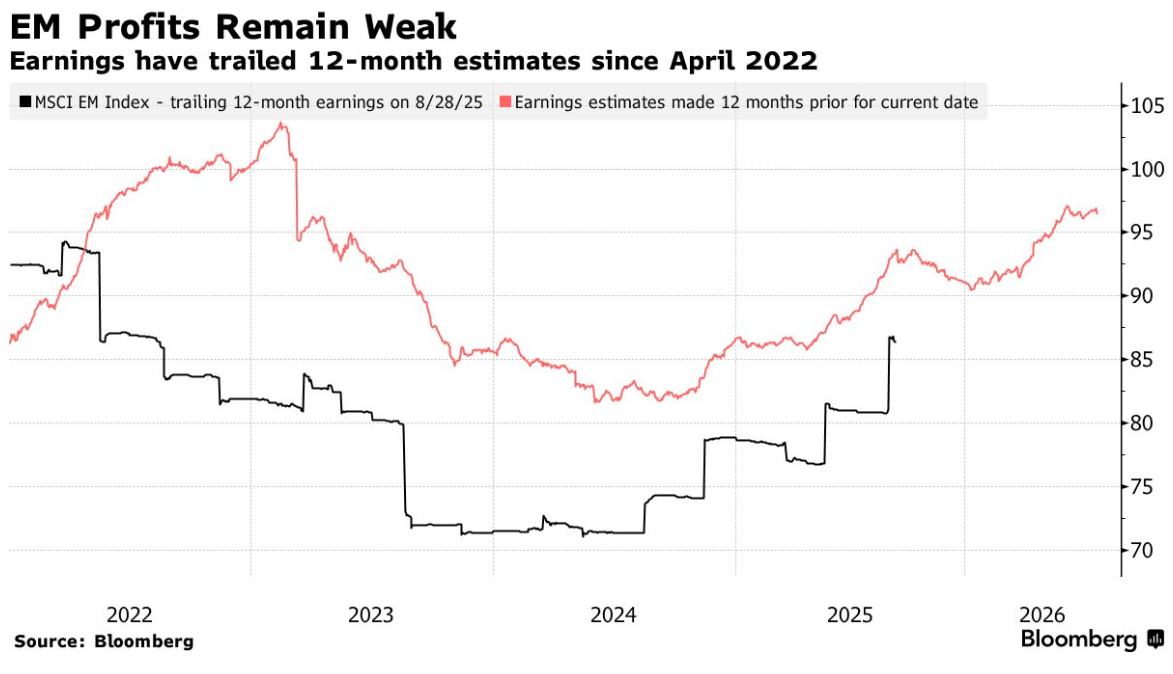
Group 1 - The beginning of Trump's second presidential term has positively impacted emerging market stocks, similar to his first term, but corporate earnings are under pressure due to trade and fiscal policies, potentially losing momentum [1] - The MSCI Emerging Markets Index has risen continuously from January to August this year, marking the third occurrence in 37 years, with the previous instances in 2017 and 1993 [1] - Despite a wealth increase of $4.3 trillion for investors this year, developing country companies are struggling to meet 2025 earnings expectations, having underperformed for 13 consecutive quarters [1][4] Group 2 - Concerns over tariff-related risks are leading to a cautious outlook on emerging market stocks, with expectations for earnings per share to decline again after a temporary pause in tariffs [2] - Initial expectations that Trump's tariffs would delay U.S. monetary easing and strengthen the dollar have been overturned, resulting in a favorable environment for emerging markets as funds flow out of the U.S. [4] - Nearly half of the companies in the MSCI Emerging Markets Index have failed to meet analyst profit expectations this year, with an average shortfall of nearly 8% [4] Group 3 - Following a 50% tariff on Indian exports, Indian stocks have become the most underweighted by investors, reflecting a significant shift in market sentiment [5] - Tata Motors reported a 63% decline in net profit, attributing the loss to U.S. tariffs, with additional costs estimated at $341 million [5] - Analysts have begun to lower future earnings forecasts, with the MSCI index's average expectation declining by about 1% over the past eight weeks, indicating a need for an 11.4% earnings growth in the next 12 months to meet current expectations [6]

新预测拉响警报:美国赤字危机愈演愈烈,特朗普政策是主因
Feng Huang Wang· 2025-08-20 08:26
Group 1 - The core viewpoint is that the U.S. federal budget deficit is projected to be nearly $1 trillion higher over the next decade than previously estimated by the Congressional Budget Office (CBO) due to tax and spending legislation and tariff policies [1] - The cumulative deficit from FY 2026 to FY 2035 is expected to reach $22.7 trillion, compared to the CBO's earlier estimate of $21.8 trillion [1] - The CBO will not release a mid-year budget update this year, instead opting to publish the next 10-year budget and economic outlook in early 2026 [1] Group 2 - The CRFB estimates that the "Big and Beautiful" legislation will increase the deficit by $4.6 trillion over the next decade, but this will be largely offset by $3.4 trillion in new tariff revenue from Trump's current tariff policies [2] - New regulations limiting Medicare subsidy eligibility are expected to reduce the deficit by an additional $100 billion by 2035, along with a potential $100 billion savings from the cancellation of funding for foreign aid and public broadcasting [2] - Net interest payments on U.S. debt are projected to total $14 trillion over the next decade, rising from nearly $1 trillion in 2025 (3.2% of GDP) to $1.8 trillion by 2035 (4.1% of GDP) [2] Group 3 - In a more pessimistic scenario, if the Court of International Trade upholds Trump's new tariffs, the expected tariff revenue could decrease by $2.4 trillion over the next decade [2] - The extension of temporary tax cuts in the "Big and Beautiful" legislation could increase the deficit by $1.7 trillion over ten years [3] - The CRFB warns that the debt-to-GDP ratio by 2035 could rise to 120% in the baseline scenario and 134% in a negative scenario, compared to the CBO's earlier estimate of 118% [3]
美国7月ADP就业人数增加10.4万人超预期 但雇主对招聘决策趋于谨慎
Hua Er Jie Jian Wen· 2025-07-30 14:35
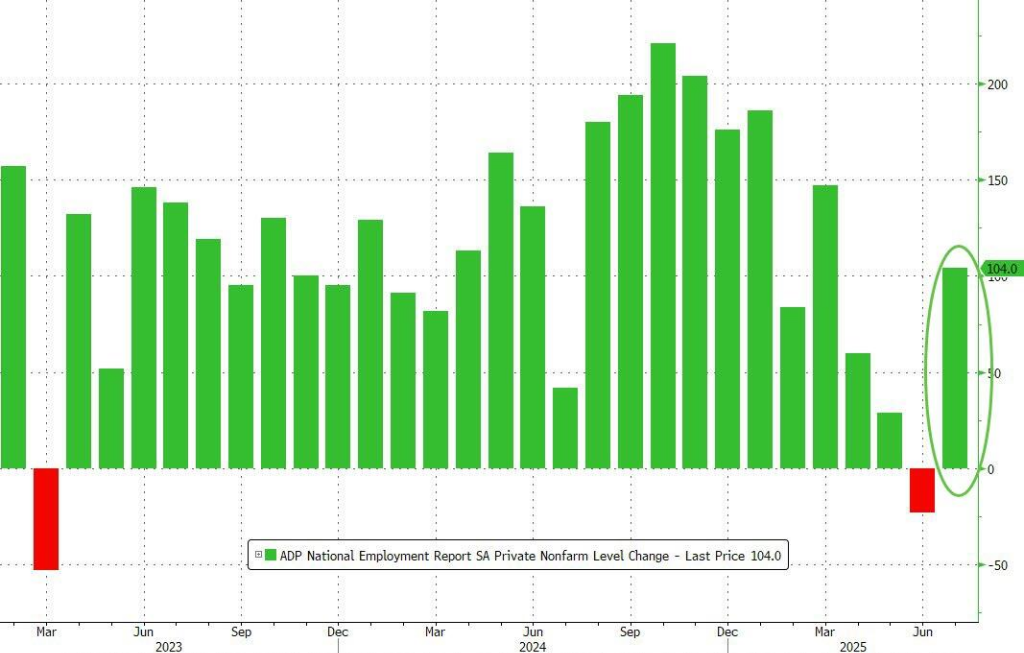
Group 1 - The core point of the article is that the U.S. private sector added 104,000 jobs in July, exceeding economists' expectations but still significantly lower than the average level from the previous year [1][3][8] - The job growth was primarily driven by a recovery in the service sector, with leisure, hospitality, and financial activities showing the most significant employment increases [4][8] - Despite the positive job growth, employers are becoming more cautious in hiring decisions due to increasing economic uncertainty surrounding Trump's policies [1][8] Group 2 - The ADP report indicates that the annual salary growth rate for employees remaining in the same position is at 4.4%, the lowest since May 2021, while job switchers experience a higher growth rate of 7.0% [7] - Initial claims for unemployment benefits remain low, but the duration for unemployed workers to find new jobs is increasing, indicating a potential slowdown in the labor market [5][8] - Following the data release, the U.S. dollar index rose by approximately 10 points, and U.S. stock futures showed minimal fluctuations, with the Nasdaq 100 futures maintaining a gain of about 0.2% [5][9]
罗思义:美元低迷就是总统执政失败,特朗普能否打破魔咒?
Sou Hu Cai Jing· 2025-07-29 00:46
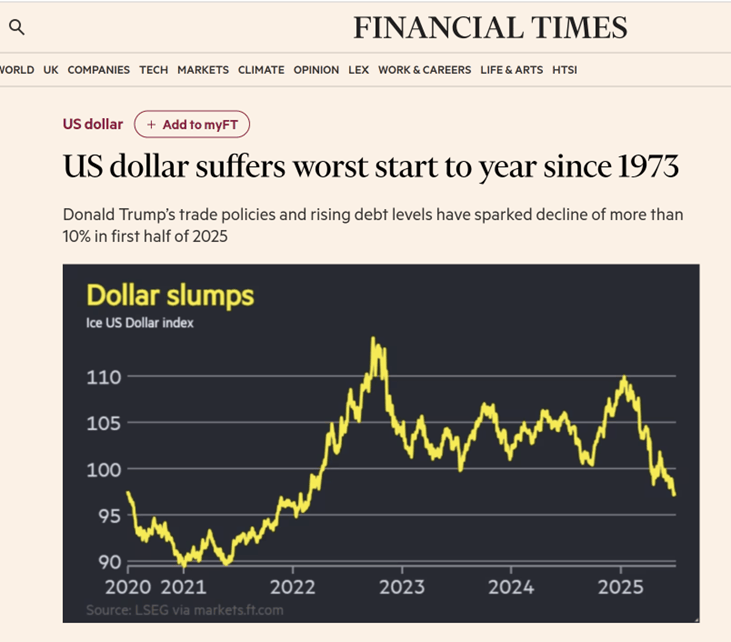
Group 1 - The core argument of the articles is that while Trump's tariff policies have led to some market volatility, the overall impact on the U.S. economy has been limited and within the normal range of economic fluctuations [1][3][4] - Analysts have differing views on the implications of Trump's policies, with some predicting significant economic turmoil while others argue that the changes are part of a normal economic cycle [3][4] - The success of Trump's economic policies hinges more on political factors rather than purely economic ones, as they aim to overturn decades of established trade policies [2][5] Group 2 - The analysis highlights that the S&P 500 index rose by 11.8% from April 1 to July 18, 2025, indicating a recovery and resilience in the market despite initial concerns [4] - The U.S. 10-year Treasury yield decreased from a peak of 4.61% on May 21 to 4.42% by July 18, suggesting a stabilization in the bond market [4] - The articles emphasize that while the tariff policies and a declining dollar may alter trade dynamics, they do not necessarily correlate with a significant downturn in U.S. economic growth [5][13] Group 3 - Trump's administration has seen the dollar experience its fastest decline since 1973, which is viewed as a strategic move to enhance U.S. competitiveness in global markets [6][10] - The combination of tariff measures and dollar depreciation has led to an estimated 25% increase in the average price of imported goods within six months [11][13] - The articles suggest that while the trade geography of the U.S. may change significantly, the overall economic slowdown is driven by different underlying economic forces [13]
黄金今日行情走势要点分析(2025.7.4)
Sou Hu Cai Jing· 2025-07-04 00:55
Group 1: Fundamental Analysis - The U.S. non-farm payroll data for June showed an addition of 147,000 jobs, significantly exceeding the market expectation of 110,000, while the unemployment rate decreased from 4.2% to 4.1%. However, the private sector job growth was only 74,000, marking the smallest increase since October 2024 [3][5] - The rise in the U.S. dollar and bond yields has diminished market expectations for an early interest rate cut by the Federal Reserve, thereby reducing the attractiveness of gold [4] - The Federal Reserve's benchmark interest rate remains at 4.25%-4.5%. The strong non-farm data and potential inflationary pressures from the Trump administration's new policies increase the likelihood of the Fed maintaining a cautious stance [5][6] - The Trump administration's large tax cuts and spending bill, projected to add $3.4 trillion to the national debt over the next decade, may exacerbate inflationary pressures, although the current strong dollar and rising bond yields are temporarily overshadowing this [6] Group 2: Technical Analysis - The daily chart indicates that the gold market experienced a bullish trend at the beginning of the week, followed by a bearish reversal on Thursday, resulting in a doji candle that suggests indecision in the market [8] - Key support levels to watch include 3319, which aligns with the 60-day moving average, and 3311, the previous low. Resistance levels are identified at 3345 and 3350, corresponding to the 30-day and 20-day moving averages [9] - On the four-hour chart, after a drop to 3247, a strong upward movement was observed, but the price faced resistance at 3365/3366, entering an adjustment phase. Key support levels are at 3307/3306 and 3293/3292, while resistance levels are at 3345, 3354, and 3365/3366 [11]