产业政策

Search documents
美国《外交事务》杂志:复兴工业,美国需要借鉴中国经验
Guan Cha Zhe Wang· 2025-07-03 08:48
Group 1 - The article emphasizes that the U.S. needs to adopt a unique industrial policy inspired by China's successful economic organization and mobilization strategies to compete effectively in manufacturing [1][2] - It highlights the long-standing perception of the U.S. as a major consumer and China as a major producer, with both countries now attempting to shift towards each other's roles [1] - The article points out that the U.S. faces a significant shortcoming in "scale," which hampers efficiency and productivity, suggesting that collaboration with allies is essential to address this issue [1][2] Group 2 - The article discusses China's remarkable achievements in electrification, particularly through the development of a comprehensive supply chain for electric vehicles, which includes investments in power infrastructure and advanced technologies [2][4] - It notes that China's vertical integration in manufacturing allows for rapid product iteration, cost reduction, and efficiency, resulting in significantly lower prices for solar panels compared to the U.S. and Europe [4][6] - The Chinese government's coordinated efforts in innovation and deployment have led to accelerated development cycles in energy technologies, exemplified by the swift commercialization of advanced nuclear reactors [6] Group 3 - The article highlights the importance of regional industrial clusters in China's manufacturing success, where companies benefit from shared resources and reduced transaction costs [7][9] - It provides an example of the Pearl River Delta, where government initiatives have attracted suppliers and manufacturers, leading to a concentration of high-value production [7] - The collaboration between local governments and electric vehicle manufacturers in cities like Hefei has resulted in the establishment of integrated supply chain ecosystems, drawing significant investments from global automakers [9]

为什么说中国经济的真正瓶颈,并非“消费不足”?
Hu Xiu· 2025-07-01 14:13
Group 1 - The concept of "consumption-driven" economic growth does not exist in the long term, as economic growth fundamentally relies on investment [2][3][5] - The relationship between consumption and investment is not a zero-sum game; rather, they complement each other in the long run [8][9] - China's consumption rate is often perceived as low, but data suggests it may actually exceed that of the United States when considering different consumption structures and price levels [13][15][16] Group 2 - The current measures to stimulate consumption need further research to assess their effectiveness, as the average final consumption rate in China has fluctuated around 54% over the past decade [24][26] - Infrastructure investment is proposed as a primary driver for economic growth, creating a virtuous cycle of income and consumption [30][31] - The government is encouraged to initiate large-scale infrastructure projects similar to the previous 4 trillion yuan stimulus plan to address economic challenges [36][37]
释放消费增长潜能 专家建议用足逆周期政策
Zhong Guo Xin Wen Wang· 2025-06-26 02:57
Group 1 - The core viewpoint of the articles is that the Chinese government is intensifying policies to boost consumption, as evidenced by the recent guidance from six departments aimed at stimulating and expanding consumer spending [1] - In the first five months of the year, retail sales of consumer goods increased by 5% year-on-year, with May seeing a notable growth of 6.4%, marking the highest monthly growth rate in 2024 [1] - The acceleration in consumption growth is primarily attributed to the "trade-in" policy, which has significantly boosted sales in furniture, communications, and home appliances, all showing growth rates exceeding 20% [1] Group 2 - Experts suggest that to further support consumption growth, it is essential to understand the underlying factors driving consumer behavior, which include GDP growth, primary and secondary distribution, and consumption propensity [1] - The most significant factor influencing consumer growth is GDP growth, while the effects of consumption propensity and distribution are comparatively less impactful [1] - Short-term policies should focus on utilizing counter-cyclical measures to enhance residents' income and expectations, thereby expanding consumption effectively [1] Group 3 - Recommendations for immediate policy actions include pilot programs to encourage childbirth, urban area development, and housing support for migrant workers, which could enhance the consumption propensity of certain demographics [2] - Long-term strategies to boost consumption involve improving social welfare and security levels, which are crucial for increasing consumption propensity over time [2] - Industrial policies aimed at unleashing the potential of the service sector are also highlighted as essential for increasing overall income growth and improving primary distribution, thereby supporting future consumption growth [2]
宏观经济周报(2025年6月16日-6月22日)
Sou Hu Cai Jing· 2025-06-23 18:43
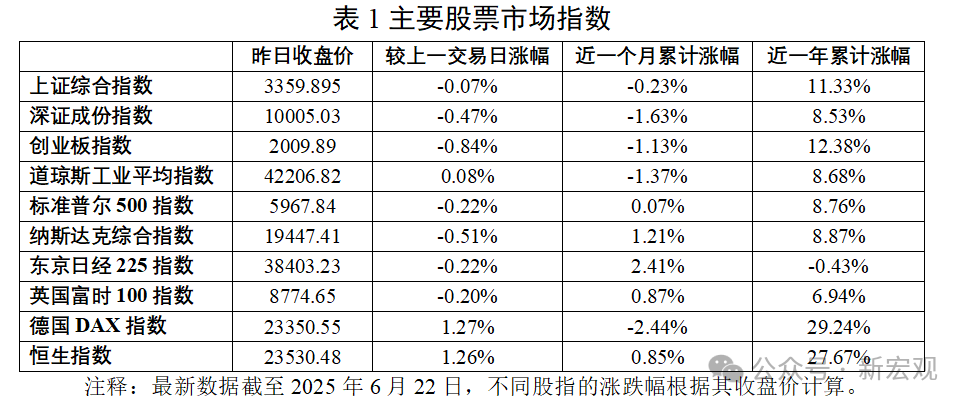
Group 1: Key Events - On June 16, the White House announced a trade agreement between the U.S. and the UK, which includes a quota of 100,000 vehicles per year for U.S. imports from the UK, with a 10% tariff rate [1] - On June 17, the Bank of Japan decided to maintain its policy interest rate at around 0.5% and slow down the pace of bond purchase reductions, currently reducing by approximately 400 billion yen per quarter [2] - On June 18, the Federal Reserve maintained the federal funds rate target range at 4.25% to 4.50%, marking the fourth consecutive meeting without a rate change, while lowering economic growth forecasts for the U.S. [1][2] Group 2: Economic Data - Japan's exports fell for the first time in eight months in May, with exports to the U.S. down 11.1% year-on-year to 1.51 trillion yen, driven by declines in automotive and automotive parts exports [5] - The ZEW Economic Sentiment Index for the Eurozone rose significantly to 35.3 in June, up from 11.6, with Germany's index increasing to 47.5 from 25.2 [5] - U.S. retail sales fell by 0.9% month-on-month in May, the largest decline since March 2023, primarily due to decreased automobile purchases [5] Group 3: Monetary Policy - The Bank of England decided to keep its key interest rate unchanged at 4.25%, citing weak GDP growth and a soft labor market [2] - The yield on 10-year U.S. Treasury bonds decreased by 0.9 basis points, while the yield on 10-year Japanese bonds fell by 1.6 basis points [10] Group 4: Commodity Prices - Brent crude oil prices fell by 3.76% to $75.78 per barrel, while WTI crude oil prices increased slightly by 0.28% to $74.04 per barrel [12] - The CRB Commodity Index decreased by 0.59%, while the Baltic Dry Index dropped by 3.54% [12]
唐程:用跨学科思维丈量世界的深度与广度丨毕业生代表发言
Sou Hu Cai Jing· 2025-06-23 16:07
Group 1 - The speaker emphasizes the importance of interdisciplinary perspectives, particularly the integration of mathematics, computer science, and economics in understanding complex economic phenomena [4][5]. - The speaker highlights practical experiences in rural revitalization and economic policy, showcasing real-world applications of economic theories [4]. - The research on a reinforcement learning algorithm tailored to different investor risk preferences illustrates the innovative intersection of investment studies and artificial intelligence [5]. Group 2 - The speaker expresses a commitment to continue research in economic game theory and computer science, indicating a focus on advancing knowledge in these fields [5]. - The graduation speech reflects on the value of diverse analytical tools and interdisciplinary approaches in addressing complex challenges and seizing development opportunities [5][6].

关税大降,又到AII IN美股了?
美股研究社· 2025-05-15 11:02
以下文章来源于海豚投研 ,作者海豚君 海豚投研 . 有灵魂的思考、有态度的研究。 来源 | 海豚投研 从4月2日的对等关税解放日到5月12日,经过一个多月的中美关税互相拉扯,5月12日,中美终于 给出了一个令人松口气的谈判结果——美国对中国征收30%的关税,另外24%暂缓90天执行;中 国对美国征收10%的关税,另外24%暂缓90天执行。 这个结果,无论是对中美双方如何,对于资本市场是一个显著的利好,但现在的问题是,是不是 说美股风险就可以消除了,美股能够继续疫情大放水后的辉煌时代,人们又可以ALL IN 美股了 吗? 这 下 , 所 有 人 都 赢 麻 了 ? 按照中美最新贸易谈判公告,等于一通互撕之后,双方都回到了4月2日,也就是解放日当天的关 税上,而2号之后互扔刀子的税率——50%、41%全都取消了。 围绕4月2日美国一键拉出的对华34%的对等关税,10%保留,剩下24%暂缓90天执行;中国也是 同样:保留10%的对美关税,其余24%暂缓90天执行。 4月2日之前,重新上任的特朗普,还以美国以芬太尼为由,对中国所有商品2、3月份连续两次加 征关税,每次加征10%,两次累计20%。 美 国 关 税 到 ...

4月CPI环比由降转升,政策合力有望利好部分领域价格
Hua Xia Shi Bao· 2025-05-10 12:37
Core Insights - In April, the Consumer Price Index (CPI) showed a month-on-month increase of 0.1%, reversing a previous decline of 0.4%, while the year-on-year CPI decreased by 0.1% [2] - The Producer Price Index (PPI) recorded a year-on-year decline of 2.7%, slightly better than market expectations, with a month-on-month decrease of 0.4% [2][4] CPI Analysis - The month-on-month CPI increase was primarily driven by a rebound in food and travel service prices, exceeding seasonal levels by 0.2 percentage points [2][4] - Year-on-year, energy prices fell by 4.8%, with gasoline prices dropping by 10.4%, contributing approximately 0.38 percentage points to the CPI decline [4][5] - Core CPI, excluding food and energy, rose by 0.5%, indicating stable inflation in essential goods [4][5] PPI Analysis - The PPI's month-on-month decline was influenced by international factors, particularly falling crude oil prices, which affected domestic oil-related industries [7] - The coal mining and processing sectors also saw a seasonal decline in prices, contributing to the overall PPI decrease [7] - Despite current pressures, there are expectations for a potential rebound in PPI due to targeted policies aimed at boosting demand in real estate and consumption [7][8] Policy Implications - The government is expected to maintain a loose monetary policy into 2025, with potential room for a 50 basis point reserve requirement ratio cut and a 20 basis point interest rate reduction [3] - Policies focusing on increasing income for low- and middle-income groups and promoting service consumption are anticipated to support stable price levels [6] - The ongoing implementation of macroeconomic policies is expected to enhance domestic demand, particularly in technology, consumption, and foreign trade sectors [6][8]
苏奎:美国商业造船业死亡之时,中国有明确的不在场证明
Sou Hu Cai Jing· 2025-05-07 02:36
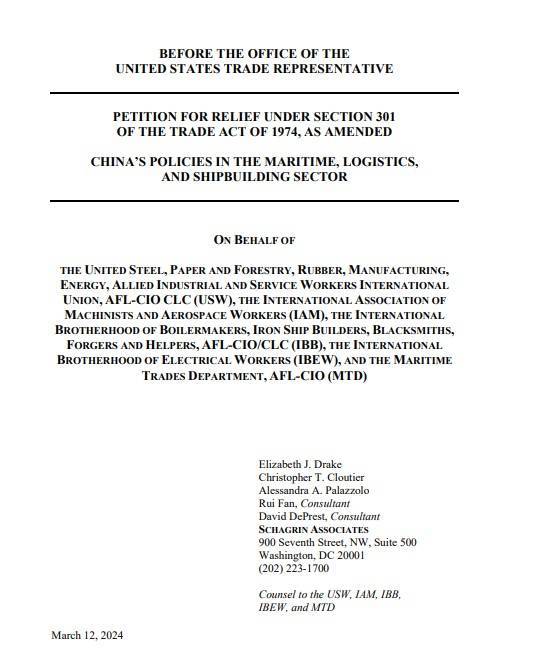
【文/观察者网专栏作者 苏奎】 近日,特朗普政府贸易代表办公室公布了针对中国船舶征收惩罚性费用的最终方案,尽管相比2月份拟议的方案已经明显放宽,但这仍然是国际贸易史上保 护主义的新高点,其政策之荒腔走板、横蛮无理,可以说是史无前例。 特别是此前对任何拥有或者预定了中国制造船舶的经营人,每次靠港最高可达150万美元收费提议,可以说是骇人听闻,也让世界再次见证了美国政客们的 丑恶嘴脸。 目前媒体和各方评论多聚焦于方案的影响和可能的发展方向,需要注意的是,方案的法律基础却是1月16日拜登政府贸易代表办公室公布的所谓301调查报 告。如果我们分析这份时间跨度了两届美国政府的调查报告以及引发调查的美国钢铁工会等的调查请愿书,更能看出美国两党政客们的绝望与仇恨,码头停 靠收费只是一次拙劣的栽赃陷害,这样没有道德底线的打击根本没有奏效的可能。 荒唐的指控 请愿书先是哀叹美国造船业辉煌不再,已经是虚有其表。二战后直到1975年,美国曾拥有全世界最大的造船能力,而仅仅过去了50年,美国商业船坞减少了 70%,失去了数万工作岗位,目前美国的年商业造船量相比世界新增总吨位已经是微不足道了(0.1%)。 请愿书还列举了一些数字,比较 ...
法媒:中国是成功产业政策教科书式的案例
Huan Qiu Wang Zi Xun· 2025-04-29 22:40
对中国电动汽车主导地位进行评估后,Strat的创始人柯努贝尔回顾了过去"时局紧张"的一年:欧洲针对 中国电动汽车展开调查,美国残酷地收紧贸易政策,导致整个汽车供应链成本的上升。在此背景下,柯 努贝尔认为"中国是个成功的产业政策教科书式案例"。 几十年来,中国一直遵循明确的产业战略:成为汽车领域的世界领军者。这一战略主要基于两大支柱: 价值链控制和外交适应能力。在价值链上,中国的领先地位是无可争议的——从关键原材料的精炼到电 池的制造,再到活性材料的生产,中国主导着电动汽车生产的几乎所有战略性阶段,并持续进行大量投 资。面对当前的贸易紧张局势,中国正调整应对措施,针对性地回应美国的制裁。对于欧洲,中方则采 取更为缓和的姿态。自今年春季以来,为缓和双边关系,中欧之间恢复了有关磋商。 来源:环球时报 法国"汽车信息网"4月28日文章,原题:中国是成功的产业政策教科书式的案例 由法国国家汽车行业委 员会率领的法国代表团近期访问上海,在此背景下,产业预测公司Strat主席雷米·柯努贝尔在上海的研 讨会上发表了这篇关于电动汽车领域的中国与欧洲的演讲。 面对中国崛起,欧洲正试图回应。尽管欧洲已启动人工智能超级工厂及电池产业 ...
“双标”的美国产业政策:类型、动因、效果及思考
清华金融评论· 2025-04-19 10:27
Core Viewpoint - The article discusses the contradictions and effects of the U.S. industrial policy, highlighting the dual standards in trade practices and the impact of domestic challenges on the competitiveness of U.S. manufacturing [2]. Group 1: Types and Mechanisms of U.S. Industrial Policy - U.S. industrial policy can be categorized into domestic supportive policies and foreign restrictive policies, aimed at enhancing domestic industry competitiveness and limiting foreign competition [5]. - Domestic supportive policies include fiscal and financial measures, government procurement, and innovation support, while foreign restrictive policies encompass investment restrictions and trade protection measures [5][4]. Group 2: Fiscal and Financial Policies - The Inflation Reduction Act plans to invest $391 billion in energy and climate initiatives from 2022 to 2031, with $234 billion allocated for tax credits and $157 billion for subsidies and loans [6]. - The CHIPS Act authorizes approximately $52 billion in subsidies and loan guarantees for semiconductor manufacturing and related research [6]. - U.S. government spending on industrial subsidies has increased from $45.8 billion in 2000 to $128 billion in 2022, maintaining around $100 billion annually thereafter [6]. Group 3: Government Procurement and Market Access Policies - The U.S. government prioritizes domestic procurement, mandating that at least $200 billion of federal purchases annually be for products with over 50% domestic content [13]. - The U.S. has pressured other countries to lower trade barriers and increase procurement of American goods, exemplified by agreements with Japan and China [14][13]. Group 4: Innovation Support Policies - Innovation support policies include funding for research and development in clean energy and technology, with significant investments outlined in the Infrastructure Investment and Jobs Act and the Inflation Reduction Act [16][18]. - The U.S. government has established various research centers to promote technological innovation, providing competitive funding to universities and companies [17]. Group 5: Infrastructure Investment Policies - The Infrastructure Investment and Jobs Act allocates nearly $100 billion for transportation infrastructure, while the Inflation Reduction Act invests approximately $30 billion in modernizing the electric grid [19][20]. - The Biden administration's broadband plan aims to invest $42.45 billion to enhance broadband access in underserved areas [19]. Group 6: Trade Protection Policies - The U.S. has implemented tariffs on imports based on national security and unfair trade practices, including a 25% tariff on steel and a 10% tariff on aluminum [24]. - The U.S. has historically pressured countries to agree to voluntary export restrictions, as seen in agreements with Japan in the 1980s [25]. Group 7: Technology Restriction Policies - The U.S. has placed several Chinese technology companies on an entity list, restricting their access to U.S. technology under the guise of national security [27]. - The CHIPS and Science Act prohibits semiconductor companies receiving U.S. subsidies from expanding operations in China for ten years [27]. Group 8: Implementation Motivations and Characteristics - The U.S. industrial policy aims to enhance competitiveness, ensure supply chain security, reduce income inequality, and maintain technological leadership [32][36]. - The federal government primarily drives these policies, with state and local governments playing a limited role [37]. Group 9: Effectiveness of U.S. Industrial Policies - Overall, U.S. industrial policies have seen varying degrees of success, particularly in innovation support, while trade protection measures have had limited effectiveness [39]. - Successful policies include innovation initiatives that have led to significant technological advancements and job creation [40][41].