反内卷

Search documents
去年全民航运客7.7亿人次,盈利65亿元
2 1 Shi Ji Jing Ji Bao Dao· 2026-01-06 13:35
Core Insights - The Chinese civil aviation industry achieved a profit of 6.5 billion yuan in 2025, marking a significant recovery after a previous loss, with a focus on improving operational efficiency and quality over mere growth [1][2][4] Group 1: Industry Performance - In 2025, the total transport turnover reached 1,640.8 billion ton-kilometers, with passenger transport volume at 770 million and cargo mail transport at 10.172 million tons, representing year-on-year growth of 10.5%, 5.5%, and 13.3% respectively [1] - International flights have recovered to over 90% of 2019 levels, with international passenger transport volume increasing by 21.6% [2] - The industry completed 1,455.1 million flight hours and 5.547 million flights, with a flight punctuality rate exceeding 90% and an average delay time reduced by 3.5 minutes [2] Group 2: Future Goals - For 2026, the industry aims to achieve a transport turnover of 1,750 billion ton-kilometers, passenger transport of 810 million, and cargo mail transport of 1.07 million tons, reflecting a growth target of only 5.2% [1][4] - The focus for this year is on high-quality development and structural reforms rather than aggressive growth, indicating a strategic shift in the industry [4][5] Group 3: Regulatory Changes - The civil aviation authority plans to revise regulations on public air transport and domestic route management to combat excessive competition and improve operational efficiency [5][6] - Measures will include establishing a passenger transport cost investigation method and a fare monitoring and early warning mechanism to address the issue of low-priced tickets affecting airline profitability [5][6] Group 4: Infrastructure and Development - Significant investments of 120 billion yuan were made in fixed assets, with several airport expansion projects completed and new routes established, including international connections to Latin America and the successful launch of the AG600 aircraft [2][3] - The establishment of a world-class aviation hub system is a key focus, with plans to implement ten international aviation hub initiatives and optimize airspace and resource allocation [6][7]
2026年大类资产配置展望:守正出奇,于结构分化中掘金
CMS· 2026-01-06 12:46
- The report discusses the construction of a "ROIC Model" for interest rate predictions. The model calculates the implied ROIC of the bond market and compares it with the equity market's ROIC to estimate the interest rate midpoint. The formula used is: $ ROIC = (Risk-free rate + Equity risk premium) × Equity proportion + (Risk-free rate + Credit risk premium) × Debt proportion $ Here, the risk-free rate is represented by the 30-year government bond yield, and the credit risk premium is derived from AAA corporate bond spreads. The model uses data from A-share listed companies (excluding financials) and large-scale industrial enterprises to calculate ROIC values. The results show a long-term downward trend in both equity and bond market ROICs, with equity ROIC consistently higher by an average of 50 basis points over the past decade[51][52][56] - The "Multi-cycle Interest Rate Timing Strategy" is introduced, which employs kernel regression algorithms to identify support and resistance levels in interest rate trends. This strategy is applied to 5-year, 10-year, and 30-year government bond yields. The annualized returns for the strategy are 2.19%, 2.48%, and 3.26%, respectively, with maximum drawdowns of 0.72%, 0.97%, and 1.71%. The strategy demonstrates stable performance, with probabilities of achieving positive absolute and excess returns close to 100% since 2008[75][77][81] - A "Pure Bond CARRY Strategy" is also highlighted, which leverages dynamic leverage to enhance returns. The strategy allocates 140% to bonds when borrowing costs (R007) are below the 80th percentile of historical levels and 100% otherwise. Over the past decade, the strategy has delivered an annualized return of 5.56%, with a return-to-drawdown ratio of 0.92. In 2023-2025, the strategy achieved annual returns of 7.21%, 7.39%, and 2.25%, respectively, with excess returns of 84 basis points, 121 basis points, and 21 basis points[83][84][88] - The "Momentum and Fundamental Composite Factor" is used for sector rotation strategies. This factor combines "Net Profit Growth Rate (QoQ)" and "ROA TTM Growth Rate (QoQ)" to rank industries. Historical backtests from 2008 to 2025 show strong performance, with an average annualized return of 18.60% and an excess return of 8.49% over the benchmark. In 2025, industries such as electronics, computers, media, defense, non-ferrous metals, and new energy equipment ranked high in both valuation and fundamental improvement metrics, making them recommended sectors for Q1 2026[45][46][47] - The "PB-ROE Framework" is applied to identify undervalued industries. By comparing the PB and ROE levels of various sectors as of December 31, 2025, industries like non-bank financials, home appliances, agriculture, basic chemicals, and light manufacturing are identified as having relatively low PB but high ROE expectations. These sectors are considered undervalued and are recommended for investment in 2026[48][49][50]
今明两年年均上涨15%至20%!高盛高呼:超配中国股票
华尔街见闻· 2026-01-06 11:49
Core Viewpoint - Goldman Sachs' strategist team has issued a strong bullish signal for Chinese assets, recommending investors to "overweight" Chinese stocks, predicting a robust bull market in 2026 and 2027 driven by corporate profit growth and valuation recovery, with an expected annual increase of 15% to 20% [1][3]. Group 1: Profit Recovery and Valuation Reassessment - The core viewpoint of Goldman Sachs is based on expectations of substantial improvement in corporate fundamentals, with profit growth rates projected at 14% and 12% for 2026 and 2027 respectively, alongside an anticipated 10% valuation uplift [3][4]. - Key factors driving profit acceleration include the widespread application of AI technology, the trend of Chinese companies "going global," and policy measures aimed at curbing disorderly competition, referred to as "anti-involution" actions [3][4]. - Goldman Sachs emphasizes that the current valuation levels of Chinese markets do not fully reflect their growth potential, suggesting that improved investor sentiment and capital reallocation will lead to significant valuation reassessment [4]. Group 2: Export Structure Optimization and "Going Global" Dividend - Despite a complex external trade environment, Goldman Sachs remains optimistic about the competitiveness of China's export sector, which is a crucial rationale for its positive outlook on Chinese listed companies [6]. - The report highlights that Chinese exporters have successfully diversified their markets, with emerging markets becoming significant growth points, and the shift from simple product exports to globalized layouts, including increased exports of intermediate and capital goods [6][7]. - It is projected that export volumes will maintain an annual growth rate of 5-6% in the coming years, providing direct performance support for related listed companies [7]. Group 3: Policy Easing and Liquidity Environment - Goldman Sachs anticipates a relatively loose monetary policy environment in China, which will benefit stock market performance, predicting two 10 basis point cuts in policy interest rates by the central bank in 2026 [9]. - The report forecasts that the central bank will maintain ample interbank liquidity to support economic growth and government bond issuance, leading to a decline in short-term interest rates, with the 7-day reverse repo rate expected to drop from 1.4% to around 1.2% by the end of 2026 [9]. - The expansionary fiscal policy, with an anticipated increase in the broad fiscal deficit, will also provide support for the real economy and market sentiment [9]. Group 4: Attractiveness of Renminbi Assets and Currency Appreciation - Beyond the potential for stock market gains, currency factors may provide additional returns for foreign investors holding Chinese assets, with the Renminbi currently undervalued by approximately 25% against the US dollar [10][12]. - The report predicts that the Renminbi will gradually appreciate to 6.85 against the US dollar within the next 12 months, supported by strong export growth and trade surpluses, with China's goods trade surplus expected to expand to $1.4 trillion by 2026 [10][12]. - An increase in the current account surplus, easing US-China trade tensions, and policy support for the internationalization of the Renminbi will further bolster the currency's strength, enhancing total returns for international investors denominated in US dollars [12].



民航局今年要整治过低票价
Di Yi Cai Jing· 2026-01-06 11:13
Core Insights - The civil aviation industry is projected to achieve a profit of 6.5 billion yuan in 2025, building on a turnaround in 2024, with improved operational efficiency and growth in passenger and cargo volumes [2][3] Group 1: Financial Performance - The civil aviation sector suffered a cumulative loss of nearly 400 billion yuan during the three years of the COVID-19 pandemic, with 2023 still showing losses exceeding any year prior to the pandemic [3] - In 2025, the industry is expected to complete a total transport turnover of 1,640.8 billion ton-kilometers, with passenger transport reaching 770 million and cargo volume at 10.172 million tons, representing year-on-year growth of 10.5%, 5.5%, and 13.3% respectively [3] - Despite the overall profit of 6.5 billion yuan in 2025, not all airlines and airports are expected to be profitable, particularly as the industry enters its traditional off-peak season in the fourth quarter [4] Group 2: Market Dynamics - The growth rate of passenger transport volume in 2025 is expected to decline compared to 2024, where passenger and cargo volumes grew by 17.9% and 22.1% respectively [4] - The Civil Aviation Administration of China (CAAC) has noted that while the industry is growing, many airlines are engaging in "price wars" to gain market share, leading to reduced profitability [5][6] Group 3: Regulatory Measures - The CAAC has emphasized the need for stronger price monitoring and regulation to maintain market order, addressing the issue of excessive low pricing by airlines [6] - In 2026, the CAAC plans to develop a passenger transport cost investigation method and establish a price monitoring and early warning mechanism to prevent unhealthy competition [6] Group 4: Domestic Production and Innovation - The term "domestic production" has been frequently mentioned, focusing on the development of domestic aircraft and components, with significant advancements in the C919 and C909 aircraft models [7] - By 2025, the domestic aircraft fleet is expected to include 220 domestically produced planes, with a core communication navigation system achieving 96% domestic production [7]

民航2025年盈利65亿元,今年整治“过低票价”要动真格
Di Yi Cai Jing· 2026-01-06 10:10
Core Insights - The Civil Aviation Administration of China (CAAC) anticipates further growth in passenger volume for 2026, along with more practical regulatory measures to combat "involution" in the industry [1][3]. Financial Performance - The civil aviation sector achieved a profit of 6.5 billion yuan in 2025, building on a turnaround from losses in 2024, indicating improved operational efficiency [2][4]. - In 2025, the industry recorded a total transport turnover of 1,640.8 billion ton-kilometers, with passenger transport reaching 770 million people and cargo/mail transport at 10.172 million tons, representing year-on-year growth of 10.5%, 5.5%, and 13.3% respectively [4]. Passenger and Cargo Trends - The growth rate of passenger throughput in 2025 was lower compared to 2024, where passenger and cargo transport increased by 17.9% and 22.1% respectively [5]. - For 2026, the CAAC aims for a total transport turnover of 1,750 billion ton-kilometers, with passenger transport projected at 810 million people and cargo/mail transport at 1.07 million tons, indicating a further decline in growth rate compared to 2025 [5]. Market Competition and Regulation - The CAAC has noted that the industry has been experiencing "involution," characterized by airlines adopting aggressive pricing strategies, leading to a decline in average ticket prices [6]. - In response, the CAAC plans to enhance price monitoring and supervision, requiring airlines to strengthen price self-discipline and stabilize pricing levels [6][7]. - The CAAC is collecting data from airlines to assess cost structures on various routes to prevent predatory pricing below cost [8]. Domestic Production and Innovation - The focus on "domestic production" includes advancements in domestic aircraft and components, with the C919 aircraft surpassing 4 million passengers in 2025 and expanding into international markets [9]. - During the "14th Five-Year Plan," the domestic aircraft fleet is expected to reach 220 units, with a target of 96% domestic production for key air traffic control equipment [9]. - The CAAC aims to promote the optimization and certification of key models like the C919 and C909, enhancing the international market presence of domestic aviation products [9].
瑞达期货PVC产业日报-20260106
Rui Da Qi Huo· 2026-01-06 08:51
1. Report Industry Investment Rating - No relevant information provided 2. Core Viewpoints of the Report - The macro sentiment is positive, and industrial products mainly rose during the day. V2605 rose 3.38% to close at 4,919 yuan/ton. Recently, the production facilities of Hanwha Ningbo and Xinpu Chemical restarted, leading to a sequential increase in PVC capacity utilization. However, the operating rate of downstream PVC products decreased sequentially, including those of pipes and profiles. The social inventory of PVC has slightly accumulated at a high level. The costs of calcium carbide-based and ethylene-based processes have declined, and the profits have slightly recovered. The impact of the maintenance of chlor-alkali plants in January is seasonally weak, with few existing maintenance plans, so the industry's operating rate is expected to remain at a relatively high level. The terminal real estate and infrastructure are in the low-season, and the operating rates of hard products such as pipes and profiles may continue to decline. The overseas market is highly competitive, and exports have limited boosting effects. The market is trading on the expectations of "anti-involution" and incremental policies in 2026, resulting in a valuation repair of the PVC futures, with the spot price at a discount to the main contract. Amid the game between weak reality and strong expectations, the PVC futures are expected to fluctuate widely, with the daily range estimated to be around 4,720 - 5,000 [2]. 3. Summary by Relevant Catalogs 3.1 Futures Market - The closing price of PVC futures was 4,919 yuan/ton, a sequential increase of 155 yuan/ton; the trading volume was 1,740,594 lots, a sequential increase of 970,429 lots; and the open interest was 1,026,198 lots, a sequential increase of 68,221 lots. The long positions of the top 20 futures holders were 985,727 lots; the short positions were 1,064,508 lots, a sequential increase of 57,356 lots; and the net long positions were -78,781 lots, a sequential increase of 1,492 lots [3]. 3.2现货市场 - In the East China region, the price of ethylene-based PVC was 4,600 yuan/ton, unchanged; the price of calcium carbide-based PVC was 4,492.69 yuan/ton, a sequential decrease of 13.08 yuan/ton. In the South China region, the price of ethylene-based PVC was 4,700 yuan/ton, unchanged; the price of calcium carbide-based PVC was 4,543.75 yuan/ton, a sequential decrease of 19.38 yuan/ton. The CIF price of PVC in China was 640 US dollars/ton, unchanged; the CIF price in Southeast Asia was 600 US dollars/ton, unchanged; and the FOB price in Northwest Europe was 660 US dollars/ton, unchanged. The basis of PVC was -319 yuan/ton, a sequential decrease of 55 yuan/ton [3]. 3.3 Upstream Situation - The mainstream average price of calcium carbide in Central China was 2,700 yuan/ton, unchanged; in North China, it was 2,606.67 yuan/ton, unchanged; and in Northwest China, it was 2,415 yuan/ton, unchanged. The mainstream price of liquid chlorine in Inner Mongolia was -150 yuan/ton, unchanged. The CFR mid - price of VCM in the Far East was 407 US dollars/ton, unchanged; in Southeast Asia, it was 448 US dollars/ton, unchanged. The CFR mid - price of EDC in the Far East was 189 US dollars/ton, unchanged; in Southeast Asia, it was 194 US dollars/ton, unchanged [3]. 3.4 Industry Situation - The operating rate of PVC was 78.63%, a sequential increase of 1.4%; the operating rate of calcium carbide - based PVC was 78.36%, a sequential decrease of 0.13%; and the operating rate of ethylene - based PVC was 79.29%, a sequential increase of 5.01%. The total social inventory of PVC was 52.52 tons, a sequential increase of 1.14 tons; the total social inventory in the East China region was 48.06 tons, a sequential increase of 1.15 tons; and the total social inventory in the South China region was 4.46 tons, a sequential decrease of 0.01 tons [3]. 3.5 Downstream Situation - The National Housing Climate Index was 91.9, a sequential decrease of 0.53. The cumulative value of newly started housing area was 53,456.7 million square meters, a sequential increase of 4,395.31 million square meters. The cumulative value of real estate construction area was 656,066.2 million square meters, a sequential increase of 3,127.17 million square meters. The cumulative value of real estate development investment was 420.2457 billion yuan, a sequential increase of 30.416 billion yuan [3]. 3.6 Option Market - The 20 - day historical volatility of PVC was 22.76%, a sequential increase of 0.08%; the 40 - day historical volatility was 17.31%, a sequential increase of 0.11%. The implied volatility of at - the - money put options was 17.09%, a sequential decrease of 0.58%; the implied volatility of at - the - money call options was 17.1%, a sequential decrease of 0.57% [3]. 3.7 Industry News - From December 27 to January 2, the operating rate of PVC plants increased by 1.4% sequentially to 78.63%. From December 27 to January 2, the operating rate of PVC downstream decreased by 0.58% sequentially to 43.94%, among which the operating rate of pipes decreased by 0.6% sequentially to 35.6%, and the operating rate of profiles decreased by 0.79% sequentially to 29.78%. As of January 2, the social inventory of PVC was 107.67 tons, a sequential increase of 1.46% [2]. 3.8 Cost and Profit - As of January 2, the weekly cost of calcium carbide - based PVC was 5,011.17 yuan/ton, a sequential decrease of 0.14%; the weekly cost of ethylene - based PVC was 5,008.38 yuan/ton, a sequential decrease of 0.57%. The profit of calcium carbide - based PVC increased by 46.74 yuan/ton sequentially to - 713.56 yuan/ton; the profit of ethylene - based PVC increased by 56.36 yuan/ton sequentially to - 279.49 yuan/ton [2].

长城汽车员工喜提周末双休,打响“反内卷”第一枪
Jin Rong Jie· 2026-01-06 08:26
| 2026年日历 | 1月 | February | March | 2月 | January | April | | | | | | | | | | | | | | | | | | | | | | | | | | | | | | | | | | | | | | | | | | | | | | | | | | | | | --- | --- | --- | --- | --- | --- | --- | --- | --- | --- | --- | --- | --- | --- | --- | --- | --- | --- | --- | --- | --- | --- | --- | --- | --- | --- | --- | --- | --- | --- | --- | --- | --- | --- | --- | --- | --- | --- | --- | --- | --- | --- | --- | --- | --- | --- | --- | --- | --- | --- | --- | --- | --- | --- | --- | --- | --- | --- | | ...


“反内卷”大幕拉开,盛虹困局难解:大炼化行业出清之年,高杠杆企业如何突围?
Guan Cha Zhe Wang· 2026-01-06 08:01
Core Viewpoint - The "anti-involution" strategy has become a clear guiding principle for China's economic policy, particularly impacting the manufacturing sector, especially in the overcapacity and fiercely competitive basic chemical industry [1] Group 1: Industry Context - The large refining sector exemplifies "involution," with years of capacity expansion leading to severe competition in PTA and polyester segments [1] - The Ministry of Industry and Information Technology convened leading companies in October 2025 to discuss capacity, production, and anti-involution measures, marking a shift from "scale competition" to "high-quality development" [1] Group 2: Company Overview - Dongfang Shenghong's rapid expansion through aggressive acquisitions has created a super-integrated platform covering oil, coal, and gas, resulting in a peak net profit of over 4.5 billion yuan in 2021 [2] - However, the company's strategy of broad diversification during a period of industry capacity release has led to significant financial strain, with a net profit loss of nearly 2.3 billion yuan in 2024, a decline of over 420% year-on-year [3] Group 3: Financial Challenges - By the end of Q3 2025, the company's total liabilities exceeded 175 billion yuan, with a debt-to-asset ratio of 82.17%, significantly higher than industry averages [4] - The company's cash flow from operating activities was negative 2.692 billion yuan in Q1 2025, indicating an inability to cover operational and debt repayment needs [4] Group 4: Future Outlook - The year 2026 is anticipated to be critical for the large refining industry, with policies expected to focus on eliminating outdated capacity and encouraging technological upgrades [5] - The competitive landscape will shift from rapid construction and scale to efficiency, cost-effectiveness, and technological strength, potentially squeezing the survival space for companies with high financial risk like Dongfang Shenghong [5] - The company must balance debt reduction and strategic transformation, facing significant uncertainty in enhancing asset utilization and product structure to withstand cyclical pressures [5][6]

2026年银行业投资策略:净息差周期拐点与银行业资产配置价值重估
HUAXI Securities· 2026-01-06 07:50
Group 1 - The banking sector is expected to see a stabilization in net interest margins in 2026, driven by a peak in deposit re-pricing and a favorable loan rate environment [6][70][75] - The overall banking index increased by 7% in 2025, with H-shares and state-owned banks leading the gains, although the banking index underperformed the Shanghai Composite Index by 11 percentage points [3][10][12] - Insurance capital has significantly increased its allocation to bank stocks, with a net increase of approximately 570 billion yuan in 2025, indicating strong future demand for bank equities [4][23][26] Group 2 - The growth of interest-earning assets is a key stabilizer for bank performance, contributing to an 8%-11% increase in earnings, while the negative impact of interest margins has been narrowing [5][45] - The profitability of banks is improving, with a notable recovery in fee income and investment returns, which have become significant growth drivers [41][45] - The performance of city commercial banks and state-owned banks has been particularly strong, with city commercial banks showing the highest profit growth due to reduced credit impairment provisions [48][49] Group 3 - The report highlights a favorable outlook for bank stock investments, focusing on high dividend yields and growth potential, with specific banks like Shanghai Pudong Development Bank and China Merchants Bank identified as beneficiaries [7] - Regulatory policies are evolving to enhance risk management and promote digital finance, which is expected to support the banking sector's stability and growth [51][54] - The macroeconomic environment is characterized by a weak recovery, with credit growth expected to slow down, impacting overall banking performance [6][63]




快递2025:谁在股价狂欢,谁在利润挣扎?
3 6 Ke· 2026-01-06 05:13
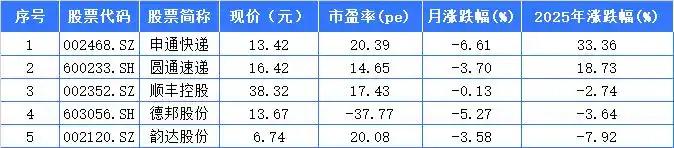
Group 1 - In 2025, the express delivery industry in China experienced significant stock price fluctuations, with Shentong Express leading the A-share market with a 33.36% increase, followed by YTO Express at 18.73%, and Jitu Express achieving a remarkable 70% increase in H-shares [1][3] - The overall express delivery business volume in China surpassed 180 billion packages by November 30, 2025, reflecting strong market vitality and economic growth [13] - Major listed express companies reported substantial growth in business volume, with SF Express exceeding 10 billion packages for the first time, Jitu surpassing 15 billion, YTO exceeding 20 billion, and Zhongtong surpassing 25 billion [14] Group 2 - The express delivery industry is shifting from a focus on price competition to a value-driven approach, emphasizing quality and digital transformation [3][4] - The National Postal Administration held discussions to address "involution" in the industry, promoting high-quality development and raising the minimum price for express services [5][7] - Companies are increasingly investing in automation and smart logistics, with major players like JD Logistics and SF Express developing advanced technologies to enhance efficiency and service quality [10][12] Group 3 - Revenue growth among major express companies varied, with SF Express reporting a revenue of 225.26 billion yuan, a year-on-year increase of 8.89%, while Shentong achieved 38.57 billion yuan, up 15.17% [15][17] - Despite overall revenue growth, profit margins are under pressure due to rising costs and intense competition, highlighting the need for improved operational efficiency [18][20] - The competitive landscape is expected to evolve, with a greater emphasis on service quality, supply chain solutions, and technological capabilities in the coming years [20]