
供给侧改革

Search documents
2025年夏季行业比较投资展望:PB-ROE双低反转策略
Shenwan Hongyuan Securities· 2025-06-09 12:47
Investment Rating - The report suggests a focus on industries with low PB-ROE ratios, particularly financials, computing, defense, pharmaceuticals, and electrical equipment, indicating a potential for undervalued reversals [4][5]. Core Insights - Since April 2025, global trade tariff conflicts have led to significant volatility in capital markets, with markets in Japan, Germany, and the US rising by 5-10% compared to pre-tariff levels, while Chinese asset prices have slightly declined [3][4]. - The report emphasizes the importance of performance benchmarks for public funds, highlighting that financials, dividends, and computing are major underweight sectors [3][4]. - The report identifies a calendar effect where certain sectors like electronics and military are expected to yield higher absolute returns in June and July [3][4]. Summary by Sections Industry Rotation Review and Outlook - Consumer, pharmaceutical, banking, and dividend assets have shown superior performance [12]. Fund Analysis - New regulations for public funds stress the significance of performance benchmarks, with financials, dividends, and computing being the main underweight sectors [3][4]. Market Trading Characteristics - Assets that have seen declines for four consecutive years, such as pharmaceuticals and certain consumer goods, are beginning to stabilize, while real estate and liquor sectors have yet to show improvement [3][4]. Economic Conditions, Valuation, and Capital Chips - The current PB-ROE framework favors industries poised for undervalued reversals, including financials, computing, defense, pharmaceuticals, and electrical equipment [4][5]. Industry Policies - The report discusses ongoing policies aimed at stabilizing capital markets, boosting consumption, and addressing internal competition, with a focus on new productivity [4][5]. 2025 Industry Allocation - The report provides a detailed allocation table for the second half of 2025, indicating sectors with potential for absolute returns [12].

调研反馈:山东市场透露哪些猪鸡行业信号?
2025-06-09 01:42
Summary of Key Points from Conference Call Industry Overview - The conference call primarily discusses the **pig and chicken farming industry** in China, with a focus on the **Shandong market** and the **white feather chicken sector** [1][2][5]. Core Insights and Arguments - **Supply-Side Reform in Pig Farming**: The pig farming sector is expected to undergo supply-side reforms, with significant impacts from weight management and changes in sow productivity on capacity reduction. Companies with a mother pig system and cost advantages in piglets are likely to have long-term advantages [1][2]. - **Valuation Levels**: Current valuations of listed companies in the pig farming sector are at historical lows, presenting opportunities for forward-looking capacity layout [1][2]. - **Focus on Key Companies**: Companies such as **Triangle Agriculture**, **DeKang**, **Shennong**, and **Juxing** in the Southwest region are highlighted for their cost control capabilities. **Wens Foodstuff Group** is also noted as a leading company with excellent cost management [1][4]. - **White Feather Chicken Industry Variables**: The core variable affecting the white feather chicken industry is the import situation from France. A reduction in the import volume of French breeding chickens could lead to a supply contraction starting from the upstream [1][5]. - **Slaughter Volume Trends**: The Linyi region in Shandong is leading in slaughter volume, with a significant increase in the number of pigs raised under a free-range model. The average complete cost for different farming tiers ranges from 12.5 to 14 yuan per kilogram [1][6][8]. Additional Important Insights - **Cost Structures**: The complete cost for first-tier self-breeding farms is approximately 6.2 to 6.5 yuan per kilogram, while second-tier farms face higher costs due to elevated piglet prices [8][9]. - **Market Demand and Supply**: The slaughterhouses anticipate challenges in reaching a slaughter volume of 300,000 heads this year, with terminal market demand not meeting expectations. This has led to a shift from fresh sales to frozen inventory [12][13]. - **Price Predictions**: The pig price is expected to face significant pressure in Q3 2025, potentially dropping to cost levels, with a slight rebound anticipated in Q4 [2][26]. - **Impact of Policies**: Recent government policies aim to control production capacity by not increasing the number of sows and reducing average slaughter weights, indicating a strong official stance on capacity management [25]. Future Outlook - **White Feather Chicken Sector**: The future of the white feather chicken sector appears promising, with increasing willingness for capacity reduction and uncertainties in overseas breeding imports. There is a need to focus on domestic breeding opportunities [24]. - **Market Dynamics**: The overall market for chicken meat remains stable but low due to an oversupply and weak demand, with expectations for price fluctuations based on seasonal demand [22][18]. This summary encapsulates the critical insights and trends discussed in the conference call, providing a comprehensive overview of the current state and future outlook of the pig and chicken farming industries in China.
2025年中期宏观经济展望:星火燎原
Shenwan Hongyuan Securities· 2025-06-08 15:21
Group 1: Economic Transformation and Challenges - Since 2022, the economic transformation has entered a "new stage," with traditional sectors like real estate showing a downward trend in contribution, with growth rates dropping from 4% to below 2%[18] - The pressure is increasingly focused on terminal demand, leading to a decline in PPI and weaker CPI performance, with midstream and downstream capacity utilization rates at 73.6% and 73.5%, respectively, lower than upstream at 79%[23] - The real estate sector's contribution to the economy has significantly decreased, with the housing price index in first, second, and third-tier cities dropping by 10.0%, 16.5%, and 18.7% from their peaks, respectively[31] Group 2: Policy Innovations and Structural Reforms - A comprehensive policy innovation has been initiated since late September 2024, focusing on supply-side structural reforms and enhancing the effectiveness of macroeconomic policies[40] - The fiscal deficit rate is projected to exceed 3% for the first time, reaching 4% in 2025, indicating a significant shift in fiscal policy[40] - The issuance of special refinancing bonds has exceeded 1.6 trillion yuan, emphasizing the government's commitment to addressing corporate debt issues[40] Group 3: Industry Evolution and Consumer Behavior - High-tech industries have seen their value-added share rise to 16.3%, with the digital economy's core industry value-added accounting for approximately 10% of GDP, nearing the real estate sector's 14%[44] - Consumer confidence is showing signs of recovery, with indicators of short-term travel intentions improving, reflecting a shift towards service-oriented consumption[49] - The service sector is expected to absorb structural employment pressures, with significant support needed to address supply shortages in this area[7]
特朗普“致命药方”,恐将亲手埋葬美元霸权
凤凰网财经· 2025-06-06 13:01
Core Viewpoint - Former U.S. Treasury Secretary Lawrence Summers warns that the "Big and Beautiful" plan promoted by the Trump administration is pushing the U.S. towards a fiscal cliff, potentially undermining the dollar's dominance and reshaping the global economic order [1][2] Group 1: Fiscal Implications - The Congressional Budget Office (CBO) estimates that the plan will add $2.4 trillion to the deficit over the next decade, but Summers' dynamic modeling suggests the actual debt increase could exceed $4 trillion when accounting for temporary tax measure extensions and interest effects [1] - Annual fiscal deficit rates are projected to exceed 7% of GDP, surpassing the dangerous threshold of 6% observed in recent years [1] Group 2: Contributing Factors - The aging population is expected to increase welfare spending significantly, with Social Security funds projected to be depleted by 2029 [1] - Government healthcare spending is growing at twice the rate of economic growth, potentially reaching 20% of GDP by 2025 [1] - Rising interest rates, with 30-year U.S. Treasury yields exceeding 5%, have led to debt servicing costs surpassing military expenditures [1] Group 3: Global Economic Concerns - As the largest debtor nation, the U.S. faces a monetary dilemma of maintaining the dollar's reserve status while issuing massive amounts of debt to cover deficits [2] - If U.S. debt surpasses $40 trillion, international confidence in the dollar may falter, leading to rapid selling of U.S. bonds by central banks [2] - The Trump economic team believes a 3.5% GDP growth rate combined with 10% tariff revenue can resolve the debt crisis, but models indicate that tariffs could raise core PCE inflation by 1.2 percentage points [2] Group 4: Policy Recommendations - Summers supports the proposal to eliminate the debt ceiling but emphasizes that restoring fiscal discipline requires tax reform, including closing loopholes for multinational corporations and implementing a digital services tax [2] - The upcoming Senate vote on the plan has prompted global central banks to initiate emergency measures, indicating the high stakes involved in maintaining dollar supremacy [2]


全球及中国金属材料检测服务行业研究及十五五规划分析报告
QYResearch· 2025-06-05 09:58
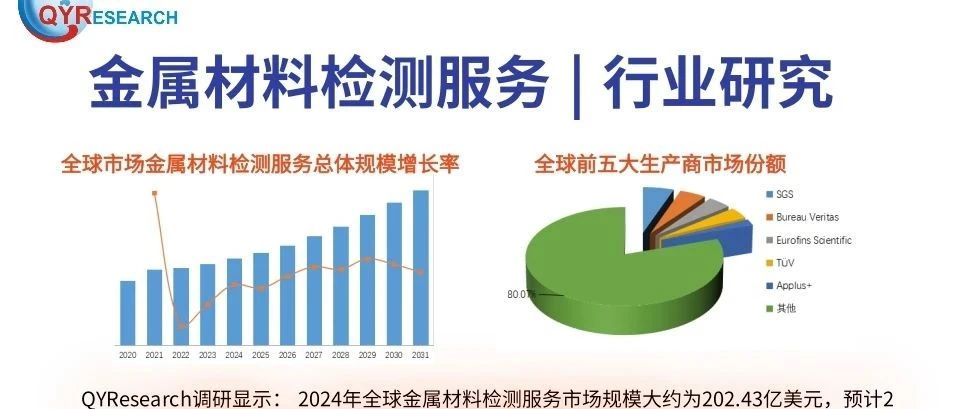
Core Viewpoint - The metal materials testing service industry is experiencing significant growth driven by technological advancements, increasing quality demands, and evolving regulatory standards, particularly in China and the Asia-Pacific region [3][4][7]. Industry Development Status and Market Outlook - The development history of China's testing industry is relatively short, beginning in the 1980s, with rapid growth following China's accession to the WTO and the demand for testing services due to economic expansion [3]. - The industry is currently facing both opportunities and challenges, with economic adjustments and overcapacity leading to slower growth rates across various sectors [4]. - Emerging technologies such as AI, robotics, and renewable energy are creating new business growth points for the testing industry, necessitating increased investment in R&D and innovation [4][5]. Global Metal Materials Testing Service Market Size and Forecast - The global metal materials testing service market is projected to reach approximately $20.243 billion in 2024 and $36.204 billion by 2031, with a compound annual growth rate (CAGR) of 9% from 2025 to 2031 [7]. - China is expected to hold a 31.26% share of the global market in 2024, with a forecasted CAGR of 10.15% over the next six years, reaching approximately $12.232 billion by 2031 [8]. Industry Policies and Standards - New policies, such as the export control of rare earth elements and updated laboratory accreditation criteria, are shaping the testing landscape, emphasizing the need for compliance and advanced capabilities in testing laboratories [11]. - National standards for recycled metal materials are being established to promote the standardized development of the recycling industry, impacting the testing requirements for these materials [11]. Competitive Landscape - The testing industry is witnessing increasing concentration, with larger, more capable institutions gaining competitive advantages, leading to market consolidation [6]. - Major global players in the metal materials testing service market include SGS, Bureau Veritas, and Eurofins Scientific, with the top three companies holding approximately 14.1% of the market share [8].
星火燎原,走向复苏
Haitong Securities International· 2025-06-04 08:14
Group 1: Market Recovery Insights - Key cities show better-than-expected recovery, with a 3% year-on-year decline in new residential sales in the first four months of 2025, compared to a national average of -2.8%[13] - After the 926 policy, the cumulative decline in the industry has narrowed significantly, indicating a positive trend in the market[6] - The supply-demand situation continues to improve, with sales area exceeding new construction area, completion area, and land acquisition area[16] Group 2: Policy and Economic Factors - The policy cycle is on an upward trend, potentially accelerating recovery, with the possibility of synchronized monetary policy cycles between China and the US[38] - The average loan interest rate for public housing funds in some cities has decreased to around 2.6%, making monthly payments comparable to rental levels, which supports first-time homebuyers[44] - The overall funding retention rate in the industry turned positive in March 2025 after 12 months of decline, indicating improved financial health[17] Group 3: Inventory and Construction Trends - As of April 2025, the monthly available housing inventory in 35 sample cities decreased by 5.5 million square meters from the peak in January 2022, with an inventory clearance cycle of 20.33 months[27] - New construction continues to decline, with total new starts in 2024 approaching levels seen in 2006, indicating a persistent supply shortage[31] - The construction area has decreased from 9.8 billion square meters in December 2021 to 6.2 billion square meters in April 2025, reflecting a significant contraction in the industry[19] Group 4: International Recovery Comparisons - Historical data shows that recovery cycles generally last longer than downturn cycles, with an average recovery period of 9 years compared to 6 years for downturns[73] - Factors such as urbanization rate, M2 growth, population growth, and GDP growth significantly influence the duration of recovery cycles[74] - Current urbanization rate in China is 67%, below the international benchmark of 75%, suggesting potential for further recovery in the real estate market[75]
龙头二线融资能力分化,淡季来临或加速出清——光伏主产业链可持续经营梳理
2025-06-04 01:50
龙头二线融资能力分化,淡季来临或加速出清——光伏主 产业链可持续经营梳理 20250603 摘要 2025 年二季度起,光伏需求环比走弱,国内分布式光伏装机下降,美 国市场受补贴政策不确定性影响需求疲软,市场化出清刚开始。需关注 政策变动对市场的影响。 光伏行业仍面临产能过剩,虽新增产能停止,但开工率走低,库存积压, 导致实际产出低于去年同期。行业自律虽能避免企业严重亏损,但国家 层面未见明显产能出清措施。 下游环节库存低的企业利润修复明显,如硅片、电池片因库存少而涨价 效果好。组件端虽涨价,但受美国出货减少影响,利润受压制。一季度 经营性现金流虽转负但较去年同期有所改善。 二线光伏公司筹资性现金流显著下降,融资压力巨大,少数公司通过 IPO 或股权融资获得资金。需警惕二线公司资金链断裂风险。 光伏行业公司负债率达历史高位,平均 67.5%,二线公司负债率更高。 高负债率主要由应付账款构成,影响企业经营风险,偿债能力受货币资 金受限问题制约。 Q&A 光伏组件体系产业链在过去一年中的变化及其影响是什么? 在过去的一年中,光伏组件体系产业链发生了显著变化。首先,行业自律加强 以及 2025 年 5 月 31 日 ...
半年度宏观展望:柳暗花明,股债双牛
2025-06-02 15:44
半年度宏观展望:柳暗花明,股债双牛 20250602 摘要 中国 2025 年全年 GDP 预计增长 5%,受益于美国关税阶段性下调和积 极的财政政策,但下半年可能面临增速放缓,三、四季度 GDP 增速或分 别降至 4.8%和 4.7%。 下半年财政和货币政策预计将侧重于稳就业,针对低附加值企业订单流 失导致的就业问题,政策将更偏向供给端,需求侧刺激可能相对缺位, 物价表现预计偏弱。 中美经贸关系仍具不确定性,关税豁免期结束后,关税上浮概率较大, 但两国元首可能在 G20 峰会上会面,或提振市场对达成经贸协定的预期。 下半年看好股票和债券,股票方面,红利类资产因中美关系不确定性具 备防御优势,科技类资产受益于机构资产配置偏好调整;债券方面,预 计 10 年期国债利率可能继续下探至 1.5%。 制造业投资是固定资产投资中最强劲的指标,受益于重大工程投资、设 备更新和高技术相关投资,以及新质生产力的推动,全年增速预计为 9.0%。 Q&A 2025 年下半年宏观经济环境的总体判断是什么? 2025 年下半年,宏观经济依然面临一定的下行压力。全年需求被前置是主要 原因之一,因此预计三四季度 GDP 可能会下降。从外 ...
2025煤炭行情分析
Sou Hu Cai Jing· 2025-05-27 08:50
Industry Overview - In 2024, China's coal production remains stable, with a significant increase in coal imports, leading to overall market supply growth. However, downstream demand from the steel and construction sectors is insufficient, causing coal prices to fluctuate and overall industry profitability to decline [2][3][4] - The coal industry is characterized by a high reliance on coal, which accounts for approximately 55.3% of China's primary energy consumption, significantly higher than the global average of 26.5% [3] - The distribution of coal resources in China shows a concentration in the northern regions, with the Shanxi, Shaanxi, and Inner Mongolia areas accounting for 81.67% of total coal production in 2024, an increase of 0.40 percentage points year-on-year [3] Supply and Demand Dynamics - In 2024, the total coal consumption in China is approximately 4.775 billion tons, a year-on-year increase of 3.07%. The main demand comes from the thermal power, steel, and construction industries [6] - The coal price performance in 2024 shows a downward trend due to oversupply and weak demand from the steel and construction sectors. By the end of 2024, the prices for various coal types have decreased significantly compared to the end of 2023 [7][8] Financial Performance - The overall profitability of coal enterprises in 2024 has declined, with major coal companies reporting a total profit of 604.64 billion yuan, a decrease of 22.20% year-on-year [11] Policy and Regulatory Environment - The National Energy Administration has issued guidelines to ensure the orderly release of new coal production capacity and to enhance coal supply stability. By 2027, a coal capacity reserve system is expected to be established [12] - The coal industry is encouraged to transition towards digitalization and intelligent development, with new coal mines required to meet intelligent standards [13] Challenges and Future Outlook - Non-operational burdens, such as personnel costs and inefficient assets, pose challenges to the sustainable development of coal enterprises, particularly during price downturns [14] - Environmental protection and safety production pressures are increasing, with stricter regulations being enforced to ensure safety in coal mining operations [15][16] - Despite the long-term pressure on coal consumption due to carbon neutrality goals, the coal industry still has significant development potential in China, especially in the context of the ongoing demand for coking coal in steel production [17][19] - The coal industry's competitive landscape is expected to stabilize, with leading companies likely to receive more policy support, enhancing their market share and resilience against economic fluctuations [18][19]

乳制品行业迎供需拐点,消费分层深化带来结构性机会
Mei Ri Jing Ji Xin Wen· 2025-05-27 01:36
Group 1 - The dairy market is experiencing a phase of supply surplus, leading to a continuous decline in retail prices, with fresh milk purchase prices expected to remain low until Q1 2025 [1] - The revenue growth rate for the dairy sector has narrowed from -7.88% in 2024 to -0.04% in Q1 2025, indicating a potential recovery with a quarter-on-quarter increase of 5.8 percentage points [1] - The net profit margin for the industry decreased by 0.93 percentage points to 6.12% in 2024, but showed a significant recovery of 16.3 percentage points to 11.6% in Q1 2025, reflecting marginal improvement in profitability [1] Group 2 - The "China Food and Nutrition Development Outline (2025-2030)" emphasizes the need to increase the supply and consumption of high-quality protein foods, anchoring the upgrade path for dairy consumption at a national strategic level [2] - The "Special Action Plan to Boost Consumption" aims to significantly enhance consumption and expand domestic demand comprehensively [2] - The supply-side reform is accelerating the elimination of outdated production capacity, while deepening consumption stratification presents structural opportunities for the industry to achieve dynamic rebalancing of supply and demand [2]