
债市

Search documents
25年11月金融数据:社融改善,信贷和存款仍有待修复
Ping An Securities· 2025-12-13 07:22
11月新增社融约2.5万亿,同比小幅多增1597亿元,对应单月社融增 速持平于8.5%。结构上,少增部分主要是政府债和信贷,政府债少 增1048亿元,其次是人民币贷款同比少增1163亿元。其他方面多同 比多增,其中:企业债券受益于科创债延续多增以及债贷相对性价 比的提升(1YLPR-1YAA+中短票收益率之差10-11月整体上升), 实现同比多增1788亿元;非标融资在低基数下同比多增1328亿元, 人民币升值背景下外币贷款同比多增246亿元。 25年11月金融数据:社融改善,信贷和存款仍 有待修复 2025年12月13日 事项:2025年12月12日,央行发布25年11月金融数据,新增社融 24885亿,同比多增1597亿元,高于wind市场预期的2.02万亿;信贷 口径,新增人民币贷款3900亿元,同比少增1900亿元,较市场预期 低1143亿元。 1 社融同比多增,主要是非标融资+企业债券多增贡献 3 存款活化趋势+流失压力,M1-M2剪刀差回落,存款结构上回落 分布相对均衡 M1、M2增速延续回落,M1-M2增速剪刀差下降。10月基数效应消退 后,M1增速重新回到回落区间,11月M1增速进一步回落1. ...
11月外贸及物价数据点评:出口超预期,PPI同比仍偏弱
Hua Yuan Zheng Quan· 2025-12-12 06:18
Group 1: Report Industry Investment Rating - No relevant information provided Group 2: Core Viewpoints of the Report - In November, the year-on-year increase in CPI was mainly driven by a sharp rebound in fresh vegetable prices, while PPI remained weak year-on-year. The unexpected rebound in exports may be due to factors such as the suppression of the base effect in October, Christmas stocking in Europe and the United States, and improvements in Sino-US tariffs. The structure of foreign trade exports continued to improve, with diversification results becoming prominent, and high-end manufacturing becoming the core driving force for exports [2]. - The economy still faces certain pressures. Although there is growth in durable goods and service consumption supported by policies on the consumer side, the structural differentiation of CPI and the mild rebound of core CPI reflect that the overall consumer willingness of residents still needs to be boosted. Exports rebounded unexpectedly in November, and the trade structure continued to improve. Affected by the high base of pre - emptive exports in the first half of this year, the resilience of foreign trade growth next year needs to be continuously observed. The 75BP interest rate cuts by the Federal Reserve in the second half of the year have brought changes in global liquidity, and overseas trade frictions may still continuously disrupt export expectations. Against the backdrop of the intertwining of internal and external factors, the probability of the introduction of growth - stabilizing policies such as reserve requirement ratio cuts and interest rate cuts has increased, and attention should be paid to the implementation effects of policies and the improvement signals of prices and foreign trade [3]. - The performance of the bond market in 2026 is expected to be better than expected. Since the second half of the year, the bond market has often deviated from the fundamentals and is mainly dominated by institutional behavior. From the perspective of the domestic fundamentals, the domestic economic data is under pressure, and the necessity of lowering the policy interest rate has significantly increased. From the external environment, the Federal Reserve has cut interest rates by 75BP, and the inversion of the Sino - US interest rate spread has been significantly relieved. Currently, the yield of long - term bonds has reached a high point this year. Under the dual effects of internal and external factors, the probability of a successful long - position strategy is relatively high [3]. Group 3: Summary by Relevant Catalogs CPI Situation - In November, CPI increased by 0.7% year - on - year, the highest level since March 2024. Food prices turned from a decline of 2.9% last month to an increase of 0.2%, while non - food prices rose by 0.8% year - on - year. Core CPI increased by 1.2% year - on - year, maintaining above 1% for three consecutive months [2]. - Food prices "turning from negative to positive" were the core driving force. Fresh vegetable prices rose by 14.5% year - on - year, with the impact on the year - on - year increase of CPI increasing by about 0.49 percentage points. The year - on - year decline in pork prices narrowed to - 15.0%, and the prices of beef and mutton increased. Energy prices had a greater drag, with energy prices falling by 3.4% year - on - year [2]. - There was a structural differentiation in core CPI. On the industrial consumer goods side, the year - on - year increase in gold jewelry prices expanded to 58.4%, and clothing prices rose by 2.0%, but household appliance prices decreased. On the service side, although the demand for post - holiday travel declined, the prices of domestic services and dining out still maintained positive growth [2]. PPI Situation - In November, PPI decreased by 2.2% year - on - year, with the decline expanding by 0.1 percentage points. Production materials decreased by 2.4% year - on - year, and living materials decreased by 1.5% year - on - year. PPI increased by 0.1% month - on - month, maintaining positive growth for two consecutive months [2]. - Domestic policies and seasonal demand supported upstream prices. The start of "peak - winter power consumption" in November led to a surge in coal demand, and the prices of coal mining and washing and coal processing increased significantly month - on - month. The effects of comprehensive rectification of "involution - style" competition were evident, and the year - on - year decline in prices of some industries continued to narrow [2]. - Input factors showed a differentiated pattern. The increase in international non - ferrous metal prices drove up the prices of domestic non - ferrous metal mining and smelting industries, while the decline in international oil prices led to a decline in the prices of the oil and gas extraction and refined petroleum product industries [2]. - The seasonal decline in downstream demand for infrastructure restricted the overall ex - factory prices. The prices of the ferrous metal smelting and rolling processing industry decreased both month - on - month and year - on - year, reflecting the weakening of infrastructure demand. Most industries' ex - factory prices were still under significant pressure year - on - year, but non - ferrous metal industries performed well [2][3]. Foreign Trade Situation - In November, the total value of imports and exports was 3.9 trillion yuan, a year - on - year increase of 4.1%. Exports were 2.3 trillion yuan, a year - on - year increase of 5.7%, turning from negative to positive compared with October. Imports were 1.6 trillion yuan, a year - on - year increase of 1.7%, continuing the six - month growth trend. The trade structure continued to have the characteristics of "strong exports and stable imports" [3]. - Trade with the EU and Africa rebounded significantly, while the decline in exports to the US continued to expand. Exports to ASEAN maintained double - digit growth. Exports to the EU rebounded strongly, and exports to Africa had a high growth rate. Although the decline in exports to the US expanded, the drag on overall exports was offset by the growth of the EU and African markets [3]. - This month's unexpected export growth was mainly affected by the rebound in export growth to the EU and Africa. High - end manufacturing became the core driving force for the rebound. Exports of mechanical and electrical products and high - tech products increased significantly year - on - year, while the growth rates of labor - intensive products were still in the decline range [3].
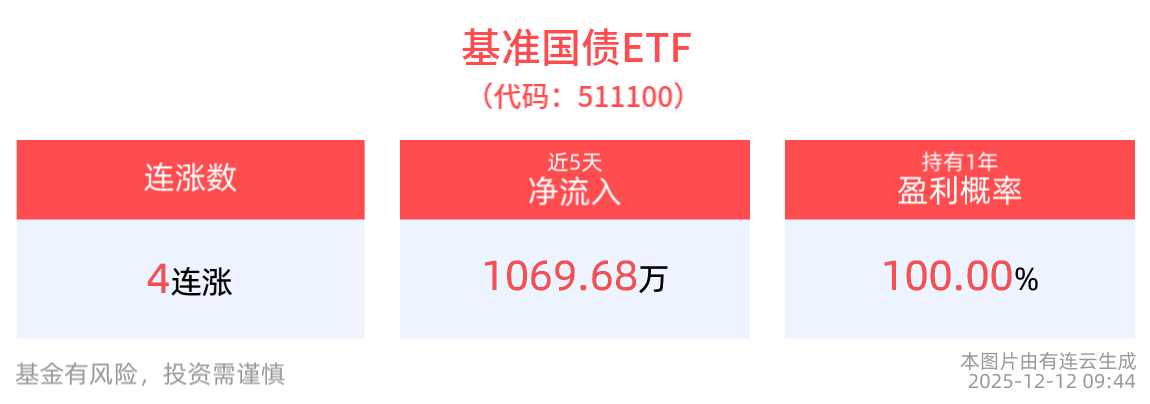
预计2026年初债市的胜率和赔率将有阶段性上修,基准国债ETF(511100)冲击4连涨
Sou Hu Cai Jing· 2025-12-12 02:03
Group 1 - The benchmark government bond ETF (511100) has seen a 0.08% increase, marking its fourth consecutive rise, with an average daily trading volume of 11.14 billion yuan over the past week [1] - The ETF has attracted a total of 10.697 million yuan in inflows over the last five trading days, bringing its latest scale to 11.131 billion yuan [1] - Since its inception, the ETF has recorded a highest monthly return of 2.67%, with the longest streak of monthly gains being 9 months and a maximum gain of 6.94% [1] Group 2 - Citic Securities indicates that the 2025 Central Economic Work Conference emphasizes "practicing internal skills," with expectations for continued fiscal policy support in 2026, focusing on domestic demand, innovation, and reform [3] - The bond market is anticipated to see an upward adjustment in winning rates and odds at the beginning of 2026, reflecting positive market expectations regarding policy [3] - The benchmark government bond ETF tracks the Shanghai Benchmark Market Government Bond Index, selecting all government bonds within the exchange's benchmark market variety, with an overall duration of 9.37, indicating a medium-term bond index [3]

债市暖意延续,宽松预期夯实债市基础,30年国债ETF(511090)盘中涨0.38%
Sou Hu Cai Jing· 2025-12-11 02:18
Core Insights - The 30-year Treasury ETF (511090) has shown a positive performance, increasing by 0.38% as of December 11, 2025, with a trading volume of 4.50 billion yuan and an average daily trading volume of 83.94 billion yuan over the past week [1] - The latest scale of the 30-year Treasury ETF reached 30.343 billion yuan, indicating a strong market presence [1] - The bond market is experiencing a favorable environment due to low returns in the real economy and expectations of monetary easing, which supports the bond market [2] Market Performance - The 30-year Treasury futures closed higher, with the main contract rising by 0.30% to 112.790 yuan, while other maturities also saw slight increases [1] - The People's Bank of China conducted a 1,898 billion yuan reverse repurchase operation at a fixed rate of 1.40%, resulting in a net injection of 1,105 billion yuan for the day [1] Economic Context - The economy is transitioning between old and new growth drivers, with low returns in the real economy providing a supportive backdrop for the bond market [2] - There are reasonable expectations for interest rate cuts and reserve requirement ratio reductions in the coming year, further bolstering the bond market [2] Index Information - The 30-year Treasury ETF closely tracks the China Bond 30-Year Treasury Index, which consists of publicly issued 30-year treasury bonds with a remaining maturity of 25-30 years [2]
通胀数据解读
2025-12-11 02:16
Summary of Key Points from Conference Call Industry Overview - The conference call primarily discusses the economic indicators related to inflation, specifically the Consumer Price Index (CPI) and Producer Price Index (PPI) for November, along with implications for the banking and real estate sectors [2][4][6]. Core Insights and Arguments - **CPI and PPI Trends**: - November CPI increased year-on-year to 0.1%, driven by rising food prices, particularly fresh vegetables, while core CPI remained stable at 1% [2][4]. - November PPI decreased by 2.2% year-on-year but showed a slight month-on-month increase of 0.1%, indicating weaker-than-expected performance [2][4][6]. - The overall inflation environment remains subdued, with significant reliance on base effects for any recovery in CPI and PPI [2][9]. - **Sector Performance**: - The banking sector faces regulatory pressures due to the accumulation of long-term bonds, impacting their willingness to hold such assets and potentially affecting yield recovery [2][10][11]. - Recent divergence in performance between real estate stocks and bank stocks reflects market uncertainty regarding the authenticity of real estate sector news, such as mortgage subsidy policies [2][12]. - **Real Estate Sector Dynamics**: - Multiple turning points are identified in the real estate sector, including the emergence of non-performing loans in development loans and anticipated risks in mortgage loans expected to peak between late 2025 and 2026 [2][14]. - Current conditions favor bank stock investments due to their priority in collateral claims over insurance companies [2][14][15]. Additional Important Insights - **Commodity Prices and Market Sentiment**: - A general decline in commodity prices, including glass and coal, is noted, with market expectations for the upcoming Central Economic Work Conference affecting sentiment [2][9]. - The potential impact of international oil prices and the performance of the non-ferrous metals sector on domestic industry differentiation is highlighted [7][8]. - **Future Monitoring Points**: - Key areas to monitor include the sustainability of food prices, particularly fresh vegetables, and the performance of livestock and poultry products [7]. - The effectiveness of anti-involution policies in sectors like photovoltaic and lithium batteries is also crucial for future economic recovery [8]. - **Global Market Influences**: - Upcoming decisions from major central banks, including the Federal Reserve and the Bank of Japan, are expected to have significant implications for global markets, particularly concerning interest rates and currency valuations [3][16]. - **Investor Sentiment**: - The recent decline in bank stocks is attributed to irrational market reactions rather than fundamental weaknesses, suggesting potential buying opportunities as prices stabilize [2][18]. This summary encapsulates the critical insights and data points discussed in the conference call, providing a comprehensive overview of the current economic landscape and sector-specific dynamics.
11月通胀数据点评:需求端或决定通胀延续性
Bank of China Securities· 2025-12-10 23:45
Report Summary 1. Report Industry Investment Rating - The report does not provide an industry investment rating. 2. Core View of the Report - Supply - side competition order optimization boosts inflation recovery, while the demand - side may determine the continuity of inflation. After inflation has reasonably recovered, the bond market will focus more on whether inflation recovery is sustainable, which should be based on not affecting the real economic growth rate. Besides capacity management in key industries, continuous improvement on the demand - side is needed to support inflation continuity [1][3]. 3. Summary by Related Content 3.1 November CPI Situation - The year - on - year increase of November CPI continued to expand, with food prices being the main driving factor. Core CPI increase was basically the same as the previous month, and the decline of energy prices widened. Due to rainfall and cooling in some areas affecting the production and storage of fresh vegetables, the fresh vegetable price increased by 7.2% month - on - month in November and turned to a 14.5% year - on - year increase, which was the main driving factor for the rise in food prices. Core CPI was in a stable trend, with the year - on - year increase basically unchanged from the previous month [3]. 3.2 PPI Situation - Supply - side competition order optimization promoted the continued improvement of PPI month - on - month, but the year - on - year decline was slightly larger than the previous month. The capacity governance of key industries continued to advance, the market competition order was continuously optimized, and the price decline of industrial products in some key industries narrowed continuously. However, as of October, housing prices still faced downward pressure, which restricted the further improvement of PPI [3]. 3.3 November Rent - related CPI Situation - In November, both the month - on - month and year - on - year declines of rent - related CPI slightly expanded. The supply and demand of urban housing may still be in a balanced state, but expectation factors still restricted the recovery of the real estate market's prosperity [3]. 3.4 Economic Growth and Inflation Continuity - Since China's economy advanced steadily in the first three quarters of this year, the pressure to achieve this year's growth target is not great. In the first half of next year, it is necessary to pay attention to the feedback of real growth indicators such as industrial added value and real GDP growth rate on inflation recovery [3].
固定收益点评:菜价推升CPI
GOLDEN SUN SECURITIES· 2025-12-10 10:38
证券研究报告 | 固定收益点评 gszqdatemark 2025 12 10 年 月 日 固定收益点评 菜价推升 CPI 11 月通胀数据显示,CPI 涨幅扩大,PPI 降幅小幅走阔。11 月 CPI 同比 涨幅扩大 0.5 个百分点至 0.7%,连续两个月上涨且为 2024 年 3 月份以 来最高,CPI 环比季节性也明显高于前两年。PPI 同比降幅小幅扩大 0.1 个 百分点至-2.2%,环比保持 0.1%的增长。 菜价是本月 CPI 回升的主要原因。11 月 CPI 同比上涨 0.7%,上月为上 涨 0.2%,环比下跌 0.1%。其中,食品价格由上月下降 2.9%转为上涨 0.2%,对 CPI 同比的影响由上月下拉 0.54 个百分点转为上拉 0.04 个百 分点。食品中菜价上涨最为明显,受天气因素等影响,鲜菜价格由上月下 降 7.3%转为上涨 14.5%,对 CPI 同比的上拉影响比上月增加约 0.49 个 百分点。由于蔬菜生长周期短,因而难以持续涨价,短期快速上涨之后往 往会由于供给增加而回落。 核心 CPI 平稳,金价影响依然显著。核心 CPI 同比上涨 1.2%,与上月持 平,涨幅连续 3 个 ...
债市放大镜
Xin Lang Cai Jing· 2025-12-08 11:22
Group 1 - The core viewpoint of the article indicates a continued decline in Vanke bonds, with significant drops observed across various bond issues [4][21][12] - The People's Bank of China (PBOC) conducted multiple reverse repo operations throughout the week, with varying amounts and consistent interest rates of 1.40% [1][2][4][13] - The interbank market showed a generally loose liquidity condition, with the DR001 weighted average interest rate fluctuating around 1.3% [5][10][30] Group 2 - The bond market experienced fluctuations, with the latest PMI data having a limited impact on overall bond prices, while market participants are focused on year-end policy directions [3][20][25] - The yield on various government bonds showed mixed movements, with some long-term bonds experiencing upward pressure [8][11][28] - The convertible bond index saw a decline, with notable drops in several specific convertible bonds, while others showed gains [6][26][31]


债市日报:12月8日
Xin Hua Cai Jing· 2025-12-08 08:19
Core Viewpoint - The bond market continues to show weakness, particularly in the ultra-long end, with rising yields and a notable supply-demand imbalance [1][7]. Market Performance - On December 8, the bond market experienced a general increase in yields, with the 30-year government bond yield rising by 1.75 basis points to 2.269% and the 50-year bond yield increasing by 3.9 basis points to 2.415% [2]. - The China Securities Convertible Bond Index rose by 0.40% to 483.93 points, with significant gains in several convertible bonds [2]. International Bond Market - In North America, U.S. Treasury yields rose across the board, with the 10-year yield increasing by 3.89 basis points to 4.137% [3]. - In Asia, Japanese bond yields also increased, with the 10-year yield rising by 2.3 basis points to 1.972% [4]. Primary Market - Agricultural Development Bank's financial bonds had competitive bidding, with the 5-year bond yield at 1.7772% and a bid-to-cover ratio of 3.03 [5]. - The Xinjiang Production and Construction Corps' local bonds saw bid-to-cover ratios exceeding 10, indicating strong demand [5]. Liquidity and Funding - The central bank conducted a reverse repurchase operation of 1,223 billion yuan, resulting in a net injection of 147 billion yuan for the day [6]. - Short-term funding rates, as indicated by Shibor, have generally increased, with the overnight rate rising to 1.302% [6]. Institutional Perspectives - Huatai Fixed Income suggests that while the ultra-long bonds have seen some risk release, the overall market remains cautious, with expectations of increased volatility in ultra-long bonds [7][8]. - Industry analysts from Guosheng Fixed Income do not foresee a significant long-term increase in ultra-long bond spreads but acknowledge short-term risks due to potential market shocks from institutional selling [8].
固定收益定期:单跌超长债背后的总量缺口和结构压力
GOLDEN SUN SECURITIES· 2025-12-07 13:48
1. Report Industry Investment Rating No relevant content provided. 2. Core Viewpoints of the Report - The overall bond market is expected to strengthen gradually in the future due to increased capital supply and decreased financing demand, but there will be structural challenges, especially for ultra - long bonds. The adjustment of ultra - long bonds may be nearing the end, but their stabilization depends on the changes in the selling power of trading institutions. The slope of the yield curve next year may be more determined by regulations. The structural pressure on ultra - long bonds is expected to ease in mid - to late December. It is recommended to conduct right - side trading and wait for the market to stabilize before making allocations. The bond market is expected to have a trending market from the end of this year to the first quarter of next year, and the 10 - year Treasury bond yield may hit a new low in the first quarter of next year [3][4][5] 3. Summary by Related Contents 3.1 Current Bond Market Situation - This week, the bond market saw a unilateral adjustment in ultra - long bonds. The 30 - year Treasury bond yield rose significantly by 7.2 bps to 2.26%, and the 50 - year Treasury bond yield soared by 9.7 bps. However, Treasury bonds with maturities of 10 years and less remained stable, with the 10 - year Treasury bond yield rising only slightly by 0.7 bps, and the yields of 1 - 3 - year Treasury bonds even declining slightly. Government financial bonds and Tier 2 capital bonds, which are held more concentratedly by public funds, also adjusted along with ultra - long bonds. The yield of 1 - year AAA certificates of deposit rose by 1 bps to 1.66% this week [1][8] 3.2 Reasons for the Overall Bond Market Strength 3.2.1 Capital Supply - The real estate slowdown will increase the capital supply in the bond market. The sum of the scales of household deposits, wealth management products, insurance, money market funds, and bond funds, which represents the capital source of the broad fixed - income market, showed a decline in growth in the first half of this year but has rebounded in recent months, mainly due to the impact of real estate. As household savings are relatively stable, but the structure of incremental household savings may change significantly, there is a high negative correlation between housing and low - risk financial assets. The recovery of real estate sales from the fourth quarter of last year to the first quarter of this year diverted the capital inflow into broad fixed - income assets, but with the recent weakening of the real estate market, the capital inflow into broad fixed - income assets such as household deposits and insurance premiums is expected to increase again in the next few months [2][12] 3.2.2 Financing Demand - The decline in the social financing growth rate means that the growth rate of asset supply will slow down in the next few months. This year, the year - on - year growth rate of social financing rebounded from 8.0% at the end of last year to a maximum of 9.0% in the middle of this year, mainly driven by government bonds, with government bonds increasing by nearly 3 trillion yuan year - on - year. Assuming a fiscal deficit of 4%, a special Treasury bond of 2 trillion yuan, and new special bonds of 4.5 trillion yuan next year, government bonds will increase by about 500 billion yuan compared with this year, a significantly smaller increase than this year. If the non - government bond social financing increment remains the same as this year, the social financing growth rate may slow down again in the first half of next year [3][13] 3.3 Reasons for the Adjustment of Ultra - Long Bonds - Banks, especially large - scale banks, have taken on a large amount of long - term bonds, resulting in excessive pressure on some indicators such as △EVE. Recently, the slowdown in insurance premium income and the shift of asset allocation towards equities have led to insufficient allocation power from traditional ultra - long bond buyers such as insurance companies. After the positions of trading institutions became too concentrated, concentrated selling led to a rapid adjustment in ultra - long bonds [3][19] 3.4 Future Outlook for Ultra - Long Bonds - After rapid selling by trading institutions such as funds and securities firms, their positions have decreased significantly, reducing the room for further selling. As the yield of ultra - long bonds adjusts, their relative cost - effectiveness has changed. The spread between mortgage loans and 30 - year Treasury bonds is at the lowest level since the third quarter of 2017, and the spread between mortgage loans and 30 - year local government bonds is at the lowest level since relevant data became available, increasing the attractiveness of ultra - long bonds to allocation - oriented institutions. Therefore, the adjustment of ultra - long bonds may be nearing the end, but their stabilization still needs to be observed in terms of the selling power of trading institutions [4][19] 3.5 Outlook for the Bond Market Structure Next Year - The slope of the yield curve next year may be more determined by regulations. If regulations continue to impose the same constraints on interest - rate risk indicators as this year, large - scale banks may continue to sell ultra - long bonds in the market, leading to a steeper yield curve. If regulations are adjusted or the central bank broadens the maturity range of bond purchases, the steepness of the yield curve will improve. The adjustment of regulatory indicators and the timing of such adjustments are highly uncertain. It is expected that the pressure on the long end will ease from the end of this year to the beginning of next year, and the slope of the yield curve is expected to recover [4][21] 3.6 Short - Term Outlook and Investment Recommendations - The overall supply - demand pattern will continue to drive the bond market to strengthen, and the structural pressure is expected to ease in mid - to late December. In the short term, the pressure on ultra - long bonds caused by selling by large - scale banks and trading institutions such as funds and securities firms still exists. It is expected that as the pressure on large - scale banks' indicators eases and the cost - effectiveness of ultra - long bonds increases after adjustment, allocation - oriented institutions will gradually increase their allocations, and the pressure is expected to ease starting in mid - to late December. Therefore, it is recommended to conduct right - side trading and wait for the market to stabilize before making allocations [5][22]