
规模效应

Search documents
零跑汽车(9863.HK):单季度盈利持续且海外拓展提速
Ge Long Hui· 2025-11-19 20:04
Core Viewpoint - Leapmotor's Q3 2025 financial results show significant growth in revenue and profitability, driven by strong sales performance and accelerated overseas expansion, positioning the company for a robust new vehicle cycle in 2025-2026 [1][2][3][4] Group 1: Financial Performance - Q3 2025 revenue reached 19.45 billion yuan, representing a year-over-year increase of 97.3% and a quarter-over-quarter increase of 36.7% [1] - The company achieved a net profit of 150 million yuan in Q3 2025, marking a turnaround from losses in previous quarters [1] - Q3 gross margin improved to 14.50%, up 6.40% year-over-year and 0.89 percentage points quarter-over-quarter, attributed to scale effects and cost management [2] Group 2: Sales and Market Expansion - Q3 2025 sales reached 174,000 units, a record high, with a year-over-year increase of 102% and a quarter-over-quarter increase of 30% [1] - The sales structure is optimizing, with B/C platform vehicles accounting for 56% and 35% of sales respectively, while the low-priced T03 model's share decreased to 9% [1] - Overseas market performance is accelerating, with 38,000 units exported from January to September 2025 and a 50% quarter-over-quarter increase in overseas registrations in Q3 [1][3] Group 3: Future Outlook - The company is entering a strong new vehicle cycle with multiple new models planned for 2025 and 2026, aiming for sales of 1 million units in 2026 [3] - Strategic partnerships and local manufacturing initiatives are expected to enhance revenue streams, with over 700 overseas sales points established by Q2 2025 [3] - Revenue projections for 2025-2027 are set at 74.5 billion, 128.7 billion, and 170.7 billion yuan respectively, with net profits expected to grow significantly during the same period [4]

新能源车企盈利破局:解码零跑“全域自研”的规模化路径
Xin Lang Cai Jing· 2025-11-19 12:54
Core Insights - Leap Motor has achieved significant milestones by completing its annual sales target of 500,000 vehicles 46 days ahead of schedule, with a net profit of 150 million yuan in Q3, marking consecutive quarterly profitability [3][6] - In a generally loss-making electric vehicle industry, Leap Motor's performance stands out, with a Q3 gross margin of 14.5% while maintaining high R&D investments [6][8] - The company has a strong cash reserve of 33.92 billion yuan as of Q3, which supports its ambitions for higher targets and boosts investor confidence [6][8] Sales and Market Expansion - Leap Motor plans to exceed 1,000 sales outlets by the end of the year, targeting more tier-4 and tier-5 cities, while also focusing on overseas markets [10][12] - The company has exported 37,772 vehicles from January to September 2025, leading the new forces in the overseas market, with significant sales in European countries [10][12] - Leap Motor's overseas orders are projected to exceed 15,000 units in November, with a target of 100,000 to 150,000 units by 2026 [12][25] Technological Innovation and Cost Efficiency - The company maintains a low defect rate in its electric drive systems, significantly below the industry average, showcasing its commitment to in-house R&D [12][14] - Leap Motor's innovative technologies, such as the integrated electric drive and generator system, have led to substantial cost reductions and weight savings [14][20] - The company emphasizes a clear boundary in its R&D strategy, collaborating with top suppliers for traditional areas while focusing on self-research in areas that create competitive advantages [14][20] Product Strategy and Market Positioning - The launch of the D series represents Leap Motor's highest level of technology integration, aimed at meeting high market demand while maintaining competitive pricing [16][18] - The company has established a comprehensive product matrix covering various market segments, with plans for multiple new models in 2026 [20][22] - Leap Motor's strategy focuses on delivering high-quality products at reasonable prices, which is expected to drive market acceptance and sustained profitability [25]

零跑汽车(09863):25Q3财报点评:毛利率持续向上,出海进程顺利
ZHONGTAI SECURITIES· 2025-11-19 11:48
Investment Rating - The report maintains a "Buy" rating for the company, indicating an expected relative performance increase of over 15% against the benchmark index within the next 6 to 12 months [12]. Core Insights - The company achieved its first half-year profit, with both domestic and international sales accelerating significantly [3]. - The third quarter of 2025 saw the company report revenue of 19.45 billion yuan, reflecting a year-on-year increase of 97.3% and a quarter-on-quarter increase of 36.7% [4]. - The gross margin for Q3 2025 reached 14.5%, showing improvements both year-on-year and quarter-on-quarter, primarily due to increased sales volume and cost management [5]. - The company delivered 174,000 vehicles in Q3 2025, maintaining its position as the top new force in vehicle deliveries for eight consecutive months [7]. - The company is expanding its product matrix and sales channels, with a significant increase in sales service network coverage [6][8]. Financial Performance Summary - Revenue projections for the company are as follows: 32.16 billion yuan in 2024, 63.90 billion yuan in 2025, 113.20 billion yuan in 2026, and 174.00 billion yuan in 2027, with growth rates of 92%, 99%, 77%, and 54% respectively [3][9]. - The company is expected to turn a profit in 2025, with a projected net profit of 738 million yuan, followed by 6.27 billion yuan in 2026 and 8.43 billion yuan in 2027 [3][9]. - The net asset return rate is projected to improve significantly, reaching 7% in 2025 and 45% in 2026 [3][9]. - The company’s cash flow per share is expected to turn positive in 2025, with projections of 15.74 yuan in 2026 and 18.80 yuan in 2027 [3][9].
金岩高新:高增长背后的集中度陷阱与以价换量困局
Zhi Tong Cai Jing· 2025-11-19 02:51
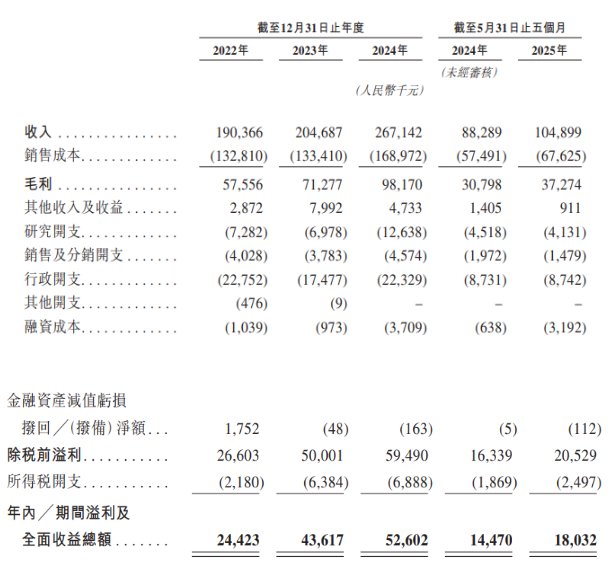
Core Viewpoint - The company, Jinyan High-Tech, is positioned as a leading player in the coal-based kaolin industry in China, with a strong vertical integration model that enhances its competitive edge in a challenging market environment [1][2]. Group 1: Market Position and Product Structure - Jinyan High-Tech is one of the few companies specializing in coal-based kaolin, with a comprehensive capability that spans mining, R&D, processing, and sales [1]. - The company holds a 5.4% market share in the coal-based calcined kaolin sector, ranking fifth in China, while it leads the market in precision casting mullite materials with a 19.1% share [1]. - The product structure is divided into two main segments: precision casting mullite materials and refractory mullite materials, which are essential for precision casting shells and refractory materials [2]. Group 2: Production Capacity and Resource Control - The production capacity for precision casting mullite materials is projected to decline from 117.9 thousand tons in 2022 to 105.6 thousand tons in 2024, while refractory mullite materials are expected to grow significantly from 5.2 thousand tons in 2022 to 25.7 thousand tons in 2024 [2]. - The acquisition of the Shuli kaolin mine in October 2021 has provided the company with a stable supply of raw materials, ensuring quality and cost advantages [3]. Group 3: Financial Performance - Revenue has shown a robust growth trajectory, increasing from 190.4 million RMB in 2022 to 267.1 million RMB in 2024, with a compound annual growth rate (CAGR) of 18.5% [4]. - The net profit has more than doubled from 24.4 million RMB in 2022 to 52.6 million RMB in 2024, achieving a CAGR of 46.8% [4]. - The gross margin has improved from 30.2% in 2022 to 36.7% in 2024, indicating enhanced profitability [4]. Group 4: Financial Risks - The financing costs have surged dramatically, reaching 3.71 million RMB in 2024, over 3.5 times the 1.04 million RMB in 2022, raising concerns about financial pressure due to increased debt [5]. - In the first five months of 2025, financing costs reached 3.19 million RMB, reflecting a more than 400% increase compared to the same period in 2024 [5]. Group 5: Market Growth and Challenges - The market for precision casting mullite materials is projected to grow at a CAGR of 8.4% from 2023 to 2028, down from 11.2% from 2019 to 2023, indicating a slowdown in growth potential [9]. - The refractory mullite materials market is expected to see a slight increase in growth rate, with a projected CAGR of 5.2% from 2024 to 2028, but overall growth remains limited [11]. - The company faces the challenge of maintaining its competitive edge and optimizing its financial structure amidst a slowing industry growth rate [11].
新股解读|金岩高新:高增长背后的集中度陷阱与以价换量困局
智通财经网· 2025-11-19 02:47
Core Viewpoint - Jin Yan High-Tech has successfully passed the listing hearing on the Hong Kong Stock Exchange, highlighting its unique position in the coal-based kaolin industry and its vertical integration model, which is crucial for its competitive edge in a challenging market environment [1][2]. Company Overview - Jin Yan High-Tech is one of the few companies in China specializing in coal-based kaolin, with a complete value chain from mining to sales [1]. - The company holds a 5.4% market share in the coal-based calcined kaolin sector, ranking fifth in the industry, and leads the market in the precision casting mullite materials segment with a 19.1% market share [1]. Product Structure and Production Capacity - The product structure is divided into two main segments: precision casting mullite materials and refractory mullite materials, which are essential for precision casting shells and refractory materials [2]. - Production data shows a focus on precision casting mullite materials, with output figures of 117.9 thousand tons in 2022, 114.5 thousand tons in 2023, and a projected 105.6 thousand tons in 2024. In contrast, refractory mullite materials production is expected to grow from 5.2 thousand tons in 2022 to 25.7 thousand tons in 2024 [2]. Resource Control and Competitive Advantage - The acquisition of the Shuli kaolin mine in October 2021 has provided Jin Yan High-Tech with a stable supply of raw materials, ensuring quality and cost advantages in a volatile market [3]. - As of May 31, 2025, the estimated total mineral resources of the Shuli kaolin mine are approximately 18,649 thousand tons, with a controlled resource amount of 8,990 thousand tons [3]. Financial Performance - Revenue has shown a steady growth trajectory, increasing from 190.4 million RMB in 2022 to 267.1 million RMB in 2024, with a compound annual growth rate (CAGR) of 18.5% [4]. - The net profit has more than doubled from 24.4 million RMB in 2022 to 52.6 million RMB in 2024, with a net profit margin improvement from 12.8% to 19.7% [4]. - Gross margin has increased from 30.2% in 2022 to 36.7% in 2024, indicating a significant improvement in profitability [4]. Financing Costs and Financial Risks - Financing costs have surged, reaching 3.71 million RMB in 2024, more than three times the 1.04 million RMB in 2022, raising concerns about financial pressure due to increased debt [5]. - In the first five months of 2025, financing costs reached 3.19 million RMB, reflecting a more than 400% increase compared to the same period in 2024 [5]. Market Growth and Challenges - The market for precision casting mullite materials in China is projected to grow at a CAGR of 8.4% from 2023 to 2028, down from 11.2% from 2019 to 2023, indicating a slowdown in growth potential [9][11]. - The refractory mullite materials market is expected to see a slight increase in growth rate, with a projected CAGR of 5.2% from 2024 to 2028, but overall growth remains modest [11]. Strategic Expansion Plans - Jin Yan High-Tech plans to expand its production capacity, including a new production line with a design capacity of 40,000 tons for refractory mullite materials [9]. - The company aims to enhance product quality and automate production processes through the procurement of advanced machinery and technology upgrades [9].
零跑汽车(09863):规模效应持续释放,零跑盈利质量进入改善通道
Haitong Securities International· 2025-11-18 08:55
Investment Rating - The report maintains an "OUTPERFORM" rating for Leapmotor [1][2][20]. Core Insights - Leapmotor has entered a clear margin-improvement cycle, with sustained profitability and enhanced gross margins driven by scale benefits and cost optimization [3][14]. - The company is on track to achieve its annual sales target of 580,000 to 650,000 units, with a revised forecast of 633,000 units for 2025 [4][15]. - Leapmotor's overseas expansion strategy is taking shape, with significant order growth and localization projects planned for 2026 [5][16][17]. - The company has established a comprehensive product matrix with four major series, enhancing its market positioning [6][18][19]. - Revenue forecasts for 2025-2027 have been updated, reflecting a strong model pipeline and expected market share growth [7][20]. Summary by Sections Financial Performance - In Q3 2025, Leapmotor reported revenue of Rmb19.45 billion, a 97% year-on-year increase, with a gross margin of 14.5% [3][14]. - The net profit for Q3 was Rmb150 million, marking a significant improvement from a loss of Rmb690 million in the same period last year [3][14]. - The company had cash reserves of Rmb33.92 billion at the end of Q3, indicating a strong liquidity position [3][14]. Sales and Delivery - Year-to-date deliveries reached 466,000 units through October, with management confident in achieving the full-year target [4][15]. - October saw single-month deliveries surpassing 70,000 units for the first time, reflecting strong demand [3][14]. Overseas Expansion - Leapmotor's overseas orders reached approximately 12,000 in October, with expectations to exceed 15,000 in November [5][16]. - The company aims for overseas sales of 100,000 to 150,000 units by 2026, maintaining a low-margin strategy for market penetration [5][16][17]. Product Development - Leapmotor has completed its ABCD product series, with new models set to launch in the coming months [6][18][19]. - The company is also developing a new category-creating product expected to launch in 2027 or 2028 [6][19]. Valuation - The updated revenue forecast for 2025-2027 is Rmb64.9 billion, Rmb94.6 billion, and Rmb127.6 billion, respectively [7][20]. - A target price of HK$73.51 is assigned based on a 1.0x price-to-sales ratio for 2026 [7][20].
甬矽电子:公司2025年前三季度归属于上市公司股东的净利润同比增长48.87%
Zheng Quan Ri Bao Zhi Sheng· 2025-11-17 14:41
Core Viewpoint - The semiconductor packaging and testing industry is currently experiencing stable and improving prices, with the company focusing on high-end packaging and testing services to enhance profitability [1] Company Performance - For the first three quarters of 2025, the company achieved operating revenue of 316,995.50 thousand yuan, representing a year-on-year growth of 24.23% [1] - The net profit attributable to shareholders increased by 48.87% year-on-year [1] Market Outlook - Growth in the IoT, computing, and automotive sectors is expected to further boost the company's profitability [1] - The company anticipates continued revenue growth, which will positively impact profitability through economies of scale [1] Strategic Initiatives - The company plans to increase R&D investment, enhance market development, and focus on cost reduction and efficiency improvement to strengthen core competitiveness [1] - The company aims to effectively manage operations to improve performance and intrinsic value [1]

零跑汽车(09863.HK)第三季度净利润为1.5亿元 同比扭亏为盈
Ge Long Hui· 2025-11-17 10:54
Core Viewpoint - Leap Motor (09863.HK) reported significant revenue growth and improved profitability in Q3 2025, driven by increased vehicle deliveries and effective cost management [1] Financial Performance - Revenue for Q3 2025 reached RMB 19.45 billion, a year-on-year increase of 97.3% [1] - Gross margin improved to 14.5% in Q3 2025, up from 8.1% in the same period of 2024 and 13.6% in Q2 2025 [1] - Net profit attributable to equity holders was RMB 150 million in Q3 2025, compared to a loss of RMB 690 million in Q3 2024 [1] Delivery and Market Position - Total vehicle deliveries for Q3 2025 amounted to 173,852 units [1] - In October, the company achieved a new delivery record of 70,289 units, maintaining its position as the top-selling new force brand in China for eight consecutive months [1]
吉利汽车Q3利润增长59%,极氪交付量同比增长13% | 财报见闻
Hua Er Jie Jian Wen· 2025-11-17 06:31
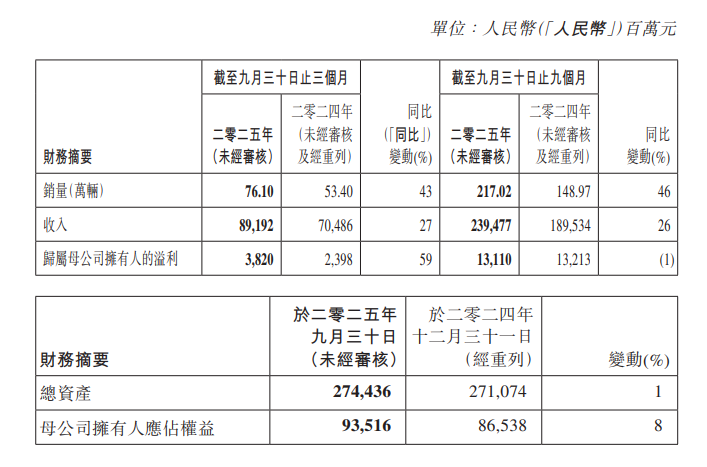
Core Viewpoint - Geely Automobile reported significant growth in both sales and profits for Q3 2025, with total sales increasing by 43% to 761,000 units and revenue rising by 27% to RMB 89.192 billion, indicating strong performance in both fuel and new energy vehicles [1][3][5]. Financial Performance - In Q3 2025, Geely's revenue reached RMB 89.2 billion, marking a historical high and a 15% increase from the previous quarter [5]. - The net profit attributable to the parent company was RMB 3.8 billion, reflecting a 59% year-on-year increase [5]. - The total gross profit for Q3 was RMB 14.8 billion, with an 11% quarter-on-quarter growth [5]. Sales and Delivery - Zeekr, Geely's premium electric vehicle brand, delivered approximately 140,000 units in Q3 2025, a 13% increase year-on-year, generating revenue of about RMB 31.6 billion [6]. - As of the end of October, Geely has achieved a cumulative sales volume of 2.477 million units for the year, reaching 82.6% of its annual target of 3 million units [1]. Cost Management and Profitability - The company attributed its profit growth to scale effects, cost control, and brand integration synergies, with net profit growth outpacing revenue growth [3]. - Adjusted net profit for the first nine months of the year was RMB 10.62 billion, a 59% increase year-on-year when excluding one-time items from the previous year [3]. Accounting Changes - Geely has changed its accounting policy effective January 1, 2025, from the "purchase method" to the "equity method" for joint control entities, impacting the way acquisitions are recorded and necessitating restatement of prior financial results [8]. - This change aims to enhance financial reporting transparency and align with international practices, affecting the financial data comparison for 2024 [8].

京东物流(02618):3Q收入同比高增,海外业务加速布局
HTSC· 2025-11-14 07:26
Investment Rating - The investment rating for the company is maintained as "Buy" with a target price of HKD 16.70 [1][5]. Core Insights - The company reported a total revenue of RMB 55.08 billion for Q3 2025, representing a year-on-year increase of 24.1%. However, the net profit attributable to shareholders decreased by 7.9% to RMB 2.03 billion [1][5]. - The revenue growth was primarily driven by the increase in JD Retail revenue, the addition of JD Delivery services, accelerated overseas market expansion, and growth in external customer business [1][3]. - The company is focusing on enhancing its logistics infrastructure and expanding into international markets, particularly in the Middle East and Asia-Pacific regions [4]. Revenue Breakdown - In Q3 2025, revenue from JD Group reached RMB 21.20 billion, a significant increase of 65.8%, accounting for 38.5% of total revenue, up 9.7 percentage points year-on-year [2]. - External customer revenue was RMB 33.88 billion, growing by 7.2% and representing 61.5% of total revenue [2]. - The integrated supply chain business generated RMB 30.14 billion, a year-on-year increase of 45.8%, reinforcing its core position in the business [2]. Profitability Analysis - The gross margin and Non-IFRS profit margin for Q3 2025 were 9.1% and 3.7%, respectively, both showing a decline of 2.6 and 2.1 percentage points year-on-year [3]. - The decline in profitability is attributed to increased resource investment in new businesses and higher employee compensation costs, which rose by 49.8% to RMB 21.8 billion [3]. Future Outlook - The company maintains its net profit forecast for 2025 at RMB 6.90 billion and Non-IFRS profit at RMB 8.34 billion, while slightly adjusting the forecasts for 2026 and 2027 downwards due to anticipated cost increases [5]. - The long-term outlook remains positive, with expectations of profit margin recovery driven by improved logistics capacity utilization and automation technology applications [3][5].