
资金面

Search documents
固收专题:结构性货币政策降息后怎么看?
Guolian Minsheng Securities· 2026-01-16 12:57
1. Report Industry Investment Rating - The report does not mention the industry investment rating [1][5] 2. Core Viewpoints of the Report - The central bank's reduction of various structural monetary policy tool interest rates by 25bp reflects support for the "five major articles of finance", helps stabilize the net interest margin of banks, and indicates a continued loose monetary policy, but does not directly lead to an immediate decline in interest rates or a follow - up reduction in LPR [5][13][14] - There is still room for reserve requirement ratio cuts (130bp) and interest rate cuts in 2026, but the probability of a comprehensive interest rate cut is low before the Two Sessions and the first release of 2026 economic data [5][14] - The central bank will increase liquidity injection, and the overnight interest rate is expected to be slightly lower than 1.40%, which does not mean a tightening of liquidity [20] - In 2026, the central bank's treasury bond trading will mainly cooperate with fiscal policies, and it is more concerned about risks of large - scale unilateral changes in interest rates [22] 3. Summary by Relevant Catalogs 3.1 Structural Monetary Policy Interest Rate Cuts - On January 15, 2026, the central bank announced a series of monetary and financial policies, including a 0.25 - percentage - point cut in various structural monetary policy tool interest rates. After the cut, the 1Y agricultural and small - business re - loan and other special tool interest rates are 1.25%, lower than the 7DOMO policy rate [5][8][13] - The reduction in interest rates can reduce banks' interest - paying costs and help stabilize the net interest margin. It is estimated that by the end of December 2025, the balance of the central bank's structural monetary policy tools will be around 5.4 trillion yuan, and the interest savings after the rate cut will be about 13.5 billion yuan. Even if all tools are fully utilized, the interest savings will only slightly exceed 20 billion yuan [5][13] - The interest rate cut does not directly lead to a decline in interest rates, and it does not meet the conditions for an LPR follow - up reduction [5][13] 3.2 Future Reserve Requirement Ratio and Interest Rate Cut Space - The central bank stated that there is still room for reserve requirement ratio and interest rate cuts in 2026 [14] - The current average statutory deposit reserve ratio of financial institutions is 6.3%, and it is expected that 5% is the bottom line, leaving a 130bp cut space [14] - The main constraint for interest rate cuts is the pressure on banks' net interest margins. Although there are factors conducive to stabilizing the net interest margin, the probability of a comprehensive interest rate cut before the Two Sessions and the first release of 2026 economic data is low [14] 3.3 Follow - up Capital Market Conditions - The central bank will continue to increase liquidity injection, keep liquidity abundant, and guide the overnight interest rate to run around the policy rate [20] - The overnight interest rate in December 2025 was generally below 1.30%. Due to the dislocation of repurchase operations, the overnight interest rate rose to 1.30% - 1.40%. It is estimated that an overnight interest rate slightly lower than 1.40% is appropriate, which does not mean a tightening of liquidity [20] 3.4 Follow - up Treasury Bond Trading - In 2025, the net investment of repurchase operations was 3.8 trillion yuan, mainly achieved through treasury bond trading [22] - Two perspectives can be used to observe the central bank's treasury bond holdings. In 2025, the balance of the central bank's claims on the central government decreased by 67 billion yuan, while the balance of other institutions' treasury bond holdings increased by 37 billion yuan, and the balance of local government bond holdings of other institutions increased by 290 billion yuan [22] - In 2026, the central bank's treasury bond trading will mainly cooperate with fiscal policies, help ensure the smooth issuance of treasury bonds at a reasonable cost, and play a role in preventing market risks. The adjustment of the 10 - year treasury bond yield range may not represent a clear regulatory target [22] 3.5 Other New Monetary and Financial Policies - Merge and use the agricultural and small - business re - loan and rediscount quotas, increase the agricultural and small - business re - loan quota by 500 billion yuan, and set up a private enterprise re - loan quota of 1 trillion yuan [8] - Increase the science and technology innovation and technological transformation re - loan quota by 400 billion yuan and expand the scope of support [8] - Merge and manage the private enterprise bond financing support tool and the science and technology innovation bond risk - sharing tool, with a total re - loan quota of 200 billion yuan [8] - Reduce the minimum down - payment ratio for commercial housing loans to 30% to support the de - stocking of the commercial real estate market [9]
日度策略参考-20260116
Guo Mao Qi Huo· 2026-01-16 06:01
1. Report Industry Investment Ratings - No clear overall industry investment ratings are provided in the report. However, specific ratings for some individual industries are as follows: - Industrial silicon is rated "bearish" [1] -沪胶 is rated "bullish" [1] 2. Core Views of the Report - The stock index is expected to continue rising after a period of shock adjustment. The bond market is favored by the asset shortage and weak economy, but short - term interest rate risks are prompted by the central bank. The prices of various commodities show different trends due to factors such as macro - policies, supply - demand relationships, and geopolitical situations [1] 3. Summary by Related Catalogs Macro - financial - **Stock index**: After the policy of lowering the margin trading leverage, the market speculative sentiment declined. The central bank's measures of lowering interest rates and increasing loan quotas are expected to further loosen the capital side. The stock index is expected to continue rising after shock adjustment [1] - **Treasury bonds**: The asset shortage and weak economy are beneficial for bond futures, but the central bank's short - term interest rate risk prompt and the Japanese central bank's interest rate decision need attention [1] Non - ferrous metals - **Copper**: The downstream demand is relatively pressured. With the cooling of market sentiment, copper prices have fallen from high levels and are currently in a volatile trend [1] - **Aluminum**: Due to limited industrial drivers and weakening macro - sentiment, aluminum prices have fallen from high levels and are expected to fluctuate [1] - **Alumina**: The alumina production capacity has a large release space, and the industrial side exerts downward pressure on prices. However, the current price is close to the cost line, so it is expected to fluctuate [1] - **Zinc**: The cost center of zinc fundamentals is stabilizing, but there is inventory pressure. Although zinc prices have made up for losses due to good macro - sentiment recently, the upside space is cautiously viewed [1] - **Nickel**: The 2026 RKAB target of Indonesian nickel mines is about 260 million wet tons, but the supply shortage pattern is difficult to change. Nickel prices are expected to be strongly volatile in the short term, and attention should be paid to Indonesian policies, macro - sentiment, and futures positions [1] - **Stainless steel**: The price has risen sharply due to the supply shortage of nickel ore. The price of raw material nickel - iron has been rising, the social inventory of stainless steel has slightly decreased, and steel mills' production in January has increased. The stainless steel futures are expected to be strongly volatile [1] - **Tin**: Due to good macro - sentiment and continuous supply disturbances, tin prices have continued to rise. The exchange's margin - increasing action on the 15th has had a short - term impact on tin prices [1] Precious metals and new energy - **Precious metals**: With the easing of geopolitical tensions and Trump's decision to postpone the tariff on key minerals, the upward momentum of precious metal prices has slowed down. Gold and silver prices are expected to fluctuate widely at high levels in the short term. Platinum and palladium prices are expected to fluctuate widely in the short term. In the long term, due to the supply - demand gap of platinum and the relatively loose supply of palladium, platinum can be allocated at a low price or a [long - platinum, short - palladium] arbitrage strategy can be adopted [1] - **Lithium carbonate**: It is in the traditional peak season of new energy vehicles, with strong demand for energy storage and increased supply from restarts. It is expected to be strongly volatile, but the spot market is weak, and the upward momentum is insufficient [1] Black metals - **Rebar and hot - rolled coil**: High output and high inventory suppress the price increase space. The transmission from futures price increases to the spot market is not smooth. Unilateral long positions should be closed and observed, and cash - and - carry arbitrage positions can be participated in [1] - **Iron ore**: There is obvious upward pressure, and it is not recommended to chase long positions at the current position [1] - **Coking coal and coke**: If the "capacity - reduction" expectation continues to ferment and there is pre - holiday stockpiling in the spot market, coking coal may still have room to rise. However, since the "capacity - reduction" expectation mainly comes from online rumors, the actual upward space is difficult to judge, and the volatility increases after a sharp rise [1] - **Glass and soda ash**: The short - term market sentiment has warmed up, and supply and demand are supportive. However, in the medium term, supply and demand will continue to be in surplus, and prices will be under pressure. Soda ash mainly follows the trend of glass, and its supply - demand situation is more relaxed in the medium term, so the price is under pressure [1] Agricultural products - **Palm oil**: The rumor that Indonesia will not implement B50 has put pressure on the market. It is expected to enter a shock - consolidation phase in the short term, waiting for positive driving factors such as Indian stockpiling and inventory reduction in the producing areas [1] - **Soybean oil**: It has a strong fundamental situation, and it is recommended to allocate more in the oil market. Consider a long - soybean - oil, short - palm - oil spread strategy [1] - **Rapeseed oil**: The expectation of improved Sino - Canadian trade and the Australian commercial crushing are expected to improve the tight domestic supply situation. Coupled with the global rapeseed harvest in the new season, the fundamentals of rapeseed oil are relatively weak in the oil market [1] - **Cotton**: There is support from the new - crop purchase price, and the downstream has rigid replenishment demand. However, there is currently no clear driving factor. Future attention should be paid to the central government's No.1 Document in the first quarter of next year, planting intentions, weather during the planting period, and the peak - season demand in March and April [1] - **Sugar**: The global sugar market has a surplus, and the domestic new - crop supply has increased. There is a strong consensus on short positions. If the futures price continues to fall, there will be strong cost support below, but there is a lack of continuous fundamental drivers in the short term [1] - **Corn**: The grain - selling progress has slowed down but is still faster than the same period last year. The port inventory is low, and there is a certain pre - holiday replenishment demand from the middle and lower reaches. The spot price is still firm in the short term, and the futures price is expected to fluctuate at a high level [1] - **Soybeans**: The USDA report is bearish. The expected harvest pressure in South America is gradually reflected in the Brazilian CNF premium. The domestic futures market is expected to be weakly volatile. In the first quarter, the concentrated ownership of imported soybeans may lead to structural problems, which may support the pre - holiday spot price, but the domestic auction policy is uncertain [1] Energy and chemicals - **Crude oil**: OPEC+ has suspended production increases until the end of 2026, the uncertainty of the Russia - Ukraine peace agreement, and US sanctions on Venezuelan oil exports have an impact on the market [1] - **Fuel oil**: It follows the trend of crude oil in the short term. The probability of the "14th Five - Year Plan" rush - work demand is falsified, and the supply of Venezuelan crude oil is not short [1] - **Asphalt**: The raw material cost provides strong support, the futures - spot price difference has rebounded significantly, and the mid - stream inventory has increased significantly [1] - **BR rubber**: The futures position has declined, the new warehouse receipts have increased, and the short - term upward momentum has slowed down. The spot price has led the recovery of the basis, and attention should be paid to the upward momentum above 12,000. The processing profit of butadiene rubber has narrowed, and the overseas cracking device capacity has been cleared, which is beneficial for the long - term domestic butadiene export [1] - **PTA**: The PX market has experienced a sharp rise, which is not due to fundamental changes. The PX fundamentals are supported, and the market is expected to be tight in 2026. Domestic PTA maintains high - level operation, and the high gasoline spread supports aromatics [1] - **Ethylene glycol**: Two MEG plants in Taiwan, China, with a total capacity of 720,000 tons/year, plan to shut down next month. Ethylene glycol has rebounded rapidly due to supply - side news. The current polyester downstream operating rate is maintained above 90%, and the demand performance slightly exceeds expectations [1] - **Styrene**: The Asian styrene market is generally stable. Suppliers are reluctant to lower prices due to continuous losses, while buyers insist on pressing prices due to weak downstream polymer demand and profit compression. Although the downstream demand is weak, the domestic market has a strong bullish sentiment due to export support. The market is in a weak - equilibrium state, and the short - term upward momentum depends on the overseas market [1] - **Hydrogen**: The upward space is limited due to weak domestic demand, but there is support from anti - involution and the cost side [1] - **PE**: The supply pressure is relatively large due to high operating load and less maintenance. The downstream improvement is less than expected, and the price has returned to a reasonable range. Geopolitical conflicts may lead to a rise in crude oil prices [1] - **PVC**: There is less global production in 2026, and the future expectation is optimistic. The cancellation of export tax rebates may lead to a rush - export phenomenon. The implementation of differential electricity prices in the northwest region may force the elimination of PVC production capacity [1] - **LPG**: The January CP has risen unexpectedly, providing strong support for the import cost. The escalation of the Middle East geopolitical conflict has increased the short - term risk premium. The EIA weekly C3 inventory accumulation trend has slowed down and is expected to turn into inventory reduction, and the domestic port inventory has also decreased. Domestic PDH maintains high - level operation but is deeply in deficit [1] Others - **Container shipping**: It is expected to reach the peak in mid - January. Airlines are still cautious about trial resumption of flights. The pre - holiday replenishment demand still exists [1] - **Paper pulp**: Affected by the decline of the commodity macro - market, paper pulp has fallen but has not broken through the shock range. The short - term commodity sentiment fluctuates greatly, and it is recommended to observe cautiously [1] - **Log**: The spot price of logs has shown signs of bottom - rebounding recently, and the further decline space of the futures price is limited. However, the January overseas offer has still declined slightly, and the log futures and spot markets lack upward driving factors, and it is expected to fluctuate in the range of 760 - 790 yuan/m³ [1] - **Live pigs**: The spot price has gradually stabilized recently. Supported by demand and with the unsold slaughter weight, the production capacity still needs to be further released [1]
每日债市速递 | 央行1月15日将开展9000亿买断式逆回购操作
Wind万得· 2026-01-14 22:47
Group 1: Open Market Operations - The central bank announced a 240.8 billion yuan reverse repurchase operation with a fixed interest rate of 1.40% on January 14, resulting in a net injection of 212.2 billion yuan after accounting for 28.6 billion yuan in reverse repos maturing on the same day [1]. Group 2: Funding Conditions - The interbank market continues to show a tightening trend, with the D R001 weighted average interest rate slightly rising to 1.39%. Overnight rates in the anonymous click (X-repo) system reached as high as 1.6% [3][5]. - The latest overnight financing rate in the U.S. stands at 3.64% [3]. Group 3: Interbank Certificates of Deposit - The latest transaction for one-year interbank certificates of deposit among major banks is at 1.64%, unchanged from the previous day [7]. Group 4: Bond Market Overview - Most yields on interbank major interest rate bonds have decreased, with specific yields for government bonds showing various declines [11]. - The 30-year main contract for government bonds fell by 0.04%, while the 10-year main contract rose by 0.08% [14]. Group 5: Recent News and Developments - The central bank plans to conduct a 900 billion yuan reverse repurchase operation on January 15, with a term of 181 days [15]. - The Ministry of Finance announced a tax refund policy for individuals selling and repurchasing housing, effective from January 1, 2026, to December 31, 2027 [15]. - The China Securities Regulatory Commission approved an adjustment to the financing margin ratio for new financing contracts, raising the minimum margin from 80% to 100% [16]. - China's foreign trade reached 45.47 trillion yuan in 2025, marking a 3.8% year-on-year increase, with exports at 26.99 trillion yuan (up 6.1%) and imports at 18.48 trillion yuan (up 0.5%) [16].


【笔记20260114— 股市过山车,债农先吐了】
债券笔记· 2026-01-14 10:28
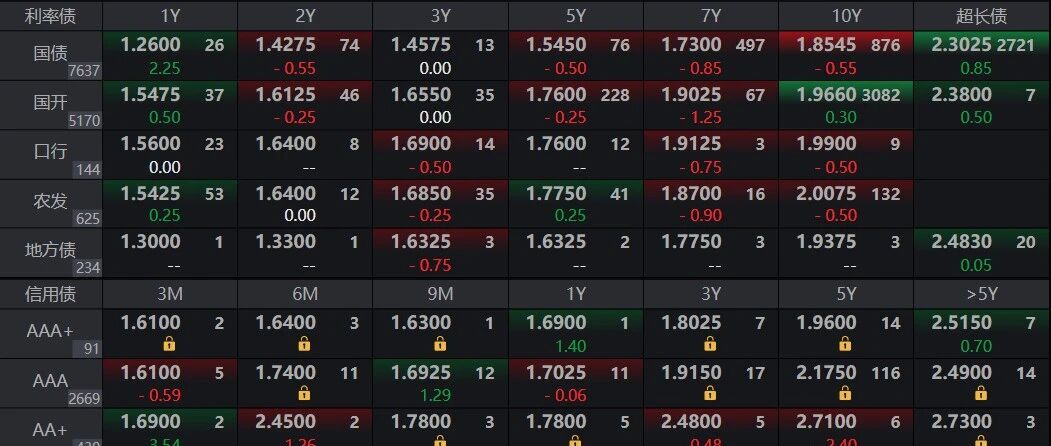
Group 1 - The stock market experienced significant volatility, with a sharp rise followed by a decline, described as a "roller coaster" effect [6] - The People's Bank of China (PBOC) conducted a 240.8 billion yuan reverse repurchase operation, with a net injection of 212.2 billion yuan after 28.6 billion yuan of reverse repos matured [3][5] - The 10-year government bond yield fluctuated, opening at 1.85%, peaking at 1.8605%, and later dropping to a low of 1.838% before closing at 1.843% [5][8] Group 2 - Import and export data for December exceeded expectations, contributing to market movements [5] - Regulatory measures were implemented to increase the margin requirement for new financing contracts, aimed at cooling down the stock market [6] - The bond market showed mixed reactions, with bond yields experiencing fluctuations throughout the day [5][6]
长城基金汪立:2026年港股机会看“三碗面” 聚焦科技与经济复苏双主线
Xin Lang Cai Jing· 2026-01-14 08:16
Core Viewpoint - The investment opportunities in the Hong Kong stock market for 2026 hinge on improvements in the policy environment, funding conditions, and the fundamental performance of companies [1] Policy Environment - The technology and consumer sectors in Hong Kong stocks are highly sensitive to policy changes; ongoing support for technological innovation and consumer encouragement will boost market confidence [1] Funding Conditions - The Hong Kong stock market is significantly influenced by global capital; with the upcoming change in the Federal Reserve chairmanship leaning towards dovish policies, global liquidity is expected to become more accommodative, potentially leading to a return of previously outflowed funds to the Hong Kong market [1] Fundamental Performance - The improvement in the profitability of listed companies is crucial for sustaining market trends; attention should be paid to revenue and profit growth in key sectors such as the internet and biotechnology [1] Investment Directions - Two main investment themes are suggested: first, aligning with technological trends by investing in artificial intelligence, semiconductors, and new energy vehicles; second, focusing on competitive consumer brands and pharmaceutical companies in line with economic recovery [1]
宏观金融数据日报-20260113
Guo Mao Qi Huo· 2026-01-13 07:28
Report Industry Investment Rating - Not provided Core View of the Report - The short - term upward trend of stock indices is expected to continue, and the bullish view on stock indices in 2026 persists. Investors are advised to mainly go long and prioritize far - month contracts due to their higher discount advantages [8] Summary According to Related Content Money Market - DRO01 closed at 1.33 with a 5.43bp increase, DR007 at 1.49 with a 1.75bp increase, GC001 at 1.58 with a 23.50bp increase, GC007 at 1.59 with a 6.00bp increase, SHBOR 3M at 1.60 with a 0.30bp increase, and LPR 5 - year at 3.50 with no change. The 1 - year, 5 - year, and 10 - year treasury bonds closed at 1.30, 1.64, and 1.87 respectively, with decreases of 4.63bp, 1.12bp, and 1.38bp. The 10 - year US Treasury bond closed at 4.18 with a 1.00bp decrease [4] - The central bank conducted 86.1 billion yuan of 7 - day reverse repurchase operations with an operating rate of 1.40%. With 50 billion yuan of repurchase maturities, the net injection was 36.1 billion yuan [4] - This week, there are 1323.6 billion yuan of reverse repurchase maturities in the central bank's open market, and there will also be 110 billion yuan of outright reverse repurchase maturities on Thursday and 6 billion yuan of treasury cash fixed - deposit maturities on Friday. After the holiday, the inter - bank market funds remained loose, and the weighted average interest rate of DR001 slightly increased and hovered around 1.3% [5] Stock Index Market - The CSI 300 closed at 4790 with a 0.65% increase, the SSE 50 at 3144 with a 0.30% increase, the CSI 500 at 8249 with a 2.39% increase, and the CSI 1000 at 8357 with a 2.80% increase. The trading volume of the Shanghai, Shenzhen, and Beijing stock markets reached 3645 billion yuan, a significant increase of nearly 500 billion yuan from the previous trading day, setting a record high for A - share trading volume [7] - The trading volume of IF, IH, IC, and IM contracts increased by 5.2%, 0.6%, 7.7%, and 20.5% respectively, while the positions of IF, IH, IC, and IM contracts changed by 0.9%, - 1.2%, - 2.4%, and 2.5% respectively [7] - The IF, IH, IC, and IM contracts showed different levels of premium and discount rates in different periods. For example, the IF current - month contract had a premium rate of 0.98%, and the IC current - month contract had a discount rate of - 27.29% [9]
固收-预期加速兑现
2026-01-13 01:10
Summary of Conference Call Notes Industry Overview - The notes focus on the Chinese bond market, specifically the dynamics affecting government and local government bonds in 2026 [1][2][4]. Key Points and Arguments Supply Pressure - Long-term supply pressure is expected to persist in the Chinese bond market, which is not a marginal issue but a fundamental one that will not improve the interest rate environment immediately [1][2][4]. - Local government bond issuance in Q1 2026 is projected to be around 2 trillion yuan, a decrease compared to the same period last year [2][3]. - In January 2026, local government bond issuance is expected to be approximately 800 billion yuan, compared to 370 billion yuan in the same month last year [2]. Government Bond Issuance - The issuance of government bonds has increased significantly, with 2-year bonds at 175 billion yuan and 10-year bonds at 180 billion yuan, both higher than the same period last year [3]. Market Behavior and Trading Characteristics - There is a noticeable phenomenon of "现券补跌" (现券补跌 refers to the adjustment of cash bonds after futures), where cash bonds decline after futures during rising yield phases [3]. - The trading rhythm is quick, with a typical basis recovery period of about half a week [3]. Inflation Expectations - Strong inflation recovery expectations are noted, with commodity prices showing upward trends, which affects the bond market [3]. - December CPI data indicates signs of inflation recovery, which is expected to influence nominal interest rates even without significant demand-side changes [1][3]. Funding Conditions - There is an optimistic but potentially overly loose expectation regarding funding conditions in January, with anticipated new credit issuance of approximately 5.4 trillion yuan, leading to a significant asset-liability gap of 2-3 trillion yuan [7]. - Despite the expected liquidity injection of 2-3 trillion yuan by the central bank, banks may reduce lending due to this gap, leading to a tightening of funding conditions, though not as extreme as the previous year [7]. Bank Behavior - Banks have been buying long-term interest rate bonds post-December 15, as this does not affect liquidity indicators, allowing them to invest surplus cash [5]. - In contrast, at the end of 2025, banks faced restrictions on purchasing long-term bonds due to liquidity indicator adjustments, leading them to lend funds instead [6]. Future Considerations - Key points to monitor in the upcoming week include funding disturbances due to the large tax period, the issuance of new 30-year government bonds to assess market absorption capacity, and annual import-export data for retrospective analysis [9]. Other Important Insights - The central bank's methods of liquidity provision may undergo changes, although a consensus on this has not yet formed [1][2]. - The market's rapid response to supply and inflation expectations indicates a strong alignment among market participants regarding these factors [4].
国债期货周报:短线或可博弈反弹-20260112
Yin He Qi Huo· 2026-01-12 11:23
1. Report Industry Investment Rating - The report does not explicitly mention the industry investment rating. 2. Core Viewpoints of the Report - The overall repair trend of December's CPI and PPI readings continued, but the structural differentiation of price indicators was not significantly improved. The core CPI's year - on - year repair momentum may have slowed, and the PPI is expected to turn positive in Q2 [6][14][18]. - The bond market was weak this week. The strong performance of the equity market at the beginning of the year suppressed the bond market. Factors such as the correction of unreasonable interest - rate cut expectations and the lower - than - expected central bank bond - buying scale led to a larger adjustment in the short - and medium - term bonds. However, the impact of the equity market on the bond market weakened marginally towards the weekend [6]. - The factors restricting the bond market's strength still exist, so a relatively cautious judgment is held for the Q1 trend. But there may be short - term trading opportunities in bond futures, and it is recommended to focus on medium - and long - term contracts [7]. 3. Summary by Relevant Catalogs 3.1 First Part: Weekly Core Points Analysis and Strategy Recommendation 3.1.1 Comprehensive Analysis - This week's CPI data met expectations, with food and tobacco prices and precious metal jewelry prices being the main drivers of CPI repair. The core CPI's year - on - year repair momentum may have slowed, and the household appliance prices in the household goods and services sub - item increased strongly [14]. - The PPI data slightly exceeded expectations. The production data prices in the upstream were the main source of PPI repair, while the downstream consumer goods prices had weak repair momentum. The domestic PPI year - on - year is expected to turn positive in Q2 [18][16]. - The strong equity market at the beginning of the year suppressed the bond market, but the impact weakened marginally towards the weekend [24]. - The capital price did not fall further, and the central bank's bond - buying was lower than expected, leading to a relatively large adjustment in the short - and medium - term bonds [26]. 3.1.2 Strategy Recommendation - Unilateral: Try to go long at low prices in the short term [7]. - Arbitrage: Wait and see [7]. 3.2 Second Part: Relevant Data Tracking 3.2.1 Futures Contract Valuation - The IRR of the main contracts of TS, TF, T, and TL were about 1.3126%, 1.4026%, 1.2506%, and 0.7725% respectively. The futures bond valuation was slightly underestimated compared to the spot bonds [36]. 3.2.2 Contract Spreads - The spreads between different contracts of TS, TF, T, and TL are presented in the data [41]. 3.2.3 Trading Volume and Open Interest - The trading volume and open interest data of TS, TF, T, and TL contracts are provided [44]. 3.2.4 Spot Bond Yields and Spreads - The curves of spot bond yields, term spreads, spreads between national bonds and local bonds, and spreads between 10Y national bonds and state - owned development bonds are presented [47]. 3.2.5 US Treasury Yields and Exchange Rates - Data on the US 10 - year Treasury yield, Sino - US 10 - year Treasury spread, US dollar index, and US dollar - offshore RMB exchange rate are provided [50].
债市的核心问题不在供给,在需求
Orient Securities· 2026-01-12 10:45
Report Investment Rating The provided content does not mention the industry investment rating. Core Viewpoints - The core issue in the bond market lies in demand rather than supply. In early 2026, the bond market continued to adjust. Although there was a high - volume supply of government bonds and a lengthening trend in local bond issuance terms, the rapid post - New Year loosening of the capital market and the "bear - steep" adjustment of the curve indicated that supply was not the core contradiction. Also, the insurance sector's adjustment of its local bond allocation term structure offset the impact of the change in local bond issuance terms [6][13]. - The root cause is the active contraction of bond investment by institutions. Since 2025, banks have been actively reducing bond investment, similar to the situation in 2016 - 2017, but the current reason is the low interest rate, which makes the return unable to cover the cost. Fund and fixed - income asset management products have been continuously redeemed, leading to large - scale bond sales [6][23]. - To solve the demand - side problem, three aspects can be considered: reigniting the market's expectation of a significant interest rate decline, the central bank taking further steps in directly purchasing long - term bonds, and increasing the necessity of strongly stimulating the economy to promote banks' rapid re - expansion of their balance sheets and spill - over into bond investment [6]. - In the short term, the overall demand problem in the bond market is difficult to solve. It is advisable to focus on structural demand changes, especially in wealth management products. Wealth management products may gradually shift to slightly longer - duration products for returns. Attention can be paid to the riding value of 2 - 3Y urban investment bonds, 1 - 2Y industrial bonds, and appropriate credit picking of high - quality urban and rural commercial banks for sub - perpetual bonds within 3Y, and trading opportunities for 3 - 4Y sub - perpetual bonds [6][27]. Summary by Directory 1. Bond Market Weekly Viewpoint - Some believe the bond market adjustment in 2026 is due to supply expansion, with the first - week government bond net issuance reaching a new high and a lengthening trend in local bond issuance terms [6][10]. - However, the core problem is on the demand side. The post - New Year capital loosening and "bear - steep" curve adjustment show that supply is not the core contradiction. Also, the insurance sector's adjustment of its local bond allocation term structure has kept the spread between local and national bonds stable [13][15]. - Institutions are actively reducing bond investment. Since 2025, banks' bond investment contraction is similar to that in 2016 - 2017, but currently due to low interest rates. Fund and fixed - income asset management products are being redeemed, leading to bond sales [23]. - To solve the demand - side problem, consider reigniting interest rate decline expectations, central bank action on long - bond purchases, and economic stimulus [23]. - In the short term, focus on wealth management products. They may shift to longer - duration products for returns, and attention can be paid to specific bond types [27]. 2. This Week's Focus in the Fixed - Income Market - **Release of December Financial Data**: This week, China will release December financial data, and the US will release December CPI and other data [30]. - **Interest - Rate Bond Issuance**: The expected issuance volume of interest - rate bonds this week is around 427.2 billion yuan, including 207 billion yuan of national bonds, 70.2 billion yuan of local bonds, and about 150 billion yuan of policy - bank financial bonds, which is at a medium level compared to the same period in previous years [30][31]. 3. Review and Outlook of Interest - Rate Bonds - **Reverse Repurchase Net Withdrawal**: Last week, the central bank's open - market operations had a net withdrawal of 165.5 billion yuan. After the New Year, the reverse repurchase maturity volume was high, and the capital market had a seasonal volume increase and price increase, with the increase in price being controllable [34][35]. - **Interest - Rate Adjustment at the Beginning of the Year**: The new fund fee regulations before New Year's Day were beneficial to bond - fund liabilities, but the market quickly took profits after the interest - rate decline. Concerns about government bond supply and the strong start of the equity market suppressed bond - market sentiment. Finally, the yields of most interest - rate bonds increased, with only the 1 - year national bond yield falling by 4.9bp, and the 3 - year national bond yield rising the most, by about 7.8bp [49]. 4. High - Frequency Data - **Production Side**: There was a divergence in operating rates. The blast - furnace and PTA operating rates increased, while the semi - steel tire and asphalt operating rates decreased. In late December, the daily average crude - steel output had a wider year - on - year decline of 14.8% [52]. - **Demand Side**: The year - on - year growth of passenger - car wholesale and retail sales improved rapidly. In the week of December 31, the year - on - year growth of passenger - car wholesale and retail sales were 45% and 17% respectively. The year - on - year decline in the commercial - housing transaction area narrowed. In the week of January 4, the land premium rate of 100 large - and medium - sized cities decreased, and the land transaction area had a seasonal decline and a large year - on - year decline. The commercial - housing sales area of 30 large - and medium - sized cities decreased to 2.75 million square meters, with a narrowed year - on - year decline of 9%. The SCFI and CCFI composite indices changed by - 0.5% and 4.2% respectively [52]. - **Price Side**: Crude - oil prices recovered, copper and aluminum prices increased, coal prices diverged, the mid - stream building - material composite price index increased slightly, and downstream vegetable and fruit prices decreased while pork prices increased. The rebar inventory decreased to a low level of 283 tons, and the futures price increased by 0.6% [53].
债市日报:1月12日
Xin Hua Cai Jing· 2026-01-12 08:16
Core Viewpoint - The bond market is showing a strong consolidation trend, with government bond futures mostly rising and interbank bond yields slightly declining, indicating a potential high point in the yield curve [1][2][6] Market Performance - Government bond futures closed mostly higher, with the 30-year main contract up 0.30% at 111.2, the 10-year main contract up 0.06% at 107.845, and the 5-year main contract up 0.05% at 105.625 [2] - The interbank bond yields mostly decreased slightly, with the 30-year government bond yield down 0.3 basis points to 2.3%, and the 10-year yield down 0.2 basis points to 1.968% [2] Overseas Bond Market - In North America, U.S. Treasury yields mostly rose, with the 2-year yield up 4.60 basis points to 3.532% and the 10-year yield up 0.4 basis points to 4.167% [3] - In Asia, Japanese bond yields continued to rise, with the 5-year and 10-year yields increasing by 2.5 basis points and 2 basis points, respectively [3] - In the Eurozone, yields on 10-year bonds from France, Germany, Italy, and Spain all decreased slightly [3] Primary Market - Agricultural Development Bank's financial bonds had bidding yields of 1.4982% for 1.0356-year, 1.6494% for 3-year, and 2.0047% for 10-year, with bid-to-cover ratios of 3.06, 3.82, and 3.65 respectively [4] Liquidity Conditions - The central bank conducted a 7-day reverse repurchase operation of 861 billion yuan at a fixed rate of 1.40%, resulting in a net injection of 361 billion yuan for the day [5] - Shibor rates for short-term products mostly increased, with the overnight rate rising by 4.4 basis points to 1.316% [5] Institutional Views - Huatai Securities noted that the market is experiencing a "New Year rally" due to increased capital inflow and high sentiment, but cautioned that rapid local market movements may require regulatory observation [6] - Zhongyou Securities emphasized that the steep yield curve presents a certain opportunity, suggesting that long-term yields lack the basis for significant upward trends [7]