
高股息

Search documents
中金:12月市场风险偏好改善 春季行情有望延续
Di Yi Cai Jing· 2026-01-07 00:14
Group 1 - The core viewpoint is that market risk appetite improved in December, and the spring market is expected to continue [1] Group 2 - Investment suggestions for January include focusing on sectors benefiting from the spread of AI technology and applications, such as optical modules, cloud computing infrastructure, robotics, consumer electronics, and intelligent driving [1] - Certain sub-sectors of non-ferrous metals are expected to benefit from the restructuring of global monetary order and supply-demand imbalances [1] - The cyclical market represented by real estate and general consumption remains tilted towards the left side, with attention on chemicals, power grid equipment, engineering machinery, white goods, and commercial vehicles [1] - Long-term capital inflow into the market is a prevailing trend, with a focus on high-dividend leading companies based on quality cash flow, volatility, and dividend certainty [1] - Improved risk appetite in the capital market is expected to boost the performance of the non-bank financial sector, with a focus on insurance and brokerage firms [1]
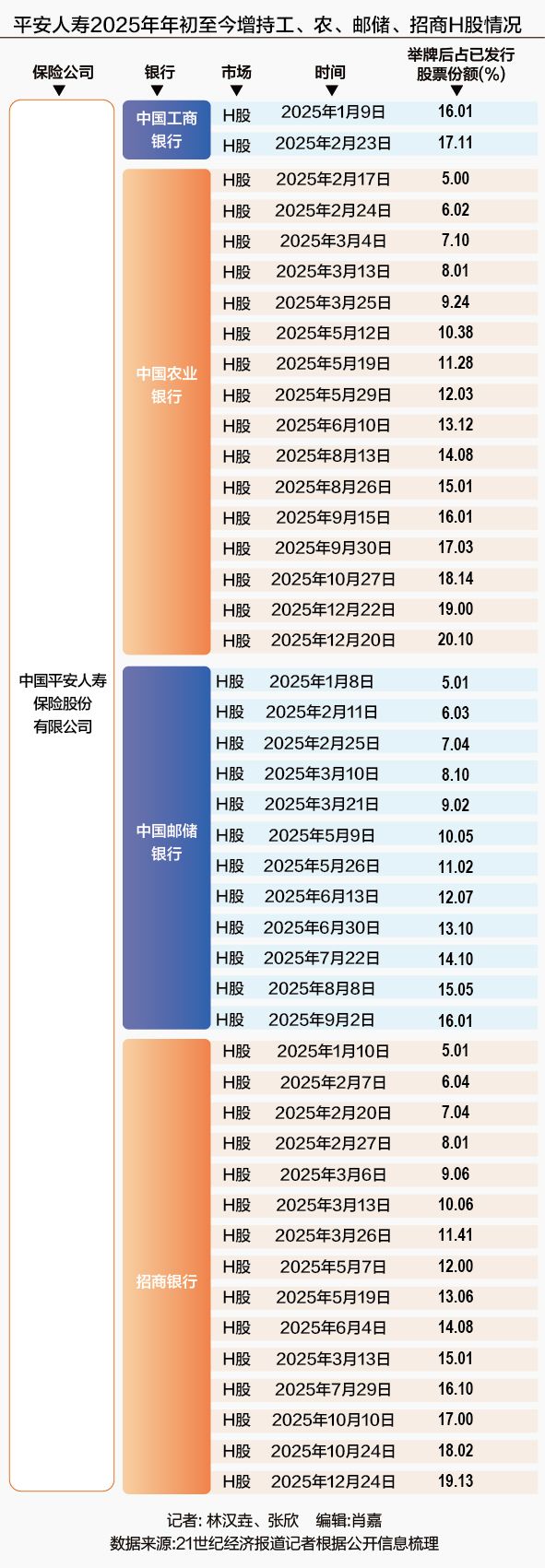
密集增持!平安人寿2025年大举“扫货”银行H股,最爱是农行
2 1 Shi Ji Jing Ji Bao Dao· 2026-01-06 07:36
Core Viewpoint - In 2025, Ping An Life Insurance Company significantly increased its holdings in major bank stocks, particularly Agricultural Bank of China (ABC), reflecting a strategic preference for high-dividend, undervalued financial assets in a declining interest rate environment [1][8]. Group 1: Investment Actions - Ping An Life conducted a total of 16 purchases of ABC H-shares throughout 2025, raising its stake from 5% to 20.10%, an increase of over 15 percentage points within a year [2][6]. - The company also made 2, 12, and 15 purchases of Industrial and Commercial Bank of China (ICBC), Postal Savings Bank, and China Merchants Bank H-shares respectively, indicating a concentrated investment strategy [1][2]. - Notably, on May 12, 2025, Ping An acquired approximately 147 million shares of ABC, pushing its holding to 10.38%, and on December 30, 2025, it added about 95.58 million shares, concluding the year with a total of approximately 4.618 billion shares [2][6]. Group 2: Strategic Rationale - Analysts suggest that Ping An's aggressive accumulation of state-owned bank H-shares reflects a broader trend among long-term investors favoring high-dividend, low-valuation financial assets [8][9]. - The preference for bank stocks is attributed to their low valuations and high dividend yields, aligning with the investment goals of insurance funds seeking stable long-term returns [8]. - Ping An's strategy is further supported by the observation that many bank stocks were trading below their net asset values, allowing for potential accounting gains when held above certain thresholds [9].




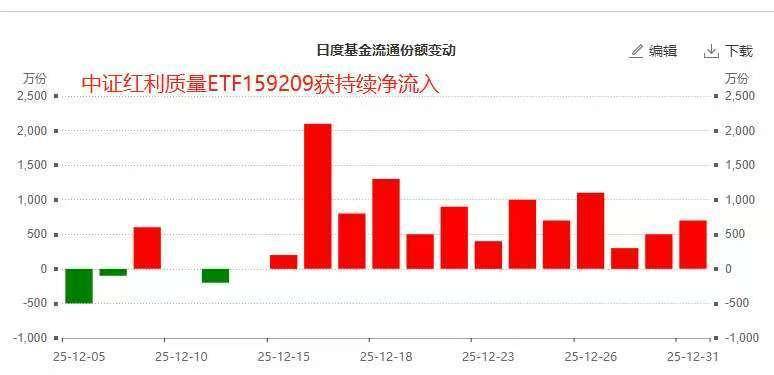
涨超2.7%的红利!主力连续14日爆买中证红利质量ETF(159209)!三七互娱、中国太保大涨
Sou Hu Cai Jing· 2026-01-05 06:40
Group 1 - The core viewpoint of the articles highlights the positive market sentiment, with the CSI Dividend Quality ETF (159209) reaching a new high, reflecting strong investor interest and a continuous inflow of funds for 14 consecutive days [1][2] - The CSI Dividend Quality Index combines "high dividend" and "high quality" factors, focusing on companies with stable dividends, strong profitability, and growth potential, making it an attractive option for investors seeking resilient investment tools in a favorable market environment [2][3] - The ETF features a cost-effective fee structure of "0.15% + 0.05%", which is the lowest in the market, and a monthly dividend assessment mechanism that enhances cash flow for investors, improving the overall holding experience [2][3]

2026年-周期怎么看
2026-01-04 15:35
Summary of Key Points from Conference Call Records Industry Overview - **Construction and Building Materials Industry**: The overall situation shows that orders are relatively sufficient, but funding remains a core constraint on companies' output. Despite the initiation of major projects by the government, these investments are unlikely to yield significant growth due to the vast existing infrastructure stock. [2][3] Core Insights and Arguments - **Investment Recommendations**: - For traditional infrastructure, companies with high dividends and low valuations are recommended, such as China State Construction, Sichuan Road and Bridge, Tunnel Shares, and China National Materials. These companies have strong core competitiveness and stable operations. [2] - In the consumer building materials sector, leading companies are increasing market share and stabilizing operations. Companies like Oriental Yuhong and Rabbit Baby are suggested for left-side positioning. [2][3] - The rise of AI is expected to increase demand for high-end products from companies like China Jushi and China National Materials Technology. [2][3] - **Real Estate Sector**: - The real estate industry is expected to remain a significant stabilizer for the economy, with annual new housing construction projected between 10 million to 14 million units. [2][17] - The development model is shifting towards integrated products, services, and operations, with a focus on housing services and second-hand property transactions. [17][19] - Companies with strong cash flow and comprehensive capabilities, such as China Resources Land and Jinfa Co., are recommended. [20] Additional Important Insights - **Transportation Sector**: - The transportation industry showed positive performance during the 2025 New Year holiday, with significant increases in passenger flow and sales in duty-free shopping. [4][5] - The airline sector is expected to perform well during the 2025 Spring Festival, with ticket prices projected to increase. Companies like Juneyao Airlines and China Spring Airlines are recommended. [5] - **Express Delivery Industry**: - The express delivery sector is viewed positively, especially in overseas markets, with recommendations for Jitu Express and Jiayou International. [6][8] - Domestic express delivery data is pending verification for January and February, with current volumes showing no significant growth. [6] - **Metals and Commodities**: - Recent trends indicate a general increase in prices for non-ferrous metals, with notable rises in diamonds, nickel, and silver. [11] - The investment focus for 2026 includes copper, aluminum, and lithium, driven by macroeconomic policies and supply constraints. [14] - **Coal Sector**: - The coal sector has seen a slight decline but is showing signs of stabilization, with demand from electricity generation and steel production remaining high. [15][16] Conclusion - The conference call highlighted various sectors with distinct investment opportunities and challenges. The construction and real estate sectors are undergoing significant transformations, while transportation and express delivery industries are poised for growth. The non-ferrous metals market is also experiencing upward trends, suggesting potential investment avenues.
寻重大工程“足迹”,挖产业转型“宝藏”
Zhong Guo Neng Yuan Wang· 2026-01-04 02:01
Core Viewpoint - The construction industry is expected to experience a shift in investment dynamics due to policy stimuli and emerging themes, with private enterprises showing significant returns compared to state-owned and central enterprises [1][2]. Group 1: Market Performance - As of November 30, 2025, the SW Construction Decoration Index increased by 8.88%, while the CSI 300 Index rose by 18.19%, indicating that the overall performance of the construction sector lagged behind the broader market [2]. - Private enterprises achieved a return of 35.6%, while local state-owned enterprises had a return of 14.96%, closely aligning with the CSI 300 Index. In contrast, central state-owned enterprises faced a significant decline with a return of -4.51% [2]. Group 2: Future Investment Outlook - The first year of the 14th Five-Year Plan is anticipated to open an investment uptrend, as historical patterns suggest that the initial years of a five-year plan typically see heightened investment intensity [2]. - Major planning and project packages are expected to be implemented in 2026, potentially leading to a new cycle characterized by "high initial growth followed by stabilization" [2]. Group 3: Value Investment Themes - Three main value investment themes are identified: 1. Key projects such as the Pinglu/Zhejiang-Jiangxi-Guangdong Canal (total investment approximately 621.1 billion), the Tibet Railway (expected total investment over 700 billion), and the Yaxi Hydropower Project (total investment around 1.2 trillion) are projected to generate long-term orders [3]. 2. High dividend yields are emphasized as regulatory measures strengthen dividend constraints, enhancing the investment appeal of low-valuation, high-dividend construction firms [3]. 3. Growth transformation opportunities in new sectors like clean rooms, AI computing infrastructure, and low-altitude economy are expected to surge, with cash-rich private enterprises likely to pursue mergers and acquisitions for rapid entry [3]. Group 4: Stock Recommendations - Specific stocks to watch include Sichuan Road and Bridge (600039), Jianghe Group (601886), Honglu Steel Structure (002541), Jinggong Steel Structure (600496), and Pudong Construction (600284) [3].


高股息有望成为投资主线
Sou Hu Cai Jing· 2026-01-02 00:20
Core Insights - In 2025, the Shanghai Composite Index (SSE) briefly surpassed the 4000-point mark, and the total market capitalization of A-shares exceeded 100 trillion yuan for the first time, indicating a significant milestone in the Chinese capital market [2][4][7] - The market experienced a "slow bull" trend, with major indices showing substantial gains: the SSE rose over 18%, the Shenzhen Component Index increased by over 30%, and the ChiNext Index surged by over 50% throughout the year [5] - The total trading volume in A-shares reached a historic high, exceeding 400 trillion yuan for the year, with an average daily trading volume surpassing 1 trillion yuan [6] Market Performance in 2025 - The A-share market saw a remarkable increase in trading activity, with a total trading volume of over 400 trillion yuan and an average daily trading volume exceeding 1 trillion yuan, setting new historical records [6] - The total market capitalization of A-shares reached a peak of over 110 trillion yuan, marking a significant achievement in the market's history [7] - The SSE recorded a nine-day consecutive rise at the end of 2025, establishing a new record for the index [8] Investment Trends and Outlook for 2026 - Looking ahead to 2026, high-dividend blue-chip stocks are expected to be a primary investment theme, alongside high-tech sectors and consumer stocks, which may emerge as the third main investment line [9][11] - The market is anticipated to face challenges as it starts the year near the 4000-point level, with a trading volume of 400 trillion yuan and a financing balance of 2.5 trillion yuan [9] - The government is expected to implement policies aimed at boosting domestic demand and consumption, which could provide investment opportunities in the consumer sector [11]

前券商首席经济学家李大霄展望今年资本市场 高股息有望成为投资主线
Shen Zhen Shang Bao· 2026-01-01 21:49
2025年,沪指一度站上4000点大关,A股总市值首次突破100万亿元,全年累计成交额突破400万亿元,日均 成交额超万亿元。 2026年市场主流热点:一个是高科技,一个是高股息,消费板块有望成为第三条主线。 6 ado Prov a chor e P (8 . . . . - 0 -11-2 x 100 1 il a 李大霄 深圳商报记者钟国斌 2025年,A股总市值突破100万亿元,为A股市场历史上首次;最高总市值突破110万亿元,创历史新高。 2025年,沪指年末9连阳,创出一个新的纪录。A股共有3次8连阳以上,年末创下9连阳。 2025年收官之际,前券商首席经济学家李大霄接受了深圳商报记者专访,畅谈2025年中国资本市场特点,展 望2026年中国资本市场投资热点。他认为,高股息为代表的蓝筹股或是2026年一条投资主线。 李大霄曾为英大证券研究所所长、首席经济学家。他曾兼任中国证券业协会证券分析师专业委员会委员、投 资顾问专业委员会委员、首席经济学家委员会委员。 2025年,市场在稳步前行中突破4000点 "2025年,中国资本市场在稳步前行中突破重要关口!"李大霄表示,沪指一度站上4000点大关,A股 ...

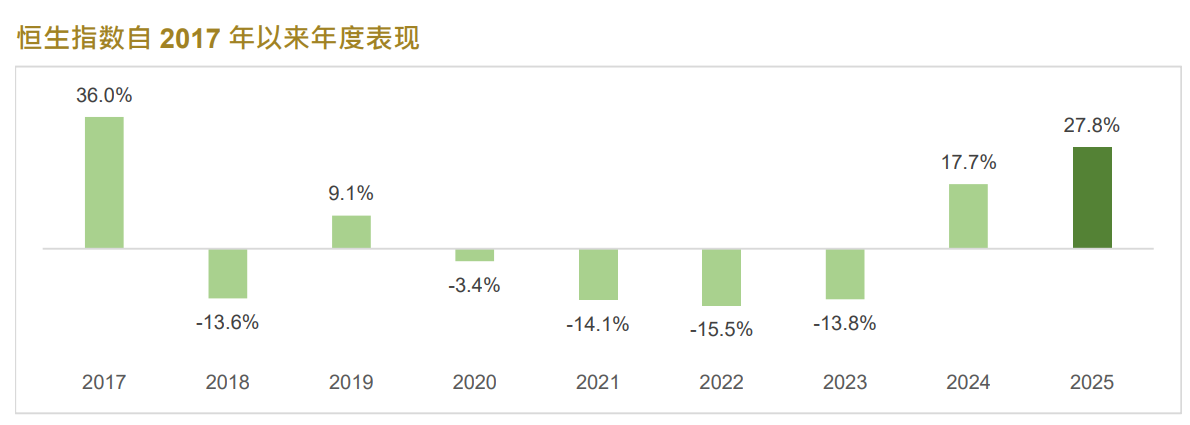
恒指公司:2025年恒指上升27.8% 为2017年以来最佳表现
智通财经网· 2025-12-31 12:07
Group 1 - The Hang Seng Index (HSI) rose by 27.8% in 2025, marking its best performance since 2017, following a 17.7% increase in 2024 [1] - The rise in the HSI was driven by record capital inflows from the Hong Kong Stock Connect, optimism about the future of artificial intelligence, and interest rate cuts [1] - The HSI outperformed two other flagship indices: the Hang Seng China Enterprises Index (up 22.3%) and the Hang Seng Tech Index (up 23.5%) [1] Group 2 - The Hang Seng Composite Index (HSCI) increased by 31.0% in 2025, with mid-cap stocks leading the gains at 31.6%, followed by large-cap stocks at 30.8% and small-cap stocks at 28.8% [2] - Among industry indices in the HSCI, the materials sector had the best performance, rising by 161.3%, while utilities had the worst performance with a 5.7% increase [2] - The Hang Seng High Dividend Yield 30 Index led the high dividend indices with a rise of 38.1% in 2025 [2] Group 3 - The Hang Seng Climate Change 1.5°C Target Index performed well, with an annual increase of 31.2% [3]
高股息为盾,静待价值修复
Xiangcai Securities· 2025-12-31 08:21
证券研究报告 2025 年 12 月 31 日 湘财证券研究所 行业研究 银行业年度策略 高股息为盾,静待价值修复 相关研究: 行业评级:增持(维持) 近十二个月行业表现 % 1 个月 3 个月 12 个月 | 相对收益 | -4.85 | 4.99 | -10.62 | | --- | --- | --- | --- | | 绝对收益 | -2.10 | 5.22 | 5.69 | 分析师:郭怡萍 证书编号:S0500523080002 Tel:(8621) 50295327 Email:guoyp@xcsc.com 中国人寿金融中心10楼 核心要点: 市场回顾 今年银行板块行情节奏呈现"前强、中弱、后稳"的走势,主要反映从避 险主导到寻求增长的市场风格转换过程,以及资产风险预期的变化。 政策导向:宽松政策过渡期,金融支持实体经济 | 1. | 《2025年中期策略-价值重估仍 | | --- | --- | | 在进行时》 | 2025.07.02 | | 2. | 《业绩底部修复,配置价值提 | | 升》 | 2025.09.05 | 2026 年,政策环境正从此前的超常规逆周期调节模式,向更具稳定性和 ...
展望2026:宏观环境、产业趋势与投资配置新思路
Mei Ri Jing Ji Xin Wen· 2025-12-31 02:33
Group 1 - The macro environment for next year may continue with fiscal policies such as trade-in programs and consumer subsidies, while overseas liquidity is expected to be supported by the Federal Reserve's interest rate cuts [1] - Concerns about whether AI has entered a bubble phase are prevalent, with significant adjustments in the US stock market and worries about cash flow and debt issues among cloud companies [1] - However, compared to the internet bubble in 2000, the cash flow, profitability, and profit margins of leading overseas cloud companies are healthier, with capital expenditure growth expected to reach 30% to 40% next year [1] Group 2 - Some growth sectors' earnings expectations for next year are already priced in, while high dividend and high cash flow assets have lagged behind, making them attractive for investment [2] - The recommendation is to diversify investments, especially for sectors with high floating profits, to achieve a better investment experience during potential market fluctuations [2] Group 3 - The direction of the Federal Reserve's interest rate cuts is relatively clear, which may lead to a more accommodative overseas liquidity environment, benefiting technology growth sectors [3] - Domestic monetary policy is expected to remain moderately loose, with potential for further rate cuts, which would favor high dividend and high cash flow assets [3] - Historical data shows a negative correlation between high dividend assets and domestic bond yields, suggesting that a decline in bond yields could enhance the attractiveness of high dividend assets in the A-share market [3] Group 4 - High dividend and high cash flow assets are becoming the core of investment allocation, with specific ETFs like cash flow ETF (159399) and dividend state-owned enterprise ETF (510720) offering distinct advantages [4] - The current market is undergoing valuation adjustments, and long-term funds are encouraged to accumulate positions at lower prices, with a balanced allocation being more suitable for the market outlook in 2026 [4]