自动驾驶

Search documents
金元证券每日晨报-20260115
Jinyuan Securities· 2026-01-15 01:54
2026 年 01 月 15 日 每日晨报 | 指数 | 开盘价 | 收盘价 | 近一交易日% | 近20交易日% | | --- | --- | --- | --- | --- | | 道琼斯工业 | 49,088 49,150 | | -0.09 | 1.51 | | 纳斯达克 | 23,564 23,472 | | -1.00 | 1.80 | | 标普500 | 6,937 | 6,927 | -0.53 | 1.62 | | 富时100 | 10,137 10,184 | | 0.46 | 5.55 | | 日经225 53,827 54,341 | | | 1.48 | 8.36 | | 上证综指 | 4,139 | 4,126 | -0.31 | 6.67 | | 深证成指 | 14,194 14,249 | | 0.56 | 8.67 | | 科创50 | 1,479 | 1,501 | 2.13 | 13.80 | | 恒生指数 | 26,972 27,000 | | 0.56 | 3.94 | | 主要市场股指表现 | | | | | | 15.00 (%) | | 近一交易日% | 近2 ...
港股早评:三大指数低开,AI应用概念股走低,自动驾驶概念股活跃,AI医疗继续活跃,携程集团跌近15%
Ge Long Hui· 2026-01-15 01:47
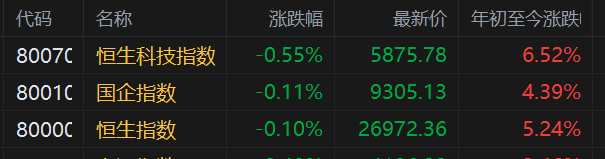
Market Overview - The technology sector in the US stock market has experienced a sell-off, leading to two consecutive days of decline [1] - Silver prices have dropped below $93, while crude oil has seen a significant decline [1] Hong Kong Stock Market - The three major indices in Hong Kong opened lower, with the Hang Seng Index down by 0.1%, the National Index down by 0.11%, and the Hang Seng Technology Index down by 0.55% [1] - Major technology stocks showed minor fluctuations, with Baidu, Meituan, and JD.com each rising by less than 1%, while Tencent and Alibaba experienced declines [1] Sector Performance - AI application stocks, which had shown strong performance previously, mostly declined, and wind power stocks continued to fall due to ongoing investigations [1] - Ctrip's stock fell nearly 3% [1] - Positive policy developments in the industry have led to increased activity in the autonomous driving sector, with stocks like Youjia Innovation and Zhejiang Shibao (002703) seeing significant gains [1] - AI healthcare stocks remain active in the market [1] Index Performance - Hang Seng Technology Index: -0.55%, latest price at 5875.78, year-to-date change of 6.52% [1] - National Index: -0.11%, latest price at 9305.13, year-to-date change of 4.39% [1] - Hang Seng Index: -0.10%, latest price at 26972.36, year-to-date change of 5.24% [1]


三星抢了高通芯片大客户?
半导体行业观察· 2026-01-15 01:38
Core Viewpoint - Samsung has made a significant breakthrough in the automotive sector by being selected to provide 5G connectivity for Tesla's upcoming autonomous vehicle fleet, marking a shift in the electric vehicle supply chain [1]. Group 1: Partnership Details - Samsung Electronics will supply in-vehicle 5G modems to Tesla, marking the first time Samsung has provided such technology for automotive applications [3]. - The collaboration began in May 2023 during a meeting between Samsung's chairman and Tesla's CEO, where they discussed cooperation in AI chips and automotive communication components [4]. - The first batch of chips is expected to be used in Tesla's Robotaxi fleet operating in Texas, with potential expansion to other models [3][2]. Group 2: Technical Challenges and Developments - The 5G modems for automotive use must withstand extreme temperatures, vibrations, and have a lifespan exceeding ten years, which Samsung has reportedly achieved [1][3]. - Samsung's System LSI division has completed the development of the 5G modem and is currently in the testing phase, with supply expected to start in the first half of the year [3]. Group 3: Strategic Implications - Tesla aims to reduce its reliance on Qualcomm by diversifying its supplier base, which is part of a broader strategy to restructure its supply chain away from single-region dependencies [1][4]. - The partnership with Samsung is seen as a potential opportunity for Samsung to expand its modem business from smartphones to the automotive sector, especially as Tesla leads in full self-driving technology [5]. Group 4: Geopolitical Context - Tesla's decision to partner with Samsung is influenced by its "OOC/OOT" policy, which aims to exclude components produced in mainland China and Taiwan from its supply chain [5]. - This strategy reflects the ongoing geopolitical tensions and the need for American companies to diversify their supply chains amid rising risks [5][6].

上海推“模速智行”行动计划,自动驾驶产业有望迎来加速发展(附概念股)
Zhi Tong Cai Jing· 2026-01-15 01:09
Core Insights - Shanghai has launched the "Mosu Zhixing" action plan to promote high-level autonomous driving, focusing on technology innovation and industrial competitiveness [1][2] - The plan aims to establish public service platforms, including a digital twin training ground for autonomous driving, and expand the open area for autonomous driving to 2,000 square kilometers [1] - The initiative is expected to facilitate the demonstration of L3-level autonomous vehicles and promote their commercial application [2] Industry Development - Shanghai has been proactive in advancing the autonomous driving industry, with previous initiatives such as the 2022 implementation plan for smart connected vehicles and the issuance of road testing licenses for driverless vehicles in 2023 [2] - The action plan includes organized trials for L3-level autonomous taxis and aims to gradually scale up the production and application of L3 vehicles [2] - The demand for advanced autonomous driving components, such as chips and lidar, is anticipated to grow rapidly as the ecosystem expands [3] Company Progress - Several domestic companies, including Changan, BYD, and GAC, have made significant advancements in L3-level autonomous driving, with multiple models receiving road testing permits [4] - Companies like Huawei and GAC have developed solutions and vehicles capable of L3-level autonomous driving, indicating a shift in consumer preferences towards vehicles with advanced driving assistance features [4] - The formal implementation of L3-level autonomous driving regulations is expected to be a key catalyst for industry growth by 2026 [4] Market Opportunities - Companies such as Junsheng Electronics and Seres are actively engaging in strategic partnerships and product launches to enhance their positions in the autonomous driving market [5][6] - The introduction of new Robotaxi services by companies like Cao Cao Mobility marks a significant step towards the commercialization of autonomous driving solutions [6] - The collaboration between ZF and Horizon Robotics to develop L3-level systems is expected to lead to mass production by 2026, highlighting ongoing innovation in the sector [7]
Robotaxi商业化进程展望
2026-01-15 01:06
Summary of Robotaxi Industry Conference Call Industry Overview - The Robotaxi industry is expected to see significant developments in 2026, particularly in major cities like Shenzhen and Shanghai, where the operational areas are projected to expand into urban districts, supported by improved legal and insurance frameworks [1][2]. Key Companies and Their Strategies - Leading domestic Robotaxi companies include Xiaoma Zhixing, Baidu's Luobo Kuaipao, and WeRide, which share similar technological routes but differ in focus: Xiaoma emphasizes stability, Luobo Kuaipao focuses on product diversity and algorithm accuracy, while WeRide excels in control systems [1][3]. - Xiaoma Zhixing is concentrating on a domestic single-vehicle profitability model, whereas WeRide is focusing on international market expansion, indicating a strategic divergence that may influence long-term competitiveness [12]. Technological Maturity and Development - The technological maturity of Robotaxi companies is categorized as follows: Waymo is at T0 level, while Xiaoma, Baidu, and WeRide are at T1 level. New entrants like XPeng and NIO are classified as T3 [4]. - The industry is approaching a plateau in technological advancement, with expectations that the gap between T0 and T1 players will diminish over the next few years [5]. Cost Structure and Future Cost Reduction - The cost of a Robotaxi is approximately 300,000 yuan, with the vehicle itself costing 120,000 to 160,000 yuan, and the remaining costs attributed to sensors and modifications [10]. - Future cost reduction strategies include using cheaper vehicle bodies, decreasing core component prices by 10%-20% annually, and reducing modification costs through increased production [10]. Regulatory and Market Dynamics - The regulatory landscape for Robotaxis is expected to become more favorable, with clearer legal frameworks and insurance policies emerging by 2026 [2]. - The transition from L2 level assisted driving to L4 level fully autonomous driving is complex and requires significant operational mileage and licensing [6]. Competitive Landscape - New entrants like Didi and Cao Cao Chuxing are currently lagging behind established players, with Didi classified in the third tier due to past regulatory setbacks [13]. - The Robotaxi industry is anticipated to shift from a technology-driven focus to an operations-driven model by 2030, where operational capabilities will become critical for success [12]. Deployment Challenges - Deploying Robotaxis in new cities typically requires at least one year, involving multiple stages such as map collection, algorithm adaptation, and road testing [15]. - Each city presents unique traffic conditions and safety requirements, necessitating tailored preparations before operational launch [16]. Future Catalysts - Significant events in 2026 may include Tesla's introduction of Robotaxis in the U.S., which could influence domestic manufacturers to follow suit, potentially altering the existing technological landscape [17][18].

从CES-2026看自动驾驶最新变化
2026-01-15 01:06
Summary of Key Points from the Conference Call Industry Overview - The conference call primarily discusses advancements in the **autonomous driving** industry, particularly highlighted during **CES 2026**. [1][3] Key Companies and Technologies - **Texas Instruments (TI)** introduced low-power chips and a new generation of imaging millimeter-wave radar, achieving a **30% performance improvement** while reducing costs. [1][3] - **Mobileye** launched the **IQ 7 series chips**, which outperform competitors in latency for visual Transformer and neural network models but fall short in floating-point computing power compared to top products like NVIDIA. [1][3] - **Qualcomm** showcased its **8,797 series cockpit platform**, priced around **$700-$800**, with **Li Auto** as the first mass-production partner. [1][6] - **Tesla** shifted its Full Self-Driving (FSD) model to a subscription service, lowering barriers for consumers and creating a new revenue stream. [1][4] - **NVIDIA** released the **AlphaMile model**, which demonstrates the capability to transition from L2 to L4 autonomous driving, thus lowering entry barriers for second and third-tier automakers. [1][11] Market Trends and Predictions - **2026** is anticipated to be a pivotal year for the mass production of **L3/L4 autonomous vehicles**, with traditional brands expected to launch several high-level intelligent driving models around the **Spring Festival**. [1][5] - The shift to subscription models and supportive policies in regions like **Shanghai** is expected to accelerate the adoption of advanced autonomous driving technologies. [1][4] - The **laser radar industry** is experiencing growth due to increased demand from service and industrial robots, with companies like **Hesai Technology** planning to double production capacity. [2][14] Additional Insights - **Qualcomm** views smart cockpits as a core direction for smart vehicle development, emphasizing the importance of differentiated innovation in high-end vehicles. [7] - **NVIDIA**'s advancements in AI and physical simulation are crucial for the development of autonomous systems, with their **COSMO simulator** aiding in generating test scenarios. [10] - The collaboration between companies like **Mobileye** and **Hesai Technology** in the robot and Robotaxi sectors indicates a strategic focus on expanding their market presence. [16] Conclusion - The autonomous driving industry is poised for significant growth, driven by technological advancements, new business models, and supportive regulatory environments. The competitive landscape is evolving, with major players investing heavily to maintain and expand their market positions. [18][19]


哈佛老徐:特斯拉下跌,但我依然认为:2026年是它的「大年」
老徐抓AI趋势· 2026-01-15 01:05
Core Viewpoint - Tesla's recent stock price decline is attributed to fourth-quarter delivery numbers falling short of market expectations, raising questions about whether this decline signifies the end of a trend or a predictable fluctuation [2][4]. Timeline Review - The stock price drop was not unexpected, as it followed key events leading up to it [5]. - On October 23, Tesla released its third-quarter earnings report, which initially caused panic in the market. However, the fundamentals were not as poor as perceived, indicating that 2026 would still be a significant year for Tesla [7]. - Following the initial panic, the stock price rebounded from around $420 to nearly $500, but caution was advised due to an impending challenge [8]. Anticipated Challenges - The anticipated challenge was the fourth-quarter sales, which were expected to be pressured due to a "policy overdraft effect" caused by the expiration of U.S. electric vehicle purchase subsidies on September 30. This led to a surge in third-quarter sales, making fourth-quarter performance difficult [9][14]. Market Reactions - The stock price began to decline before the sales data was released because the market anticipated the fourth-quarter pressure, indicating that the decline was more about "expectation fulfillment" rather than a collapse of logic [15]. Key Developments in Autonomous Driving - A significant development is Tesla's recruitment of high-performance computing engineers in Shanghai, indicating preparations for the rollout of Full Self-Driving (FSD) in China [17]. - Elon Musk mentioned during the third-quarter earnings call that FSD is expected to enter the Chinese market in early 2026, which many may have overlooked [19]. Data Regulation and Local Training - For FSD to perform well in China, local data and training are essential due to strict data regulations, necessitating the establishment of local computing centers [20]. - The recruitment of HPC engineers signals a serious commitment to building local infrastructure for FSD, indicating a higher level of certainty regarding this initiative [21]. Market Implications of FSD - If FSD successfully launches in China, it could enhance product differentiation, increase vehicle appeal, and boost software revenue, fundamentally changing the value proposition [23]. - The potential for Robotaxi services could transform asset efficiency and valuation models once autonomous driving reaches a certain maturity [24]. Continuous Monitoring and Adaptation - The analysis emphasizes the importance of ongoing assessment and adaptation in the fast-evolving tech landscape, rather than relying on static predictions [26]. - The focus should be on identifying key signals and maintaining a stable judgment amidst market fluctuations, which is crucial for navigating the investment landscape [32].
宏观金融类:文字早评2026/01/15星期四-20260115
Wu Kuang Qi Huo· 2026-01-15 00:58
Group 1: Report Industry Investment Rating - Not provided in the content Group 2: Report's Core View - For the stock index, at the beginning of the year, incremental funds entered the market, the margin trading scale increased significantly, and the market trading volume quickly expanded. In the long - term, policies support the capital market. In the short - term, focus on the market rhythm and adopt the strategy of buying on dips [4]. - For treasury bonds, the market's improved economic expectations may put pressure on the bond market, but the sustainability of economic recovery needs to be observed. In the first quarter, the bond market is expected to fluctuate weakly due to factors such as the stock market's spring rally, government bond supply, and interest rate cut expectations [7]. - For precious metals, the current international gold price is rising steadily, and the silver price is rising rapidly with significant volatility. It is recommended to hold existing long positions, and there are significant risks in opening new long or short positions [8]. - For non - ferrous metals, most metal prices are expected to fluctuate widely. For example, copper prices are supported by tight supply at the mine end, aluminum prices are affected by overseas low inventory and domestic downstream demand, and nickel prices are constrained by oversupply pressure but supported by macro - factors [12][14][18]. - For black building materials, steel prices are expected to continue to oscillate at the bottom, iron ore prices are expected to oscillate at a relatively high level, and the prices of coking coal and coke are expected to oscillate in the current range [32][34][38]. - For energy and chemicals, rubber can be considered with a neutral strategy, oil prices can be traded with a low - buying and high - selling strategy, and the strategies for other chemicals vary according to their fundamentals [54][56]. - For agricultural products, the short - term trend of hog prices is expected to be stable with partial fluctuations, egg prices may have different trends in the near and far months, and the prices of other agricultural products are also affected by supply and demand and other factors [78][79][81]. Group 3: Summary by Related Catalogs Macro - financial Stock Index - **Market Information**: Three departments held a symposium on new energy vehicle enterprises, Shanghai issued an action plan for high - level autonomous driving, the central bank carried out a 900 - billion - yuan repurchase operation, and tax rebates were offered for housing purchases [2]. - **Strategy**: Buy on dips in the short - term [4]. Treasury Bonds - **Market Information**: The prices of main contracts showed different changes. The central bank carried out a 900 - billion - yuan repurchase operation, and China's export and import data in December 2025 were positive. The central bank's net investment was 212.2 billion yuan [5]. - **Strategy**: The bond market is expected to fluctuate weakly in the first quarter [7]. Precious Metals - **Market Information**: Gold and silver prices rose, and there were differences in the statements of Fed officials. US PPI and retail sales data were released [8]. - **Strategy**: Hold existing long positions, and avoid opening new long or short positions [8]. Non - ferrous Metals Copper - **Market Information**: The domestic equity market fluctuated, copper prices rose, LME copper inventory increased, and the import loss of Shanghai copper expanded [10]. - **Strategy**: Copper prices are expected to oscillate at a high level in the short - term [12]. Aluminum - **Market Information**: The domestic spot market weakened, aluminum prices fluctuated, and inventory increased [13]. - **Strategy**: Aluminum prices are expected to oscillate at a high level in the short - term [14]. Zinc - **Market Information**: Zinc prices rose, and inventory and other data were released [15]. - **Strategy**: Zinc prices are expected to oscillate widely following the non - ferrous sector [15]. Lead - **Market Information**: Lead prices rose, and inventory and other data were released [16]. - **Strategy**: Lead prices are expected to oscillate widely following the non - ferrous sector [16]. Nickel - **Market Information**: Nickel prices fluctuated, and the prices of raw materials such as nickel ore and nickel iron were stable [17]. - **Strategy**: Nickel prices are expected to oscillate widely in the short - term, and it is recommended to wait and see [18]. Tin - **Market Information**: Tin prices rose to the daily limit, supply and demand and inventory data changed [19][20]. - **Strategy**: Tin prices are expected to fluctuate following market sentiment, and it is recommended to wait and see [21]. Carbonate Lithium - **Market Information**: The price of carbonate lithium decreased, and the trading volume and open interest changed [22]. - **Strategy**: Be cautious due to the risk of a significant correction, and it is recommended to wait and see or take a light position [23]. Alumina - **Market Information**: The price of alumina rose, and inventory and other data changed [24]. - **Strategy**: It is recommended to wait and see, and it is not cost - effective to chase long positions. Consider shorting near - month contracts on rallies [25]. Stainless Steel - **Market Information**: Stainless steel prices rose, and inventory decreased [26]. - **Strategy**: Stainless steel prices are expected to oscillate at a high level in the short - term [27]. Cast Aluminum Alloy - **Market Information**: Cast aluminum alloy prices fluctuated, and inventory decreased [28]. - **Strategy**: Cast aluminum alloy prices are supported by cost and supply factors, and may strengthen further [29]. Black Building Materials Steel - **Market Information**: Steel prices fluctuated, and inventory and other data changed [31]. - **Strategy**: Steel prices are expected to continue to oscillate at the bottom, and attention should be paid to market rumors and policy impacts [32]. Iron Ore - **Market Information**: Iron ore prices rose, and supply, demand, and inventory data changed [33]. - **Strategy**: Iron ore prices are expected to oscillate at a relatively high level in the short - term, and attention should be paid to steel mills' restocking and iron - making production rhythms [34]. Coking Coal and Coke - **Market Information**: Coking coal prices rose, and coke prices fell. Spot prices and inventory data changed [35]. - **Strategy**: Coking coal and coke prices are expected to oscillate in the current range, and attention should be paid to market sentiment and policy impacts [38]. Glass and Soda Ash - **Market Information**: Glass prices were stable, and inventory decreased. Soda ash prices rose, and inventory increased [39][41]. - **Strategy**: For glass, it is recommended to wait and see due to high inventory. For soda ash, the market is weak and lacks substantial positive support [40][41]. Manganese Silicon and Ferrosilicon - **Market Information**: Manganese silicon and ferrosilicon prices rose slightly [42]. - **Strategy**: The market is affected by market sentiment and cost factors. Pay attention to manganese ore supply and "dual - carbon" policy impacts [44]. Industrial Silicon and Polysilicon - **Market Information**: Industrial silicon prices rose, and polysilicon prices fell. Supply, demand, and inventory data changed [45][47]. - **Strategy**: Industrial silicon prices are expected to be under pressure, and polysilicon prices are expected to be weak in the short - term. Pay attention to production plans and policy impacts [46][49]. Energy and Chemicals Rubber - **Market Information**: Rubber prices fluctuated, and supply and demand data changed [51][52]. - **Strategy**: Adopt a neutral strategy. If the RU2605 contract falls below 16,000, switch to a short - term short strategy [54]. Crude Oil - **Market Information**: Crude oil and refined oil prices rose, and inventory data showed accumulation [55]. - **Strategy**: Do not be overly bearish on oil prices in the short - term. Adopt a low - buying and high - selling strategy and wait and see for now [56]. Methanol - **Market Information**: Methanol prices changed, and regional spot prices and MTO profits changed [57]. - **Strategy**: Methanol has limited downward space and is suitable for buying on dips [58]. Urea - **Market Information**: Urea prices rose, and regional spot prices and basis data changed [59][60]. - **Strategy**: Take profits on rallies due to expected fundamental bearish factors [61]. Pure Benzene and Styrene - **Market Information**: Pure benzene prices were stable, and styrene prices changed. Supply, demand, and inventory data changed [62]. - **Strategy**: It is possible to go long on non - integrated styrene profits before the first quarter [63]. PVC - **Market Information**: PVC prices fell, and supply, demand, and inventory data changed [64]. - **Strategy**: Adopt a short - selling strategy on rallies in the medium - term due to strong supply and weak demand [65]. Ethylene Glycol - **Market Information**: Ethylene glycol prices rose, and supply, demand, and inventory data changed [66]. - **Strategy**: The supply - demand pattern needs to be improved by increasing production cuts. Be cautious of rebound risks in the short - term [67]. PTA - **Market Information**: PTA prices fell, and supply, demand, and inventory data changed [68]. - **Strategy**: PTA is expected to enter the Spring Festival inventory accumulation stage after short - term inventory reduction. Pay attention to mid - term long - buying opportunities [69]. p - Xylene - **Market Information**: PX prices fell, and supply, demand, and inventory data changed [70][71]. - **Strategy**: PX is expected to maintain a small inventory accumulation pattern before the maintenance season and follow crude oil for mid - term long - buying opportunities [72]. Polyethylene (PE) - **Market Information**: PE prices rose, and supply, demand, and inventory data changed [73]. - **Strategy**: Go long on the LL5 - 9 spread on dips as the long - term contradiction shifts to production mismatch [74]. Polypropylene (PP) - **Market Information**: PP prices rose, and supply, demand, and inventory data changed [75]. - **Strategy**: The PP price may bottom out in the first quarter of next year as the supply - surplus pattern changes [76]. Agricultural Products Hogs - **Market Information**: Hog prices were stable with partial fluctuations [78]. - **Strategy**: The short - term spot price has limited downward momentum, and the mid - term supply is large. Consider short - selling on rallies and long - buying on dips in the long - term [79]. Eggs - **Market Information**: Egg prices were stable with some increases [80]. - **Strategy**: Short - sell near - month contracts on rallies and be cautious of over - valued far - month contracts [81]. Soybean and Rapeseed Meal - **Market Information**: Protein meal prices fell, and supply, demand, and inventory data changed [82]. - **Strategy**: Maintain a wait - and - see attitude in the short - term [83]. Oils and Fats - **Market Information**: Oil prices fluctuated, and supply, demand, and inventory data changed [84][85]. - **Strategy**: The current fundamentals are weak, but the long - term outlook is optimistic, and oil prices may be near the bottom [86]. Sugar - **Market Information**: Sugar prices rebounded, and supply, demand, and inventory data changed [87][88]. - **Strategy**: Wait for the international sugar price to rebound after the northern hemisphere's harvest in February. Temporarily wait and see in the domestic market [89]. Cotton - **Market Information**: Cotton prices rose, and supply, demand, and inventory data changed [90][91]. - **Strategy**: The 1 - month USDA report is neutral. Wait for a pullback to go long on Zhengzhou cotton [92].
特斯拉从“卖车”转向“软件SAAS”?马斯克:FSD将暂停“一次性付费模式”,只接受“按月订阅”
Hua Er Jie Jian Wen· 2026-01-15 00:42
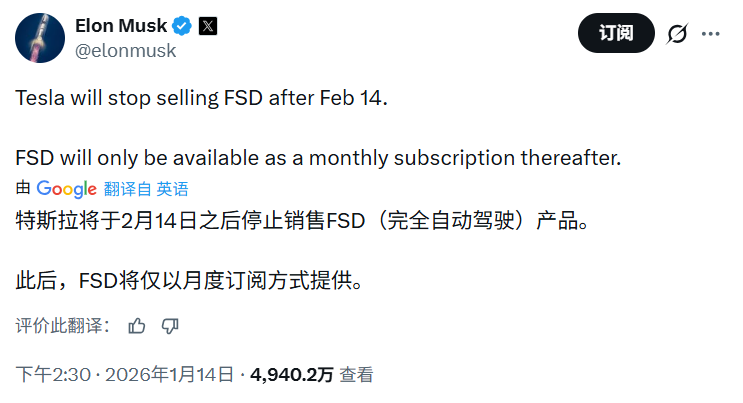
Core Viewpoint - Tesla CEO Elon Musk announced that the company will stop selling the Full Self-Driving (FSD) system as a one-time purchase and will only offer it as a monthly subscription service starting February 14 [1][2] Group 1: Strategic Shift - The decision reflects Tesla's strategic shift from primarily selling electric vehicles to focusing on autonomous driving and robotics, while seeking to expand high-margin subscription revenue [2] - Tesla's stock price fell by 1.8% following the announcement [2] Group 2: Sales and Subscription Details - In 2025, Tesla's sales are projected to decline by 9%, with a 16% year-over-year drop in fourth-quarter sales. Currently, electric vehicle sales account for three-quarters of Tesla's revenue [5] - As of the end of 2025, approximately 12% of Tesla vehicles will have either a monthly or lifetime subscription for FSD [5] - The FSD system is currently available in the U.S. for $8,000 as a one-time payment or $99 per month as a subscription [6] Group 3: FSD System Capabilities - The FSD system assists drivers with lane changes and navigation around other vehicles and objects but does not enable fully autonomous driving, requiring driver attention at all times [6][7] - Despite progress in autonomous driving, the commercial version of FSD has not achieved full autonomy, as it can navigate streets and park automatically but may require the driver to take over in case of issues [7] Group 4: Customer Hardware Issues - Early Tesla users with older models cannot access the latest software versions due to outdated hardware [9] - Tesla has acknowledged the need for hardware upgrades to address these customers' issues but has not specified a timeline or method for resolution [9]
新华财经早报:1月15日
Zhong Guo Jin Rong Xin Xi Wang· 2026-01-15 00:21
转自:新华财经 •上海市经济和信息化委员会等部门印发《上海高级别自动驾驶引领区"模速智行"行动计划》。其中提到,按照"模型驱动引领、应用示范带动、产业协同发 展、政策举措支撑"的总体思路,推动自动驾驶技术创新向产业竞争力加速转化。到2027年,高级别自动驾驶应用场景实现规模化落地,公共服务平台有力 支撑行业创新,关键技术和产业规模达到国际领先水平,形成具有国际竞争力和影响力的智能网联汽车产业集群,基本建成全球领先的高级别自动驾驶引领 区。(新华财经) •从80%上调至100% 沪深北交易所调整融资保证金比例 促进市场长期健康发展 •三部门部署规范新能源汽车产业竞争秩序相关工作 坚决抵制无序"价格战" 加强成本调查和价格监测 •财政部、税务总局、住房城乡建设部:延续实施支持居民换购住房有关个人所得税政策 •财政部、国家税务总局、住房城乡建设部1月14日对外发布公告称,自2026年1月1日至2027年12月31日,对出售自有住房并在现住房出售后1年内在市场重 新购买住房的纳税人,对其出售现住房已缴纳的个人所得税予以退税优惠。根据公告,享受优惠政策的纳税人须同时满足以下条件:纳税人出售和重新购买 的住房应在同一城市 ...