新消费

Search documents
科沃斯(603486):收入业绩高增 被忽视的新消费公司
Xin Lang Cai Jing· 2025-07-11 12:29
Core Insights - The company expects to achieve a net profit attributable to shareholders of 960-990 million yuan for the first half of 2025, representing a year-on-year increase of 57.64% to 62.57% [1] - The company anticipates a revenue growth of approximately 25% year-on-year for the first half of 2025, with a nearly 40% increase expected in the second quarter [1] - The company has improved its profit margins significantly through operational efficiency and product structure optimization [2] Financial Performance - The expected net profit for Q2 2025 is between 48.532-51.532 million yuan, with a year-on-year growth of 55.9% to 65.6% [1] - The net profit margin for Q2 2025 is projected to be 9.9% to 10.5%, an increase of 1 to 1.6 percentage points year-on-year [2] - The company forecasts net profits attributable to shareholders of 2.02 billion yuan, 2.46 billion yuan, and 2.9 billion yuan for the years 2025, 2026, and 2027, respectively [3] Business Growth - The core business has performed well, with new business segments contributing significantly to revenue growth [3] - The introduction of innovative products, particularly the X and T series of vacuum robots, has led to strong sales and market recognition [1] - The company’s new product categories have maintained high growth momentum, with the Ecovacs brand seeing over 60% revenue growth in Q2 2025 [1]

轻工消费2025年夏季策略:新消费需求多点迸发,竞争格局重构进行时
Shenwan Hongyuan Securities· 2025-07-11 11:44
Group 1 - The report highlights the emergence of new consumer demands driven by generational changes, with the Z generation becoming the main consumer force, leading to a restructuring of the competitive landscape in the consumer goods sector [3][5][11] - The growth of domestic brands is emphasized, particularly in categories such as personal care, pet products, and home goods, where companies like Baiya Co., Ltd. and Dengkang Oral Care are gaining market share through innovative products and effective marketing strategies [5][19][24] - The report identifies significant opportunities in the AI-driven product categories, such as AI mattresses and AI glasses, which are expected to see high growth in the medium to long term [5][19][29] Group 2 - The housing market is projected to stabilize, with policies encouraging home upgrades and replacements, which will drive demand for home goods, particularly in the AI mattress segment [6][9] - The packaging industry is undergoing a global supply chain restructuring, leading to accelerated consolidation and improved profitability for leading companies [7][10] - The report notes that the export sector is expected to see a reduction in the impact of tariff policies, allowing for better growth prospects in overseas markets [10][19] Group 3 - The report discusses the rise of IP-derived products, particularly in the emotional consumption space, where younger consumers are increasingly drawn to products that fulfill social and emotional needs [34][37][43] - Companies like Bluku and Chengyuan Co., Ltd. are highlighted for their innovative approaches in the IP toy market, leveraging strong brand partnerships and diverse product offerings to capture market share [44][49][56] - The report emphasizes the importance of digital marketing and e-commerce strategies in driving sales for companies in the consumer goods sector, particularly in the context of changing consumer behaviors [50][52][61]


香港金管局总裁,重磅发声!
Zhong Guo Ji Jin Bao· 2025-07-11 11:21
Group 1 - The Hong Kong Monetary Authority (HKMA) Chief Executive, Eddie Yue, indicated a potential increase in Hong Kong dollar interbank rates due to reduced liquidity and recent triggers of the "weak side convertibility guarantee" [12] - As of July 11, the one-month interbank rate rose to 1.08%, while the overnight rate adjusted from near zero to 0.09% [12] - The HKMA emphasized the importance of monitoring financial market changes and maintaining monetary stability through the linked exchange rate system [12] Group 2 - The Hong Kong stock market showed mixed performance on July 11, with the Hang Seng Index rising by 0.46% to 24,139.57 points and the Hang Seng Tech Index increasing by 0.61% to 5,248.48 points [2] - Major blue-chip stocks like WuXi AppTec surged by 10.46%, while some consumer stocks like Lao Pu Gold and Pop Mart experienced declines of 11.42% and 4.14%, respectively [5][8] - The brokerage sector saw significant gains, with Zhongzhou Securities soaring by 47.47% and other firms like Guolian Minsheng and Hengtou Securities also posting substantial increases [2][4]



上半年私募圈十大黑马!新消费、北交所、黄金等均被捕获!3500点只是牛市起点?
私募排排网· 2025-07-11 10:27
Core Viewpoint - The article highlights the performance of top private equity firms in the A-share market during the first half of 2025, categorizing them into subjective, quantitative, and mixed strategies, providing insights for investors [2][3]. Group 1: Top Subjective Private Equity Firms - In the first half of 2025, the average return of subjective private equity firms with assets under management below 2 billion was 10.27%, significantly outperforming the CSI 300 index [3]. - The top ten subjective private equity firms include: Fuyuan Capital, Nengjing Investment Holdings, Binli Investment, Weifang Fund, Chenyao Private Equity, Jiu Private Equity Fund, Youbo Capital, Rongshu Investment, Beiheng Fund, and Beijing Xiyue Private Equity [3][4]. - Fuyuan Capital's eight products had a total scale of approximately 7.23 million, achieving an impressive average return of ***% in the first half of the year, primarily focusing on Hong Kong's new consumption sector [4][5]. Group 2: Top Quantitative Private Equity Firms - The average return of quantitative private equity firms with assets under management below 2 billion was 8.64%, also outperforming the CSI 300 index [7]. - The top ten quantitative private equity firms include: Liangchuang Investment, Jinwang Investment, Zhixin Rongke, Guangzhou Tianzhanhan, Xiangmu Asset, Shanghai Zijie Private Equity, Guangyi Wanda Private Equity, Quancheng Fund, Anzi Fund, and Hongtong Investment [7][8]. - Liangchuang Investment's three products had a total scale of approximately 2.68 million, achieving an average return of ***% [8][9]. Group 3: Top Mixed Strategy Private Equity Firms - The average return of mixed strategy private equity firms with assets under management below 2 billion was 10.46%, indicating strong overall performance [10]. - The top ten mixed strategy private equity firms include: Qinxing Fund, Shenzhen Zeyuan, Yaoling Capital, Shanghai Geru Private Equity, Zhongmin Huijin, Huanle Port Bay, Zheyun Private Equity, Manfeng Asset, Guangzhou Qianquan Private Equity, and Alpha Private Equity [10][11]. - Qinxing Fund's four products had a total scale of approximately 0.49 million, achieving an average return of ***% and focusing on Hong Kong investments [11][12].

国泰海通证券吴信坤:港股下半年牛市可期 关注四类稀缺性资产
2 1 Shi Ji Jing Ji Bao Dao· 2025-07-11 10:04
Core Viewpoint - The Hong Kong stock market has shown resilience and vitality, with the Hang Seng Index and Hang Seng Tech Index rising by 20% and 18.68% respectively in the first half of 2025, driven by significant inflows of southbound funds [1][2] Group 1: Market Performance - The Hong Kong stock market has outperformed globally, entering a technical bull market, primarily due to the revaluation of Chinese assets and the alignment with the rapid development of AI and consumption upgrades [1][3] - Southbound funds have significantly contributed to the market's strength, with net purchases exceeding 730 billion HKD in the first half of the year, nearly double the amount from the same period last year [1][2] Group 2: Characteristics of Southbound Funds - The inflow of southbound funds has been characterized by explosive growth and structural optimization, with institutional funds accounting for about 70% of the total inflow [2][3] - In the first quarter alone, southbound funds reached a record high of 440 billion HKD, indicating strong institutional interest, particularly from public funds and insurance companies [2][3] Group 3: Investment Opportunities - Four categories of scarce assets in the Hong Kong market are highlighted: AI applications, innovative pharmaceuticals, new consumption, and dividend-paying stocks [3][4] - AI-related assets represent over 60% of the market capitalization in the tech sector, making them a focal point for investment as the sector experiences significant growth [4][5] - New consumption assets also account for approximately 60% of the market capitalization in the consumption sector, reflecting changing consumer preferences [4][5] Group 4: Changing Investment Logic - The investment logic for innovative pharmaceuticals has shifted from being concept-driven to being fundamentally driven, supported by policy enhancements and improved R&D capabilities [5][6] - New consumption trends are evolving from short-term themes to long-term structural opportunities, with a focus on products that resonate with younger consumers [6][7] Group 5: Outlook for the Second Half - The Hong Kong stock market is expected to continue its bull market in the second half of the year, supported by ample liquidity and favorable industry cycles [7] - Key investment areas include scarce assets that are unique to the Hong Kong market and closely aligned with current industry trends, particularly in AI applications and dividend stocks [7]

300059,成交额A股第一!
新华网财经· 2025-07-11 09:52
今天,A股三大指数集体上涨,稀土永磁板块全天领涨。午后,有色金属板块走强,大金融股表现分 化,券商股持续活跃,银行股集体调整。 截至收盘,上证指数涨0.01%,深证成指涨0.61%,创业板指涨0.8%, 全天成交额约1.74万亿元,较上 一交易日增加2215亿元 ,超2900只个股上涨。 个股方面,稀土永磁板块中, 北方稀土等多股涨停。 证券板块中, 龙头股中银证券两连板;哈投股 份、中原证券涨停;同花顺数据显示, 东方财富(300059)涨3.07%,总市值3770.8亿元,成交额 263.14亿元,位居A股成交额第一。 有色金属板块中,中色股份、湖南白银等涨停。 国泰海通证券表示,A股或维持区间震荡格局,7月关注政策预期带来的结构性机会。配置上,可以采 取以红利低波类稳健型资产为底仓,以科技、新消费等成长型资产把握收益弹性。 大金融股表现分化 午后,大金融股走势分化。受消息面刺激,证券板块持续活跃,板块内个股全部飘红;银行板块震荡回 调。 | 融 002670 | 15.ZU | +4.10% +5.01% | | --- | --- | --- | | 中信建投 | 25.22 | +3.66% +5. ...

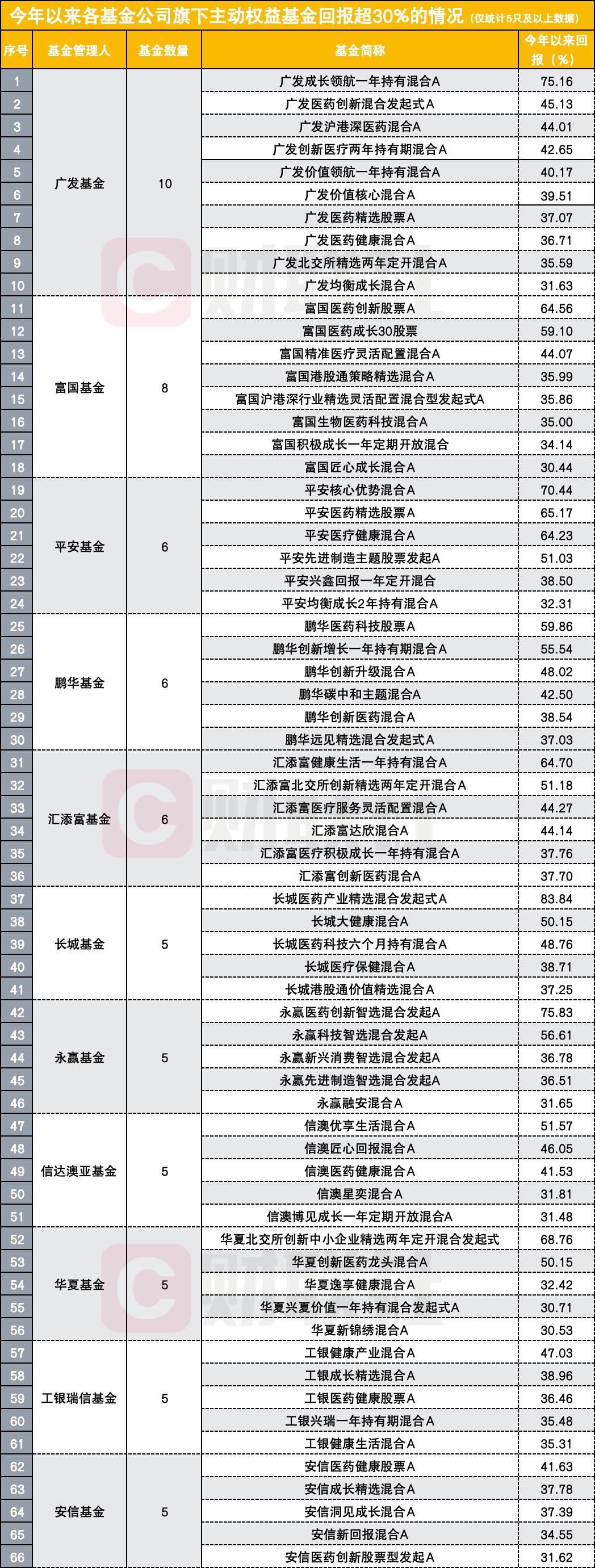
公募基金年内收益百强榜:主动权益占85席,30%以上收益的哪家基金公司最多?
Xin Lang Cai Jing· 2025-07-11 08:50
Core Viewpoint - The active equity funds have shown a strong performance recovery amid the gradual rebound of the stock market, with 85 out of the top 100 performing equity funds being actively managed [1][2]. Group 1: Fund Performance - As of July 10, 2023, the average return of 7,037 equity funds was 7.12%, with nearly 85% (5,940 funds) achieving positive returns, and over 26% (1,841 funds) exceeding 10% returns [2]. - Active equity funds have outperformed passive index funds, with 85 of the top 100 funds being actively managed, contrasting with previous years where passive products dominated [2][3]. - The top-performing funds this year are heavily invested in sectors like AI, humanoid robots, new consumption, and innovative pharmaceuticals, showcasing the ability of active funds to generate alpha [1][2]. Group 2: Fund Companies - The performance concentration effect among leading fund companies has become more pronounced, with 150 active equity products achieving over 30% net value growth this year, primarily from top firms like GF Fund, Fuguo Fund, Penghua Fund, and Huatai-PB [1][4]. - GF Fund leads with 10 products returning over 30%, and 18 products exceeding 20% returns, highlighting its strong performance in the market [5]. - Fuguo Fund has 8 active equity funds with returns over 30%, focusing on sectors such as new consumption and AI [6]. Group 3: Sector Focus - The top ten funds are predominantly focused on the pharmaceutical sector, with funds like Changcheng Pharmaceutical Industry Select and GF Pharmaceutical Innovation leading with returns of 83.84% and 45.13%, respectively [3][9]. - The performance of funds in the pharmaceutical sector has been particularly strong, with several funds achieving returns exceeding 30% [6][7]. Group 4: Market Sentiment and Outlook - Investor confidence in the A-share market is improving, supported by favorable liquidity and risk premiums, with expectations of continued market performance driven by fiscal policies and consumer resilience [10][11]. - The market is anticipated to experience a steady upward trend, with a focus on technology growth, Chinese manufacturing, and new consumption as key areas for investment [11][12].


资管一线 | 国金资管史伟:行业、壁垒和长坡是优质企业三重标准
Xin Hua Cai Jing· 2025-07-11 07:19
Core Viewpoint - The investment logic of high-probability events is emphasized, focusing on identifying quality companies that meet three criteria: industry quality, strong barriers, and broad growth potential [1][4]. Group 1: Investment Philosophy - The investment journey is divided into three phases: initial exploration (2005-2010), self-improvement (2010-2016), and focusing on companies post-2017 [2]. - The importance of macroeconomic direction and respecting market dynamics is highlighted as a foundational investment principle [2]. - The realization that investment should focus on the essence of economic and industry fundamentals rather than market trends is a key learning [2]. Group 2: Criteria for Quality Companies - The first criterion is assessing whether the industry is of high quality, focusing on stable or growing prices rather than just volume increases [4]. - The second criterion emphasizes the necessity of high barriers to entry, which prevent low-level competition and allow companies to maintain profitability [4]. - The third criterion is identifying industries with long-term growth potential, which should align with economic development trends [4]. Group 3: Focus Areas for Investment - The technology sector, particularly artificial intelligence (AI), is identified as a core investment theme, with expectations of significant long-term potential [5]. - The innovative pharmaceutical sector is also highlighted, showcasing China's efficiency in research and development, which could lead to substantial profit margins [5]. - Caution is advised regarding the new consumption sector due to its volatility and the need for alignment between fundamentals and valuations [6].
A500ETF基金(512050)上涨近1%,机构:中国资产有望承接全球资本
Sou Hu Cai Jing· 2025-07-11 07:00
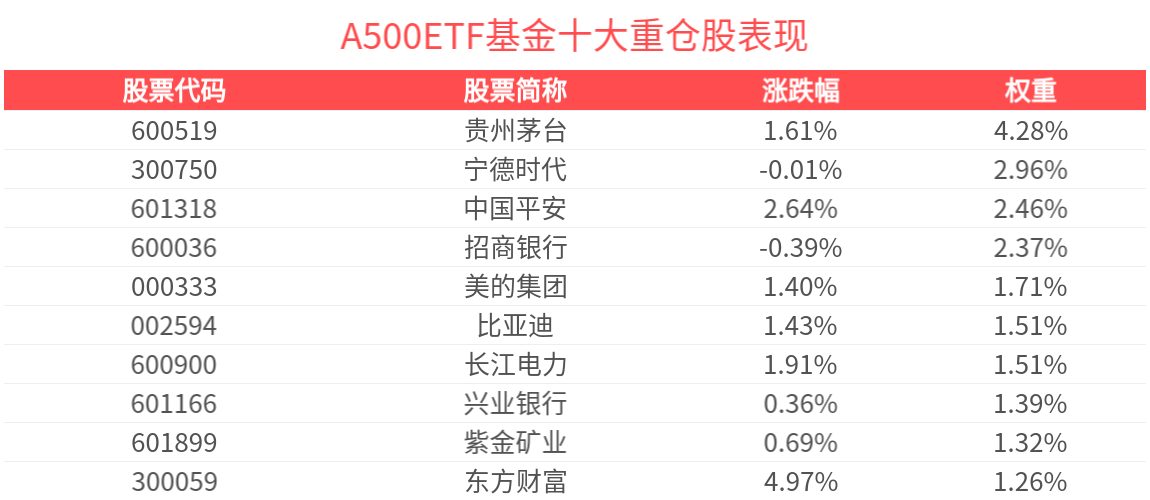
Core Viewpoint - The A500 index and its constituent stocks are experiencing significant upward movement, indicating a positive market sentiment and potential investment opportunities in the Chinese market [1][2]. Group 1: A500 Index Performance - As of July 11, 2025, the A500 index (000510) increased by 0.62%, with notable gains from stocks such as Harbin Electric (10.00%), Baotou Steel (10.00%), Northern Rare Earth (10.00%), and WuXi AppTec (9.99%) [1]. - The A500 ETF fund (512050) rose by 0.72%, with the latest price reported at 0.99 yuan [1]. Group 2: Market Analysis and Future Outlook - Western Securities suggests that the current "anti-involution" phase faces different structural challenges compared to previous cycles, with a more moderate capacity reduction expected than in 2016 [1]. - The economic rebalancing requires not only supply-side adjustments but also demand-side initiatives, emphasizing the importance of upgrading quality supply to stimulate demand [1]. - China is gradually promoting economic transformation, which may attract global capital, especially in the technology and military sectors, as the U.S. "Build Back Better" plan unfolds [1]. Group 3: A500 Index Composition - As of June 30, 2025, the top ten weighted stocks in the A500 index include Kweichow Moutai (4.28%), CATL (2.96%), Ping An Insurance (2.46%), and China Merchants Bank (2.37%), collectively accounting for 20.67% of the index [2][4].






王宁对周杰伦可能有些误解
投中网· 2025-07-11 06:51
Core Viewpoint - The article discusses the emergence of a new era of diversified consumption in China, highlighting the success stories of companies like Pop Mart, Mixue, and Laopuhuangjin, which have transformed from humble beginnings to significant players in the market [2][5][26]. Group 1: Company Backgrounds - Wang Ning, the founder of Pop Mart, initially faced skepticism from investors but eventually achieved a market valuation exceeding 100 billion HKD after listing on the Hong Kong Stock Exchange [4][10]. - Mixue, founded by Zhang Hongchao and his brother, started as a small ice cream stall and has grown to become a major player in the beverage industry, with a market capitalization surpassing 100 billion HKD [4][10]. - Xu Gaoming, the founder of Laopuhuangjin, transitioned from a government job to entrepreneurship, focusing on high-end gold jewelry and successfully carving out a niche in the luxury market [20][21]. Group 2: Market Dynamics - The article emphasizes the importance of emotional value in consumer products, suggesting that companies are not just selling goods but also providing emotional satisfaction to consumers [5][25]. - The rise of these companies coincides with a broader shift in consumer behavior, where individuals seek unique experiences and products that resonate with their identities [26]. - The success of these brands illustrates the potential for growth in the Chinese market, particularly in lower-tier cities, where Mixue has established a significant presence [26]. Group 3: Challenges and Adaptations - Pop Mart faced challenges in its early years, including losing exclusive rights to a key product, which prompted a strategic pivot towards developing its own IP [12][15]. - Mixue encountered internal conflicts regarding expansion strategies, which were resolved through improved communication and decision-making processes between the founding brothers [18][19]. - Laopuhuangjin's rebranding and focus on high-end products allowed it to differentiate itself in a competitive market, leveraging traditional craftsmanship combined with modern design [21][26]. Group 4: Future Outlook - The article suggests that the future of these companies will depend on their ability to adapt to changing consumer preferences and market conditions, as well as their capacity to innovate and maintain brand relevance [27]. - The ongoing evolution of consumer demands presents both opportunities and uncertainties for these brands, highlighting the need for continuous refinement of their business models [26][27].