债券市场

Search documents
哈塞特:美联储有大量降息空间 不止25个基点
Xin Lang Cai Jing· 2025-12-09 14:48
白宫国家经济委员会主任凯文·哈塞特表示,美联储有"大量降息空间"。 当采访者问其这是否意味着超过25个基点时,哈塞特回答说:"没错"。 当被问及债券市场时,哈塞特表示,美联储主席最重要的职责是关注经济数据,避免卷入政治。 新浪合作大平台期货开户 安全快捷有保障 白宫国家经济委员会主任凯文·哈塞特表示,美联储有"大量降息空间"。 当采访者问其这是否意味着超过25个基点时,哈塞特回答说:"没错"。 当被问及债券市场时,哈塞特表示,美联储主席最重要的职责是关注经济数据,避免卷入政治。 新浪合作大平台期货开户 安全快捷有保障 责任编辑:李桐 责任编辑:李桐 ...
存款”落谁家,春水向“中游”——2026年宏观与资配展望
2025-12-08 15:36
Summary of Key Points from Conference Call Industry and Company Overview - The conference call discusses the macroeconomic outlook for China in 2026, focusing on various sectors including the midstream manufacturing industry, real estate, and the overall stock and bond markets. Core Insights and Arguments Economic Growth Projections - The actual GDP growth rate for 2026 is expected to be around 4.8%-4.9%, with nominal GDP growth at approximately 4.5% [5][6][12] - Retail sales growth could reach 4%-4.5% under certain subsidy assumptions, while export growth is projected to maintain resilience at about 5% [5][7] - Fixed asset investment is anticipated to rise from -3.1% this year to a range of 0%-1%, with manufacturing expected to grow by 2% and real estate continuing to decline by -10% to -13% [5][7] Fiscal Policy and Price Trends - Fiscal policy is expected to remain expansionary in 2026, with budget expenditure growth around 5% and new government debt between 1 trillion to 1.5 trillion [6][8] - CPI is projected to gradually rise and turn positive, while PPI trends are uncertain, with potential for stabilization in midstream PPI in the first half of 2026 [6][9][10] Midstream Manufacturing Industry - The midstream manufacturing sector is highlighted as the most promising area, benefiting from a recovery with overseas gross margins surpassing domestic margins for the first time, reaching 25%-30% [13][16] - Demand growth in this sector has outpaced supply growth for over a year, indicating a recovery in return on equity (ROE) [13][16] Stock Market Outlook - A strategic bullish outlook for the stock market in 2026 is maintained, although the pace of valuation increases and the outperformance of the ChiNext index may weaken [21][23] - The focus will shift towards sectors with low valuation percentiles and high dividend yields, such as insurance and home appliances [23][24] Bond Market Perspective - A cautious view on the bond market is expressed, with expectations of rising yields, particularly for ten-year government bonds, which are projected to exceed 2% [26] - The bond market is considered relatively expensive compared to equities, and adjustments are anticipated [26] Additional Important Insights Uncertainties in Policy Implementation - Several uncertainties regarding policy implementation are identified, including the use of special bonds and the structure of long-term special government bonds [8] - The impact of service consumption subsidies on the service sector and overall economic performance remains to be seen [8] Key Timeframes for Investors - Two critical timeframes in 2026 are highlighted: January for CPI expectations and around May for PPI consensus, which are significant for macroeconomic assessments [12] Investment Focus Areas - Investors are advised to focus on sectors with high capacity utilization and low capital expenditure, such as synthetic fibers, black metals, oil and gas, and general equipment [25] - The midstream manufacturing sector is emphasized as the most reliable investment direction due to its current performance and growth potential [20] Future of Real Estate Market - The real estate market's future remains uncertain, with a need for policy support to stabilize prices, especially given the current oversupply situation [11] This summary encapsulates the key points discussed in the conference call, providing insights into the economic outlook, sector performance, and investment strategies for 2026.
固定收益市场周观察:资金难收紧,债市难大涨
Orient Securities· 2025-12-08 13:12
固定收益 | 动态跟踪 资金难收紧,债市难大涨 固定收益市场周观察 研究结论 风险提示 政策变化超预期;货币政策变化超预期;经济基本面变化超预期;信用风险暴露超预 期;数据统计可能存在遗漏 | △ * = li | | --- | 报告发布日期 2025 年 12 月 08 日 | 齐晟 | 执业证书编号:S0860521120001 | | --- | --- | | | qisheng@orientsec.com.cn | | | 010-66210535 | | 杜林 | 执业证书编号:S0860522080004 | | | dulin@orientsec.com.cn | | | 010-66210535 | | 王静颖 | 执业证书编号:S0860523080003 | | | wangjingying@orientsec.com.cn | | | 021-63326320 | | 徐沛翔 | 执业证书编号:S0860525070003 | | | xupeixiang@orientsec.com.cn | | | 021-63326320 | | 债市难以复刻 2020 年末行情:固定收益市 | ...
债市收盘| 万科债券反弹,30年国债收益率盘中最高上行超2BP
Xin Lang Cai Jing· 2025-12-08 09:52
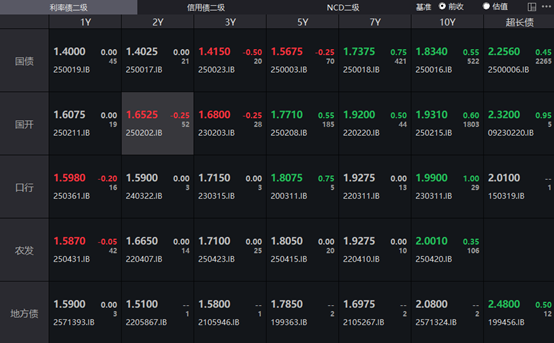
Core Viewpoint - The yield on 30-year government bonds continues to rise, with fluctuations observed throughout the day, indicating a bearish trend in the bond market [1][3]. Group 1: Government Bond Market - The yield on the 30-year government bond active coupon rose by over 2 basis points during the day, with a slight narrowing of the increase in the afternoon [1]. - The closing prices for government bond futures showed a mixed performance, with the 30-year main contract down by 0.29% to 112.240, while the 10-year main contract increased by 0.02% to 107.910 [1]. - As of 16:30, the yield on the 10-year government bond active coupon rose by 0.55 basis points to 1.834%, while the 30-year government bond yield increased by 0.45 basis points to 2.256% [1][2]. Group 2: Market Sentiment and Technical Analysis - Analysts indicate that the 30-year government bond futures have technically broken down, confirming a downward trend, with trading firms continuing to follow this trend [3]. - The market sentiment was slightly calmed by a political bureau meeting, but the bond market still lacks direction, suggesting potential further weakness influenced by upcoming news [3]. Group 3: Central Bank Operations - The central bank conducted a reverse repurchase operation of 122.3 billion yuan at a fixed rate of 1.40%, with a net injection of 14.7 billion yuan for the day [4]. - Short-term Shibor rates have collectively risen, with the overnight rate up by 0.1 basis points to 1.302% and the 7-day rate up by 1.0 basis points to 1.426% [4]. Group 4: Secondary Market Performance - In the secondary market, Vanke bonds showed significant rebounds, with "21 Vanke 04" rising over 31% and "21 Vanke 02" increasing over 23% [2]. - Conversely, some bonds like "22 Vanke 06" and "24 Industrial Integration 08" experienced declines of over 4% [2].


宏观经济和债券市场一周观点:本周信用债发行只数、规模环比下降均超10%,平均发行成本上行8.18BP-20251208
Da Gong Guo Ji· 2025-12-08 07:02
Report Summary 1. Industry Investment Rating - Not mentioned in the provided content 2. Core View - In the week from 2025.11.24 - 2025.11.30, the issuance volume and scale of credit bonds decreased by over 10% week - on - week, and the average issuance cost increased by 8.18BP. The 11 - month composite PMI fell below the boom - bust line, with the non - manufacturing PMI being the main drag on the economy. The central bank's open - market operations led to a net withdrawal of 642 billion yuan, but the end - of - month liquidity was ample and capital prices were stable. There were new bond types issued, and 2 issuers had their main body ratings downgraded [1][4] 3. Summary by Directory 3.1 Macroeconomic Dynamics - **Economic Data**: The November composite PMI output index dropped 0.3 percentage points to 49.7%, the lowest of the year. The manufacturing PMI rose 0.2 percentage points to 49.2%, showing a "weak stabilization" pattern. The non - manufacturing PMI declined 0.6 percentage points to 49.5%, mainly due to the fading of the "National Day" holiday effect and the drag of the real - estate chain [6] - **Funding Situation**: From November 24th to 28th, the central bank conducted 7 - day reverse repurchase operations of 15,118 billion yuan, with 16,760 billion yuan of large - scale reverse repurchases maturing. The MLF was net - injected with 1,000 billion yuan, and the central bank's open - market operations had a net withdrawal of 642 billion yuan. The end - of - month funding was looser, and the DR001 and DR007 averaged 1.31% and 1.46%, respectively, down 11.69BP and 3.5BP from the previous week [7][8] 3.2 Bond Market Observation - **Bond Issuance**: A total of 1,084 bonds were issued in the primary market this week, with a total issuance scale of 18,812.79 billion yuan and a net financing of 4,990.95 billion yuan. The number and scale of credit bond issuances decreased by 13.47% and 11.93% week - on - week respectively, but the net financing remained positive at 2,643.19 billion yuan. The average issuance cost of most bond types increased by 8.18BP [9][10] - **New Bond Types**: On November 28th, Zhejiang Erqing successfully issued the country's first special science - innovation bond to support intelligent ships, with a total issuance scale of 10 billion yuan and a current issuance of 3 billion yuan at a coupon rate of 2.00%. Recently, the science - innovation bond market has been actively innovating, with multiple first - of - its - kind bonds issued [12] 3.3 Risk Warning - **Main Body Rating Downgrade**: This week, the main body ratings of 2 issuers, Vanke Enterprise Co., Ltd. and Vanke Real Estate (Hong Kong) Co., Ltd., were downgraded by S&P [14] - **Main Body Outlook Downgrade**: No issuer's rating outlook was downgraded this week [15]
Asia Market Open: Bitcoin Holds Near $92k, Equities Slip On Fresh Economic Signals
Yahoo Finance· 2025-12-05 03:42
Cryptocurrency Market - Bitcoin is currently held just under $92,000, with traders considering various economic factors including labor data and central bank expectations [1] - The crypto market shows strong resilience, supported by renewed whale accumulation, with ETH whales adding over 450,000 ETH since mid-November [1] - A significant rate cut probability of 93% this month is contributing to buying pressure, with a potential move above $96,000 possibly accelerating Bitcoin's momentum towards $100,000 [1] Asian Markets - Japan's Nikkei 225 fell approximately 1.5%, erasing gains made earlier in the week, while the MSCI Asia Pacific index outside Japan slipped about 0.1% but is on track for a modest weekly gain of around 0.5% [3][4] - Household spending in Japan decreased at the fastest rate in nearly two years in October due to inflationary pressures [4] - The yield on 10-year Japanese government bonds reached 1.94%, the highest since mid-2007, indicating solid demand in recent auctions as investors capitalize on lower bond prices [4] Chinese Markets - Chinese markets displayed mixed results, with the Shanghai Composite down 0.02% and the SZSE Component up about 0.17% [5] - The China A50 index decreased by 0.17%, while DJ Shanghai saw a slight increase of 0.12%, and Hong Kong's Hang Seng index fell by approximately 0.40% [5] European and US Markets - European futures indicated a slightly firmer tone, with DAX futures up about 0.79%, FTSE 100 futures gaining 0.19%, and Euro Stoxx 50 futures adding roughly 0.41% [6] - US stock futures were mixed, with Dow futures down 0.07% and S&P 500 futures up 0.11% [6] - Recent US labor data showed initial jobless claims dropped to the lowest level in over three years, although the Thanksgiving holiday may have influenced the figures [7] Cryptocurrency Prices - Current prices include Bitcoin at $92,387 (down 1.2%), Ether at $3,174 (down 1.1%), and XRP at $2.09 (down 4.6%) [8] - The total cryptocurrency market capitalization stands at $3.22 trillion, reflecting a decrease of 1.3% [8]
每日债市速递 | 央行将开展10000亿买断式逆回购
Wind万得· 2025-12-04 22:35
Open Market Operations - The central bank announced a 7-day reverse repurchase operation on December 4, with a fixed rate of 1.40% and a total amount of 180.8 billion yuan, matching the bidding amount [1] - On the same day, 356.4 billion yuan of reverse repos matured, resulting in a net withdrawal of 175.6 billion yuan [1] Funding Conditions - The interbank market in China continues to show a loose funding environment, with the D R001 weighted average interest rate slightly rising but remaining below 1.3% [3] - Overnight rates in the anonymous click (X-repo) system stabilized at 1.28%, indicating ample supply [3] - Non-bank institutions are borrowing overnight funds secured by credit bonds, with rates fluctuating between 1.43% and 1.47% [3] - In the U.S., the latest overnight financing rate is reported at 4.01% [4] Interbank Certificates of Deposit - The latest transaction for one-year interbank certificates of deposit among major banks is around 1.66%, which is an increase of over 1 basis point from the previous day [8] Government Bond Futures - The 30-year main contract fell by 1.04%, reaching a new low since November 22, 2024 [12] - The 10-year main contract decreased by 0.35% [12] - The 5-year main contract dropped by 0.24% [12] - The 2-year main contract declined by 0.05% [12] Central Bank Announcements - On December 5, the central bank will conduct a 1 trillion yuan buyout reverse repo operation with a 3-month term, matching the amount maturing on the same day [13] - The Ministry of Finance will issue an additional 7 billion yuan of government bonds in Hong Kong on December 10, including 2 billion yuan of 2-year bonds, 3 billion yuan of 3-year bonds, and 2 billion yuan of 5-year bonds [13] Fund Distribution - As of December 3, public funds have distributed dividends over 6,700 times this year, totaling 214.714 billion yuan [14] - Bond funds are the main contributors, with over 4,900 dividend distributions and a total of 155.791 billion yuan, accounting for 72.56% of the total dividends [14] Global Macro Insights - Concerns have been raised among Wall Street bond investors regarding Kevin Hassett potentially becoming the Federal Reserve Chair, fearing aggressive rate cuts to please President Trump [16] - The Bank of Japan's Governor stated that they are working to narrow the estimate range for the neutral interest rate, with expectations of another rate hike this month [16] - South Korea's Ministry of Trade reported that exports are expected to reach a record high of over 700 billion dollars in 2025, driven by strong performance in semiconductors, automobiles, and ships [16] Bond Market Events - The Hong Kong court approved Country Garden's debt restructuring plan, with creditors approving a scheme involving 9 bonds totaling over 13.7 billion yuan [18] - A rescue plan involving 8 billion yuan of common debt is in place for Suning's restructuring, with two major asset management firms planning to revitalize four ongoing projects [18]

11月PMI数据点评:PMI数据对债市的影响中性偏多
Yong Xing Zheng Quan· 2025-12-04 07:49
1. Report's Industry Investment Rating - The report gives a neutral to positive investment rating for the bond market. It suggests that investors may increase their allocation to fixed - income assets such as bonds at the end of the year, and is optimistic about the bond market's performance in the medium term. [4][37] 2. Core Viewpoints - Manufacturing demand drives production recovery, with the November manufacturing PMI rising slightly to 49.20%, but still below the boom - bust line. The new order index and production index have both increased. The improvement in the foreign trade environment due to Sino - US economic and trade consultations has led to an overall recovery in demand, which in turn has accelerated production. [2][13] - The improvement in the international trade environment has led to a recovery in external demand, driving a phased repair of demand. The new export order index and import index have both increased in November, and the BDI index has increased by 31.28%. However, there are still uncertainties in exports that may affect the fourth - quarter economic trend. [2][23] - The manufacturing price end continues to show positive changes. The raw material purchase price index remains in the expansion range, the ex - factory price index has increased, and the inventory of finished products has decreased, which may promote the repair of the manufacturing production end. [3][27] - Non - manufacturing business has slowed down. The service industry PMI has declined due to the high - base effect of the National Day holiday, and the construction industry is still in the contraction range, but infrastructure - related activities continue to grow. [3][34] 3. Summary of Each Section 3.1 Manufacturing Production Shows Slight Repair - In November, the manufacturing PMI was 49.20%, up 0.2 percentage points from the previous value. The new order index rose 0.40 percentage points to 49.20%, and the production index rose 0.3 percentage points to 50.00%. [13] - Among different manufacturing industries, the PMI of high - tech manufacturing remains in the expansion range, while the PMI of equipment manufacturing and consumer goods industries has fallen into the contraction range, and the PMI of basic raw material industries has increased. [13] 3.2 External Environment Drives Demand Recovery - In November, the new export order index was 47.60%, up 1.70 percentage points from the previous value, and the import index was 47.00%, up 0.20 percentage points from the previous value. The BDI index increased by 31.28% in November, indicating an improvement in the external trade environment. [23] - The short - term external environment is easing, but there are still uncertainties in exports that may affect the fourth - quarter economic trend. [23] 3.3 Positive Changes in the Price End Continue - The manufacturing raw material purchase price index remains in the expansion range, and the ex - factory price index has increased. The difference between the two has widened by 0.4 percentage points to 5.40pct. [27] - The raw material purchase price index in November was 53.60%, better than the average of the past five years. The procurement volume index has increased slightly, the ex - factory price index has increased, and the inventory of finished products has decreased. [27] - The economic kinetic energy index in November was 1.90pct, up 1.20 percentage points. The positive recovery in prices may reflect the policy effect of rectifying "involution - style" competition, and the PPI data in November may also show a reaction. [27][29] 3.4 Attention Should Be Paid to Corporate Business Vitality - In November, the PMI of large enterprises was 49.30%, down 0.60 percentage points from the previous value, while the PMI of medium - sized and small enterprises increased by 0.20 and 2.00 percentage points respectively. [32] - The recovery of external demand helps to improve the prosperity of small and medium - sized enterprises, but the prosperity of large enterprises is the guarantee of the overall business vitality of domestic enterprises and needs continuous attention. [32] 3.5 Non - manufacturing Prosperity Declines - In November, the official non - manufacturing PMI was 49.50%, down 0.60 percentage points from the previous value. The service industry PMI was 49.50%, down 0.70 percentage points from the previous value due to the high - base effect of the National Day holiday. [34] - After the concentrated release of consumer demand during the National Day Golden Week, the business activity indexes of consumer - related service industries have declined to varying degrees, but the business activity index and new order index of the financial industry have increased significantly. [34] - The construction industry is still in the contraction range, with the business activity index at 49.60%, up 0.50 percentage points from the previous value. Infrastructure - related activities continue to grow, and investment is expected to strengthen at the end of the year. [35] 3.6 Investment Suggestion - The PMI data has a neutral to positive impact on the bond market. As the market sentiment adjusts, investors may increase their allocation to fixed - income assets such as bonds at the end of the year. In the short term, attention should be paid to policy expectations such as the Politburo meeting, the Central Economic Work Conference, and the Fed's interest - rate meeting. In the medium term, the bond market is expected to perform well. [4][37]
固定收益点评:超长债阴跌,怎么看?
Guohai Securities· 2025-12-03 06:33
Report Summary 1. Core Issues Addressed - Analyze the reasons for the recent decline in the bond market - Provide an outlook for the subsequent market trends [3] 2. Core Views - Interest rate decline requires positive factors for catalysis, and the yield curve may remain steep due to supply - demand dynamics - For band trading, it is advisable to avoid 30 - year treasury bonds for now. If investing in 30 - year treasury bonds, attention should be paid to the potential increase in liquidity of Special 02 and Ordinary 02 in the future - The coupon strategy has relatively higher certainty under loose liquidity conditions [6][8][18] 3. Summary by Section 3.1 Event - In the past month, despite many positive factors in the bond market (weak fundamentals, loose funds, less supply in the fourth quarter, and the traditional year - end front - running behavior of institutions), the market has seen more declines than gains, and ultra - long bonds have performed particularly weakly. As of December 2, 25 Special 02 has reached its highest level since listing [4][13] 3.2 Comments - **Central Bank's Bond Transactions**: In November, the central bank's treasury bond transactions were only 50 billion yuan. After the news was announced, the active 30 - year treasury bond showed a repair of about 0.5 basis points, indicating that the previous pessimistic expectations had materialized. The central bank's bond transactions are mainly for government bond issuance and to maintain liquidity, with limited actual benefits to the bond market [6][14] - **Banks' Bond Sales for Profit - Taking**: This year is the second year with a significantly higher proportion of ultra - long bond supply. As of December 2, the net financing of treasury bonds this year was 4.97 trillion yuan, of which bonds with a maturity of over 10 years accounted for 30% (1.48 trillion yuan), compared with 28% in 2024 and 7% in 2023. Due to duration assessment and profit requirements, banks have a "negative feedback" effect on ultra - long bonds. Some banks, such as rural commercial banks, are unable to absorb more ultra - long bonds, and banks as a whole have the demand to sell old bonds through AC/OCI accounts to realize floating profits [6][15] - **Trading - Desk Negative Factors**: The trading volume of 10 - year treasury bonds has significantly declined, with the daily trading volume of the active 10 - year treasury bond dropping from about 60 billion yuan to about 30 billion yuan. From the CNEX divergence index on December 2, the main selling institutions are funds and securities firms. Public funds are facing the uncertainty of new redemption fee regulations, and securities firms are still short - selling 30 - year treasury bonds by borrowing them [6][8][18] - **Insurance Institutions' Investment Preference**: This year, the main investment of insurance institutions is local government bonds, which may further increase the volatility of 30 - year treasury bonds [8][18]
视说丨10月债券市场发债超6.3万亿元
Sou Hu Cai Jing· 2025-12-02 06:01
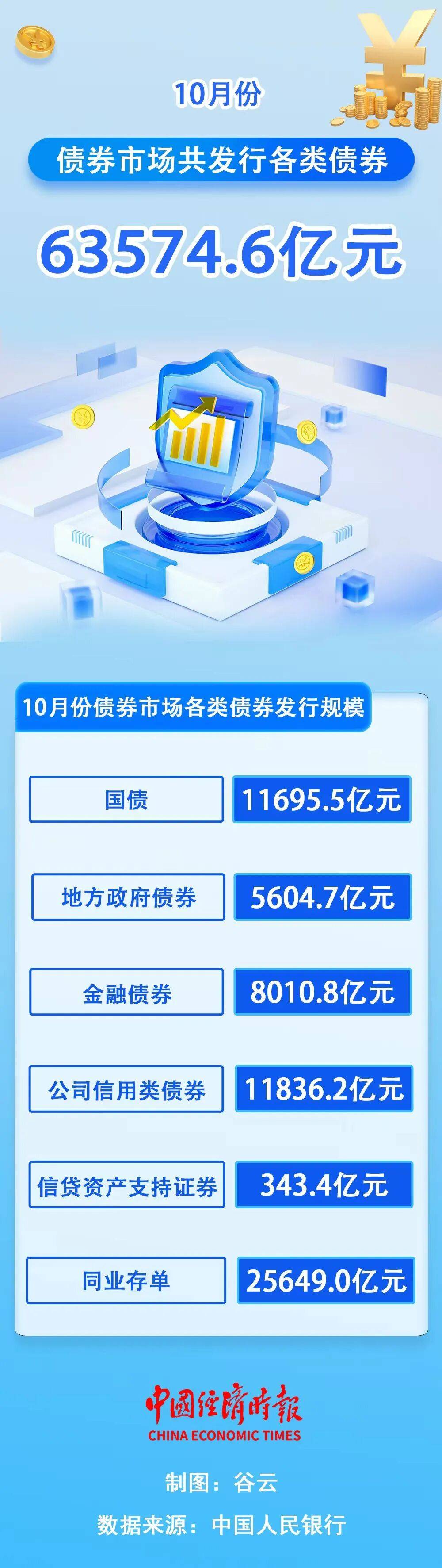
Core Viewpoint - In October, the bond market in China issued a total of 63,574.6 billion yuan across various types of bonds, indicating significant activity in the financial sector [4]. Group 1: Bond Issuance Breakdown - The issuance of government bonds amounted to 11,695.5 billion yuan [4]. - Local government bonds were issued at 5,604.7 billion yuan [4]. - Financial bonds reached a total issuance of 8,010.8 billion yuan [4]. - Corporate credit bonds saw an issuance of 11,836.2 billion yuan [4]. - Credit asset-backed securities totaled 343.4 billion yuan [4]. - Interbank certificates of deposit issued were valued at 25,649.0 billion yuan [4].