弱美元

Search documents
优质红利资产与半导体龙头双因子驱动,亚太精选ETF(159687)打开跨市场配置窗口
Hua Xia Shi Bao· 2025-07-25 06:26
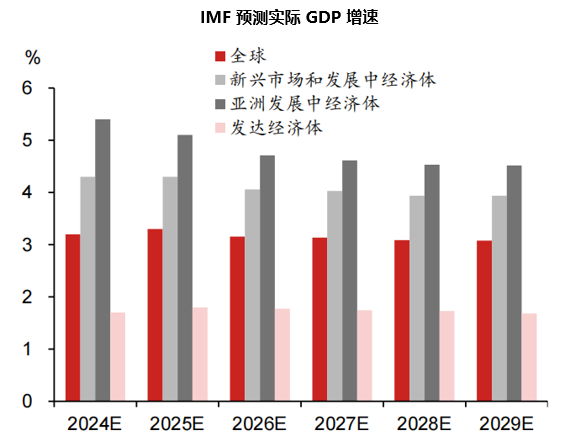
Core Viewpoint - The weakening of the US dollar index in 2025 is leading to a significant restructuring of global capital flows, with major foreign investment firms like BlackRock, Goldman Sachs, and Citigroup expressing optimism about the Asian market [1][3] Group 1: Market Trends - Over 20% of BlackRock's clients are considering reducing their exposure to the US market and dollar assets, with many investors focusing on Asian stock allocation opportunities [1] - Goldman Sachs notes that global investors are seeking more diversified investment configurations due to the weak dollar, with A-shares and Hong Kong stocks being among the beneficiaries [1] - Citi forecasts that despite macroeconomic volatility, Asian stock markets will outperform global peers, predicting a return of approximately 7% for the MSCI Asia (excluding Japan) index by mid-2026 [1] Group 2: Investment Strategies - The Asia-Pacific Select ETF (159687; Class A 021189, Class C 021190) has gained significant market attention, doubling in size since the beginning of the year, focusing on high-dividend assets and leading technology firms [2][6] - The FTSE Asia Pacific Low Carbon Select Index, which the ETF tracks, combines high-dividend assets with growth-oriented semiconductor companies, achieving positive returns in a volatile market over the past three years [2][6] Group 3: Economic Outlook - The IMF predicts that the Asia-Pacific market will continue to lead global economic growth at least until 2029, driven by structural advantages and the weakening dollar [3][5] - The Asia-Pacific market indices are currently valued significantly lower than global and US markets, presenting a high cost-performance ratio for investors [5] Group 4: Sector Analysis - Japan's corporate governance reforms since 2012 are enhancing dividend stability, making Japanese stocks an attractive option for long-term investors amid global uncertainties [8] - The semiconductor industry in the Asia-Pacific region holds a dominant 57.6% market share globally, with significant growth potential driven by technological advancements and increasing demand [9] Group 5: Historical Performance - The Asia-Pacific Select ETF has consistently achieved positive returns over the past three years, validating the effectiveness of its strategy combining high-quality dividend assets and semiconductor leaders [10]

中辉有色观点-20250725
Zhong Hui Qi Huo· 2025-07-25 01:55
Report Industry Investment Ratings - Gold: High-level adjustment, long-term strategic allocation [1] - Silver: Bullish [1] - Copper: Bounce under pressure, long-term optimistic [1] - Zinc: Bounce under pressure, long-term supply increase and demand decrease [1] - Lead: Bounce under pressure [1] - Tin: Bounce under pressure [1] - Aluminum: Bounce under pressure [1] - Nickel: Bounce under pressure [1] - Industrial silicon: Cautiously bullish [1] - Polysilicon: Cautiously bullish [1] - Lithium carbonate: Bullish [1] Core Views - Some tariffs have been implemented, reducing the safe-haven sentiment, leading to an adjustment in gold and silver prices. However, the strong long-term support factors for gold, such as a weak US dollar, interest rate cuts, debt issuance, and central bank gold purchases, still exist [2] - The copper market is affected by a rebound in the US dollar index, with high-level consolidation. In the long term, the tight global copper ore supply and its strategic importance support a positive outlook [5] - The zinc market faces supply surplus and demand weakness during the off-season, with prices under pressure. Long-term, there are opportunities to short on rallies [8] - The aluminum market is pressured by inventory accumulation, and the price rebound is limited. Alumina also shows a similar trend [11] - The nickel market is suppressed by supply factors, and the price is under pressure. Stainless steel also faces inventory pressure during the off-season [13] - The lithium carbonate market is influenced by supply disruptions, and the price remains strong. Low-buying strategies are recommended [14] Summary by Variety Gold - **Core view**: High-level adjustment, long-term strategic allocation [1] - **Main logic**: Short-term tariff risks have landed, reducing the risk and causing a price adjustment. However, Powell's pressure, a medium-term weak US dollar trend, and loose monetary policies of multiple countries, along with continued central bank gold purchases, support long-term investment [1] - **Price range**: 770 - 794 [1] Silver - **Core view**: Bullish [1] - **Main logic**: Supported by economic demand, with increased industrial and physical demand due to loose fiscal policies. Short-term, it is affected by gold's adjustment sentiment [1] - **Price range**: 9250 - 9550 [1] Copper - **Core view**: Bounce under pressure, long-term optimistic [1] - **Main logic**: The US dollar index rebounds, and domestic social copper inventories have decreased seasonally. In the long term, the tight global copper ore supply and its strategic importance support a positive outlook [1][6] - **Price range**: Shanghai copper 78500 - 80500; London copper 9700 - 10000 USD/ton [7] Zinc - **Core view**: Bounce under pressure, long-term supply increase and demand decrease [1] - **Main logic**: In 2025, zinc concentrate supply is abundant, and new smelting capacity is being released. Demand is weak during the off-season [9] - **Price range**: Shanghai zinc 22600 - 23200; London zinc 2750 - 2950 USD/ton [10] Lead - **Core view**: Bounce under pressure [1] - **Main logic**: Affected by maintenance in domestic primary lead smelters and increased losses in secondary lead enterprises, with high social inventories [1] - **Price range**: 16500 - 17200 [1] Tin - **Core view**: Bounce under pressure [1] - **Main logic**: Slow resumption of production in Myanmar's Wa State tin mines during the rainy season, with weak supply and demand in the domestic market and inventory accumulation [1] - **Price range**: 265000 - 273000 [1] Aluminum - **Core view**: Bounce under pressure [1] - **Main logic**: Disturbance from overseas bauxite news, inventory accumulation in domestic aluminum ingots and aluminum rods, and weakening开工率 in the aluminum processing industry [1][11] - **Price range**: 20500 - 21000 [1] Nickel - **Core view**: Bounce under pressure [1] - **Main logic**: Stable overseas nickel ore prices, slowdown in downstream stainless steel production cuts, and inventory accumulation during the off-season [1][13] - **Price range**: 122000 - 124000 [1] Industrial Silicon - **Core view**: Cautiously bullish [1] - **Main logic**: The market is strongly influenced by policies, with an increase in southwest开工率 and stable demand [1] - **Price range**: 9600 - 10000 [1] Polysilicon - **Core view**: Cautiously bullish [1] - **Main logic**: The "sales price not lower than cost" provides strong support, with little change in fundamentals and positive market sentiment [1] - **Price range**: 51000 - 56000 [1] Lithium Carbonate - **Core view**: Bullish [1] - **Main logic**: Little change in fundamentals, sensitive to positive news, and influenced by supply disruptions. Technical indicators are strong [1][15] - **Price range**: 75000 - 80000 [1]
“弱美元”预期强化 人民币汇率积蓄升值动能
证券时报· 2025-07-25 00:03
Core Viewpoint - The article discusses the recent trends in the RMB/USD exchange rate, highlighting the strengthening of the RMB amidst a backdrop of a weakening USD and the implications for RMB internationalization [1][6][9]. Group 1: RMB Exchange Rate Trends - On July 24, the RMB/USD central parity rate was raised by 29 basis points to 7.1385, marking a total increase of 149 basis points since the beginning of July, reaching the highest level since November 6, 2024 [1]. - The RMB's stable performance is attributed to China's improving economic fundamentals, which continue to support the currency's appreciation potential despite fluctuations in the USD index and uncertainties surrounding the Federal Reserve's interest rate decisions [1][7]. Group 2: USD Weakness and Economic Factors - The expectation of a "weak dollar" is strengthening, with the USD index falling to 97.20 as of July 23, reflecting an approximate 11% depreciation since the beginning of the year [3]. - U.S. economic data, including employment and retail figures, have shown resilience, but inflationary pressures and tariff policies are complicating the Fed's potential for rate cuts [3][4]. - The erosion of the Fed's independence and the increasing correlation between dollar assets are raising concerns about the dollar's credibility and long-term value [5]. Group 3: Domestic Support for RMB Stability - The RMB's stability is further supported by the Chinese central bank's proactive measures to prevent excessive fluctuations in the exchange rate, which have been effective in stabilizing the RMB during periods of USD strength [7][8]. - Experts suggest that the RMB is relatively insulated from international financial market changes, with domestic market forces playing a crucial role in determining the exchange rate [7][8]. Group 4: Opportunities for RMB Internationalization - The weakening of the USD and increasing volatility in international financial markets present an opportunity for RMB internationalization, as global investors seek diversified asset allocations [10][11]. - There has been a net increase of $10.1 billion in foreign investment in domestic stocks and funds in the first half of the year, indicating growing confidence in the Chinese economy and the attractiveness of RMB-denominated assets [10]. - Recommendations include promoting RMB settlement in bilateral trade and enhancing the use of RMB in international transactions, particularly in commodity imports [11].

“弱美元”预期强化人民币汇率积蓄升值动能
Zheng Quan Shi Bao· 2025-07-24 18:25
Core Viewpoint - The Chinese yuan has shown a stable upward trend against the US dollar, supported by a favorable economic environment in China and a weakening dollar expectation in the global market [1][5][7]. Group 1: Yuan Exchange Rate Dynamics - On July 24, the yuan's central parity against the US dollar was raised by 29 basis points to 7.1385, marking a cumulative increase of 149 basis points since the beginning of July, reaching the highest level since November 6, 2024 [1][5]. - The yuan's stability is attributed to China's improving economic fundamentals and the relatively minor impact of international financial market fluctuations on the yuan compared to developed economies' currencies [5][6]. Group 2: US Economic Indicators and Dollar Weakness - Despite strong US economic data in June, including employment and retail figures, the dollar index has weakened, falling to 97.20 as of July 23, reflecting an almost 11% depreciation since the beginning of the year [2][4]. - The US tariff policies have contributed to inflationary pressures, complicating the Federal Reserve's decision-making regarding interest rate cuts [2][3]. Group 3: Implications for Yuan Internationalization - The weakening of the dollar and the increasing volatility in international financial markets present an opportunity for the internationalization of the yuan [7][8]. - There is a growing consensus among global investors for diversified asset allocation, with yuan-denominated assets becoming increasingly attractive for risk diversification and yield enhancement [7][8].
宋雪涛:港股的新支点
雪涛宏观笔记· 2025-07-22 12:55
Group 1 - The core viewpoint of the article is that the Hong Kong stock market is experiencing a structural bull market driven by various factors, including geopolitical risk reduction, a weak dollar environment, liquidity support from the Hong Kong Monetary Authority, and increased southbound capital inflows [2][28][29]. Group 2 - Geopolitical risk reduction has improved market risk appetite, benefiting the Hong Kong stock market, which is known for its volatility and trading opportunities [5]. - The weak dollar environment has supported the stability of the Hong Kong stock market, with the onshore and offshore RMB appreciating by 1.2% and 1.5% respectively since early April [8]. - The Hong Kong Monetary Authority's significant liquidity injection has reinforced market rebound momentum, with a total liquidity injection of 129.4 billion HKD in a single month, the second-highest in a decade [12]. - Southbound capital, particularly from insurance funds, has become a strong stabilizing force for the Hong Kong stock market, with cumulative net purchases reaching 14.5 trillion HKD, 2.9 times that of the same period last year [17]. Group 3 - From an industry perspective, southbound capital shows a preference for the financial sector, while other funds have diverse holdings across various sectors, including technology and consumer goods [21]. - The outlook for the Hong Kong stock market remains positive, with expectations of continued support from the RMB and southbound capital, despite potential challenges from U.S.-China relations and Fed interest rate policies [29][36]. Group 4 - The article anticipates a third round of revaluation for RMB assets, driven by improved consumer confidence and the potential for reduced country risk premium in the Hong Kong stock market [40].

三大人民币汇率指数上周全线上涨,CFETS按周涨0.54
Xin Hua Cai Jing· 2025-07-21 05:52
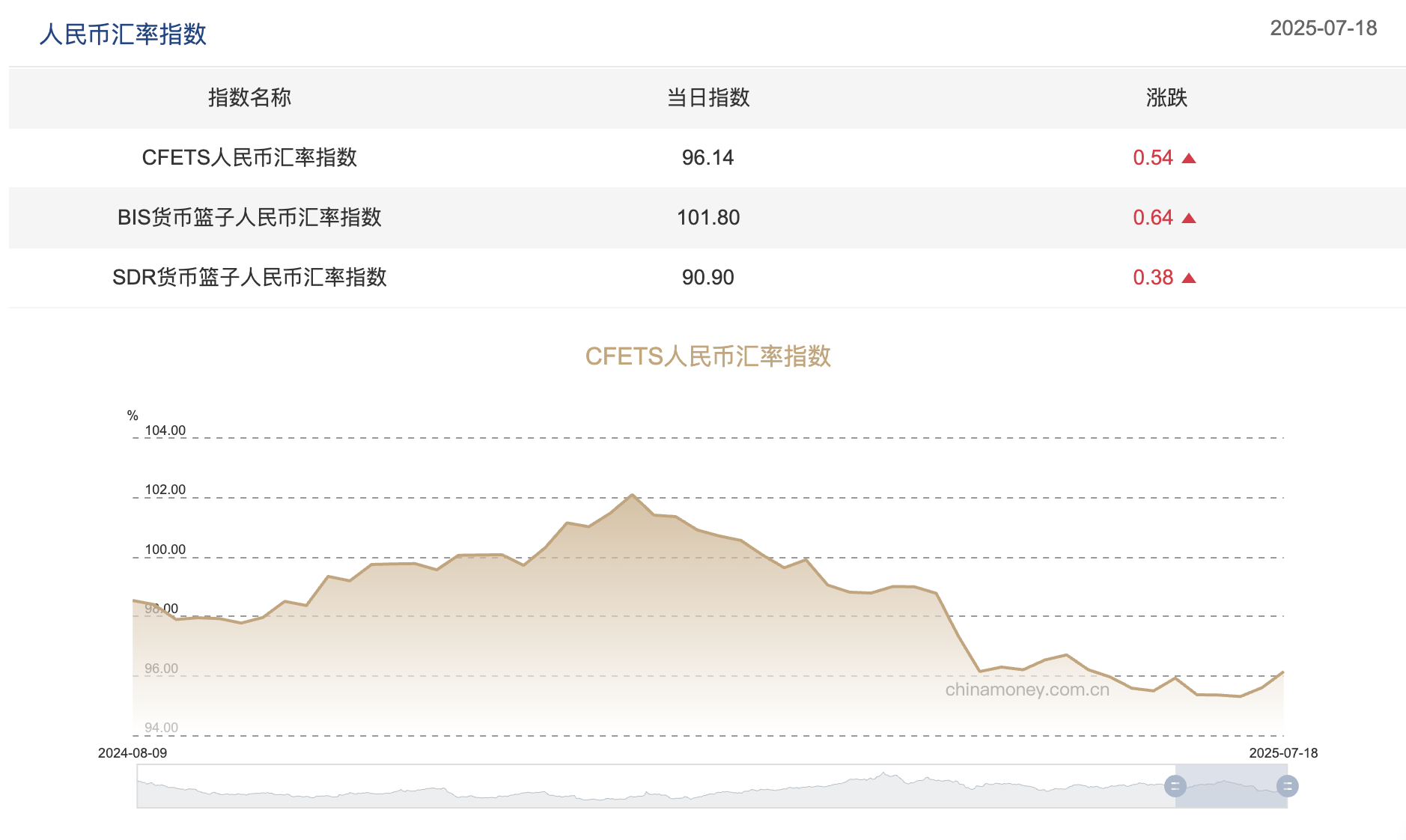
Core Viewpoint - The recent data from the China Foreign Exchange Trading Center indicates a general appreciation of the Renminbi against a basket of currencies, with the CFETS index rising to 96.14, reflecting a weekly increase of 0.54% [1][2]. Exchange Rate Indices - CFETS Renminbi Exchange Rate Index: 96.14, up 0.54% week-on-week [2] - BIS Currency Basket Renminbi Exchange Rate Index: 101.80, up 0.64% week-on-week [1][2] - SDR Currency Basket Renminbi Exchange Rate Index: 90.90, up 0.38% week-on-week [1][2] Market Sentiment and Currency Performance - The market showed moderate changes in risk appetite, with the US dollar index rebounding by 0.6%, marking the second consecutive week of increase [6] - The Renminbi's depreciation against the US dollar was relatively mild, with the onshore Renminbi closing at 7.1766, down 56 points for the week [6] - Analysts noted that the Renminbi's middle rate continues to rise, indicating the central bank's intention to guide a moderate appreciation of the currency [6][7]. Economic Context - The Chinese economy demonstrated strong resilience and vitality in the first half of the year, contributing to the Renminbi's stability [6][7]. - The People's Bank of China emphasized that it does not seek to gain international competitive advantage through currency depreciation, maintaining a clear and consistent stance on exchange rate policy [7]. Future Outlook - Analysts predict a higher probability of moderate appreciation for the Renminbi, supported by stable economic expansion in China [8]. - The ongoing trend of "de-dollarization" and the expectation of further interest rate cuts by the Federal Reserve may contribute to a weaker US dollar, which could enhance the attractiveness of Renminbi assets [8][9].
海外弱美元与国内资产荒的再平衡 - 2025年中期宏观策略
2025-07-16 15:25
Summary of Key Points from Conference Call Records Industry or Company Involved - The discussion primarily revolves around the macroeconomic environment in China, the performance of the A-share and Hong Kong stock markets, and the implications of U.S. economic policies under the Trump administration. Core Insights and Arguments 1. **Domestic Supply and Demand Rebalancing** The core policy goal for the second half of the year is to achieve domestic supply and demand rebalancing through a combination of policies to address the challenges posed by the continuous negative growth of PPI [2][18][35] 2. **A-Share Market Trends** The A-share market is expected to exhibit a slow bull market trend, with a significant focus on the period around September when U.S.-China tariffs are clarified and domestic incremental policies are introduced [5][29][36] 3. **Hong Kong Stock Market Performance** The Hong Kong stock market has shown strong performance in the first half of the year, benefiting from a weak dollar environment and expectations of a shift in economic power [6][7] 4. **U.S. Economic Policy Shifts** The Trump administration's economic policies have shifted focus from austerity and debt reduction to tax cuts and interest rate reductions to stabilize the economy and reduce U.S. debt costs [8][11] 5. **Challenges in the U.S. Economy** The U.S. economy faces challenges such as rising unemployment, high deficit rates, and inflationary pressures, which are expected to impact economic performance in the second half of the year [11][14] 6. **Market Sentiment and Investment Strategies** The overall market sentiment is expected to remain stable, with specific investment strategies focusing on sectors like financial innovation, energy transformation, and AI [31][37] 7. **Consumer Spending Highlights** Key areas of consumer spending to watch include service-related consumption, new consumption patterns, and childcare subsidies, which are expected to improve in the second half of the year [20][22] 8. **Impact of Anti-Inflation Measures** Anti-inflation measures are expected to affect traditional industries significantly, with a focus on sectors like photovoltaic, new energy vehicles, and steel [21][34] 9. **Stock-Bond Rebalancing** The trend of stock-bond rebalancing is supported by low bond yields and the increasing attractiveness of equities, particularly in the context of a weak dollar [3][35] 10. **Future Market Expectations** The market is anticipated to experience a slow bull trend, with significant attention on the September timeframe for potential policy shifts and economic indicators [27][36] Other Important but Possibly Overlooked Content 1. **ETF Inflows** Stock ETFs have seen continuous net inflows, becoming an important vehicle for asset allocation among residents, indicating a shift in investment preferences [4][25][26] 2. **Global Economic Context** The global economic context, including the performance of non-U.S. assets and the implications of a weak dollar, is crucial for understanding the investment landscape [9][15] 3. **Long-term Investment Themes** Long-term investment themes include a focus on sectors like stable coins, energy transformation, AI, and defense, which are expected to drive future growth [33][38] 4. **Policy-Driven Market Dynamics** The dynamics of the market are heavily influenced by policy decisions, particularly in response to inflation and economic pressures, which will shape investment strategies moving forward [34][36]
2025年中期宏观策略:海外弱美元与国内资产荒的再平衡
Huaxin Securities· 2025-07-15 09:47
Group 1: Overseas Macro - Concerns about stagflation and policy negotiations are prevalent, with a weak dollar expected to persist [4][13] - The economic outlook indicates inflation will rise initially before declining, with a focus on the interplay between low base effects and demand [38][39] - The impact of tariffs on the US economy is expected to be delayed, with a projected downturn in economic activity in the second half of the year [68][71] Group 2: Domestic Macro - The domestic economy is showing signs of slowing down, with challenges such as declining exports, insufficient consumer momentum, and falling real estate prices [5][6] - Potential support measures include monetary easing and fiscal policies aimed at boosting consumption and investment [5][6] Group 3: A-share Market Outlook - The A-share market is anticipated to experience a slow bull market supported by three main factors: a weak dollar, asset scarcity, and government intervention [6][10] - The market is expected to exhibit structural trends, with opportunities arising from dividend-focused sectors and industry rotations [7][10] Group 4: Sector and Style Analysis - The report highlights a narrowing dividend circle due to asset scarcity and institutional underweighting, with a focus on stable dividend-paying sectors such as banking and utilities [7][10] - A neutral strategy is recommended, emphasizing quantitative approaches and monitoring market signals for potential opportunities [7][10] - Industry rotations are expected to accelerate, with attention on sectors like financial innovation, energy security, and advanced manufacturing [7][10]
宋雪涛:弱美元的共识,会反转么?
雪涛宏观笔记· 2025-07-15 05:47
Core Viewpoint - The article discusses the mismatch between short-term foreign exchange hedging and the long-term narrative of de-dollarization, suggesting that while there is a strong belief in a weak dollar, it may overlook potential reversal opportunities [1][3]. Group 1: Foreign Capital and Dollar Hedging - Since the second quarter, there has been a strong consensus that actions like Trump's tariffs and interference with the Federal Reserve's independence have impacted the credibility of the dollar, leading to non-U.S. capital fleeing dollar-denominated assets [3][4]. - A recent BIS report questions whether non-U.S. investors are truly abandoning dollar assets, suggesting they may be more focused on currency hedging rather than divesting from dollar securities [4][6]. - Data from CFTC indicates a significant increase in short positions on the dollar index by asset management companies, reflecting a rising demand for hedging against currency risk [6][8]. Group 2: Market Indicators and Trends - The risk reversal options market shows that investors are increasingly hedging against the risk of a dollar decline, with a notable rise in demand for euro-dollar call options [10][12]. - The cross-currency basis for Asian currencies and euros relative to the dollar has decreased, indicating that the cost of hedging dollar risk has become more expensive due to strong demand [12][15]. - Despite the potential for non-U.S. and alternative assets to mitigate risks associated with the dollar, the substantial positions held by foreign investors in dollar assets make a quick shift challenging [15][18]. Group 3: Potential Reversal Opportunities for the Dollar - The article identifies several potential catalysts for a dollar rebound, including a reduction in hedging demand as observed in the options market [18][22]. - The dollar index is approaching long-term support levels, and the U.S. productivity advantage may provide a basis for a rebound if market sentiment shifts [22][25]. - Political factors, such as Trump's focus on revitalizing U.S. manufacturing, may also influence the dollar's status, as a weak dollar is not necessarily aligned with his long-term goals [25][26]. Group 4: Interest Rates and Federal Reserve Independence - The article discusses the complex implications of potential interest rate cuts by the Federal Reserve, influenced by Trump's pressure, which could lead to varied outcomes for the dollar depending on economic data [27][28]. - Four scenarios are outlined regarding the interaction between U.S. economic data, Trump's influence on the Fed, and the resulting impact on the dollar's value [28][29]. - The influence of the debt ceiling on dollar liquidity is deemed limited, with current market conditions suggesting a more stable dollar environment despite potential increases in Treasury supply [31][33].

申万宏观·周度研究成果(7.5-7.11)
申万宏源宏观· 2025-07-12 04:03
Group 1: Key Insights - The "One Big Beautiful Bill Act" signed by Trump on July 4, 2025, raises the debt ceiling and increases the deficit rate, legalizing "Trump economics" [7] - The act is projected to impact the nominal GDP of the year at $29.2 trillion, with a 10-year deficit effect of $3.9 trillion, accounting for 13% of the GDP [7] - The act's economic effects and potential to reignite "U.S. debt panic" are under scrutiny [7] Group 2: Inflation and Economic Trends - June inflation data shows a CPI of 0.1% year-on-year, with PPI at -3.6%, indicating a divergence in inflation trends [16] - The U.S. is shifting from equal tariffs to "discriminatory tariffs," with new tariffs set to take effect on August 1, 2025 [19] - Domestic travel intensity remains high, reflecting robust consumer activity [21] Group 3: Policy Developments - The Central Financial Committee's sixth meeting emphasized the need for orderly exit of outdated production capacity and regulation of low-price competition among enterprises [29] - The meeting also highlighted the importance of promoting high-quality development in the marine economy and enhancing marine ecological protection [29]