
产能调控

Search documents
钢铁周报20250907:环保限产下供需双弱,关注旺季修复情况-20250907
Minsheng Securities· 2025-09-07 06:11
Investment Rating - The report maintains a "Buy" recommendation for several steel companies, including Hualing Steel, Baosteel, Nanjing Steel, and others, indicating a positive outlook for the sector [3][4]. Core Viewpoints - The steel industry is experiencing a dual weakness in supply and demand due to environmental production restrictions, with a focus on the recovery during peak demand seasons [3][4]. - Short-term impacts from environmental restrictions are expected to ease, leading to a gradual recovery in both supply and demand [3][4]. - Long-term capacity regulation remains a key theme, with expectations for more precise management to promote industry consolidation and improve profitability for steel companies [3][4]. Price Trends - As of September 5, 2025, steel prices showed mixed trends, with rebar prices at 3,260 CNY/ton, up 10 CNY/ton from the previous week, while other products like high-line and cold-rolled steel saw price declines [1][9]. - The report notes that the average price changes for various steel products over the past month and year reflect a complex market environment, with some products experiencing price increases while others decline [10][24]. Production and Inventory - As of September 5, 2025, total steel production decreased to 8.61 million tons, a reduction of 239,600 tons week-on-week, with rebar production specifically down by 18,800 tons [2][3]. - Total social inventory of major steel products increased by 311,800 tons to 10.765 million tons, indicating a build-up in stock levels despite reduced production [2][3]. Profitability - The report indicates a decline in steel margins, with estimated changes in gross profit for rebar, hot-rolled, and cold-rolled steel being -46 CNY/ton, -38 CNY/ton, and -36 CNY/ton respectively [1][3]. Investment Recommendations - The report recommends specific companies for investment, including Hualing Steel, Baosteel, Nanjing Steel in the general steel sector, and companies like Xianlou New Materials and CITIC Special Steel in the special steel sector [3][4].


温氏股份(300498)中报点评:养殖成本持续优化 业绩稳健兑现
Xin Lang Cai Jing· 2025-09-05 06:47
Performance Summary - In H1 2025, the company reported revenue of 49.85 billion yuan, a year-on-year increase of 5.9%, and a net profit attributable to shareholders of 3.48 billion yuan, a significant increase of 195.1% [1] - In Q2 2025, the company achieved revenue of 25.54 billion yuan, a year-on-year increase of 1.2%, but the net profit attributable to shareholders decreased by 42.83% to 1.473 billion yuan [1] Operational Analysis - The company has made significant progress in reducing costs and increasing efficiency in pig farming, with H1 2025 pig output reaching 17.93 million heads, a year-on-year increase of 24.75%, and an average selling price of 14.93 yuan/kg. The comprehensive cost of pig farming was 12.4 yuan/kg in H1 2025, which is expected to decrease to below 12 yuan/kg by the end of the year [2] - The company sold 598 million yellow feathered chickens in H1 2025, a year-on-year increase of 9.2%. Despite a decline in prices leading to losses, there is an expectation of profitability for the full year as prices have started to recover [2] - The company's debt ratio has been decreasing, with a debt ratio of 50.57% as of Q2 2025, down 2.6 percentage points from the previous quarter. This indicates a stable operational performance and potential for continued cost reduction [2] Profit Forecast, Valuation, and Rating - The company is expected to achieve net profits attributable to shareholders of 8.63 billion yuan, 13.26 billion yuan, and 15.29 billion yuan for the years 2025 to 2027, with year-on-year changes of -6.5%, +53.7%, and +15.2% respectively. Corresponding EPS is projected to be 1.3 yuan, 2.0 yuan, and 2.3 yuan [3] - The current stock price corresponds to a PE valuation of 14X, 9X, and 8X for the years 2025, 2026, and 2027, respectively, with a maintained "buy" rating [3]

需求支撑不足,猪价延续低位
Zhong Xin Qi Huo· 2025-09-05 05:17
1. Report Industry Investment Ratings - **Oils and Fats**: Expected to be volatile in the short term and likely to strengthen in the medium term [5] - **Protein Meal**: Expected to remain range - bound [5] - **Corn and Starch**: Short - term: Consider closing out short positions and look for short - selling opportunities on rebounds; Long - term: Support for low - buying in far - month contracts [6][7] - **Hogs**: Expected to be volatile. Spot and near - month prices are likely to be weak, while far - month contracts are supported by de - capacity expectations [1][7] - **Natural Rubber**: Expected to be volatile and slightly bullish in the short term [10] - **Synthetic Rubber**: Expected to be volatile and slightly bullish in the short term [11] - **Cotton**: Short - term: Range - bound; After new cotton is on the market: May face downward pressure [11][12] - **Sugar**: Expected to be volatile and slightly bearish in the long term; Short - term: Range - bound between 5500 - 5750 [15] - **Pulp**: Expected to be volatile [16] - **Logs**: Expected to be weak in the near term and stronger in the far term [18] 2. Core Views of the Report - The agricultural market shows a complex pattern with different trends for various products. The hog cycle is still in a downward phase in the short - to - medium term but may turn around in 2026 if de - capacity policies are implemented. Oils and fats are affected by factors such as weather, trade, and demand, with short - term volatility and medium - term upward potential. Protein meal is expected to remain range - bound. Other products like natural rubber, cotton, etc., also have their own supply - demand and market factors influencing their price trends [1][5] 3. Summary by Related Catalogs 3.1 Oils and Fats - **Logic**: Due to concerns about US soybean demand, US soybeans declined on Wednesday, and domestic oils continued to consolidate. The macro environment includes a weaker US dollar and falling crude oil prices. The US soybean growing area is affected by drought, and the export outlook is pessimistic. Domestic soybean imports are expected to decrease seasonally, and palm oil inventory accumulation may be limited. Rapeseed oil inventory is slowly falling but still high year - on - year [5] - **Outlook**: Short - term: Volatile adjustment; Medium - term: Likely to strengthen [5] 3.2 Protein Meal - **Logic**: International soybean prices are affected by weather, with a possible reduction in US soybean yields in the September report. Brazilian soybean premiums have adjusted, and US soybean exports are affected by the trade war. Domestically, the market is range - bound, and demand may improve as the temperature drops [5] - **Outlook**: Range - bound. Hold long positions at 2900 - 2910 and add positions on dips. Oil mills are advised to sell on rallies, and downstream enterprises can buy basis contracts or price at low levels [5] 3.3 Corn and Starch - **Logic**: Corn prices are generally stable, with local declines. Supply is affected by the release of old - crop inventory and the upcoming new - crop supply. Demand is weak as feed enterprises have sufficient inventory. The price difference between corn and wheat is increasing, and wheat substitution may decline [6][7] - **Outlook**: Short - term: Close out short positions and look for short - selling opportunities on rebounds; Long - term: Support for low - buying in far - month contracts [6][7] 3.4 Hogs - **Logic**: Supply is abundant in the short term, with an expected increase in the second half of the year. Demand shows a stable ratio of fat to lean pigs. Inventory weight has decreased slightly. In the long term, de - capacity policies may drive price increases in 2026 if implemented [1][7] - **Outlook**: Volatile. Spot and near - month prices are likely to be weak, while far - month contracts are supported by de - capacity expectations [1][7] 3.5 Natural Rubber - **Logic**: The price is range - bound between 157 - 161. There are many speculation themes, and the short - term supply is limited while demand is stable. The price may rise due to seasonality [10] - **Outlook**: Volatile and slightly bullish in the short term [10] 3.6 Synthetic Rubber - **Logic**: The price is range - bound, following natural rubber and supported by the cost of raw material butadiene. Butadiene supply is under no significant pressure, and demand is stable [11] - **Outlook**: Volatile and slightly bullish in the short term [11] 3.7 Cotton - **Logic**: The current low - inventory and improving - demand situation provides support for cotton prices. The expected increase in purchase prices is limited by the expected large increase in new cotton production. After new cotton is on the market, prices may face downward pressure [11][12] - **Outlook**: Short - term: Range - bound; After new cotton is on the market: May face downward pressure [11][12] 3.8 Sugar - **Logic**: International sugar production is expected to increase, and domestic imports are rising, resulting in downward pressure on prices [15] - **Outlook**: Long - term: Volatile and slightly bearish; Short - term: Range - bound between 5500 - 5750 [15] 3.9 Pulp - **Logic**: The decline is mainly due to the low acceptance of BCTMP pulp. After the 09 contract delivery, the pressure may be alleviated. The market shows a differentiated performance among different types of pulp [16] - **Outlook**: Volatile [16] 3.10 Logs - **Logic**: The price decline is due to lower foreign quotes and weaker domestic spot prices. The market is in a game between weak reality and peak - season expectations. Supply pressure will ease in the coming weeks [17][18] - **Outlook**: Weak in the near term and stronger in the far term [18]
九月出栏继续增加,猪价压力持续
Zhong Xin Qi Huo· 2025-09-03 07:01
1. Report Industry Investment Ratings - **Oils and Fats**: Oscillation [6] - **Protein Meal**: Oscillation [6] - **Corn/Starch**: Weak oscillation [7] - **Live Pigs**: Oscillation [8] - **Natural Rubber**: Oscillation [9] - **Synthetic Rubber**: Oscillation [12] - **Cotton**: Oscillation with a slight upward trend [13] - **Sugar**: Weak oscillation [15] - **Pulp**: Oscillation [16] - **Logs**: Weak oscillation [16] 2. Core Views of the Report - The supply of live pigs is expected to increase in the second half of 2025, and the pig price is under pressure. However, the "anti - involution" policy may lead to a turnaround in the pig cycle in 2026 [1][8]. - Oils and fats may continue to oscillate and adjust in the short term, but have a high probability of running strongly in the medium term [6]. - Protein meal is expected to continue to oscillate within a range, and attention should be paid to the support at the lower edge [6]. - The market sentiment for corn should not be overly pessimistic. Traders are pre - arranging to stock up, and there are opportunities for short - term profit - taking and long - term low - buying [7][8]. - The upward driving force of rubber prices is limited, but the downside support is strong, and the short - term trend is expected to be oscillating and slightly stronger [9][11]. - Synthetic rubber follows the oscillation of natural rubber, and the short - term trend is expected to be oscillating and slightly stronger [12]. - Cotton prices are expected to be oscillating and slightly stronger from now to early October, with the key to upward breakthrough being the purchase price. After the large - scale listing of new cotton, prices may be under pressure [13]. - Sugar prices are under increasing supply pressure and are expected to run weakly [15]. - The core driving force of pulp futures is difficult to determine, and the trend is expected to be oscillating [16]. - The log market is in a game between weak reality and peak - season expectations, and the short - term trend is expected to be weakly oscillating [16]. 3. Summary by Related Catalogs 3.1 Live Pigs - **Supply**: In the short term, the planned slaughter volume in September is expected to increase. In the medium term, the supply of commercial pigs in the second half of the year is expected to increase. In the long term, the "anti - involution" policy aims to eliminate excess capacity, but there are resistance to active production cuts [1][8]. - **Demand**: The temperature is getting cooler, the price difference between fat and lean pigs is expanding, and the price ratio of meat to pigs is stable [1][8]. - **Inventory**: The average slaughter weight decreased slightly this week, and the weight inventory is higher than the same period last year, with the main goal of destocking before the National Day [1][8]. - **Outlook**: Before the National Day, the spot and near - month pig prices are expected to remain weak. The far - month contract prices are supported by the expectation of supply - side capacity reduction, presenting a pattern of "weak reality + strong expectation" [2][8]. 3.2 Oils and Fats - **Macro Environment**: The market focuses on the Fed's September monetary policy expectations, and the US dollar is oscillating weakly. Attention should be paid to geopolitical situations and US crude oil supply and demand [6]. - **Industrial End**: The drought - affected area of US soybeans is expanding, and the export demand of US soybeans is affected by Sino - US trade relations. The inventory of domestic soybeans and rapeseed has different trends, and attention should be paid to trade negotiations and policies [6]. - **Outlook**: In the short term, oils and fats may continue to oscillate and adjust. In the medium term, they are more likely to run strongly [6]. 3.3 Protein Meal - **International Situation**: The excellent rate of US soybeans is high, and attention should be paid to weather changes. The discount of Brazilian soybeans has been adjusted, and the export of US soybeans is affected by the trade war [6]. - **Domestic Situation**: The spot price is stable, and the downstream demand is expected to improve. There is no supply gap before December, and attention should be paid to trade relations and national reserve auctions [6]. - **Outlook**: The internal - external price difference may be repaired, and it is expected to oscillate within a range [6]. 3.4 Corn/Starch - **Supply**: The inventory of old - crop corn is decreasing, and new - crop corn is about to be listed. There are doubts about whether there will be a supply gap during the transition period [7][8]. - **Demand**: The downstream inventory is seasonally low, and the procurement intention of large feed enterprises is low, but small enterprises in South China are replenishing stocks [8]. - **Outlook**: In the short term, short - term short positions are recommended to take profits, and opportunities to short on rebounds can be waited for. In the long term, there is a low - buying opportunity [7][8]. 3.5 Natural Rubber - **Market Information**: The prices of various rubber products and raw materials have different changes, and the global natural rubber production and consumption have different trends [9]. - **Logic**: The upward driving force of rubber prices is limited, but the downside support is strong. There are many speculative themes, and the short - term supply may decrease while the demand is rigid [9][11]. - **Outlook**: The short - term trend is expected to be oscillating and slightly stronger [11]. 3.6 Synthetic Rubber - **Market Information**: The prices of butadiene rubber and butadiene have different trends [12]. - **Logic**: The synthetic rubber market follows the natural rubber market, and the short - term tightness of raw material butadiene provides cost support [12]. - **Outlook**: The short - term trend is expected to be oscillating and slightly stronger [12]. 3.7 Cotton - **Supply**: The commercial inventory of cotton is at a low level in the same period, and the supply pattern is tight before the new cotton is listed [13]. - **Demand**: The downstream demand is gradually picking up, and the orders are increasing [13]. - **Purchase**: The expected purchase price of seed cotton by ginners may increase, but the expected large increase in new cotton production will suppress the increase [13]. - **Outlook**: From now to early October, it is expected to be oscillating and slightly stronger, and the key to upward breakthrough is the purchase price. After the large - scale listing of new cotton, prices may be under pressure [13]. 3.8 Sugar - **International Market**: In the new crushing season, the sugar production in Brazil, Thailand, and India is expected to increase [15]. - **Domestic Market**: The domestic sugar is in the pure sales period, and the import volume is increasing [15]. - **Outlook**: The supply pressure is increasing, and the sugar price is expected to run weakly [15]. 3.9 Pulp - **Market Situation**: The pulp futures have been weak, and the main reason for the decline is the low market acceptance of Brilliant Needle pulp [16]. - **Outlook**: The internal contradictions of the pulp market are divided, and the trend is expected to be oscillating [16]. 3.10 Logs - **Market Situation**: The log market is in a game between weak reality and peak - season expectations, with some positive factors such as cost support and reduced supply pressure [16]. - **Outlook**: The short - term trend is expected to be weakly oscillating [16].
农林牧渔行业周报:生猪板块半年报高增,推荐“平台+生态”服务型企业德康农牧-20250902
Hua Yuan Zheng Quan· 2025-09-02 01:06
Investment Rating - The investment rating for the agriculture, forestry, animal husbandry, and fishery industry is "Positive" (maintained) [3] Core Viewpoints - The swine industry is experiencing high-quality development with significant policy transformations aimed at protecting farmers' rights and stimulating enterprise innovation. Future growth stocks will likely focus on technological content and innovative models that balance farmer interests [4][12] - The overall profitability of listed pig companies has significantly increased due to a stable pig price year-on-year and a substantial decrease in costs. Although pig prices may face pressure in the second half of the year, the trend of improving efficiency suggests that profitability will remain strong [4][12] - The poultry sector is facing a persistent contradiction of "high capacity, weak consumption," leading to losses that force breeding farms to reduce capacity. Integrated enterprises and contract farming are expected to gain market share [5][13] - The feed sector is recommended to focus on Hai Da Group, which is expected to see growth due to improved management and increased capacity utilization [6][14] - The pet industry is witnessing a concentration of market share among leading brands, with potential growth opportunities for mid-tier brands. The impact of tariffs on exports is expected to diminish over time [7][16] - The agricultural sector is closely monitoring the effects of US-China trade negotiations, with expectations of tightening soybean supply and potential price increases for soybean meal [8][17] Summary by Sections 1. Swine - Latest pig price is 13.70 CNY/kg (down 0.01 CNY/kg month-on-month), with an average slaughter weight of 127.83 kg (down 0.15 kg month-on-month) and a price of 445 CNY for 15 kg piglets (down 18 CNY month-on-month). Short-term price declines may be due to policy-driven weight reductions [3][12] - The industry is undergoing profound policy transformations, focusing on protecting farmers' rights and stimulating innovation. Companies with cost advantages and strong connections with farmers are expected to enjoy excess profits and valuation premiums [4][12][13] 2. Poultry - As of September 1, the price of chicken seedlings in Yantai is 3.45 CNY/piece (down 5.5% month-on-month) and the price of broiler chickens is 3.55 CNY/kg (down 1.39% month-on-month) [5][13] - The white feather chicken industry is facing ongoing challenges of high capacity and weak consumption, leading to a reduction in breeding capacity among chicken farms [5][13] 3. Feed - The feed sector is recommended to focus on Hai Da Group, which is expected to benefit from industry recovery and improved management effects [6][14] 4. Pets - The pet industry is characterized by a stable four-brand dominance, with increasing concentration expected. The impact of tariffs on exports is anticipated to lessen, and leading companies are expected to maintain high growth rates [7][16] 5. Agricultural Products - The agricultural sector is closely watching the impact of US-China trade negotiations, with expectations of tightening soybean supply and potential price increases for soybean meal [8][17] 6. Market and Price Situation - The Shanghai and Shenzhen 300 Index closed at 4497, up 2.71% from the previous week, while the agriculture, forestry, animal husbandry, and fishery index closed at 3001, up 2.02% [18][21]



研究所晨会观点精萃-20250829
Dong Hai Qi Huo· 2025-08-29 01:06
Report Industry Investment Ratings No specific industry investment ratings are provided in the report. Core Viewpoints of the Report The report analyzes the market conditions of various asset classes including macro - finance, stocks, precious metals, black metals, non - ferrous metals, energy chemicals, and agricultural products. It points out that short - term macro upward drivers are marginally strengthening, with focus on domestic incremental stimulus policies, loose expectations, Sino - US trade negotiation progress, and implementation of domestic incremental policies. Different asset classes are expected to have different short - term trends, mainly presenting震荡 (oscillation) or震荡偏强 (oscillation with a slightly upward trend) patterns [2][3]. Summaries by Relevant Catalogs Macro Finance - Overseas: The second - quarter GDP had a year - on - year growth rate of 3.3%, higher than the expected 3.1%. After the New York Fed President Williams hinted at a possible rate cut, market expectations for a Fed rate cut next month increased, the US dollar index was weak, and global risk appetite increased. - Domestic: China's economic data in July slowed down and was below expectations. The Ministry of Commerce will introduce policies to expand service consumption in September. With the extension of the Sino - US tariff truce for 90 days and increased US easing expectations, short - term external risks decreased, and domestic risk appetite increased. - Asset Performance: Stocks are expected to be short - term oscillatory and slightly stronger, with short - term cautious long positions; treasury bonds are expected to be high - level oscillatory in the short term, with cautious observation; commodities: black metals, non - ferrous metals, and energy chemicals are short - term oscillatory, with cautious observation; precious metals are high - level and slightly stronger oscillatory in the short term, with cautious long positions [2]. Stocks - The domestic stock market fell significantly due to the drag of sectors such as clothing and home textiles, biomedicine, and liquor. - The short - term macro upward driver is marginally strengthening, with focus on Sino - US trade negotiation progress and implementation of domestic incremental policies. Short - term cautious observation is recommended [3]. Precious Metals - Gold and silver prices rose on Thursday. The Fed's independence concerns and the weakening US dollar supported the upward movement of precious metals. - The number of initial jobless claims in the US decreased, and the second - quarter GDP was stronger than expected. The market is focused on the PCE data to be released on Friday. Gold has strong short - term support, but be wary of the Fed's changing attitude [3][4]. Black Metals Steel - Steel futures and spot prices rebounded slightly on Thursday, and trading volume increased slightly. The expectation of steel production cuts in the next two years has increased. - The fundamentals remain weak, with an increase in the inventory of five major steel products and a decline in the apparent consumption of some products. Supply is mixed, with an increase in rebar production and a slight decrease in hot - rolled coil production. There is a possibility of further production restrictions in the north in early September, and the steel market may continue to rebound [5]. Iron Ore - Iron ore futures and spot prices rebounded significantly on Thursday. Steel mills' profits are high, but due to production restrictions in the north in the next week, steel mills' procurement is cautious. - Global iron ore shipments and arrivals decreased this week. Port inventories decreased slightly on Monday. Iron ore prices are expected to be range - bound in the short term [5]. Silicon Manganese/Silicon Iron - Silicon iron prices were flat, and silicon manganese prices rebounded slightly on Thursday. The demand for ferroalloys is okay as the production of five major steel products continues to increase. - The production of silicon manganese in Inner Mongolia is stable, with some minor production fluctuations. There are new production capacity plans in the future, and the daily output may be affected by 500 - 800 tons. The prices of ferroalloys are expected to be range - bound in the short term [6][7]. Soda Ash - The soda ash main contract oscillated on Thursday. Supply increased due to the return of previous maintenance, and there is supply pressure with new capacity coming online. - Demand remained stable week - on - week, but overall demand support is weak. Profits decreased week - on - week. Soda ash is expected to be range - bound in the short term [7]. Glass - The glass main contract oscillated on Thursday. Supply remained stable, and demand is difficult to improve significantly. - Profits decreased as glass prices fell. With the support of real - estate news, glass is expected to be range - bound in the short term [7]. Non - Ferrous Metals and New Energy Copper - Due to concerns about US tariffs and the expected tightening of the Japanese central bank's monetary policy, and the weakening of domestic demand, the strong copper price is difficult to sustain [9]. Aluminum - Aluminum prices fell slightly on Thursday, and inventories continued to increase. The medium - term upward space for aluminum prices is limited, and it is expected to be oscillatory in the short term [9]. Aluminum Alloy - The supply of scrap aluminum is tight, the cost of recycled aluminum plants is rising, and demand is weak. The price is expected to be oscillatory and slightly stronger in the short term, but the upward space is limited [9]. Tin - The supply - side开工率 (operating rate) increased, and the mine supply is expected to be loose. The demand side is weak, but the price decline has stimulated downstream replenishment. Tin prices are expected to be oscillatory in the short term, with support from smelter maintenance and peak - season expectations, but restricted by high tariffs,复产 expectations (restoration of production expectations), and weak demand [10]. Lithium Carbonate - The lithium carbonate main contract fell on Thursday. After the previous sentiment subsided, it is expected to be widely oscillatory, with short - term short positions and long - term long positions [11]. Industrial Silicon - The industrial silicon main contract fell on Thursday. With the oscillation of black metals and polysilicon, industrial silicon is expected to be weakly oscillatory [11]. Polysilicon - The polysilicon main contract fell on Thursday. The production in August is approaching 130,000 tons, and the number of warehouse receipts is increasing. It is facing a game between strong expectations and weak reality. It is recommended to short on rebounds [12]. Energy and Chemicals Crude Oil - The possibility of more Russian oil supply entering the market in the short term has decreased, and oil prices rose slightly on Thursday. However, the market has limited risk premium digestion, and short - term oil prices are expected to be weakly oscillatory [14]. Asphalt - Due to limited oil price changes, the asphalt main price remained almost unchanged. The spot market has slightly improved, but inventory removal is limited. Asphalt is expected to be weakly oscillatory in the short term [14]. PX - After the price increase due to Zhejiang Petrochemical's maintenance, PX supply is tight, and it is expected to be oscillatory in the short term, waiting for changes in PTA devices [14]. PTA - The PTA price declined, but there is some support from domestic and South Korean petrochemical capacity adjustments and the temporary shutdown of the Huizhou device. It is expected to be oscillatory in the short term, with attention to the downstream recovery space [15]. Ethylene Glycol - Ethylene glycol prices continued to decline, and port inventories decreased slightly. It is expected to be narrowly oscillatory in the short term, with support from downstream start - up recovery, but supply pressure is still large [16]. Short - Fiber - Short - fiber prices fell slightly due to sector resonance. Terminal orders have increased seasonally, and it is recommended to short on highs in the medium term [16]. Methanol - The restart of inland devices and concentrated arrivals have pressured prices, but there is some support from the reflux window and the planned restart of MTO devices. Methanol is expected to be oscillatory [16]. PP - The supply - side pressure is increasing, and demand is showing signs of recovery. The 09 contract is expected to be weakly oscillatory, and attention should be paid to the peak - season inventory situation of the 01 contract [16]. LLDPE - The supply - side pressure remains, and demand is showing a turning point. The 09 contract is expected to be weakly oscillatory, and attention should be paid to demand and inventory situation of the 01 contract [17]. Agricultural Products US Soybeans - The CBOT soybean price was supported by the continuous improvement of US new - season soybean exports. The export sales of the current market year decreased, while the next - year exports increased significantly. Pakistan is expected to sign a purchase agreement [19]. Soybean Meal and Rapeseed Meal - The pressure of continuous inventory accumulation of domestic oil mills' soybeans and soybean meal has eased, but the near - month/spot risk has not subsided. Rapeseed meal has an upward fluctuation basis due to low inventory and few long - term purchases [19]. Oils - Rapeseed oil port inventories are decreasing, and the supply of soybean oil is expected to strengthen. Palm oil is in the production - increasing cycle, and the market is expected to be oscillatory [20]. Corn - The national corn price is running weakly, but the futures price has entered a relatively low - valuation range, and the possibility of breaking through last year's range is small [20]. Hogs - Group farms continued to reduce weight in August, and the pig price did not rebound as expected at the end of August. The theoretical slaughter volume will increase in September, but there is no need to be overly pessimistic. Some local areas have started purchasing and storage [20][21].
温氏股份20250828
2025-08-28 15:15
Summary of Wens Foodstuff Group Conference Call Company Overview - **Company**: Wens Foodstuff Group - **Industry**: Livestock and Poultry Farming Key Points and Arguments Financial Performance - In the first half of 2025, Wens achieved a net profit of 3.5 billion yuan and total profit of 5.1 billion yuan, with chicken business losses amounting to 1.2 billion yuan, including a 500 million yuan price drop provision [16] - The comprehensive cost of pork farming decreased to 6.2 yuan per kilogram, a year-on-year decline of 1.2 yuan, with July costs stabilizing around 6.1 yuan [2][4] - The company sold 21.1 million pigs and 709 million chickens by July 2025 [4] Cost Management - The company implemented measures to control costs, achieving a profit of over 300 yuan per pig [2][4] - The average cost of feed for chickens decreased to 5.6 yuan per kilogram, with a slight increase due to rising feed prices in June and July [4] - Wens plans to optimize feed formulas, currently using only 3% soybean meal, and aims to reduce feed costs by 5 to 10 yuan per ton through AI nutritional formula technology [3][21] Organizational Changes - Wens restructured its poultry division into three business units and one independent operating unit to enhance management efficiency [2][3] - A marketing center and experience center were established to promote traditional Chinese chicken culture and new business brands [2][3] Debt and Asset Management - As of mid-2025, the company's debt-to-asset ratio decreased to 50.6%, with plans to reduce it further to below 45% [2][7][38] - The company intends to increase dividend payouts to enhance investor confidence [3][7] Future Projections - By the end of 2025, Wens aims to maintain a breeding sow count of around 1.8 million and expects to produce over 36 million market pigs in 2026 [2][10][24] - The company is focused on improving production efficiency and reducing costs through various strategies, including lean management and technological innovation [8][40] Industry Context - Wens is adapting to industry capacity control policies by optimizing breeding structures and managing weight control for fattening pigs [29][30] - The company anticipates a stable market price for pork, currently around 6.8 to 6.9 yuan per kilogram, with ongoing profitability [30] Challenges and Opportunities - The company faces challenges in improving the death rate of sows, which is currently at 8%, but is optimistic about enhancing key performance indicators like PSY (pigs weaned per sow per year) [19][17] - Wens is exploring expansion in the golden chicken sector, targeting annual growth of 5% to 10% [11] Conclusion - Wens Foodstuff Group is positioned for stable growth through effective cost management, organizational restructuring, and strategic planning, aiming to capitalize on market opportunities while navigating industry challenges [40]
政策收储释放暖意!猪肉板块强势冲高,“猪茅”市值重返3000亿
Ge Long Hui A P P· 2025-08-26 11:01
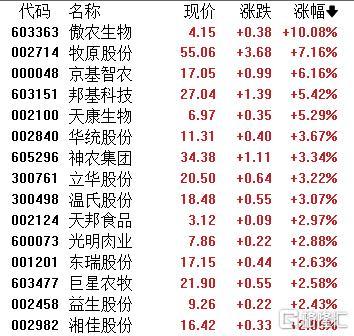
Core Viewpoint - The recent central government initiative to store pork has significantly boosted the A-share pork sector, leading to a strong market performance, particularly for companies like Aonong Biological, which reported a turnaround in profits [1][11]. Market Performance - Aonong Biological's stock surged to the daily limit, closing at 4.15, with a rise of 10.08% [2] - Other notable performers included Muyuan Foods, which saw a rise of over 7%, and several other companies like Jingji Zhino and Bangji Technology also experienced gains [2]. Price Trends and Market Conditions - The average price of live pigs has dropped from 16.04 yuan/kg at the beginning of the year to 13.75 yuan/kg as of August 26, reflecting a significant decline of 14.25% [3][4]. - The pig-to-grain price ratio has fallen below 6:1, indicating a challenging profitability environment for pig farming, with the current ratio at 5.78:1 [6][7]. Policy Actions - In response to the declining prices, the National Development and Reform Commission announced plans for central frozen pork storage, with a total of 1.9 million tons to be stored [10]. - Previous measures included limiting the number of breeding sows and reducing the average weight of pigs at slaughter to stabilize the market [10]. Company Performance - Aonong Biological reported a net profit of 361 million yuan for the first half of the year, marking a significant recovery from losses [11]. - Other companies like New Hope and Zhengbang Technology also reported substantial profit increases, with New Hope's net profit expected to rise by 155.85%-164.07% [12]. - Muyuan Foods reported a remarkable net profit increase of 1169.77%, with a revenue of 764.63 billion yuan for the first half of 2025 [12]. Future Outlook - Analysts suggest that the pork industry is likely to enter a phase of stable and high-quality development, with a focus on eliminating inefficient production capacity and improving cost structures [13]. - The emphasis on quality improvement and efficiency in the industry is expected to enhance the market share of financially stable and low-cost producers [13].


生猪养殖行业“反内卷”政策密集发布,建信中证农牧主题ETF(159616)跟踪指数冲高上涨2.41%
Sou Hu Cai Jing· 2025-08-26 07:06
Group 1 - The China Securities Agricultural and Animal Husbandry Theme Index (931778) increased by 2.41%, with notable stock performances including Muyuan Foods (002714) up 7.51%, Tiankang Bio (002100) up 6.04%, and Jiangshan Co. (600389) up 5.74% [1] - Recent policies aimed at regulating the pig farming industry have been intensively released, including a proposal from the National Development and Reform Commission in early June to not increase production capacity and to stabilize prices, followed by a meeting in late July where the Ministry of Agriculture urged core enterprises to strictly implement capacity control measures [1] - On August 13, an industry association meeting advocated for reducing production capacity to 39.5 million pigs, with several leading enterprises responding positively to the capacity control policies, indicating a reduction in the breeding sow inventory [1] - Despite continued profitability in fattening and breeding segments, the ongoing implementation of anti-involution policies and the need to mitigate pandemic risks are expected to lead to a reduction in industry capacity [1] - Glyphosate prices have rebounded from a low point, with some product demand recovering; from Q3 2025, the average market price of glyphosate increased by 11.2% compared to Q2 [1] - The pesticide industry shows rigid demand but is currently at the bottom of the industry cycle, characterized by "increased volume but reduced profits," with ongoing destocking bringing global pesticide channel inventory closer to reasonable levels [1] Group 2 - The China Construction Bank China Securities Agricultural and Animal Husbandry Theme ETF (159616) closely tracks the China Securities Agricultural and Animal Husbandry Theme Index, which selects 50 listed companies involved in grain planting, seed production, pesticide and fertilizer, agricultural machinery, livestock farming, feed production, and animal health [2]


生猪行业“反内卷”的政策逻辑与实践创新
Qi Huo Ri Bao· 2025-08-25 01:28
Core Viewpoint - The central government emphasizes preventing "involution" in the pig industry, focusing on capacity control, weight reduction, and limiting secondary fattening to promote high-quality development in the sector [1][4][6]. Group 1: Involution and Market Dynamics - The concept of "involution" refers to a harmful competition where economic entities invest significant resources without overall profit growth, leading to a "zero-sum" situation [2]. - The pig industry faces a supply-demand mismatch, with rapid capacity expansion following the African swine fever outbreak, while demand growth lags behind, resulting in fierce competition and profit compression [2][3]. Group 2: Policy Measures and Industry Response - The Ministry of Agriculture and Rural Affairs has introduced a framework to reduce the national breeding sow population by 1 million to 39.5 million, optimize production, and lower market weights [4][5]. - Policies include strict monitoring of breeding practices and the introduction of a registration management system for livestock farms to ensure quality and stability in supply [4][6]. Group 3: Industry Trends and Statistics - The scale of pig farming has increased, with the proportion of large-scale operations rising from 53% in 2021 to 69% in 2024, indicating a trend towards industry consolidation [7]. - As of mid-2025, leading companies like Muyuan Foods have reduced their breeding sow inventory by 54,000 heads, reflecting a commitment to capacity control [7][8]. Group 4: Weight Reduction and Secondary Fattening - The average slaughter weight of pigs decreased to 90.3 kg in June, down 0.58% month-on-month and 2.11% year-on-year, indicating a clear trend towards weight reduction in response to policy guidance [8]. - The practice of secondary fattening, where pigs are purchased and fattened before sale, disrupts price stability and is being targeted by environmental policies aimed at upgrading or eliminating outdated production capacities [8].