
美国例外论

Search documents
聪明钱跑路?期权交易员转向欧元,美元“失宠”
Jin Shi Shu Ju· 2025-06-20 09:50
在市场质疑美元稳定性的同时,欧元兑日元汇率的波幅相对于美元兑日元货币对的波动而言,正处于近 四年来的最平静水平。 "市场认为,在负面市场冲击中,美元兑日元的波动性将大于欧元兑日元,这与市场过去处理这些事件 的方式正好相反,"Brennan说。"如果真是这种想法,那就意味着市场认为欧元比美元更具避险功能。" 由于交易员因不可预测的美国政策风险而避开美元,欧元正在全球货币期权市场中扮演起更重要的角 色。 交易量出现了明显转变。根据美国存管信托和清算公司(DTCC)的数据,对比2024年最后五个月,今 年前五个月与美元兑主要货币挂钩的合约中,约有15%至30%转向了欧元。还有迹象表明,欧元正被用 作避风港,这在传统上是美元的角色。 虽然在日交易额高达7.5万亿美元的外汇市场中,涉及美元的交易仍占主导地位,但这可能是美元作为 世界储备货币正面临更激烈竞争的早期证据。在美元经历多年来最大幅度的暴跌后,交易员们正在规避 它,而欧元似乎成了主要受益者,因为该地区的市场正受益于数十亿的政府刺激支出。 "如果我们正在进入一个欧洲资金流向更重要的环境,那么我们可能也正在进入一个由欧元货币对驱动 一切的环境,"法国巴黎银行的期权策 ...
施罗德:环球股市风险偏好改善 尤其看好美国与欧洲的金融板块
Zhi Tong Cai Jing· 2025-06-20 06:13
Group 1 - The core viewpoint is that the recent 90-day suspension of mutual tariffs between China and the U.S. is expected to reduce the risks of trade disruptions and rising unemployment, leading to a lowered probability of economic recession [1] - The investment stance reflects high geopolitical uncertainty, with the theme of "market differentiation" becoming a dominant trend this year [1] - The company has reduced concentrated allocations in U.S. equities and shifted towards a more geographically diversified asset allocation strategy, favoring European markets and increasing holdings in Japanese and emerging market assets [1] Group 2 - Outside the U.S., inflationary pressures are relatively mild, leading to a preference for German government bonds while being bearish on U.S. government bonds [2] - Gold is recommended as a core tool for diversifying asset allocation [2] - The outlook for the energy sector remains cautious to negative due to continuous supply growth, and there is a cautious stance on the U.S. credit market, particularly high-yield bonds [2]
油价涨≠欧洲痛?弱势美元改写能源冲击传导链
Zhi Tong Cai Jing· 2025-06-19 13:00
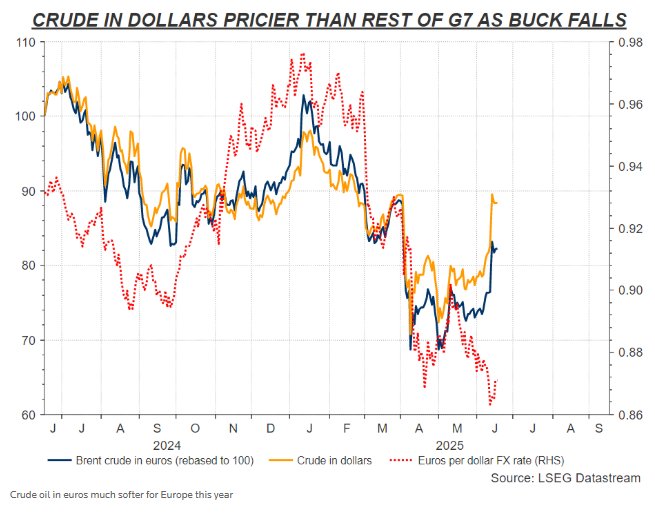
Group 1 - The current weak dollar period is significantly alleviating the pressure on oil-importing countries despite renewed tensions in the Middle East causing energy price fluctuations [1][3] - Global crude oil prices, priced in dollars, have risen approximately 14% since early last week, but remain about 7% lower year-on-year, indicating that the situation has not reached a "crisis" level [1][3] - The euro has appreciated by 12% against the dollar this year, resulting in a milder impact on Europe, where Brent crude oil prices in euros are down 12% for 2025 and 20% year-on-year [1][3] Group 2 - The depreciation of the dollar provides a crucial buffer for oil-importing countries, mitigating the direct impact of rising oil prices and limiting broader economic repercussions [3][4] - If the dollar continues to weaken, it will effectively reduce the relative impact of energy price volatility on the European economy, potentially supporting its performance compared to the U.S. this year [3][4] - A decline in energy prices alongside a persistently weak dollar may increase pressure on the European Central Bank to lower interest rates to avoid inflation rates falling significantly below the 2% policy target [3][4] Group 3 - The relationship between the dollar and oil prices has become increasingly unstable, as foreign investors reassess their dollar asset allocations due to trade wars and domestic turmoil [4][6] - Traditionally, the dollar has served as a safe-haven asset, but it appears to have lost this status during periods of uncertainty, with the dollar and stocks/bonds moving in tandem downwards in April [6][9] - The causal relationship between oil prices and the dollar has inverted in recent years, with oil price surges leading to aggressive rate hikes by the Federal Reserve, followed by a period of easing as oil prices and inflation declined [9][10]

独家对话!橡树资本霍华德·马克斯最新发声
天天基金网· 2025-06-19 05:23
一年一度陆家嘴论坛前夕,橡树资本联合创始人和联席董事长霍华德·马克斯 在 接受 中国基 金报记者 独家采访时表示,债券市场投资者不喜欢关税政策造成的混乱,预计关税政策模糊 性难以消退。他认为,投资者适度降低对美国资产的配置是合理的。 霍华德·马克斯: 因为事态持续变化,所以它不可能完全消化。当我们说市场"已经定 价"时,指的是市场对关税最终结果的定价。但现实是,没有人能够准确预测六个月 以及 两 年后的关税政策。既然如此,市场怎么可能做到完全定价呢?事实上,关税政策刚刚宣布 时,股票和债券市场的反应都非常负面,随后股市却反弹。这是否意味着关税的影响已经被 市场忽略?还是说市场认为这些影响最终会是良性的?我们无法轻易下结论。 中国基金报: 美国股市在所谓的"大解放日"之后反弹。有人认为,这说明"美国例外论"并未 彻底衰落。一方面,美国仍然拥有强大的创新能力 ; 另一方面,它拥有"七巨头"这样盈利能 力极强的公司。你怎么看"美国例外论"? 霍华德·马克斯: 谈论"美国例外论"彻底衰落可能并不恰当。过去80 年 到100年间,美国在 全球的卓越地位是由多方面因素共同造就的。创新能力是其中之一,还包括自由市场机制、 ...

橡树资本霍华德·马克斯最新发声
Zhong Guo Ji Jin Bao· 2025-06-18 14:53
【导读】霍华德·马克斯:全球投资者应充分理解中国务实的运作方式,信任中国的实践智慧 霍华德·马克斯:这一"警告"来自债券市场,该市场的投资者不喜欢关税政策造成的混乱。商业活动最害怕的就是不确定性,而现在的关税政策却充满了 变数——美国一会儿宣布加征关税,一会儿宣布取消,一会儿暂停,一会儿又恢复,一会儿又降低。政策反复无常,企业难以制定长期计划。进口商品的 成本上升,而企业如果在美国国内建设工厂,它又无法预测四年后的关税政策。四年后,关税会变得更高,还是会降低,抑或会被完全取消?企业家无从 判断。如果无法预判关税的最终水平,那么,任何关于建厂的决策都变得极其困难。这种不确定性是最大的风险。 中国基金报:美国债券市场已经完全消化关税政策的影响了吗? 霍华德·马克斯:因为事态持续变化,所以它不可能完全消化。当我们说市场"已经定价"时,指的是市场对关税最终结果的定价。但现实是,没有人能够 准确预测六个月以及两年后的关税政策。既然如此,市场怎么可能做到完全定价呢?事实上,关税政策刚刚宣布时,股票和债券市场的反应都非常负面, 随后股市却反弹。这是否意味着关税的影响已经被市场忽略?还是说市场认为这些影响最终会是良性的?我们 ...

美股光环逐渐褪去?美银调查:超五成基金经理押注未来五年国际股票跑赢美股
贝塔投资智库· 2025-06-18 04:17
Core Viewpoint - A significant shift in investment sentiment is observed, with 54% of fund managers believing that international stocks (excluding the US) will outperform US stocks over the next five years, indicating a decline in the dominance of the US stock market [1][2]. Group 1: International Stocks vs. US Stocks - The term "international stocks" refers to stock markets outside the US, including both developed and emerging markets such as Europe, Japan, Canada, Australia, and various emerging markets like China, India, and Brazil [2]. - This is the first time Bank of America has asked institutional investors to predict the best-performing asset class over a five-year horizon, reflecting a growing trend of "Sell America" since April [2][3]. - If fund managers' predictions hold true, it would reverse the trend of heavily investing in US stocks, which have outperformed international stocks in 13 out of the last 15 years [2][3]. Group 2: Market Performance and Trends - The S&P 500 index has recorded its largest underperformance against the MSCI World Index (excluding the US) since 2009, with European stocks showing a rare trend of outperforming US stocks by 20% after adjusting for currency fluctuations [3]. - Amundi SA's report indicates that ongoing uncertainty in US government policy and a growing budget deficit will create a challenging environment for the economy and markets, prompting a shift in focus towards European and emerging markets [3][4]. - Jeffrey Gundlach, CEO of DoubleLine Capital, suggests that the "American exceptionalism" narrative is collapsing, predicting a long-term depreciation of the US dollar and continued outperformance of international stocks [4]. Group 3: Fund Manager Sentiment - In the latest Bank of America survey, 59% of institutional investors do not expect a boost in US economic activity from the government's spending plans [5]. - 21% of respondents anticipate an increase in US Treasury yields over the next year, the highest proportion since August 2022 [5]. - There is a notable shift in asset allocation preferences, with a net 31% of investors planning to reduce their holdings in the US dollar and a net 36% planning to reduce their exposure to US stocks [5].

从华盛顿噪音到欧亚机遇:欧洲资管巨头Amundi押注欧洲与新兴市场崛起
智通财经网· 2025-06-17 09:25
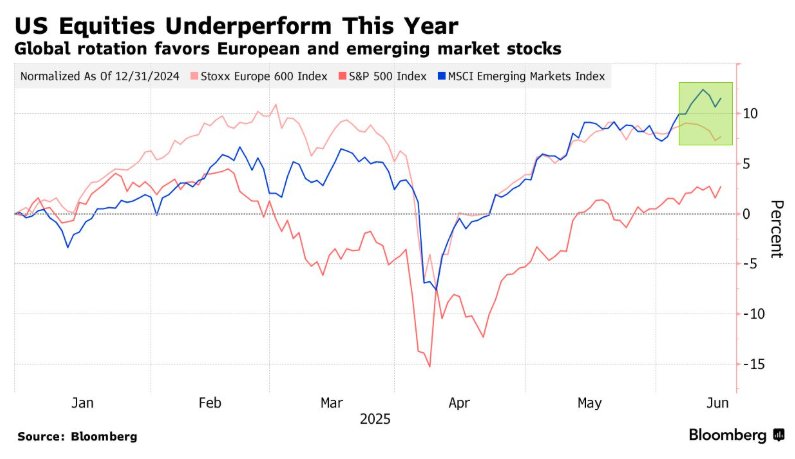
Core Viewpoint - Amundi SA, a major European asset management firm, is shifting its investment focus from the US to Europe and emerging markets due to anticipated economic slowdown in the US and potential market volatility caused by US tax and trade policies [1][2][5] Investment Strategy - Amundi is adopting a "moderate risk preference" and advises investors to hedge against inflation and currency fluctuations [1] - The firm expects US economic growth to slow significantly to 1.6% by 2025-2026, prompting a diversification of investment portfolios away from US assets [1][5] - The asset manager favors Japanese yen and euro over the traditionally preferred US dollar, indicating a long-term bearish outlook on the dollar [5] Market Trends - The "American exceptionalism" narrative is collapsing, leading to a sell-off of US assets by international investors and some Wall Street firms [2][5] - The S&P 500 index has seen a modest increase of less than 3% this year, while the Stoxx 600 index has surged by 20% after adjusting for dollar exchange rates [2] - Amundi highlights a structural change in global trade and international relations under the Trump administration, which is expected to have lasting effects beyond the current government term [5] Emerging Markets Focus - Amundi is increasingly focusing on European defense and infrastructure stocks, as well as Asian markets, particularly the "Make in India" initiative [5] - The firm holds a positive outlook on emerging market bonds, which are seen as providing significant buffers against volatility in the US Treasury market [5] Broader Market Sentiment - Jeffrey Gundlach, CEO of DoubleLine Capital, echoes Amundi's sentiment, predicting a long-term decline in the dollar and suggesting that international stocks, particularly from emerging markets, will outperform US equities [7] - Other analysts, including those from JPMorgan, predict that markets in Japan, the EU, and China will outperform the US over the next 10 to 15 years, driven by concerns over US fiscal debt and high market valuations [8]
特朗普猛然惊醒,中国是一个“无法分割”的对手
Hu Xiu· 2025-06-16 23:31
特朗普再次当政后,在百日内急风暴雨般出台了多项内政和外交政策。不仅美国的政界和商界震荡不 已,一向被视为"象牙塔"的学术界也受到巨大冲击。很多学者将特朗普的新政批评为"政治干预学术", 还有人认为这是一个"草台班子"的疯狂行动。然而,从围绕"美国例外论"的长期视角来看,美国当前的 乱局却有着久远的历史根源,不能仅仅解读为特朗普内阁的肆意妄为之举。 "美国例外论"的威权式回归 已故的美国政治学家西蒙·李普塞特曾对"美国例外论"进行了深刻而详尽的对比分析。在他看来,相比 于世界上其他国家(特别是欧洲国家),美国建立在一套独特的价值观念之上,可称为"美国信 条"(the American Creed)。美国信条包括五大要素:自由、平等、个人主义、民粹主义与自由放任的 经济模式。信条中的"自由"是指那种不受政府干预的消极自由;"平等"并不是指当代左翼主张的结果平 等,而是强调个人机会与尊严的平等。 进入现代社会后,欧洲的封建体制虽然分崩离析,但重视社会等级的文化特征仍然留存下来,欧洲人因 而具有鲜明的阶级意识。李普塞特指出,欧洲各国的左右翼政党为了解决中下阶层的社会问题,都乐于 采取福利制度、公共住房和医疗保障等国家 ...
大变化!“美国例外论”失效,全球资金再平衡
券商中国· 2025-06-16 06:50
Core Viewpoint - The narrative of "American exceptionalism" is being challenged as global asset allocation shifts away from US assets towards other markets, driven by factors such as tariffs, stagflation, and AI industry developments [1][2][4]. Global Asset Reallocation - The transition from "American exceptionalism" to "American denialism" is seen as a potential long-term paradigm shift rather than a short-term narrative [5]. - As of June 2, 2023, major global equity markets like Germany's DAX and Hong Kong's Hang Seng Index have risen by 20.2% and 15.6% respectively, while US indices have remained flat [3]. - The US Treasury bond yields have seen a decline, with the 20-year yield at approximately 5% and the 10-year yield at about 4.5%, indicating a loss of confidence in US debt [4]. Market Performance and Predictions - The macroeconomic environment suggests that the US may be entering a phase of simultaneous declines in stocks, bonds, and currency, termed "triple kill" [3]. - The potential for a decline in the US dollar's attractiveness could lead to capital outflows, further exacerbating the situation [3]. - The impact of tariffs on the US economy is expected to manifest in the latter half of the year, increasing the risk of economic downturn and putting pressure on the dollar [6]. Investment Opportunities - Emerging markets and alternative assets like gold and cryptocurrencies are anticipated to gain traction as the narrative around US assets weakens [8][9]. - The focus on European markets is increasing, particularly in sectors like defense and infrastructure, which may benefit from geopolitical developments [10]. - The Chinese market is viewed positively, especially in the technology sector, which is expected to perform well due to lower valuations and less correlation with the US market [11].

中金:大类资产2025下半年展望-秉韧谋新
中金· 2025-06-16 03:16
Investment Rating - The report suggests maintaining an overweight position in gold, increasing allocation to Chinese stocks, shifting from aggressive to defensive in US stocks, underweighting global commodities, and maintaining a standard allocation in domestic and foreign bonds to achieve good returns [1]. Core Viewpoints - The US tariff policy is the main contradiction affecting global asset performance in the first half of 2025, with significant impacts on market sentiment and asset allocation strategies [2]. - The report highlights the potential for a "super cycle" in certain commodities driven by green transformation, although short-term economic cycles may have a more significant impact on commodity prices [6]. - The AI revolution is seen as a major opportunity for stock assets, particularly in the context of China's market, which is expected to benefit from the application of AI technologies [4]. Summary by Sections Tariff Outlook - The unexpected impact of US tariffs since April has led to a shift towards a risk-averse market environment, with tariffs remaining a significant factor influencing global trade and economic conditions [2]. - The report notes that the average effective tariff rate in the US is close to 16%, significantly higher than the 2.4% level at the end of 2024, indicating potential negative effects on global trade [2]. Dollar Cycle - The report indicates that the long-term dollar bull market may be coming to an end, with expectations of a decline in the dollar's value impacting the attractiveness of dollar-denominated assets [3]. - It predicts that the US fiscal deficit may continue to shrink in 2025, potentially leading to a lack of support for economic growth [3]. Technology Cycle - The emergence of AI is expected to drive a new wave of technological revolution, with significant implications for stock market performance, particularly in the US and China [4]. - The report emphasizes that Chinese stocks have not fully priced in the potential of AI, suggesting a valuation advantage [4]. Real Estate Cycle - The report discusses the stabilization of the real estate market in China post-September 2024, although it notes that the market has not yet completed its downward cycle [7]. - It highlights the relationship between credit cycles and real estate cycles, suggesting that stock markets may respond positively during periods of deleveraging [7]. Asset Allocation Insights - The report recommends an asset allocation strategy that favors gold, high-dividend bonds, and Chinese technology stocks while being cautious with US stocks and commodities [8]. - It suggests that the uncertainty surrounding US fiscal policy and inflation could lead to opportunities in US Treasuries, although the overall outlook remains cautious [8].