
债券市场

Search documents
固定收益专题:如何理解央行利率比价
GOLDEN SUN SECURITIES· 2025-11-17 12:28
Report Industry Investment Rating No relevant information provided. Core View of the Report Currently, various interest rate parity relationships are generally within a reasonable range, which provides further room for subsequent monetary easing. With the decline of deposit rates, it will further broaden the space for subsequent monetary policy easing to drive down the social financing cost [4][29]. Summary by Relevant Catalogs Comparison between Central Bank Interest Rates and Market Interest Rates - At the beginning of this year, the market interest rate deviated significantly from the policy rate, but it has now returned to the normal level. The DR007 rate has gradually fallen back to near the 7 - day reverse repurchase rate [1][9]. - In a smooth interest rate transmission mechanism, short - term money market interest rates revolve around the policy rate center and affect the overall market interest rate level through the financial system [1][9]. Comparison between Commercial Banks' Asset - side and Liability - side Interest Rates - Deposit rates and lending rates have been declining in tandem, which is expected to open up more policy operation space. Before 2024, the trends of deposit and lending rates diverged, but after 2024, the deposit rate turned downward, and the pressure on the narrowing net interest margin has been relieved to some extent [2][12]. Comparison of Yields of Different Types of Assets - **Long - term**: The comprehensive loan yield after deducting non - performing loans and taxes is highly consistent with the 5 - year Treasury bond yield. In the second quarter of this year, the weighted average loan interest rate was 3.29%, and the calculated weighted average loan yield was 1.52%, close to the 1.54% average yield of 5 - year Treasury bonds in the same period. Similar results can be obtained for mortgage loans [2][14]. - **Short - term**: The yield trends of different assets at the short - end are similar, with small spreads, indicating a stable parity relationship [2][17]. Comparison of Interest Rates of Different Terms The previously abnormal yield curve has now returned to a normal state. The 1 - year and 10 - year Treasury bond spread is currently around 40bps, which is basically at a normal historical level [3][20]. Comparison of Interest Rates of Different Risks - Subsequent reduction of lending rates may require a decline in bond yields. Enterprise lending rates cannot be lower than government bond yields such as Treasury bonds and local bonds [4][22]. - High - interest 30 - year local bonds may restrict the downward movement of lending rates. Considering tax factors, the loan lower - limit determined by government bonds may be higher, which can reduce competitive low - price lending by banks but may also limit the decline in financing costs to some extent [4][25].
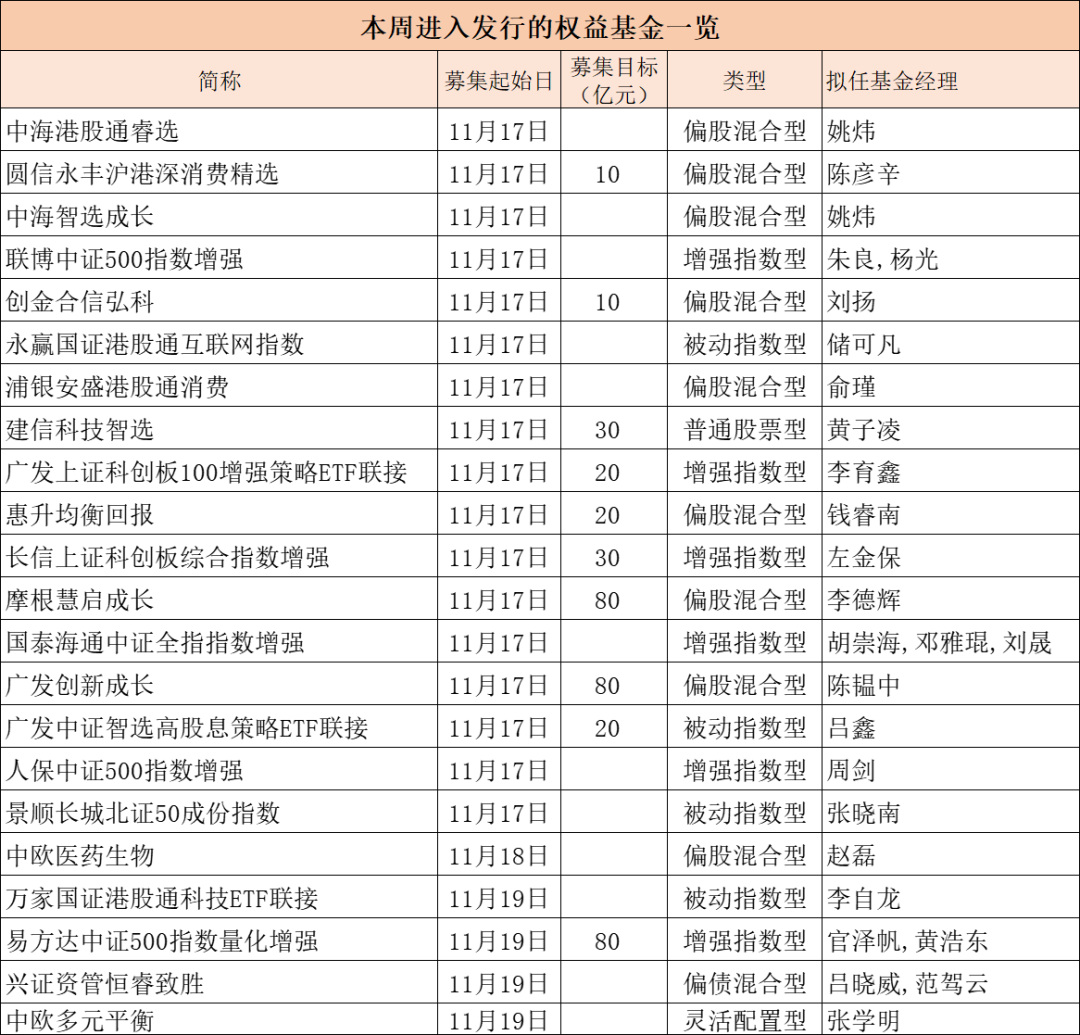
33只新品,来了
Zhong Guo Ji Jin Bao· 2025-11-17 02:13
Summary of Key Points Core Viewpoint - This week, 33 new funds are set to launch, with equity funds making up two-thirds of the total offerings, reflecting a strong interest in equity investments amid market fluctuations [1][4]. Fund Launch Details - A total of 26 out of the 33 new funds will start issuing on Monday, November 17, accounting for 78.79% of the week's new funds. The average subscription period for these new funds is 21.27 days, which is longer than previous periods, likely due to recent market conditions [2][4]. - The longest subscription period is for the China Aviation Xiangtai 6-month closed fund at 89 days, while the shortest is for the浦银安盛港股通消费 and 广发上证科创板100增强策略ETF联接 at just 5 days [2]. Fund Types and Goals - Among the new funds, 22 are equity funds, representing two-thirds of the total. There are 10 index equity funds, with two tracking the CSI 500 index. The funds also include a variety of themes such as high dividend and technology growth [4][5]. - 18 of the new funds have specified fundraising targets, with five aiming for 8 billion units. The lowest target is set at 1 billion units for two specific funds [3]. Fixed Income and FOF Products - In the fixed income category, only 7 new bond funds are being launched, indicating a decline in interest for pure bond funds as equity markets recover. However, "fixed income plus" funds are gaining traction [6][7]. - Four mixed-asset FOF products are also being introduced this week, reflecting a growing investor preference for diversified investment strategies. The average return for FOFs that have been established for over six months is 14.29% [8][9].

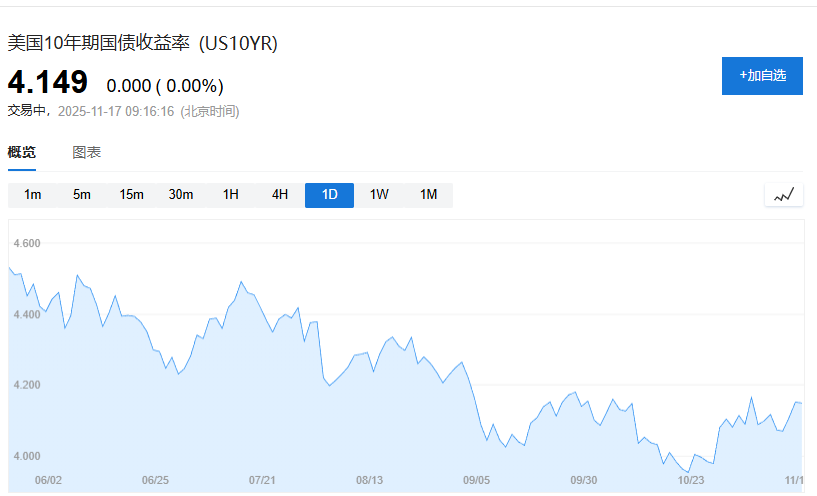
几乎所有因素都“利好”,美国债市有望创2020年以来“最佳表现”
Hua Er Jie Jian Wen· 2025-11-17 01:33
Core Viewpoint - The U.S. bond market is experiencing its best performance since 2020, driven by multiple favorable factors including Federal Reserve rate cuts, moderate economic slowdown, and easing inflation pressures [1][2]. Group 1: Market Performance - The Bloomberg U.S. Aggregate Bond Index has achieved a return of approximately 6.7% year-to-date, marking a potential best annual performance since 2020 [1]. - The 10-year U.S. Treasury yield has decreased by nearly 0.5 percentage points this year, closing at 4.149% last Friday [3]. Group 2: Federal Reserve Actions - The Federal Reserve's rate cuts have become the core driver of the bond market's rise, as bonds issued at higher rates become more valuable when market expectations shift towards lower rates [2]. - The labor market cooling has prompted the Federal Reserve to cut rates twice this year, with the possibility of further cuts [2]. Group 3: Economic Concerns - Despite concerns over the U.S. budget deficit impacting yields, the decline in interest rates has largely overshadowed these worries [6]. - The U.S. budget deficit for fiscal year 2025 is projected at $1.8 trillion, remaining stable compared to 2024, which could pose future challenges for the bond market [9]. Group 4: Investor Sentiment - Investors are optimistic about the continuation of favorable conditions, believing that despite rising uncertainties, there is still room for further rate declines [9]. - The additional yield spread of investment-grade corporate bonds relative to Treasuries fell to 0.72 percentage points in September, the lowest since the late 1990s, indicating potential overvaluation in the corporate bond market [8].
每日债市速递 | 央行披露下一阶段货币政策主要思路
Wind万得· 2025-11-11 22:31
Monetary Policy Overview - The central bank conducted a reverse repurchase operation of 403.8 billion yuan with a fixed rate of 1.40% on November 11, resulting in a net injection of 286.3 billion yuan after accounting for 117.5 billion yuan in reverse repos maturing on the same day [2][4]. Market Liquidity - The central bank's significant net injection has led to a more balanced supply and demand in the interbank market, although overnight repo rates have increased to 1.51% [4]. - The latest overnight financing rate in the U.S. stands at 3.93% [4]. Interbank Certificates of Deposit - The latest transaction rate for one-year interbank certificates of deposit is approximately 1.63%, remaining stable compared to the previous day [7]. Bond Yield Rates - The yield rates for various government bonds are as follows: - 1-year: 1.40% - 2-year: 1.43% - 3-year: 1.43% - 5-year: 1.53% - 7-year: 1.70% - 10-year: 1.80% - 30-year: 2.15% [9]. Recent Policy Developments - The central bank emphasized enhancing financial support to boost consumption and proposed measures to support personal credit recovery and the real estate sector [13]. - The National Development and Reform Commission reported that 500 billion yuan in new policy financial tools have been fully allocated, with 105 infrastructure REITs projects recommended, leading to an expected total investment exceeding 1 trillion yuan [14]. Global Economic Insights - European Central Bank officials noted a balanced inflation risk and slightly higher growth and inflation than expected, while expressing concerns about retail investor participation in the stock market [16]. Bond Market Events - Upcoming bond issuance includes 26.16416 billion yuan in local government bonds by Guizhou Province on November 18 [18]. - Notable negative events in the bond market include downgrades and extensions involving various companies, indicating potential risks in the sector [19]. Non-standard Asset Risks - Recent disclosures indicate various non-standard asset risks associated with trust plans and other products, highlighting the need for vigilance in investment strategies [20].

5万亿资金缺口待填补!摩根大通解析AI热潮融资路径
Sou Hu Cai Jing· 2025-11-11 07:46
Core Insights - JPMorgan Chase reports that AI hyperscale data center operators are entering a significant expansion phase, with financing needs projected to reach at least $5 trillion over the next five years, potentially exceeding $7 trillion [1][3] Financing Channels - The investment-grade bond market is expected to provide approximately $1.5 trillion for AI data center construction over the next five years [3] - Leveraged finance is projected to contribute around $150 billion within the same timeframe, but even with additional funding from investment-grade bonds, high-yield debt markets, and up to $40 billion annually from data center securitization, there remains a funding gap of about $1.4 trillion [3] - Private credit and government funding are anticipated to be crucial supplementary sources to address this funding shortfall [3] Internal Funding Sources - The primary source of funding for AI data centers will not be external capital markets but rather the AI operators themselves, who generate approximately $700 billion in net revenue annually, with $500 billion allocated to capital expenditures [4]

小摩:不止美股,5万亿美元的AI数据中心热潮也将席卷美国债市
智通财经网· 2025-11-11 00:41
Group 1 - The core viewpoint of the articles highlights the significant investment required for the construction of data centers by AI giants, estimated at approximately $1.5 trillion in investment-grade bond funding over the next five years [1] - Analysts predict that leveraged financing could provide around $150 billion in funding within the next five years, but this will still fall short of the total required amount [1] - The total funding needed for data center expansion is estimated to be between $5 trillion and $7 trillion, which will accelerate growth in the bond and syndicated loan markets [1][2] Group 2 - Demand for data centers is expected to grow linearly, driven by physical factors such as computing resources, real estate, and energy, despite concerns about potential market bubbles [2] - Recent bond issuances, such as Meta's $30 billion and Oracle's $18 billion, indicate strong investor interest in funding data center projects [2] - There are warnings about the potential for over-optimism among investors, with over half of data industry executives expressing concerns about future challenges [2] Group 3 - The majority of funding for data center construction is anticipated to come from large enterprises themselves, which currently generate $700 billion in net operating income annually, with $500 billion allocated for capital expenditures [3]
公募基金泛固收指数跟踪周报(2025.11.03-2025.11.07):央行购债落地,债市震荡调整-20251110
HWABAO SECURITIES· 2025-11-10 08:26
Report Industry Investment Rating No relevant content provided. Core View of the Report - Last week (from November 3rd to November 7th, 2025), the bond market experienced volatile adjustments. The yields of 1-year, 10-year, and 30-year treasury bonds all increased. The central bank's bond purchase in October was less than expected, and the strong and volatile stock market led to a slight decline in bond market sentiment. The bond market may continue to fluctuate, and its short - term volatility direction may be affected by the stock market trend. The yields of US treasury bonds fluctuated downward, and the China Securities REITs Total Return Index declined. The scale of bond ETFs exceeded 70 billion yuan [3][10][11][12]. Summary by Relevant Catalogs 1. Weekly Market Observation 1.1. Pan - fixed - income Market Review and Observation - **Bond Market in China**: Last week, the bond market in China adjusted with fluctuations. The yields of 1 - year, 10 - year, and 30 - year treasury bonds rose by 2.19BP, 1.88BP, and 1.50BP respectively. The central bank's 20 billion yuan bond purchase in October was less than expected, and the strong stock market led to a slight decline in bond market sentiment. The bond market may continue to fluctuate, and its short - term direction may be affected by the stock market [3][10]. - **US Treasury Bonds**: Last week, the yields of US treasury bonds fluctuated downward. The 1 - year yield dropped 7BP to 3.63%, the 2 - year yield dropped 5BP to 3.55%, and the 10 - year yield remained flat at 4.11%. There were both negative and positive factors during the week [10]. - **REITs**: Last week, the China Securities REITs Total Return Index dropped 0.40% to 1041.51 points. The park and warehousing logistics sectors led the decline, while the consumption and data center sectors had relatively high gains. In the primary market, 3 new public REITs made progress last week [11]. 1.2. Public Fund Market Dynamics - The scale of bond ETFs exceeded 70 billion yuan. As of October 31, 2025, the scale of bond ETFs reached 70.0044 billion yuan. At the beginning of 2025, it was less than 18 billion yuan. Among the 53 bond ETFs in the market, 50 had a scale of over 1 billion yuan, and 30 had a scale of over 10 billion yuan [12]. 2. Pan - fixed - income Fund Index Performance Tracking 2.1. Currency Enhancement Index Tracking - **Currency Enhancement Strategy Index**: It aims at liquidity management, pursuing a curve that surpasses money market funds and rises smoothly. It mainly allocates money market funds and inter - bank certificate of deposit index funds. The performance comparison benchmark is the China Securities Money Fund Index [14]. 2.2. Pure Bond Index Tracking - **Short - term Bond Fund Preferred Index**: It aims at liquidity management, pursuing a smooth upward curve while controlling drawdowns. It mainly configures 5 funds with stable long - term returns, strict drawdown control, and significant absolute return capabilities. The performance comparison benchmark is 50% * Short - term Pure Bond Fund Index+50% * Ordinary Money Market Fund Index [17]. - **Medium - and Long - term Bond Fund Preferred Index**: It invests in medium - and long - term pure bond funds, pursuing stable returns while controlling drawdowns. It selects funds with both return and drawdown control capabilities, and adjusts the proportion of credit bond funds and interest - rate bond funds according to market conditions [19]. 2.3. Fixed - income + Index Tracking - **Low - volatility Fixed - income + Preferred Index**: The equity center is positioned at 10%. It selects 10 fixed - income + targets with an equity center within 15% in the past three years and recently. The performance comparison benchmark is 10% China Securities 800 Index+90% ChinaBond New Composite Full - price Index [20][23]. - **Medium - volatility Fixed - income + Preferred Index**: The equity center is positioned at 20%. It selects 5 fixed - income + targets with an equity center between 15% and 25% in the past three years and recently. The performance comparison benchmark is 20% China Securities 800 Index+80% ChinaBond New Composite Full - price Index [25]. - **High - volatility Fixed - income + Preferred Index**: The equity center is positioned at 30%. It selects 5 fixed - income + targets with an equity center between 25% and 35% in the past three years and recently. The performance comparison benchmark is 30% China Securities 800 Index+70% ChinaBond New Composite Full - price Index [27][28]. 2.4. Convertible Bond Fund Preferred Index - It selects bond - type funds with an average convertible bond investment proportion of at least 60% in the latest period and at least 80% in the past four quarters as the sample space. It constructs an evaluation system from multiple dimensions and selects 5 funds to form the index [29]. 2.5. QDII Bond Fund Preferred Index Tracking - The underlying assets of QDII bond funds are overseas bonds. It selects 6 funds with stable returns and good risk control according to credit and duration to form the index [32]. 2.6. REITs Fund Preferred Index Tracking - The underlying assets of REITs are mainly high - quality and stable infrastructure projects. It selects 10 funds with stable operation, reasonable valuation, and certain elasticity according to the underlying asset type to form the index [33].
多空因素交织,农商行再入场
Southwest Securities· 2025-11-10 07:15
Report Industry Investment Rating No relevant content provided. Report's Core View - The bond market has shown a volatile downward trend recently due to a mix of bullish and bearish factors. The central bank's restart of open - market Treasury bond trading and the marginal weakening of macro - data have strengthened the expectation of policy easing, providing core support for the bond market. However, the strengthening of the equity market and the approaching implementation of the "Sales New Rules" have caused short - term disturbances to market sentiment. Despite short - term disturbances, the core logic supporting the bond market's improvement at the end of the year remains solid. As the suppression from the equity market eases and market forces undergo structural changes, bond market sentiment is expected to continue to recover, and short - term fluctuations may present good allocation opportunities [2][87][88]. - The central bank's open - market Treasury bond trading in October was relatively restrained. It is a regular operation to enrich the liquidity - injection toolbox, bringing longer - term and cheaper funds to the market, which is expected to maintain overall market liquidity and ease the fund - stratification phenomenon. The weakening of October's economic data may lead to a marginal increase in the market's expectation of reserve - requirement ratio cuts and interest - rate cuts, which could boost the year - end "long" sentiment in the bond market. The independent strength of the A - share market has temporarily boosted risk appetite and suppressed the bond market, but this suppression may be only temporary at the end of the year. The approaching implementation of the "Sales New Rules" has recently increased short - term market disturbances, but there is a possibility of a "sell - the - rumor, buy - the - news" market trend after the policy is officially implemented. Market forces are undergoing structural changes, with the active trading forces retreating, while rural commercial banks, which were previously conservative, have started to replenish their positions significantly, which is important for warming market sentiment and restoring confidence [2][88]. - If there is no increase in the expectation of interest - rate cuts to catalyze the bond - market rally, the market may show a narrow - range downward oscillation from November to December. Considering the weakening economic data, the market's expectation of reserve - requirement ratio cuts and interest - rate cuts may increase marginally, boosting the year - end "long" sentiment in the bond market. It is conservatively estimated that the lower limits of the yields of 30 - year and 10 - year Treasury bonds (old bonds) may be around 1.9% and 1.7% respectively. In terms of investment strategy, it is recommended to set the portfolio duration in the medium - to - long range. For allocation, it is advisable to select high - quality coupon - bearing assets as the bottom - position, adopting the "coupon + carry - trade" income approach, and exploring the allocation opportunities of 2 - year AA -/AA - rated credit bonds and 10 - year local government bonds. For trading, it is recommended to pay attention to the trading opportunities of medium - duration varieties such as secondary perpetual bonds that have experienced significant declines [2][89]. Summary by Relevant Catalog 1. Important Matters - In October, the central bank's open - market Treasury bond trading net - injected 20 billion yuan of liquidity. Through various central - bank loans, a total of 174.8 billion yuan of liquidity was injected, and through various open - market operations, a total of - 205.3 billion yuan of liquidity was injected. Among them, the net - injection scale of open - market Treasury bond trading reached 20 billion yuan [5]. - In November, the 3 - month term buy - back repurchase was carried out at the same volume. On November 5, 2025, the central bank conducted a 700 - billion - yuan buy - back repurchase operation with a 3 - month (91 - day) term, and the maturity scale of the 3 - month term buy - back repurchase in November was also 700 billion yuan [6]. - From January to October 2025, China's total import and export value was 37.31 trillion yuan, a year - on - year increase of 3.6%. In October, China's export value in US dollars decreased by 1.1% year - on - year, and the import value increased by 1.0% year - on - year [8]. 2. Money Market 2.1 Open - Market Operations and Fund - Rate Trends - From November 3 to November 7, 2025, the central bank injected 495.8 billion yuan through 7 - day reverse - repurchase operations, with 2068 billion yuan maturing, resulting in a net - injection of - 1572.2 billion yuan. From November 10 to November 14, 2025, it is expected that 495.8 billion yuan of base money will be matured and withdrawn. The policy rate of the 7 - day open - market reverse - repurchase was 1.40% from November 3 to November 7. As of November 7, R001, R007, DR001, and DR007 were 1.392%, 1.468%, 1.332%, and 1.413% respectively, with changes of - 1.53BP, - 2.46BP, 1.37BP, and - 4.21BP compared to October 31. The interest - rate centers also changed to some extent [11][12][15]. 2.2 Certificate of Deposit (CD) Rate Trends and Repurchase Transaction Situations - In the primary market of CDs, last week, the total CD issuance scale was 527.86 billion yuan, a decrease of 206.66 billion yuan from the previous week. The maturity scale was 376.87 billion yuan, a decrease of 187.44 billion yuan from the previous week, and the net - financing scale was 150.99 billion yuan, a decrease of 19.22 billion yuan from the previous week. As of the 45th week of 2025, the cumulative annual CD issuance scale had reached 29.04 trillion yuan. The institution with the largest CD issuance scale last week was city commercial banks, with a net - financing scale of 182.16 billion yuan. The CD issuance scales of state - owned banks, joint - stock banks, city commercial banks, and rural commercial banks were 118.15 billion yuan, 127.78 billion yuan, 237.78 billion yuan, and 48.69 billion yuan respectively, accounting for 22.2%, 24.0%, 44.7%, and 9.1% of the total issuance. The CD issuance rates of various types of banks decreased to some extent compared to the previous week [18][21][24]. - In the secondary market of CDs, the yields of CDs of all maturities increased overall. The yields of AAA - rated 1 - month, 3 - month, 6 - month, 9 - month, and 1 - year CDs increased by 6.05BP, 1.13BP, 0.73BP, 0.37BP, and 0.50BP respectively, and the 1Y - 3M spread was at the 54.41% quantile level [28]. 3. Bond Market - In the primary market, last week, the supply of discounted Treasury bonds and short - term Treasury bonds increased. A total of 54 interest - rate bonds were issued, with an actual issuance amount of 513.997 billion yuan and a net - financing amount of 318.843 billion yuan. From January to November, the net - financing pace of local government bonds was generally faster than that of Treasury bonds. As of November 7, 2025, the cumulative net - financing scale of various Treasury bonds was about 5.85 trillion yuan, and that of various local bonds was about 6.44 trillion yuan, with a more obvious increase in the supply scale of central - government finances compared to the 2021 - 2024 average [31]. - In the secondary market, the bullish market of the restarted Treasury bond trading has temporarily ended. As the implementation of the "Sales New Rules" approaches, interest rates have generally shown a volatile upward trend. The yields of 1 - year, 3 - year, 5 - year, 7 - year, 10 - year, and 30 - year Treasury bonds and the corresponding yields of China Development Bank bonds have all changed to some extent. The implied tax rate of 10 - year China Development Bank bonds increased slightly. The liquidity premium of active bonds has generally increased. The average spread between the active and sub - active bonds of 10 - year China Development Bank bonds was about - 6BP [31][45]. - The supply of Treasury bonds increased significantly last week. Among them, 5 Treasury bonds were issued, with an actual issuance amount of 295.89 billion yuan and a net - financing amount of 225.8 billion yuan; 32 local government bonds were issued, with an actual issuance amount of 91.607 billion yuan and a net - financing amount of - 5.457 billion yuan; 17 policy - financial bonds were issued, with an actual issuance amount of 126.5 billion yuan and a net - financing amount of 98.5 billion yuan. As of last week, the issuance scale of special refinancing bonds had reached 2.06 trillion yuan, mainly with long - and ultra - long - term maturities, and the issuance scale of bonds with maturities of 10 years and above was about 1.81 trillion yuan, accounting for about 88.02%. Regions with relatively large issuance scales include Jiangsu, Sichuan, Shandong, Guizhou, and Henan, accounting for about 35.67% of the total issuance scale [40][42]. 4. Institutional Behavior Tracking - Last week, the scale of leveraged trading fluctuated around a high - level center, with an average of about 7.97 trillion yuan. In the cash - bond market, the buying power of state - owned banks weakened, and they continued to prefer to increase their holdings of Treasury bonds with maturities of less than 5 years, but the buying scale decreased compared to the previous week. Rural commercial banks changed from selling to buying, with a total weekly increase in holdings of less than 5 billion yuan, which was a significant improvement compared to the previous week's net - selling of over 124 billion yuan. The承接 power of funds weakened, and securities companies sold about 31 billion yuan net. In contrast, the insurance industry's willingness to increase its holdings increased marginally, and it increased its holdings of policy - financial bonds with maturities of over 5 years [61][71]. - In September 2025, the overall inter - bank market institutional leverage ratio was about 118.68%, an increase of about 0.06 percentage points from August. The leverage ratios of commercial banks, securities companies, and other institutions in the inter - bank market in September were about 109.85%, 192.23%, and 133.25% respectively [61]. - The 20 - day moving average of the daily trading volume of inter - bank pledged repurchase last week was 7.37 trillion yuan, a change of about 430 billion yuan from the previous week. The average scale of leveraged trading last week was about 7.97 trillion yuan, and the daily leveraged - trading scales from November 3 to November 7 were 7.69 trillion yuan, 7.93 trillion yuan, 8.09 trillion yuan, 8.42 trillion yuan, and 7.72 trillion yuan respectively [67]. - Based on the net - buying data of institutional investors in the past 20 trading days, the recent average cost of adding positions in 10 - year Treasury bonds for major trading players such as rural commercial banks, securities companies, funds, and other products is around 1.830%. Rural commercial banks' behavior of adding positions at high prices was obvious last week, while the position - adding actions of securities companies and funds cooled down [74]. - According to the calculation methods in relevant reports, since the current spread between local government bonds and Treasury bonds is relatively high, both commercial banks and insurance companies can obtain relatively higher returns by investing in local government bonds [81]. 5. High - Frequency Data Tracking - In terms of high - frequency data, last week, the settlement price of rebar futures decreased by 3.42% week - on - week, the settlement price of wire rod futures remained unchanged at 0.00%, the settlement price of cathode - copper futures decreased by 1.54%, the cement - price index increased by 0.06%, and the Nanhua Glass Index increased by 0.74%. The CCFI index increased by 3.60% and the BDI index increased by 7.02% week - on - week. In terms of food prices, the wholesale price of pork increased by 2.42% and the wholesale price of vegetables increased by 1.58% week - on - week. The settlement prices of Brent crude - oil futures and WTI crude - oil futures decreased by 2.60% and 2.54% respectively week - on - week. The central parity rate of the US dollar against the RMB last week was 7.08 [84]. 6. Market Outlook - The bond market is expected to continue to recover as the suppression from the equity market eases and market forces undergo structural changes. Short - term fluctuations may present good allocation opportunities. It is conservatively estimated that the lower limits of the yields of 30 - year and 10 - year Treasury bonds (old bonds) may be around 1.9% and 1.7% respectively. In terms of investment strategy, it is recommended to set the portfolio duration in the medium - to - long range, select high - quality coupon - bearing assets as the bottom - position, and explore the allocation opportunities of 2 - year AA -/AA - rated credit bonds and 10 - year local government bonds. For trading, it is recommended to pay attention to the trading opportunities of medium - duration varieties such as secondary perpetual bonds that have experienced significant declines [87][88][89].
进阶之选,公司债ETF(511030)为您的收益注入新维度
Sou Hu Cai Jing· 2025-11-10 05:42
Group 1 - As of November 7, the total scale of credit bond ETFs reached 493.8 billion yuan, with a daily increase of 2.87 billion yuan, while the benchmark market-making ETF decreased by 0.23 billion yuan and the Sci-Tech Innovation Bond ETF increased by 0.63 billion yuan; the weighted average duration median is 3.3 years [1] - The overall trading volume was 169.4 billion yuan, with an average single transaction amount of 5.98 million yuan (benchmark market-making 5.73 million yuan, Sci-Tech Innovation Bond 6.30 million yuan); the median turnover rate was 33.7% [1] - The median yield was 1.84%, and the median discount rate was -19.6 basis points (benchmark market-making -31.3 basis points, Sci-Tech Innovation Bond -16.7 basis points) [1] Group 2 - Last week, the bond market experienced a three-day rally driven by the central bank's bond purchases, but adjustments began due to rumors of redemption new regulations, leading to significant net redemptions in several bond ETFs, although the overall scale still showed slight growth [2] - The top-ranked funds by scale include Hai Fu Tong Short-term Bond ETF (69.073 billion yuan, 1st), Bosera Convertible Bond ETF (57.732 billion yuan, 2nd), and others, with notable inflow into Ping An Corporate Bond ETF (511030) of 470 million yuan, attributed to its short duration (1.95 years) and static high yield (current 1.90%) [2] - The Ping An Corporate Bond ETF (511030) ranked first in drawdown control since the bond market adjustment began this year, with a relatively stable net value and controllable drawdown, averaging a premium of 2 basis points over the past week [3] Group 3 - The bond market's trading last week was primarily influenced by the central bank's treasury transactions, upcoming fund fee regulation rumors, and market risk appetite, with future pricing likely shifting to fundamental changes and the final implementation of bond fund redemption regulations [3] - The market did not continue the bullish trend from the end of last month, maintaining a bearish oscillation, with long-end bonds strengthening towards the end of the week; the overall market showed fluctuations with collective yield increases [3] Group 4 - Institutions believe that domestic demand is weak and supply is excessive, indicating no inflation issues in the coming years; the impact of pandemic-related spending in Europe and the U.S. may have peaked, making sustained export growth challenging [5] - The formal implementation of punitive redemption fees is anticipated to be a negative factor, but the market remains optimistic about the bond market, expecting a second wave of momentum in Q4 [5] - The opening of bond funds under the amortized cost method is expected to lead to a transition from government bonds to credit bonds, benefiting long-duration industrial bonds and urban investment bonds in the next six months [5]
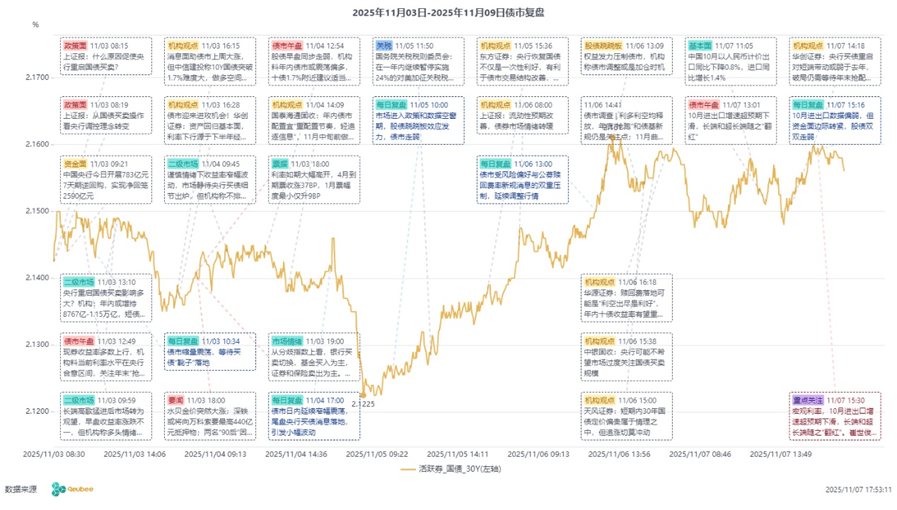
周观:债市震荡格局难破,如何应对?(2025年第43期)
Soochow Securities· 2025-11-09 12:03
1. Report Industry Investment Rating No relevant content provided. 2. Core Viewpoints of the Report - The bond market remained in a box - shock range this week. Despite the lower - than - expected net Treasury bond purchase scale announced this week, the central bank's support for liquidity remains unchanged. The 10 - year Treasury bond yield is expected to continue the narrow - range shock pattern this year, and the impact of the redemption fee rate new rules will be mitigated. A rapid rise in interest rates due to the new rules could present a good entry opportunity [1][16]. - Last week, the monetary policy orientations of the US, Europe, and Japan tended towards marginal balance. After the China - US Busan dialogue, the overall overseas certainty decreased marginally, and the technology valuation faced short - term pressure. However, in 2026, with the change of the Fed chairman, the Fed is likely to maintain a loose monetary policy, and the technology market may continue until the second half of 2026 [2][19]. 3. Summary According to the Directory 3.1 One - Week View 3.1.1 Analysis of the Central Bank's Treasury Bond Purchase - From November 3 to 7, 2025, the yield of the 10 - year Treasury bond active bond rose 1.35bp from 1.7925% to 1.8060%. Market sentiment, the central bank's bond - buying scale, the stock - bond relationship, and the expected implementation of the new fund fee rules all affected the yield fluctuations [1][11][12]. - The bond market is expected to continue narrow - range fluctuations. The impact of the new redemption fee rate rules will be mitigated by the transition period, and the central bank's support for liquidity remains strong. A rapid rise in interest rates due to the new rules will create a good entry opportunity [16]. 3.1.2 Analysis of US Bond Yield Trends - Last week, the monetary policy orientations of the US, Europe, and Japan tended towards marginal balance. After the China - US Busan dialogue, overseas uncertainty increased, and risk - aversion sentiment emerged. The technology market may face short - term pressure but is expected to recover in 2026 [2][19]. - In the US, the commercial crude oil inventory increased significantly in the week of October 31, 2025, mainly due to loose supply and insufficient demand. The ISM manufacturing PMI index in October was lower than expected, indicating weak manufacturing vitality. The Fed's internal differences on the December interest - rate cut path intensified, with different stances from radical doves, moderate doves, and hawks [2][20][24]. 3.2 Domestic and Overseas Data Summary 3.2.1 Liquidity Tracking - In the open - market operations from November 3 to 7, 2025, the net investment was - 15,722 billion yuan, mainly due to the large - scale maturity of reverse repurchases [35]. - The money - market interest rates showed a downward trend overall this week [36][37]. 3.2.2 Domestic and Overseas Macro Data Tracking - The total commercial housing transaction area showed mixed trends. Steel prices declined across the board, and LME non - ferrous metal futures official prices showed mixed trends [57][58][61]. - The prices of coking coal and thermal coal, inter - bank certificate of deposit rates, 7 - day annualized yield of Yu'E Bao, and vegetable price index all had their own trends [62][65][70]. - The VIX panic index led the rise, and the Philadelphia Semiconductor Index led the fall. US bond yields increased overall compared to half a month ago, and the term spreads between 10 - year and 2 - year US bonds, and between 10 - year and 3 - month US bonds decreased [74][79][80]. 3.3 One - Week Review of Local Bonds 3.3.1 Primary Market Issuance Overview - This week, 32 local bonds were issued in the primary market, with a total issuance amount of 91.607 billion yuan, including 45.211 billion yuan of refinancing bonds and 46.396 billion yuan of new special bonds. The net financing was - 33.641 billion yuan, mainly invested in comprehensive, highway, and shantytown renovation projects [89]. - Five provinces and cities issued local special refinancing special bonds for replacing hidden debts, with Yunnan, Shaanxi, Ningbo, Fujian, and Inner Mongolia ranking in the top five in terms of issuance amount [96]. 3.3.2 Secondary Market Overview - This week, the stock of local bonds was 53.78 trillion yuan, with a trading volume of 40.6417 billion yuan and a turnover rate of 0.76%. The top three provinces with active local bond trading were Guangdong, Jiangxi, and Shandong, and the top three active terms were 30Y, 10Y, and 20Y [104]. - The overall yield of local bonds declined this week [109]. 3.3.3 Local Bond Issuance Plan for the Month The local bond issuance plans of various provinces and cities for this month are presented, including the planned issuance amounts of Chongqing, Shandong, and other places [112]. 3.4 One - Week Review of the Credit Bond Market 3.4.1 Primary Market Issuance Overview - This week, 316 credit bonds were issued in the primary market, with a total issuance amount of 288.652 billion yuan, a total repayment amount of 198.141 billion yuan, and a net financing amount of 90.511 billion yuan, an increase of 106.811 billion yuan compared to last week [110]. - Specifically, the net financing of urban investment bonds was - 9.80 billion yuan, and the net financing of industrial bonds was 91.491 billion yuan [111][115]. 3.4.2 Issuance Interest Rates The issuance interest rates of various credit bond types decreased this week, with short - term financing bonds, medium - term notes, enterprise bonds, and corporate bonds all showing downward trends [122]. 3.4.3 Secondary Market Transaction Overview The total trading volume of credit bonds this week was 592.039 billion yuan, with different trading volumes for different ratings and bond types [123]. 3.4.4 Yield to Maturity - The yield of China Development Bank bonds increased across the board this week [124]. - The yields of short - term financing bonds and medium - term notes showed mixed trends, while the yields of enterprise bonds and urban investment bonds generally declined [124][125][127]. 3.4.5 Credit Spreads The credit spreads of short - term financing bonds, medium - term notes, enterprise bonds, and urban investment bonds generally narrowed this week [130][132][134]. 3.4.6 Rating Spreads The rating spreads of short - term financing bonds, medium - term notes generally narrowed this week [137][140].