美元走弱

Search documents
2026年铜价预测84000~110000元之间。
Sou Hu Cai Jing· 2025-12-29 09:02
Group 1 - Supply remains tight due to rigid constraints at the mining level, with frequent production disruptions at major mines like Indonesia's Grasberg and Chile's El Teniente, leading to insufficient new capacity and tight copper concentrate supply [2] - The smelting sector is under pressure as copper concentrate processing fees (TC/RC) have dropped to negative values, causing Chinese smelting companies to face production cuts due to raw material shortages and losses, which may further impact refined copper supply [2] - There is a structural demand highlight despite weak demand in traditional real estate, with strong growth points emerging from investments in power grids, electric vehicles, AI data centers, and supporting power facilities, providing resilient support for copper demand [2] Group 2 - A unique "regional inventory imbalance" has emerged due to U.S. tariff policies, resulting in a significant flow of global copper inventory to U.S. warehouses, causing tight spot supply in Asia (including China) and Europe, which has driven up spot premiums and prices in these regions [2] - The macroeconomic and financial environment is supportive, with expectations of global liquidity easing during the Federal Reserve's interest rate cut cycle and a weaker dollar enhancing the financial attributes and allocation value of commodities like copper [2] Group 3 - The overall outlook for copper prices in China for 2026 suggests that under supply constraints, emerging demand, and financial support, prices are likely to rise and remain high, making significant declines less probable [2]

暴涨!铜价创纪录
新华网财经· 2025-12-29 08:02
Group 1 - The core viewpoint of the article highlights that copper prices have reached a historical record, with three-month copper futures on the London Metal Exchange touching $12,960 per ton, reflecting a daily increase of 6.18% [1] - Analysts indicate that market expectations of continued loose monetary policy by the Federal Reserve next year, along with a weaker dollar reducing holding costs, have led to a collective rise in copper and other non-ferrous metals [2]

野村:美联储降息或引摩擦,7 - 11月美市场负面
Sou Hu Cai Jing· 2025-12-29 05:52
【12月29日野村报告:美联储降息或引质疑与摩擦,美市场负面因素集中7至11月】12月29日,野村发 布报告指出,市场对美联储新任主席领导能力的质疑,可能在明年6月降息时显现。随后若暂停降息, 或引发与美国政府的摩擦。野村还表示,美国市场负面因素可能集中在7月至11月,市场关注点将从美 国市场转移,美元走弱。 本文由 AI算法生成,仅作参考,不涉投资建议,使用风险自担 ...
野村:市场对美联储新主席能力的质疑或随明年6月降息而显现
Sou Hu Cai Jing· 2025-12-29 03:01
野村发报告指,市场对于美联储新任主席领导能力的质疑可能随着明年6月的降息而显现,而随后暂停 降息,则可能导致与美国政府的摩擦。野村表示,美国市场的负面因素可能集中在7月至11月,市场关 注点从美国市场转移,美元走弱。 ...
金银铜齐齐新高-周期怎么看
2025-12-29 01:04
Summary of Key Points from Conference Call Records Industry Overview Commodities - Recent strong performance in commodity prices, with gold surpassing 4,600 yuan, silver increasing by 11% to 80 USD, and LME copper stabilizing above 12,000 USD. Early year copper prices were below 75,000 yuan [2][7] - Short-term price fluctuations due to factors like silver delivery month squeeze, not driven by supply-demand improvements. Long-term outlook remains positive due to a weaker dollar and anticipated Fed rate cuts [2][7] - The current commodity cycle is influenced by international competition, differing from previous cycles driven by real estate and infrastructure [3][8] Aviation Sector - Positive outlook for the aviation sector in 2026, with New Year ticket prices up by 6-7% and passenger load factors increasing by 1-2%. Recovery in China-Japan-Korea routes noted [4] - Anticipated recovery in airline profitability to exceed 2019 levels due to extended holiday periods and improved travel demand [4] Express Delivery Industry - Jitu's stable growth in Southeast Asia, recommended as a stock with potential for doubling in three years. SF Express exited the Douyin return segment to protect profits, with a 30% increase in package volume but unfulfilled profit expectations [5][6] - Focus on bottoming SF Express stock, while waiting for data from other express companies for validation of growth potential [6] Non-Ferrous Metals - Positive outlook for the non-ferrous metals sector in 2026, though growth may not match 2025 levels. Current valuations are lower than in 2025, with high certainty of EPS recovery [10] - Energy metals remain undervalued, presenting investment opportunities [10] Coal Industry - Recent decline in coal prices, with the coal index down by 0.89%. However, coking coal fundamentals remain strong, with prices up 170 yuan per ton year-on-year [11][12] - High inventory levels suppress price rebounds, but potential stabilization due to weather factors is noted. Recommendations include investing in high-dividend coal companies [12] Core Insights and Arguments - The commodity price center is expected to rise long-term, supported by macroeconomic factors such as a weaker dollar and Fed rate cuts [2][7] - The aviation sector is projected to recover significantly, driven by increased travel demand and favorable pricing trends [4] - The express delivery market shows resilience, with specific companies like Jitu and SF Express highlighted for their growth potential [5][6] - Non-ferrous metals are positioned for a strong performance, with a focus on energy metals as attractive investment options [10] - The coal industry faces challenges with price declines but offers opportunities in high-dividend stocks amidst stable fundamentals [12] Additional Important Points - The equity market is not overheated, with P/E and P/B ratios at historical lows, indicating a favorable environment for investment [9] - The end of the current commodity cycle will depend on factors such as the restoration of dollar credit, supply chain restructuring, and domestic policies [8]
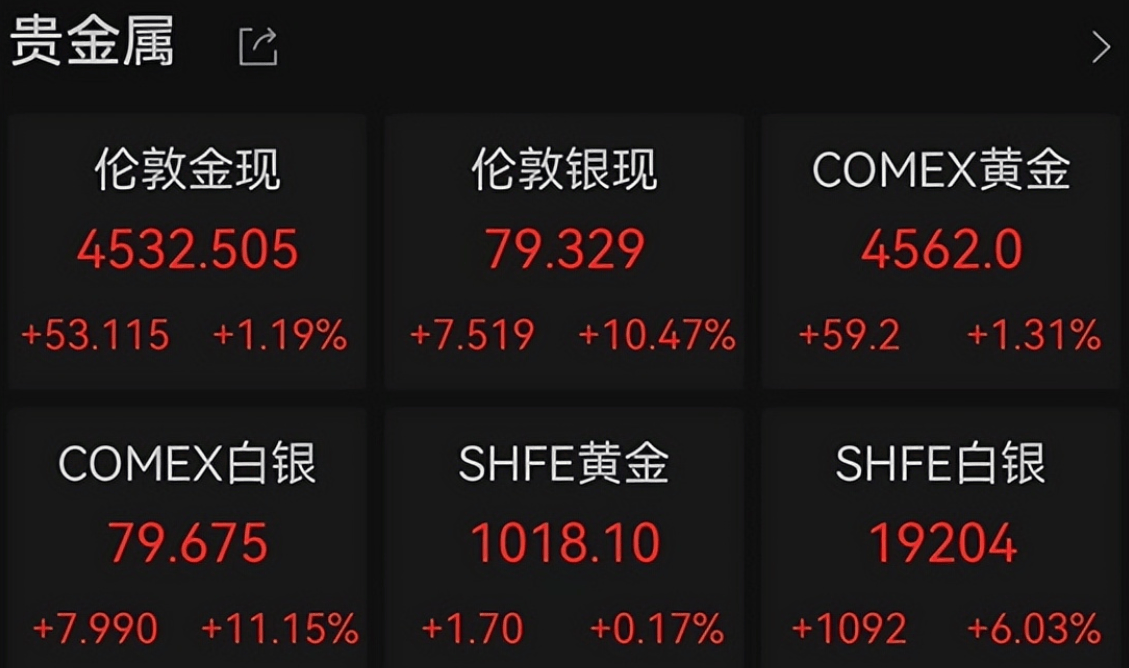
继上周五之后,今日白银再暴涨
Sou Hu Cai Jing· 2025-12-29 00:41
Group 1: Silver Market Performance - Silver prices have surged significantly, with spot silver rising over 5% and futures increasing by more than 7% on December 29 [1] - On December 26, COMEX silver futures experienced a spike of over 11%, while spot silver rose by more than 10% [3] - Other precious metals, including gold, platinum, and palladium, also saw varying degrees of increase [2] Group 2: Market Analysis and Factors - Analysts attribute the rise in precious metal prices to escalating geopolitical tensions, a weakening dollar, and low market liquidity [3] - Concerns have been raised about the sustainability of current precious metal prices, with some analysts suggesting they are at levels difficult to justify based on fundamentals [4] - The global silver market has been in a structural deficit for five consecutive years, with physical inventories rapidly depleting [6] Group 3: Industrial Demand and Supply Issues - Silver's price is influenced by both industrial and investment demand, with a ratio of approximately 6:4 favoring industrial use [5] - The demand for silver in the photovoltaic sector has significantly increased, contributing to recent price surges [5] - Current data indicates a supply gap of 100 million to 250 million ounces by 2025, highlighting a critical supply shortage in the silver market [6]
刚刚!白银再暴涨
证券时报· 2025-12-29 00:22
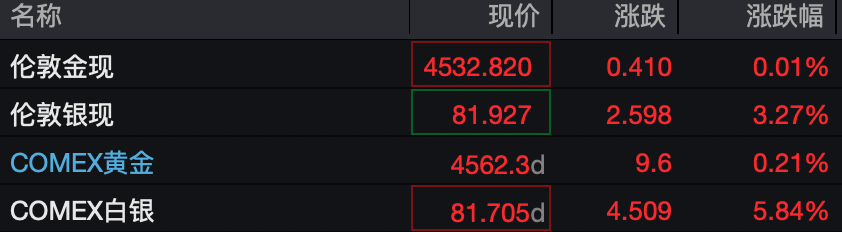
Core Viewpoint - Silver prices have surged significantly, with recent increases attributed to geopolitical tensions, a weakening dollar, and low market liquidity [1][3][4]. Group 1: Price Movements - On December 29, silver prices rose sharply, with spot silver increasing over 5% and futures rising over 7% [1]. - As of the latest data, London silver was priced at $81.927, reflecting a 3.27% increase, while COMEX silver reached $81.705, up 5.84% [2]. - Last week, on December 26, precious metals experienced a broad rally, with COMEX silver futures soaring over 11% and spot silver rising over 10% [3]. Group 2: Market Analysis - Analysts warn that precious metal prices are at unsustainable levels, with potential for a significant correction as speculative trading increases [4]. - UBS highlighted that the rapid price increase is largely due to insufficient market liquidity, raising short-term risks for precious metals trading [4]. - The current market dynamics suggest that while long-term factors like "de-dollarization" may support prices, the recent rapid increases are overly speculative [4]. Group 3: Supply and Demand Dynamics - Silver is facing supply pressures due to a structural deficit, with industrial demand and investment demand split approximately 60% to 40% [5]. - The silver market has been in a structural deficit for five consecutive years, with physical inventories rapidly depleting [6]. - Projections indicate a significant supply gap, with demand expected to reach 1.24 billion ounces by 2025, while supply is only anticipated at 1.01 billion ounces, resulting in a shortfall of 100 million to 250 million ounces [6].

金价银价飙升,国内金饰卖出1413元,买入也超千元,投资者该怎么选?
Sou Hu Cai Jing· 2025-12-28 18:11
Core Viewpoint - The recent surge in gold and silver prices has created a tense atmosphere in the market, with gold surpassing $4,526 per ounce and silver reaching $75 per ounce, leading to rapid re-evaluation of positions by traders [1][3]. Market Dynamics - The price increase is driven by multiple factors including geopolitical uncertainties, a temporary weakening of the dollar, and expectations of declining real interest rates, which have disrupted traditional asset allocation models [5]. - The demand for silver from industrial sectors such as photovoltaics and electronics is increasing, raising concerns about supply chain bottlenecks and inventory adjustments [5][9]. Regulatory Environment - Exchanges and public funds are facing dual constraints: physical limits on positions imposed by exchanges and prohibitions on high leverage by public funds, creating a complex situation where relaxing purchase limits could lead to default risks [3][5]. - Notifications from exchanges urging members to strengthen risk management highlight the regulatory focus on position limits and compliance issues [3]. Investor Behavior - Ordinary investors exhibit polarized views, with some seeing gold as a safe haven while others fear a potential bubble, reflecting broader anxieties about household finances [5][9]. - Experts advise investors to focus on asset allocation and risk management, emphasizing the importance of understanding personal investment experience and financial needs [7]. Supply Chain Implications - Businesses are considering delaying inventory replenishment or switching to alternative materials due to compressed profit margins, which could amplify changes in the entire supply chain and impact gold and silver prices [7][9]. - The logistics capabilities of major banks are being expanded to capture profit opportunities from liquidity and settlement capabilities, indicating a shift in market participant risk preferences [7].
周末大消息,银价暴涨36%,白银LOF还要跑吗?
Sou Hu Cai Jing· 2025-12-28 09:01
Group 1 - The recent surge in silver prices is driven by multiple factors, including the Federal Reserve entering a rate-cutting cycle, which has lowered the dollar interest rate by a total of 75 basis points this year [5] - The CME's "FedWatch" tool indicates that there may be 1-2 more rate cuts expected next year, with a median forecast of a 25 basis point cut in 2026 [5] - As the dollar weakens, the cost of holding dollar-denominated assets decreases, leading to increased purchases of precious metals, particularly silver, as investors seek safe-haven assets amid geopolitical tensions [5] Group 2 - COMEX silver inventories remain low, and as delivery dates approach, concerns about the availability of physical silver for delivery have created a short squeeze, further driving up prices [6] - A similar situation occurred earlier this month when COMEX silver futures approached their delivery date, causing a spike in prices due to fears of insufficient silver for delivery [6] - The timing of this price surge is particularly sensitive as the year-end approaches, which can amplify market reactions [6]
【中金外汇 · 周报】市场料在年末维持平稳
Sou Hu Cai Jing· 2025-12-28 08:27
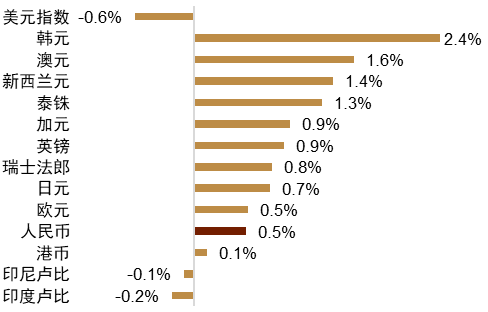
Group 1 - The core viewpoint of the article indicates that the US dollar index has returned to around 98, with market liquidity significantly weakened during the Christmas week, despite the US Q3 GDP data exceeding expectations. Concerns about the US labor market persist, supporting high expectations for Federal Reserve rate cuts [1][18] - Non-US currencies experienced overall appreciation last week, with significant gains in commodity currencies such as the Australian dollar (up 1.57%), New Zealand dollar (up 1.37%), Norwegian krone (up 1.34%), and Canadian dollar (up 0.95%). The British pound rose by 0.88%, while the euro saw a modest increase of about 0.5% [1] - The Japanese yen reversed previous losses after the Bank of Japan's dovish rate hike in December, ultimately appreciating by 0.75% last week. The Chinese yuan also accelerated its appreciation, with the offshore rate briefly surpassing 7.0 due to a weak dollar and increased year-end settlement demand [1][10] Group 2 - Looking ahead, the market is expected to remain relatively stable during the last three trading days of 2025, with liquidity likely to remain weak due to many traders being on holiday. Attention will be focused on the Chinese yuan exchange rate, which may face upward pressure as year-end settlement pressures are released [2] - The prediction range for USD/CNY is set between 7.00 and 7.03. Last week, the yuan maintained a moderate appreciation trend, although the pace of appreciation was limited by the steady exchange rate policy [3][10] - The yuan's appreciation is supported by seasonal factors, but the central bank's steady exchange rate policy has constrained the rate of appreciation. The central bank's recent signals emphasize the need to prevent excessive fluctuations in the exchange rate [11][16] Group 3 - The euro experienced a rise early last week but faced resistance around 1.18, ultimately closing with a weekly gain of about 0.5%. The market's focus on the Federal Reserve's dovish expectations may continue to influence the euro's performance [17] - Concerns about the US labor market persist, with Q3 GDP growth recorded at 4.3%, surpassing expectations. However, weekly unemployment claims data indicates a weakening employment growth momentum, maintaining high expectations for Federal Reserve rate cuts [18] - The European Central Bank (ECB) is perceived to have ended its current rate cut cycle, as indicated by the OIS market, which reflects a relatively calm European market during the Christmas holiday [21]