降准降息

Search documents
2026年开年中国LPR持稳
Zhong Guo Xin Wen Wang· 2026-01-20 10:58
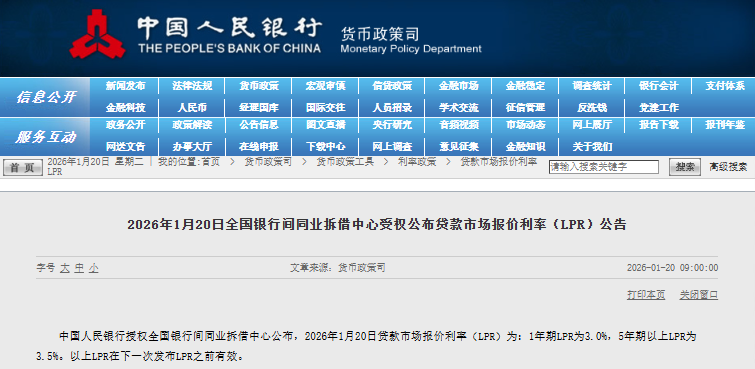
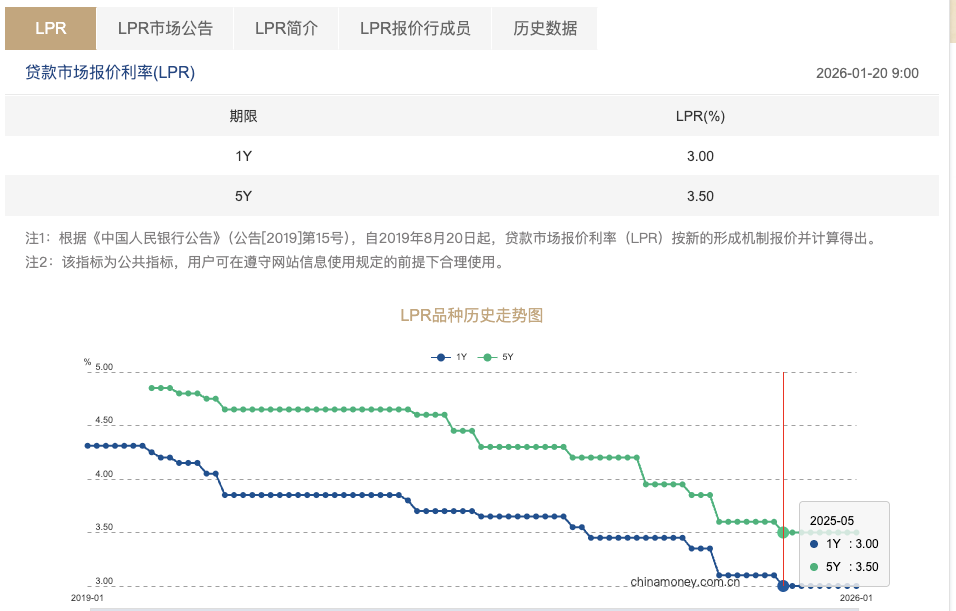
Core Viewpoint - The Loan Prime Rate (LPR) in China remains stable at 3.0% for the one-year term and 3.5% for the five-year term, unchanged for eight consecutive months, reflecting a steady macroeconomic environment despite external pressures [1][2]. Group 1: LPR Stability - The one-year and five-year LPRs have been held steady at 3.0% and 3.5% respectively since May 2025, following a rate cut [1]. - The stability of LPR is attributed to strong exports and rapid development in high-tech manufacturing sectors, which have helped China meet its annual growth targets [1]. Group 2: Economic Performance - In 2025, China's GDP exceeded 140 trillion yuan, growing by 5.0% year-on-year at constant prices [1]. - The People's Bank of China has introduced eight structural monetary policy measures in January 2026, indicating potential for further adjustments in interest rates and reserve requirements [1]. Group 3: Future Monetary Policy Outlook - Analysts suggest that the necessity for short-term LPR cuts is reduced due to structural rate adjustments and active stock market trading, which may prevent overheating of asset prices [2]. - The central bank has various monetary tools available, and the likelihood of immediate rate cuts or reserve requirement reductions appears to be decreasing [2][3].
市场分析:金融地产行业领涨,A股震荡整固
Zhongyuan Securities· 2026-01-20 09:32
Market Overview - On January 20, the A-share market experienced a slight fluctuation, with the Shanghai Composite Index facing resistance around 4128 points before retreating[2][3] - The Shanghai Composite Index closed at 4113.65 points, down 0.01%, while the Shenzhen Component Index fell by 0.97% to 14155.63 points[7][8] - Total trading volume for both markets reached 28,044 billion yuan, above the median of the past three years[3][14] Sector Performance - Strong performers included banking, insurance, precious metals, and real estate sectors, while communication equipment, aerospace, photovoltaic equipment, and computer equipment sectors lagged[3][7] - Over 50% of stocks in the two markets declined, with notable gains in precious metals, chemical raw materials, cement, and real estate development sectors[7] Valuation Metrics - The average price-to-earnings (P/E) ratios for the Shanghai Composite and ChiNext indices are 16.85 times and 53.40 times, respectively, above the median levels of the past three years, indicating a suitable environment for medium to long-term investments[3][14] Economic Indicators - The central bank has indicated that there is still room for further interest rate cuts this year, aiming to support economic transformation and boost market confidence[3][14] - Regulatory measures are being implemented to encourage long-term capital inflow while maintaining market stability through adjustments in margin trading and transaction regulations[3][4] Investment Recommendations - Investors are advised to focus on financial, real estate, precious metals, and engineering construction sectors for short-term opportunities[3][14] - Future market trends are expected to concentrate on performance and industry trends, with a likelihood of the Shanghai Composite Index maintaining a slight upward trend[3][14]

LPR连续8个月“按兵不动” 今年房贷利率仍有下探空间
Bei Ke Cai Jing· 2026-01-20 09:25
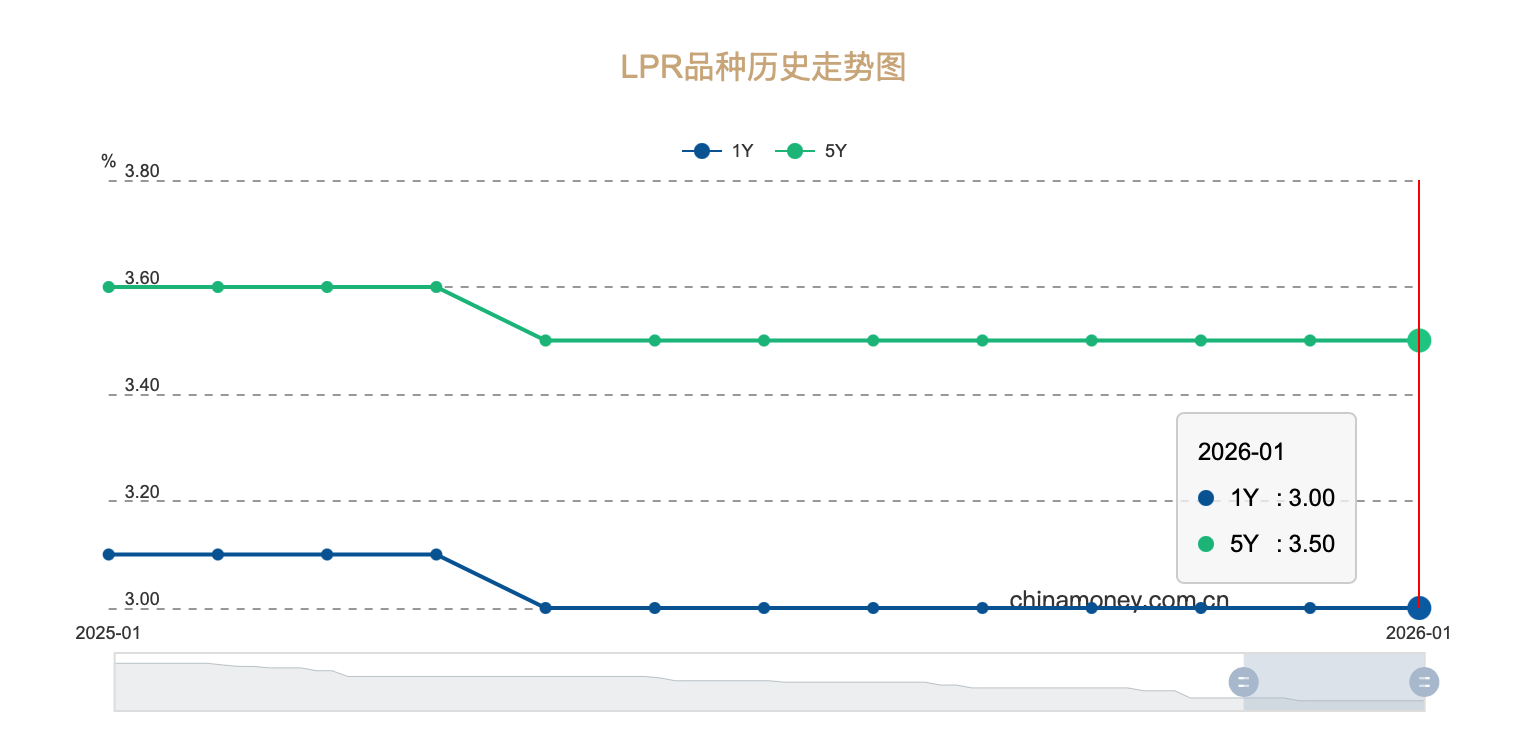
Core Viewpoint - The Loan Prime Rate (LPR) remains unchanged for the eighth consecutive month, with the 1-year rate at 3.0% and the 5-year rate at 3.5%, reflecting a stable monetary policy environment [1][6][12]. Group 1: LPR Stability - The LPR has not changed since May 2025, indicating a period of stability in interest rates [2]. - The People's Bank of China (PBOC) has indicated that there is still room for interest rate cuts in 2026, particularly in relation to consumer and mortgage loan rates [3][14]. - The current LPR pricing is influenced by stable market rates, including the 7-day reverse repurchase rate, which remains at 1.4% [7][9]. Group 2: Factors Influencing LPR - Multiple factors are constraining the LPR, including stable financing costs for commercial banks and pressures to maintain net interest margins [10][12]. - The recent stability in the LPR is attributed to strong export performance and rapid development in high-tech manufacturing sectors [12]. - Analysts suggest that the marginal effect of interest rate cuts is diminishing, making it less urgent to lower the LPR at this time [11]. Group 3: Future Outlook - There is a consensus among market participants that there is still potential for further reductions in consumer and mortgage loan rates, as they are currently at historical lows [14]. - Predictions indicate that the LPR may have room to decrease in 2026, supported by lower deposit rates and a potential reduction in the reserve requirement ratio by the PBOC [15][16]. - External factors, such as the U.S. Federal Reserve's interest rate cuts, may ease constraints on China's market rates, potentially leading to broader monetary policy adjustments [17].

LPR连续8个月不变,总量降息紧迫性下降
Di Yi Cai Jing· 2026-01-20 06:21
Core Viewpoint - The implementation of structural "interest rate cuts" indicates that monetary policy will enter an observation period in the short term, with policy rates and LPR expected to remain stable [2][3]. Group 1: LPR Stability - The LPR has remained unchanged for eight consecutive months since May 2025, with the 1-year LPR at 3.0% and the 5-year LPR at 3.5% as of January 20 [2]. - The stability of the LPR is attributed to the unchanged 7-day reverse repurchase rate, which serves as the pricing basis for LPR [3]. - Banks are currently facing historical low net interest margins, which diminishes their motivation to lower LPR quotes [3]. Group 2: Monetary Policy Context - Recent monetary policies, including structural "interest rate cuts," suggest that there is no immediate urgency for overall interest rate reductions [4][6]. - The weighted average interest rates for new corporate loans and personal housing loans were approximately 3.1% in December 2025, reflecting a decline of 2.5 and 2.6 percentage points respectively since the second half of 2018 [4]. - The central bank's deputy governor indicated that there is still room for rate cuts and reductions in reserve requirements, given the stable RMB exchange rate and the recent stabilization of bank net interest margins [4][5]. Group 3: Future Expectations - Analysts believe that the timing for a comprehensive interest rate cut may be delayed following the initial implementation of structural "interest rate cuts" [5]. - The urgency for total interest rate cuts is low, as structural "interest rate cuts" have already reduced banks' funding costs to some extent [6]. - The focus for 2026 should be on enhancing the coordination of macro policies to effectively support the real economy, with fiscal policy playing a crucial role in risk mitigation and incentivizing financial resources [6].
LPR连续八个月“按兵不动”
Zheng Quan Shi Bao· 2026-01-20 05:26
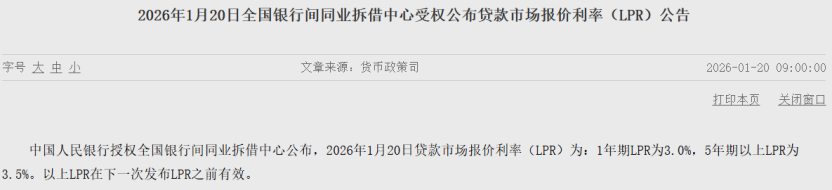
LPR连续八个月"按兵不动"。 1月20日,中国人民银行授权全国银行间同业拆借中心公布的新一期贷款市场报价利率(LPR)维持上期报价不变,其 中1年期LPR为3.0%,5年期以上LPR为3.5%。目前,LPR报价已连续八个月维持不变。 新的一年,央行明确将继续实施好适度宽松的货币政策,灵活高效运用降准降息等多种货币政策工具,保持流动性充 裕。市场机构普遍认为,年内降准降息等传统货币政策操作依然有空间,但短期内落地的必要性较小。 近期央行出台实施一批货币金融政策,包括下调结构性货币政策工具利率0.25个百分点等。"本次结构性降息,可能意 味着短期内降息的必要性降低。目前央行货币投放的工具很多,短期降准的概率也在降低。"民生银行首席经济学家温 彬表示,2026年,央行或更多通过结构性工具、强化政策一致性等来实现稳增长和多重平衡目标。 政策利率是LPR报价的定价基础,开年以来,作为央行政策利率的公开市场7天期逆回购利率保持稳定,已在很大程度 上预示LPR报价缺乏调整动力。另外,由于LPR报价加点由报价行共同决定,而当前银行净息差水平偏低,报价行同 样缺乏主动下调LPR报价加点的动力。 LPR是贷款利率定价的主要参考 ...
LPR连续八个月“按兵不动”
证券时报· 2026-01-20 05:21
Core Viewpoint - The Loan Prime Rate (LPR) has remained unchanged for eight consecutive months, with the 1-year LPR at 3.0% and the 5-year LPR at 3.5% [1][2]. Group 1: LPR Stability - The stability of the LPR is attributed to the lack of adjustment momentum, as the central bank's policy rate, the 7-day reverse repurchase rate, has remained stable [2]. - The low net interest margin for banks has resulted in a lack of incentive for banks to lower the LPR quote [2]. - The LPR serves as a key reference for loan pricing, with expectations that the average interest rates for new corporate and personal housing loans will remain around 3.1% until December 2025 [2]. Group 2: Monetary Policy Outlook - The central bank plans to continue implementing a moderately accommodative monetary policy, utilizing various tools such as reserve requirement ratio (RRR) cuts and interest rate reductions to maintain ample liquidity [3]. - Market institutions believe there is still room for RRR cuts and interest rate reductions this year, although the necessity for immediate action is low [3]. - Recent monetary policies include a 0.25 percentage point reduction in the rate of structural monetary policy tools, indicating a reduced need for immediate interest rate cuts [3]. Group 3: Economic Forecast - A survey conducted by Securities Times indicates that nearly 59% of economists expect the next RRR cut or interest rate reduction to occur between the Lunar New Year and the end of the first quarter [4].
LPR连续8个月“按兵不动” 降准降息仍待有利时机
2 1 Shi Ji Jing Ji Bao Dao· 2026-01-20 05:07
Core Viewpoint - The latest Loan Prime Rate (LPR) remains unchanged at 3.00% for the 1-year term and 3.50% for terms over 5 years, marking eight consecutive months of stability since the last reduction in May 2025 [1][9] Group 1: LPR Mechanism and Current Status - The LPR is determined by adding a spread to the 7-day reverse repurchase rate, which is currently at 1.40%, indicating limited potential for LPR reduction [1][9] - The net interest margin of commercial banks has stabilized at 1.42%, but there is pressure to maintain this margin while reducing costs for the real economy [1][9] Group 2: Monetary Policy and Future Expectations - The People's Bank of China (PBOC) has lowered the interest rates on various structural monetary policy tools by 0.25 percentage points, which could encourage banks to increase lending in key areas [4][12] - Despite the current stability of the LPR, there is potential for a reduction later in the year due to decreasing costs of bank liabilities and expected reserve requirement ratio (RRR) cuts [5][13] Group 3: Structural Monetary Policy Tools - The PBOC announced an increase in the quotas for agricultural and small business loans by 500 billion yuan and for technological innovation loans by 400 billion yuan [5][12] - The impact of structural monetary policy tools on overall bank funding costs is limited, with a total balance of only 6 trillion yuan compared to the total liabilities of 372 trillion yuan [4][12] Group 4: Financial Stability and Policy Coordination - The average statutory deposit reserve ratio is currently at 6.3%, indicating room for further RRR cuts [6][13] - The coordination between monetary and fiscal policies is crucial, with a focus on stabilizing net interest margins and monitoring market volatility in the bond and stock markets [8][14][15]
LPR连续8个月不变,降准降息仍待有利时机
21世纪经济报道· 2026-01-20 04:45
Core Viewpoint - The latest Loan Prime Rate (LPR) remains unchanged at 3.00% for the 1-year term and 3.50% for the 5-year term, marking eight consecutive months of stability since the last decline in May 2025 [1][4]. Group 1: LPR Mechanism and Current Status - The LPR is determined by adding points to the 7-day reverse repurchase rate, which is currently at 1.40%, indicating limited potential for LPR reduction [1][4]. - Despite signs of stabilization in net interest margins, banks face pressure to maintain these margins while reducing costs for the real economy, limiting their motivation to lower LPR quotes [1][4]. Group 2: Structural Monetary Policy and Its Impact - Recent adjustments in structural monetary policy tools, including a reduction in the one-year re-lending rate from 1.50% to 1.25%, aim to encourage banks to increase lending in key areas, although the overall impact on banks' funding costs is minimal [5][8]. - The balance of structural monetary policy tools is approximately 6 trillion yuan, which is small compared to the total liabilities of commercial banks at 372 trillion yuan, resulting in a limited effect on overall funding costs [5][8]. Group 3: Future Expectations for LPR Adjustments - There is potential for LPR adjustments later in the year due to expected declines in banks' funding costs as a significant amount of fixed-term deposits mature [6][8]. - External factors, such as the U.S. Federal Reserve's interest rate cuts, may also ease constraints on domestic monetary policy, providing room for potential LPR reductions [6][8]. Group 4: Broader Monetary Policy Context - The average statutory reserve requirement ratio for financial institutions is currently at 6.3%, indicating room for further reserve requirement cuts [8]. - The stability of the RMB exchange rate and the ongoing U.S. interest rate cuts suggest that external pressures on monetary policy are lessening, allowing for potential future rate cuts [8][9]. Group 5: Key Considerations for Financial Stability - Monitoring the pace of fiscal policy implementation and government bond issuance is crucial, as government bonds accounted for 38.9% of total social financing in 2025 [9]. - Continued stability in banks' net interest margins is essential, especially with significant long-term deposits maturing in 2026 [9]. - Attention to market volatility in the bond and stock markets is necessary to avoid sharp fluctuations that could impact financial stability [9].

LPR连续8个月按兵不动,解读来了
Sou Hu Cai Jing· 2026-01-20 04:27
Core Viewpoint - The Loan Prime Rate (LPR) remains unchanged for eight consecutive months, with the one-year LPR at 3.0% and the five-year LPR at 3.5%, indicating stability in monetary policy and lending conditions [1][3]. Group 1: LPR Stability - The LPR has not changed since May 2025, when it was reduced by 10 basis points for both terms [1]. - The stability of the LPR is attributed to the unchanged policy interest rates, particularly the central bank's 7-day reverse repurchase rate, which serves as a pricing basis for LPR [1][3]. - Major medium to long-term market interest rates, including the one-year interbank certificate of deposit yield, have remained stable, limiting banks' motivation to lower LPR quotes [1]. Group 2: Monetary Policy Context - On January 15, the People's Bank of China announced a reduction in various structural monetary policy tool rates by 0.25 percentage points, making borrowing from the central bank cheaper [3]. - The average interest rates for new corporate loans and personal housing loans are at historical lows, reflecting a decrease in overall financing costs, which suggests that guiding LPR down is not an immediate priority [3]. - The central bank is expected to continue increasing liquidity and using flexible open market operations to maintain ample liquidity while adjusting the yield curve through government bond transactions [4].

LPR持平八个月,降准降息空间仍存
Huan Qiu Wang· 2026-01-20 03:50
Core Viewpoint - The People's Bank of China (PBOC) has maintained the Loan Prime Rate (LPR) at 3.0% for the 1-year term and 3.5% for the 5-year term, marking eight consecutive months of stability, which aligns with market expectations due to policy rate anchoring and banks' funding cost considerations [1][4]. Group 1: LPR Stability - The 1-year LPR remains at 3.0% and the 5-year LPR at 3.5%, unchanged from the previous period [1][3]. - The stability of the LPR is attributed to the unchanged 7-day reverse repurchase rate, which serves as a primary reference for pricing [3]. - Major market interest rates, including the 1-year interbank certificates of deposit yield, have remained stable, indicating little change in banks' funding costs [3]. Group 2: Future Monetary Policy Outlook - Despite the LPR's stability, there is still room for monetary easing, as indicated by the PBOC's vice governor, who stated that there is potential for further reserve requirement ratio (RRR) cuts and interest rate reductions [4]. - The current banking net interest margin is at a historical low, which may limit banks' motivation to lower LPR quotes [3][4]. - Market analysts have differing views on the timing of potential interest rate cuts, with some suggesting that structural rate reductions have already eased some funding costs, while others anticipate that a broader policy rate cut may occur in the second quarter of 2026 [4][5]. Group 3: Economic Context and Implications - The economic environment is showing signs of recovery, supported by resilient exports and new policy initiatives, which may reduce the urgency for comprehensive interest rate cuts in the short term [5]. - However, as uncertainties in external trade increase, there is an expectation that the PBOC may open the window for rate cuts to counter potential downward pressures and stimulate domestic demand [5]. - A targeted reduction in the 5-year LPR may be implemented to stabilize the real estate market and significantly lower residential mortgage rates, which is seen as a crucial step to improve market expectations [5].