
信用利差

Search documents
【财经分析】供需结构仍偏弱 信用债四季度布局需审慎
Xin Hua Cai Jing· 2025-10-23 13:59
Core Viewpoint - The recent decline in market risk appetite, influenced by ongoing US-China tariff issues, has led to a recovery in bond market sentiment, resulting in a general decrease in credit bond yields [1][2]. Market Sentiment and Trends - The credit bond market has seen a general downtrend in yields, with credit spreads narrowing. From October 13 to 17, yields on municipal bonds with a maturity of 10 years or less fell by 1 to 6 basis points, while credit spreads narrowed by 1 to 7 basis points [2]. - Institutions are currently favoring short to medium-term bonds with higher coupon rates and a safety margin, particularly 3-year municipal bonds and 2 to 4-year bank capital bonds. Demand for long-term bonds has not recovered in parallel [1][2][3]. Institutional Behavior - Fund demand for credit bonds with maturities of 3 years or more remains weak. In contrast to the period from mid-March to early April, where funds increased their holdings of medium to long-term credit bonds, the recent weeks have seen a shift back to shorter maturities [3][4]. - The demand for credit bonds is expected to decline further in the fourth quarter due to a decrease in the growth of wealth management products, which typically see a larger increase in the first half of the year [4][5]. Future Outlook - The credit bond market is anticipated to continue a pattern of oscillation and consolidation in the fourth quarter, with institutions likely to reduce their credit bond positions due to a weak supply-demand structure [4][5]. - Analysts suggest that, given the current supply-demand imbalance, credit bonds are unlikely to yield excess returns compared to interest rate bonds, and liquidity issues may exacerbate risks during interest rate hikes [5][6]. Investment Strategies - Institutions are advised to maintain a cautious approach, focusing on short-duration bonds with higher coupon rates to identify structural opportunities. Specific recommendations include targeting municipal bonds with maturities of 1 to 3 years and yields above 2.2% [7][8].
市场狂欢何时结束?摩根大通交易员:密切关注这三大风险
Hua Er Jie Jian Wen· 2025-10-22 03:28
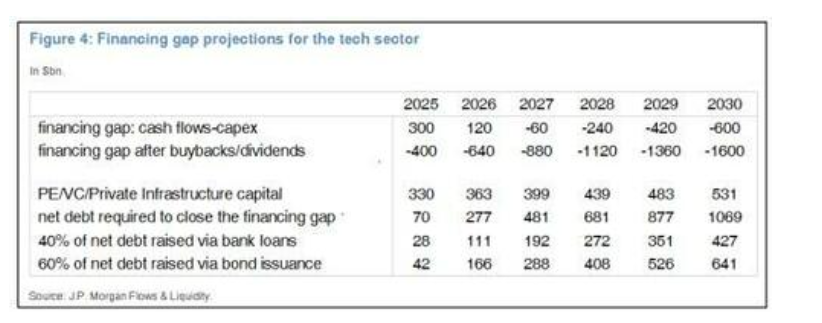
Group 1: Market Risks - The return of market volatility has led to increased discussions about potential risks that could end the current bull market, including significant investments in AI, the health of consumer credit, and signs of stress in the corporate sector [1] - JPMorgan's internal discussions indicate that their trading team is closely monitoring the sustainability of AI capital expenditures, rising auto loan delinquency rates, and credit asset write-downs at some banks [1] - Despite these concerns, JPMorgan currently views these risks as "tail risks" and not systemic threats, suggesting that recent fluctuations in consumer and corporate credit are more a normalization towards pre-pandemic trends rather than signs of systemic deterioration [1] Group 2: AI Investment and Financing Gap - The surge in AI investment is driving remarkable capital expenditures, with projections indicating that data center spending will grow from approximately $600 billion in FY2025 to between $3 trillion and $4 trillion by 2030 [2] - JPMorgan analyst Nikos believes this scale of spending is "manageable," as the tech sector can potentially cover these expenditures through internally generated cash flow, although this may require halting stock buybacks and dividend payments [2] - If tech companies continue to prioritize shareholder returns, the market could face a financing gap of approximately $1.6 trillion by 2030 [2] Group 3: Consumer Credit Trends - Concerns have arisen regarding a report stating that auto loan delinquency rates have increased by 50% since 2010; however, JPMorgan analysts argue that this increase is from a low of about 1% to 1.6%, while other categories of consumer credit have declined during the same period [4][5] - The current debt repayment burden for American households is approximately 11.25% of disposable income, which is lower than the 11.73% recorded in Q4 2019 and significantly below the peak of 15.85% in Q4 2007 [6] Group 4: Corporate Credit Health - The health of the corporate sector is also a focal point, with recent asset write-downs, such as Zion Bancorp's $60 million write-down, raising market concerns [8] - JPMorgan's credit trading department views recent credit "blow-up" events as more indicative of a return to trend rather than the onset of systemic issues [8] - Strategist Eric Beinstein anticipates that credit spreads will widen by the end of the year, with investment-grade (IG) spreads increasing by 6 basis points and high-yield (HY) spreads by 35 basis points, although current default rates remain significantly below historical averages [10]

固收:哪些债券策略还有空间
2025-10-20 14:49
Summary of Key Points from the Conference Call Industry Overview - The conference call primarily discusses the bond market, focusing on fixed income strategies and interest rate predictions for the fourth quarter of 2025. [1][2] Core Insights and Arguments 1. **Interest Rate Predictions**: The current interest rate model has shifted to a bullish stance since October 10, with a historical success rate of approximately 85%. The bond market is expected to experience limited downward movement in interest rates, with the 10-year government bond rate fluctuating around 1.75% and unlikely to drop below 1.7% without external shocks. [2][3] 2. **Market Conditions**: The bond market is influenced by two main factors: the lack of expectations for domestic monetary policy easing and the realization of economic growth targets for the year. This results in limited downward pressure on interest rates in the short term. [3] 3. **Strategy Recommendations**: Traditional duration strategies are not recommended due to limited space for significant downward movement. Instead, investors should focus on non-directional strategies that capitalize on high spread compression opportunities, particularly in slightly longer durations and higher interest rate positions. [4] 4. **Credit Spread Evaluation**: The comparison between 5-year subordinated capital bonds and 5-year government bonds shows a spread of approximately 40 basis points, indicating that subordinated capital bonds have better holding value despite lower liquidity. [5] 5. **Investment Opportunities in Credit Bonds**: There is potential for further compression in credit spreads for certain long-term credit bonds. The analysis of credit spreads across different maturities suggests that mid to long-term credit bonds still have room for compression. [6][7] 6. **Impact of Redemption Fee Regulations**: The new redemption fee regulations may lead to increased fund redemption, widening spreads. However, the market has partially absorbed the impact, and high credit quality bonds may still attract investment despite potential short-term volatility. [8][9] 7. **Local vs. National Bonds**: The overall spread between local and national bonds is high, with specific maturities showing significant differences. New local bonds have a higher implied VAT rate, making them worthy of attention, particularly the 30-year local bonds which still hold investment value relative to national bonds. [10] 8. **Portfolio Construction**: It is recommended to construct portfolios based on the value proposition of different bond types, with government bonds in the 6-7 year range and credit bonds in the 4-6 year range being particularly attractive. The overall duration of the portfolio should remain neutral or slightly high. [11] 9. **Special Government Bonds**: The issuance of special government bonds in the first quarter of 2025 remains uncertain, with the issuance plan typically announced around April. This uncertainty could affect the performance of specific bond types. [12][13] 10. **Focus on 30-Year Bonds**: Four specific 30-year government bonds are recommended for attention due to their good configuration value and liquidity. [14] 11. **Mid-Term Government Bonds**: Two mid-term government bonds (5-year and 7-year) are highlighted for their favorable value in the current market environment. [15] 12. **Floating Rate Bonds**: Current floating rate bonds do not imply any easing expectations, leading to relatively high prices. While there is some attraction for certain funds, large purchases are not advised. [16] 13. **Government Bond Futures**: The December futures contract is considered overpriced relative to cash bonds, but there is potential for basis compression in the far-month contracts. [17] Other Important Insights - The analysis emphasizes the importance of monitoring economic indicators and external factors such as trade tensions and interest rate expectations, which could significantly impact the bond market dynamics. [3][4][8]
华源晨会精粹20251020-20251020
Hua Yuan Zheng Quan· 2025-10-20 12:19
Group 1: Fixed Income Market - Credit spreads across the curve have compressed, with slight widening observed in the banking sector while other industries saw a majority of spreads compressing [2][7][9] - The issuance volume of traditional credit bonds and asset-backed securities has increased, with AA and AA+ rated industrial and urban investment bonds yielding between 2.4% and 2.8% [6][9] - The strategy suggests a cautious approach to credit allocation, recommending short-end positioning and moderate allocation to medium to long-term credit bonds [9] Group 2: Emerging Industries and Index Funds - The "Specialized, Refined, Characteristic, and Innovative" (专精特新) initiative has led to the cultivation of over 140,000 specialized small and medium enterprises in China, with 1,460 "little giant" companies [11][12] - The North Exchange's specialized index, launched in June 2025, selects the top 50 securities from these "little giants," focusing on high-end manufacturing, new materials, and biomedicine [11][12] - The expected scale of the first batch of index funds is around 10 funds with an average size of 500 million yuan, potentially exceeding 15 billion yuan by 2027 [12] Group 3: Transportation and Logistics - The express delivery sector has shown resilience, with major companies reporting improved single-ticket revenue and volume growth, indicating a trend of price increases in the industry [20][21][30] - The privatization attempt of Aneng Logistics by a consortium is still in preliminary stages, introducing uncertainty into the acquisition process [22] - The implementation of new port fees between China and the U.S. is expected to create a dual market structure, affecting shipping costs and efficiency [23][24] Group 4: Media and Entertainment - The gaming sector is expected to continue benefiting from strong product performance, with companies like Ice Glacier Network projecting significant earnings growth [34][35] - The launch of Manus1.5 enhances AI web application capabilities, indicating ongoing innovation in AI technology [35][36] - The CTE event showcases a wide array of global toy brands, highlighting the rapid expansion of the trendy toy industry [35] Group 5: Energy and Utilities - The electricity and environmental sectors are projected to see stable operations in hydropower and nuclear power, with significant growth expected in waste-to-energy projects [4][30] - The oil and gas pipeline sector is undergoing reforms, with an emphasis on fair access and market structure improvements [4][30] - The anticipated increase in electricity demand driven by AI advancements presents opportunities for equipment exports [4][30]
固收指数月报 | 债券通渠道跨境回购结算量将崛起;功夫债指数年至今回报达6.67%
彭博Bloomberg· 2025-10-20 06:05
Core Insights - Bloomberg is the first global index provider to include Chinese bonds in mainstream global indices, offering a unique perspective on the Chinese bond market through its flagship Bloomberg China Fixed Income Index series [3] - The Bloomberg China Aggregate Index recorded a return of -0.36% in September, with a year-to-date return of 0.06%, while the 30-day volatility showed a downward trend [5][7] - The China Treasury and Policy Bank Index also reported a return of -0.32% in September, while the China USD Credit (Kungfu) Index achieved a return of 0.86% for the month and 6.67% year-to-date [5][7] Index Performance Summary - The China Aggregate Index (I08271CN) had a month-to-date return of -0.36% and a year-to-date return of 0.06%, with an index level of 243.09 [7] - The China Treasury Index (I08273CN) recorded a month-to-date return of -0.44% and a year-to-date return of -0.15%, with an index level of 232.73 [7] - The China USD Credit (Kungfu) Index (I29380US) had a month-to-date return of 0.86% and a year-to-date return of 6.67%, with an index level of 202.13 [7] Market Developments - On September 26, China announced the opening of its domestic bond repurchase market to foreign investors, aligning with international practices and potentially accelerating the internationalization of Chinese bonds and the renminbi [13] - This reform aims to attract long-term capital inflows and may help mitigate short-term capital outflows, with the cross-border repurchase settlement volume through the Bond Connect expected to increase significantly [13] - Strong current account surpluses and high savings rates indicate China's robust domestic financial strength, which can act as a buffer in the event of mismatches in the dollar financial market [13]

美国流动性短缺 回购市场压力加剧
Sou Hu Cai Jing· 2025-10-19 16:16
Core Insights - The current financial market is facing significant challenges due to liquidity shortages and rising pressures in the repurchase market, reminiscent of past crises in 2019 and 2023 [1][6][10] - Regional banks are particularly vulnerable, with increasing concerns over credit events and potential contagion effects on larger banks and the broader financial system [2][3][9] Group 1: Regional Bank Challenges - Regional banks, such as Zions Bancorporation and Western Alliance Bank, are experiencing severe financial strain due to high exposure to commercial loans and consumer credit, leading to significant write-offs and lawsuits [2][3] - The economic divide is exacerbating the situation, with high-income groups benefiting from asset price increases while low-income groups face inflation and unemployment pressures, impacting loan quality [2][3] Group 2: Broader Market Implications - The turmoil in regional banks is beginning to affect larger financial institutions, with notable declines in stock prices for major banks like Citigroup and Goldman Sachs, indicating a potential spillover of credit risk [3][4] - The widening credit spreads, as indicated by the LQD/HYG ratio, suggest increasing investor preference for investment-grade bonds over high-yield bonds, reflecting heightened credit risk [3][9] Group 3: Repurchase Market Dynamics - The repurchase market is under significant stress, with the SOFR rate reaching its highest level since 2019, indicating a shift from liquidity abundance to scarcity [4][5] - The recent activation of the Federal Reserve's Standing Repo Facility (SRF) signals a critical need for liquidity support, particularly in the mortgage-backed securities market [5][6] Group 4: Policy and Economic Factors - The liquidity crisis is driven by multiple factors, including a substantial fiscal deficit, the rebuilding of the Treasury General Account (TGA), and ongoing quantitative tightening by the Federal Reserve [7][8] - The potential for credit events and market volatility is increasing, necessitating careful monitoring of key indicators and possible policy responses from the Federal Reserve and Treasury [9][10]
信用周报20251019:信用再现α利差压缩行情,后续如何参与?-20251019
Huachuang Securities· 2025-10-19 13:24
1. Report Industry Investment Rating No information provided regarding the industry investment rating. 2. Core Viewpoints of the Report - Credit bonds showed a compensatory rise this week, with most yields declining and credit spreads narrowing. The market is expected to consolidate around the 1.75% level, and investors can focus on adding positions in 4 - 5y bonds with spreads above the central level [5][10]. - The marginal release of negative factors in the bond market, with the main negative disturbances being the implementation of the fund sales fee policy and potential short - term increases in risk appetite. The attractiveness of medium - and long - term bonds with wider credit spreads has increased [5][10]. - The allocation power of funds for 3 - 5y credit bonds has recovered. The 4 - 5y bonds are cost - effective, and the narrowing of spreads is expected, but it may be difficult to reach the lows of July - August [2][14]. - For bonds over 5y, although the yields are high, caution is needed as they test the stability of the liability side. Institutions with stable liability sides can capture allocation opportunities, while those with weak liability sides should participate with small positions [3][23]. 3. Summary by Directory 3.1 Credit Strategy: 4 - 5y Bond Spreads Are Still Above the Central Level, and Positions Can Be Appropriately Added 3.1.1 Credit Bond Market Review: Yields Generally Declined, and Credit Spreads Generally Narrowed - This week, credit bonds compensated for the rise, with most yields declining and credit spreads narrowing. The capital price remained low, and the bond market was affected by various factors such as Sino - US tariff games, the stock - bond seesaw effect, and the new regulations on public fund sales fees, showing a volatile trend. Institutions had a good allocation sentiment for credit bonds, and credit performance was better than interest - rate products [9]. 3.1.2 Outlook for the Future: Negative Factors Are Marginally Released, and Attention Should Be Paid to the Opportunity to Add Positions in 4 - 5y Bonds - The 10y Treasury bond's volatility center has moved down due to tariff shocks, and the market may consolidate around 1.75%. The negative factors in the bond market are marginally released, and the main negative disturbances are the implementation of the fund sales fee policy and potential short - term increases in risk appetite. The attractiveness of 4 - 5y bonds with spreads above the central level has increased [5][10]. 3.2 Key Policies and Hot Events: The New Policy - Based Financial Instruments in This Round Have Exceeded One Billion, and the Chairman of Vanke Has Changed - The Ministry of Finance will continue to issue in advance the new local government debt quota for 2026, which can be used for project construction, resolving implicit debts, and solving government arrears to enterprises [24]. - The first - phase funds of new policy - based financial instruments in 12 provinces have exceeded 1.1 billion, with local state - owned enterprises as the main recipients, including many urban investment companies [24]. - Xin Jie resigned as the chairman of Vanke, and Huang Liping took over. Vanke's bond valuation has fluctuated recently, and attention should be paid to Shenzhen Metro's support and debt - resolution plans [25]. - The Ministry of Finance has issued a quota of 28 billion yuan for Hebei Province to replace implicit debts in 2026, which is currently awaiting allocation [25]. - Beijing has issued a plan to strengthen the role of the capital market in supporting scientific and technological innovation, including creating a "Zhongguancun Science and Technology Board" for bonds and supporting eligible projects to issue REITs [26]. 3.3 Secondary Market: Credit Bond Yields Generally Declined, and Credit Spreads Generally Narrowed - This week, credit bond yields generally declined, and credit spreads generally narrowed. For different types of bonds such as urban investment bonds, real - estate bonds, cyclical bonds, and financial bonds, most yields declined and spreads narrowed, with some individual varieties showing different trends [29]. 3.4 Primary Market: The Net Financing of Credit Bonds and Urban Investment Bonds Increased Month - on - Month - This week, the issuance of credit bonds was 418.1 billion yuan, a month - on - month increase of 341.9 billion yuan, and the net financing was 184.7 billion yuan, a month - on - month increase of 295 billion yuan. The net financing of urban investment bonds was 22 billion yuan, a month - on - month increase of 89.9 billion yuan [6]. 3.5 Trading Liquidity: The Trading Activity in the Inter - bank and Exchange Markets of Credit Bonds Increased - This week, the trading activity in both the inter - bank and exchange markets of credit bonds increased [6]. 3.6 Rating Adjustments: No Rating Upgrades or Downgrades This Week - There were no rating upgrades or downgrades of bond issuers this week [6].
广发基金刘志辉:在顺势中保持理性在波动中追求稳健
Shang Hai Zheng Quan Bao· 2025-10-19 12:31
Core Viewpoint - Liu Zhihui emphasizes a rational approach to investment amidst market volatility, focusing on macroeconomic cycles and industry allocation to achieve steady returns [2][3] Investment Philosophy - Liu's investment framework consists of three core elements: understanding macro cycles, assessing odds, and respecting market signals [3] - The investment philosophy includes "Investment Way," "Investment Method," and "Investment Technique," focusing on market trends, macro and industry analysis, and specific trading strategies [4] Multi-Asset Framework - Liu's investment strategy spans fixed income, equities, and convertible bonds, aiming for absolute returns through flexible allocation and odds thinking [5] - In bond investment, Liu adjusts duration and leverage based on macro analysis, credit environment, and market sentiment [6] Stock and Convertible Bond Strategy - Liu captures industry trends and cyclical turning points through sector rotation and concentrated allocation, focusing on both intrinsic value and market pricing signals [6] - For convertible bonds, Liu only allocates when they exhibit characteristics of downside protection and upside potential, guided by macroeconomic fundamentals [6] Recent Market Actions - In response to market adjustments, Liu increased exposure to sectors like innovative pharmaceuticals and AI, while also considering undervalued sectors such as machinery and real estate [7] - Liu maintains a neutral stance on the bond market, focusing on short-duration government bonds and high-rated credit bonds due to low yield levels [7]
3Y以内普信债与3-5Y二永债利差继续压缩
Xinda Securities· 2025-10-18 12:37
Group 1: Report's Overall Information - Report Title: 3Y within General Credit Bonds and 3 - 5Y Tier 2 and Perpetual Bonds Spread Continues to Compress - Credit Spread Weekly Tracking 20251018 [1] - Report Date: October 18, 2025 [2] - Report Type: Special Report [2] Group 2: Report's Core Views - Interest rates are oscillating, and credit bonds continue to recover. The spreads of 1Y medium - low grade and 3Y medium - high grade bonds have significantly compressed. Credit spreads have generally converged, with short - duration spreads having a larger convergence amplitude. [2][5] - Urban investment bond spreads have generally declined by 4 - 5BP, with spreads of different external ratings and administrative levels all showing a downward trend. [2][9] - Most industrial bond spreads have declined, but the spreads of mixed - ownership real estate bonds have still increased. The spreads of central and state - owned enterprise real estate bonds have declined, while those of mixed - ownership and private real estate bonds have increased. The spreads of coal, steel, and chemical bonds have mostly declined. [2][20] - The yields of Tier 2 and perpetual bonds have all declined this week, and the spreads of 3 - 5Y bonds have continued to recover, with high - grade varieties performing better. [2][31] - The excess spread of 3Y industrial perpetual bonds has increased, while the excess spread of 5Y urban investment bonds has decreased. [2][34] Group 3: Summary by Directory I. Interest rates oscillate, and credit bonds continue to recover, with the spreads of 1Y medium - low grade and 3Y medium - high grade bonds significantly compressing - Interest rate bonds have maintained an oscillating pattern. The yields of 1Y, 3Y, 5Y, and 7Y China Development Bank bonds have increased by 1BP, 2BP, 1BP, and 2BP respectively compared to last week, while the yield of 10Y bonds has decreased by 1BP. [2][5] - Most credit bond yields have declined, and credit spreads have significantly converged. Short - duration credit spreads have a larger convergence amplitude. [2][5] - In terms of rating spreads, the spreads of different grades and terms have shown different changes. In terms of term spreads, the spreads of different grades and terms have also shown different trends. [5] II. Urban investment bond spreads have generally declined by 4 - 5BP - The credit spreads of external rating AAA platforms have generally declined by 4BP compared to last week, while those of AA+ and AA have both declined by 5BP. Spreads of platforms in different regions have different degrees of decline. [2][9] - In terms of administrative levels, the credit spreads of provincial platforms have generally declined by 4BP, while those of municipal and district - county platforms have both declined by 5BP. Spreads of platforms in different regions have different degrees of decline. [2][17] III. Most industrial bond spreads have declined, but the spreads of mixed - ownership real estate bonds have still increased - The spreads of central and state - owned enterprise real estate bonds have declined by 4BP, while those of mixed - ownership real estate bonds have increased by 46BP, and those of private real estate bonds have increased by 1BP. The spreads of some real estate companies have different degrees of change. [2][20] - The spreads of all grades of coal bonds have declined by 4BP; the spreads of AAA steel bonds have declined by 4BP, and those of AA+ have declined by 5BP; the spreads of AAA chemical bonds have declined by 4BP, and those of AA+ have declined by 5BP. The spreads of some companies have different degrees of decline. [2][20] IV. The spreads of 3 - 5Y Tier 2 and perpetual bonds continue to recover - The yields of 1Y Tier 2 capital bonds of all grades have declined by 1BP, and perpetual bonds have remained roughly flat, with credit spreads declining by 2 - 3BP. [2][31] - The yields of 3Y Tier 2 capital bonds of all grades have declined by 3 - 4BP, and the yields of perpetual bonds have declined by 2 - 3BP, with spreads compressing by 5 - 7BP. [2][31] - The yields of 5Y Tier 2 capital bonds of all grades have declined by 2 - 3BP, and the yields of all grades of perpetual bonds have declined by 3 - 5BP, with spreads declining by 3 - 6BP. [2][31] V. The excess spread of 3Y industrial perpetual bonds has increased, while the excess spread of 5Y urban investment bonds has decreased - The excess spread of industrial AAA 3Y perpetual bonds has increased by 0.99BP compared to last week to 15.51BP, at the 41.31% quantile since 2015. The excess spread of industrial 5Y perpetual bonds has remained flat compared to last week at 12.39BP, at the 25.90% quantile since 2015. [2][34] - The excess spread of urban investment AAA 3Y perpetual bonds has increased by 0.15BP to 4.97BP, at the 3.01% quantile. The excess spread of urban investment AAA 5Y perpetual bonds has declined by 3.39BP to 11.08BP, at the 16.73% quantile. [2][34] VI. Credit spread database compilation instructions - The overall market credit spreads, commercial bank Tier 2 and perpetual bond spreads, and urban investment/industrial perpetual bond credit spreads are calculated based on ChinaBond medium - short - term notes and ChinaBond perpetual bond data, with historical quantiles since the beginning of 2015. The credit spreads related to urban investment and industrial bonds are compiled and statistically analyzed by Cinda Securities R & D Center, with historical quantiles since the beginning of 2015. [39] - The calculation methods for various spreads and the sample selection criteria for industrial and urban investment bonds are provided. [41]
信用债周度观察(20251013-20251017):信用债发行量环比增长,各行业信用利差整体下行-20251018
EBSCN· 2025-10-18 09:17
1. Report Industry Investment Rating No relevant content provided. 2. Core View of the Report - Credit bond issuance volume increased month - on - month, and the credit spreads of various industries generally declined [1] 3. Summary by Directory 3.1 Primary Market 3.1.1 Issuance Statistics - From October 13 to October 17, 2025, a total of 379 credit bonds were issued, with a total issuance scale of 433.329 billion yuan, a month - on - month increase of 206.54% [1][11] - In terms of issuance scale, 177 industrial bonds were issued, with a scale of 237.725 billion yuan, a month - on - month increase of 270.37%, accounting for 54.86% of the total credit bond issuance scale; 164 urban investment bonds were issued, with a scale of 101.634 billion yuan, a month - on - month increase of 132.16%, accounting for 23.45%; 38 financial bonds were issued, with a scale of 93.970 billion yuan, a month - on - month increase of 181.35%, accounting for 21.69% [1][11] - The average issuance term of credit bonds was 2.30 years, among which industrial bonds had an average issuance term of 1.86 years, urban investment bonds 2.87 years, and financial bonds 1.93 years [2][16] - The average issuance coupon rate of credit bonds was 2.20%, among which industrial bonds had an average issuance coupon rate of 2.09%, urban investment bonds 2.37%, and financial bonds 1.94% [2][20] 3.1.2 Cancellation of Issuance Statistics - Four credit bonds cancelled their issuance during the period [3][24] 3.2 Secondary Market 3.2.1 Credit Spread Tracking - The overall industry credit spreads declined. Among Shenwan primary industries, for AAA - rated industries, the largest upward spread was in agriculture, forestry, animal husbandry and fishery (8.2BP), and the largest downward spread was in electronics (9.8BP); for AA + - rated industries, the largest upward spread was in non - ferrous metals (2.9BP), and the largest downward spread was in electrical equipment (25.4BP); for AA - rated industries, the largest upward spread was in real estate (10.1BP), and the largest downward spread was in machinery (12.9BP) [3][26] - The credit spreads of coal and steel both declined. The credit spreads of AAA and AA + - rated coal declined by 1.7BP and 7.7BP respectively, and those of AAA and AA + - rated steel declined by 6.8BP and 6.3BP respectively [26] - The credit spreads of urban investment and non - urban investment bonds at all levels declined. The credit spreads of three - level urban investment bonds declined by 3.8BP, 4.7BP, and 4.4BP respectively, and those of three - level non - urban investment bonds declined by 5BP, 4.4BP, and 5.3BP respectively [27] - The credit spreads of state - owned enterprises and private enterprises both declined. The credit spreads of three - level central state - owned enterprises declined by 4.9BP, 3.1BP, and 7.6BP respectively, those of three - level local state - owned enterprises declined by 4.9BP, 4.5BP, and 5.3BP respectively, and the credit spreads of AAA and AA + - rated private enterprises declined by 7.9BP and 8BP respectively [27] - The regional urban investment credit spreads showed mixed trends. In terms of spread levels, for AAA - rated regions, the three regions with the highest credit spreads were Shaanxi, Liaoning, and Jilin; for AA + - rated regions, they were Qinghai, Shaanxi, and Gansu; for AA - rated regions, they were Sichuan, Shaanxi, and Guangxi. In terms of month - on - month changes, for AAA - rated regions, the largest upward spread was in Shaanxi (8.8BP), and the largest downward spread was in Inner Mongolia (9.1BP); for AA + - rated regions, the largest downward spread was in Heilongjiang (9BP); for AA - rated regions, the largest upward spread was in Fujian (8.4BP), and the largest downward spread was in Yunnan (12.9BP) [28] 3.2.2 Trading Volume Statistics - The total trading volume of credit bonds was 1457.824 billion yuan, a month - on - month increase of 70.45%. The top three in terms of trading volume were commercial bank bonds, corporate bonds, and medium - term notes. Specifically, commercial bank bonds had a trading volume of 380.333 billion yuan, a month - on - month increase of 49.20%, accounting for 26.09% of the total credit bond trading volume; corporate bonds had a trading volume of 406.552 billion yuan, a month - on - month increase of 71.21%, accounting for 27.89%; medium - term notes had a trading volume of 361.073 billion yuan, a month - on - month increase of 103.74%, accounting for 24.77% [4][29] 3.2.3 Actively Traded Bonds in the Current Period - The top 20 urban investment bonds, industrial bonds, and financial bonds in terms of trading volume were selected for investors' reference [31]