宏观经济政策

Search documents
CPI增长持续承压 研究者建议尽快出台新的增量政策
Jing Ji Guan Cha Wang· 2025-06-09 10:54
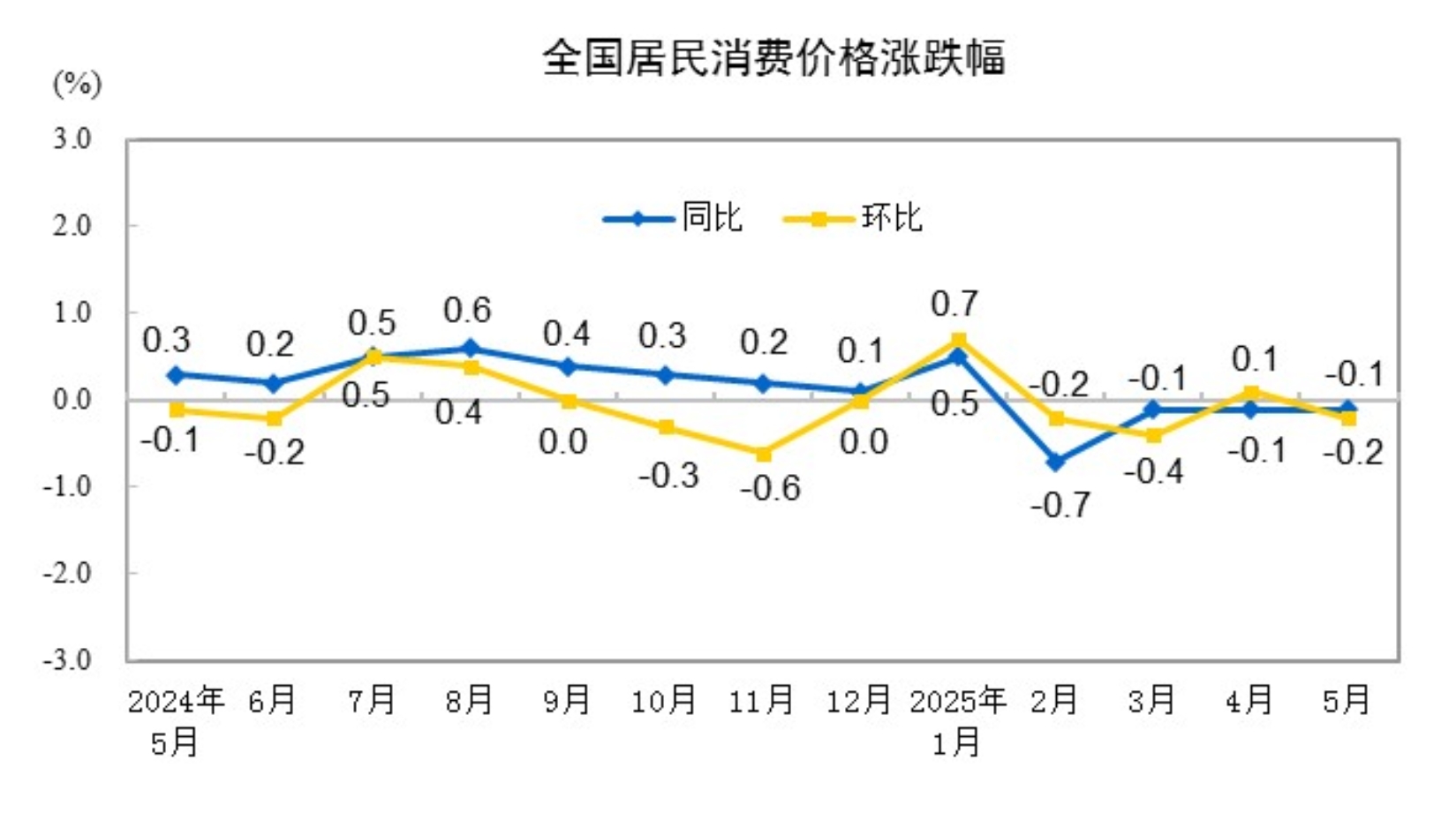
5月CPI数据发布当天,东方金诚宏观研究发展部发布的报告提出,剔除波动较大的食品和能源价格,更能反映基本物价水平的核心CPI同比持续处于1.0%以 下的低位,表明当前国内物价水平稳中偏弱,其中消费需求不足是主要原因。 国务院发展研究中心宏观经济研究部研究员张立群表示,近几个月CPI的走势说明,国内由市场引导的供求总量失衡态势仍在发展中。这种现象会进一步弱 化企业预期、打击企业信心,进而使居民消费活动向更谨慎的态势发展,为此要高度重视并尽快扭转此态势。 启铼研究院首席经济学家潘向东表示,物价是经济活跃度的一个反映。近期物价下跌的核心原因是需求不旺和供给过剩。需求不旺与国内经济面临的内外部 环境密切相关,包括外部的国际贸易摩擦,以及内部的就业压力和财产性收入增长压力等。 6月9日,国家统计局公布的数据显示,2025年5月全国居民消费价格指数(CPI)同比下降0.1%,CPI同比增速已连续四个月出现负增长。1—5月平均,CPI 比上年同期下降0.1%。 具体来看,5月蔬菜价格同比降幅由上月的-5.0%扩大到-8.3%,猪肉价格同比涨幅也出现回落。此外,受5月上旬国际原油价格走低影响,当月国内成品油价 格下调,能源价 ...

瑞达期货铁矿石市场周报-20250606
Rui Da Qi Huo· 2025-06-06 09:32
「2025.06.06」 铁矿石市场周报 研究员:蔡跃辉 添加客服 期货从业资格号F0251444 期货投资咨询从业证书号Z0013101 关 注 我 们 获 取 更 多 资 讯 瑞达期货研究院 业务咨询 目录 目录 1、周度要点小结 2、期现市场 3、产业情况 1、周度要点小结 2、期现市场 3、产业情况 4、期权市场 「周度要点小结1」 行情回顾 3 来源:瑞达期货研究院 1. 价格:截至6月6日收盘,铁矿主力合约期价为707.5(+5.5)元/吨,青岛港麦克粉776(-1)元/干吨。 2. 发运:本期澳巴发运总量环比+242.3万吨。2025年05月27日-06月02日Mysteel全球铁矿石发运总量3431.0万吨,环比增加 242.3万吨。澳洲巴西铁矿发运总量2868.8万吨,环比增加78.8万吨。澳洲发运总量1920.5万吨,环比减少92.7万吨,其中澳 洲发往中国的量1499.8万吨,环比减少281.4万吨。巴西发运量948.3万吨,环比增加171.5万吨。 3. 到港:本期47港到港量+253.3万吨。2025年05月26日-06月01日中国47港到港总量2597.4万吨,环比增加253.3万 ...
以高质量发展应对外部环境变化
Jing Ji Ri Bao· 2025-05-22 22:02
Group 1 - China's economy has shown a good start in the first quarter, with solid progress in high-quality development, but the foundation for sustained recovery needs further strengthening due to increasing external shocks [1] - The Central Political Bureau meeting emphasized the need to focus on "stabilizing employment, enterprises, markets, and expectations" as a response to current international and domestic situations [2][3] - The meeting highlighted the importance of macroeconomic policies as effective means to stabilize the economy, especially in the context of global economic downturn expectations [4] Group 2 - The focus on stabilizing employment includes promoting the transformation and upgrading of the manufacturing sector and developing the service industry to create more high-quality job opportunities [2] - The government aims to optimize the business environment to boost enterprise confidence and improve operational performance, particularly for those facing challenges due to international trade conflicts [2][4] - There is a call for a comprehensive approach to enhance domestic demand, with an emphasis on increasing the income of middle and low-income groups to drive consumption growth [7][8] Group 3 - The government plans to implement more proactive fiscal policies, including accelerating the issuance and use of local government special bonds to support growth [4] - Monetary policy will focus on maintaining ample liquidity and reducing financing costs for micro entities to support the real economy [4] - The need for a unified national market and the cultivation of new driving forces through reform and innovation is emphasized to adapt to new production capacities [5]
金十图示:2025年05月20日(周二)新闻联播今日要点
news flash· 2025-05-20 13:18
Group 1 - The Chinese government is focusing on modernizing the industrial system and strengthening agriculture to improve people's livelihoods and enhance social governance [3] - The government aims to promote ecological environment protection and cultural prosperity as part of its high-quality development strategy [3] Group 2 - The meeting between Wang Huning and the Mexican Speaker of the House emphasized the commitment to deepen practical cooperation and strengthen cultural exchanges between China and Mexico [4] - Both sides expressed a desire to enhance collaboration in trade, technology, education, and training [4] Group 3 - The Ministry of Housing and Urban-Rural Development announced plans to improve living conditions in urban areas, focusing on the renovation of old residential communities [5][6] - Financial support will be provided through tax incentives and increased funding for urban renewal projects [5][6] Group 4 - The National Development and Reform Commission reported that multiple macroeconomic policies have been effective in expanding domestic demand, with fixed asset investment projects totaling 573.7 billion yuan approved in the first four months of the year [7][8] - The sales of automobiles, home appliances, and digital products reached approximately 830 billion yuan as of May 5 [8] Group 5 - The National Food and Strategic Reserves Administration announced that summer grain procurement is set to reach around 200 billion jin, with preparations already in place for the peak season [9] - The railway sector reported a total cargo shipment of 1.299 billion tons from January to April, reflecting a year-on-year growth of 3.6% [10]

肖耿:中国企业需要继续走出去,成为真正的全球性跨国公司
Jing Ji Guan Cha Wang· 2025-05-16 03:08
Group 1 - The recent high-level economic talks between China and the U.S. in Geneva resulted in substantial progress on tariff policies [2] - The trade imbalance between China and the U.S. is a reflection of their differing development models, with the U.S. adopting a strong dollar and high consumption approach leading to long-term trade deficits, while China maintains a weak yuan and high savings resulting in trade surpluses [3] - The previous U.S. administration's tariffs were aimed at addressing structural economic issues domestically, rather than being a direct critique of China's performance [3] Group 2 - Chinese enterprises need to expand globally and explore becoming true multinational companies, with local and central government policies supporting this initiative [4] - Current macroeconomic policies are correctly focused on encouraging consumption, but there is a need for greater emphasis on increasing residents' income and wealth to change expectations fundamentally [5]

ETO交易平台:我国外汇储备规模4月上升 趋势背后的原因是什么?
Sou Hu Cai Jing· 2025-05-14 11:06
Core Insights - China's foreign exchange reserves reached $32,817 billion at the end of April, increasing by $41 billion from March, marking a 1.27% rise and maintaining stability above $3.2 trillion for 17 consecutive months [1][6] Group 1: Reasons for Increase in Foreign Exchange Reserves - The decline in the US dollar index positively impacted China's foreign exchange reserves, as it led to an appreciation of other currencies relative to the dollar, increasing the value of non-dollar assets in the reserves [3] - Global financial asset prices exhibited mixed trends in April, affecting the asset allocation of China's foreign exchange reserves. The appreciation of some assets contributed to the increase, while declines in others had a counterbalancing effect [4] Group 2: Stability of China's Economy - China's economy is showing positive trends with strong resilience and vitality, providing a solid foundation for the stable growth of foreign exchange reserves. This stability enhances market confidence in RMB assets and attracts more foreign investment [5] - The continuous stability of foreign exchange reserves above $3.2 trillion reflects the effectiveness of China's macroeconomic policies and robust financial regulation, as well as its increasing position in the global economy [6] Group 3: Positive Implications of Stable Foreign Exchange Reserves - The stable growth of China's foreign exchange reserves not only indicates stable economic development but also contributes positively to global economic stability. It enhances market confidence in the RMB and increases China's influence in international financial markets [7] - The stability of foreign exchange reserves provides a strong safeguard for China to respond to global economic uncertainties, with a commitment to maintaining prudent macroeconomic policies and promoting high-quality economic development [7]
【广发宏观团队】供需比与中美宏观经济政策
郭磊宏观茶座· 2025-05-11 11:48
Group 1 - The article discusses the impact of tariffs on supply and demand dynamics between China and the US, highlighting that tariffs can lead to product surplus in exporting countries and shortages in importing countries, affecting price levels [1][2][3] - China's macroeconomic policy is shifting towards stimulating demand and stabilizing supply, contrasting with the US approach of incentivizing supply while constraining demand, as indicated by recent policy measures [2][3] - The article anticipates future policies in China that may optimize supply, including adjustments in real estate and key industries, to stabilize the supply-demand ratio and price levels [2][3] Group 2 - In the context of ongoing tariff negotiations and a stable Federal Reserve, global stock markets have shown mixed performance, with US indices experiencing slight declines while Asian markets, particularly Japan and China, have demonstrated resilience [4][5] - The article notes fluctuations in commodity prices, with gold prices rising amid geopolitical tensions, while oil prices have rebounded but face limitations due to OPEC+ production plans [5][6] - The performance of the Chinese stock market is highlighted, with significant gains in the ChiNext index and military-industrial sectors, reflecting a positive market sentiment following recent economic dialogues and policy adjustments [7][8] Group 3 - The article outlines the recent US-UK trade agreement, which maintains certain tariffs while reducing others, indicating a complex trade environment that may influence future negotiations with China [8][9] - The Federal Reserve's recent meeting maintained interest rates, with indications that any potential rate cuts may be delayed until July, reflecting a cautious approach to economic data [9][10] - The article presents high-frequency economic data showing a slowdown in GDP growth rates, with actual and nominal GDP growth at 4.89% and 3.71% respectively, indicating a deceleration compared to the previous quarter [10][11] Group 4 - The article discusses the ongoing trends in industrial production and consumer prices, noting a mixed performance in various sectors, with some experiencing slowdowns while others show signs of recovery [11][12] - It highlights the expected rise in CPI and PPI, with projections indicating a potential stabilization in consumer prices despite ongoing weaknesses in industrial prices [12][13] - The article emphasizes the importance of balancing monetary policy with supply-demand dynamics to achieve reasonable price recovery, suggesting a coordinated approach to economic policy [16][17] Group 5 - The article details the acceleration of fiscal measures, with central government bond issuance outpacing local government efforts, reflecting a proactive stance in economic management [17][18] - It notes the contributions of various industries to PPI declines, particularly traditional sectors like coal and steel, which have seen increased pressure on prices [18][19] - The article concludes with observations on the overall weakness in industrial prices, while consumer goods prices show stability, indicating a divergence in market trends [20][21]


股指期货将偏强震荡,黄金、螺纹钢期货将偏弱震荡,白银、铜期货将偏强震荡,氧化铝、原油行情将震荡偏强
Guo Tai Jun An Qi Huo· 2025-05-09 02:31
Report Industry Investment Rating No relevant information provided. Core View Through macro - fundamental and technical analysis, the report predicts the market trends of various futures on May 9, 2025. It also presents the market performance of these futures on May 8, 2025, and provides an outlook for the market trends in May 2025 [2][3]. Summary by Directory 1. Macro News and Trading Tips - China and Russia signed a joint statement to deepen their comprehensive strategic partnership, with leaders witnessing the exchange of over 20 bilateral cooperation texts [8]. - China's Ministry of Commerce responded to Sino - US economic and trade talks, stating that the US should correct wrong practices and cancel unilateral tariffs [8]. - Multiple departments interpreted the Private Economy Promotion Law, with the National Development and Reform Commission accelerating the improvement of a long - term mechanism for private enterprises to participate in major national projects, and about 3 trillion yuan of high - quality projects to be launched in key areas this year [8]. - The cross - strait integration development demonstration area inter - ministerial and provincial working meeting was held in Fuzhou [8]. - The Hong Kong Monetary Authority maintained the benchmark interest rate at 4.75% [9]. - The UK and the US reached an agreement on tariff trade terms, with the US reducing tariffs on UK - made cars to 10% and on steel and aluminum to zero, and negotiations on a digital trade agreement to be launched [9]. - The EU announced a retaliatory list of 95 billion euros of US goods and sued the US at the WTO over its tariff policies [9]. - The Bank of England cut interest rates by 25 basis points to 4.25%, but there were internal differences [9]. - The US is to start legislative work on a large - scale tax cut plan next week [10]. - The US and Ukraine reached a rare - earth agreement [10]. - The Bank of Japan will continue to raise interest rates if the economy meets expectations [10]. - US initial jobless claims decreased by 13,000 to 228,000 last week, and continuing claims decreased by 28,000 to 1.879 million, both better than expected. However, the labor market may deteriorate under tariff threats [10]. - US labor productivity decreased by 0.8% annually in the first quarter, and unit labor costs jumped by 5.7% [10]. 2. Commodity Futures - related Information - Most domestic commodity futures closed higher at night on May 8, with energy and chemical products generally rising and black series falling across the board [11]. - International oil prices rose sharply on May 8, with US crude oil up 3.81% and Brent crude up 3.40% [11]. - International precious metal futures generally closed lower on May 8, with COMEX gold down 2.40% and COMEX silver down 0.57% [12]. - Most Chicago Board of Trade (CBOT) agricultural futures closed lower on May 8 [12]. - Most London base metals closed higher on May 8 [12]. - Kazakhstan has no plan to cut oil production in May, with its output expected to reach 2 million barrels per day [13]. - The US and Russia held talks on assisting Russia in resuming natural gas exports to Europe [13]. - On May 8, the on - shore RMB against the US dollar closed down 101 basis points, and the central parity rate was down 68 basis points [13]. - The US dollar index fell 0.73% on May 8, and most non - US currencies fell [14]. 3. Futures Market Analysis and Outlook 3.1 Stock Index Futures - On May 8, the main contracts of CSI 300, SSE 50, CSI 500, and CSI 1000 stock index futures all opened slightly lower, then fluctuated upwards. They are expected to be strongly volatile on May 9, and strongly and widely volatile in May 2025 [14][15][16][19][20]. 3.2 Treasury Bond Futures - On May 8, the main contract of the 10 - year treasury bond futures opened slightly higher, fluctuated upwards strongly, and is expected to be widely volatile on May 9. The 30 - year treasury bond futures also opened slightly higher, fluctuated upwards, and are expected to be widely volatile on May 9 [35][37]. 3.3 Gold Futures - On May 8, the main contract of gold futures opened slightly lower, fluctuated downwards, and is expected to be weakly volatile on May 9, and strongly and widely volatile in May 2025 [40][41]. 3.4 Silver Futures - On May 8, the main contract of silver futures opened slightly lower, fluctuated downwards weakly, and is expected to be strongly volatile on May 9, and strongly and widely volatile in May 2025 [47][48]. 3.5 Copper Futures - On May 8, the main contract of copper futures opened slightly lower, fluctuated downwards, and is expected to be strongly volatile on May 9, and widely volatile in May 2025 [53]. 3.6 Aluminum Futures - On May 8, the main contract of aluminum futures opened flat, fluctuated slightly upwards, and is expected to be strongly volatile on May 9, and weakly and widely volatile in May 2025 [58]. 3.7 Alumina Futures - On May 8, the main contract of alumina futures opened slightly higher, fluctuated upwards strongly, and is expected to be strongly volatile on May 9, and widely volatile in May 2025 [62]. 3.8 Zinc Futures - On May 8, the main contract of zinc futures opened slightly higher, fluctuated slightly downwards, and is expected to be strongly volatile on May 9, and weakly and widely volatile in May 2025 [67]. 3.9 Nickel Futures - On May 8, the main contract of nickel futures opened slightly lower, fluctuated downwards, and is expected to be strongly volatile on May 9, and weakly and widely volatile in May 2025 [71]. 3.10 Rebar Futures - On May 8, the main contract of rebar futures opened slightly higher, fluctuated downwards, and is expected to be weakly volatile on May 9, and weakly and widely volatile in May 2025 [75][76]. 3.11 Hot - Rolled Coil Futures - On May 8, the main contract of hot - rolled coil futures opened slightly higher, fluctuated downwards, and is expected to be weakly volatile on May 9 [79]. 3.12 Iron Ore Futures - On May 8, the main contract of iron ore futures opened slightly higher, fluctuated downwards weakly, and is expected to be widely volatile on May 9, and weakly and widely volatile in May 2025 [80][81]. 3.13 Coking Coal Futures - On May 8, the main contract of coking coal futures opened slightly lower, fluctuated downwards, and is expected to be weakly volatile on May 9 [84]. 3.14 Glass Futures - On May 8, the main contract of glass futures opened slightly lower, fluctuated downwards, and is expected to be weakly volatile on May 9 [86]. 3.15 Soda Ash Futures - On May 8, the main contract of soda ash futures opened slightly lower, fluctuated and sorted out, and is expected to be weakly volatile on May 9 [88]. 3.16 Crude Oil Futures - On May 8, the main contract of crude oil futures opened slightly lower, fluctuated downwards, and is expected to be strongly volatile on May 9, and weakly and widely volatile in May 2025 [90]. 3.17 Fuel Oil Futures - On May 8, the main contract of fuel oil futures opened slightly lower, fluctuated weakly, and is expected to be strongly volatile on May 9 [94][95]. 3.18 PTA Futures - On May 8, the main contract of PTA futures opened slightly lower, fluctuated upwards strongly, and is expected to be strongly volatile on May 9 [95]. 3.19 PVC Futures - On May 8, the main contract of PVC futures opened slightly lower, fluctuated downwards, and is expected to be weakly volatile on May 9 [98]. 3.20 Methanol Futures - On May 8, the main contract of methanol futures opened slightly lower, fluctuated downwards, and is expected to be strongly volatile on May 9 [100].
有色商品日报-20250508
Guang Da Qi Huo· 2025-05-08 05:32
Report Industry Investment Rating No relevant content provided. Core Viewpoints of the Report - Copper: Overnight LME copper weakened with a 1.2% decline to $9,406/ton, and SHFE copper dropped 0.74% to CNY 77,450/ton. The Fed paused rate - cuts, boosting the dollar and suppressing non - ferrous metals. However, with an improving macro - outlook and strong copper demand since April leading to rapid inventory drawdown, there is no strong reason to be bearish on copper. Copper prices are expected to reach CNY 78,000 - 80,000/ton. Attention should be paid to downstream acceptance at high prices and inventory performance in late May [1]. - Aluminum: Alumina and沪铝 (SHFE aluminum) both trended weakly. Alumina may rebound slightly after the holiday driven by electrolytic aluminum, but will continue to be in an oversupply situation. Aluminum ingot de - stocking is slowing, and demand is weakening. It is recommended to short at high prices and consider bottom - fishing in stages [1][2]. - Nickel: Overnight LME nickel fell 0.38% to $15,630/ton, and SHFE nickel dropped 0.35% to CNY 123,640/ton. Stainless steel prices will oscillate with cost support at the bottom and demand constraints at the top. Short - term nickel ore is relatively strong, but if primary nickel inventory continues to accumulate, it will put pressure on nickel prices [2]. Summary by Directory Research Views - **Copper**: LME copper prices fell, and SHFE copper also declined. The Fed's pause in rate - cuts affected the market, but strong demand and inventory drawdown supported prices. The expected price range is CNY 78,000 - 80,000/ton [1]. - **Aluminum**: Alumina and SHFE aluminum prices were weak. Alumina is in an oversupply situation, and aluminum ingot demand is waning [1][2]. - **Nickel**: Nickel prices declined. Stainless steel prices will oscillate, and primary nickel inventory accumulation may pressure nickel prices [2]. Daily Data Monitoring - **Copper**: Market prices showed some changes, with inventory adjustments in different exchanges. For example, LME inventory decreased by 1,650 tons, and SHFE copper warehouse receipts dropped by 3,381 tons [1][3]. - **Lead**: Most prices remained stable, with minor changes in some indicators like lead ingot discounts [3]. - **Aluminum**: Prices of aluminum products changed, and inventory also adjusted. Alumina inventory increased by 43,000 tons on a weekly basis [3][4]. - **Nickel**: Nickel - related prices and inventory had some fluctuations, such as a decrease in SHFE nickel warehouse receipts by 416 tons [2][4]. - **Zinc**: Prices declined slightly, and inventory increased in some areas. For example, social inventory increased by 0.34 million tons on a weekly basis [5]. - **Tin**: The main settlement price increased by 0.6%, and inventory decreased in some cases [5]. Chart Analysis - **Spot Premium**: Charts show the historical trends of spot premiums for copper, aluminum, nickel, zinc, lead, and tin [7][8][9]. - **SHFE Near - Far Month Spread**: Charts display the historical trends of near - far month spreads for copper, aluminum, nickel, zinc, lead, and tin [12][16][18]. - **LME Inventory**: Charts present the historical trends of LME inventory for copper, aluminum, nickel, zinc, lead, and tin [19][21][23]. - **SHFE Inventory**: Charts show the historical trends of SHFE inventory for copper, aluminum, nickel, zinc, lead, and tin [24][26][29]. - **Social Inventory**: Charts display the historical trends of social inventory for copper, aluminum, nickel, zinc, stainless steel, and 300 - series [30][32][35]. - **Smelting Profit**: Charts present the historical trends of copper concentrate index, rough copper processing fees, aluminum smelting profit, nickel - iron smelting cost, zinc smelting profit, and stainless steel 304 smelting profit margin [37][39][42]. Non - Ferrous Metals Team Introduction - Zhan Dapeng: A senior researcher in non - ferrous metals and precious metals at Everbright Futures Research Institute, with over a decade of commodity research experience [44]. - Wang Heng: A non - ferrous metals researcher at Everbright Futures, mainly focusing on aluminum and silicon research [44]. - Zhu Xi: A non - ferrous metals researcher at Everbright Futures, mainly researching lithium and nickel [45].
黄益平:当前形势下的稳增长政策思考 | 宏观经济
清华金融评论· 2025-05-07 10:35
Core Viewpoint - The article emphasizes the need for a combination of macroeconomic, industry, and reform policies to stabilize growth in the face of persistent downward pressure on China's economy [1][4][10]. Macroeconomic Policies - Macroeconomic policies, including monetary and fiscal measures, are essential for counter-cyclical adjustments during economic downturns. The focus should be on monetary easing and fiscal expansion to stimulate growth [4][10]. - Continuous reliance on macroeconomic policies over extended periods is unsustainable, highlighting the need for a balanced approach [4][10]. Industry Policies - Industry policies are crucial as certain sectors lose competitiveness due to rising costs and changing market conditions. This necessitates the entry of emerging industries to support economic growth [4][5]. - The real estate sector's ongoing decline poses significant challenges for overall economic stability, as it heavily influences both investment and consumption [5][7]. - There is a need to create a conducive environment for emerging industries while stabilizing critical sectors like real estate in the short term [7][8]. Reform Policies - Reform policies are vital for improving the business environment as China transitions from an input-driven growth model to an innovation-driven one. This includes enhancing resource allocation efficiency and boosting the confidence of private enterprises [8][10]. - Private enterprises play a significant role in driving innovation and economic growth, necessitating the effective implementation of policies that support them [8][10]. Current Policy Recommendations - The article suggests that the current policy response should be proactive, considering potential economic downturns. It highlights the importance of preparing for risks and adjusting policies based on economic performance [10][11]. - The recent increase in U.S. tariffs poses challenges for Chinese exports, necessitating decisive macroeconomic policies to stabilize growth and expand domestic demand [12][13]. - Targeted measures should be designed to assist industries and workers directly affected by external shocks, such as tariffs, to mitigate their impact on the economy [12][13].