
股债跷跷板效应

Search documents
年内第五次创新高,公募总规模首次突破36万亿,权益基金扛起增长主力军
Ge Long Hui· 2025-09-27 01:09
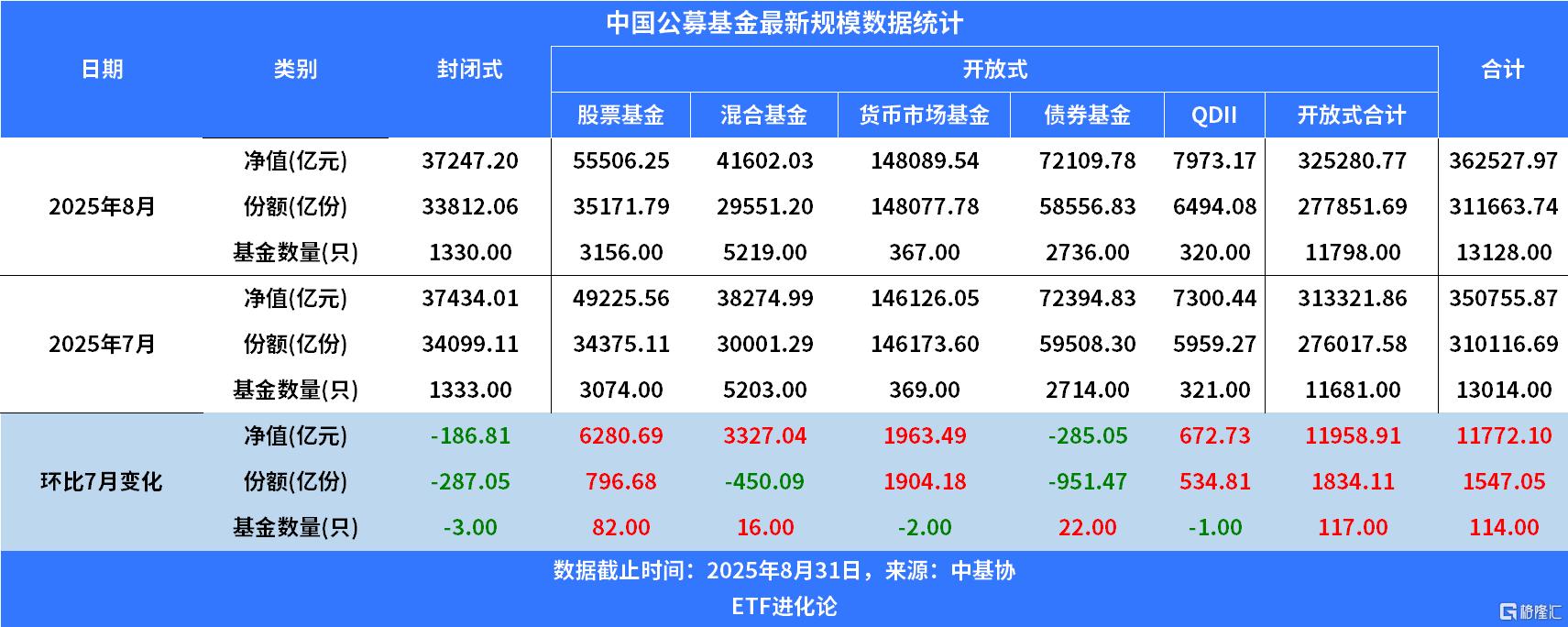
Core Insights - The public fund market in China reached a record high of 36 trillion yuan in August 2025, marking a growth of 1.18 trillion yuan from July, with a growth rate of 3.36% [1][2] Fund Categories Summary - **Equity Funds**: The scale reached 5.55 trillion yuan in August, increasing by 628.07 billion yuan from June, with a growth rate of 12.76%. The number of shares increased by 79.67 billion from July, a growth of 2.32% [2][3] - **Mixed Funds**: The scale was 4.16 trillion yuan in August, with an increase of 332.70 billion yuan, representing a growth rate of 8.69%. However, the number of shares decreased by 45.01 billion from July, a decline of 1.50% [2][3] - **Money Market Funds**: The scale reached 14.81 trillion yuan, with an increase of 196.35 billion yuan, reflecting a growth rate of 1.34%. The number of shares increased by 190.42 billion from July, a growth of 1.30% [2][3] - **Bond Funds**: The scale was 7.21 trillion yuan, with a decrease of 28.51 billion yuan, representing a decline of 0.39%. The number of shares decreased by 95.15 billion from July, a decline of 1.62% [2][3] - **Cross-Border Funds (QDII)**: The scale reached 797.32 billion yuan, increasing by 67.27 billion yuan, with a growth rate of 9.21%. The number of shares increased by 51.65 billion from July, a growth of 8.64% [2][3] Market Trends - The mixed fund category experienced significant net redemptions, totaling 450 billion yuan in August and 370 billion yuan in July, indicating a total net redemption of 820 billion yuan over two months [3][4] - The bond market saw a notable shift, with net redemptions of bond funds reaching 951 billion yuan in August, a decrease from 1.944 trillion yuan in July, as funds moved towards equity markets [5] - Non-bank deposits in China showed significant growth, with an increase of 5.87 trillion yuan in the first eight months of 2025, accounting for 28.63% of the total increase in RMB deposits during the same period [6][7]

国债期货周报:债市底部震荡,多头动能偏弱-20250926
Rui Da Qi Huo· 2025-09-26 09:39
Report Industry Investment Rating No relevant content provided. Core View of the Report The current bond market is intertwined with multiple factors. The economic data in August indicates that the pattern of "strong supply and weak demand" may continue, and the economic growth in the third quarter is under pressure. Coupled with the increasing expectation of the central bank restarting bond purchases, it provides some support for the current bond market. However, in the absence of incremental positive factors, the market is sensitive to negative news. The uncertainty of the new regulations on public bond funds continues to disrupt the market, and bearish sentiment still dominates. There are also differences in the market's expectations for loose monetary policies. It is expected that Treasury bond futures will continue to show a weak and volatile pattern in the short term. For strategies, it is recommended to wait and see for unilateral operations, and at the same time, pay attention to the trading opportunities of long - term term spreads brought about by the steepening of the yield curve [102]. Summary According to the Table of Contents 1. Market Review - **Weekly Data of Treasury Bond Futures**: The main contracts of Treasury bond futures all declined this week. The TL2512 (30 - year) contract fell 0.53%, the T2512 (10 - year) contract fell 0.14%, the TF2512 (5 - year) contract fell 0.13%, and the TS2512 (2 - year) contract fell 0.02%. The trading volumes of the TS, TF, T, and TL main contracts all decreased. The open interests of the TF, T, and TL main contracts increased, while that of the TS main contract decreased [11][15][21][29]. - **Price Changes of Deliverable Bonds**: The prices of the top two cheapest - to - deliver (CTD) bonds for each contract term also changed. For example, the price of 210005.IB (18y) for the 30 - year contract decreased by 1.18 [12]. 2. News Review and Analysis - **Domestic Policy News**: On September 19, the central bank adjusted the 14 - day reverse repurchase operation in the open market. On September 22, the loan prime rate (LPR) remained unchanged. On September 24, the central bank planned to conduct a 6000 - billion - yuan medium - term lending facility (MLF) operation, with a net MLF injection of 3000 billion yuan this month. Also on September 24, nine departments including the Ministry of Commerce issued 13 measures to support service exports. On September 25, the scale of China's public funds exceeded 36 trillion yuan for the first time [32][33]. - **Overseas News**: On September 25, the US announced that the annualized final value of real GDP in the second quarter increased by 3.8% quarter - on - quarter. The US President Trump announced that starting from October 1, the US will impose a new round of high - tariff policies on multiple categories of imported products [33][34]. 3. Chart Analysis - **Spread Changes** - **Yield Spreads**: The spread between 10 - year and 5 - year Treasury bond yields narrowed slightly, while the spread between 10 - year and 1 - year Treasury bond yields widened slightly. The spread between the TF and TS main contracts widened slightly, and the spread between the T and TF main contracts narrowed slightly. The inter - term spread of the 10 - year contract narrowed, while that of the 30 - year contract widened. The inter - term spread of the 5 - year contract narrowed, and that of the 2 - year contract widened [42][48][52][59]. - **Changes in Main Contract Positions**: The net long positions of the top 20 holders of the T Treasury bond futures main contract increased significantly [66]. - **Interest Rate Changes** - **Shibor and Treasury Bond Yields**: Overnight and 2 - week Shibor rates decreased, while 1 - week and 1 - month Shibor rates increased. The DR007 weighted average rate rebounded to around 1.53%. The yields of Treasury bond cash bonds weakened across the board, with the yields of 1 - 7 - year maturities rising by 1.8 - 4bp, and the 10 - year and 30 - year yields rising by about 0.9bp and 0.4bp to 1.80% and 2.22% respectively [70]. - **Sino - US Treasury Bond Yield Spreads**: The spread between 10 - year Sino - US Treasury bond yields widened slightly, and the spread between 30 - year Sino - US Treasury bond yields narrowed slightly [74]. - **Central Bank's Open - Market Operations**: This week, the central bank conducted 24674 billion yuan in reverse repurchases and 6000 billion yuan in MLF injections in the open market. With 18268 billion yuan in reverse repurchases and 3000 billion yuan in MLF maturing, the net injection was 9406 billion yuan. The DR007 weighted average rate rebounded to around 1.53% [79]. - **Bond Issuance and Maturity**: This week, the total bond issuance was 14184.42 billion yuan, and the total repayment amount was 16612.56 billion yuan, resulting in a net financing of - 2428.14 billion yuan [83]. - **Market Sentiment** - **Exchange Rate**: The central parity rate of the RMB against the US dollar was 7.1152, with a cumulative depreciation of 21 basis points this week. The spread between the offshore and onshore RMB strengthened [86]. - **US Treasury Bond Yields and Volatility Index**: The yield of 10 - year US Treasury bonds fluctuated upwards, and the VIX index increased [92]. - **A - Share Risk Premium**: The yield of 10 - year Treasury bonds increased, and the A - share risk premium decreased slightly [98]. 4. Market Outlook and Strategy - **Domestic Fundamental Situation**: In August, the growth rates of industrial added value, social retail sales, and exports declined compared with previous values. The scale of fixed - asset investment continued to shrink, and the unemployment rate increased seasonally. In terms of financial data, the growth rate of social financing slowed down slightly in August, and the support of government bonds for social financing weakened. Although new loans turned positive, the credit growth rate continued to weaken, and overall demand remained weak. Since July, the economic recovery has continued to slow down [101]. - **Overseas Situation**: The US economic growth momentum is stronger than expected. The annualized quarterly rate of real GDP in the second quarter was revised up to 3.8%. The labor market remains resilient, and inflation is still sticky. Market expectations for multiple interest rate cuts by the Fed this year have cooled [101]. - **Market Outlook and Strategy Suggestion**: It is expected that Treasury bond futures will continue to show a weak and volatile pattern in the short term. For unilateral operations, it is recommended to wait and see. At the same time, pay attention to the trading opportunities of long - term term spreads brought about by the steepening of the yield curve [102].
债券 调整之势难以改变
Qi Huo Ri Bao· 2025-09-26 06:53
Group 1 - The core viewpoint indicates a significant decline in bond futures prices across various maturities, with the 30-year bond futures dropping by 2.7% and the 10-year bond futures down by 0.4% since September [1] - The equity market's strength is exerting pressure on the bond market, leading to a noticeable "see-saw" effect between stocks and bonds, as liquidity shifts from the bond market to equities [1] - Economic data from August shows weakness, with the official manufacturing PMI improving but still below the growth line, indicating economic pressure [1] Group 2 - The article highlights the importance of responding to potential liquidity tightening risks, suggesting strategies for hedging in such scenarios [2] - Historical research indicates that the basis is significantly influenced by funding rates, with tightening conditions favoring long positions in bond futures [2] - The article recommends participating in interest rate flattening strategies and prioritizing the "short TS long T" arbitrage strategy, as the net basis showed a pattern of first expanding and then contracting in September [2]
中泰期货晨会纪要-20250926
Zhong Tai Qi Huo· 2025-09-26 02:31
Report Industry Investment Rating - Not provided in the given content Core Views of the Report - **Stock Index Futures**: Consider buying on dips and adopting a range - trading strategy. The A - share market shows divergence, and the market is expected to be volatile in the short term. The probability of central bank easing is increasing [9]. - **Treasury Bond Futures**: Continue to consider steepening the short - end and ultra - long - end yield curves in the long - term, and maintain the idea of buying bonds on dips, betting on future monetary policy easing [10]. - **Coking Coal and Coke**: The prices may continue to fluctuate and rise in the short term. Later, attention should be paid to the demand of the finished steel market during "Golden September and Silver October" and the inventory replenishment rhythm before the National Day [12]. - **Ferroalloys**: For manganese silicon, the mid - to long - term strategy is to go short on rallies, and the same for silicon iron. The price fluctuations are mainly affected by the sentiment of coking coal in the black sector [13]. - **Soda Ash and Glass**: For soda ash, observe the sentiment of the industrial chain in the short term and then turn bearish; for glass, adopt a wait - and - see approach for now [14]. - **Non - ferrous Metals and New Materials**: For aluminum, it is advisable to wait and see at high levels; for alumina, consider shorting on rallies; for zinc, the price is expected to decline after the macro impact fades; for lithium carbonate, it will fluctuate widely; for industrial silicon, consider buying on dips for far - month contracts; for polysilicon, it will maintain a wide - range shock [20]. - **Agricultural Products**: For cotton, be cautious when shorting on rallies; for sugar, maintain a short - selling strategy in the medium - term; for eggs, adopt a short - selling strategy on rebounds; for apples, consider buying on dips with a light position; for corn, sell out - of - the - money call options on the 01 contract; for dates, wait and see; for hogs, the short - term price will be weak and short on rallies for near - month contracts [23][25][26]. - **Energy and Chemicals**: For crude oil, consider shorting on rallies; for fuel oil, its price will follow the oil price; for plastics, it will be weak and fluctuate; for rubber, be cautious in holding positions; for methanol, it will be in a relatively strong shock; for caustic soda, it will fluctuate; for asphalt, it will follow the oil price; for liquefied petroleum gas, maintain a bearish view in the long - term; for paper pulp, it will fluctuate; for urea, it will fluctuate; for synthetic rubber, be cautious in holding positions [31][35][36]. Summary by Relevant Categories Macro - finance - **Stock Index Futures**: A - share market shows divergence, with the ChiNext Index hitting new stage highs. The CSI 300, SSE 50, and CSI 500 index futures are in different trends. The overall market is expected to be volatile, and it is recommended to buy on dips and trade in a range. The A - share trading volume is 2.39 trillion yuan, and the market capitalization of the technology sector accounts for over 1/4. Long - term funds' holding of A - share market value has increased by 32% compared to the end of the "13th Five - Year Plan" [9]. - **Treasury Bond Futures**: The end - of - quarter capital market is balanced, with capital interest rates rising slightly. It is recommended to steepen the short - end and ultra - long - end yield curves in the long - term and buy bonds on dips. The scale of public funds in China has exceeded 36 trillion yuan, and the scale of stock - type funds has increased significantly in August [10]. Black Metals - **Coking Coal and Coke**: Supply is gradually recovering, but "anti - involution" and environmental protection restrictions are expected to ferment again. The price is expected to fluctuate and rise in the short term, and attention should be paid to downstream demand and inventory replenishment [12]. - **Ferroalloys**: The new production capacity of manganese silicon is the main factor affecting the long - term market. For silicon iron, it is in an oversupply situation. The prices of both are affected by the sentiment of coking coal in the black sector [13]. - **Soda Ash and Glass**: Soda ash production is increasing, and the inventory is decreasing. It is recommended to observe in the short term and then turn bearish. Glass prices are rising, and the inventory is decreasing. It is recommended to wait and see [14]. Non - ferrous Metals and New Materials - **Aluminum and Alumina**: Aluminum has low - level inventory replenishment before the festival, but the overall demand is insufficient. Alumina has a surplus pressure, with high production and high supply, and the price is expected to decline [15]. - **Zinc**: The domestic social inventory is fluctuating, and the smelter's production resumption rhythm is accelerating. The zinc price is expected to decline after the macro impact fades [17]. - **Lithium Carbonate**: The short - term de - stocking supports the price, and it will fluctuate widely without obvious driving factors [19]. - **Industrial Silicon and Polysilicon**: Industrial silicon is expected to be strong in a range, and it is advisable to buy on dips for far - month contracts. Polysilicon is mainly affected by policy progress and will maintain a wide - range shock [20]. Agricultural Products - **Cotton**: The supply pressure is increasing, and the demand is weak. It is recommended to be cautious when shorting on rallies, and pay attention to the impact of the crude oil market and international trade tariffs [23]. - **Sugar**: The domestic and international sugar supply is in a surplus situation. It is recommended to short - sell in the medium - term and pay attention to the change of the sugar - to - ethanol ratio in Brazil and the domestic sugar price policy in India [25]. - **Eggs**: The egg - laying hen inventory is high, and it is recommended to short - sell on rebounds. Pay attention to the capacity reduction situation [26]. - **Apples**: The new - season opening price is expected to be high. It is recommended to buy on dips with a light position and pay attention to the weather in the producing areas [27]. - **Corn**: The domestic corn price shows a differentiated trend. It is recommended to sell out - of - the - money call options on the 01 contract and pay attention to the purchasing enthusiasm of traders and downstream enterprises [28]. - **Dates**: The market price is stable, and it is recommended to wait and see [29]. - **Hogs**: The supply is strong, and the demand is weak. The price is expected to be weak in the short term, and it is recommended to short on rallies for near - month contracts [29]. Energy and Chemicals - **Crude Oil**: The supply is expected to increase, and the demand is expected to weaken after the peak season. It is recommended to short on rallies and pay attention to the progress of US - Russia negotiations and OPEC+ quota adjustments [31]. - **Fuel Oil**: Its price will follow the oil price [32]. - **Plastics**: The supply pressure is large, and it will be weak and fluctuate. It may have a short - term rebound and then return to the fundamental logic [35]. - **Rubber**: Affected by extreme weather, the raw material price in China has strengthened. It is recommended to be cautious in holding positions [36]. - **Methanol**: The port inventory pressure is large, but the inventory accumulation speed has slowed down. It is recommended to trade in a relatively strong shock range [36]. - **Caustic Soda**: The fundamentals are relatively weak, and it will fluctuate [38]. - **Asphalt**: It will follow the oil price, and the current demand is in the peak season [38]. - **Liquefied Petroleum Gas**: The supply is abundant, and it is recommended to maintain a bearish view in the long - term [42]. - **Paper Pulp**: The spot fundamentals are weak, but the external market is strong. It is expected to fluctuate, and attention should be paid to port de - stocking and spot transactions [43]. - **Urea**: The supply is increasing, and the demand is decreasing. It is recommended to trade in a shock range and pay attention to export and procurement news [44]. - **Synthetic Rubber**: The main contract price has declined, and it is recommended to be cautious in holding positions before the festival [45].
公募基金规模首破36万亿 -20250926
申银万国期货研究· 2025-09-26 00:49
Group 1 - The total scale of public funds in China has surpassed 36 trillion yuan, reaching 36.25 trillion yuan by the end of August, with a monthly increase of 1.18 trillion yuan [1] - The scale of bond funds has slightly decreased by 28.5 billion yuan due to the stock-bond seesaw effect [1] - The U.S. GDP growth for the second quarter has been revised up to 3.8%, the highest in nearly two years, indicating stronger inflationary pressures with a PCE price index of 2.6% [1][7] Group 2 - The U.S. stock market indices have experienced three consecutive declines, with the 2-year Treasury yield rising and prices for gold and crude oil increasing [1] - The financing balance in the Chinese market increased by 14.08 billion yuan to 24,141.23 billion yuan, indicating a more volatile market in September compared to July and August [2][11] - The market is currently in a high-level consolidation phase after a prolonged period of rising, with a divergence in bullish and bearish forces [2][11] Group 3 - The international oil market is affected by Russia's partial ban on diesel exports and extended ban on gasoline exports, leading to fuel shortages in certain regions [3][14] - The U.S. initial jobless claims have decreased to 218,000, the lowest since July, indicating a tightening labor market [3][14] - The International Energy Agency reports a significant acceleration in the decline of global oil and gas field production, primarily due to increased reliance on shale oil and deep-sea resources [3][14] Group 4 - The glass futures market continues to rebound, with production enterprise inventories decreasing by 1.42 million heavy boxes to 53.29 million heavy boxes [4][18] - The soda ash futures market has also seen a slight rebound, with inventories down by 54,000 tons to 1.444 million tons [4][18] - The Ministry of Industry and Information Technology has released a plan to stabilize growth in ten key industries, leading to positive expectations for future supply changes in the glass industry [4][18]

债市为何“跌跌不休”
Guo Ji Jin Rong Bao· 2025-09-25 16:48
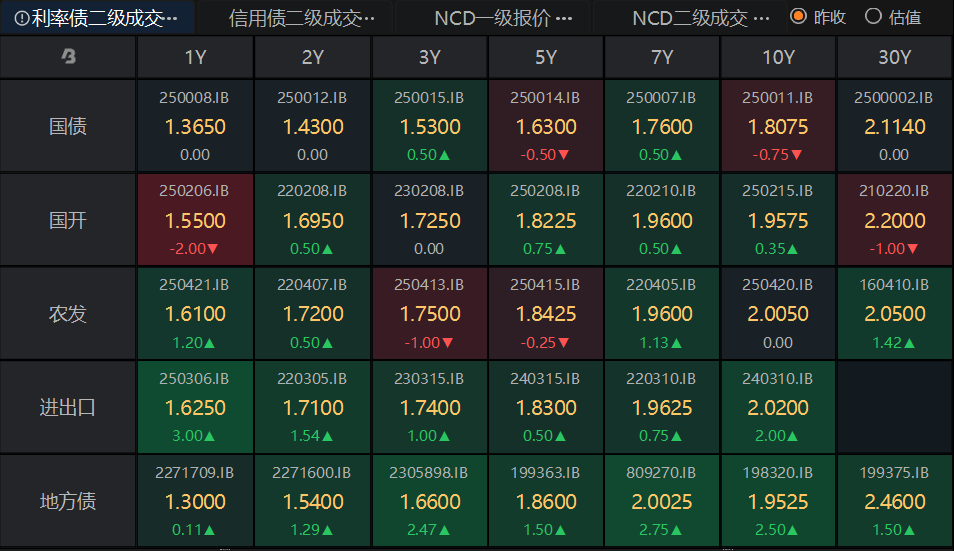
Group 1 - The bond futures market continued to decline overall, with a slight rebound in the afternoon, as the 30-year main contract rose by 0.11% while the 10-year, 5-year, and 2-year contracts fell by 0.01% each [1] - As of 4:30 PM, the yields on major interbank government bonds showed mixed results, with the 10-year government bond yield decreasing by 0.75 basis points to 1.8075%, while the 30-year bond yield remained unchanged at 2.114% [1][2] - Recent adjustments in the bond market are attributed to multiple factors, including unmet policy expectations and increased short-term redemption costs for bond funds due to new public fund fee regulations [3] Group 2 - The recent bond market adjustments have led to a rise in the yields of the 10-year and 30-year government bonds, reaching previous highs, indicating a potential shift in market dynamics [2][3] - Analysts suggest that the current market volatility may define future trading ranges, with the possibility of a rebound in the short term, while the medium to long-term outlook remains uncertain [3] - Investment strategies recommended include cautious trading for short-term funds and gradual allocation for long-term investments, focusing on high-quality short to medium-duration bonds [3]
本币市场:资金面整体均衡
Jin Rong Shi Bao· 2025-09-25 02:05
Core Insights - The overall liquidity in the interbank market remained balanced in August 2025, with a decrease in trading volume and balances in the money market, while major repo rates declined [1][2] - The Shanghai Composite Index reached a nearly 10-year high, and the recovery of VAT on government bond interest income contributed to a decrease in bond issuance and trading [1][4] - Long-term bond yields continued to rise, with the yield curve steepening, and the interest rate swap curve shifted upward [1][6] Group 1: Liquidity and Market Operations - The central bank maintained a supportive liquidity stance, with significant net injections in the open market, totaling 446.6 billion yuan for the month [2] - The central bank's MLF and reverse repos saw substantial net injections, with MLF at 300 billion yuan and reverse repos at 300 billion yuan [2] - Major repo rates, including overnight repo rates, saw slight declines, with DR001 and R001 down to 1.35% and 1.40% respectively [2][3] Group 2: Bond Market Dynamics - In August, the interbank market issued bonds totaling 4.72 trillion yuan, a decrease of 10.8% month-on-month and 13% year-on-year [4] - The net financing from bonds was 1.87 trillion yuan, reflecting a month-on-month decrease of 18.7% and a year-on-year decrease of 19.2% [4] - The yields on long-term government bonds fluctuated, with the 10-year bond yield ranging from 1.69% to 1.85%, and the yield curve steepening [4][5] Group 3: Interest Rate Swaps and Trading Activity - The interest rate swap curve shifted upward, with significant increases in long-term swap rates, particularly for 5-year and 10-year swaps [6] - The average daily trading volume for RMB interest rate swaps decreased, with a total nominal principal of 4.1 trillion yuan, reflecting a 3% decline [6][7] - Standard bond futures and interest rate options also saw a decrease in daily trading volume, indicating reduced market activity [7]
银行理财周度跟踪(2025.9.15-2025.9.21):理财公司加码指数化布局:跟踪现有指数、自主构建双策并行-20250923
HWABAO SECURITIES· 2025-09-23 08:58
Investment Rating - The report does not explicitly provide an investment rating for the industry Core Insights - The report highlights a significant trend in the banking wealth management sector, with companies increasingly focusing on index-based products to enhance their offerings and meet market demands [4][11] - The collaboration between financial institutions, such as the partnership between Huaxia Wealth and Huaxia Fund, aims to create a robust index ecosystem to support high-quality development in asset management [13][14] - The report notes the successful IPO of Hesai Technology, marking a significant event in the market, with postal wealth management participating in this investment [15][16] - The introduction of the Shanghai Sci-Tech Financial Theme Wealth Management Product by Puyin Wealth Management reflects a strategic move to align with national innovation policies and support local tech enterprises [18] Summary by Sections 1. Regulatory and Industry Dynamics - Wealth management companies are actively launching index-based products, with an increase in both the number and issuance of such products in the market [4][11] - The core motivation for this shift includes reducing active management risks, enhancing strategy transparency, and meeting customized client demands through self-constructed indices [12] 2. Peer Innovation Dynamics - Huaxia Wealth and Huaxia Fund have signed a memorandum to deepen cooperation in the index business, aiming to build a market-influential index ecosystem [13][14] - Puyin Wealth Management has launched a new product focused on technology finance, raising 220 million yuan to support quality tech enterprises in Shanghai [18] 3. Yield Performance - Cash management products recorded a 7-day annualized yield of 1.29%, remaining stable compared to the previous week, while money market funds saw a slight increase to 1.19% [19][20] - The report indicates a general recovery in annualized yields for fixed-income products across various maturities [23][27] 4. Net Value Tracking - The net value ratio of banking wealth management products decreased to 2.04%, down by 0.61 percentage points, indicating a positive trend in credit spreads [29][32]

2025年8月图说债市月报:美联储降息渐行渐近,弱复苏下信用债投资进入“冷静期”-20250923
Zhong Cheng Xin Guo Ji· 2025-09-23 07:21
Key Insights - The expectation of a Federal Reserve interest rate cut has significantly increased, with market predictions exceeding 90% probability, driven by weak economic data, particularly in the labor market [8][9] - The credit bond market is experiencing a cooling trend, with issuance down to 13,127.58 billion yuan in August, a decrease of 1,349.78 billion yuan from the previous month, and net financing dropping to 543.99 billion yuan [10][49] - The monthly rolling default rate in the bond market is at 0.17%, with one new defaulting entity, Shenzhen Zhongzhuang, indicating ongoing credit risks [21][24] Market Review - The manufacturing PMI in August slightly improved to 49.4, indicating a weak recovery in the economy, while liquidity remains generally ample with the central bank injecting 1,466 billion yuan [10][36] - The average issuance rate for credit bonds has mostly increased, with the 3-year AAA corporate bond rate rising by 16 basis points, reflecting higher borrowing costs across various sectors [49][50] - The secondary market saw most bond yields rise, with the 10-year government bond yield increasing by 13 basis points to 1.84% [12][30] Credit Risk and Regulatory Environment - The ongoing high-pressure regulatory environment for implicit debt emphasizes the need to prevent "disposal risk" [11][12] - Five entities, including those in the real estate sector, have extended their bonds due to operational performance declines and cash flow issues, highlighting the challenges faced by these industries [24][25] - Credit spreads for short-term notes have generally widened, with most sectors experiencing increased issuance costs [30][51]
宝城期货国债期货早报(2025年9月23日)-20250923
Bao Cheng Qi Huo· 2025-09-23 01:21
Report Summary 1. Investment Rating No investment rating is provided in the report. 2. Core View The report suggests that Treasury bond futures are expected to trade in a low - level range in the short term, with both upward and downward pressures. There is potential for medium - to long - term interest rate cuts, but the possibility of an immediate full - scale rate cut is low [1][5]. 3. Summary by Section 3.1 Variety View Reference - Financial Futures Stock Index Sector - For the TL2512 variety, the short - term view is "sideways", the medium - term view is "sideways", the intraday view is "sideways - bullish", and the overall view is "sideways". The core logic is that there are still medium - to long - term expectations of interest rate cuts, but the possibility of a short - term full - scale rate cut is low [1]. 3.2 Main Variety Price and Market Driving Logic - Financial Futures Stock Index Sector - The varieties include TL, T, TF, and TS. The intraday view is "sideways - bullish", the medium - term view is "sideways", and the reference view is "sideways". - The core logic is that Treasury bond futures fluctuated and rose yesterday. Although the September LPR remained unchanged, there is still potential for medium - to long - term interest rate cuts. The weak credit data in August, the marginal slowdown in consumption growth, and the weak inflation data have increased the expectation of macro - policies to stabilize demand in the fourth quarter. With the Fed's rate cut in September and two more expected cuts this year, there is still an expectation of monetary easing in the future, providing strong support for Treasury bond futures in the medium - to long - term. - However, the upward momentum of Treasury bond futures is insufficient. Firstly, there is no high need for an immediate full - scale rate cut, which needs to be coordinated with fiscal policies. Secondly, the stock - bond seesaw effect suppresses the demand for Treasury bonds [5].