
财政扩张

Search documents
沪指再创10年新高,A股“系统性慢牛”来了?
2 1 Shi Ji Jing Ji Bao Dao· 2025-08-21 07:07
Group 1 - The recent performance of A-shares has been a major focus, with the Shanghai Composite Index reaching a 10-year high and the STAR Market Index rising over 3%, marking a near two-and-a-half-year high [1] - Global favorable factors have contributed to the bullish trend in A-shares, including a decrease in policy uncertainty due to agreements reached by the US with multiple countries, which has improved market sentiment [1] - A significant shift in US fiscal policy expectations has occurred, with a projected $4 trillion tax cut over the next decade, leading to a direct shift towards expansionary fiscal policy, supporting the rise of US and global risk assets [1] Group 2 - The expectation of interest rate cuts by the Federal Reserve has led to a nearly 20 basis point decline in US Treasury yields, benefiting the valuation recovery of growth stocks [2] - Central banks in many countries have lowered interest rates earlier than the Federal Reserve, increasing global money supply and driving capital towards non-US markets [2] Group 3 - The resilience of A-shares is crucial, with China's GDP growing by 5.3% in the first half of the year, outperforming other major economies [3] - The appreciation expectation of the RMB has enhanced the attractiveness of A-share assets, while government policies aimed at reducing systemic risks have provided a solid foundation for a long-term market reversal [3] - There has been a significant inflow of funds into popular sectors such as pharmaceuticals and electronics, with margin financing increasing and foreign hedge funds rapidly buying Chinese stocks [3] Group 4 - The sustainability of the current bullish trend in A-shares will depend on external factors, particularly any changes in US policy or a strengthening of the dollar, which could tighten global liquidity and impact A-share performance [3] - The domestic environment remains relatively stable and supportive, providing a good foundation for financing and active thematic trading, as long as there are no major fluctuations in macroeconomic conditions [3]
沪指再创10年新高!A股“系统性慢牛”来了?
Sou Hu Cai Jing· 2025-08-21 05:17
Group 1 - The recent performance of A-shares has been a major focus, with the Shanghai Composite Index reaching a 10-year high and the STAR Market Index rising over 3%, marking a near two-and-a-half-year peak [1] - The semiconductor industry has shown strong growth, with stocks like Cambricon Technologies surging over 8% and stabilizing above the 1,000 yuan mark, while consumer electronics and automotive stocks have also performed well [1] - Global factors, including a decrease in policy uncertainty due to trade agreements and a significant shift in U.S. fiscal policy towards expansion, have supported the bullish trend in A-shares [1][2] Group 2 - The expectation of interest rate cuts by the Federal Reserve has led to a decline in U.S. Treasury yields, benefiting the valuation recovery of growth stocks [2] - The Chinese economy has shown resilience, with a GDP growth rate of 5.3% in the first half of the year, outperforming other major economies [2] - The influx of capital into A-shares is driven by a stronger expectation of RMB appreciation and a series of government measures aimed at reducing systemic risks, which have lowered risk premiums [2] Group 3 - The sustainability of the current bullish trend in A-shares will depend on external factors, particularly U.S. policy changes and potential strengthening of the dollar, which could tighten global liquidity [3] - The domestic environment remains relatively stable and supportive, providing a solid foundation for financing and active thematic trading [3]
财政担忧持续,日本10年期国债收益率创2008年以来新高
Hua Er Jie Jian Wen· 2025-08-21 04:23
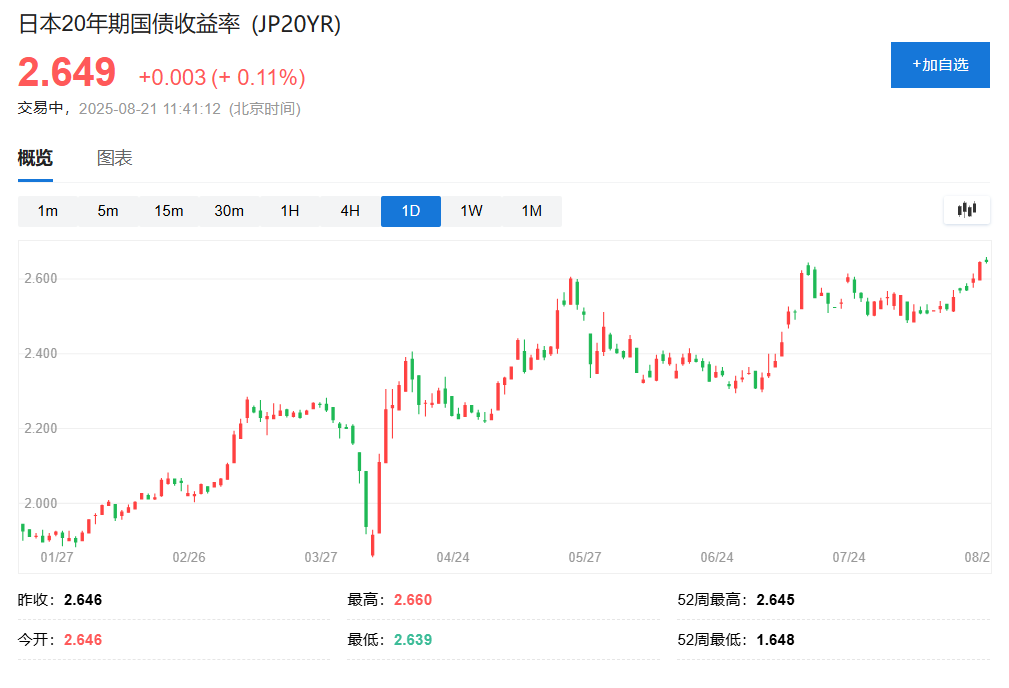
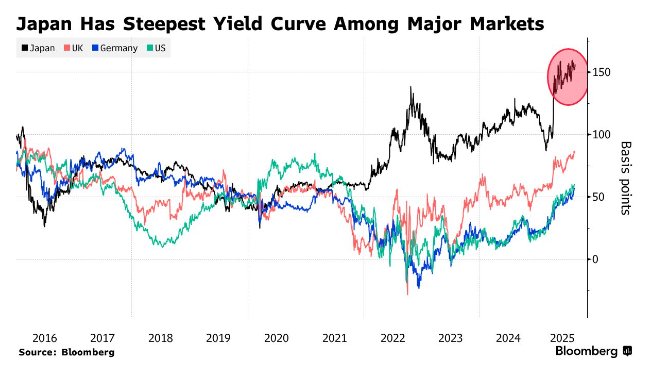
Core Viewpoint - The Japanese bond market is experiencing a significant sell-off, with yields on 10-year and ultra-long government bonds reaching multi-decade highs due to ongoing concerns about fiscal expansion and inflation [1][6]. Group 1: Bond Yield Trends - The yield on Japan's 10-year government bonds rose to 1.61%, the highest since October 2008 [1]. - The 20-year bond yield reached 2.655%, marking the highest level since 1999 [1]. - The 30-year bond yield climbed to 3.18%, nearing the historical high of 3.2% set in July [1]. Group 2: Fiscal Concerns - The steepening of the yield curve reflects market worries about Japan's future fiscal discipline, especially after the ruling coalition's loss in the upper house elections in July [1]. - Investors anticipate potential new fiscal stimulus measures from the government, which could lead to a significant increase in bond issuance [6]. Group 3: Inflation and Monetary Policy - Persistent inflation pressures are negatively impacting ultra-long bonds and increasing the likelihood of interest rate hikes by the Bank of Japan [1][7]. - Recent data indicates that aggressive traders are growing more confident about a potential rate hike in October, suggesting that the market may fully price in this expectation [7]. Group 4: Demand Dynamics - There has been a notable decline in demand from overseas investors, which is exacerbating upward pressure on yields [1][8]. - In July, net purchases of Japanese government bonds with maturities over 10 years by overseas investors fell to 480 billion yen (approximately $3.3 billion), only one-third of the amount purchased in June [8]. - The sharp decline in overseas investment raises concerns about the stability of the long-end of the yield curve [8].

财政扩张与需求疲软双重打压!日本超长债收益率升至数十年高位
智通财经网· 2025-08-21 04:13
Group 1 - The yield on Japan's 20-year government bonds has risen to 2.655%, the highest level since 1999, while the 30-year bond yield has reached 3.185%, approaching historical highs since its introduction [1][2] - The fluctuations in bond yields are attributed to expectations of increased bond issuance following the ruling coalition's losses in the July Senate elections, exacerbating the pressure on already strained long-term bonds [1] - Ongoing inflation concerns are increasing pressure on ultra-long-term bonds, forcing the Bank of Japan to face greater interest rate hike pressures [1] Group 2 - Investor demand for Japanese government bonds is declining, with net purchases of bonds with maturities over 10 years by foreign investors dropping to 480 billion yen (approximately 3.3 billion USD) in July, only one-third of the June level [2] - The significant decrease in foreign net purchases raises concerns about potential volatility in the long end of the yield curve [2] - Recent increases in open interest in Japanese government bond futures indicate that aggressive traders are increasingly confident that the probability of an interest rate hike in October has shifted from 50% to fully priced in [2]
本轮A股上涨的逻辑
2 1 Shi Ji Jing Ji Bao Dao· 2025-08-19 22:50
Market Overview - The Shanghai Composite Index recently reached a nearly 10-year high, surpassing 3746 points, while the Shenzhen Index hit a two-year high, with the total market capitalization of A-shares exceeding 100 trillion yuan [1] - Global markets have shown significant gains this year, influenced by favorable global factors, including agreements reached by the U.S. government with certain countries and a shift from fiscal contraction to expansion in the U.S. [1][2] Dollar Liquidity and Capital Flows - The recent decline in the U.S. dollar index, down 2.7% in the past quarter and nearly 10% year-to-date, has created a favorable liquidity environment for non-U.S. markets [2] - As of June 30, foreign capital held approximately 2.29 trillion yuan in A-shares through northbound channels, an increase of 871 billion yuan compared to the end of 2024 [2] Economic Fundamentals - China's GDP growth rate for the first half of the year was 5.3%, with an expected annual growth of around 5%, making it unique among major economies [3] - The strong performance of the renminbi is attracting foreign investment, providing more room for domestic monetary policy adjustments [3] Policy Environment - China's policy environment is characterized by stability compared to the uncertainty in U.S. policies, which lowers the risk premium required by investors [3] - Recent policy adjustments aimed at reducing systemic risks are expected to have a long-term positive impact on the A-share market [3] Market Dynamics - The recent surge in the A-share market has been driven by retail and leveraged funds, with significant increases in new accounts and net inflows into the stock market [4] - Foreign capital is showing signs of recovery, with a 36.3% increase in average daily trading volume from northbound funds in July [4] Sustainability of Market Trends - The sustainability of the A-share market's upward trend is influenced by external macroeconomic conditions, with potential risks from U.S. policy uncertainties and a tightening of dollar liquidity [5] - A relatively loose domestic market environment supports active financing leverage and thematic trading [5]
金融期货早班车-20250818
Zhao Shang Qi Huo· 2025-08-18 03:27
Report Summary on Financial Futures 1. Market Performance - On August 15, A-share's four major stock indexes all rose, with the Shanghai Composite Index up 0.83% to 3696.77 points, the Shenzhen Component Index up 1.6% to 11634.67 points, the ChiNext Index up 2.61% to 2534.22 points, and the STAR 50 Index up 1.43% to 1101.29 points. Market trading volume was 2272.8 billion yuan, a decrease of 33.4 billion yuan from the previous day [2]. - In terms of industry sectors, comprehensive (+3.92%), non-bank finance (+3.16%), and power equipment (+2.85%) led the gains; banks (-1.46%), food and beverage (+0.04%), and media (+0.51%) led the losses [2]. - From the perspective of market strength, IC > IM > IF > IH, and the number of rising/flat/falling stocks was 4623/155/641 respectively. Institutional, main, large - scale, and retail investors' net inflows in the Shanghai and Shenzhen stock markets were 12.3 billion, - 10 billion, - 18.7 billion, and 16.3 billion yuan respectively, with changes of +37.8 billion, +18.9 billion, - 24.9 billion, and - 31.8 billion yuan respectively [2]. 2. Stock Index Futures - **Basis and Annualized Yield**: The basis of IM, IC, IF, and IH next - month contracts were 31.3, 37.57, - 7.05, and - 13.52 points respectively, with annualized basis yields of - 4.23%, - 5.5%, 1.61%, and 4.59% respectively, and three - year historical quantiles of 70%, 44%, 76%, and 97% respectively [3]. - **Trading Strategy**: In the medium - to - long term, maintain the judgment of going long on the economy. Currently, using stock index as a long - position substitute has certain excess returns. It is recommended to allocate long - term contracts of each variety on dips [3]. 3. Treasury Bond Futures - **Cash Bond Situation**: The current active contract is the 2509 contract. For the 2 - year treasury bond futures CTD bond (250006.IB), the yield change was +0bps, the corresponding net basis was 0.03, and the IRR was 1.15%; for the 5 - year (240020.IB), the yield change was +1bps, the net basis was - 0.001, and the IRR was 1.49%; for the 10 - year (220010.IB), the yield change was +1.25bps, the net basis was - 0.027, and the IRR was 1.78%; for the 30 - year (210005.IB), the yield change was +1.75bps, the net basis was - 0.062, and the IRR was 2% [4]. - **Funding Situation**: In open - market operations, the central bank injected 238 billion yuan and withdrew 122 billion yuan, with a net injection of 116 billion yuan [4]. - **Trading Strategy**: With the increase in risk appetite and the expectation of economic recovery, it is recommended to hedge T and TL contracts on rallies in the medium - to - long term [4]. 4. Economic Data - High - frequency data shows that the recent social activity sentiment is weak [11]. - Based on the comparison of domestic meso - level data with the same period in the past five years, the manufacturing, real estate, social activity, infrastructure, and import - export sectors are analyzed. Positive scores indicate an improvement in sentiment, negative scores indicate a weakening, and zero scores indicate little change [13][14].
金融期货早班车-20250812
Zhao Shang Qi Huo· 2025-08-12 02:26
Report Summary 1. Market Performance - On August 11th, the four major A-share stock indices all rose, with the Shanghai Composite Index up 0.34% to 3647.55 points, the Shenzhen Component Index up 1.46% to 11291.43 points, the ChiNext Index up 1.96% to 2379.82 points, and the STAR 50 Index up 0.59% to 1049.73 points. Market turnover was 1.8499 trillion yuan, an increase of 113.6 billion yuan from the previous day [2]. - In terms of industry sectors, power equipment (+2.04%), communication (+1.95%), and computer (+1.94%) led the gains, while banks (-1.01%), petroleum and petrochemicals (-0.41%), and coal (-0.35%) led the losses [2]. - In terms of market strength, IM > IC > IF > IH. The number of rising, flat, and falling stocks was 4,185, 166, and 1,066 respectively. Institutional, main, large - scale, and retail investors had net inflows of 11.9 billion, -4.6 billion, -17.2 billion, and 9.9 billion yuan respectively, with changes of +24.8 billion, +17.4 billion, -19.1 billion, and -23.1 billion yuan respectively [2]. 2. Stock Index Futures - The basis of the next - month contracts of IM, IC, IF, and IH were 92.74, 92.96, 17.71, and 0.5 points respectively, with annualized basis yields of -11.13%, -12.12%, -3.58%, and -0.15% respectively, and three - year historical quantiles of 30%, 10%, 25%, and 43% respectively [3]. - The trading strategy is to maintain a long - term bullish view on the economy. Currently, using stock index futures as a long - position substitute has certain excess returns, and it is recommended to allocate long - term contracts of each variety on dips [3]. 3. Treasury Bond Futures - On August 11th, the yields of treasury bond futures all rose. Among the active contracts, the implied interest rate of the two - year bond was 1.4, up 1.06 bps from the previous day; the five - year bond was 1.566, up 2.42 bps; the ten - year bond was 1.653, up 2.18 bps; and the thirty - year bond was 2.022, up 3.49 bps [3]. - For the current active contracts, the CTD bonds and their corresponding net basis and IRR are as follows: for the 2 - year treasury bond futures (2509 contract), the CTD bond is 250006.IB, with a yield change of +1 bps, a net basis of 0.005, and an IRR of 1.39%; for the 5 - year, the CTD bond is 240020.IB, yield change +3.25 bps, net basis - 0.007, IRR 1.51%; for the 10 - year, the CTD bond is 250007.IB, yield change +2.75 bps, net basis - 0.044, IRR 1.88%; for the 30 - year, the CTD bond is 210005.IB, yield change +3.6 bps, net basis - 0.086, IRR 2.08% [4]. - In terms of the money supply, the central bank injected 112 billion yuan and withdrew 544.8 billion yuan, resulting in a net withdrawal of 432.8 billion yuan [4]. - The trading strategy is that due to the rising risk appetite and the expectation of economic recovery, it is recommended to hedge T and TL contracts on rallies in the medium - to - long term [4]. 4. Economic Data - High - frequency data shows that the recent import - export and social activity sentiment has declined [10].
德国拟启动千亿欧元基金 能否拯救“欧洲经济引擎”?
2 1 Shi Ji Jing Ji Bao Dao· 2025-08-11 23:15
Group 1 - Germany's industrial output decreased by 1.9% month-on-month and 3.6% year-on-year in June, marking a five-year low, with expectations of continued economic challenges due to U.S. tariffs [1][8] - The new German government, under Merz, is aggressively pursuing fiscal expansion, including a €500 billion infrastructure fund and a proposed €1 trillion "Germany Fund" aimed at strategic sectors like defense and energy [1][2][3] - The German government plans to leverage public-private partnerships to mobilize significant investments in infrastructure and support for small and medium enterprises, addressing long-standing investment deficiencies [2][5] Group 2 - Germany's international competitiveness has declined significantly, with public investment as a percentage of GDP falling below the EU average, leading to an estimated investment gap of €400 billion to €600 billion [2][3] - The government aims to improve energy infrastructure and defense industries while enhancing control over critical raw materials and supply chains, aligning with market needs [2][3] - A large-scale investment initiative, "Investing for Germany," has been launched, committing €631 billion by 2028, involving major corporations like Siemens and Deutsche Bank [6][8] Group 3 - The recent U.S. tariff policies have created uncertainty in global trade, impacting investment decisions in Germany, which has experienced consecutive years of economic decline [7][9] - The German economy, heavily reliant on exports, faces significant challenges due to tariffs, with estimates suggesting a potential GDP reduction of 0.5% this year [9] - Despite the government's optimistic measures to stimulate the economy, the effectiveness of these initiatives remains uncertain, particularly in attracting private sector investment [6][7]
特朗普上任半年成绩单:把世界谈成了生意,却把美国带进了赌局
Sou Hu Cai Jing· 2025-08-10 06:30
Group 1: Trade Policy - Trump's tariff policy has been a significant achievement, simplifying global trade negotiations into transactional deals, with tariffs used as leverage [3] - The EU and Japan have agreed to raise average tariffs on products exported to the U.S. from less than 2% to 15%, committing to invest billions in the U.S. over the coming years [3] - The use of tariffs has created a precedent where traditional trade rules are undermined, allowing for arbitrary adjustments based on personal relationships [3] Group 2: Fiscal Policy - The "Beautiful Big Law" has passed, projecting an additional $3 trillion in deficits over the next decade, pushing the total U.S. debt towards $40 trillion [5] - The strategy involves using tariffs to create an "industrial wall" while distributing consumer benefits through increased deficits, which may lead to global economic uncertainty [5] Group 3: Cryptocurrency Regulation - New legislation regarding cryptocurrencies mandates stablecoins to be backed by "safe assets," while leaving regulatory gaps that could benefit Trump's family's digital assets [7] - The lack of inquiry into potential conflicts of interest in Congress highlights a shift in the balance of power, with the executive branch gaining unilateral legislative authority [7] Group 4: Economic Indicators - Despite a lack of immediate alarm in economic fundamentals, there are signs of potential recession as non-farm payroll data has shown weakness, and the second-quarter GDP growth was 3% [9] - The annual tariff revenue of $300 billion has created a false sense of security among importers and consumers, masking the long-term impacts of tariff policies [9] Group 5: Financial Risks - The proliferation of unregulated cryptocurrencies poses significant financial risks, with leverage exceeding that of historical private banking practices [11] - The potential for inflation due to tariff wars could force the Federal Reserve into a difficult position, impacting the national debt significantly [11] Group 6: Institutional Integrity - The erosion of institutional checks and balances is concerning, as the President has bypassed Congress to adjust tariffs, undermining the separation of powers [11] - The normalization of declaring "national emergencies" for policy changes raises questions about the integrity of the decision-making process [11] Group 7: International Relations - Global tolerance for U.S. unilateralism is nearing a breaking point, with discussions in the EU about automatic retaliatory tariffs and Japan accelerating yen internationalization [13] - Political instability in the U.S. could lead to a backlash against tariffs, potentially fragmenting the global trade landscape [13]
从全球宏观看铅锌市场
Zhao Shang Qi Huo· 2025-08-08 02:55
Report Summary 1. Investment Rating No investment rating for the industry is provided in the report. 2. Core Viewpoints - Analyze the lead - zinc market from a global macro perspective, exploring the relationship between macro factors and lead - zinc, and the impact of "anti - involution" and fiscal policies on lead - zinc prices [1][6] - There are signs of endogenous kinetic energy repair, including the possible start of an active inventory replenishment cycle and improvement in PMI [36][39] - The central price of lead - zinc is related to GDP growth and industrial added - value [42][44] 3. Summary by Related Contents 3.1 Macro and Lead - Zinc Relationship - In terms of macro - attributes, the order is gold > copper > aluminum > zinc > lead, and lead has a very weak macro - attribute [4] - Analyze the relationship between lead - zinc and coal, copper, and use coal to understand "anti - involution" and copper to understand global fiscal policies [6] 3.2 "Anti - Involution" and Lead - Zinc Price Performance - Historically, during "supply - side reforms", lead - zinc often rose together with stocks and commodities. It is necessary to analyze the intensity of the current "anti - involution" [9] - From 2010 to 2025, lead and zinc prices showed different percentage changes during different "anti - involution" periods. For example, from 2016 - 2017, lead rose 141.6% and zinc rose 212.9%, while since July 2025, lead decreased 3.1% and zinc increased 2.2% [11] 3.3 Reasons for "Anti - Involution" - "Involution" refers to a vicious competition where economic entities invest a lot of resources without overall revenue growth, and production factor prices deviate from value [15] - The purpose of "anti - involution" is to reverse the situation of "quantity increase and price decrease". In June 2025, CPI increased 0.1% year - on - year, PPI decreased 3.6% year - on - year, and the PPI - CPI gap continued to widen [18] 3.4 Fiscal Policies and Lead - Zinc Market - Fiscal policies are crucial as high resident and enterprise leverage ratios make fiscal policies determine the economic performance differences among countries. For example, China's exports are related to fiscal policies [30] - China's fiscal policy is continuously strengthening, and the US is also implementing fiscal expansion. Global major countries are all conducting fiscal expansion [33][34] 3.5 Endogenous Kinetic Energy Repair - There are signs of an active inventory replenishment cycle (profit increase and inventory increase), and PPI and industrial enterprise profits have basically bottomed out [38] - From the perspective of the difference between enterprise and resident deposits, PMI is expected to improve after the third quarter [41] 3.6 Determinants of Lead - Zinc Central Price - The IMF has raised this year's GDP growth forecast to 3% and predicts a slight recovery of global economic growth in 2025, which is related to the central price of lead - zinc [42] - Industrial added - value provides a more accurate perspective for determining the central price of lead - zinc [44]