
美国经济

Search documents
2025Q2美国GDP数据点评:增速虽反弹,美国经济放缓趋势难改
Orient Securities· 2025-08-04 09:13
Economic Growth Insights - The actual GDP growth rate for Q2 2025 was 3%, significantly above the expected 2.6% and a recovery from the previous quarter's -0.5%[6] - Personal consumption increased by 1.4% compared to the previous quarter's 0.5%, while private investment saw a sharp decline of -15.6% from a prior growth of 23.8%[6] - Domestic final sales, which exclude trade, inventory, and government impacts, recorded a mere 1.2% growth, down from 1.9%, indicating a weakening underlying economic momentum[6] Consumption and Investment Trends - Personal consumption, a critical component of GDP, showed a slight recovery but remained low at 1.4%, with goods outperforming services[6] - Private investment's significant contraction of -15.6% contributed to a 3.1% drag on GDP, with both residential and non-residential investments shrinking for two consecutive quarters[6] - The decline in consumer confidence and income growth is expected to further suppress consumer demand moving forward[6] Inflation and Policy Outlook - The PCE price index for Q2 2025 rose to 2.6%, exceeding expectations, while the core PCE index reached 2.8%[6] - The impact of tariffs is becoming evident in consumer prices, with notable increases in durable goods and services[6] - The market may be overestimating both economic growth and inflation, with potential for monetary policy easing in 2026, contrary to current market pricing[6]
黄金创近两个月最大涨幅,两大因素驱动
Sou Hu Cai Jing· 2025-08-04 07:34
Group 1 - Gold prices remain stable after a significant increase last Friday, with traders assessing the impact of weak U.S. employment data on the economy and Federal Reserve interest rate path [1][2] - The trading price of gold is around $3,360 per ounce, having risen by 2.2% in the previous trading session, while the stock market experienced a decline [2] - The U.S. Labor Department reported that 73,000 new jobs were added in July, with previous months' data revised down by nearly 260,000, leading to a significant market downturn [2] Group 2 - Gold prices have increased by over 25% this year, with expectations of further rises due to continued central bank purchases and potential interest rate cuts [2] - As of the latest report, gold is priced at $3,354.29 per ounce, reflecting a 0.3% decrease, while silver, palladium, and platinum also saw declines [2]

重新审视关税、美国经济与降息路径
IMF· 2025-08-04 05:49
Economic Data - The US GDP for Q2 2025 showed a seasonally adjusted annualized growth rate of +3.0%, exceeding expectations of +2.4%[17] - Personal Consumption Expenditures (PCE) increased by 0.4% month-on-month in June, with a year-on-year increase of 4.7%[19] - Non-farm payrolls added only 73,000 jobs in July, significantly below the expected 110,000, with prior months' data revised down by a total of 258,000 jobs[27] Market Trends - The S&P 500 index decreased by 2.36% to 6238.01, while the Nasdaq index fell by 2.17% to 20650.13[2] - The US 10-year Treasury yield dropped by 17 basis points to 4.23%, and the 2-year yield fell by 22 basis points to 3.69%[2] - The US dollar index rose by 1.04% to 98.6900, indicating a stronger dollar amidst economic uncertainty[2] Inflation and Employment - The unemployment rate increased to 4.25% in July, up from 4.11% in the previous month, while the U3 unemployment rate reflects a cooling labor market[29] - Core PCE inflation rose to 2.8% year-on-year, slightly above the expected 2.7%[23] - Job openings in June decreased to 7.437 million, with a vacancy rate of 4.4%, indicating a tightening labor market[25] Policy and Trade - President Trump announced a new tariff list affecting nearly 70 countries, raising concerns about potential inflationary pressures and trade negotiations with China[3] - The Federal Reserve's decision-making is complicated by the dual pressures of weakening economic data and ongoing tariff implications, with a 80% probability of a rate cut in September following the weak non-farm payroll data[11]
美国二季度经济点评:超预期的GDP与放缓的经济
LIANCHU SECURITIES· 2025-08-04 02:26
Economic Overview - The actual GDP growth rate for the US in Q2 was 3%, exceeding expectations of 2.6% and the previous value of -0.5%[3] - The contribution of net exports to GDP shifted from a drag of -4.61% in Q1 to a boost of 4.99% in Q2[3] - Inventory contributions turned negative at -3.17% in Q2, compared to a positive contribution of 2.59% in Q1[3] Consumption Insights - Consumer spending showed a mild recovery with a year-on-year growth of 1.4%, up from 0.5% in the previous quarter[4] - Durable goods consumption improved from -0.28% to 0.27%, while service consumption rose from 0.30% to 0.53%[4] - Non-durable goods consumption declined, contributing 0.18% compared to 0.29% in Q1, reflecting the impact of tariff policies[4] Investment Trends - Private investment decreased significantly, with an overall growth rate of -3.09% in Q2, down from 3.9% in Q1[4] - Equipment investment's contribution to GDP fell from 1.11% to 0.26%, despite knowledge-based investments maintaining growth[4] - Residential and construction investments continued to face pressure in a high-interest-rate environment, with contributions declining further[4] Trade and Inventory Dynamics - Imports decreased by 30.3% in Q2, a smaller decline than the previous quarter's increase of 37.9%[5] - Exports turned negative at -1.8% due to the impact of tariffs, indicating a shift in trade dynamics[5] - Inventory consumption in Q2 was greater than the accumulation in Q1, contributing -3.17% to GDP[5] Government Spending - Federal government spending remained low, contributing only 0.08% to GDP, while state and local government spending increased to 0.32%[5] - Defense spending rebounded to 0.08%, while non-defense spending continued to decline[5] Future Outlook - The economic growth in Q2 relied heavily on trade fluctuations, with weak performance in consumption, investment, and government spending[11] - The expectation of continued pressure on consumption and investment in Q3 due to tariff impacts and delayed interest rate cuts from the Federal Reserve[11] - The upcoming quarter is critical for assessing economic risks, particularly regarding inflation and labor market changes[12]
美国GDP表面繁荣背后的隐忧:2025经济数据的真相与悬念
Sou Hu Cai Jing· 2025-08-04 01:06
Economic Overview - The U.S. GDP growth rate for Q2 2025 was reported at 3.0%, significantly exceeding the mainstream forecast of 2.5%, but this figure is misleading due to a sharp 30.3% drop in imports, which artificially inflated the GDP data [1] - The core indicator of domestic private final purchases has seen a decline in annual growth rate from 2.7% last year to 1.2%, indicating underlying economic weakness despite the seemingly strong GDP figure [1] Consumer Behavior - Actual personal consumption growth increased from 0.5% in Q1 to 1.4% in Q2, but this is still below last year's robust performance, with service consumption remaining weak, only slightly recovering by 1.1% [3] - Despite acceptable income and savings levels, consumer and investor sentiment is cautious due to various uncertainties, leading to a reluctance to increase spending [5] Investment Trends - Non-residential fixed investment growth has significantly slowed, with construction investment plummeting by 10.3% in Q2 following a 2.4% decline in Q1, while residential investment also fell by 4.6% [5] - Inventory changes further illustrate economic volatility, with inventory contributing 2.6 percentage points to GDP growth in Q1 but detracting 3.2 percentage points in Q2 [6] Inflation and Economic Dynamics - The core PCE price index rose to 2.54% in Q2, exceeding market expectations, which has led to more conservative spending and investment behaviors among households and businesses [8] - The economic landscape in the first half of 2025 has been characterized by significant fluctuations, with contrasting trends in imports and inventory affecting market sentiment and analyst predictions [8] Emerging Sectors - Surprisingly, sectors such as AI and data centers have not emerged as engines of economic growth, with reduced investments in power plants and a slowdown in data center and IT investments [9] Employment and Income Relevance - For the general public, GDP figures are less relevant than personal employment and income, as the true impact of economic conditions is reflected in daily life [11]
美国白宫国家经济委员会主任哈塞特:尽管就业报告不佳,但经济“一帆风顺”。
news flash· 2025-08-03 13:11
Core Viewpoint - Despite a disappointing employment report, the U.S. economy is described as "smooth sailing" by the White House National Economic Council Director Hassett [1] Group 1 - The employment report did not meet expectations, indicating potential challenges in the labor market [1] - The overall economic outlook remains positive, suggesting resilience in other economic indicators [1] - Hassett's comments reflect confidence in the broader economic conditions despite specific employment data [1]
非农疲软下的美债走高与政策博弈
Hua Tai Qi Huo· 2025-08-03 09:00
Report Industry Investment Rating - Not provided in the content Core Viewpoints - The Fed's meeting signaled policy divergence, making the short - term interest - rate cut path uncertain. After the weak non - farm employment data on August 1st, the market's expectation of a Fed rate cut in September increased, with the probability of a 25bp cut exceeding 85%. The overall labor market showed structural weakness, and after the data release, the US Treasury yields declined across the board [12]. - The US Treasury maintains a stable long - and medium - term bond issuance rhythm, but the increase in the proportion of short - term bonds has a greater impact on liquidity. The market sentiment swings between "economic recession" and "policy game", and the short - term volatility of US Treasury assets has increased. It is expected that the US Treasury market will face intensified fluctuations around September [13][16]. Summary by Related Catalogs 1. US Treasury Yield Review - As of August 1st, the 10 - year US Treasury yield dropped 21bp in two weeks, falling to 4.23%. Compared with two weeks ago, the 2 - year yield decreased by 19bp, and the 30 - year yield dropped 19bp [5]. 2. US Treasury Market Changes - In actual bond issuance, the duration of US Treasury issuance declined slightly in late July, with 68.44 billion for 2 - year, 69.88 billion for 5 - year, and 43.92 billion for 7 - year bonds. The US had a fiscal surplus of 27.01 billion dollars in June, and the 12 - month cumulative deficit slightly declined to 1.90 trillion dollars [5]. 3. Derivatives Market Structure - The net short position in US Treasury futures decreased slightly. As of July 29th, the net short positions of speculators, leveraged funds, asset management companies, and primary dealers rose to 5.681 million lots. The federal funds rate futures market shifted from a net long to a net short position of - 0.13 million lots, reflecting an increased demand for hedging against the expected decline in interest rates [5]. 4. US Dollar Liquidity and US Economy - **Monetary Policy**: In July 2025, the Fed kept the federal funds rate between 4.25% and 4.50%, in line with market expectations. The policy statement recognized a slowdown in economic activity in the first half of the year, and there was a divergence of opinions within the Fed, with two governors advocating a 25 - basis - point rate cut being rejected [6]. - **Fiscal Policy**: As of July 30th, the US Treasury's TGA deposit balance increased by 107.361 billion dollars in two weeks, and the Fed's reverse repurchase tool contracted by 49 billion dollars in two weeks, leading to uncertainty in the short - term liquidity buffer space [6]. - **Economic Situation**: As of July 26th, the Fed's weekly economic indicator was 2.56 (2.34 two weeks ago), indicating a short - term improvement in the economy after stability [6]. 5. US Treasury Yield Trends - The Fed's meeting signaled policy divergence, and the short - term rate - cut path is uncertain. After the weak non - farm employment data on August 1st, the market's expectation of a September rate cut increased, and the US Treasury yields declined across the board, with the 2 - year yield dropping 25bp in a single day [12]. 6. US Treasury Issuance Policy - The US Treasury maintains a stable long - and medium - term bond issuance rhythm but increases the proportion of short - term bonds. The new refinancing plan is 125 billion dollars, with an increase in short - term Treasury issuance and a decrease in long - and medium - term bonds. Relying more on short - term debt financing may increase fiscal financing volatility and weaken the efficiency of monetary policy transmission [13].
洪灝:特朗普怒斩局座——是开启暴跌,还是。。?
Sou Hu Cai Jing· 2025-08-03 07:28
原创 经济学家洪灝 洪灝的宏观策略 2025年08月02日 市场质疑统计数据的声音四起。很多人认为出现如此大的就业数据下修,那么一定是统计局局长水平不够,或者是就业数据被掺水了,并据此而 对于特朗普的斩首行动拍手称快。如果各位还记得,在不到一年前,2024年的9月大选前,特朗普的手下干将Rubio认为当时的就业数据显著地低 估了拜登时期经济困难的状况。也就是说,卢比奥不到一年前认为美国的就业数据太高了,美化了拜登的执政政绩。那么,现在特朗普又认为就 业数据太低了,并以此为借口炒掉了劳力统计局局长,不免有选择性执法之嫌。顺便说一下,这位局长是拜登任命的。 上一次美国劳动统计局局长被炒,还是1932年大萧条时期。当时由于局长不同意胡佛的经济政策,胡佛就把他炒了,而大萧条继续。 特朗普不仅仅炒掉了局座,他还在自己的社交媒体上继续对于美联储主席鲍威尔攻击施压。这是过去几年来,特朗普在自己的社交媒体上攻击鲍 威尔最频繁的一次,并在上周实地视察了美联储斥资30亿美元的装修工程,当面施压。特朗普认为鲍威尔早就应该降息,但补充说不"会马上炒掉 鲍威尔",然后又加了一句"如果不是担心市场波动,早就把他炒了"。随后,媒体又爆出了 ...

高瑞东 周欣平:为什么美国非农就业大幅下修?
Sou Hu Cai Jing· 2025-08-03 06:06
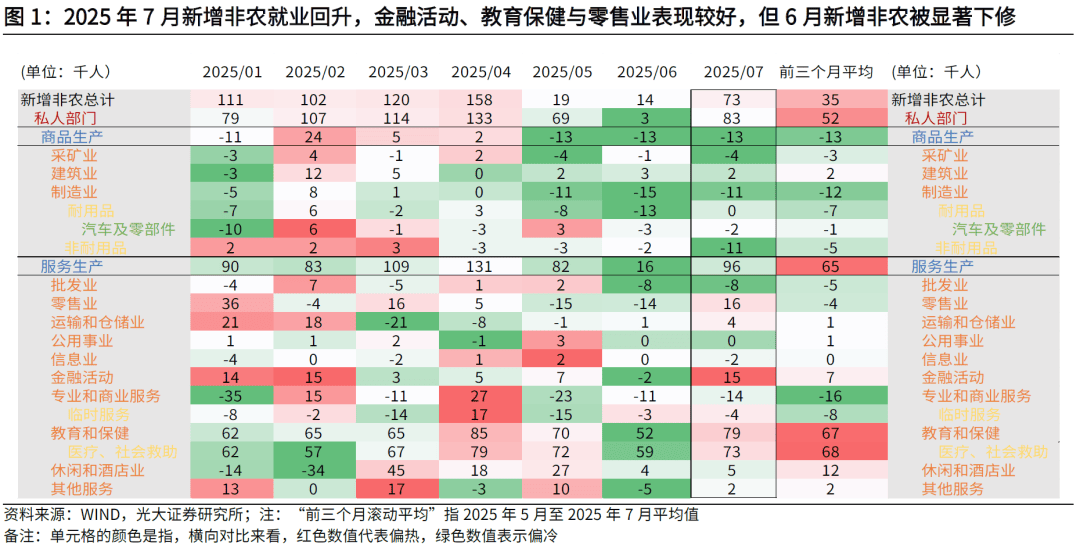
Group 1 - The core viewpoint indicates that the significant downward revision of June non-farm data reflects substantial disruptions to the U.S. economy due to tariffs, suggesting that the resilience of the U.S. economy should not be overestimated, and the direction of interest rate cuts remains highly certain [2][4][17] - In July, non-farm employment increased by 73,000, which is below the expected 110,000, and the previous value was revised down from 147,000 to 14,000, indicating pressure on the U.S. job market [6][11][22] - The unemployment rate in July rose to 4.2%, up from 4.1% in the previous month, while the average hourly wage increased by 3.9% year-on-year, exceeding the expected 3.8% [1][6][31] Group 2 - In July, the financial activities, healthcare, and retail sectors added 15,000, 79,000, and 16,000 jobs respectively, showing a stable demand in the service sector [3][22] - The manufacturing sector has seen negative job growth for three consecutive months, indicating insufficient production willingness among enterprises [3][22] - The labor force participation rate decreased to 62.2% in July, down from 62.3% in the previous month, with a notable decline in employment willingness among younger demographics [26][31] Group 3 - The downward revision of June non-farm data was primarily due to significant adjustments in government, leisure, and hotel employment, which collectively accounted for a 90,000 downward revision, representing nearly 70% of the total revision [12][17] - The cumulative downward revision for May and June non-farm data reached 258,000, while the July employment figure of 73,000 is a significant drop compared to the average monthly increase of over 100,000 in the first quarter [4][17] - The market anticipates that the Federal Reserve will cut interest rates three times in 2025, with an 80% probability for the first cut in September [4][21][37] Group 4 - The average hourly wage growth has shown an upward trend, with a month-on-month increase of 0.3% in July, higher than the previous 0.2% [37][39] - The service sector's job growth in July rebounded to 96,000, compared to a previous value of 16,000, indicating a relatively stable demand in the service industry [22][31] - The overall economic environment remains challenging, with second-quarter GDP growth at 3.0%, driven by a "import rush" effect, while core GDP growth has declined [18][22]
2025年7月美国非农数据点评:为什么美国非农就业大幅下修?
EBSCN· 2025-08-02 12:01
Employment Data Summary - In July 2025, the U.S. non-farm payrolls increased by 73,000, significantly below the expected 110,000, and the previous value was revised down from 147,000 to 14,000[1][11]. - The unemployment rate in July 2025 was 4.2%, matching expectations but up from the previous 4.1%[1][14]. - Average hourly earnings rose by 3.9% year-on-year, exceeding the expected 3.8% and revised from a previous increase of 3.7%[1][14]. Data Revision Insights - The June non-farm payrolls were revised down by a total of 258,000, with significant downward adjustments in government, leisure, and construction sectors, accounting for 90,000 of the total revision[2][12]. - The downward revision reflects the impact of tariffs on the U.S. economy, indicating a decline in the accuracy of the "birth-death model" used for employment predictions[2][5]. Sector Performance - In July, the financial activities, education, and healthcare sectors added 15,000, 79,000, and 16,000 jobs respectively, showing stability in service sector demand[3][27]. - The goods-producing sector continued to show negative job growth for three consecutive months, indicating weak production intentions among businesses[3][28]. Labor Market Dynamics - The labor force participation rate fell to 62.2% in July, down from 62.3% in June, with a notable decline in employment willingness among younger demographics[4][35]. - The number of unemployed individuals increased by 221,000 in July, contributing to the rise in the U3 unemployment rate to 4.2%[4][35]. Economic Outlook - The Federal Reserve is expected to initiate rate cuts, with market predictions indicating three rate cuts in 2025, starting in September with an 83.4% probability[5][26]. - The overall economic environment remains challenging, with the second quarter GDP growth at 3.0%, driven by a "import rush" effect, but core GDP growth showing signs of decline[5][23].