十五五规划

Search documents
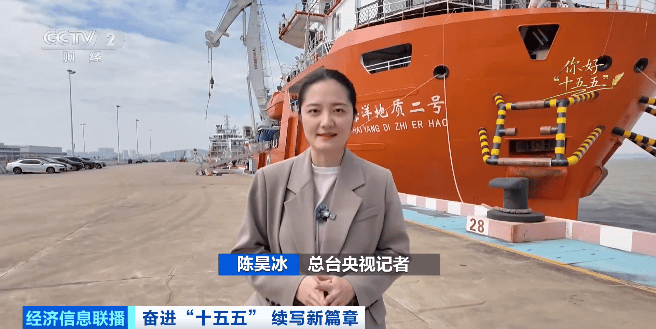
你好“十五五”丨南海深潜取“源火” 国产大邮轮破浪启新程
Sou Hu Cai Jing· 2025-11-09 15:54
Group 1: Marine Exploration and Resources - The "14th Five-Year Plan" emphasizes the need to enhance marine development, utilization, and protection, aiming for high-quality growth in the marine economy and the establishment of a strong marine nation [1][20] - The "Haima" cold spring area in the South China Sea is identified as a significant site for methane hydrate, which is recognized as a future alternative energy source, with global reserves estimated to be twice that of oil, coal, and natural gas combined [7][11] - The "Haima" deep-sea remote-controlled submersible, with over 90% domestic production, can dive to depths of 4,500 meters, playing a crucial role in the collection of combustible ice and associated gases [9][11] Group 2: Technological Advancements in Marine Research - A new major scientific infrastructure project, the "Cold Spring Ecosystem Research Facility," is under construction in Nansha, Guangzhou, with a total investment of 2.66 billion yuan, aiming to be completed by 2030 [20] - This facility will include a seabed laboratory the size of three Chinese space stations, designed for long-term human habitation at depths of 2,000 meters, significantly advancing deep-sea research capabilities [20][19] Group 3: Cruise Industry Development - The second domestically produced large cruise ship, "Aida Huacheng," is nearing 85% completion, with a construction efficiency improvement of approximately 20% due to innovative technologies and experience accumulation [22][24] - The ship will feature 2,838 cabins, with over 1,100 utilizing prefabricated cabin technology, reducing the overall interior installation time by 8 months compared to the first ship [32][28] - The Chinese cruise market is projected to become the world's most significant by 2030, with an expected annual visitor count of 10 million and an industry economic scale surpassing 400 billion yuan by 2035 [42]

沪指4000点强势震荡,A股年末平稳无忧
AVIC Securities· 2025-11-09 15:18
Market Overview - The Shanghai Composite Index (沪指) is experiencing strong fluctuations around the 4000-point mark, indicating a resilient A-share market as the year-end approaches[2] - Following the hawkish interest rate cut by the Federal Reserve in October, market expectations for a December rate cut have cooled, with the US dollar index briefly surpassing 100 points, leading to declines in major global stock markets[2] Economic Factors - Recent trade negotiations between China and the US have led to a consensus on tariff issues, which may improve trade relations and boost market risk appetite[2] - The upcoming Central Economic Work Conference in December is expected to set the tone for macroeconomic policies and key tasks for the following year, influencing investment strategies[2] Performance Correlation - Historical analysis from 2014 to 2023 shows that from November onwards, the correlation between stock price performance and the current year's earnings significantly decreases, while the correlation with the next year's earnings increases[10] - The correlation between stock prices and next year's earnings continues to rise from November to April, suggesting a shift in investment focus towards future performance[10] Investment Recommendations - Investors are advised to consider sectors with high earnings growth and relatively low valuations for 2026, such as marine equipment, precious metals, medical services, and industrial metals[6] - The military industry is expected to remain a strategic focus during the 14th Five-Year Plan, with trends towards cost reduction, automation, and globalization[6] Risk Considerations - Market participants should remain cautious due to uncertainties surrounding the Federal Reserve's monetary policy and potential impacts on global markets[2] - The ongoing concerns regarding the AI bubble and its effects on large tech stocks in the US may also pose risks to market stability[2]
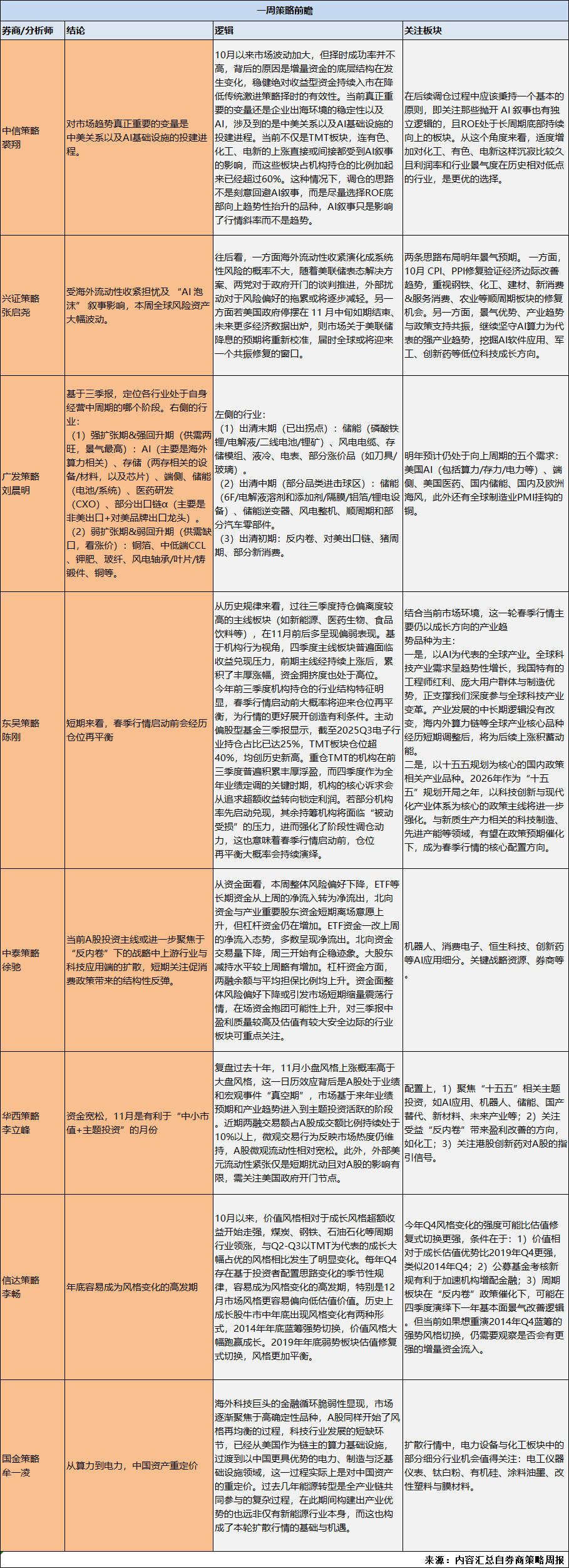
【十大券商一周策略】市场正在为新一轮向上趋势蓄势!风格切换可能会越来越强
券商中国· 2025-11-09 14:55
Group 1 - The core viewpoint is that the AI narrative has influenced the slope of market trends rather than the overall trend itself, with a focus on the stability of the corporate overseas environment and AI infrastructure investment in the context of US-China relations [2] - The current market volatility is attributed to changes in the underlying structure of incremental capital, with steady absolute return funds entering the market, reducing the effectiveness of traditional aggressive timing strategies [2] - The TMT sector, along with materials like non-ferrous metals and chemicals, has seen price increases influenced by the AI narrative, with these sectors comprising over 60% of institutional holdings [2] Group 2 - A-shares are expected to maintain resilience supported by stable economic and policy expectations, with a focus on cyclical sectors such as steel, chemicals, and new consumption [3] - The market is anticipated to be in a phase of rapid rotation among themes, with attention on sectors like electric grid equipment, lithium batteries, and chemicals, reflecting a gradual confirmation of the anti-involution theme [4] - The market is preparing for a new upward trend, with structural highlights emerging from the third-quarter reports of listed companies, emphasizing high-quality development and technological self-reliance [4][5] Group 3 - The overall A-share market may remain in a fluctuating state, with long-term upward trends in technology growth facing short-term fundamental concerns [6] - November is seen as favorable for small-cap and thematic investments, with historical data indicating a higher probability of small-cap style gains during this month [7] - The recent price increase in the market is viewed as a preemptive move for a cyclical recovery year, with key sectors including coal, non-ferrous metals, and parts of the chemical industry being highlighted for potential investment [10] Group 4 - The A-share market's investment focus is shifting towards three main lines: AI applications, anti-involution strategies, and brokerage opportunities, with an emphasis on sectors like robotics and innovative pharmaceuticals [12] - The market is expected to experience a structural rebalancing, with a focus on high-certainty products as the industry transitions from reliance on US-based infrastructure to China's advantages in power and manufacturing [11] - The upcoming spring market is likely to start earlier than usual, with a focus on growth-oriented sectors driven by AI and domestic policy initiatives [9]

宏观周报:中美经贸会谈取得重要成果-20251109
KAIYUAN SECURITIES· 2025-11-09 13:45
Domestic Macro Policy - The "15th Five-Year Plan" emphasizes expanding domestic demand as a strategic foundation, aiming for GDP per capita to reach the level of moderately developed countries by 2035[2][9]. - The plan outlines that economic and social development should maintain an appropriate speed during the "15th Five-Year" period, with a focus on enhancing living standards and promoting consumption[9][10]. - Infrastructure policies include promoting the application of "AI + healthcare" and accelerating the cultivation of new application scenarios[3][11]. Monetary and Fiscal Policy - The central bank aims to narrow the short-term interest rate corridor and enhance the role of policy interest rates, with expectations of diverse monetary mechanisms by 2026[3][14]. - Fiscal policy will focus on optimizing expenditure structures and increasing the central government's financial contribution, with a goal to strengthen financial support for major strategic tasks and basic livelihood[3][16][17]. Real Estate and Trade Policies - Recent real estate policies aim to promote high-quality development, optimize the supply of affordable housing, and reform financing and sales systems[4][18]. - In trade, significant progress was made in US-China economic talks, with the US agreeing to suspend a 10% tariff on Chinese goods and a 24% tariff for one year[4][22][23]. International Monetary Policy - The Federal Reserve cut interest rates by 25 basis points, with internal divisions on future rate decisions, while the European Central Bank and Bank of Japan maintained their rates[4][25]. - The US government remains in a state of partial shutdown, affecting economic data availability and future monetary policy decisions[4][25]. Risk Factors - There is a risk of continued divergence in domestic and international monetary policies, with concerns that domestic policy execution may fall short of expectations[5][29].
33433亿美元! 10月末我国外储创近10年新高
Sou Hu Cai Jing· 2025-11-09 13:45
Core Viewpoint - China's foreign exchange reserves have continued to rise, reaching over $3.3 trillion for three consecutive months, the highest level since November 2015, driven by factors such as major economies' monetary policies, macroeconomic data, and the performance of global financial assets [2][6]. Group 1: Foreign Exchange Reserves Trends - As of the end of October, China's foreign exchange reserves stood at $3.3 trillion, marking a significant increase of $140.99 billion compared to the end of the previous year [2][6]. - The increase in reserves is attributed to the depreciation of the US dollar, a decline in US Treasury yields, and a rise in major global stock indices [2][6]. - The US dollar index rose by 2.1% in October, reaching 99.8, while the Chinese yuan appreciated against major non-USD currencies [3][4]. Group 2: Global Financial Market Impact - The rise in the US dollar index and the overall increase in global financial asset prices have created a supportive environment for China's foreign reserves [3][4]. - Major stock indices, including the Nikkei, which surged by 16.6%, and the S&P 500, which rose by 2.3%, contributed to the positive valuation effect on foreign reserves [4][6]. - The Federal Reserve's decision to cut interest rates by 25 basis points in October has also played a role in boosting asset prices globally [4]. Group 3: Future Outlook for Foreign Reserves - Analysts expect China's foreign exchange reserves to remain stable, supported by a solid economic foundation and the emphasis on high-level opening-up in the "14th Five-Year Plan" [6][7]. - The potential for the central bank to conduct foreign exchange net selling may help maintain reserves within an appropriate range [6]. - The long-term positive trends in China's economy are expected to provide a stable backdrop for foreign exchange reserves [6][7].

一线城市近一周新房、二手房成交承压
Xiangcai Securities· 2025-11-09 13:33
Investment Rating - The industry investment rating is maintained as "Buy" [2][7] Core Insights - The real estate market is experiencing a traditional off-season, with both new and second-hand housing transactions showing a year-on-year decline due to high base effects from the previous year [7] - In major cities, new housing transaction volumes are under pressure, with significant declines observed in Beijing, Shanghai, and Shenzhen [4][5][6] Summary by Sections New and Second-Hand Housing Transactions - In Beijing, the average daily transaction of second-hand homes decreased to 448 units, down 25.2% year-on-year, while new homes saw a drop to 80 units, down 51.7% year-on-year [4] - In Shanghai, second-hand home transactions averaged 730 units, down 17% year-on-year, and new homes averaged 268 units, down 21% year-on-year [4] - In Shenzhen, second-hand home transactions averaged 159 units, down 40% year-on-year, and new homes averaged 65 units, down 77% year-on-year [5] Market Performance - The new housing transaction area in 30 major cities decreased by 43% year-on-year for the week of November 2-8, and by 47.3% year-on-year for the month of November [6] - Cumulatively, from January to November, the transaction area decreased by 9.2% year-on-year [6] Investment Recommendations - The report suggests focusing on leading real estate companies with strong land acquisition capabilities and land reserves in core cities, such as Poly Developments [7] - It also highlights the potential for valuation recovery among leading intermediary firms benefiting from an increase in second-hand housing transactions, such as I Love My Home [7]
A股分析师前瞻:年末为什么会出现仓位与风格的再平衡?
Xuan Gu Bao· 2025-11-09 13:15
Group 1 - The focus of brokerage strategy analysts this week is on year-end style rebalancing, with historical patterns indicating that sectors with high deviation in holdings during the third quarter, such as new energy, pharmaceuticals, and food and beverage, tend to show weaker performance around November [1][3] - The fourth quarter is expected to face profit-taking pressure in main sectors, as previous main lines have accumulated significant gains, leading to high levels of capital crowding [1][3] - The structure of institutional holdings in the first three quarters of this year is evident, suggesting a high probability of position rebalancing before the spring market rally, which will create favorable conditions for better market performance [1][3] Group 2 - The strategy team from Guojin highlights the fragility of financial cycles among overseas tech giants, leading to a focus on high-certainty varieties, with A-shares also beginning a process of style rebalancing [2][4] - The transition of the tech industry's development from U.S.-led computing infrastructure to China's advantages in electricity, manufacturing, and general infrastructure represents a repricing of Chinese assets [2][4] - In the diffusion market, opportunities in specific sub-sectors within the electric equipment and chemical sectors are worth attention, including electrical instruments, titanium dioxide, organic silicon, and specialty plastics [2][4] Group 3 - The strategy team from Dongwu notes that the spring market rally is likely to experience a position rebalancing before its initiation, with a focus on sectors that have independent logic beyond AI narratives and are experiencing upward trends in ROE from long-term lows [1][3] - The analysis indicates that the small-cap style has a higher probability of rising compared to large-cap style in November, attributed to A-shares being in a performance and macro event "vacuum period," leading to active theme investments based on next year's performance expectations [1][3] Group 4 - The strategy team from Huaxi reviews the past decade, noting that November is favorable for "small-cap value + theme investment," with the market entering an active phase based on performance expectations and industry trends [1][3] - The current investment focus in A-shares may further concentrate on upstream industries and technology applications under the "anti-involution" strategy, with short-term attention on policies promoting consumption [1][3]
年底容易成为风格变化的高发期
Xinda Securities· 2025-11-09 12:55
Core Insights - Since October, value style has begun to outperform growth style, marking a significant shift compared to the dominance of growth represented by TMT in Q2-Q3 [2][10] - The cyclical rotation between growth and value styles typically occurs over a 2-3 year period, primarily driven by changes in profit trends [2][11] - The fourth quarter is prone to style changes, particularly in December, as investor allocation strategies shift based on economic and profit outlooks [2][16] Summary by Sections Strategy Viewpoint - The current growth style has been dominant since September 2024, lasting about one year, and is expected to continue due to the upward trend in AI and high-end manufacturing [3][11] - Q4 is historically a high-frequency period for style changes, especially in December, as investors focus on stability and valuation safety margins [3][16] - Historical examples of style shifts include the strong switch to blue-chip stocks in late 2014 and a more balanced style shift in late 2019 [3][17] Market Changes - The report indicates that the probability of value style outperforming in December significantly increases, with historical data supporting this trend [7][20] - The report highlights that in 2014, the non-bank financial sector saw a substantial rise, with the Shanghai Composite Index showing a rapid increase in excess returns [17][21] - In 2019, a valuation repair shift occurred, leading to a more balanced market style, with previously weak sectors rebounding [23][24] Industry and Sector Recommendations - The report suggests focusing on low-valuation sectors, particularly in finance, as they may benefit from the anticipated style shift [32][33] - Specific sectors recommended for investment include non-bank financials, electric equipment, steel, and chemicals, with an emphasis on their potential for recovery and growth [35][36] - The report notes that the financial sector's valuation remains attractive, with expectations of recovery driven by regulatory support and market conditions [35][36]
铜产业链周度报告-20251109
Guo Tai Jun An Qi Huo· 2025-11-09 12:15
1. Report Industry Investment Rating - Not provided in the report 2. Core Viewpoints - The logic of tight copper supply has weakened, but the long - term consumption logic remains strong. Copper prices are expected to fluctuate, with a neutral strength - weakness analysis and a price range of 83000 - 88000 yuan/ton [3]. - Macro factors provide support, and there is a game between micro - reality and expectations. It is expected that copper prices will continue to fluctuate. In terms of spread trading, although the loss of spot imports has narrowed, domestic inventories have increased significantly, so hold the internal - external reverse arbitrage positions with caution [5]. 3. Summary by Relevant Catalogs 3.1 Trading End - **Volatility**: The volatility of SHFE, INE, and LME copper has declined, while that of COMEX copper has increased. The LME copper price volatility is around 16%, with a slight decline from the previous week, and the SHFE copper volatility is about 21%, with a relatively large decline from the previous week [9]. - **Term Spread**: The term structure of SHFE copper has weakened, and the LME copper spot discount has widened. The SHFE 11 - 12 spread on November 7 was - 20 yuan/ton, lower than 20 yuan/ton on October 31; the LME 0 - 3 discount on November 7 was 18.22 US dollars/ton, lower than 14.44 US dollars/ton on October 31; the COMEX near - end C structure has expanded [11]. - **Position**: The positions of LME, SHFE, and COMEX copper have decreased. Among them, the SHFE copper position has decreased by 39,000 lots, to 554,400 lots [12]. - **Fund and Industry Position**: The net short position of LME commercial enterprises has increased from 74,400 lots on October 24 to 78,200 lots on October 31; the net long position of CFTC non - commercial enterprises has decreased from 30,300 lots on September 16 to 30,200 lots on September 23 [17]. - **Spot Premium**: The domestic copper spot premium has strengthened, rising from par on October 31 to 40 yuan/ton on November 7. The Yangshan Port copper premium has declined, from 36 US dollars/ton on October 31 to 35 US dollars/ton on November 7, at a historically low level. The US copper premium has remained at a high level, the Rotterdam copper premium has been maintained at 145 US dollars/ton, and the Southeast Asian copper premium has declined from 135 US dollars/ton on October 31 to 127.5 US dollars/ton on November 7 [22]. - **Inventory**: The global total copper inventory has increased, from 719,200 tons on October 30 to 751,400 tons on November 6. The domestic social inventory has increased, from 182,600 tons on October 30 to 203,300 tons on November 6. The bonded - area inventory has remained stable at 81,200 tons. The COMEX inventory has increased, reaching a historically high level, from 355,700 short tons on October 30 to 369,400 short tons on November 7. The LME copper inventory has increased from 134,600 tons on October 31 to 135,900 tons on November 7 [28]. - **Position - Inventory Ratio**: The position - inventory ratio of LME copper has rebounded, while that of SHFE copper is at a historically low level. The position - inventory ratio of the SHFE 12 - contract has declined, indicating that the overseas spot tightness logic continues to strengthen [29]. 3.2 Supply End - **Copper Concentrate**: The import of copper concentrate has increased year - on - year. In September 2025, the import volume of copper ore and its concentrates in China was 2.587 million tons, a month - on - month decrease of 6.24% and a year - on - year increase of 6.22%. The port inventory of copper concentrate has increased from 461,000 tons on October 31 to 498,000 tons on November 7. The processing fee of copper concentrate has remained weak, and the smelting loss has narrowed from 3,241 yuan/ton on October 31 to 3,234 yuan/ton on November 7 [34]. - **Recycled Copper**: The import of recycled copper has increased. In September, the import of recycled copper was 184,100 tons, a year - on - year increase of 14.80%, and the domestic output of recycled copper was 97,700 tons, a year - on - year increase of 17.85%. The refined - scrap spread of recycled copper has narrowed but is still above the break - even point, and the import loss of recycled copper has narrowed [35][40]. - **Blister Copper**: The import of blister copper has decreased. In September, the import volume was 50,100 tons, a year - on - year decrease of 32.84%. In September, the blister copper processing fee was at a low level, with the southern processing fee at 700 yuan/ton and the import fee at 85 US dollars/ton [44]. - **Refined Copper**: The domestic refined copper output has increased year - on - year. In September, the output was 1.121 million tons, a year - on - year increase of 11.62%, and the cumulative output from January to September was 10.0598 million tons, a year - on - year increase of 12.22%. It is expected that the output in October will be 1.0825 million tons, a year - on - year increase of 8.72%. The import volume of refined copper has increased, with 334,300 tons imported in September, a year - on - year increase of 3.66%. The import volume of unwrought copper and copper products in China in October was 437,800 tons, a year - on - year decrease of 14.16%. The loss of copper spot imports has narrowed, from a loss of 678.78 yuan/ton on October 31 to 471.05 yuan/ton on November 7 [47]. 3.3 Demand End - **开工率**: In October, the operating rates of copper tube and copper plate - strip - foil enterprises declined, reaching historically low levels. In the week of November 6, the operating rate of wire and cable enterprises increased marginally [51]. - **Profit**: The copper rod processing fee has rebounded but is still at a historically low level. As of November 7, the processing fee for copper rods used in the power industry in East China was 510 yuan/ton, higher than 425 yuan/ton on November 31. The copper tube processing fee has declined, at a historically neutral level. On November 7, the 10 - day moving average of the processing fee for R410A special copper tubes was 5,121 yuan/ton, lower than 5,140 yuan/ton on November 7. The processing fees of copper plate - strip and lithium - ion copper foil have remained stable at low levels [55]. - **Raw Material Inventory**: In October, the raw material inventory of copper rod enterprises was at a historically low - to - neutral level, the raw material inventory of copper tubes was at a historically low level, and the weekly raw material inventory of wire and cable has remained at a low level [56]. - **Finished Product Inventory**: In October, the finished product inventory of copper rods was at a historically high level, the finished product inventory of copper tubes was at a historically low level, and the weekly finished product inventory of wire and cable has decreased [59]. 3.4 Consumption End - **Apparent Consumption**: The domestic actual copper consumption has performed well. From January to September, the cumulative consumption was 12.0359 million tons, a year - on - year increase of 9.77%. From January to September, the apparent consumption was 1.4289 million tons, a year - on - year increase of 9.01%. Power grid investment, home appliances, and new energy industries are important supports for copper consumption. Among them, the growth rate of power grid investment has slowed down. From January to September, the cumulative power grid investment was 473.8 billion yuan, a year - on - year increase of 9.9%, but at a historically high level [65]. - **Air - Conditioner and New - Energy Vehicle Production**: In September, the domestic air - conditioner production was 10.567 million units, a year - on - year decrease of 13.48%. In September, the domestic new - energy vehicle production was 1.617 million units, a year - on - year increase of 23.72% [67].
迈向“十五五”:新能源产业开启发展新篇章 中国天楹示范高质量增长新路径
Quan Jing Wang· 2025-11-09 10:17
Group 1: Industry Overview - The "15th Five-Year Plan" marks a new phase of comprehensive market-oriented development for the renewable energy sector, focusing on "scale expansion" and "quality improvement" [1] - By 2035, the total installed capacity of wind and solar power in China is targeted to exceed 3.6 billion kilowatts, with non-fossil energy accounting for over 30% of the energy mix [2] - The plan emphasizes the integration of renewable energy with traditional industries and the promotion of new business models such as green electricity direct connection and virtual power plants [2][3] Group 2: Policy and Strategic Initiatives - The "15th Five-Year Plan" aims to accelerate the construction of a new energy system, focusing on increasing the share of renewable energy and ensuring a reliable transition from fossil fuels [3] - Key initiatives include the development of distributed energy, zero-carbon factories, and parks, which are essential for implementing new energy concepts [3] - The dual-driven effect of policy and market forces is expected to significantly enhance the high-quality and stable development of renewable energy enterprises [3] Group 3: Company Performance - China Tianying (000035.SZ) reported a remarkable net profit of 102 million yuan for Q3 2025, a year-on-year increase of 2905.15%, driven by industry growth and technological innovation [4] - The company focuses on technological innovation as its core competitive advantage, investing in research and development across the hydrogen energy value chain [4][5] - China Tianying's projects, such as those in Liaoyuan and Anda, exemplify the integration of renewable energy generation, storage systems, and hydrogen production, enhancing energy utilization efficiency [5] Group 4: Future Outlook - The implementation of the "15th Five-Year Plan" is expected to create broader development opportunities for the renewable energy industry [6] - China Tianying's focus on technological innovation and project execution positions it as a leader in the transition from an "energy power" to an "energy strong country" [6]