反内卷政策

Search documents
“双十”基金经理最新调仓:朱少醒再买紫金矿业,谢治宇加码科技
Sou Hu Cai Jing· 2026-01-22 09:21
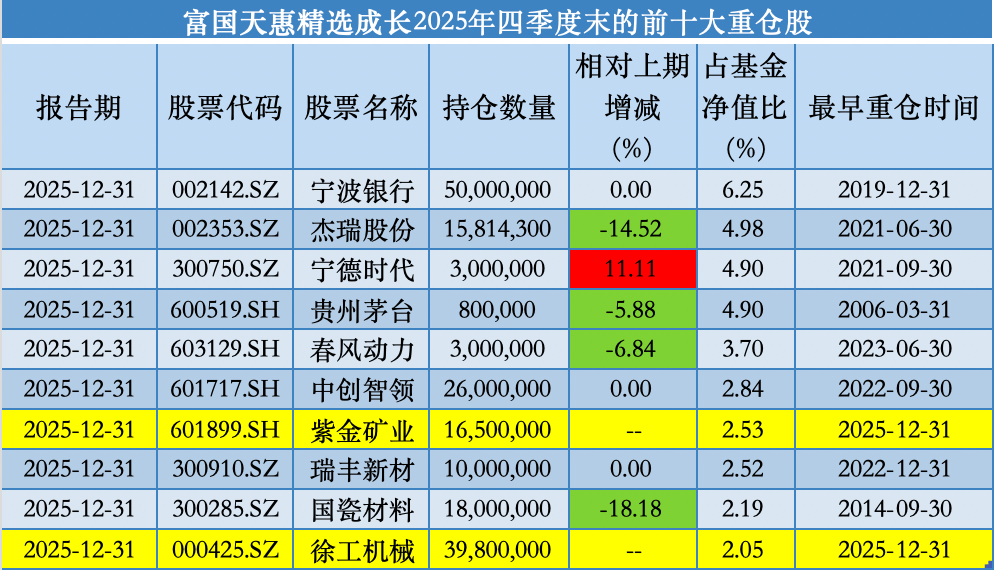
Core Viewpoint - The latest quarterly reports reveal significant adjustments in the portfolios of renowned fund managers Zhu Shaoxing and Xie Zhiyu, highlighting their investment strategies and stock selections for Q4 2025. Group 1: Zhu Shaoxing's Investment Strategy - Zhu Shaoxing's fund, Fuqun Tianhui Select Growth, increased its holdings in Ningde Times and made a notable "reverse operation" by selling Zijin Mining in the first half of 2025 and repurchasing it in the second half [2][3] - As of the end of Q4 2025, the fund's net asset value was 22.484 billion yuan, with top ten holdings including Ningbo Bank, Jerry Holdings, Ningde Times, and Guizhou Moutai [3][4] - Zhu's portfolio adjustments indicate a focus on sectors benefiting from anti-involution policies, suggesting a positive outlook for the A-share market despite rising valuations [4][5] Group 2: Xie Zhiyu's Investment Strategy - Xie Zhiyu's fund, Xingquan Helun, reported a total fund size of 38.618 billion yuan, with significant new investments in stocks like Baiwei Storage, Tuojing Technology, and Huahai Qingke [6][7] - The fund increased its position in Ningde Times while reducing holdings in several other stocks, including East Mountain Precision and Lixun Precision [6][7] - Xie expressed optimism about the domestic supply chain's growing influence in international markets and highlighted opportunities in the storage and semiconductor sectors driven by AI-related capital expenditures [7][8]




关注反内卷政策推进
Hua Tai Qi Huo· 2026-01-22 05:11
Report Summary 1. Industry Investment Rating - Not mentioned in the provided content. 2. Core Viewpoints - The government has taken measures to address "involution" in different industries. For example, the Ministry of Finance issued a notice to solve the problem of abnormally low prices in government procurement, and the People's Bank of China plans to promote the high - quality development of the modern payment system [1][2] 3. Summary by Directory 3.1. Meso - level Event Overview Production Industry - The Ministry of Finance issued a notice to address "involution" in government procurement. Purchasers should form scientific procurement requirements and set reasonable maximum prices [1]. Service Industry - The Chinese Foreign Ministry responded to a question about potential Sino - US trade negotiations, emphasizing the need to implement the consensus of the two heads of state. The People's Bank of China plans to promote the high - quality development of the modern payment system, including accelerating the construction of the RMB cross - border payment system and strengthening supervision [2]. 3.2. Industry Overview Upstream - Black: Iron ore prices slightly declined. - Agriculture: Egg and pork prices continued to rise. - Non - ferrous: Copper prices slightly declined [2]. Midstream - Chemical: The operating rates of PX and urea remained high. - Energy: The coal consumption of power plants was at a low level [3]. Downstream - Real Estate: The sales of commercial housing in second - tier cities increased seasonally. - Services: The number of domestic flight schedules decreased [4]. 3.3. Key Industry Price Indicators | Industry | Indicator | Value on 1/21 | YoY | | --- | --- | --- | --- | | Agriculture | Corn spot price | 2264.3 yuan/ton | + 0.19% | | | Egg spot price | 7.9 yuan/kg | + 3.70% | | | Palm oil spot price | 8724.0 yuan/ton | + 1.09% | | | Cotton spot price | 15837.7 yuan/ton | - 0.62% | | | Average pork wholesale price | 18.5 yuan/kg | + 1.70% | | Non - ferrous Metals | Copper spot price | 100221.7 yuan/ton | - 3.75% | | | Zinc spot price | 24188.0 yuan/ton | - 1.31% | | | Aluminum spot price | 23721.7 yuan/ton | - 3.86% | | | Nickel spot price | 145100.0 yuan/ton | - 3.08% | | Ferrous Metals | Rebar spot price | 3204.7 yuan/ton | - 1.24% | | | Iron ore spot price | 807.6 yuan/ton | - 3.89% | | | Wire rod spot price | 3437.5 yuan/ton | - 1.72% | | | Glass spot price | 12.9 yuan/square meter | - 0.23% | | Non - metals | Natural rubber spot price | 15533.3 yuan/ton | - 1.32% | | | China Plastic City price index | 775.2 | + 0.14% | | Energy | WTI crude oil spot price | 60.4 dollars/barrel | - 0.94% | | | Brent crude oil spot price | 64.9 dollars/barrel | - 0.84% | | | Liquefied natural gas spot price | 3522.0 yuan/ton | - 1.29% | | | Coal price | 806.0 yuan/ton | + 0.62% | | Chemical | PTA spot price | 5044.9 yuan/ton | - 0.96% | | | Polyethylene spot price | 6725.0 yuan/ton | + 2.39% | | | Urea spot price | 1752.5 yuan/ton | + 0.29% | | | Soda ash spot price | 1202.9 yuan/ton | - 0.94% | | Real Estate | National cement price index | 133.7 | - 0.92% | | | Building materials composite index | 114.8 points | - 0.77% | | | National concrete price index | 90.2 points | - 0.17% | [37]
供需重塑+政策赋能,石油板块迎周期机遇,石油ETF涨超2%
Mei Ri Jing Ji Xin Wen· 2026-01-22 03:15
Core Viewpoint - The oil and petrochemical industry is undergoing a critical transition phase characterized by the reshaping of the old structure and the initiation of a new cycle, driven by multiple factors such as global supply adjustments, domestic anti-competition policies, and deepening refining and chemical integration, leading to a gradual increase in industry prosperity and sustained investment value [1] Group 1: Industry Dynamics - The global supply structure is being reshaped, with production focus shifting towards China as overseas capacities exit, including approximately 4.5 million tons/year of ethylene capacity in Europe and 2.7 to 3.7 million tons/year in South Korea, optimizing the global petrochemical supply landscape [3] - China is becoming a core capacity hub, with its PE and PP production capacity share increasing from 2018 to 2025, and a compound annual growth rate of 13.5% for ethylene capacity, with over 37 million tons of related facilities planned during the 14th Five-Year Plan [3] - Geopolitical tensions, such as the Russia-Ukraine conflict, are supporting marginal supply, with reduced oil production and exports from Russia, and uncertainties in Iran, providing temporary support for oil prices [3] Group 2: Domestic Policy and Supply Structure - Domestic anti-competition policies are accelerating the elimination of outdated capacities, with over 35% of old capacities in industries like soda ash and polyester being phased out, indicating significant optimization potential [4] - Industry self-discipline is being promoted, with leading companies in the polyester and organic silicon sectors collaborating on production cuts to stabilize prices, achieving over 24% cumulative production cuts in the polyester filament sector [4] - The industry is shifting from "scale expansion" to "high-quality development," with smaller local refineries gradually exiting the market, leading to increased market share for leading companies like Hengli and Zhejiang Petrochemical [5] Group 3: Refining and Chemical Integration - The deepening of refining and chemical integration is enhancing cost reduction and efficiency, with domestic petrochemical companies accelerating their integration strategies to cover the entire supply chain from crude oil processing to chemical production, effectively hedging against oil price volatility [6] - Technological upgrades are improving competitiveness, with diverse chemical processes like light hydrocarbon cracking and coal-to-olefins rapidly developing, leading to a compound annual growth rate of 22% in ethylene production capacity from 2019 to 2024, boosting overall industry profitability [6] Group 4: Future Outlook - The oil industry is at the bottom of the previous price cycle and is entering a new cycle, with inventory dynamics shifting from passive destocking to active restocking, indicating a gradual onset of an upturn in industry prosperity [7] - Long-term growth logic remains solid, with ongoing optimization of capacity structure during the 14th Five-Year Plan focusing on high-end and differentiated production, and continuous phasing out of outdated capacities [8] - Demand growth potential is broad, with a steady recovery in traditional chemical product demand and explosive growth in new materials driven by emerging fields such as renewable energy, electronics, and high-end manufacturing [9]
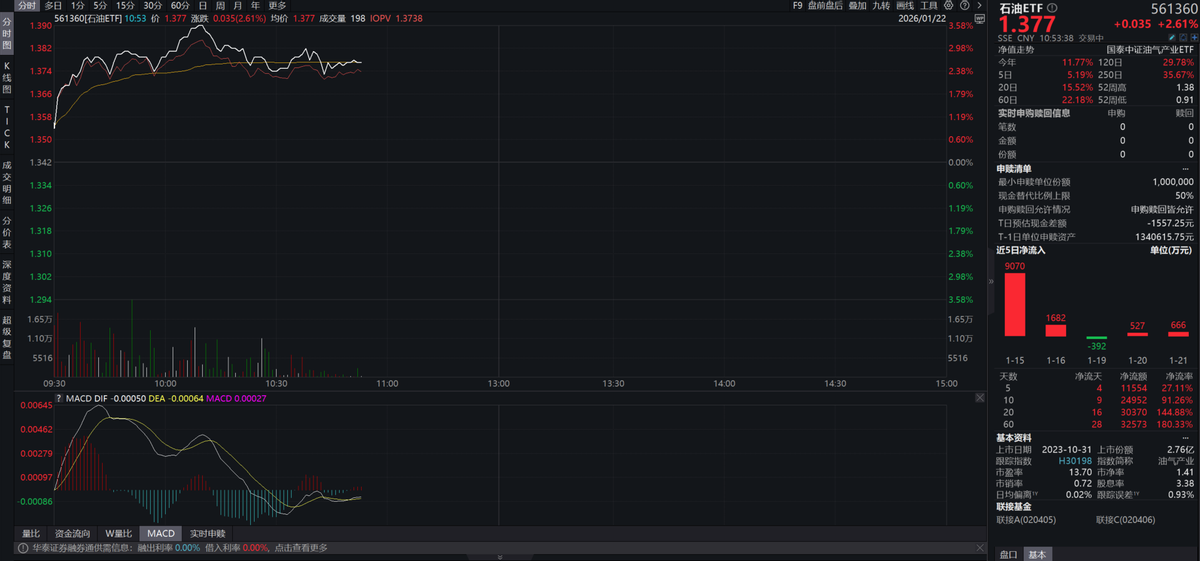
供需重塑+政策赋能,石油板块迎周期机遇,石油ETF(561360)涨超2%
Sou Hu Cai Jing· 2026-01-22 03:11
Core Viewpoint - The oil and petrochemical industry is undergoing a critical transition phase characterized by the reshaping of the old structure and the initiation of a new cycle, driven by multiple factors such as global supply adjustments, domestic anti-competition policies, and deepening refining and chemical integration, leading to a gradual increase in industry prosperity and investment value [1] Group 1: Industry Dynamics - The global supply structure is being reshaped, with a shift of industrial focus towards China. European countries are shutting down ethylene production due to high energy costs and weak demand, with a cumulative exit of approximately 4.5 million tons/year of ethylene capacity since 2024. South Korea plans to reduce ethylene capacity by 2.7 to 3.7 million tons/year, optimizing the global petrochemical supply landscape [3] - China is becoming a core capacity hub, with the share of global PE and PP capacity increasing from 2018 to 2025, and an annual compound growth rate of 13.5% for ethylene capacity. Over 37 million tons of olefin-related facilities are planned during the 14th Five-Year Plan, accelerating the shift of global industrial focus eastward [3] - Geopolitical tensions, such as the Russia-Ukraine conflict, are causing disruptions in Russian refinery production, leading to declines in oil product output and exports, which supports oil prices. The uncertainty in Iran's situation, combined with OPEC+ halting production increases, provides temporary support for oil prices [3] Group 2: Domestic Policy and Supply Structure - Domestic anti-competition policies are driving the optimization of supply structure. A joint initiative by five departments is targeting the elimination of outdated petrochemical facilities, with over 35% of old capacity in sectors like soda ash and polyester being phased out, indicating significant optimization potential [4] - Industry self-discipline is being promoted, with leading companies in the polyester and organic silicon sectors collaborating to reduce production to stabilize prices. The polyester filament industry has seen cumulative production cuts exceeding 24%, while organic silicon companies have agreed to a 30% reduction and a price increase to 13,500 yuan/ton, effectively alleviating supply-demand conflicts [4] - Capacity expansion is becoming more rational, with a shift from "scale expansion" to "high-quality development." Smaller local refineries are gradually exiting the market, while leading companies like Hengli and Zhejiang Petrochemical are increasing their market share, significantly optimizing supply concentration [4] Group 3: Refining and Chemical Integration - The deepening of refining and chemical integration is establishing a solid foundation for profitability. Domestic petrochemical companies are accelerating their integration efforts, achieving full-chain coverage from crude oil processing to chemical production, effectively hedging against oil price fluctuations [5] - Technological upgrades are enhancing competitiveness, with diverse processing routes like light hydrocarbon cracking and coal-to-olefins rapidly developing. The capacity for light hydrocarbon cracking to produce ethylene is expected to grow at a compound annual growth rate of 22% from 2019 to 2024, driving overall industry profitability [5] Group 4: Future Outlook - The industry is at the bottom of the previous price cycle and is beginning a new cycle, with the inventory cycle transitioning from passive destocking to active restocking. Since the second half of 2025, industrial product PPI and chemical raw material PPIRM have been rebounding, indicating that the price decline and destocking phase is nearing its end, with an upward trend in prosperity approaching [6] - The long-term growth logic of the industry remains solid, with continuous optimization of capacity structure during the 14th Five-Year Plan focusing on high-end and differentiated products, while the elimination of outdated capacity continues to improve supply quality [7] - There is significant growth potential in demand, with traditional chemical product demand recovering steadily, and emerging fields such as new energy, electronics, and high-end manufacturing driving explosive demand for new materials, providing long-term growth momentum for the industry [8] - The oil ETF (561360) covers the entire oil industry chain and serves as an important tool for capturing industry allocation opportunities, tracking the oil and gas industry index (H30198) which focuses on exploration, extraction, production, and sales related to oil and gas [8]
中国光伏 - 2025 年第四季度初步数据后:解答定价与行业格局动态的核心问题;后续策略如何?-China Solar_ Addressing key questions on pricing and landscape dynamic after prelim 4Q25 result; what to do from here?
2026-01-22 02:44
Summary of Key Points from the Conference Call Industry Overview - The conference call focused on the solar industry, particularly the performance of Tier 1 solar players in light of recent anti-monopoly regulations and preliminary results for 4Q25 [1][2]. Core Insights and Arguments 1. **Widening Losses in 4Q25**: - Six Tier 1 solar players (Tongwei, Daqo A, TZE, Longi, JA Solar, and Trina Solar) reported significant losses in 4Q25, attributed to upstream price hikes and weak downstream demand [2][3]. - An average of approximately 7% quarter-over-quarter (qoq) price increase in the value chain did not offset the negative earnings impact from lower volumes and higher costs of raw materials like Poly and Silver [2][6]. 2. **Company-Specific Financial Results**: - **Tongwei**: Reported a net loss of Rmb3.7-4.7 billion in 4Q25, significantly worse than previous expectations, primarily due to lower margins and fixed asset impairments [3][9]. - **Daqo A**: Reported a net profit range of -Rmb227 million to Rmb73 million, better than expected due to higher recognized Poly prices [9]. - **Longi**: Reported a net loss of Rmb2.6-3.1 billion, attributed to lower margins from Wafer and Module businesses [9]. - **TZE**: Reported a net loss of Rmb2.4-3.8 billion, also due to lower margins [9]. 3. **Pricing Outlook for 2026**: - The pricing outlook for 2026 is expected to be influenced by ongoing anti-monopoly regulations and supply-side measures, with a potential for cost reductions driven by R&D efforts from Tier 1 players [8][12]. - Silver paste prices are projected to increase by 120% from previous estimates, impacting profitability for integrated Module players [10][15]. 4. **Future Cost Dynamics**: - Tier 1 players are expected to adopt low-cost technologies to reduce silver usage significantly, which could alleviate cost pressures in the near term [10][16]. - Upstream Poly/Wafer prices are anticipated to decline by 11% qoq in 1Q26 and 2Q26 due to supply-side measures, with a potential recovery in 4Q26 [11][12]. 5. **Investment Recommendations**: - The report suggests a cautious approach towards companies like Tongwei and Daqo A, while recommending a "Buy" on Longi due to its potential for EBITDA inflection and better mid-cycle returns [24][28][32]. Other Important Insights - The current negative demand cycle in the solar industry is deemed unsustainable, with expectations for industry consolidation driven by R&D advancements [2][6]. - The report emphasizes the importance of company-specific unit transaction rates (UTR) and cost reduction progress as key indicators for future performance [21][22]. - The overall sentiment is cautious, with a downward revision of EBITDA estimates by approximately 16% for 2025 and varying adjustments for 2026 based on UTR changes [22][24]. This summary encapsulates the critical insights and financial performance of the solar industry and its leading players, highlighting the challenges and potential strategies moving forward.
【冠通期货研究报告】热卷日报:止跌企稳-20260121
Guan Tong Qi Huo· 2026-01-21 13:28
Report Industry Investment Rating - Not provided Core Viewpoints - The current production pressure of hot-rolled coils is not significant. The anti-involution policy still has expectations, providing strong support at the lower end. The weekly-on-week apparent demand has rebounded, and the year-on-year demand remains strong. The demand during the off-season shows strong resilience. The warming up of winter storage sentiment may drive a wave of demand. The total inventory is relatively high, posing some pressure, but the recent continuous destocking may relieve the pressure if it persists. The daily line of hot-rolled coil futures is currently near the support of the 30-day and 60-day moving averages. In the short term, it is necessary to pay attention to whether it can stabilize at this level and break through the pressure near the 10-day moving average. It is recommended to adopt a cautiously bullish approach, but note that the oscillation range has not been completely broken yet [6]. Summary by Directory Market Review - **Futures Price**: On Wednesday, the trading volume of the main hot-rolled coil futures contract decreased compared to the previous trading day. The price fluctuated and stabilized within the day, with a daily low of 3271 yuan and a high of 3290 yuan. It closed at 3286 yuan/ton, down 2 yuan or 0.06%. The short-term moving average retraced to the support near the 30-day moving average and then rebounded. Attention should be paid to the pressure near the 10-day moving average [1]. - **Spot Price**: The price of hot-rolled coils in the mainstream Shanghai area was reported at 3270 yuan/ton, remaining stable compared to the previous trading day [2]. - **Basis**: The basis between futures and spot was -16 yuan, with futures slightly at a premium to the spot [3]. Fundamental Data - **Supply**: As of January 15, the weekly output of hot-rolled coils increased by 2.85 million tons to 3.0836 billion tons compared to the previous week. The year-on-year output decreased by 1.183 million tons. The production has been rising for four consecutive weeks, mainly due to improved profitability of steel mills, increased production enthusiasm, the transfer of molten iron from building materials to plates, and the resumption of production after the end of annual maintenance [4]. - **Demand**: As of January 15, the weekly apparent consumption increased by 5.82 million tons to 3.1416 billion tons compared to the previous week. The apparent demand rebounded significantly this week, with a year-on-year increase of 0.51 million tons. The demand data is at a high level in recent years, indicating strong demand resilience [4]. - **Inventory**: As of January 15, the total inventory decreased by 5.8 million tons to 3.6233 billion tons compared to the previous week. The social inventory decreased by 5.01 million tons, and the steel mill inventory decreased by 0.79 million tons. The total inventory continued to decline, indicating strong demand for hot-rolled coils. The total inventory is at a high level in the past five years, but if the destocking continues, the pressure on prices will decrease [4]. - **Policy**: New regulations on the export license management of steel products have been introduced, which will cause short-term fluctuations in exports, an increase in supply, and price pressure. In the long term, it will promote industrial upgrading, structural optimization, and competitiveness enhancement. The Central Economic Work Conference in December proposed a proactive fiscal policy and a moderately loose monetary policy, and listed the in-depth rectification of involution competition as a key task for 2026, which is beneficial to prices and industry profitability. Efforts will be made to stabilize the real estate market and expand domestic demand [5]. Market Driving Factor Analysis - **Bullish Factors**: Decrease in supply output, expected start of winter storage demand, export rush market, policy support ("14th Five-Year Plan", infrastructure investment), and strong iron ore prices [6]. - **Bearish Factors**: Unexpected resumption of production by steel mills in January, seasonal weakening of demand, insufficient manufacturing orders, and inventory accumulation suppressing prices [6].
【广发宏观贺骁束】核心线索渐变,价格潜流蓄势:2026年通胀环境展望
郭磊宏观茶座· 2026-01-21 12:14
Group 1 - The core viewpoint of the article is that the inflation landscape for 2025 is characterized by a bottoming out and stabilization, with the GDP deflator index showing a decline of -1.2% year-on-year in Q2, the lowest since 2010, and a slight recovery to -1.0% in Q3 [1][11] - The article highlights that the manufacturing investment, as a representative of productive capital expenditure, has seen a decline, leading to a gradual easing of supply-demand pressure [1][11] - Key price increase signals have emerged in sectors such as storage, non-ferrous metals, and phosphorous chemicals, indicating a potential recovery in prices [1][12] Group 2 - For 2026, the article discusses the technical detail of the base period rotation for the PPI, which will be based on 2025, with updates to the survey directory and weight adjustments reflecting the latest industrial revenue proportions [2][14] - The macro logic for 2026 includes a likely recovery from the low investment gap in the first year of the 14th Five-Year Plan, stabilization of the real estate market, and a narrowing consumption gap, all of which are expected to positively influence prices [2][17] - The financial logic indicates that leading indicators such as M1 suggest a continuation of price recovery for domestic industrial products, with global liquidity conditions remaining supportive [2][20] Group 3 - The article identifies four key industrial factors influencing prices for 2026, including the pig cycle, the easing of capacity pressure in key industries, the cumulative effects of anti-involution policies, and the profit cycle indicating limited expansion in manufacturing investment [3][23] - The manufacturing sector's contribution to PPI decline is significant, with eight key industries accounting for 88% of the cumulative impact, particularly in automotive, electrical machinery, and computer communication electronics [3][26] - The article emphasizes the importance of upstream commodities, such as coal, steel, copper, and oil, in analyzing PPI, noting that price volatility in these commodities can significantly affect PPI contributions [4][30] Group 4 - The article outlines five key signals regarding CPI for 2026, including favorable base effects, the impact of core goods and services, and the expected recovery in medical service prices due to aging population needs [5][34] - The potential influence of gold prices on CPI is discussed, with projections indicating a reduced contribution compared to the previous year, reflecting a high base effect [5][37] - Housing prices are highlighted as a critical variable, with expectations for stabilization in the second half of 2026, influenced by policy measures aimed at stabilizing the real estate market [6][39] Group 5 - The comprehensive assessment of price data for the year indicates a moderate recovery in both PPI and CPI, with CPI expected to rise to a peak in Q1 before stabilizing in subsequent quarters [7][43] - The baseline scenario predicts average CPI and PPI values of 0.8% and -0.6% respectively, with variations in conservative and optimistic scenarios also presented [7][44] - Structural price increase signals for 2026 include the impact of anti-involution policies, new energy industries, and the aging population's influence on service prices [8][47][48]

核心线索渐变,价格潜流蓄势:2026年通胀环境展望
GF SECURITIES· 2026-01-21 11:07
Economic Overview - The inflation environment for 2025 is characterized by a bottoming out and stabilization, with the GDP deflator index dropping to -1.2% in Q2, the lowest since 2010, and improving to -1.0% in Q3[4][17]. - The manufacturing investment growth rate fell from 9.0% in February to 1.9% in November, indicating a slowdown in capacity expansion[4][5]. Price Trends - The PPI has shown signs of recovery, with a five-month consecutive increase from July to December, marking the first positive growth since June 2022[4][5]. - Key price increases in sectors such as storage chips (up 478%), copper (up 25.2%), and lithium hexafluorophosphate (up 248.2%) were noted from July to December 2025[4][20]. Structural Changes - The PPI base year will shift in 2026, with significant updates to the survey directory and weight adjustments, particularly increasing the weight of non-ferrous metal processing and computer communication electronics[4][28]. - The new PPI structure will better reflect emerging industries and technological advancements, potentially leading to a more pronounced impact on price readings[4][28]. Investment and Consumption - The "14th Five-Year Plan" is expected to stimulate investment, particularly in infrastructure, which will support raw material prices in the construction sector[5][12]. - Consumer spending is anticipated to increase due to policies aimed at enhancing consumption rates, with a focus on public service equalization and short-term incentives for service consumption[5][12]. Global Economic Factors - Global liquidity conditions remain supportive, with M2 growth in major economies rising from 2.4% to 8.0% year-on-year, indicating a favorable environment for commodity prices[6][12]. - The export environment is projected to remain stable, with expected growth rates of 3-4% for exports, contributing to a balanced pricing scenario for major export products[5][12]. Risks and Uncertainties - Potential risks include unexpected downward pressure on the domestic economy, uncertainties in real estate policies, and fluctuations in global commodity prices[12][14]. - The impact of the pig cycle and other agricultural price trends may also influence inflation dynamics in 2026, with expectations of a price bottoming out in the first half of the year[10][12].
2025年增长目标实现,今年仍需发力稳投资促消费| 宏观月报
2 1 Shi Ji Jing Ji Bao Dao· 2026-01-21 08:43
Economic Growth and Projections - In 2025, China's economy successfully achieved its growth target despite external shocks, with a GDP growth of 5% for the year and a quarterly breakdown showing 5.4% in Q1, 5.2% in Q2, 4.8% in Q3, and 4.5% in Q4 [5][6] - The first quarter of 2026 is expected to benefit from ample project and policy reserves, aiming to boost investment and consumption [5][6] Financing and Credit Trends - In December 2025, the social financing scale increased by 22,080 billion yuan, with a total annual increase of 35.6 trillion yuan, up from 32.3 trillion yuan in 2024, supported by proactive fiscal policies [1] - The total new credit for 2025 was 16.27 trillion yuan, a decrease of 1.82 trillion yuan compared to 2024, indicating a need for improved domestic investment and consumption [1][3] - The corporate sector saw a total new credit of 15.47 trillion yuan in 2025, an increase of 1.14 trillion yuan from 2024, driven by counter-cyclical policies and lower interest rates [3] Government Bonds and Fiscal Policy - Government bonds became a key support for social financing in 2025, with a total issuance of 13.84 trillion yuan, an increase of 2.54 trillion yuan from 2024 [4] - The M1 and M2 money supply growth rates improved in December 2025, with M1 at 3.8% and M2 at 8.5%, indicating a recovery in liquidity [4] Investment Trends - Fixed asset investment in 2025 was 485,186 billion yuan, a decrease of 3.8% year-on-year, highlighting a shift in China's growth drivers [6][7] - Industrial investment showed resilience, with mining investment up 2.5%, manufacturing up 0.6%, and electricity and water supply up 9.1%, despite a 2.2% decline in infrastructure investment [7] - Equipment and tool purchases increased by 11.8% in 2025, driven by policies supporting new technologies [8] Consumption and Retail - The total retail sales of consumer goods in 2025 reached 501,202 billion yuan, growing by 3.7%, with December sales at 45,136 billion yuan, a 0.9% increase year-on-year [8] - To stimulate consumption, improving residents' income and consumption willingness is essential, particularly through enhancing property income [8] External Trade and Risks - In 2025, exports grew by 6.1%, surpassing the overall economic growth rate, despite challenges from external trade policies [9] - The adjustment of export tax rebates for solar and battery products starting in 2026 aims to redirect fiscal support towards domestic demand recovery [9] Price Levels and Inflation - In 2025, the CPI remained flat year-on-year, while the core CPI increased by 0.7%, indicating a gradual recovery in price levels [10] - Policies aimed at reducing supply and enhancing demand are necessary to stabilize and increase industrial product prices moving forward [10]
化工买什么-20260120
2026-01-21 02:57
Summary of Chemical Industry Conference Call Industry Overview - The chemical industry is currently valued at historical lows, with leading companies like Wanhua and Hualu having a PB of approximately 2.4 times and a PE of around 15 times, significantly lower than historical peaks, indicating potential profit elasticity and long-term investment value [2][4] - The midstream chemical sector benefits from global demand diversification, with China's chemical production accounting for over 40% of global capacity, positioning it to meet global needs amid overseas energy pressures [2][6] - Capital expenditure in the basic chemical industry is declining, leading to a slowdown in supply growth, while low oil prices favor midstream profit recovery, supported by a global economic recovery driving demand for chemical products [2][7] Key Companies - **Wanhua Chemical**: Focused on maximizing shareholder value, with stable MDI business and improvements in petrochemical operations. The company is investing in lithium battery materials, particularly lithium iron phosphate and anodes, indicating long-term investment potential [2][9] - **Hualu Hengsheng**: Leveraging low-cost advantages for platform development, with clear bottom-line profits. New projects and technological upgrades in gasification are expected to drive growth, with several products experiencing price increases due to shortages [2][10] - **Jushi Group**: The fiberglass industry is dominated by domestic supply, with management changes leading to a focus on profitability. Supply-demand dynamics are expected to push prices of mid-to-high-end products upward, with supply growth anticipated to lag behind demand growth by 2026 [2][10] Market Dynamics - The potassium fertilizer market is experiencing expanding demand, with supply growth slowing, leading to a tightening supply-demand balance that supports rising prices. The global potassium fertilizer demand is projected to reach 75 million tons by 2025 [2][13] - The phosphate rock market remains robust, driven by stable demand for phosphate fertilizers and emerging applications in new energy sectors, with limited supply growth expected due to environmental regulations [2][14][15] Policy Impact - Recent government policies aimed at reducing "involution" are positively impacting certain segments of the chemical industry, potentially improving supply-demand balances and supporting price recovery [2][8] Investment Recommendations - Wanhua and Hualu are highlighted as core investment targets due to their strong fundamentals and market positioning. Jushi Group is also recommended for its growth potential in the fiberglass sector [2][10] Additional Insights - The chemical industry has shown good market performance recently, although the fundamentals have not changed significantly. The stock prices are rising due to liquidity and allocation demand, particularly from insurance investments [3] - The midstream chemical sector is favored for investment due to its low valuation and diverse global demand characteristics, including sectors like new energy, electronics, and automotive [5][6]