
行业轮动

Search documents
7月资产配置报告:宏观景气度边际改善,相对看好小盘走势
2025-07-02 15:49
Summary of Key Points from the Conference Call Industry or Company Involved - The report focuses on the A-share market and investment strategies proposed by Industrial Securities, particularly in the context of macroeconomic conditions and sector performance. Core Insights and Arguments - **Market Valuation and Timing**: The improved stock-bond valuation indicator suggests that A-shares have been in a low valuation state since 2022, with potential bottom-fishing opportunities starting in 2024 [1][3] - **Economic Leading Indicators**: The economic leading index constructed by Industrial Securities shows a slight upward trend in comprehensive leading indicators, real economy, and financial environment as of June 30, 2025, indicating a relatively positive outlook [4] - **Stock-Bond Rotation Strategies**: Two types of stock-bond rotation portfolios have been constructed: a flexible allocation portfolio with a historical annualized return of 14% and a conservative fixed-income portfolio with a 7.8% annualized return, both outperforming fixed-weight benchmark portfolios [5] - **Growth vs. Value Rotation Model**: The growth-value rotation model has achieved approximately 25% annualized returns since its inception in late 2013, outperforming the benchmark by 5%. As of June 30, 2025, the model indicates a preference for value stocks [6] - **Market Sentiment and Fund Flows**: As of June 30, 2025, the A-share margin financing balance is at a historical median level, indicating a neutral market sentiment. However, net inflows from major funds are optimistic, with over 90% of the data indicating positive sentiment [10] Additional Important Content - **Sector Recommendations**: Industrial Securities recommends sectors such as telecommunications, defense, construction decoration, steel, and computers, which include both cyclical and growth-oriented industries. The defense sector's weight is doubled based on macroeconomic calendar effects [11][12][14] - **Performance Metrics**: The recommended strategy has an annualized return of approximately 14% as of June 30, 2025, exceeding the benchmark by 15 percentage points, with a volatility of 9.33% and a Sharpe ratio of 1.63 [16] - **Historical Similarity Analysis**: The current macroeconomic environment is compared to historical periods, particularly noting similarities with the second half of 2015, characterized by economic pressure and a loose monetary environment, leading to a cautious outlook for the stock market [9] - **ETF Strategy**: The strategy includes matching ETF holdings based on correlation and return levels, with a performance difference of 2 to 3 percentage points compared to the rotation results [15]
转债市场日度跟踪20250702-20250702
Huachuang Securities· 2025-07-02 15:24
Report Industry Investment Rating No relevant content provided. Core View of the Report On July 2, 2025, the convertible bond market showed an incremental decline with compressed valuations. The market style favored large-cap value stocks, and the trading sentiment in the convertible bond market heated up. The central price of convertible bonds decreased, and the proportion of high-priced bonds declined. In the industry, more than half of the underlying stock industry indices rose in the A-share market, while 25 industries in the convertible bond market declined [2][3][4]. Summary by Related Catalogs 1. Market Overview - **Index Performance**: The CSI Convertible Bond Index decreased by 0.32% compared to the previous day. The Shanghai Composite Index decreased by 0.09%, the Shenzhen Component Index decreased by 0.61%, the ChiNext Index decreased by 1.13%, the SSE 50 Index increased by 0.18%, and the CSI 1000 Index decreased by 1.01% [2]. - **Market Style**: Large-cap value stocks were relatively dominant. Large-cap growth decreased by 0.23%, large-cap value increased by 0.62%, mid-cap growth decreased by 0.26%, mid-cap value increased by 0.59%, small-cap growth decreased by 0.72%, and small-cap value increased by 0.38% [2]. - **Fund Performance**: The trading sentiment in the convertible bond market heated up. The trading volume of the convertible bond market was 65.532 billion yuan, a 4.39% increase compared to the previous day. The total trading volume of the Wind All A was 1.405109 trillion yuan, a 6.11% decrease compared to the previous day. The net outflow of the main funds in the Shanghai and Shenzhen stock markets was 33.19 billion yuan, and the yield of the 10-year treasury bond decreased by 0.37bp to 1.64% [2]. 2. Convertible Bond Price and Valuation - **Convertible Bond Price**: The weighted average closing price of convertible bonds was 122.40 yuan, a 0.32% decrease compared to the previous day. The closing price of equity-oriented convertible bonds was 161.10 yuan, a 3.28% decrease; the closing price of bond-oriented convertible bonds was 113.48 yuan, a 0.05% decrease; the closing price of balanced convertible bonds was 123.06 yuan, a 0.44% decrease. The proportion of high-priced bonds above 130 yuan was 28.85%, a 3.78pct decrease compared to the previous day. The price median was 123.75 yuan, a 0.84% decrease compared to the previous day [3]. - **Convertible Bond Valuation**: The valuation was compressed. The fitted conversion premium rate of 100-yuan par value was 24.49%, a 0.53pct decrease compared to the previous day. The overall weighted par value was 92.65 yuan, a 0.50% increase compared to the previous day. The premium rate of equity-oriented convertible bonds was 5.49%, a 1.26pct decrease; the premium rate of bond-oriented convertible bonds was 93.19%, a 1.57pct decrease; the premium rate of balanced convertible bonds was 18.96%, a 0.49pct decrease [3]. 3. Industry Performance - **Underlying Stock Industry**: In the A-share market, the top three industries in terms of increase were steel (+3.37%), coal (+1.99%), and building materials (+1.42%); the top three industries in terms of decrease were electronics (-2.01%), communication (-1.96%), and national defense and military industry (-1.94%). - **Convertible Bond Market**: A total of 25 industries in the convertible bond market declined. The top three industries in terms of decrease were communication (-2.34%), bank (-2.17%), and automobile (-1.51%); the top three industries in terms of increase were steel (+0.70%), coal (+0.21%), and national defense and military industry (+0.08%) [4]. - **Industry Indicators**: In terms of closing price, large-cycle decreased by 0.41%, manufacturing decreased by 0.79%, technology decreased by 1.16%, large-consumption decreased by 0.56%, and large-finance decreased by 1.55%. In terms of conversion premium rate, large-cycle decreased by 1.5pct, manufacturing decreased by 1.2pct, technology increased by 0.82pct, large-consumption decreased by 1.1pct, and large-finance decreased by 0.54pct. In terms of conversion value, large-cycle increased by 0.37%, manufacturing decreased by 0.42%, technology decreased by 1.56%, large-consumption decreased by 0.06%, and large-finance decreased by 1.80%. In terms of pure bond premium rate, large-cycle decreased by 0.57pct, manufacturing decreased by 1.0pct, technology decreased by 1.7pct, large-consumption decreased by 0.68pct, and large-finance decreased by 2.3pct [4][5]. 4. Industry Rotation - **Leading Industries**: Steel, coal, and building materials led the rise. The daily increase of steel in the underlying stock was 3.37%, and 0.70% in the convertible bond market; the daily increase of coal in the underlying stock was 1.99%, and 0.21% in the convertible bond market; the daily increase of building materials in the underlying stock was 1.42%, and -0.83% in the convertible bond market [53].
做好准备!A股要创新高了?接下来,大盘走势分析
Sou Hu Cai Jing· 2025-07-02 05:15
Group 1 - The Shanghai Composite Index is close to reaching a new high, with key sectors like liquor, banking, and insurance not yet forming a coordinated movement [1][3][5] - The current market environment shows a trend of upward fluctuations in the index, with a rotation among industries [1][5] - The index's performance is largely influenced by the weight of liquor, banking, and insurance stocks, which together account for over 40% of the index [3][5] Group 2 - The market is expected to continue rising, with a focus on index performance rather than individual stock trading [5][7] - The current low trading volume is seen as a positive signal for further upward movement [1][7] - The commentary emphasizes a separation between index investors and stock traders, suggesting that individual stock performance may not correlate with index movements [3][5][7]

转债市场日度跟踪20250701-20250701
Huachuang Securities· 2025-07-01 15:37
Report Industry Investment Rating No relevant content provided. Core Viewpoints - On July 1, 2025, the convertible bond market showed incremental growth with rising valuations. The trading sentiment in the convertible bond market heated up, while the total trading volume of the A-share market decreased slightly. The median price and overall weighted average parity of convertible bonds increased, and the proportion of high-priced bonds rose. In the industry, more than half of the underlying stock industry indices rose, with different performance trends among different industries [2][3]. Summary by Directory 1. Market Overview - **Index Performance**: The CSI Convertible Bond Index rose 0.48% compared to the previous day, the Shanghai Composite Index rose 0.39%, the Shenzhen Component Index rose 0.11%, the ChiNext Index fell 0.24%, the SSE 50 Index rose 0.21%, and the CSI 1000 Index rose 0.28% [2]. - **Market Style**: Mid-cap value stocks outperformed. Large-cap growth stocks rose 0.10%, large-cap value stocks rose 0.63%, mid-cap growth stocks fell 0.04%, mid-cap value stocks rose 0.88%, small-cap growth stocks rose 0.37%, and small-cap value stocks rose 0.39% [2]. - **Fund Performance**: The trading sentiment in the convertible bond market heated up. The trading volume of the convertible bond market was 62.777 billion yuan, a 15.43% increase compared to the previous day. The total trading volume of the Wind All-A Index was 1.496531 trillion yuan, a 1.37% decrease compared to the previous day. The net outflow of main funds from the Shanghai and Shenzhen stock markets was 23.112 billion yuan, and the yield of the 10-year treasury bond decreased 0.36bp to 1.64% [2]. 2. Convertible Bond Price and Valuation - **Convertible Bond Price**: The weighted average closing price of convertible bonds was 122.81 yuan, a 0.47% increase compared to the previous day. The closing price of equity-biased convertible bonds was 166.37 yuan, a 2.00% decrease; the closing price of bond-biased convertible bonds was 113.54 yuan, a 0.23% increase; the closing price of balanced convertible bonds was 123.61 yuan, a 0.48% increase. The proportion of high-priced bonds above 130 yuan was 32.62%, a 2.13 percentage point increase compared to the previous day. There were 2 bonds with a closing price below 100 yuan. The median price was 124.80 yuan, a 0.48% increase compared to the previous day [3]. - **Convertible Bond Valuation**: The conversion premium rate of the 100-yuan parity fitting was 25.02%, a 0.30 percentage point increase compared to the previous day. The overall weighted parity was 92.22 yuan, a 0.61% increase compared to the previous day. The premium rate of equity-biased convertible bonds was 6.68%, a 0.35 percentage point decrease; the premium rate of bond-biased convertible bonds was 94.76%, a 1.21 percentage point increase; the premium rate of balanced convertible bonds was 19.45%, a 0.03 percentage point increase [3]. 3. Industry Performance - **Underlying Stock Industry Index**: In the A-share market, the top three rising industries were Medicine and Biology (+1.80%), Banks (+1.53%), and Non-ferrous Metals (+1.49%); the top three falling industries were Computer (-1.18%), Commerce and Retail (-0.79%), and Communications (-0.45%). In the convertible bond market, 22 industries rose, with the top three rising industries being Non-ferrous Metals (+2.04%), National Defense and Military Industry (+1.52%), and Banks (+1.23%); the top three falling industries were Communications (-1.15%), Computer (-0.62%), and Steel (-0.26%) [4]. - **Industry Indicators**: In terms of closing price, the large-cycle sector rose 0.73%, the manufacturing sector rose 0.18%, the technology sector fell -0.02%, the large-consumption sector rose 0.39%, and the large-finance sector rose 0.70%. In terms of conversion premium rate, the large-cycle sector fell -0.53 percentage points, the manufacturing sector rose 0.67 percentage points, the technology sector rose 0.83 percentage points, the large-consumption sector fell -0.19 percentage points, and the large-finance sector fell -0.99 percentage points. In terms of conversion value, the large-cycle sector rose 1.00%, the manufacturing sector fell -0.14%, the technology sector fell -0.67%, the large-consumption sector rose 0.46%, and the large-finance sector rose 0.68%. In terms of pure bond premium rate, the large-cycle sector rose 0.91 percentage points, the manufacturing sector rose 0.21 percentage points, the technology sector fell -0.083 percentage points, the large-consumption sector rose 0.45 percentage points, and the large-finance sector rose 0.83 percentage points [4][5].
基金半年成绩单出炉:最高赚超80% 北交所、医药基金成赢家
Bei Ke Cai Jing· 2025-07-01 06:00
Group 1 - The core viewpoint of the article highlights the strong performance of actively managed equity funds, particularly those focused on the Beijing Stock Exchange and the pharmaceutical sector, with the top-performing fund achieving a return of 82.45% in the first half of 2025 [1][7]. - The top-performing funds include the CITIC Securities Beijing Stock Exchange Selected Two-Year Open A Fund, which is the only fund to exceed an 80% return, and other notable funds such as Great Wall Pharmaceutical Industry Selected A and Bank of China Hong Kong Stock Connect Pharmaceutical A, both exceeding 70% returns [2][7]. - The overall performance of the A-share and Hong Kong stock markets was positive, with major indices showing gains, particularly the North Exchange 50 Index, which rose by 39.45% [5][6]. Group 2 - Looking ahead to the second half of 2025, several fund companies express optimism about investment opportunities in the A-share market due to historically low valuation levels and supportive fiscal and monetary policies [3][10]. - Fund managers are particularly focused on sectors such as technology, innovative pharmaceuticals, and new consumption, anticipating structural opportunities in these areas [11][12]. - The Hong Kong market is expected to attract more investment due to the internationalization of the RMB and the listing of quality A-shares and overseas Chinese assets, which enhances its appeal [10]. Group 3 - Despite the overall positive outlook, some actively managed equity funds have underperformed, with the Qianhai Kaiyuan Artificial Intelligence A Fund showing a decline of 20.57%, marking it as the worst performer [9]. - Fund managers emphasize the importance of identifying structural opportunities in the market, particularly in sectors like AI, semiconductors, and military industry, as well as in cyclical industries that have seen significant price declines [11][12].
投资者微观行为洞察手册·6月第3期:全球资本流向非美,国内杠杆资金加快扩张
GUOTAI HAITONG SECURITIES· 2025-06-30 11:14
Market Overview - The overall trading activity in the market has significantly increased, with the average daily trading volume rising from 1.2 trillion to 1.5 trillion CNY[1] - The Shanghai Composite Index turnover rate has increased to the 85th percentile, while the STAR Market turnover rate has reached the 40th percentile[1] - The proportion of stocks rising has increased to 88.6%, with a median weekly return of 4.4%[3] Capital Flow Insights - Net inflow of southbound funds has risen to 28.4 billion CNY, marking a 96th percentile since 2022[3] - Foreign capital has seen a net outflow of 3.74 million USD from the A-share market[39] - Financing funds have net bought 25.6 billion CNY, with the total margin balance increasing to over 1.8 trillion CNY[3] Fund Issuance and Performance - The issuance scale of new equity funds has decreased to 15.9 billion CNY, down from 25.7 billion CNY[31] - The private equity confidence index has slightly declined, while the positions have marginally increased[37] - The average return of funds has shown a significant improvement, with most funds reporting positive returns year-to-date[33] Sector Performance - The trading concentration in certain sectors has increased, with seven industries having turnover rates above 90%, including comprehensive finance and defense[2] - The electronic and computer sectors have the highest average daily trading volumes, at 1829.61 billion CNY and 1684.80 billion CNY respectively[20] - Notable inflows in financing funds were observed in the computer sector (+4.94 billion CNY) and non-bank financials (+3.93 billion CNY), while real estate saw outflows (-0.24 billion CNY)[3] Risk Considerations - There are potential risks related to data collection methods and measurement errors, as well as biases from third-party data sources[3]
行业轮动周报:指数创下年内新高但与题材炒作存在较大割裂,银行ETF获大幅净流入-20250630
China Post Securities· 2025-06-30 11:04
- The diffusion index model tracks industry rotation and has achieved an excess return of 0.37% since 2025[26][27][31] - The diffusion index ranks industries weekly based on momentum, with top industries including non-bank finance (1.0), comprehensive finance (1.0), and media (0.976)[4][28][30] - The diffusion index suggests monthly industry allocation, recommending sectors such as non-bank finance, banking, and media for June 2025[27][31] - GRU factor model focuses on industry rotation based on transaction data, achieving an excess return of -4.76% in 2025[33][36][34] - GRU factor ranks industries weekly, with top industries including textile & apparel (3.7), construction (3.34), and real estate (3.28)[5][13][34] - GRU factor suggests weekly industry allocation, recommending sectors such as real estate, transportation, and coal for the current week[36][34][33]
A500ETF基金(512050)成分股掀涨停潮!机构:优先选择筹码出清后的成长板块
Sou Hu Cai Jing· 2025-06-30 03:55
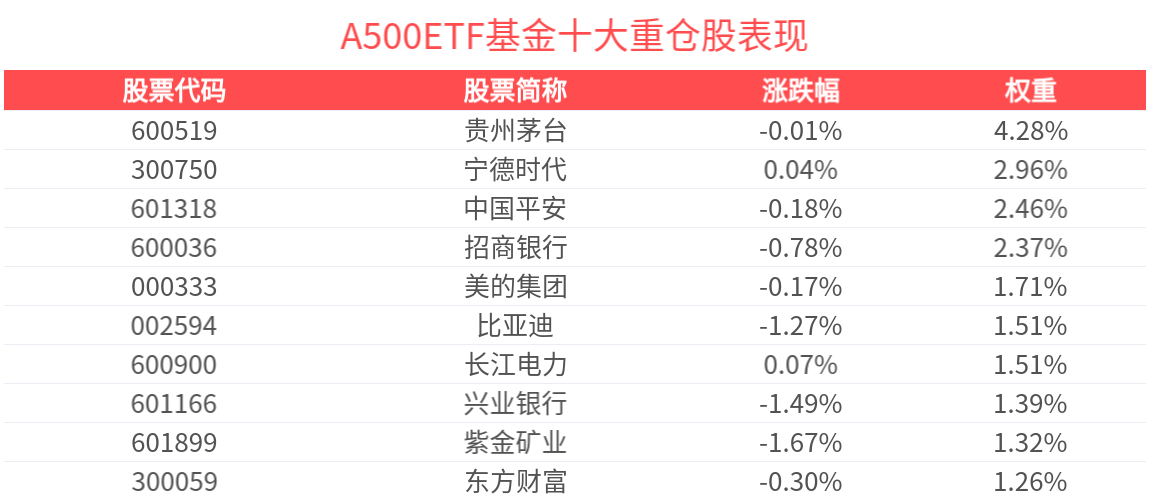
Group 1 - The core viewpoint of the articles indicates that the A500 index and its ETF are experiencing positive momentum, with notable increases in specific constituent stocks [1][2] - The A500 ETF fund has shown active trading, with a turnover rate of 13.7% and a transaction volume of 22.13 billion yuan, indicating a vibrant market [1] - The A500 index is designed to reflect the performance of the 500 largest and most liquid stocks across various industries, with the top ten stocks accounting for 21.21% of the index [2][4] Group 2 - The macroeconomic fundamentals have not fundamentally changed compared to late 2024 and early 2025, suggesting a potential shift from small-cap to large-cap value stocks as market conditions evolve [2] - Future investment strategies may focus on growth sectors that benefit from policy support, particularly in technology and healthcare, such as AI, robotics, and innovative pharmaceuticals [2] - The top ten weighted stocks in the A500 index include major companies like Kweichow Moutai, CATL, and Ping An, with varying performance metrics [4]





中金:如何寻找行业轮动的线索?
中金点睛· 2025-06-29 23:56
Core Viewpoint - The Hong Kong stock market has shown strong performance since Q4 2024, significantly outperforming the A-share market, but faces challenges such as pulse-like rebounds and concentration in a few sectors, making it difficult for investors to achieve excess returns. However, precise timing and understanding of market rhythms can lead to substantial gains [1][2]. Industry Rotation Context - The market has experienced several rounds of rebounds driven by macroeconomic factors, including fiscal policy shifts and the rise of AI technology. Key phases include: 1. The "924" policy shift led to a rally in non-bank and real estate sectors, focusing on total policy [1]. 2. The emergence of "DeepSeek" post-Spring Festival revalued AI-related tech and internet leaders, driven by industry trends [1]. 3. The tariff situation in April spurred growth in new consumption and innovative pharmaceuticals, influenced by industry catalysts and liquidity [1][2]. Macro Environment Analysis - The current market dynamics are characterized by a combination of abundant liquidity and structural challenges, leading to index fluctuations and active structural trends. The macroeconomic backdrop includes: - Continued credit contraction in the private sector and limited fiscal stimulus, which restricts overall credit cycle expansion while supporting market stability [8][9]. - The emergence of new growth points, particularly in AI and new consumption sectors, which contribute to the active structural market [9][10]. Investment Strategy Insights - The investment strategy emphasizes the importance of focusing on sectors with stable or improving return on equity (ROE). Key insights include: - Stable returns are found in sectors like banking and utilities, which maintain consistent ROE, while growth opportunities lie in technology, new consumption, and innovative pharmaceuticals, which have shown significant ROE recovery [18][19]. - The analysis of trading concentration, southbound capital flows, and valuation metrics is crucial for identifying sector rotation opportunities [22][23]. Trading and Positioning Dynamics - The analysis of trading dynamics reveals: - High trading concentration in new consumption and innovative pharmaceuticals, with recent declines in AI sector concentration [23][24]. - Southbound capital flows have favored new consumption and innovative pharmaceuticals, indicating strong investor interest in these sectors [32][34]. - The increase in short positions in certain sectors suggests a shift in investor sentiment, highlighting the need for caution in trading strategies [36][37]. Valuation Considerations - Valuation analysis indicates that while high-dividend sectors are under scrutiny, technology and new consumption sectors are experiencing valuation recovery. Key points include: - The AH premium threshold is set at 125%, which serves as a benchmark for high-dividend stocks, while technology and new consumption sectors are aligning with their ROE [44][45].

主力资金109亿涌入电子板块,中际旭创获9.22亿净买入居首
Jin Rong Jie· 2025-06-27 04:13
Group 1 - The core viewpoint of the articles highlights a significant divergence in capital flow across different sectors, with the electronic sector attracting over 10.9 billion yuan in net inflow, while traditional sectors like banking and oil faced net outflows [1][2] - The communication industry stood out with a net inflow of 2.472 billion yuan, indicating optimistic market expectations for the development of communication equipment and related technologies [2] - Continuous capital flow trends show a structural preference in the market, with 119 stocks experiencing net inflows for five consecutive trading days or more, demonstrating sustained investor interest [1] Group 2 - Zhongji Xuchuang led individual stocks with a net buying amount of 922 million yuan, reflecting strong market confidence in the company, which is a leader in the optical communication module sector [1] - The technology leadership of Zhongji Xuchuang, particularly in the 800G optical module market and its first-mover advantage in 1.6T products expected to be mass-produced by 2025, is a key factor attracting main capital [1] - On the other hand, Dazhongnan faced a net sell-off exceeding 500 million yuan, marking it as the stock with the highest capital outflow for the day [1]
