
AI算力

Search documents
蔚来穿过“生死线”,盈利模型还有待检验
虎嗅APP· 2026-03-14 03:34
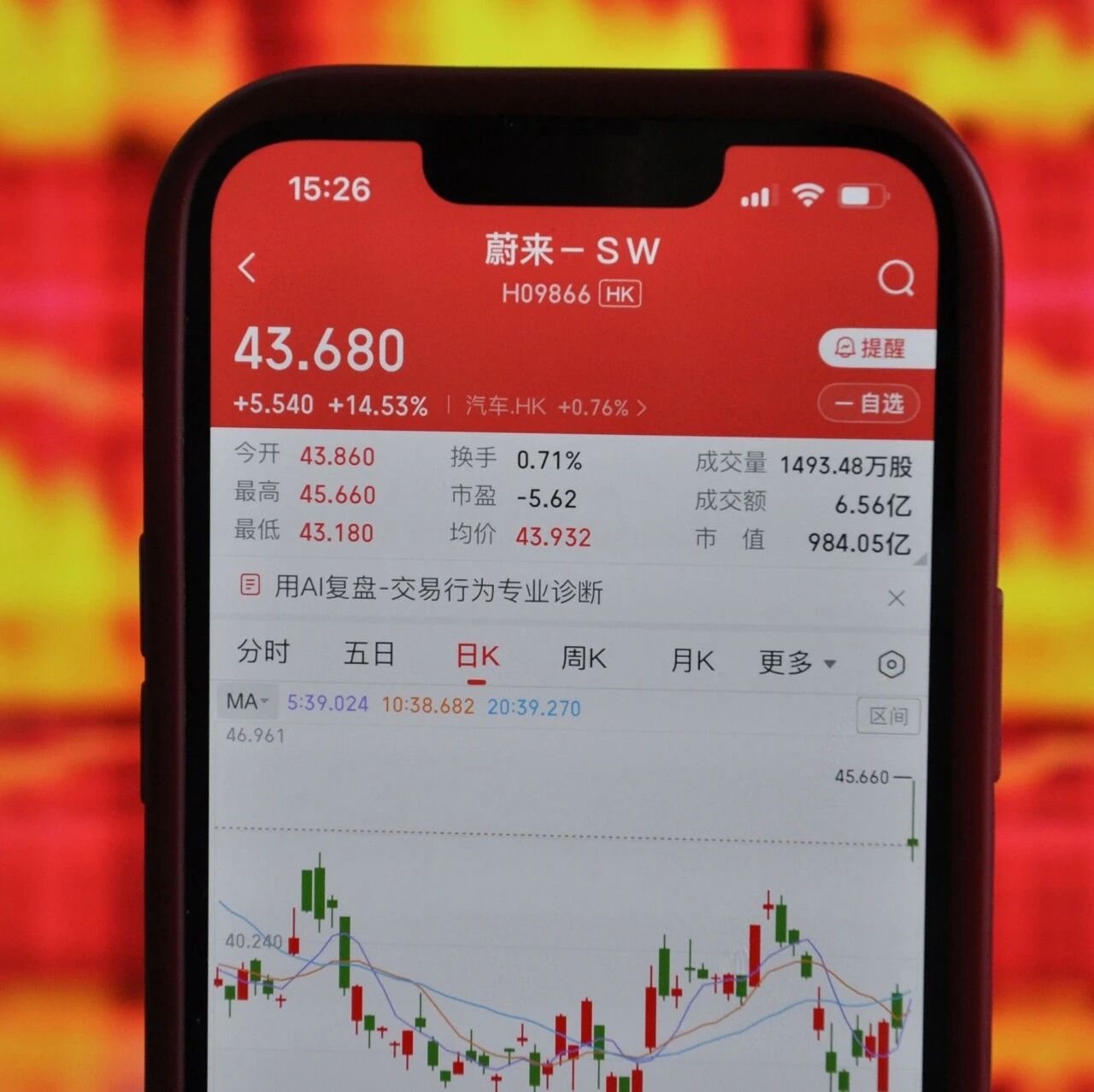
Core Viewpoint - NIO has achieved a significant milestone by reporting a net profit of 283 million yuan for the first time in Q4 2025, prompting a reevaluation of its market position and future prospects [2][3]. Financial Performance - In Q4 2025, NIO delivered 124,800 vehicles, a year-on-year increase of 71.7%, with revenue reaching 34.65 billion yuan, up 75.9%, and achieving a net profit of 283 million yuan [8][9]. - The profitability was driven by the introduction of high-margin models like the new ES8, which contributed nearly one-third of total deliveries and had a gross margin close to 25% [11]. - Cost control measures were effective, with R&D expenses down 44.3% to 2.026 billion yuan and sales and management expenses down 27.5% to 3.537 billion yuan, saving nearly 3 billion yuan compared to the same period in 2024 [12]. Operational Improvements - NIO has demonstrated improved cash flow, with positive operating cash flow for two consecutive quarters and cash reserves increasing from 36.7 billion yuan in Q3 to 45.9 billion yuan in Q4 [15]. - The company’s service system is transitioning from a cost center to a profit center, with other sales revenue reaching 3.044 billion yuan, a 36.6% increase year-on-year [18]. - The multi-brand strategy is showing results, with record deliveries across NIO, Ladao, and Firefly brands, indicating effective market coverage and product optimization [18]. Challenges Ahead - NIO faces cost pressures due to rising prices in chips and raw materials, with potential increases in vehicle costs by 6,000 to 10,000 yuan, although the company plans to absorb these costs without passing them to consumers [20][22]. - The competitive landscape is intensifying, particularly in the large SUV market, with competitors like Li Auto and BYD entering the fray, necessitating careful brand management and resource allocation [22]. - The company must balance its multi-brand expansion while maintaining brand identity and profitability amidst fluctuating costs and market competition [28].

板块内部分化,电子化学品表现优异
Yin He Zheng Quan· 2026-03-13 13:56
Investment Rating - The report maintains a "Recommended" rating for the electronic industry [1] Core Insights - The electronic sector is experiencing structural differentiation, with electronic chemicals performing exceptionally well [1] - The semiconductor equipment sector has seen a significant pullback, but the long-term outlook remains positive due to high industry demand [3] - The semiconductor materials and electronic chemicals sectors show strong resilience, driven by rising prices in storage chips and strategic value in upstream materials [3] - The integrated circuit packaging and testing sector has a negative performance this week, but expansion expectations remain unchanged [3] - The analog chip design sector has shown excellent performance, with major companies planning to raise prices, indicating a structural recovery [3] - The digital chip design sector has faced a decline, but upcoming product launches from major companies may act as a catalyst for growth [3] Summary by Sections Semiconductor Equipment - The sector has experienced a notable pullback, but the long-term growth logic remains strong, supported by stable performance expectations from domestic semiconductor equipment companies [3] Semiconductor Materials & Electronic Chemicals - This sector has demonstrated strong resilience, with strategic value highlighted by recent price increases from major electronic materials companies [3] Integrated Circuit Packaging and Testing - Despite a decline in performance, expansion plans for packaging and testing firms remain intact, with new facilities expected to enhance capabilities [3] Analog Chip Design - The sector has performed well, with price increases anticipated from leading companies, indicating a healthy recovery driven by demand in AI data centers [3] Digital Chip Design - The sector has seen a decline, but upcoming product launches are expected to provide a boost, with a shift towards inference computing in AI infrastructure [3] Investment Recommendations - The report suggests focusing on companies such as Cambrian, Haiguang Information, Zhongwei Company, Northern Huachuang, Tuojing Technology, Anji Technology, Dinglong Co., and Changdian Technology due to their strong positioning in the market [3]
智微智能(001339):智联网整体解决方案提供商,强化AI算力服务能力
Hua Yuan Zheng Quan· 2026-03-13 09:11
Investment Rating - The report assigns an "Accumulate" rating for the company, marking its first coverage in the market [5][7]. Core Insights - The company, Zhiwei Intelligent, is a leading provider of intelligent network hardware products and solutions, focusing on AI computing service capabilities and a comprehensive ability system covering multiple application scenarios [6][10]. - The report highlights the significant growth in AI computing demand, which is driving a new capital expenditure cycle for global cloud service providers (CSPs), with expected capital expenditure growth rates of 65% in 2025 and around 40% in 2026 [10][35]. - The company is actively enhancing its AI computing service capabilities, offering a full range of services from planning and design to equipment delivery and operational optimization [10][58]. Summary by Sections Financial Performance - The company is projected to achieve revenues of RMB 4,547 million in 2025, with a year-on-year growth rate of 12.72%, and further increase to RMB 5,163 million in 2026 [5][74]. - The net profit attributable to shareholders is expected to reach RMB 217 million in 2025, with a significant growth of 74.08%, and RMB 458 million in 2026, reflecting a growth of 110.74% [5][74]. - The earnings per share (EPS) is forecasted to be RMB 0.86 in 2025 and RMB 1.82 in 2026, with corresponding price-to-earnings (P/E) ratios of 87.62 and 41.58 [5][74]. Business Segments - The company operates in four core business segments: Industry Terminals, ICT Infrastructure, Industrial IoT, and Intelligent Computing, with a strong focus on AI applications [6][14]. - The Industry Terminals segment is expected to grow at a rate of 4% to 5% from 2025 to 2027, generating revenues of RMB 27.01 million to RMB 29.63 million [8][75]. - The ICT Infrastructure segment is projected to see revenue growth of 2% to 4%, reaching RMB 6.44 million to RMB 6.90 million [8][75]. - The Industrial IoT segment is anticipated to grow significantly at rates of 30% to 40%, with revenues expected to reach RMB 2.12 million to RMB 3.71 million [8][75]. - The Intelligent Computing segment is forecasted to experience explosive growth, with revenue projections of RMB 6.23 million to RMB 13.93 million, reflecting growth rates of 107% to 38% [9][75]. Market Trends - The report emphasizes the increasing capital expenditures by major CSPs, with significant investments planned by companies like Google, Meta, and Amazon to enhance their AI capabilities and infrastructure [35][39]. - The domestic market is also witnessing a similar trend, with companies like Alibaba and Tencent ramping up their capital expenditures to support cloud and AI infrastructure [39][41]. - The demand for AI servers is expected to grow rapidly, with the global market projected to reach USD 158.7 billion by 2025, indicating a robust growth trajectory [48][50].
万泽股份:华创交运,航空强国系列研究(六)航发与燃机双轮驱动,皇冠明珠金牌供应商-20260313
Huachuang Securities· 2026-03-13 02:25
Investment Rating - The report gives a "Buy" rating for Wanzhe Co., Ltd. (万泽股份) [1] Core Views - Wanzhe Co., Ltd. is positioned as a dual-business model focusing on "micro-ecological live bacteria products and high-temperature alloys," with strong growth potential in both sectors [5][7] - The company is expected to benefit from the booming commercial aviation engine market and the increasing demand for gas turbines, particularly in the context of AI data centers [8][9] Summary by Sections Company Overview - Wanzhe Co., Ltd. transitioned to a dual-business model in 2019, focusing on micro-ecological live bacteria products and high-temperature alloys [13] - The company has shown stable revenue growth since the transition, with a CAGR of 14.5% from 2019 to 2024 [16] Financial Analysis - The total revenue for Wanzhe Co., Ltd. is projected to reach 1,336 million yuan in 2025, with a year-on-year growth rate of 23.9% [6] - The net profit attributable to shareholders is expected to be 245 million yuan in 2025, reflecting a growth rate of 27.3% [6] - The company maintains a gross margin above 70%, with a slight decline due to the increasing share of lower-margin high-temperature alloy products [31] Micro-Ecological Live Bacteria Products - The micro-ecological live bacteria segment is expected to grow significantly, with the Chinese probiotic market projected to reach 180 billion yuan by 2028, growing at a CAGR of 8.8% from 2024 to 2028 [5][57] - Key products like "Jin Shuangqi" and "Ding Junsheng" have established strong market positions, with high gross margins around 90% [5][62] High-Temperature Alloy Business - The high-temperature alloy business is experiencing rapid growth, with revenues increasing from 7.2 million yuan in 2019 to an estimated 236 million yuan in 2024, representing a CAGR of 101% [5][51] - The company has a unique integrated capability in the production of high-temperature alloys, which is rare among private enterprises in China [41] Market Opportunities - The commercial aviation engine market in China is expected to exceed 2.6 trillion yuan over the next 20 years, with significant opportunities in both new deliveries and aftermarket services [8] - The gas turbine market is also expanding, driven by AI data center construction, creating a favorable environment for Wanzhe Co., Ltd. to capture market share [8][9] Profitability Forecast - The forecasted net profits for 2025, 2026, and 2027 are 245 million yuan, 326 million yuan, and 420 million yuan, respectively, with corresponding PE ratios of 93, 70, and 54 [9]

英大证券晨会纪要-20260313
British Securities· 2026-03-13 02:07
Market Overview - The A-share market is currently experiencing a volatile upward trend, with significant fluctuations in various sectors, particularly in coal, electricity, and chemical stocks [1][4][7] - The overall market sentiment remains low, with more stocks declining than rising, as evidenced by the trading volume of 24,419 billion yuan across the Shanghai and Shenzhen markets [5][10] Sector Analysis - Coal stocks have shown strength due to geopolitical instability in the Middle East, leading to increased oil prices and a shift towards coal as an energy source [6][10] - The electricity sector is benefiting from government support for "computing and electricity collaboration," which is expected to drive infrastructure investment and demand growth [6][10] Investment Opportunities - Investors are advised to focus on three main areas for potential gains: 1. High-quality oil and chemical stocks with stable dividends and strong earnings certainty [2][8] 2. Technology growth stocks that are less affected by oil price fluctuations, such as AI computing, semiconductors, and humanoid robots [2][8] 3. Companies with earnings that exceed expectations as the reporting season approaches in late March and April [2][8]
A股低开,油气、风电、煤炭板块走强
第一财经· 2026-03-13 01:47
Group 1 - The coal sector opened high, with Zhengzhou Coal Power hitting the daily limit, and companies like Huadian Energy, Haohua Energy, Lanhua Sci-Tech, New Dazhou A, and Shaanxi Black Cat following suit [3]. - The A-share market opened with all three major indices declining: the Shanghai Composite Index down 0.28%, the Shenzhen Component Index down 0.51%, and the ChiNext Index down 0.63% [4][5]. - In the market, sectors such as CPO, semiconductor equipment, high-speed copper connections, photovoltaics, superhard materials, cybersecurity, nuclear fusion, gold, and AI computing power saw declines, while oil and gas, wind power, and coal sectors strengthened [5]. Group 2 - The Hong Kong stock market opened lower, with the Hang Seng Index down 0.52% and the Hang Seng Tech Index down 0.42%. Companies like Li Auto, CATL, and Horizon Robotics experienced significant declines, while China Shenhua and NetEase saw gains of over 2% [6][7].







山西证券研究早观点-20260313
Shanxi Securities· 2026-03-13 01:25
Market Trends - The domestic market indices showed a slight decline, with the Shanghai Composite Index closing at 4,129.10, down 0.10%, while the Shenzhen Component Index fell by 0.63% [4][5]. Industry Commentary Chemical Raw Materials - The new materials sector experienced a decline of 5.28%, underperforming the ChiNext Index by 2.83%. Key segments such as semiconductor materials and electronic chemicals saw significant drops of 9.92% and 7.39%, respectively [6]. - The disruption of commercial shipping in the Strait of Hormuz due to geopolitical tensions has led to increased prices in the vitamin and amino acid sectors. For instance, the price of vitamin E rose by 11.76% to 66,500 CNY/ton, and methionine surged by 24.54% to 23,850 CNY/ton [6][7]. Communication Industry - Nvidia's strategic investment of $4 billion in optical communication firms Lumentum and Coherent highlights the importance of optical chips and modules in AI infrastructure. This investment aims to enhance domestic manufacturing capabilities in the U.S. [8]. - The "14th Five-Year Plan" emphasizes the significance of AI computing and satellite internet as key investment areas, with plans for large-scale projects in integrated circuits and satellite internet [8][9]. Textile and Apparel - The textile and apparel sector saw a decline of 2.8%, with specific sub-sectors like textile manufacturing and home textiles also experiencing downturns. Notably, On Running reported a 30% revenue increase for FY2025, with a projected 23% growth for FY2026 [11][15]. - Adidas reported record global revenue of 24.8 billion euros for 2025, marking a 13% increase, with significant growth in the Greater China region [14][15]. Company Commentary Zhongchumai (688267.SH) - Zhongchumai reported a historical high in performance, with a revenue of 856 million CNY for 2025, reflecting a 28.37% year-on-year increase, and a net profit of 212 million CNY, up 45.55% [18][20]. - The company is benefiting from increased demand for tail gas catalysts and has successfully expanded its product line through continuous R&D innovation [20][21].

A股市场资金大调仓:67亿资金大挪移
第一财经· 2026-03-12 14:21
Group 1 - The article highlights a significant shift in A-share market funding, characterized by a "cold-hot" dichotomy, with substantial inflows into the electric grid equipment sector and outflows from the oil and gas sector [2][4][6] - As of March 12, the electric grid equipment index-related ETFs saw a net inflow exceeding 6.7 billion yuan in the past week, while the oil and gas index ETFs experienced a similar outflow of approximately 6.7 billion yuan [2][4] - Analysts suggest that the current market is undergoing a structural adjustment rather than a complete capital exit, indicating a period of style convergence [2] Group 2 - The electric grid equipment sector is attracting significant investment due to rising expectations for new power system construction, with net inflows into related ETFs reaching 3.5 billion yuan on March 11 alone [4] - Major ETFs in the electric grid sector, such as the Huaxia Electric Grid Equipment ETF, have seen substantial net inflows, with the latest scale reaching 34.3 billion yuan [4] - The National Grid's investment plan during the 14th Five-Year Plan period is projected to be as high as 4 trillion yuan, accelerating the construction of major projects like ultra-high voltage and flexible direct current transmission [4] Group 3 - The explosive growth of AI computing power presents new challenges for the electric grid, with projections indicating that electricity consumption by computing centers in China could exceed 700 billion kWh by 2030, accounting for 5.3% of total electricity consumption [5] - The electric power index funds have shown significant growth, with the Huaxia Electric Grid Equipment ETF increasing over 40% year-to-date [5] - The sustainability of this growth is under observation, as rapid capital inflows may lead to increased short-term trading congestion [5] Group 4 - The oil and gas sector is experiencing significant capital outflows, with the Guotai Junan Oil ETF seeing the largest net outflow of 3.6 billion yuan in the past week [7] - Analysts attribute the decline in the oil and gas sector to profit-taking after prior strong performance and a market shift towards technology growth and new productive forces [7][8] - Recent geopolitical tensions have caused volatility in oil prices, with Brent crude oil futures reaching nearly $120 per barrel before a rapid decline [8] Group 5 - The article concludes that escalating conflicts have led to a decrease in global risk appetite, prompting a shift of funds from high-valuation growth stocks to defensive sectors like electricity and utilities [9] - The intensification of geopolitical conflicts has heightened global concerns over energy security, accelerating the push for energy independence and benefiting the electric grid and power equipment sectors [9]

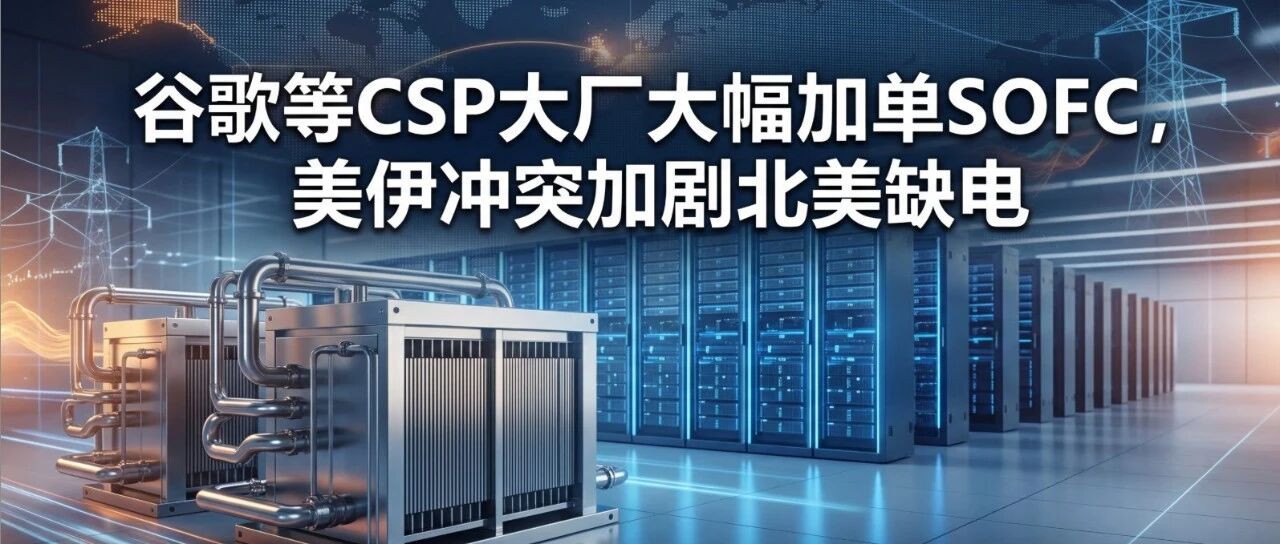
谷歌等CSP大厂大幅加单SOFC,美伊冲突加剧北美缺电
傅里叶的猫· 2026-03-12 12:53
Core Viewpoint - The article discusses the significant power shortage in the U.S. driven by the rapid expansion of data centers and the slow pace of infrastructure development, predicting a power gap of approximately 45 GW by 2028 and potentially 68 GW by 2029 [2][4]. Group 1: Power Shortage Dynamics - The power shortage in the U.S. is not just a challenge of energy quantity but also a competition for "Time to Power," with new data centers facing delays of up to 5 years due to labor shortages and regulatory processes [4]. - The ongoing U.S.-Iran conflict has disrupted LNG exports, affecting global supply and leading to increased competition for North American resources, which may raise wholesale electricity prices in gas-dominated regions [5]. Group 2: Solutions to Power Shortage - The market is shifting towards "stock game" strategies to address the power gap, as new grid construction is lagging behind demand [6]. - The self-generation (BYOG) model is emerging as a key solution for AI data centers, allowing for faster deployment and reduced reliance on public grids, cutting the setup time from nearly 5 years to just a few months [7]. Group 3: Bloom Energy's Role - Bloom Energy's solid oxide fuel cell (SOFC) technology aligns well with the BYOG model, offering rapid deployment and compliance advantages, with delivery times of 3-4 months [8]. - Bloom Energy holds a dominant market share in the SOFC sector, with 75%-85% of the global market and 65% in the data center backup power segment, positioning it as a critical provider for addressing power shortages [10]. Group 4: Orders and Capacity - Bloom Energy's total backlog reached $20 billion by the end of 2025, a 65% increase from 2024, indicating strong future performance [10]. - The company has secured significant contracts, including a $5 billion partnership with Brookfield for AI infrastructure and a $2.65 billion order from AEP for Amazon's power needs [10][11]. Group 5: Supply Chain Insights - Key suppliers for Bloom Energy include Chunhui Instrument, which provides temperature sensors, and Sanhuan Group, which supplies SOFC membrane materials, both of which are expected to benefit from the growing demand for SOFC systems [14][15].
北交所半月报:北交所公司业绩快报全部发布,北证50公布新一轮调整方案-20260312
ZHONGTAI SECURITIES· 2026-03-12 11:29
Investment Rating - The industry investment rating is maintained at "Overweight" [2][33] Core Insights - The report highlights that as of March 1, 2026, the average market capitalization of the 296 constituent stocks in the North Exchange is 3.184 billion yuan, with the North 50 index, Shanghai and Shenzhen 300, ChiNext, and Sci-Tech 50 showing respective changes of +0.48%, +1.08%, +1.05%, and +1.20% during the reporting period [6][12] - The top five performing sectors in the North Exchange during this period are Oil and Petrochemicals (+21.79%), Environmental Protection (+7.97%), Transportation (+6.08%), Building Materials (+3.68%), and Nonferrous Metals (+3.13%) [21] - A total of 295 stocks were listed on the North Exchange, with 193 stocks rising, 96 falling, and 6 remaining flat, resulting in a rise ratio of 66.78% [23] Summary by Sections North Exchange Market Overview - As of March 1, 2026, the North Exchange has 296 constituent stocks with an average market capitalization of 3.184 billion yuan. The performance of major indices during the period from February 16 to March 1, 2026, is as follows: North 50 (+0.48%), Shanghai and Shenzhen 300 (+1.08%), ChiNext (+1.05%), and Sci-Tech 50 (+1.20%) [6][12] - The average daily trading volume for North A-shares during this period was 18 billion yuan, a decrease of 8.06% from the previous period [16] New Stocks on the North Exchange - Two new stocks were issued during this period: Haifeiman (920183) and Mirui Technology (920036) [27] Key News from the North Exchange - By February 27, 2026, all 295 companies on the North Exchange had released their 2025 annual performance reports. Of these, 187 companies achieved positive revenue growth, accounting for approximately 63%, with 29 companies experiencing revenue growth exceeding 30%. Additionally, 140 companies reported positive growth or reduced losses in net profit attributable to the parent company, representing about 47% [31] - The new adjustment plan for the North 50 index was announced, with companies such as Guangxin Technology, Tiangong Co., and Jikang Technology being added, effective from March 16 [31] Investment Strategy for the North Exchange - The report expresses optimism for the high-quality development of the North Exchange in 2026, suggesting a focus on sectors such as Data Centers, Robotics, Semiconductors, Consumer Goods, and Military Information Technology [29][32]