地缘政治风险

Search documents
三轮黄金上涨周期复盘,黄金如何定价?
Hua Er Jie Jian Wen· 2025-11-19 13:56
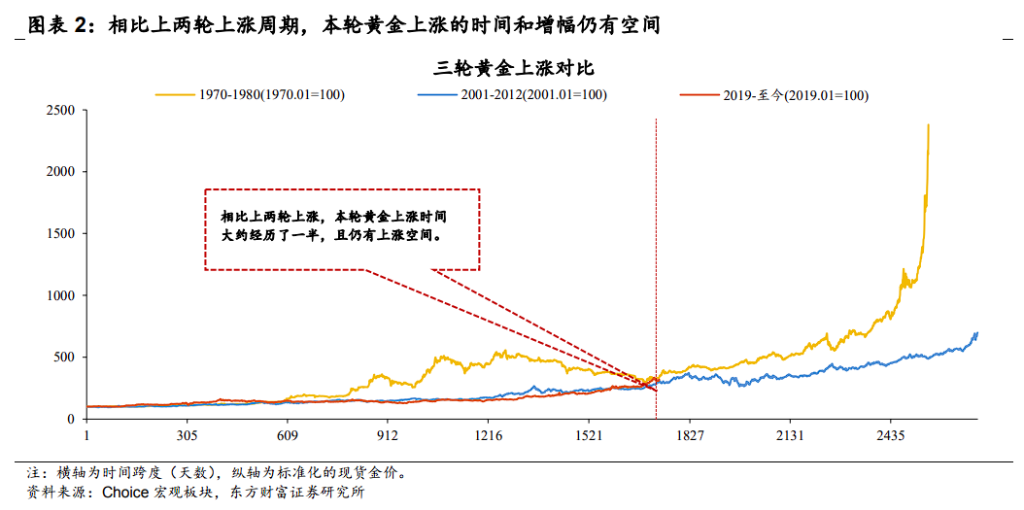
Core Viewpoint - The current gold price uptrend, which began in 2019, has lasted for six years with a cumulative increase of 219%, raising market concerns about future price movements [1][2]. Group 1: Historical Context - Gold has experienced three major uptrends since 1968, with the first from 1970 to 1980 (highest increase of 2323%) and the second from 2001 to 2012 (highest increase of 599%) [2]. - The current uptrend, starting in 2019, has shown a cumulative increase of 219% over six years, which is shorter in duration compared to previous cycles [3]. Group 2: Monetary Attributes - The dollar has depreciated nearly 100% against gold since 1970, with a 35% decline in 2025 alone, driven by increasing fiscal deficits and monetary supply [9]. - The relationship between the dollar index and gold prices has been negative, with the dollar index dropping nearly 10 percentage points since 2025, benefiting gold prices [9]. - Economic and political uncertainties have increased the U.S. economic policy uncertainty index significantly since early 2025, impacting the dollar's credibility [11]. Group 3: Commodity Attributes - Central bank gold purchases have surged from 255 tons in 2020 to 1089 tons in 2024, with an average annual growth rate of 44%, increasing their share of total demand from 5% to 22% [15]. - Jewelry demand has decreased from approximately 50% before 2020 to 32% in the first three quarters of 2025, indicating a shift in demand dynamics [15]. - Global gold reserves have increased significantly, with European countries showing high reserve ratios, contributing to upward pressure on gold prices [15]. Group 4: Financial Attributes - The traditional negative correlation between real interest rates and gold prices has weakened since 2021, as high inflation distorts real interest rates and enhances gold's anti-inflation properties [22]. - Real interest rates have increased by 213% during the current cycle, contrasting with previous cycles where they remained near zero or negative [38]. - The ratio of the S&P 500 to gold prices is approaching historical averages, suggesting that gold may be fully valued relative to equities, yet still has room for growth compared to previous cycles [22]. Group 5: Key Variables for Future Price Movements - The report identifies three critical variables that will influence future gold prices: geopolitical risks, growth in gold reserves, and changes in real interest rates [25][32]. - The geopolitical risk index has risen by 72% since 2019, reflecting heightened global tensions due to events like the COVID-19 pandemic and the Russia-Ukraine conflict [28][31]. - Global gold reserves have increased by 167% during the current cycle, a significant rise compared to previous periods, indicating a strategic shift among central banks [35].

德意志银行:卖压释放,黄金向上冲
Sou Hu Cai Jing· 2025-11-19 09:00
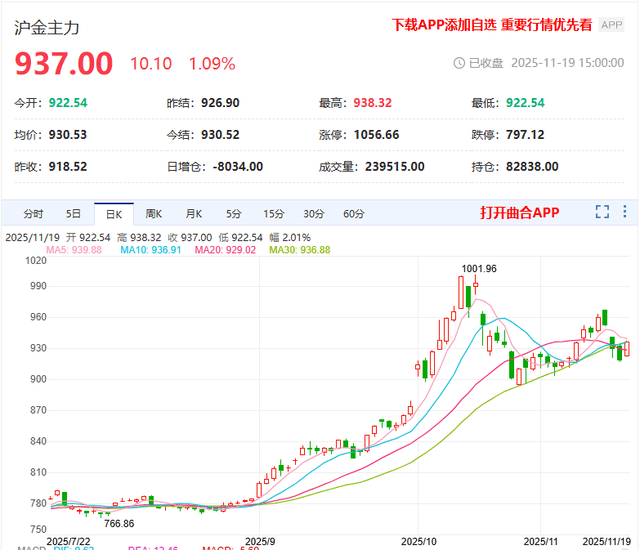
Group 1 - The recent sell-off of gold ETFs in developed markets is nearing its end, with 86% of the total sell-off from April to May already released in the past 8 trading days [1] - On October 27, the most significant sell-off occurred, with a reduction of 449,000 troy ounces, following a four-day period of the largest daily price drop, indicating that the price drop triggered ETF outflows rather than the other way around [1] - Gold prices have shown resilience, maintaining above the key support level of $3,900 per ounce despite hawkish signals from the Federal Reserve regarding potential interest rate hikes in December [1] Group 2 - Short-term market volatility risks are present, with the current one-month gold volatility significantly exceeding implied volatility, creating a gap of -12.6, the largest since March 2020 [1] - Historical trends suggest that such volatility gaps typically narrow to normal levels within 2-3 months, with fundamental factors expected to support a recovery in gold prices by year-end [1] - The Shanghai gold price increased by 1.09%, closing at 937 yuan per gram [3] Group 3 - The U.S. economy and job market are facing challenges from government shutdowns and trade tensions, while the Federal Reserve's internal divisions and hawkish signals add to short-term policy uncertainty [4] - Increased central bank purchases of gold and a shift in asset pricing strategies are expected to drive precious metals towards a bull market similar to the 1970s in the medium to long term [4] - Short-term international gold is expected to exhibit wide fluctuations, with buying opportunities if prices drop below $3,900 [5]
亚洲最惨!印度外资疯狂出逃,中国凭啥成资本避风港?
Sou Hu Cai Jing· 2025-11-19 06:37
Group 1 - The Indian stock market is experiencing a significant capital outflow, with foreign investors withdrawing over $17 billion, marking a new low compared to a net inflow of $20 billion during the same period last year [2][4] - Major funds from the US, Luxembourg, and Japan are leading the withdrawal, indicating a lack of confidence in the Indian market [4][5] - The geopolitical landscape has shifted, diminishing India's appeal as a "balancer" in the US-China rivalry, which previously attracted capital [8][10] Group 2 - India's attempts to balance relations between the US and Russia have backfired, leading to increased tariffs from the US and cautious behavior from China [10][11] - Foreign investors have faced an unfriendly environment in India, with companies like Xiaomi and Vodafone suffering significant financial losses due to changing tax policies and administrative barriers [13][14] - India's ranking in the World Bank's business environment report has consistently been below 130, highlighting the challenges in attracting foreign investment [16] Group 3 - In contrast, China is becoming increasingly attractive to foreign capital due to its market stability and robust economic performance, despite ongoing US pressure [18][21] - The complete industrial chain in China, from raw materials to assembly, provides a competitive advantage that is difficult for other countries to replicate [18] - The easing of US-China relations has further boosted investor confidence in China, leading to increased foreign investments from companies like Tesla and Apple [19][24] Group 4 - India's current situation serves as a warning, emphasizing the need for improvements in the business environment and a clear diplomatic stance to attract foreign investment [26][28] - The global investment landscape will continue to evolve, but stability and strong economic fundamentals will remain crucial for retaining capital [28]

贵金属日评:ADP周度新增就业人数为负支撑贵金属价格-20251119
Hong Yuan Qi Huo· 2025-11-19 02:48
1. Report Industry Investment Rating No relevant information provided. 2. Core View of the Report The negative weekly new employment figures from the US ADP private - sector, upcoming US economic data, Japan's economic stimulus plan, the weakening of digital currency prices, global debt expansion, fiscal deficit expectations, and geopolitical risks may support the rebound of precious metal prices in the short - term and provide medium - to long - term support [1]. 3. Summary by Relevant Catalogs 3.1 Precious Metal Market Data - **Shanghai Gold**: The closing price was 930.22 yuan/gram, with a change of - 28.76 yuan compared to the previous period. The trading volume was - 22,326.00, and the inventory was 90,426.00 (in ten - gram units) [1]. - **Shanghai Silver**: The closing price was 11,697.00 yuan/ten - gram, with a change of - 273.00 yuan. The trading volume was 623,148.00, and the inventory was 563,671.00 (in ten - gram units) [1]. - **COMEX International Gold**: The closing price of the active contract was 4067.40 dollars/ounce, with a change of 22.30 dollars. The trading volume was 231,322.00, and the inventory was 37,224,744.19 (in troy ounces) [1]. - **COMEX International Silver**: The closing price of the active contract was 50.54 dollars/ounce, with a change of 0.13 dollars. The trading volume was 75,851.00, and the inventory was 465,535,121.46 (in troy ounces) [1]. 3.2 Important Information - The number of initial jobless claims in the US for the week ending October 18 was 232,000. The average weekly reduction in private - sector employment in the US for the four - week period ending November 1 was 2,500 [1]. - Trump has selected candidates for the Fed chair, and the US Treasury Secretary said the candidates have been narrowed down to five [1]. 3.3 Long - Short Logic - The negative weekly new employment figures from the US ADP private - sector, the uncertainty of future expectations due to upcoming US economic data, Japan's economic stimulus plan, and the weakening of digital currency prices may lead to a rebound in precious metal prices [1]. - Global debt expansion, fiscal deficit expectations, and geopolitical risks will support precious metal prices in the medium - to long - term [1]. 3.4 Trading Strategy - In the short - term, lightly go long on the main contracts at low prices. For London gold, pay attention to the support level around 3850 - 3950 and the resistance level around 4180 - 4384. For Shanghai gold, focus on the support level around 870 - 890 and the resistance level around 960 - 1000. For London silver, note the support level around 38 - 45 and the resistance level around 52 - 55. For Shanghai silver, pay attention to the support level around 10,000 - 11,000 and the resistance level around 12,400 - 13,000 [1].
大越期货燃料油早报-20251119
Da Yue Qi Huo· 2025-11-19 02:31
Report Summary 1. Report Industry Investment Rating - No specific industry investment rating is provided in the report. 2. Core Viewpoints - The overall oil price is oscillating, with geopolitical risks providing support. The fundamentals of high - sulfur fuel oil are slightly boosted, but the high - low sulfur price spread remains high and is expected to take time to narrow. FU2601 is expected to run strongly in the range of 2540 - 2590, and LU2601 in the range of 3220 - 3280 [3]. 3. Summary by Directory 3.1 Daily Tips - **Fundamentals**: High - sulfur fuel oil is supported by strong downstream marine fuel demand, with stable buying interest this week. Some low - sulfur fuel oil is sent to China, and refineries are buying high - sulfur fuel oil as raw materials. The spot spread of Singapore's 0.5% sulfur marine fuel has turned positive for the first time in six weeks [3]. - **Basis**: Singapore high - sulfur fuel oil is at 347.77 dollars/ton with a basis of 0 dollars/ton, and low - sulfur fuel oil is at 448.05 dollars/ton with a basis of 24 dollars/ton, indicating a flat cash - futures relationship [3]. - **Inventory**: Singapore's fuel oil inventory in the week of November 12 was 2087.9 million barrels, a decrease of 19 million barrels [3]. - **Market**: Prices are below the 20 - day line, and the 20 - day line is flat [3]. - **Main Positions**: High - sulfur main positions are short, with short positions increasing; low - sulfur main positions are short, changing from long to short [3]. 3.2 Long - Short Concerns - **Positive Factors**: Russian fuel oil export restrictions and the cancellation of US - Russia talks along with sanctions on Russian oil - related enterprises [4]. - **Negative Factors**: The optimism on the demand side remains to be verified, and the upstream crude oil is under pressure [4]. 3.3 Fundamental Data - The high - sulfur fuel oil market is supported by strong downstream demand, and some low - sulfur fuel oil is sent to China. Refineries are also purchasing high - sulfur fuel oil as raw materials. The spot spread of Singapore's 0.5% sulfur marine fuel has turned positive [3]. 3.4 Spread Data - No specific spread data analysis is provided other than the basis information mentioned above. 3.5 Inventory Data - Singapore's fuel oil inventory in the week of November 12 was 2087.9 million barrels, a decrease of 19 million barrels. Historical inventory data from September 3 to November 12 are also provided [3][8].
FICC日报:TMT板块反弹-20251119
Hua Tai Qi Huo· 2025-11-19 02:31
FICC日报 | 2025-11-19 TMT板块反弹 市场分析 青年失业率较高。国内方面,国家统计局公布数据,10月份,不包含在校生,全国城镇16-24岁劳动力失业率为17.3%, 25-29岁劳动力失业率为7.2%,30-59岁劳动力失业率为3.8%。对外关系方面,外交部亚洲司司长刘劲松同日本外务 省亚大局局长金井正彰举行磋商,磋商结束后,刘劲松回应相关问题时表示对磋商结果不满意,并称双方会面时 气氛严肃。海外方面,ADP就业数据显示,截至11月1日的四周,美国私营部门就业人数平均每周减少2500人。另 外,美国劳工部数据显示,截至10月18日当周,美国初请失业金人数23.2万人,续请失业金人数小幅上升至195.7 万人。 股指回调。现货市场,A股三大指数震荡走低,沪指跌0.81%收于3939.81点,创业板指跌1.16%。行业方面,板块 指数跌多涨少,仅传媒、计算机、电子、食品饮料收红,煤炭、电力设备、钢铁、有色金属行业跌幅居前。当日 沪深两市成交额保持在1.9万亿元。海外方面,美国三大股指全线收跌,纳指跌1.21%报22432.85点。 IF继续增仓。期货市场,基差方面,IF、IC、IM基差回升。成交 ...
多位美联储官员放鹰使贵金属价格承压:贵金属日评20251118-20251119
Hong Yuan Qi Huo· 2025-11-19 01:48
1. Report Industry Investment Rating No relevant content provided. 2. Core Viewpoints - Multiple Fed officials' hawkish remarks have put pressure on precious metal prices. The probability of a Fed rate cut in December has dropped below 40%. Short - term precious metal prices may adjust due to upcoming US economic data and uncertain future expectations. However, factors such as global debt expansion, fiscal deficit growth, continuous gold purchases by central banks, and geopolitical risks may support precious metal prices in the medium - to - long term [1]. 3. Summary by Related Content Precious Metal Market Data - **Shanghai Gold**: The closing price of the futures active contract was 929.46 yuan/gram on 2025 - 11 - 18, down 23.74 yuan from the previous week. The trading volume was 307,687.00, and the open interest was 101,723.00, down 29,322.00 from the previous week. The closing price of spot Shanghai gold T + D was 930.22 yuan/gram, down 16.28 yuan from the previous week. The trading volume was 82,068.00, and the open interest was 232,228.00, down 946.00 from the previous week [1]. - **Shanghai Silver**: The closing price of the futures active contract was 11,933.00 yuan/ten - gram on 2025 - 11 - 18, down 418.00 yuan from the previous week. The trading volume was 1,026,209.00, and the open interest was 233,702.00. The closing price of spot Shanghai silver T + D was 11,970.00 yuan/ten - gram, down 356.00 yuan from the previous week. The trading volume was 759,026.00, and the open interest was 51,236.00 [1]. - **COMEX International Gold**: The closing price of the futures active contract was 4045.10 US dollars/ounce on 2025 - 11 - 18, down 39.30 US dollars from the previous day. The trading volume was 231,322.00, and the open interest was - 12,222.00. The London gold spot price was 4071.10 US dollars/ounce. The SPDR gold ETF holding was 1041.43 tons, down 2.57 tons from the previous week [1]. - **COMEX International Silver**: The closing price of the futures active contract was 50.05 US dollars/ounce on 2025 - 11 - 18, down 0.35 US dollars from the previous day. The trading volume was 11,693.00, and the open interest was 70,253.00. The London silver spot price was 52.01 US dollars/ounce [1]. Important Information - Trump's chief economic advisor Hasset said that AI - driven productivity gains may lead to a "quiet period" in the job market, and the Fed should be truly "data - driven" [1]. - Fed Chair candidate Waller supports a December rate cut, while Fed Vice - Chair Jefferson emphasizes a slow - paced policy approach [1]. Trading Strategy - Wait for price pull - backs to enter long positions. For London gold, pay attention to support levels around 3850 - 3950 and resistance levels around 4180 - 4384. For Shanghai gold, focus on support around 870 - 890 and resistance around 960 - 1000. For London silver, watch support around 38 - 45 and resistance around 52 - 55. For Shanghai silver, look at support around 10000 - 11000 and resistance around 12400 - 13000 [1].
山金期货贵金属策略报告-20251118
Shan Jin Qi Huo· 2025-11-18 14:13
Report Industry Investment Rating No relevant content provided. Core Views of the Report - Today, precious metals fluctuated downward, with the main contract of Shanghai Gold closing down 1.33% and the main contract of Shanghai Silver closing down 2.54%. The short - term safe - haven factor: the negative impact of the China - US talks has been realized, but geopolitical risks still exist; the US employment is weakening and inflation is moderate, Fed officials are hawkish, and the expectation of interest rate cuts has been adjusted back. The safe - haven attribute: the results and consensus of the China - US economic and trade consultations have been announced, and geopolitical risks in regions such as Russia - Ukraine and the Middle East still exist. The monetary attribute: more Fed policymakers have hinted at caution regarding a December interest rate cut. The market is waiting for more economic data, and the probability of a 25 - basis - point interest rate cut by the Fed in December remains below 50%. The US dollar index and US Treasury yields are facing resistance on the downside and are relatively strong. The commodity attribute: the CRB commodity index fluctuates weakly, and the depreciation of the RMB is beneficial to domestic prices. It is expected that precious metals will fluctuate weakly in the short term, oscillate at a high level in the medium term, and rise step - by - step in the long term. The price trend of gold is the anchor for the price of silver. In terms of capital, the net long position of CFTC silver and the iShare silver ETF have slightly increased their positions. In terms of inventory, the recent visible inventory of silver has slightly decreased [1][5]. Summary by Relevant Catalogs Gold - **Strategy**: Conservative investors should wait and see, while aggressive investors can buy low and sell high. It is recommended to manage positions well and set strict stop - loss and take - profit levels [2]. - **Gold - related Data**: - **International Prices**: The closing price of the Comex gold main contract was $4045.10 per ounce, down $39.30 (-0.96%) from the previous day and down $78.30 (-1.90%) from the previous week. The price of London gold was $4072.50 per ounce, up $1.40 (0.03%) from the previous day and down $17.75 (-0.43%) from the previous week. - **Domestic Prices**: The closing price of the Shanghai Gold main contract was 918.52 yuan per gram, down 10.94 yuan (-1.18%) from the previous day and down 30.36 yuan (-3.20%) from the previous week. The closing price of Gold T + D was 915.55 yuan per gram, down 14.67 yuan (-1.58%) from the previous day and down 30.95 yuan (-3.27%) from the previous week. - **Basis, Spread, and Ratio**: The difference between the Shanghai Gold main contract and London gold was - 8.57 yuan per gram, with a significant change compared to the previous day and week. The gold - to - silver ratio (London gold/London silver) was 79.77, up 1.88 (2.42%) from the previous day and down 1.97 (-2.41%) from the previous week. - **Positions**: The position of Comex gold was 528,789 lots (100 ounces per lot), unchanged from the previous day and week. The position of the Shanghai Gold main contract was 90,872 lots (kilograms per lot), down 10,851 lots (-10.67%) from the previous day and down 40,173 lots (-30.66%) from the previous week. - **Inventory**: The LBMA inventory was 8,598 tons, unchanged. The Comex gold inventory was 1,152 tons, down 13 tons (-1.08%) from the previous week. The Shanghai Gold inventory was 18 tons, with a small change compared to the previous day and week [2]. - **Top 10 Net Positions of Futures Companies in Shanghai Gold on the Shanghai Futures Exchange**: The net long positions of the top 5, 10, and 20 companies had different changes compared to the previous day, with the top 10 net long positions totaling 91,567.00, down 2,014.00 (27.40%). The net short positions of the top 10 companies also had corresponding changes, with the top 10 net short positions totaling 18,604.00, up 251.00 (5.57%) [3]. Silver - **Strategy**: Similar to gold, conservative investors should wait and see, while aggressive investors can buy low and sell high. Position management and strict stop - loss and take - profit are recommended [6]. - **Silver - related Data**: - **International Prices**: The closing price of the Comex silver main contract was $50.05 per ounce, down $0.35 (-0.69%) from the previous day and down $0.36 (-0.70%) from the previous week. The price of London silver was $51.06 per ounce, down $0.95 (-1.84%) from the previous day and up $1.02 (2.03%) from the previous week. - **Domestic Prices**: The closing price of the Shanghai Silver main contract was 11,699.00 yuan per kilogram, down 234.00 yuan (-1.96%) from the previous day and down 181.00 yuan (-1.52%) from the previous week. The closing price of Silver T + D was 11,697.00 yuan per kilogram, down 273.00 yuan (-2.28%) from the previous day and down 168.00 yuan (-1.42%) from the previous week. - **Basis and Spread**: The difference between the Shanghai Silver main contract and London silver was 35.30 yuan per gram, with a significant change compared to the previous day and week. - **Positions**: The position of Comex silver was 165,805 lots (5000 ounces per lot), unchanged from the previous day and week. The position of the Shanghai Silver main contract was 4,836,015 lots (kilograms per lot), up 163,290 lots (3.49%) from the previous day and up 768,660 lots (18.90%) from the previous week. - **Inventory**: The total visible inventory was 42,209 tons, down 191 tons (-0.45%) from the previous day and down 391 tons (-0.92%) from the previous week [6]. - **Top 10 Net Positions of Futures Companies in Shanghai Silver on the Shanghai Futures Exchange**: The net long positions of the top 5, 10, and 20 companies had different changes compared to the previous day. The net short positions of the top 10 companies also had corresponding changes, with the top 10 net short positions totaling 55,928.00, up 3,493.00 (7.77%) [7]. Fundamental Key Data - **Monetary Attribute - Related Data**: The upper limit of the federal funds target rate was 4.00%, the discount rate was 4.00%, and the reserve balance interest rate (IORB) was 3.90%. The total assets of the Fed were $6,631.098 billion, up $74.55 (0.00%) from the previous week. The year - on - year growth rate of M2 was 4.49%, up 0.07 percentage points. The real yield of the 10 - year US Treasury was 2.42%, up 0.02 (0.83%) from the previous day and week. The US dollar index was 99.53, up 0.25 (0.25%) from the previous day and down 0.09 (-0.09%) from the previous week. The yield spread between 3 - month and 10 - year US Treasuries was 0.37, up 0.04 (12.12%) from the previous day and down 0.01 (-2.78%) from the previous week [8]. - **Other Key Indicators**: - **Inflation**: The year - on - year CPI was 3.00%, and the month - on - month CPI was 0.30%. The year - on - year core CPI was 3.00%, and the month - on - month core CPI was 0.30%. - **Economic Growth**: The annualized year - on - year GDP growth rate was 2.00%, down 0.30 percentage points. The annualized quarter - on - quarter GDP growth rate was 3.80%, up 4.40 percentage points. - **Labor Market**: The unemployment rate was 4.30%, up 0.10 percentage points. The monthly change in non - farm payrolls was 2.20 million, down 0.57 million. - **Real Estate Market**: The NAHB housing market index was 37.00, up 5.00 (15.63%). The existing home sales were 4.06 million units, up 5.00 (1.25%). The new home sales were 0.66 million units, up 0.10 million (15.15%). - **Consumption**: The year - on - year growth rate of retail sales was 3.76%, down 0.26 percentage points. The month - on - month growth rate of retail sales was 0.72%, down 0.27 percentage points. - **Industry**: The year - on - year growth rate of the industrial production index was 0.87%, down 0.39 percentage points. The month - on - month growth rate of the industrial production index was 0.10%, up 0.47 percentage points. - **Trade**: The year - on - year growth rate of exports was - 25.17%, up 1.86 percentage points. The month - on - month growth rate of exports was 1.79%, down 6.77 percentage points. - **Central Bank Gold Reserves**: China's central bank gold reserves were 2304.46 tons, up 2.18 tons (0.09%). The US central bank gold reserves were 8133.46 tons, unchanged. - **IMF Foreign Exchange Reserves**: The proportion of the US dollar was 57.80%, up 0.51 percentage points. The proportion of the euro was 19.83%, down 0.20 percentage points. The proportion of the RMB was 2.18%, down 0.00 percentage points. - **Safe - haven and Commodity Attributes**: The geopolitical risk index was 90.76, down 7.64 (-7.76%) from the previous day and down 2.12 (-2.28%) from the previous week. The VIX index was 22.38, up 2.55 (12.86%) from the previous day and up 4.78 (27.16%) from the previous week. The CRB commodity index was 301.64, down 0.71 (-0.23%) from the previous day and down 5.41 (-1.76%) from the previous week [10][12]. - **Fed's Latest Interest Rate Expectations**: The probability of different interest rate ranges at each Fed meeting from December 2025 to October 2027 is given, showing the market's expectations for the Fed's interest rate adjustments [13].
贵金属日评-20251118
Jian Xin Qi Huo· 2025-11-18 11:58
研究员:黄雯昕(国债集运) 021-60635739 huangwenxin@ccb.ccbfutures.com 期货从业资格号:F3051589 研究员:聂嘉怡(股指) 021-60635735 niejiayi@ccb.ccbfutures.com 期货从业资格号:F03124070 行业 贵金属日评 日期 2025 年 11 月 18 日 宏观金融团队 研究员:何卓乔(宏观贵金属) 021-60635739 hezhuoqiao@ccb.ccbfutures.com 期货从业资格号:F3008762 请阅读正文后的声明 每日报告 一、贵金属行情及展望 日内行情: 上周在伦敦黄金反弹至 4245 美元/盎司和伦敦白银接近历史记录之后,美联 储官员表态鹰派抑制了美联储降息预期,美元汇率获得提振而金银价格随之回落; 我们判断短期内美联储放缓降息步伐甚至暂停降息、中美贸易形势边际缓和等利 空因素,与地缘政治风险上升和国际贸易货币体系加速重组等利多因素相平衡, 伦敦黄金需要在 3880-4380 美元/盎司的波动区间内运行更长时间以积累再次突 破动能,目前阶段不宜过度追涨杀跌。但在中期维度,环球央行宽松、地缘政 ...
日经指数暴跌3%:全球资本为何集体“出逃”?
Sou Hu Cai Jing· 2025-11-18 10:59
Group 1 - The Nikkei 225 index experienced a significant drop of 3.93%, marking the largest single-day decline of the year, falling below the 17,000-point threshold [3] - The semiconductor sector was heavily impacted, with major companies like Tokyo Electron seeing stock prices plummet nearly 8%, following TSMC's downward revision of its 2024 semiconductor growth forecast [3] - A widespread sell-off occurred across all 33 industry sectors on the Tokyo Stock Exchange, indicating a rare and comprehensive market collapse [3] Group 2 - Other Asian markets also faced severe declines, with the South Korean Composite Index down 1.9%, the Hong Kong Hang Seng Index down 1.4%, and the Singapore Straits Times Index down 1.2%, highlighting a systemic decline in investor risk appetite across the region [4] - The depreciation of the yen against the dollar, which fell below 144, further pressured export-oriented companies, illustrating the dual impact of currency fluctuations on market performance [3][4] - Geopolitical risks, including ongoing tensions in the Middle East and the Russia-Ukraine conflict, have significantly undermined investor confidence, prompting a retreat from emerging markets to safer assets [5] Group 3 - Recent hawkish signals from multiple Federal Reserve officials regarding potential delays in interest rate cuts or even a resumption of rate hikes have contributed to market volatility and tightened global liquidity expectations [6] - The overall bleak outlook for the global economy, exacerbated by trade tensions and sluggish growth in major economies, is shaking long-term market confidence [6] - These factors are interlinked, creating a vicious cycle where geopolitical risks raise oil prices, increasing inflationary pressures, which in turn limit central bank policy options and hinder economic recovery [6]