
货币政策

Search documents
锰硅周报:密集宏观事件落地,虽未有超预期增量政策,但建议偏乐观看待-20251213
Wu Kuang Qi Huo· 2025-12-13 12:59
密集宏观事件落地,虽未有超预期 增量政策,但建议偏乐观看待 0755-23375161 chenzy@wkqh.cn 从业资格号:F03098415 交易咨询号:Z0020771 陈张滢(黑色建材组) 锰硅周报 2025/12/13 CONTENTS 目录 01 周度评估及策略推荐 04 供给及需求 02 期现市场 05 库存 03 利润及成本 06 图形走势 产业链示意图 01 周度评估及策略推荐 周度要点小结 ◆ 天津6517锰硅现货市场报价5700元/吨,环比-20元/吨;期货主力(SM603)收盘报5730元/吨,环比-28元/吨;基差160元/吨,环比+8元/吨, 基差率2.74%,处于历史统计值的偏高水平。 ◆ 利润:锰硅测算即期利润(不含折旧等费用)维持低位,内蒙-551元/吨,环比+27元/吨;宁夏-707元/吨,环比-42元/吨;广西-671元/吨, 环比+76元/吨。(利润为测算值,仅供参考) ◆ 成本:测算内蒙锰硅即期成本(不含折旧等费用)在6071元/吨,环比-37元/吨;宁夏在6187元/吨,环比+2元/吨;广西在6271元/吨,环比- 26元/吨。(成本为测算值,仅供参考) ◆ 供 ...
2025年中央经济工作会议学习心得:挖掘潜能,苦练内功
Changjiang Securities· 2025-12-13 09:15
Group 1: Economic Policy Directions - The meeting proposed five new "musts," which are an iteration of last year's five "musts," reflecting a deeper understanding of economic work[16] - Fiscal policy continues to be described as "more proactive," focusing on improving fiscal revenue, maintaining debt intensity, and optimizing expenditure structure[18] - Monetary policy remains "appropriately loose," with an emphasis on policy effectiveness, balancing between broad money supply and credit[22] Group 2: Key Economic Tasks - Expanding domestic demand remains the top priority, with expectations for a "rural and urban resident income increase plan" and efforts to stabilize investment[24] - Risk prevention in key areas, particularly in real estate, focuses on stabilizing housing prices and improving supply-demand dynamics, with "deepening housing fund system reform" as a major highlight for next year[28]
6000亿元买断式逆回购,央行出手!
Sou Hu Cai Jing· 2025-12-13 08:37
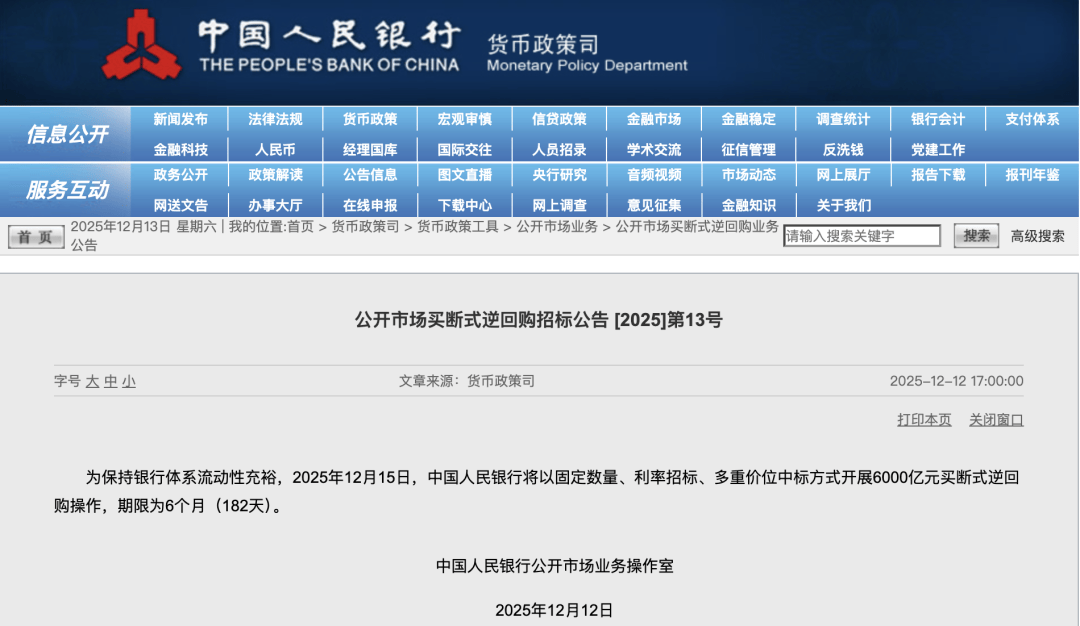
本文转自【人民网】; 中国人民银行(以下简称"央行")公告表示,为保持银行体系流动性充裕,2025年12月15日,央行将以固定数量、利率招标、多重价位中标方式开展6000 亿元买断式逆回购操作,期限为6个月(182天)。 | | | | 中国人民银行 THE PEOPLE'S BANK OF CHINA | | 货币政策司 Monetary Policy Department | | | | | | | --- | --- | --- | --- | --- | --- | --- | --- | --- | --- | --- | | 信息公开 | 新闻发布 | 法律法规 | 货币政策 | 宏观审慎 | 信贷政策 | 金融市场 | 金融稳定 | 调查统计 | 银行会计 | 支付体系 | | | 金融科技 | 人民币 | 经理国库 | 国际交往 | 人员招录 | 学术交流 | 征信管理 | 反洗钱 | 党建工作 | | | 服务互动 | 政务公开 | 政策解读 | 公告信息 | 图文直播 | 央行研究 | 音频视频 | 市场动态 | 网上展厅 | 报告下载 | 报刊年鉴 | | | 网送文告 | 办事大厅 | ...

25年11月金融数据:社融改善,信贷和存款仍有待修复
Ping An Securities· 2025-12-13 07:22
11月新增社融约2.5万亿,同比小幅多增1597亿元,对应单月社融增 速持平于8.5%。结构上,少增部分主要是政府债和信贷,政府债少 增1048亿元,其次是人民币贷款同比少增1163亿元。其他方面多同 比多增,其中:企业债券受益于科创债延续多增以及债贷相对性价 比的提升(1YLPR-1YAA+中短票收益率之差10-11月整体上升), 实现同比多增1788亿元;非标融资在低基数下同比多增1328亿元, 人民币升值背景下外币贷款同比多增246亿元。 25年11月金融数据:社融改善,信贷和存款仍 有待修复 2025年12月13日 事项:2025年12月12日,央行发布25年11月金融数据,新增社融 24885亿,同比多增1597亿元,高于wind市场预期的2.02万亿;信贷 口径,新增人民币贷款3900亿元,同比少增1900亿元,较市场预期 低1143亿元。 1 社融同比多增,主要是非标融资+企业债券多增贡献 3 存款活化趋势+流失压力,M1-M2剪刀差回落,存款结构上回落 分布相对均衡 M1、M2增速延续回落,M1-M2增速剪刀差下降。10月基数效应消退 后,M1增速重新回到回落区间,11月M1增速进一步回落1. ...
事关明年经济!韩文秀、肖渭明、王一鸣,重磅发声
Zhong Guo Zheng Quan Bao· 2025-12-13 06:46
出台实施增量政策 韩文秀:明年还将根据形势变化 12月13日,2025-2026中国经济年会召开,主题为"贯彻落实中央经济工作会议精神,以高质量发展 为'十五五'开好局"。中央财办分管日常工作的副主任、中央农办主任韩文秀,国家发展改革委副秘书 长肖渭明,中国国际经济交流中心副理事长王一鸣发表演讲。 韩文秀表示,做好明年经济工作,要坚持稳中求进,提质增效,加大逆周期和跨周期调节,切实提升宏 观经济治理效能。去年9月26日中央政治局会议以来,先后出台实施了一系列政策措施,明年还将根据 形势变化出台实施增量政策。要协同发挥存量政策和增量政策的集成效应,推动经济稳中向好。市场经 济很大程度上是预期经济,要健全预期管理机制,做好经济宣传和舆论引导,及时回应市场关切,有效 提振社会信心。 要深入扩大高水平对外开放,进一步拓展中间品贸易。培育服务出口新增长点,引导外资更多投向先进 制造、现代服务、高新技术、节能降碳环保的领域,扎实推动共建"一带一路"高质量发展,研究一批扩 大自主开放单边开放的新举措。以海南自贸港全岛封关为契机,不断完善政策制度体系,加快推进区域 和双边贸易投资协定进程,扩大和丰富高标准自由贸易区域网络。 ...
央行公告:将开展6000亿元买断式逆回购操作
Jin Rong Shi Bao· 2025-12-13 03:57
Group 1 - The People's Bank of China (PBOC) will conduct a 600 billion yuan reverse repurchase operation on December 15, 2025, to maintain ample liquidity in the banking system, with a term of 6 months (182 days) [1] - The PBOC's liquidity injection strategy has become consistent, with operations scheduled around the 5th, 15th, and 25th of each month, focusing on 3-month and 6-month reverse repos and Medium-term Lending Facility (MLF) operations [1] - The recent Central Economic Work Conference emphasized the continuation of a moderately accommodative monetary policy, with expectations that the PBOC will utilize various policy tools to ensure liquidity remains abundant [1] Group 2 - The PBOC has established a comprehensive set of liquidity management tools to effectively respond to short-term fluctuations in fiscal revenue and government bond issuance, ensuring overall stability in the money market [2] - Recent innovations in liquidity management include incorporating government bond trading into the monetary policy toolkit and creating two new monetary policy tools to support the capital market, which will enhance the effectiveness of liquidity management [2]
大宗商品“表情”各异:原油创新低,铜金为何“分道扬镳”?
Sou Hu Cai Jing· 2025-12-13 03:06
Core Viewpoint - The global commodity market is experiencing divergent trends, with oil prices hitting a low, copper prices facing significant drops, and gold showing mixed signals, reflecting complex global economic dynamics driven by supply-demand fundamentals, industry logic, and monetary policy [1][3][5]. Oil Market - Oil prices have fallen to their lowest level since May, primarily due to an oversupply situation, with market expectations indicating that global oil supply will exceed demand next year [3]. - High production levels in the U.S. and concerns about economic prospects are suppressing demand expectations, creating fundamental pressure on oil prices [3]. - The approaching holiday season is leading to thin trading volumes, which can amplify price volatility in response to market movements, such as declines in U.S. stock markets [3]. Copper Market - Copper prices dropped by 3%, influenced by a significant decline in U.S. tech stocks, which are seen as a proxy for future demand [3]. - The market has redefined copper as the "AI metal," essential for AI data center construction and grid upgrades, making its pricing sensitive to shifts in tech stock performance [3]. - The recent price drop is viewed as a correction of previous rapid gains, but the long-term narrative surrounding global green transition and electrification remains strong [4]. Gold Market - Gold's price movements are closely tied to market perceptions of Federal Reserve policy, with recent hawkish comments from Fed officials dampening expectations for rapid rate cuts [3]. - Although gold is supported by safe-haven demand, the momentum for significant price increases has weakened, leading to a narrowing of its price gains [3]. - The core rationale for holding gold should focus on hedging against currency credit risks and extreme uncertainties rather than chasing short-term rate cut benefits [4]. Investment Strategy - For oil, the current oversupply situation suggests that it is better suited as an indicator of global demand and economic cycles rather than a long-term investment, with high short-term trading risks [4]. - For copper, the recent adjustment may provide a better entry point for investors who believe in its long-term value, emphasizing the need to distinguish between "bubble" and "value" [4]. - For gold, the current market conditions suggest a phase of high volatility, where maintaining positions for observation is preferable to aggressive buying [4].

金融有力支持经济回升向好
Jing Ji Ri Bao· 2025-12-13 01:20
原标题:金融有力支持经济回升向好 中国人民银行12月12日公布的11月金融统计数据报告显示,广义货币供应量(M_2)和社会融资规 模增速均保持在较高水平;贷款规模保持合理增长,信贷结构持续优化;贷款利率保持在历史低位水 平。 金融总量合理增长有支撑 清华大学国家金融研究院院长田轩表示,中长期来看,贷款增速回落是经济新旧动能转换在金融领 域的反映,一方面是传统领域的信贷需求有所降温,另一方面是新的经济增长点较少依赖银行贷款。旧 的信贷缺口难以被新的信贷需求完全填补,导致当前贷款增速出现趋势性放缓,这也是经济向高质量发 展转型在信贷领域的反映。 宏观政策协同发力 "货币政策和财政政策的协调配合十分重要。今年央行继续综合施策维护资金面平稳,保持流动性 充裕,有力支持了政府债券的顺利发行。"田轩表示,今年以来,我国宏观政策逆周期调节力度加大, 财政政策积极发力,加力支持实体经济效果明显。 在促消费、调结构等方面,财政政策与货币政策也在协同发力。王青认为,今年的消费贷款贴息政 策就是很好的体现。对消费贷款贴息,降低贷款利率是减轻居民融资消费负担的一种方式,既体现了金 融体系的融资支持,也是财政资金对居民消费的投入。 《 ...
央行:灵活高效运用降准降息等多种货币政策工具,把握好政策实施的力度、节奏和时机
Hua Xia Shi Bao· 2025-12-13 01:19
Core Viewpoint - The People's Bank of China emphasizes the continuation of a moderately loose monetary policy and the acceleration of financial supply-side structural reforms to stabilize economic growth and ensure reasonable price recovery [1] Group 1: Monetary Policy - The meeting highlights the importance of using various monetary policy tools such as reserve requirement ratio cuts and interest rate reductions flexibly and efficiently [1] - It stresses maintaining ample liquidity and promoting low financing costs for the real economy [1] - The central bank aims to ensure the basic stability of the RMB exchange rate at a reasonable and balanced level [1] Group 2: Financial Support and Risk Management - The meeting calls for strengthening financial support for key areas such as expanding domestic demand, technological innovation, and small and medium-sized enterprises [1] - It emphasizes the need to prevent and resolve financial risks in key sectors to maintain financial stability [1] - The central bank plans to enhance the central banking system and promote high-level financial openness while ensuring national financial security [1]
2026货币政策定调适度宽松,强调灵活高效降准降息
Sou Hu Cai Jing· 2025-12-13 00:53
Group 1 - The monetary policy for 2026 is set to be "moderately loose," emphasizing "flexible and efficient use of reserve requirement ratio (RRR) and interest rate cuts" alongside "reasonable recovery of prices," shifting the focus from scale expansion to precise regulation and structural optimization [1][2] - The core objectives of the monetary policy now include "promoting reasonable price recovery" alongside "stabilizing economic growth," aiming to alleviate the current structural contradiction of "strong supply and weak demand" [2] - The policy will likely involve 1-2 RRR or interest rate cuts in 2026, with potential reductions of 10-50 basis points, and will emphasize coordination with a more proactive fiscal policy, including an expansion of special bonds and targeted funding towards technology innovation and green industries [3] Group 2 - The central bank's operational logic is shifting from traditional "interest rate cuts to promote inflation" to a focus on supply-side reforms and demand activation, aiming to reduce ineffective production capacity and enhance consumer spending through fiscal measures [4] - The Consumer Price Index (CPI) is expected to moderately rise to a target range of 0.4%-0.6%, while caution is advised regarding market distortions such as "price increases followed by subsidies" [5] Group 3 - External pressures are easing with the Federal Reserve's continuous interest rate cuts, which have reduced the US-China interest rate differential, providing a window for domestic interest rate reductions [6] - The strategy includes expanding exports of "new three items" (new energy vehicles, lithium batteries, etc.) to counteract risks from US tariffs and global supply chain issues, while also focusing on financial safety and optimizing local debt restructuring [7] Group 4 - Financing costs for enterprises are expected to decrease further, particularly benefiting technology and green sectors, while personal mortgage rates are likely to continue their downward trend, alleviating household leverage through policies supporting the acquisition of existing homes [8] - The loose liquidity is expected to support a structural market in A-shares, with a focus on technology (AI, robotics) and cyclical sectors (electricity, chemicals), while the value of national bonds and technology innovation bonds is becoming more prominent, attracting foreign investment in RMB assets [9]