AI产业

Search documents
周周芝道-2026-铜金共振-还是铜金接力
2025-12-29 01:04
Summary of Key Points from Conference Call Industry and Company Overview - The discussion primarily revolves around the Chinese currency (RMB) exchange rate, the copper and gold markets, and the impact of macroeconomic factors on these commodities. Core Insights and Arguments 1. **RMB Exchange Rate Dynamics** - The RMB is unlikely to break the 7 mark in the short term due to the current Chinese economic fundamentals not supporting a stronger currency. The central bank may intervene at critical levels to prevent excessive volatility, particularly around 7.2 and 7.3 [1][3][7] 2. **Seasonal Settlement Impact** - Seasonal currency settlements significantly influence the RMB exchange rate, particularly at year-end and year-beginning, which can lead to short-term appreciation but do not alter the long-term trend [1][4][5] 3. **Carry Trade Effects** - The "Chinese version of carry trade" affects the performance of Chinese sectors, as companies assess the opportunity cost of holding foreign currency assets. This has led to a return of funds to China, impacting foreign capital holdings and increasing M1 growth [1][6] 4. **Long-term RMB Internationalization** - Long-term RMB internationalization could lead to a significant decline in gold prices, as a strong international currency diminishes gold's appeal as a safe-haven asset. However, no immediate changes are expected [1][10] 5. **Investment Recommendations for 2026** - The recommendation is to short U.S. Treasuries and go long on copper, as U.S. Treasury rates are expected to rise in the long term while copper prices have room for growth due to economic recovery and increased demand [2][11] 6. **Copper-Gold Ratio Importance** - The copper-gold ratio is a critical indicator of relative value, historically showing that during economic recoveries, this ratio tends to rise. Current low levels of this ratio are expected to correct as economic conditions improve [12][13] 7. **Market Expectations for 2026** - The market outlook for 2026 includes factors such as the global tech race and increased manufacturing capital expenditure in emerging markets, which are expected to drive demand for copper. The Fed's monetary policy may also converge, affecting gold demand [17][23] 8. **Central Bank Gold Purchases** - Central bank gold purchases have been a significant driver of gold prices in 2025, but this momentum may weaken in 2026 unless new geopolitical events challenge U.S. credit [18][22] 9. **Geopolitical Influences on Gold Demand** - The Russia-Ukraine conflict has led to increased gold purchases by countries like Russia and Ukraine, highlighting the dual role of the dollar as both an economic and political tool [19][20][21] 10. **Private Sector vs. Central Bank Influence on Gold Prices** - Gold prices are influenced by both private sector investments and central bank purchases. A reduction in private sector investment could lead to price adjustments, but central bank support is expected to maintain a higher price level [25] Other Important Insights - The historical context of copper and gold price movements during economic shifts provides valuable insights into current market dynamics, particularly the unique conditions observed from 2001 to 2003 and 2013 [14][15][16] - The potential for AI industry growth is expected to support copper prices in the near term, despite concerns about possible bubbles in the sector [23][24]
黄金、AI、量化……2026谁主沉浮?头部公募年度最新对话曝光!
券商中国· 2025-12-28 23:30
Core Viewpoint - The article discusses the evolving investment landscape driven by technological advancements, particularly in AI, and highlights the importance of strategic asset allocation in a changing global economy [2][3]. Group 1: Global Macro Trends - The article emphasizes the acceleration of global capital seeking new coordinates amid the shifting dynamics of the dollar's credibility and the rise of Chinese assets [2]. - It notes that the macroeconomic environment is characterized by uncertainty, with a consensus emerging around the "dumbbell strategy" to balance high-dividend assets with growth opportunities in technology [4][6]. Group 2: Investment Strategies - The "DeepAlpha Annual Dialogue" event gathered experts to discuss investment paths for 2026, focusing on the integration of AI and multi-asset strategies [3]. - The multi-asset platform developed by the company aims to provide comprehensive asset management solutions, covering various investment fields including equities, fixed income, and alternative investments [3]. Group 3: Key Insights from Experts - Liu Yuhui suggests that the "dumbbell strategy" is essential for navigating uncertainty, advocating for a focus on high-dividend assets and long-term growth opportunities [4][6]. - Zhu Qing highlights the continued investment value in A-shares and H-shares, driven by a reallocation of funds from traditional assets to equities [4][8]. - Gu Xinfeng expresses confidence in the valuation of Chinese assets, particularly in AI hardware and applications, as key areas for future investment [4][10]. Group 4: AI and Technology Investment - The article discusses the transition in AI investment from a focus on training models to commercial applications, indicating a shift towards a more sustainable growth model [12][13]. - It emphasizes the importance of selecting individual stocks in the AI sector as the market matures, moving away from broad-based growth [12][13]. Group 5: Gold as an Investment - The article presents gold as a significant asset in 2025, with prices nearing $2000 per ounce, driven by a decline in trust in the dollar and increased central bank purchases [6][20]. - Hua Long outlines the three frameworks for gold pricing: the dollar index, liquidity, and risk events, all of which support gold's mid-term price stability [20][21]. Group 6: Quantitative Strategies - The article highlights the growing role of quantitative strategies in asset management, particularly in a market characterized by structural changes and active trading [18][19]. - Sun Meng discusses the integration of AI into quantitative investment processes, enhancing the ability to capture market trends and generate excess returns [18][19].


海外宏观及大类资产周度报告-20251228
Guo Tai Jun An Qi Huo· 2025-12-28 14:12
CONTENTS 01 国泰君安期货研究所· 海 外 研 究 联系人 杨藤 F03151619 国泰君安期货·君研海外 海外宏观及大类资产周度报告 戴璐 Z0021475 刘雨萱 Z0020476 日期:2025年12月28日 Guotai Junan Futures all rights reserved, please do not reprint Special report on Guotai Junan Futures 02 03 大类资产周度表现及市场高频数据 周度重点宏观逻辑追踪及资产观点 • 固定收益 – 海外固收周度表现 • 汇率市场 – 主要汇率周度表现 • 汇率市场 – 中国货币政策框架演进 • 汇率市场 – 人民币汇率月频指标 • 汇率市场 – 人民币汇率高频指标 • 大宗商品 – 主要大宗商品周度表现 宏观数据全息图及基本面高频数据 • 海外权益 – 波动率与风险情绪指标 2 • 周度海外宏观要点:宏观清淡平稳搭台,贵金 属、有色爆发 二为交割制度 • FICC-人民币:人民币破七,贸易账为基石,利 差和结汇配合 • FICC-人民币:政策态度较为明确,短期升值空 间或有限 • 周度 ...
锡作为AI产业发展的重要原材料,下游AI应用及消费电子等产业推动锡需求持续增长
Sou Hu Cai Jing· 2025-12-27 05:48
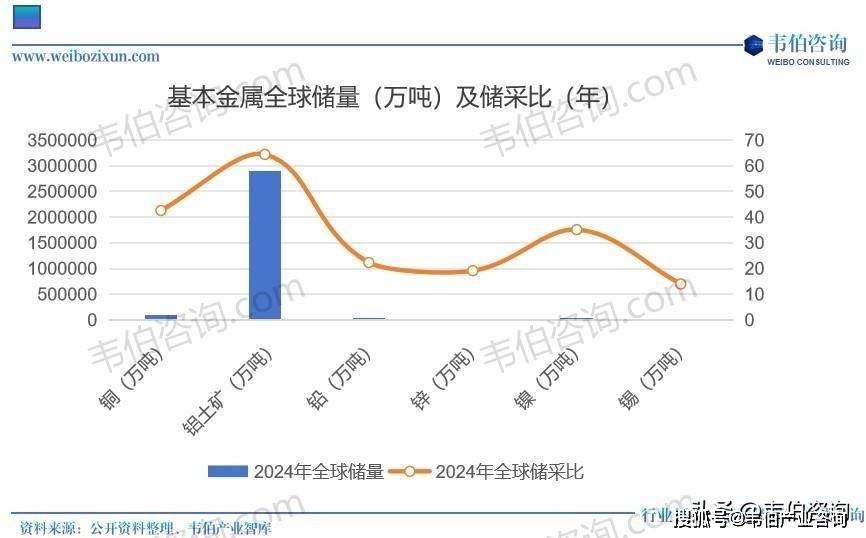
铝土矿方面,截至2024年底,全球已探明铝土矿储量约290亿吨,静态储采比约为64.44年。而中国铝土矿储量为6.8亿吨, 2024年产量9300万吨,储采比约为7.31年。 铅矿方面,全球已探明铅储量9600万吨,全球铅矿储采比为22.33年。中国铅资源储量2200万吨,占全球的22.92%,但作为 铅消费大国,中国铅矿储采比低于15年。 图表2:2024年基本金属中国储量及储采比(万吨,年) 锌矿情况与铅矿类似,全球已探明锌储量23000万吨,全球锌矿资源储采比约为19.17年。中国锌矿储量在全球占比较大, 储量4600万吨,占比20%,但储采比约为11.5年。 2025年全球铜矿供应偏紧格局依旧,将进一步传导至冶炼端制约产能释放,精炼铜供应量增速放缓,但在新能源、AI等下 游行业的拉动下,需求量增加,供需矛盾扩大叠加关税冲突,铜价向上弹性较大。 图表1:2024年基本金属全球储量及储采比(万吨,年) 铝供需增长空间有限,俄铝恢复对美出口或拉大国内供需缺口。基本面上,供给侧全球增长空间有限,中国电解铝产能已 接近天花板,海外新建产能2025年预期投产较少,需求侧白色家电、新能源汽车、光伏装机增速放缓,叠加 ...
反转!SK海力士无锡厂提高DDR4产能
是说芯语· 2025-12-27 01:45
Core Viewpoint - The semiconductor industry is experiencing a phase adjustment in technology iteration due to the imbalance of supply and demand in the global memory market and soaring prices. Samsung and SK Hynix have postponed their plans to cease DDR4 memory production from the end of 2025 to 2026 [1]. Group 1: Strategy Adjustment - Samsung and SK Hynix's decision to delay DDR4 production is not a sudden move; they had previously signaled to customers about gradually reducing DDR4 capacity starting in early 2024, with a complete stop planned between late 2025 and early 2026 [3]. - This strategy aligns with the semiconductor industry's logic of "technology iteration driving capacity upgrades," especially as major chip manufacturers like AMD and Intel are phasing out support for DDR4 [3]. Group 2: Market Dynamics - The explosive growth of the AI industry has significantly increased the demand for HBM, with storage needs for AI servers exceeding traditional servers by more than three times. This shift has led manufacturers to allocate more capacity to HBM, severely constraining DDR4 production [4]. - The transition of Chinese DRAM suppliers to DDR5, driven by government subsidies, will result in a complete halt of DDR4 production by 2025, further exacerbating the global supply shortage [4]. Group 3: Price Movements - Since the beginning of 2025, the price of a 16GB DDR4 module has surged from 180-200 yuan to around 800 yuan by December, marking a cumulative increase of over 200%. There have been instances of older products surpassing the prices of newer DDR5, with some specifications showing price differences of up to 100% [4]. - Current inventory levels for DDR memory are critically low, with only 9 weeks of supply for PC and mobile devices and 11 weeks for server DDR memory, contributing to further price increases. It is projected that DDR contract prices will rise by 35% in Q4 2025 and continue to increase by 30% in Q1 2026 [4]. Group 4: Manufacturer Responses - In response to market conditions, SK Hynix has officially notified customers of the extension of DDR4 production until 2026 and plans to increase DDR4 capacity at its Wuxi factory to meet rising orders. Samsung will maintain stable DDR4 supply while focusing on advanced DRAM products [5]. - Unlike Samsung and SK Hynix, Micron is sticking to its original plan, with its DDR4 and LPDDR4 products entering the end-of-life phase and expected to cease shipments in the next 2-3 months [5]. Group 5: Long-term Outlook - In the short term, the maintenance of DDR4 production by Samsung and SK Hynix is expected to alleviate supply tightness and somewhat curb price surges, but prices are likely to remain high due to significant supply gaps [6]. - Long-term, this adjustment does not alter the industry's trend towards advanced technologies like DDR5 and HBM; rather, it provides a buffer period for market transition. The continued focus on DDR4 by leading manufacturers may compress market space for domestic storage companies while allowing them time to mature their DDR5 technology and capacity [6].


【策略】A股牛市见顶三重预警框架——解密牛市系列之五(张宇生/郭磊)
光大证券研究· 2025-12-27 00:04
Core Viewpoint - The peak of a bull market is a result of multiple factors interacting over time, including policy and external environment factors, fundamental factors, and market trading factors [4]. Group 1: Warning Signals for Bull Market Peaks - Policy tightening and external risks are key warning signals for bull market peaks, with historical examples including internal policy tightening and external shocks like the subprime crisis from 2005-2007, and trade frictions from 2016-2018 [5]. - A decline in fundamentals is a significant warning signal for bull market peaks, characterized by a downturn in core profit metrics such as actual GDP growth, nominal GDP growth, and A-share net profit growth [5]. - Structural bull markets show that the decline in leading sectors' profit growth serves as a leading indicator for the overall market, reinforcing the signal of a bull market's end [5]. Group 2: Trading Signals for Bull Market Confirmation - Trading signals are crucial for confirming bull market peaks, with different signals being more applicable to comprehensive bull markets versus structural bull markets [6]. - High turnover rates and the number of stocks reaching new highs are more indicative of comprehensive bull markets, signaling overheating and exhaustion of upward momentum [6]. - Valuation-related signals, such as historical high price-to-earnings ratios and significant shareholder net reductions, serve as universal warning signals across various bull markets [7]. Group 3: Current Market Outlook - Currently, there are no clear warning signals indicating a peak in the bull market, suggesting that future performance in the A-share market remains promising [8]. - Internal policies are still actively supportive, and the overall stability of US-China relations is improving, with external risks gradually easing [8]. - The fundamentals of the A-share market are on an upward trend, with a low probability of continued decline, particularly in the context of accelerating AI industry development [8].

铜价破12000美元关口创新高,江西铜业套保风险引关注
Sou Hu Cai Jing· 2025-12-26 22:40
Group 1 - The core point of the article is the significant rise in copper prices, which has reached historical highs due to a combination of supply shortages, increased demand from new industries, and macroeconomic policies [1][3][4] - Copper prices on the London Metal Exchange (LME) surpassed $12,000 per ton, marking a year-to-date increase of over 37%, potentially the largest annual gain since 2010 [1][3] - Domestic copper futures in China also rose, with the main contract closing at 96,200 yuan per ton, reflecting a 1% increase in a single day [1][3] Group 2 - The supply side is facing challenges, with global copper mine production expected to decline by 4.7% year-on-year due to issues in major mining regions, leading to a potential supply gap of 150,000 to 300,000 tons [3][4] - The demand for copper is being driven by new industries such as renewable energy and AI, with significant copper consumption in solar and wind energy, as well as electric vehicles [3][4] - Macroeconomic factors, including expectations of interest rate cuts by the Federal Reserve and a weaker dollar, have contributed to increased investment in the metals market, further pushing copper prices higher [4] Group 3 - Jiangxi Copper, as the largest copper producer in China, employs hedging strategies to mitigate price volatility, which has become a focal point amid rising copper prices [1][5] - The company utilizes futures and options to lock in profits and avoid losses from price fluctuations, with a structured risk management approach in place [4][5] - In the first half of 2025, Jiangxi Copper reported revenues of 256.96 billion yuan and a net profit of 4.18 billion yuan, indicating a 15.42% year-on-year increase, with hedging contributing to stable performance [4][5] Group 4 - Despite the hedging strategy, Jiangxi Copper faces risks due to the extreme price increases, including potential losses from short positions and increased margin requirements [5][6] - The company is prepared to adjust its hedging strategies in response to market volatility, with regular assessments and compliance audits to ensure effective risk management [7] - Market analysts predict that copper prices may continue to rise, with forecasts suggesting prices could reach $15,000 per ton by mid-2026, which could increase the pressure on Jiangxi Copper's hedging operations [7][8]
解密牛市系列之五:A股牛市见顶三重预警框架
EBSCN· 2025-12-26 12:31
Group 1 - The core viewpoint of the report is that the peak of a bull market is driven by multiple factors, including policy tightening, external risks, fundamental downturns, and market trading signals [1][15][16] - The report identifies three main categories of warning signals for a bull market peak: policy and external environment factors, fundamental factors, and market trading factors [1][15] - Historical examples illustrate that policy tightening and external risks have been significant warning signals in previous bull markets, such as the tightening of monetary policy and the impact of the subprime mortgage crisis from 2005 to 2007 [2][17][18] Group 2 - A downturn in fundamentals is highlighted as an important warning signal for a bull market peak, with indicators such as GDP growth rates and corporate profit growth showing consistent declines at the end of historical bull markets [2][35][40] - The report emphasizes that the decline in profitability of leading sectors serves as a key indicator for structural bull market peaks, as it reflects a shift in market sentiment and risk appetite [2][42][43] Group 3 - Trading signals are crucial for confirming a bull market peak, with high turnover rates and the number of stocks reaching new highs being significant indicators in a broad bull market [3][50] - The report notes that while absolute valuation levels may not effectively signal a peak, relative valuation metrics such as the five-year moving average of price-to-earnings ratios can indicate market overheating [3][62][63] Group 4 - The current A-share market does not show clear warning signals of a bull market peak, with supportive internal policies and improving fundamentals suggesting continued market performance [4][12] - The report indicates that while current market valuations are relatively high, turnover rates are at historical average levels, and the proportion of stocks reaching new highs is low, which does not signal an imminent peak [4][27][28]

特朗普又要征税,给中国18个月期限,不到24小时,中方通告全球
Sou Hu Cai Jing· 2025-12-26 04:21
在当今世界舞台上,中美关系无疑是最为引人瞩目的焦点之一。在特朗普再度宣告对中国半导体产业加征关税的背景下,各方反应不一,甚至颇具戏剧性。 有人认为这是稳定中美关系的信号,但是否真的如此?在这个看似错综复杂的局面中,我们是否能找到更深层次的逻辑和实质? 首先,让我们审视特朗普政府此次加征关税的理由。特朗普声称,中国在半导体领域的"垄断行为"对美国企业造成了困扰,因而他决定采取行动。然而,这 种说辞显得相当牵强。加征关税的税率设定为0%,并且计划在18个月后才可能实施,显然是在态度和政策间摇摆不定。这一切给人的感觉就像是一场空洞 的表演,既没有实际的力度,也让人困惑于特朗普的真实意图。 或许,特朗普的这一举动意在给自己一个缓冲期。根据分析,0%的税率与未来18个月的等待期,实际上是在为即将进行的301调查交代,让外界觉得"美国 仍在发声"。然而,这种"放你一马"的策略又反映出更深的无奈。美国经济与中国之间的依赖程度日益加深,特朗普或许意识到,随意加税不仅会影响到中 国,也会对本国经济造成巨大的冲击,最终受害的还是普通消费者。 从另一个角度来看,特朗普的举动还暴露出他内心的焦虑。在新一轮的贸易战中,中国早已不再是那 ...
挖掘全球多元资产?这个方向值得关注起来
Sou Hu Cai Jing· 2025-12-25 20:54
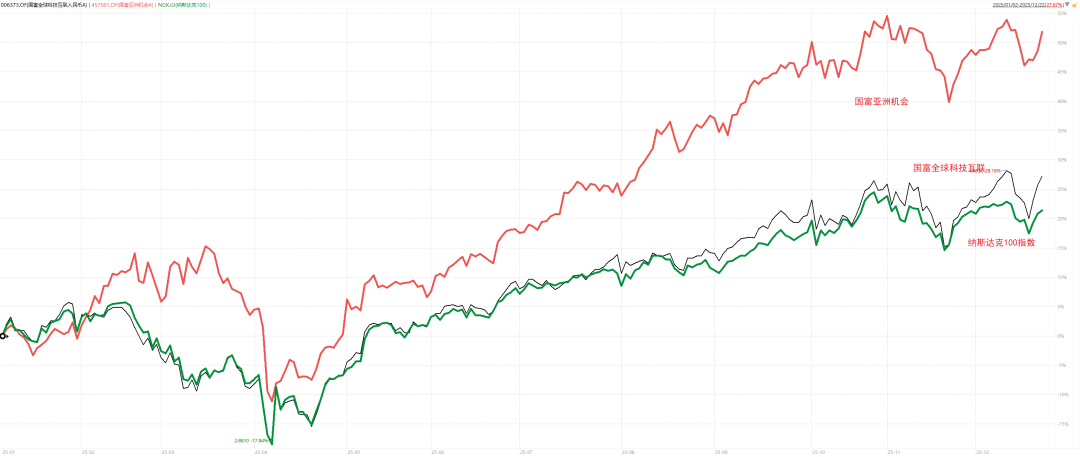
Group 1 - The core viewpoint of the article highlights the performance comparison between two funds: Guofu Global Technology Internet Fund (006373) and Guofu Asia Opportunities Fund (457001), with the latter showing stronger growth recently [1][5] - Both funds are primarily invested in AI-related sectors, but Guofu Global Technology Internet focuses on North American tech companies, while Guofu Asia Opportunities targets Asian markets, including stocks from Hong Kong, Taiwan, and South Korea [3][5] - The article emphasizes the importance of diversifying investments in both core AI industry players and supporting companies to fully benefit from the AI industry's growth [5][7] Group 2 - The performance data indicates that Guofu Asia Opportunities has outperformed the Hang Seng Technology Index, with a cumulative return of 11.26% over the past five years, compared to the index's -34.41% [5] - The fund's holdings include significant positions in companies like Alibaba, Weisheng Holdings, and TSMC, with notable increases in their respective market values [4] - Guofu Asia Opportunities is characterized as a less popular fund with no purchase limits, making it an attractive option for global diversified asset allocation strategies [7]