
反内卷

Search documents
粤开宏观前瞻2026:对中国经济和宏观调控的思考与建议
Yuekai Securities· 2025-11-30 23:49
Economic Overview - In 2025, China's economy demonstrated resilience with two "above expectations" and two "below expectations" characteristics, showing a "front high and back low" trend throughout the year[1] - The GDP growth for 2025 is projected to be around 5%, with a nominal GDP growth target of 5% as well, indicating a need for price recovery embedded in growth targets[2] Key Economic Drivers - The main economic lines for 2026 will focus on real estate and local government debt, with exports and central government-supported infrastructure investment serving as primary support forces[2] - In 2025, China's exports grew by 5.3% year-on-year, supported by diversified market layouts and upgraded export structures[8] Challenges and Risks - The real estate market's recovery in 2025 was slower than expected, with real estate investment declining by 14.7% year-on-year from January to October, exceeding the previous year's decline of 10.6%[10] - Internal challenges include low consumer spending and ongoing adjustments in the real estate market, which may prolong the recovery process[28] Policy Recommendations - Fiscal policy should be proactive, with a recommendation for a fiscal deficit rate of no less than 4% in 2026 to counteract the negative effects of real estate downturns and local government debt[33] - Monetary policy should leverage the opportunity presented by the Federal Reserve's interest rate cuts to further lower domestic interest rates and stimulate economic recovery[34] Consumer and Investment Outlook - Consumer spending is expected to gradually recover, supported by subsidy policies in childcare and pensions, alongside a potential increase in service consumption[24] - Fixed asset investment is projected to decline by 1.8% in 2026, with real estate investment expected to decrease by 15.2%[26]
美团亏160亿,外卖大战激烈,王兴称难以为继
Sou Hu Cai Jing· 2025-11-30 22:39
Core Viewpoint - The intense competition in the food delivery market has led to significant financial losses for major players like Meituan, Alibaba, and JD, with aggressive subsidy strategies impacting profitability and market dynamics [1][3][11]. Group 1: Market Dynamics - In Spring 2024, JD entered the food delivery sector, prompting Alibaba's Taobao to follow suit, leading to a fierce competition that forced all players to increase spending [1]. - By Summer, the market saw unprecedented subsidy levels, with consumers benefiting from numerous promotions, while businesses struggled with the financial implications of these strategies [3]. - The competition has resulted in a significant increase in marketing expenses for all three major companies, with Meituan's spending rising from 18 billion to 34.3 billion, and Alibaba's from 32.5 billion to 66.5 billion year-on-year [3][11]. Group 2: Financial Performance - Meituan reported a core local business operating loss of 14.1 billion in Q3, with expectations of continued losses into Q4, indicating a challenging financial landscape [5]. - Alibaba's CFO indicated that the company would tighten its spending on flash purchase business after a peak in Q3, suggesting a potential shift in strategy to mitigate losses [5][9]. - All three companies reported significant losses in Q3, with Meituan losing 16 billion, while Alibaba and JD also faced substantial financial challenges, leading to a bleak outlook for the industry [15][17]. Group 3: Competitive Strategies - Meituan's market share remains strong, particularly in mid-to-high price orders, with two-thirds of orders over 15 yuan and 70% of orders over 30 yuan being processed through its platform [7]. - Despite the ongoing competition, Meituan's leadership emphasized a commitment to avoiding low-quality, price-driven competition, focusing instead on long-term value creation [13][15]. - The industry is witnessing a shift towards more sustainable practices, with companies beginning to reconsider their aggressive subsidy strategies in light of regulatory pressures and financial realities [9][17].


【十大券商一周策略】布局跨年行情!“赚钱效应”最好的时间窗,即将打开
Sou Hu Cai Jing· 2025-11-30 15:09
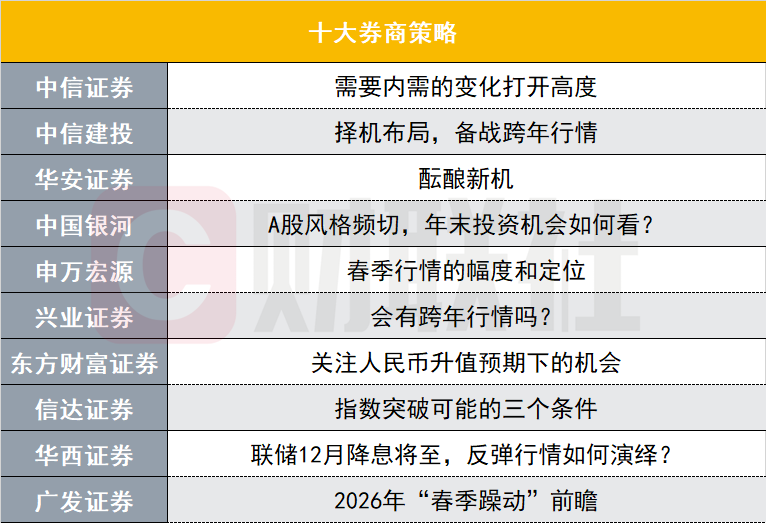
Group 1 - The market is characterized by a slow bull trend with reduced volatility and improved Sharpe ratios compared to the past, but subjective long positions have limited improvement [1] - The current market structure shows an increase in allocation-type funds, but there is a lack of incremental funds with individual stock pricing power, leading to higher valuation and safety margin requirements for subjective long positions [1] - A significant change in domestic demand is needed to unlock market potential, with recommendations to focus on resource and traditional manufacturing sectors as well as companies expanding overseas [1] Group 2 - December is expected to be a favorable time for "profit-making effects," with a shift in market dynamics from low to high win rates around the Spring Festival and Two Sessions [2] - The average duration of the "spring market" is about 20 trading days, with a focus on sectors with positive earnings forecasts for the upcoming year [2] - Many sectors have already seen adjustments of around 20%, making December a good time to start observing potential investments [2] Group 3 - The cross-year market is supported by easing overseas disturbances and a warming expectation of global liquidity, with a focus on sectors with high growth forecasts for 2026 [3] - Key sectors to watch include AI, advantageous manufacturing, and structural recovery in domestic demand, with an emphasis on policy support and sustainable valuation recovery [3] - The technology sector is expected to lead the market rally, particularly in AI applications and domestic computing power industries [3] Group 4 - December is anticipated to mark the beginning of a cross-year market rally, with a high probability of upward movement following three months of consolidation [4] - Investment opportunities are expected to arise in non-bank financials and sectors influenced by upcoming policy directions from key meetings [4] - The dual focus on the Shanghai 50 and Sci-Tech 50 indices is seen as advantageous for capitalizing on the cross-year market [4] Group 5 - The market is expected to experience a cross-year rally, with a focus on technology growth and resource sectors [6] - Key industries to consider include non-ferrous metals, AI, new energy, and innovative pharmaceuticals [6] - The theme of commercial aerospace is highlighted as a significant area of interest [6] Group 6 - The A-share market is entering a critical policy observation window, with expectations of increased risk appetite and a favorable environment for cross-year market positioning [7] - Key sectors include commercial aerospace, AI applications, and military technology, which are expected to benefit from policy catalysts [7] - The focus on industries related to the "14th Five-Year Plan" is emphasized for investment opportunities [7] Group 7 - The cross-year and spring market strategies are highlighted as key focus areas for December, with policy factors being a core driver [8] - The market is expected to transition from value-driven to growth-driven dynamics, with small-cap stocks showing strong performance in recent years [8] - The upcoming Central Economic Work Conference is anticipated to provide new investment themes if specific industry proposals are introduced [8] Group 8 - The current A-share market is assessed as being in a high-cut-low phase, with expectations of continued volatility until the end of the year [9] - The market's ability to break through the 4000-point level is seen as crucial for future performance, with a need for a transition from liquidity-driven to fundamentals-driven growth [9] - The technology sector is expected to remain sensitive to market conditions, with a focus on resource sectors as potential winners [9] Group 9 - The market is currently in a "slow bull" phase, with significant room for growth, but short-term volatility is expected due to a lack of strong catalysts [10] - Defensive and consumer sectors are recommended for short-term focus, while TMT and advanced manufacturing sectors are highlighted for mid-term investment [10] - The market is anticipated to remain in a consolidation phase, with high-dividend and consumer sectors likely to perform better [10] Group 10 - The foundation supporting the current liquidity-driven bull market remains solid, with potential for improved earnings and capital inflows to extend the bull market [11] - The market may experience volatility due to weak economic data and adjustments in overseas markets, but opportunities for upward movement are expected as policies and funding conditions improve [11] - The focus on clearing capacity and inventory, along with the commercialization of emerging industries like AI, is seen as crucial for market health [11]
潜伏“跨年行情”,静待“春季躁动”,十大券商策略盘点年末机会
Feng Huang Wang· 2025-11-30 15:00
Core Viewpoint - Major brokerages are focusing on the upcoming 2026 market outlook while still identifying opportunities in December 2025, with terms like "cross-year market" and "spring excitement" frequently mentioned [1] Group 1: Broker Strategies - CITIC Securities emphasizes the need for significant changes in domestic demand to unlock market potential, suggesting a focus on resource and traditional manufacturing sectors [3] - CITIC Jiantou advocates for strategic positioning ahead of the cross-year market, highlighting the importance of the Federal Reserve's meeting and the Central Economic Work Conference [4] - Huazhong Securities notes that the upcoming Central Economic Work Conference is expected to align with market expectations, while also suggesting that the AI industry remains a core focus [6] - China Galaxy observes frequent style shifts in the A-share market, indicating a cautious investor sentiment as the year-end approaches [13] - Shenwan Hongyuan discusses the potential for a spring market rally, suggesting that the current market adjustments may lead to a recovery phase [16] Group 2: Economic Indicators - Economic data shows a continued slowdown, with November retail sales expected to grow by approximately 2.6% year-on-year, while fixed asset investment is projected to decline by 1.8% [8] - The market is experiencing high volatility, with significant sector rotation observed, particularly between high-growth and low-valuation stocks [9] - The overall economic environment remains challenging, with PMI data indicating a contraction in manufacturing and services sectors [37] Group 3: Industry Focus - Key sectors identified for potential growth include AI applications, renewable energy, innovative pharmaceuticals, and mechanical equipment [5][38] - The AI industry is highlighted as a primary investment focus, particularly in areas such as computing power and software applications [10] - The focus on sectors benefiting from supply-demand improvements, such as storage and energy chains, is emphasized as a strategic investment direction [10] Group 4: Market Outlook - The market is expected to enter a phase of cross-year positioning, with significant attention on policy developments from the Central Economic Work Conference [34] - The potential for a spring market rally is anticipated, driven by macroeconomic data and liquidity conditions [40] - The upcoming year is projected to see a shift towards growth sectors, particularly in technology and renewable energy, as the market adjusts to new economic realities [41]
开源晨会-20251130
KAIYUAN SECURITIES· 2025-11-30 14:45
Macro Economic Overview - Manufacturing and construction sectors show signs of low-level recovery, while the service sector is weakening, as indicated by the November PMI data [3][5] - The PMI for manufacturing increased by 0.3 percentage points to 50.0%, with improvements in new orders and export orders [3][4] - The construction PMI improved by 0.5 percentage points to 49.6%, supported by the acceleration of special bond issuance [5][6] Corporate Profit Trends - In the first ten months of 2025, the cumulative profit of large-scale industrial enterprises increased by 1.9% year-on-year, down from 3.2% [8][9] - October saw a significant decline in profits, with a year-on-year drop of 5.5%, attributed to a high base effect and rising costs [9][10] - The profit structure indicates a shift, with midstream profits increasing while upstream profits are declining [11][41] Investment Strategies - The report suggests early positioning for the upcoming spring market rally, with December being a crucial macroeconomic window [14][15] - Growth style is expected to continue, with a focus on technology and cyclical sectors [19][27] - The report highlights the potential of small-cap stocks, particularly in a liquidity-rich environment [18][22] Sector-Specific Insights - The real estate sector is seeing a shift towards infrastructure REITs, with a notable performance in affordable housing REITs [3][5] - The coal mining sector is experiencing price stability, with coal prices expected to remain firm [3][5] - The pharmaceutical sector is advancing rapidly in clinical trials for PD-1/VEGF dual antibodies, with four candidates entering registration trials [3][5] ETF and Index Performance - The report discusses the core investment value of the China Securities 2000 Enhanced Strategy ETF, emphasizing its growth potential and resilience [20][21] - The index is characterized by high growth and elasticity, particularly benefiting from liquidity easing and stimulus policies [21][22] Financial Engineering and Asset Allocation - The report recommends a multi-asset allocation strategy favoring short-term bonds, undervalued convertible bonds, and gold assets [55][56] - The bond market is expected to experience upward pressure on yields, with a shift in asset allocation from safe-haven assets to risk assets [43][48]






化工周报:发改委持续推进“反内卷”进程,多地MDI停车检修致价格上涨,钾肥进口大合同同比持稳-20251130
Shenwan Hongyuan Securities· 2025-11-30 14:29
行 业 及 产 业 行 业 研 究 / 行 业 点 评 相关研究 证券分析师 马昕晔 A0230511090002 maxy@swsresearch.com 宋涛 A0230516070001 songtao@swsresearch.com 研究支持 任杰 A0230522070003 renjie@swsresearch.com 赵文琪 A0230523060003 zhaowq@swsresearch.com 邵靖宇 A0230524080001 shaojy@swsresearch.com 周超 A0230525090001 zhouchao@swsresearch.com 李绍程 A0230525070002 lisc@swsresearch.com 联系人 马昕晔 A0230511090002 maxy@swsresearch.com 2025 年 11 月 30 日 发改委持续推进"反内卷"进程, 多地 MDI 停车检修致价格上涨, 钾肥进口大合同同比持稳 看好 ——《化工周报 25/11/24-25/11/28》 本期投资提示: 请务必仔细阅读正文之后的各项信息披露与声明 本研究报告仅通过邮件提 ...

电力设备与新能源行业12月第1周周报:工信部推进电池行业“反内卷”,中国启动国际科学计划-20251130
Bank of China Securities· 2025-11-30 13:52
Investment Rating - The report maintains an "Outperform" rating for the electric equipment and new energy industry [1]. Core Views - The fourth quarter is expected to be a peak sales season for new energy vehicles, with domestic sales in 2025 projected to maintain high growth, driving demand for batteries and materials [1]. - The Ministry of Industry and Information Technology is promoting a "de-involution" strategy in the battery industry, which is expected to restore profitability across the supply chain [1]. - Solid-state battery industrialization is progressing, with a focus on related materials and equipment companies [1]. - In the photovoltaic sector, the "de-involution" strategy is seen as a key investment theme, although terminal demand is currently weak [1]. - Wind power demand is expected to continue growing, with a focus on wind turbine and offshore wind directions [1]. - Energy storage demand remains robust, with battery cells and integration still in a price increase phase [1]. - Hydrogen energy is anticipated to open up demand for green hydrogen, with a focus on downstream applications [1]. - Nuclear fusion is viewed as a long-term catalyst for energy development, with attention on core suppliers in this area [1]. Summary by Sections Industry Performance - The electric equipment and new energy sector rose by 3.59% this week, outperforming the Shanghai Composite Index, which increased by 1.40% [10]. - The power generation equipment sector saw the highest increase at 5.34%, followed by wind power at 4.99% and new energy vehicles at 4.48% [13]. Key Industry Information - NIO reported a record high revenue of 21.79 billion yuan for Q3 2025, a year-on-year increase of 16.7% [25]. - The Ministry of Industry and Information Technology is accelerating targeted policy measures to regulate irrational competition in the battery industry [25]. - LG Chem announced a significant improvement in solid-state battery performance, with a basic capacity increase of approximately 15% and a high-rate discharge capacity increase of about 50% [25]. - As of the end of October, China's cumulative installed power generation capacity reached 3.75 billion kilowatts, a year-on-year increase of 17.3% [25]. Company Developments - Longpan Technology signed a supplementary agreement with Chuangneng New Energy, with a total sales amount exceeding 45 billion yuan [27]. - JinkoSolar expects global energy storage installation demand to exceed 400 GWh next year, with a compound annual growth rate of over 30% until 2030 [28].


——电新环保行业周报20251130:储能产业链景气度延续,氢氨醇有望统筹、规模化、超前建设-20251130
EBSCN· 2025-11-30 12:44
Investment Ratings - The report maintains a "Buy" rating for both the power equipment and environmental protection sectors [1]. Core Views - The report highlights the continued prosperity of the energy storage industry chain, with hydrogen and ammonia expected to be developed in a coordinated, large-scale, and advanced manner [2][3]. - The National Development and Reform Commission (NDRC) has recognized the achievements in energy storage and hydrogen energy development, emphasizing the importance of market-oriented mechanisms for reasonable returns [2]. - The investment outlook for energy storage, hydrogen energy, and lithium batteries remains positive, with expectations for sustained demand and favorable bidding data in the domestic market [3][4]. Summary by Sections Energy Storage - Domestic energy storage is expected to maintain a good level of independent storage bidding in 2026, supported by a complete revenue model through energy, capacity, and ancillary service markets [3]. - Overseas energy storage demand is anticipated to rise, particularly in the U.S. due to ongoing electricity shortages, and in regions like the Middle East and Ukraine [3][6]. - The report notes a continuous high level of bidding and production in domestic energy storage, with significant projects being awarded [6][7]. Wind Power - The report states that China's onshore wind power installed capacity is projected to grow by 9.68% year-on-year in 2024, while offshore wind power capacity is expected to decrease by 40.85% [8]. - The bidding capacity for domestic wind power projects has seen a significant increase, with a 90% year-on-year growth in 2024 [11]. - The profitability of wind turbine manufacturers is expected to improve due to rising order deliveries and ongoing cost reductions [18]. Lithium Batteries - The lithium battery supply chain is experiencing strong demand, particularly in the electric vehicle and energy storage markets, with expectations for a favorable supply-demand balance [19][22]. - The report suggests focusing on investment opportunities in lithium mines and components that are not yet supporting production expansion [22]. - The pricing dynamics for lithium carbonate and other battery materials are expected to remain strong due to tight supply conditions [21][23].
美国进一步信用宽松,中国市场大盘价值占优——产业经济周观点-20251130
Huafu Securities· 2025-11-30 12:30
Group 1 - The report indicates that the US is experiencing further short-term credit easing, but long-term resistance is expected to increase [2][3] - The driving force behind China's price recovery is strengthening, with greater momentum for RMB appreciation as US credit easing continues [3][8] - If the US maintains its credit easing, it may lead to increased inflationary pressures overseas, favoring large-cap value stocks in the Chinese market [3][8] Group 2 - The report highlights a significant decline in the Hong Kong stock market, with the Hang Seng Technology Index dropping by 5.23% in November [11] - The industrial profits in China showed a year-on-year decline of 5.5% in October, down 27.1 percentage points from September, indicating a challenging economic environment [8] - The report notes that while most sectors declined, consumer sectors showed resilience, with specific industries like fisheries and steel raw materials outperforming [28][32]
企业开始主动去库
CAITONG SECURITIES· 2025-11-30 12:30
Group 1: Manufacturing Sector Insights - The Manufacturing Purchasing Managers' Index (PMI) for November is at 49.2%, a slight increase of 0.2 percentage points from the previous month, marking the eighth consecutive month below the threshold line[4] - The new orders index and finished goods inventory index for November are 49.2% and 47.3%, respectively, with new orders increasing by 0.4 percentage points and finished goods inventory decreasing by 0.8 percentage points[5] - The "production momentum" index (new orders - finished goods inventory) is at 1.9%, up 1.2 percentage points from last month, indicating a recovery in production momentum[5] Group 2: Inventory and Pricing Dynamics - Manufacturing firms are actively reducing inventory, with the finished goods inventory index significantly below seasonal levels[15] - The raw material purchase price index is at 53.6%, up 1.1 percentage points, while the factory price index is at 48.2%, indicating a widening price gap that compresses profit margins[20] - The "raw material purchase price - factory price" gap is 5.4%, an increase of 0.4 percentage points, further squeezing profit margins for enterprises[20] Group 3: Export and Demand Trends - The new export orders index is at 47.6%, showing a recovery of 1.7 percentage points from the previous month, although still below the threshold line[9] - The recent trade agreement between China and the U.S. has reduced trade friction, contributing to improved export conditions[9] - The forecast for U.S. holiday shopping indicates a record participation of 187 million people, which may positively impact demand for exports[9] Group 4: Sectoral Performance and Risks - Small enterprises show the fastest recovery, with a PMI of 49.1%, up 2.0 percentage points, reaching the highest level in five years[28] - The non-manufacturing business activity index is at 49.5%, down 0.6 percentage points from last month, indicating a contraction in the sector[37] - Risks include potential underperformance of domestic policies and unexpected changes in international geopolitical situations[41]