
人民币资产重估

Search documents
中金 | AH比较系列(4):A股优势有望延续
中金点睛· 2025-12-14 23:44
Core Viewpoint - The A-share market is expected to outperform the Hong Kong stock market in the second half of 2025 due to factors such as increased incremental capital, restructuring of international monetary order, and favorable policies that benefit A-share sectors [2][3]. Group 1: Market Performance - From August 18 to December 12, the A-share market showed a significant performance advantage, with the Shanghai Composite Index rising by 5.2%, the CSI 300 by 9.0%, and the ChiNext Index and STAR 50 by 26.0% and 22.5% respectively, while the Hang Seng Index and Hang Seng Tech Index only increased by 2.8% and 1.7% [2]. - The leading sectors in both A-shares and Hong Kong stocks were similar, with notable gains in non-ferrous metals, semiconductors, and electrical equipment [2]. Group 2: Fundamental Factors - A-share advantages stem from high growth in sectors like hard technology and new energy, with A-shares benefiting more from the domestic economic recovery compared to Hong Kong stocks [3]. - The A-share market has a stronger focus on hardware sectors such as semiconductors and electronics, while Hong Kong stocks are more represented by large internet companies [3]. Group 3: Liquidity Factors - The A-share market has seen increased liquidity due to active participation from individual investors, with margin trading balances rising from 2.1 trillion yuan in mid-August to 2.5 trillion yuan by mid-December [4]. - The trend of "deposit migration" continues, with non-bank deposits maintaining high growth rates, contributing to the liquidity in the A-share market [4]. Group 4: Overseas Factors - The Hong Kong market is more sensitive to overseas factors, including international liquidity and trade policies, which have led to greater volatility compared to A-shares [5]. - Recent fluctuations in U.S. monetary policy and trade tensions have had a more pronounced negative impact on the Hong Kong market, while A-shares demonstrated resilience during these periods [5]. Group 5: Future Outlook - The A-share market is expected to maintain its advantages in the medium term, particularly in hardware sectors related to AI and cloud computing, as these areas are projected to see increased industrial application [6]. - Continued liquidity support from long-term capital inflows and favorable policies is anticipated to sustain A-share market activity [6]. - The restructuring of international monetary order and the potential for improved U.S.-China trade relations may further enhance the attractiveness of A-shares compared to Hong Kong stocks [6].


AH比较系列(4):A股优势有望延续
CICC· 2025-12-14 11:27
Core Insights - The report indicates that A-shares are expected to outperform Hong Kong stocks in the second half of 2025, driven by factors such as increased domestic capital inflow, restructuring of international monetary order, and favorable policies for certain sectors [1][2]. Market Performance - From August 18 to December 12, 2025, the Shanghai Composite Index rose by 5.2%, and the CSI 300 increased by 9.0%. In contrast, the Hang Seng Index only gained 2.8% during the same period [1]. - The growth of the ChiNext Index and the STAR 50 was significant, with increases of 26.0% and 22.5% respectively, highlighting the strong performance of growth-oriented stocks in A-shares [1]. Reasons for A-share Outperformance - **Fundamentals**: A-shares have advantages in high-growth sectors such as hard technology and new energy, which are expected to see improved performance in the second half of the year. The report notes that A-shares are more focused on hardware sectors like semiconductors and electronics, while Hong Kong stocks are more represented by large internet companies [2]. - **Liquidity**: The report highlights that the active participation of individual investors and the inflow of medium to long-term funds have provided A-shares with additional liquidity. The margin trading balance increased from 2.1 trillion yuan in mid-August to 2.5 trillion yuan by mid-December [2][4]. - **Overseas Factors**: A-shares are less affected by overseas liquidity and trade policy risks compared to Hong Kong stocks, which have a higher proportion of foreign investment. The report notes that recent fluctuations in U.S. monetary policy and trade relations have had a more pronounced impact on Hong Kong stocks [2][3]. Future Outlook - The report anticipates that A-shares will continue to maintain their relative advantages in the medium term, particularly as AI technology begins to see more widespread industrial application. Key areas of focus include computing power, cloud computing, and domestic production [4]. - The liquidity in the A-share market is expected to remain active, with the potential for further inflows from bank wealth management products and institutional investors [4]. - The restructuring of the international monetary order and the revaluation of Chinese assets are expected to further support the performance of A-shares compared to Hong Kong stocks [4].
美债“掉链子”,A股“接棒”,人民币资产重估的历史性窗口
Sou Hu Cai Jing· 2025-12-11 13:05
Group 1 - The A-share market has experienced significant growth, with the ChiNext Index rising by 47% and the Sci-Tech 50 Index increasing by 43% by the end of September [1][2] - The current market rally is attributed to issues within the US dollar system, leading to a revaluation of RMB assets [3][10] - The US debt situation has deteriorated, with the debt-to-GDP ratio reaching 120.8% and external debt nearing 90% of GDP, raising concerns about the safety of US Treasury bonds [8][10] Group 2 - The Chinese economy is showing resilience, with advancements in AI and innovative pharmaceuticals, where self-developed drugs have increased from 4% to 42% of the pipeline [12][14] - Recent US-China trade negotiations have yielded unexpected results, including tariff reductions on certain tech products and new agreements on agricultural purchases, indicating a mutual understanding of the costs of trade conflicts [17][19] - The rise in rare earth prices reflects China's strengthened position in strategic resource pricing, positively impacting related industries and the stock market [20][22] Group 3 - The shift in asset pricing dynamics is evident, with the Chinese bond market becoming a new benchmark, as the risk premium for the Hang Seng Index has increased from 4% to 7% when calculated against Chinese bonds [24] - Global investment patterns are changing, with long-term funds beginning to allocate more towards RMB assets, moving away from the previously imbalanced allocation favoring US assets [24][26] - The current market conditions represent a historic opportunity for asset value reconfiguration, as the RMB assets are being liberated from the constraints of the US dollar system [29][31]
人民币重估窗口开启:资本回流与资产博弈新局
Sou Hu Cai Jing· 2025-12-10 09:39
Group 1 - The core viewpoint is that the Chinese yuan is undervalued by 39.2% according to the Big Mac Index, and the current economic environment presents a critical opportunity for the revaluation of yuan assets, influenced by the Federal Reserve's interest rate cuts and the low valuation of A-shares [1][3] - The potential for yuan valuation recovery is widely recognized in the market, with estimates of undervaluation ranging from 10% to 40%, supported by China's strong trade relationships and expected capital inflows [3] - The current economic conditions, including the Federal Reserve's rate cuts and the low valuation of A-shares, create a favorable environment for the revaluation of yuan assets, suggesting a shift in asset pricing dynamics [3] Group 2 - The path for capital repatriation is complicated by the "dual-track" nature of US-China relations, with recent trade negotiations providing temporary optimism but underlying geopolitical tensions remaining a significant risk [4] - The internationalization of the yuan has established a safety buffer, as evidenced by the rise of CIPS and bilateral currency swap networks, which facilitate capital flows independent of traditional channels [6] - Investment strategies should balance opportunities and risks, focusing on currency-sensitive assets in the short term while aligning with the long-term goal of upgrading the manufacturing sector [6]

华泰证券梁红:当前经济增长源于效率提升,为人民币资产重估与汇率走强奠定基础
Sou Hu Cai Jing· 2025-12-07 09:50
Core Viewpoint - The current economic growth in China is primarily driven by improvements in production efficiency, which lays the foundation for the revaluation of RMB assets and a stronger exchange rate [3]. Group 1: Economic Growth and RMB Valuation - The majority of the approximately 5% economic growth in China over the past two years has come from enhanced production efficiency rather than simple capital expansion [3]. - The improvement in the quality of growth is expected to lead to a revaluation of RMB assets, providing solid fundamental support for the appreciation of the RMB exchange rate [3]. Group 2: Policy Recommendations - Short-term focus should be on stabilizing the real estate market and local finances to prevent deterioration that could drag down the economy, requiring corresponding policy support [3]. - In the long term, it is essential to utilize the current adjustment period in the real estate market to address housing issues for certain groups, thereby stimulating domestic demand and alleviating pressure in the real estate sector [3]. - A critical task is to "activate the stock," meaning effectively utilizing existing state-owned asset stock to support low-income group consumption and fill social security funding gaps [3]. Group 3: Expected Outcomes - Progress in the aforementioned areas is anticipated to not only achieve actual economic growth but also restore "nominal growth" to normal levels, promoting a more resilient and sustainable appreciation phase for the RMB exchange rate [3].


加速升值!人民币资产重估下 A股牛市稳了?
Sou Hu Cai Jing· 2025-11-28 03:27
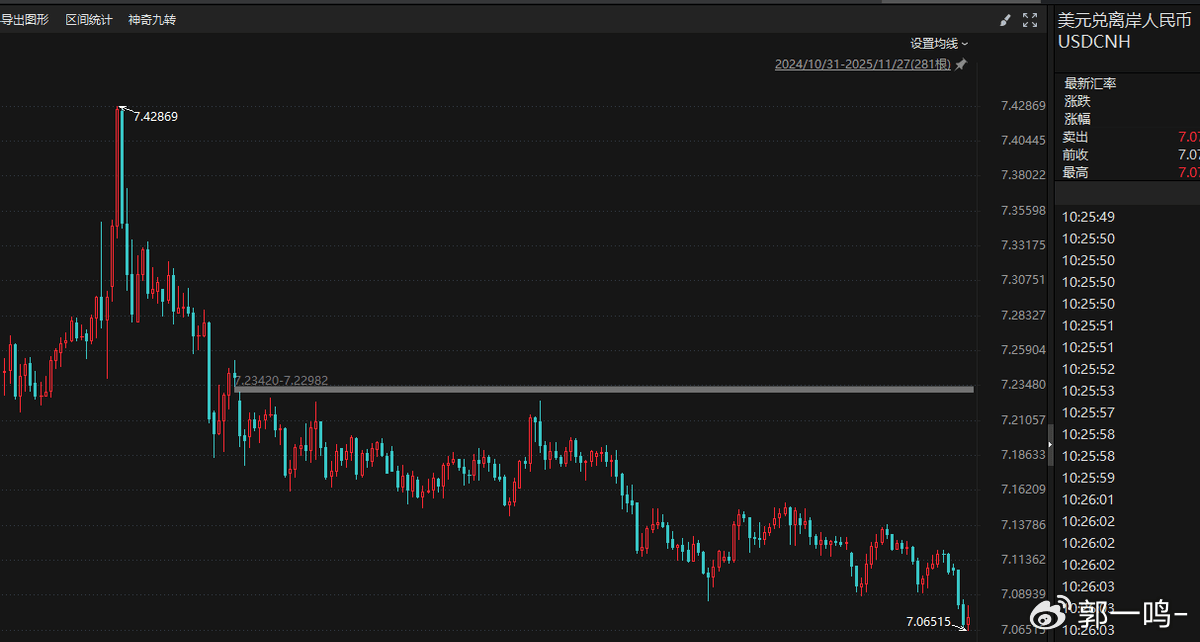
Group 1 - The recent appreciation of the Renminbi (RMB) against the US dollar has reached new highs, with the offshore RMB surpassing 7.08 and the onshore RMB exceeding 7.09, marking the highest levels in over a year [1][3] - The RMB's middle exchange rate against the US dollar has increased by approximately 1000 basis points this year, while the CFETS RMB exchange rate index has risen to 98.22, indicating a strong performance against a basket of currencies [1][3][4] Group 2 - The appreciation of the RMB is attributed to multiple factors, including a decline in the US dollar index, which has dropped over 8% since the beginning of the year, and expectations of further interest rate cuts by the Federal Reserve [4][6] - Domestically, the resilience of the Chinese economy, particularly strong export performance, has provided support for the RMB, with a surplus of 80.9 billion USD in foreign exchange settlements in the first ten months of the year [6] Group 3 - The appreciation of the RMB is expected to positively impact the stock market through three main channels: capital flow, corporate profitability, and policy space, with historical data showing a correlation between RMB appreciation and stock market performance [7][8] - Specific sectors such as aviation, paper manufacturing, and non-ferrous metals are likely to benefit significantly from the RMB's appreciation due to reduced import costs [10] Group 4 - Looking ahead, the RMB is expected to maintain a strong performance, supported by a stable monetary policy environment and ongoing structural adjustments in the economy [11] - The current environment presents a significant opportunity for the revaluation of RMB assets, particularly in sectors like new energy vehicles and semiconductors, which are enhancing their international competitiveness [13]
帮主郑重:人民币强势突破!如何把握汇率波动中的投资机会?
Sou Hu Cai Jing· 2025-11-27 02:32
Core Viewpoint - The recent appreciation of the Renminbi (RMB) has been significant, with both onshore and offshore rates surpassing the 7.08 mark, marking a year-high and reflecting a positive sentiment in the asset market [1][3]. Group 1: Factors Contributing to RMB Appreciation - The appreciation is supported by external factors, particularly the Federal Reserve's interest rate cuts, which have led to a 50 basis point reduction this year and a more than 10% decline in the US dollar index, the largest drop for the first half of the year since 1973 [3][4]. - Domestic economic fundamentals are also strong, with resilient exports and a recovering A-share market. The securities transaction stamp duty has increased by 88.1% year-on-year in the first ten months, indicating enhanced market vitality [4]. Group 2: Investment Strategies for Long-term Investors - Investors should focus on the revaluation opportunities of RMB assets, as the stable exchange rate enhances the attractiveness of these assets, potentially leading to continued foreign capital inflow and A-share value revaluation [5]. - Sectors benefiting from exchange rate fluctuations, such as airlines and paper manufacturing, which have significant dollar liabilities, may experience alleviated cost pressures [5]. - It is advisable for enterprises and individuals with USD needs to strategically arrange their funds during this relatively stable exchange rate period [5].

(经济观察)关税扰动难改A股中长期向上趋势
Zhong Guo Xin Wen Wang· 2025-10-15 08:29
Core Viewpoint - The recent announcement by the U.S. to impose additional tariffs on Chinese goods has led to increased volatility in China's A-shares, but analysts believe this will not alter the long-term upward trend of the market [1][2]. Economic Impact - Despite a significant year-on-year decline in exports to the U.S. in September, China's total export value in U.S. dollars increased by 8.3% during the same period, indicating resilience [1]. - In the first three quarters, China's trade with Belt and Road Initiative countries reached 17.37 trillion yuan, a year-on-year increase of 6.2%, accounting for 51.7% of total trade, up by 1.1 percentage points [1]. Market Reactions - Analysts suggest that the market's reaction to tariff announcements has become muted over time, as seen after previous tariff shocks in April and 2018 [2]. - The potential for a 100% tariff may serve more as a negotiation tactic rather than a definitive policy, with analysts expecting limited impact on A-shares compared to earlier tariff announcements [2]. Investment Outlook - The current environment is characterized by clearer boundaries regarding trade risks, and ongoing policy support for stabilizing the capital market, suggesting that external shocks will not derail market trends [3]. - The demand for quality assets remains strong, and any asset price declines due to external conflicts may present opportunities for increasing investments in Chinese assets [3]. - The restructuring of the global monetary order and the declining safety of U.S. dollar assets may lead to a revaluation of RMB assets, supporting a stable upward trend in A-shares [3].
每日投行/机构观点梳理(2025-10-13)
Jin Shi Shu Ju· 2025-10-13 11:33
Group 1: Copper and Nickel Market Outlook - Goldman Sachs forecasts copper prices to remain in the range of $10,000 to $11,000 per ton in 2026/2027 [1] - Goldman Sachs predicts nickel prices will decline by 6% to $14,500 per ton by December 2026 due to the need for Indonesian nickel producers to lower profit margins to limit supply growth [1] Group 2: Gold Price Predictions - Canadian Imperial Bank of Commerce expects gold prices to rise to $4,500 per ounce in 2026 and 2027, before falling to $4,250 in 2028 and $4,000 in 2029, driven by long-term inflation concerns [1] - The recent surge in gold prices is attributed to fears of long-term inflation and wealth preservation, as the Federal Reserve's monetary policy has not adequately addressed these concerns [1] Group 3: Japanese Yen and Interest Rate Expectations - State Street Bank indicates that the delay in interest rate hikes has exacerbated the weakness of the Japanese yen, with market reactions expected if there is no consensus on the appointment of the new Prime Minister [2] Group 4: European Central Bank's Stance - Pantheon Macroeconomics suggests that the European Central Bank is unlikely to lower interest rates in the coming months despite a weak economic outlook, as they may view current economic weakness as temporary [3] Group 5: Chinese Market and Liquidity - China International Capital Corporation highlights October as a potential liquidity resonance window, suggesting that A-shares and Hong Kong stocks offer better value compared to U.S. stocks due to a shift towards a more accommodative monetary policy [4] - The report indicates that the recent escalation in U.S.-China trade tensions is expected to have a weaker impact on A-shares compared to previous events, with a focus on long-term asset revaluation in China [5] Group 6: Gold Market Dynamics - Guoxin Securities notes that the recent rise in gold prices is driven by expectations of Federal Reserve rate cuts, geopolitical risks, and increased investment demand, marking the beginning of a new strong cycle for gold [6] Group 7: Energy Storage and Lithium Battery Sector - CITIC Securities continues to recommend the energy storage sector, citing a turning point in domestic energy storage economics and a favorable outlook for the lithium battery industry [7] Group 8: Cobalt and Rare Earth Strategic Opportunities - CITIC Securities identifies strategic opportunities in cobalt and rare earths, with new export quotas from the Democratic Republic of Congo expected to lead to a market shift from surplus to shortage [8] Group 9: Market Volatility and Investment Strategy - Everbright Securities predicts that the market may enter a phase of wide fluctuations due to high valuations and cautious capital, while also noting potential support from upcoming policy expectations [9] Group 10: Long-term Outlook for Gold - Guoxin Securities maintains a positive long-term outlook for gold, suggesting that the third wave of opportunities may arise from shifts in capital flows due to the peak of the AI technology wave [10] Group 11: External Shocks and Chinese Market Opportunities - Guotai Junan Securities views external shocks as buying opportunities for the Chinese market, emphasizing the internal certainty of China's transformation and the demand for quality assets [11]
海外降息周期开启,外资增量有望边际提升,低费率的自由现金流ETF(159201)交投活跃
Mei Ri Jing Ji Xin Wen· 2025-10-13 03:01
Core Viewpoint - The A-share market experienced a significant decline followed by a recovery, with the National Free Cash Flow Index showing a reduced drop of approximately 1.4%. Leading stocks included Guodian Nanzi, Baiyin Nonferrous Metals, Tubao, and Shanghai Electric [1]. Group 1: Market Performance - The three major A-share indices opened sharply lower but showed signs of recovery during the trading session [1]. - The National Free Cash Flow Index's decline has been narrowing, indicating potential stabilization in the market [1]. Group 2: ETF Activity - The largest free cash flow ETF (159201) followed the index adjustment, with trading volume exceeding 170 million yuan, indicating active trading and frequent premium transactions [1]. - The ETF focuses on industry leaders with abundant free cash flow, covering sectors such as non-ferrous metals, automotive, petrochemicals, and power equipment, which helps mitigate risks associated with single industry volatility [1]. Group 3: Economic Outlook - China’s economic outlook is influenced by expectations of a Federal Reserve interest rate cut, a prolonged low dollar, and a potential short-term increase in gold prices [1]. - Attention is needed on the "14th Five-Year Plan" and the phase escalation of China-US trade tensions, which may impact market sentiment [1]. - The long-term trend of a weaker dollar is expected to continue, and the initiation of an overseas rate cut cycle may aid in the revaluation of RMB assets [1]. - A marginal increase in foreign capital inflow is anticipated in the fourth quarter, which could support the continuation of incremental funds into the A-share market [1]. Group 4: Fund Management - The fund management annual fee rate is set at 0.15%, and the custody annual fee rate is 0.05%, both of which are the lowest in the market [1].