宏观经济政策

Search documents
2026年01月21日:期货市场交易指引-20260121
Chang Jiang Qi Huo· 2026-01-21 01:28
Report Industry Investment Ratings Macroeconomic and Financial - Index: Long - term optimistic, buy on dips [1][5] - Treasury bonds: Range - bound [1][5] Black Building Materials - Coking coal: Short - term trading [1][7] - Rebar: Range trading [1][7] - Glass: Sell on rallies [1][8] Non - ferrous Metals - Copper: Exit long positions on rallies and wait and see [1][10] - Aluminum: Strengthen observation [1][13] - Nickel: Wait and see [1][14] - Tin: Range trading or take profit on previous long positions [1][15] - Gold: Range trading [1][18] - Silver: Bullish [1][16] - Lithium carbonate: Range - bound [1][18] Energy and Chemicals - PVC: Range trading [1][20] - Caustic soda: Temporarily wait and see [1][21] - Soda ash: Temporarily wait and see [1][28] - Styrene: Range trading [1][22] - Rubber: Range trading [1][22] - Urea: Range trading [1][25] - Methanol: Range trading [1][25] - Polyolefins: Weakly range - bound [1][26] Cotton and Textile Industry Chain - Cotton and cotton yarn: Range adjustment [1][28] - Apples: Weakly range - bound [1][29] - Jujubes: Weakly range - bound [1][30] Agricultural and Livestock - Pigs: Short - term rebound, roll short opportunities [1][32] - Eggs: Not advisable to short in the short term [1][35] - Corn: Be cautious about chasing highs, wait for rebounds to hedge [1][37] - Soybean meal: Bearish on rallies [1][39] - Oils: Weakly range - bound [1][40] Core Views - The report provides investment ratings and trading strategies for various futures products in different industries, considering factors such as supply - demand relations, cost changes, geopolitical situations, and policy impacts [1][5][7] Summary by Directory Macroeconomic and Financial - Index: Although the external environment is deteriorating and may put pressure on the index, it is still optimistic in the long - term, and investors can buy on dips [5] - Treasury bonds: Yields of various maturities declined yesterday, with the long - end declining more. The market shows a situation where trading positions are passing on to allocation positions, and treasury bonds are expected to move in a range [5] Black Building Materials - Coking coal: The coal market has a strong wait - and - see sentiment due to weak fundamentals. Although supply may be tightened, demand is weak, and prices are under pressure. Short - term trading is recommended [7] - Rebar: Futures prices are weakly running. The valuation is neutral, and the short - term supply - demand contradiction is not significant. Range trading is the main strategy [7] - Glass: Speculative sentiment has cooled. Although the inventory pressure of float glass factories has eased, the inventory in the middle reaches has increased. Demand may decline before the Spring Festival, and prices are expected to be weakly range - bound. Sell on rallies [8][9] Non - ferrous Metals - Copper: Prices have risen first and then fallen, and are in a high - level range. Although the long - term supply - demand shortage is expected, short - term support has decreased. Investors can exit long positions on rallies [10][11][12] - Aluminum: The prices of bauxite are under pressure to decline. The supply of alumina and electrolytic aluminum is relatively stable, but demand is entering the off - season. The market may continue to adjust at a high level, and investors are advised to strengthen observation [13] - Nickel: Although the reduction of Indonesian nickel ore quotas has boosted prices, the current market has fully priced in. The fundamentals are weak, and investors are advised to wait and see [14] - Tin: Supply is tight, and downstream consumption maintains rigid demand. Prices are expected to be range - bound. Range trading or taking profit on previous long positions is recommended [15][16] - Gold and silver: Geopolitical tensions have increased, and the US economic data is weak. The mid - term price centers of gold and silver have moved up. Gold is suitable for range trading, and silver is recommended to hold long positions [16][17][18] - Lithium carbonate: Supply and demand are both in a state of change. The price is expected to be range - bound, and attention should be paid to the disturbances at the Yichun mine end [18] Energy and Chemicals - PVC: The bottom may have emerged. Although the current supply - demand situation is weak, the valuation is low, and there may be structural opportunities in the long - term. Range trading is recommended [20] - Caustic soda: Demand is difficult to support, and supply pressure is large. There is short - term delivery pressure, and investors are advised to wait and see [21] - Soda ash: Supply is in surplus, but the cost support is strong. The downward space of the market may be limited, and investors are advised to temporarily leave the market and wait and see [28] - Styrene: The previous rebound was fast, but the current valuation is high. Range trading is recommended, and attention should be paid to the improvement of cost and supply - demand patterns [22] - Rubber: The bottom support of natural rubber is weakening, and the seasonal inventory accumulation trend remains unchanged. The market may be weakly range - bound in the short - term [22] - Urea: Supply is increasing, demand is relatively stable, and prices are expected to be range - bound. Attention should be paid to factors such as compound fertilizer start - up and export policies [25] - Methanol: The supply in the inland area has recovered, and the demand for methanol - to - olefins remains high, but the traditional terminal demand is weak. The price in some areas is strong, and range trading is recommended [25] - Polyolefins: The cost support is strengthened, but the upward space of prices is limited. PE and PP are expected to be weakly range - bound, and short on rallies is the main strategy [26] Cotton and Textile Industry Chain - Cotton and cotton yarn: Global cotton supply has decreased, and demand has increased. Although there is a high - level correction in the short - term, the long - term expectation is optimistic [28] - Apples: The Spring Festival stocking is in progress, but the transaction of fruit farmers' goods is not fast. Prices are expected to be weakly range - bound [29][30] - Jujubes: The acquisition in Xinjiang has ended, and the market transactions in Hebei and Guangdong are okay. Prices are expected to be weakly range - bound [30] Agricultural and Livestock - Pigs: The short - term price is under pressure due to supply and demand factors. In the long - term, the price may be affected by capacity reduction. Short on rallies is recommended for off - season contracts, and be cautious about bullishness for far - month contracts [32][34] - Eggs: The short - term spot price is expected to be strong, not advisable to short. In the medium - term, the pressure of new production is not large. In the long - term, the capacity clearance still takes time, and attention should be paid to external factors [35][37] - Corn: The short - term supply - demand is balanced, and the long - term supply - demand pattern is relatively loose. Be cautious about chasing highs and wait for rebounds to hedge [37][38][39] - Soybean meal: The short - term price is supported by cost, and the far - month price is under pressure. Bearish on rallies is the main strategy [39] - Oils: The short - term trends of different oils are differentiated. Rapeseed oil is weakly range - bound, and the rebounds of soybean oil and palm oil are limited. Attention can be paid to the narrowing strategy of the spreads between rapeseed oil and palm oil and between rapeseed oil and soybean oil [40][45]
沪镍不锈钢市场周报:利润修复产量回升,镍不锈钢上行遇阻-20260116
Rui Da Qi Huo· 2026-01-16 09:25
1. Report Industry Investment Rating - No information provided in the content 2. Core Viewpoints of the Report - It is expected that Shanghai nickel will undergo wide - range adjustments in the short term, with attention on the MA10 support, in the range of 140,000 - 150,000 yuan/ton. Stainless steel futures prices are expected to adjust strongly, with the range to be concerned about 14,000 - 15,000 yuan/ton [9] 3. Summary of Each Section 3.1 Week - ly Highlights Summary 3.1.1 Shanghai Nickel - This week, the main contract of Shanghai nickel rose first and then fell, with a weekly increase of +1.62% and an amplitude of 9.79%. As of the end of this week, the closing price of the main contract was 141,350 yuan/ton [9] - Macroscopically, the People's Bank of China decided to lower the re - lending and rediscount rates by 25 basis points, and there is still room for reserve requirement ratio and interest rate cuts this year. In the US, the number of initial jobless claims last week decreased to 198,000, and the US dollar rebounded to a more than one - month high [9] - Fundamentally, the Philippines has entered the rainy season, and the import volume of nickel ore is in a downward trend. Indonesia plans to significantly cut the RKAB quota to 2.5 - 2.6 billion tons next year, causing market concerns about raw material supply. It is expected that the supply will be relatively loose in the first quarter. The production of nickel iron in Indonesia remains high, and the quantity flowing back to China is expected to increase. The domestic refined nickel production capacity is large, and recently the nickel price has rebounded, with profits repaired. It is expected that the subsequent production of refined nickel will rise again. In terms of demand, the cost of nickel iron for stainless steel has decreased, the profit of steel mills has improved, and the production volume is expected to be at a high level. The production and sales of new energy vehicles continue to climb, and ternary batteries contribute a small incremental demand [9] - Technically, the price is adjusted at a high position of positions, with large differences between long and short positions. There is resistance above, and it is expected to be mainly in wide - range adjustment [9] 3.1.2 Stainless Steel - This week, stainless steel rose first and then pulled back, with a weekly increase of +2.99% and an amplitude of 6.60%. As of the end of this week, the closing price of the main contract was 14,275 yuan/ton [9] - In terms of raw materials, the Philippines is gradually entering the rainy season, and the grade of nickel ore is decreasing. The raw material inventory of domestic nickel - iron plants is tightening. Indonesia plans to significantly cut the RKAB quota next year. Under the situation of shrinking raw material supply, nickel - iron production will face production - cut pressure [9] - In terms of supply, the production profit of stainless steel plants has improved. Although the traditional peak demand season has passed, the actual decline in production is expected to be limited, and the supply pressure still exists. In terms of demand, downstream demand is gradually turning to the off - season, and the export volume of stainless steel shows a downward trend. The impact of previous export squeezing is beginning to appear. The market's purchasing willingness is not high, and the overall inquiry and transaction performance are average. However, the market arrivals are also not many, so the national social inventory of stainless steel maintains a seasonal small decline [9] - Technically, the price is strong with an increase in positions, and the long sentiment is strong [9] 3.2 Futures and Spot Market 3.2.1 Futures and Spot Prices - As of January 9, the closing price of Shanghai nickel was 139,090 yuan/ton, an increase of 6,240 yuan/ton from last week; the closing price of stainless steel was 13,860 yuan/ton, an increase of 735 yuan/ton from last week [15] - As of January 9, the average price of nickel pig iron (1.5 - 1.7%) was 3,350 yuan/ton, an increase of 50 yuan/ton from last week; the average price of nickel iron (7 - 10%) nationwide was 965 yuan/nickel, an increase of 50 yuan/nickel from last week [15] 3.2.2 Basis - As of January 9, the spot price of electrolytic nickel was 141,900 yuan/ton, with a basis of 2,810 yuan/ton; the closing price of stainless steel was 14,350 yuan/ton, with a basis of 490 yuan/ton [20] 3.2.3 Price Ratios - As of January 9, the price ratio of Shanghai nickel to stainless steel on the Shanghai Futures Exchange was 10.04, a decrease of 0.09 from last week; the price ratio of Shanghai tin to Shanghai nickel on the Shanghai Futures Exchange was 2.53 yuan/ton, an increase of 0.1 from last week [27] 3.2.4 Net Long Positions of the Top 20 - As of January 16, 2026, the net long position of the top 20 in Shanghai nickel was - 78,736 lots, a decrease of 6,275 lots compared with January 12, 2026. The net long position of the top 20 in stainless steel was - 9,792 lots, a decrease of 1,029 lots compared with January 12, 2026 [33] 3.3 Industrial Chain Situation 3.3.1 Supply Side - Nickel ore port inventory decreased. As of January 9, the nickel ore inventory in major domestic ports was 13.1977 million tons, a decrease of 122,600 tons from last week [38] - The production profit of electrowinning nickel was profitable but decreased. As of January 9, the production profit of electrowinning nickel was 10,700 yuan/ton, a decrease of 7,650 yuan/ton from last week [39] - Domestic electrolytic nickel production increased and imports decreased. In December 2025, the electrolytic nickel production was 29,058 tons, a year - on - year decrease of 0.16%. In November 2025, the import volume of refined nickel and alloys was 12,840.486 tons, a year - on - year increase of 29.18%; from January to November, the cumulative import volume of refined nickel and alloys was 209,244.351 tons, a year - on - year increase of 157.2% [44] - The inventory of the Shanghai Futures Exchange increased, and the LME nickel inventory increased slowly. As of January 2, the Shanghai Futures Exchange nickel inventory was 45,544 tons, an increase of 1,090 tons from last week. As of December 31, the LME nickel inventory was 255,186 tons, an increase of 426 tons from last week [51][52] 3.3.2 Demand Side - The production of 300 - series stainless steel decreased slightly, and the export volume decreased. In December 2025, the total stainless steel crude steel production was 3.2605 million tons, a month - on - month decrease of 6.66%. Among them, the production of 400 - series was 572,800 tons, a month - on - month decrease of 16.91%; the production of 300 - series was 1.7472 million tons, a month - on - month decrease of 0.82%; the production of 200 - series was 940,500 tons, a month - on - month decrease of 9.74%. In November 2025, the stainless steel import volume was 109,100 tons, a month - on - month decrease of 12,600 tons; the export volume was 333,000 tons, a month - on - month increase of 32,700 tons. In January, the cumulative net import volume was - 2.4695 million tons, a year - on - year decrease of 223,900 tons [55] - The inventory of 300 - series stainless steel in Foshan and Wuxi showed a downward trend. As of December 26, the stainless steel inventory in Foshan was 264,500 tons, a decrease of 21,646 tons from last week; the stainless steel inventory in Wuxi was 544,038 tons, a decrease of 9,489 tons from last week [60] - The stainless steel production profit increased. As of January 9, the stainless steel production profit was 377 yuan/ton, an increase of 439 yuan/ton from last week [64] - The real estate industry was in a weak downward trend, and the home appliance industry showed a decline. From January to November 2025, the new housing construction area was 534.567 million square meters, a year - on - year decrease of 20.5%; the housing completion area was 394.5393 million square meters, a year - on - year decrease of 18%; real estate development investment was 785.909 million square meters, a year - on - year decrease of 15.9%. In November 2025, the air - conditioner production was 15.026 million units, a year - on - year decrease of 23.64%; the household refrigerator production was 9.442 million units, a year - on - year increase of 9.67%; the household washing - machine production was 12.013 million units, a year - on - year increase of 7.96%; the freezer production was 2.619 million units, a year - on - year increase of 7.17% [68] - The automobile industry performed well, and the machinery industry stabilized and improved. In November 2025, the production of new energy vehicles in China was 3.532 million units, a year - on - year increase of 9.5%; the sales volume was 3.429 million units, a year - on - year increase of 11.3%. In November 2025, the excavator production was 33,623 units, a year - on - year increase of 14.3%; the large - and medium - sized tractor production was 22,592 units, a year - on - year increase of 8.11%; the small - tractor production was 9,000 units, a year - on - year decrease of 25% [71]
螺纹钢市场周报:消费淡季、宏观偏暖,螺纹期价区间整理-20260116
Rui Da Qi Huo· 2026-01-16 09:23
Report Industry Investment Rating - Not provided in the document Core Viewpoints of the Report - The macro - environment is mixed with overseas and domestic factors. Domestically, the central bank's "combination punch" supports economic development, while overseas there are concerns about inflation and geopolitical situations. In the industry, it is the consumption off - season for rebar. Rebar maintains low production and low inventory, with apparent demand turning from decline to increase, but overall performance is average. The RB2605 contract is expected to be range - bound, and considering trading in the 3120 - 3200 range with attention to market changes and risk control [9]. - Given the positive macro - expectations and the average performance of the rebar industry, the market may be range - bound. A strategy of simultaneously selling out - of - the - money call and put options is recommended [59]. Summary by Relevant Catalogs 1. Week - to - Week Summary 1.1 Market Review - As of January 16, the closing price of the rebar main contract was 3163 yuan/ton (+19 yuan/ton), and the spot price of Hangzhou Zhongtian rebar was 3350 yuan/ton (+10 yuan/ton) [7]. - Rebar production decreased slightly to 190.3 million tons (-0.74 million tons) year - on - year (-2.99 million tons) [7]. - Apparent demand turned from decline to increase, with this period's apparent demand at 190.34 million tons (+15.38 million tons) year - on - year (+5.19 million tons) [7]. - Factory inventory decreased while social inventory increased. The total rebar inventory was 438.07 million tons (-0.04 million tons) year - on - year (+12.08 million tons) [7]. - The steel mill profitability rate was 39.83%, a 2.17 - percentage - point increase from last week and a 10.39 - percentage - point decrease from last year [7]. 1.2 Market Outlook - **Macro - aspect**: Overseas, the Kansas City Fed President opposes immediate interest - rate cuts due to inflation concerns, and the Trump administration's policies may increase inflation pressure. The situation in Iran is being closely monitored. Domestically, the central bank has introduced a series of measures to support economic development, and there is still room for reserve - requirement ratio cuts and interest - rate cuts this year [9]. - **Cost - aspect**: Iron ore supply is stable, iron - water production decreased slightly, and port inventories continued to accumulate. The price of iron ore may be range - bound. Coking coal and coke showed weakness again. Coke spot prices increased, but futures prices corrected from highs, reducing the expectation of further spot price increases [9]. - **Technical - aspect**: The RB2605 contract is range - bound, with technical support at the 3100 level. The MACD indicator shows that DIFF and DEA are above the 0 - axis, and the red bars are relatively stable [9]. 2. Futures and Spot Market 2.1 Futures Price Movement - This week, the RB2605 contract was range - bound and stronger than the RB2610 contract. On the 16th, the spread was - 49 yuan/ton, a week - on - week increase of 3 yuan/ton [15]. 2.2 Warehouse Receipts and Positions - On January 16, the Shanghai Futures Exchange's rebar warehouse receipts were 82,680 tons, a week - on - week increase of 6,047 tons. The net short position of the top 20 futures contract holders was 28,705 lots, an increase of 231 lots from last week [22]. 2.3 Spot Price and Basis - On January 16, the spot price of Hangzhou's third - grade 20mm HRB400 rebar was 3350 yuan/ton, a week - on - week increase of 10 yuan/ton, and the national average price was 3350 yuan/ton, a week - on - week increase of 13 yuan/ton. This week, the rebar spot price was weaker than the futures price. On the 16th, the basis was 187 yuan/ton, a week - on - week decrease of 9 yuan/ton [28]. 3. Upstream Market 3.1 Iron Ore - On January 16, the price of 60.8% PB fines at Qingdao Port was 869 yuan/dry ton, unchanged from last week. The spot price of first - grade metallurgical coke at Tianjin Port was 1560 yuan/ton, also unchanged [32]. - From January 5 - 11, 2026, the total arrivals at 47 ports in China were 30.15 million tons, a week - on - week increase of 1.903 million tons; the total arrivals at 45 ports were 29.204 million tons, a week - on - week increase of 1.64 million tons; the total arrivals at the six northern ports were 14.692 million tons, a week - on - week decrease of 0.437 million tons. The total inventory of imported iron ore at 47 ports was 172.887 million tons, a week - on - week increase of 2.4426 million tons; the daily average port clearance volume was 3.3502 million tons, a decrease of 0.0194 million tons [36]. 3.2 Coking Industry - This week, the capacity utilization rate of coking plants decreased to 71.47% (-0.14%), and the daily average coke production was 50.01 million tons (-0.1 million tons). Coke inventory was 40.61 million tons (-3.56 million tons), and the total coking coal inventory was 954.83 million tons (+42.87 million tons). The available days of coking coal were 14.4 days (+0.67 days) [40]. 4. Industry Situation 4.1 Supply Side - In November 2025, China's crude - steel production was 69.87 million tons, a year - on - year decrease of 10.9%. The cumulative crude - steel production from January to November was 891.67 million tons, a year - on - year decrease of 4.0% [44]. - On January 16, the blast - furnace operating rate of 247 steel mills was 78.84%, a week - on - week decrease of 0.47 percentage points and a year - on - year increase of 1.66 percentage points. The blast - furnace iron - making capacity utilization rate was 85.48%, a week - on - week decrease of 0.56 percentage points and a year - on - year increase of 1.20 percentage points. The daily average hot - metal production was 2.2801 million tons, a week - on - week decrease of 0.0149 million tons and a year - on - year increase of 0.0353 million tons. On January 15, the weekly rebar production of 139 building - material producers was 190.3 million tons, a decrease of 0.74 million tons from last week and 2.99 million tons from the same period last year [47]. - On January 15, the weekly rebar capacity utilization rate of 139 building - material producers was 41.72%, a decrease of 0.16% from last week and 0.65% from the same period last year. The average operating rate of 94 independent electric - arc - furnace steel mills was 72.97%, unchanged from last week and a year - on - year increase of 17.05 percentage points [50]. - On January 15, the in - factory inventory of rebar at 137 building - material producers was 1.4266 million tons, a decrease of 0.0527 million tons from last week and an increase of 0.1729 million tons from the same period last year. The inventory of building steel in 35 major cities was 2.9541 million tons, an increase of 0.0523 million tons from last week and a decrease of 0.0521 million tons from the same period last year. The total rebar inventory was 4.3807 million tons, a week - on - week decrease of 0.0004 million tons and a year - on - year increase of 0.1208 million tons [53]. 4.2 Demand Side - From January to November 2025, national real - estate development investment was 7.8591 trillion yuan, a year - on - year decrease of 15.9%. The construction area of real - estate development enterprises was 6.56066 billion square meters, a year - on - year decrease of 9.6%; the new - construction area was 534.57 million square meters, a decrease of 20.5%; and the completed area was 394.54 million square meters, a decrease of 18.0%. - From January to November 2025, infrastructure investment (excluding electricity, heat, gas, and water production and supply) decreased by 1.1% year - on - year. Among them, pipeline - transportation investment increased by 16.8%, water - transportation investment increased by 8.9%, and railway - transportation investment increased by 2.7% [56]. 5. Options Market - Due to positive macro - expectations and average industry performance, the market may be range - bound. A strategy of simultaneously selling out - of - the - money call and put options is recommended [59].
铁矿石市场周报:港口续增、宏观偏暖铁矿期价高位整理-20260116
Rui Da Qi Huo· 2026-01-16 09:23
1. Report Industry Investment Rating - Not provided in the content. 2. Core Viewpoints of the Report - The macro - environment is positive with the central bank's "combination punch" to support high - quality economic development. The industrial situation shows stable spot supply, a slight decline in hot metal production, continuous inventory accumulation at ports, and an increase in factory inventories. The iron ore price may fluctuate within the range of 800 - 825 yuan. It is recommended to consider range - bound trading for the I2605 contract, paying attention to trading rhythm and risk control [8]. 3. Summary by Relevant Catalogs 3.1. Weekly Highlights Price - As of January 16, the closing price of the iron ore main contract was 812 (-2.5) yuan/ton, and the price of 60.8% PB fines at Qingdao Port was 869 (+0) yuan/dry ton [6]. Shipment - The global iron ore shipment volume decreased by 32.8 tons week - on - week. From January 5 to January 11, 2026, the global iron ore shipment volume was 31.809 million tons. The total shipment volume from Australia and Brazil was 26.064 million tons, a decrease of 1.364 million tons week - on - week [5][6]. Arrival - From January 5 to January 11, 2026, the arrival volume at 47 ports in China increased by 1.903 million tons to 30.15 million tons; the arrival volume at 45 ports increased by 1.64 million tons to 29.204 million tons; the arrival volume at six northern ports decreased by 0.437 million tons to 14.692 million tons [6]. Demand - The daily average hot metal production was 2.2801 million tons, a decrease of 0.0149 million tons week - on - week and an increase of 0.0353 million tons year - on - year [6]. Inventory - As of January 16, 2026, the inventory of imported iron ore at 47 ports was 172.887 million tons, an increase of 2.4426 million tons week - on - week and 15.7135 million tons year - on - year. The inventory of imported ore at 247 steel mills was 92.6222 million tons, an increase of 2.7263 million tons week - on - week and a decrease of 10.0249 million tons year - on - year [6]. Profit Rate - The profit rate of steel mills was 39.83%, an increase of 2.17 percentage points week - on - week and a decrease of 10.39 percentage points year - on - year [6]. 3.2. Futures and Spot Market Futures Price - This week, the I2605 contract's rebound was under pressure. The price of the I2605 contract was weaker than that of the I2609 contract. On the 16th, the price difference was 18.5 yuan/ton, a decrease of 3 yuan/ton week - on - week [14]. Warehouse Receipts and Net Positions - On January 16, the number of iron ore warehouse receipts at the Dalian Commodity Exchange was 1500, a decrease of 100 week - on - week. The net short position of the top 20 holders of the iron ore futures contract was 18609, a decrease of 1649 compared with the previous week [20]. Spot Price - On January 16, the price of 60.8% PB fines at Qingdao Port was 869 yuan/dry ton, with no change week - on - week. This week, the spot price of iron ore was stronger than the futures price. On the 16th, the basis was 57 yuan/ton, an increase of 3 yuan/ton week - on - week [26]. 3.3. Industrial Situation Arrival Volume - From January 5 to January 11, 2026, the global iron ore shipment volume decreased by 32.8 tons week - on - week. The total shipment volume from Australia and Brazil decreased by 1.364 million tons. The arrival volume at 47 ports in China increased by 1.903 million tons, the arrival volume at 45 ports increased by 1.64 million tons, and the arrival volume at six northern ports decreased by 0.437 million tons [30]. Inventory - This week, the total inventory of imported iron ore at 47 ports was 172.887 million tons, an increase of 2.4426 million tons. The daily average port clearance volume was 3.3502 million tons, a decrease of 0.0194 million tons. The inventory of steel mills' imported iron ore was 92.6222 million tons, an increase of 2.7263 million tons. The daily consumption of imported ore by sample steel mills was 2.8184 million tons, a decrease of 0.0143 million tons. The inventory - to - consumption ratio was 32.86 days, an increase of 1.13 days [33]. Inventory Availability Days - As of January 14, the average inventory availability days of imported iron ore for large and medium - sized domestic steel mills was 21 days, an increase of 2 days. On January 15, the Baltic Dry Index (BDI) was 1532, a decrease of 156 week - on - week [37]. Import and Capacity Utilization - In December, China imported 119.647 million tons of iron ore and concentrates, an increase of 9.107 million tons month - on - month, a growth rate of 8.2%. From January to December, the cumulative import was 1.258709 billion tons, a year - on - year increase of 1.8%. As of January 16, the capacity utilization rate of 266 domestic mines was 62.82%, an increase of 4.06% compared with the previous period. The daily average output of fine powder was 396,600 tons, an increase of 25,600 tons. The inventory was 435,400 tons, a decrease of 25,600 tons [41]. Domestic Iron Ore Production - In November 2025, China's iron ore raw ore production was 83.028 million tons, a year - on - year increase of 3.7%. From January to November, the cumulative production was 923.622 million tons, a year - on - year decrease of 2.8%. In November, the iron fine powder production of 433 domestic iron mines was 22.811 million tons, a decrease of 0.129 million tons month - on - month, a decline of 0.6%. From January to November, the cumulative production was 252.471 million tons, a cumulative year - on - year decrease of 8.576 million tons, a decline of 3.3% [44]. 3.4. Downstream Situation Crude Steel Production - In November 2025, China's crude steel production was 69.87 million tons, a year - on - year decrease of 10.9%. From January to November, the cumulative crude steel production was 891.67 million tons, a year - on - year decrease of 4.0% [47]. Steel Import and Export - In December 2025, China's steel exports were 11.301 million tons, an increase of 1.321 million tons month - on - month, a growth rate of 13.2%. From January to December, the cumulative steel exports were 119.019 million tons, a year - on - year increase of 7.5%. In December, China imported 0.517 million tons of steel, an increase of 0.021 million tons month - on - month, a growth rate of 4.2%. From January to December, the cumulative steel imports were 6.059 million tons, a year - on - year decrease of 11.1% [47]. Blast Furnace Operating Rate and Hot Metal Production - On January 16, the blast furnace operating rate of 247 steel mills was 78.84%, a decrease of 0.47 percentage points week - on - week and an increase of 1.66 percentage points year - on - year. The blast furnace iron - making capacity utilization rate was 85.48%, a decrease of 0.56 percentage points week - on - week and an increase of 1.20 percentage points year - on - year. The daily average hot metal production of 247 steel mills was 2.2801 million tons, a decrease of 0.0149 million tons week - on - week and an increase of 0.0353 million tons year - on - year [50]. 3.5. Options Market - With a slight decline in hot metal production, continuous inventory accumulation at ports, relatively sufficient spot resources but uneven variety distribution, and a positive macro - environment, the iron ore price may enter a range - bound consolidation. It is recommended to consider simultaneously selling out - of - the - money call and put options for the I2605 contract [53].
金融期货早评-20260116
Nan Hua Qi Huo· 2026-01-16 02:19
1. Report's Industry Investment Ratings No investment ratings were provided in the report. 2. Core Views - **Financial Futures**: China's central bank has introduced eight structural optimization policies, signaling a shift from chasing liquidity to focusing on economic fundamentals and corporate earnings. The RMB exchange rate maintains two - way flexibility, and the central bank has room for RRR cuts and interest rate cuts. China's exports are expected to remain resilient, and the monetary policy will stay moderately loose. For RMB exchange rates, the willingness of enterprises to settle foreign exchange has increased significantly, and the RMB is expected to appreciate moderately against the US dollar before the Spring Festival [1][3]. - **Stock Index Futures**: The previous regulatory actions mainly caused short - term fluctuations without changing the medium - to - long - term trends. After the release of multiple favorable policies by the central bank, the stock index is more likely to strengthen again [4]. - **Treasury Bonds**: The central bank's use of structural tools to support the real economy has a certain boosting effect on the bond market, but the scope of the market may be limited. It is recommended to hold medium - term long positions and not chase short - term highs [6]. - **Container Shipping to Europe**: The market logic has shifted from trading geopolitical risk premiums to trading pre - Spring Festival spot price cuts. The futures are expected to be in a weakly oscillating pattern in the short term, and it is recommended to short on rallies [6][8][9]. - **Commodities** - **New Energy**: For lithium carbonate, it is recommended to gradually realize profits in the short term and wait for opportunities to go long on dips. For industrial silicon and polysilicon, pay attention to polysilicon production resumption and shutdown dynamics in the short term, and consider long positions on dips for industrial silicon in the medium - to - long term [12][15]. - **Non - ferrous Metals**: For copper, do not build new positions above 100,000 yuan; for aluminum, it is expected to be oscillating and strengthening; for alumina, it is expected to be oscillating and weakening; for zinc, it is expected to be oscillating strongly; for nickel and stainless steel, they are expected to be oscillating and adjusting; for tin, it is recommended to go long on dips; for lead, it is expected to be oscillating strongly [17][19][22]. - **Oils and Fats and Feeds**: For oilseeds, the external soybean market will be weakly oscillating, and the domestic soybean meal will be strong in the near term and weak in the far term. For oils, the short - term market will continue to rebound in a wide - range oscillation. It is recommended to reduce positions in the M3 - 5 long spread and short positions in rapeseed meal [24][25][27]. - **Energy and Oil and Gas**: For fuel oil, beware of geopolitical fluctuations and consider the 5 - 9 long spread after a correction. For asphalt, pay attention to long spread opportunities. The short - term price is expected to oscillate with limited upside and downside [29][30][33]. - **Precious Metals**: Platinum and palladium are expected to continue their bull market in the medium - to - long term. Gold and silver are in an upward - biased pattern, and it is recommended to add long positions on dips while controlling positions [35][36][38]. - **Chemicals**: For pulp and offset paper, it is recommended to wait and consider long positions on dips. For LPG, follow geopolitical changes and domestic device maintenance. For PTA - PX, do not chase long positions at high valuations. For MEG - bottle chips, it is in a weak pattern, and it is recommended to wait for macro - policy changes. For methanol, do not short. For PE, it is expected to decline. For pure benzene - styrene, styrene is running strongly. For rubber, it is recommended to wait and see, and consider long positions in the RU - BR spread on dips [39][42][55]. - **Glass and Soda Ash**: Soda ash is in an over - supply situation, and glass is facing high inventory pressure. Caustic soda is expected to be weakly oscillating [57][58][59]. - **Propylene**: It fluctuates with costs, and pay attention to geopolitical impacts on costs and PDH device changes [59][60]. - **Black Metals**: For steel products, the downside is limited, but the upside lacks drivers, and the price will oscillate. For iron ore, the price is expected to decline in the short term. For coking coal and coke, the supply - demand structure is still in surplus, but the inventory may improve [61][62][64]. - **Agricultural and Soft Commodities**: For live pigs, the market is oscillating, and it is recommended to sell call options on the 03 contract around 13,000. For cotton, there is a short - term callback risk, but the decline may be limited. For sugar, the short - term price is oscillating strongly with increasing pressure. For rubber, it oscillates and it is recommended to wait and see. For apples, it may continue to strengthen after a short - term adjustment. For red dates, the price will oscillate at a low level in the short term and be under pressure in the medium - to - long term. For logs, the price will oscillate strongly, and it is recommended to consider short positions around 800 [65][67][75]. 3. Summaries by Relevant Categories Financial Futures - **Macro**: The central bank has introduced eight measures, including a 0.25 - percentage - point cut in the interest rates of various structural monetary policy tools and a reduction of the minimum down - payment ratio for commercial housing loans to 30%. The US initial jobless claims were lower than expected, and the Fed's stance on interest rates is divided. The US is facing multiple issues such as stagflation, institutional disputes, and geopolitical conflicts. China's exports in 2025 maintained medium - to - high - speed growth, and the full - year social financing increment exceeded 35 trillion yuan [1]. - **RMB Exchange Rate**: The willingness of enterprises to settle foreign exchange has increased significantly. The RMB is expected to appreciate moderately against the US dollar before the Spring Festival, and its appreciation is affected by the US dollar index and the central bank's regulation [1][3]. - **Stock Index Futures**: The previous regulatory actions mainly caused short - term fluctuations. After the release of multiple favorable policies by the central bank, the stock index is more likely to strengthen again. The impact of external factors on A - shares is limited [4]. - **Treasury Bonds**: The central bank's use of structural tools to support the real economy has a certain boosting effect on the bond market, but the scope of the market may be limited. It is recommended to hold medium - term long positions and not chase short - term highs [6]. Container Shipping to Europe - **Market Logic**: The market logic has shifted from trading geopolitical risk premiums to trading pre - Spring Festival spot price cuts. The futures are expected to be in a weakly oscillating pattern in the short term, and it is recommended to short on rallies [6][8][9]. - **Risk Factors**: Pay attention to the rhythm and amplitude of pre - Spring Festival price cuts by shipping companies, geopolitical fluctuations, and the guidance of shipping companies' February opening prices and actual shipment volume data in late January [14]. Commodities New Energy - **Lithium Carbonate**: The spot market is in a "not - so - off - season" state. The futures volatility is at a historical high. It is recommended to gradually realize profits in the short term and wait for opportunities to go long on dips [12]. - **Industrial Silicon and Polysilicon**: In the short term, pay attention to polysilicon production resumption and shutdown dynamics. In the medium - to - long term, consider long positions on dips for industrial silicon [13][15]. Non - ferrous Metals - **Copper**: The decline in copper prices is limited due to the small amount of available goods. Do not build new positions above 100,000 yuan. Enterprises in need of spot procurement can consider constructing option strategies [16][17]. - **Aluminum and Its Industry Chain**: Aluminum is expected to be oscillating and strengthening; alumina is expected to be oscillating and weakening; casting aluminum alloy is expected to be oscillating and strengthening. Pay attention to the impact of policies such as tariffs and export tax rebates [18][19]. - **Zinc**: It is expected to be oscillating strongly. Although the fundamentals have the potential to go long, there is significant hedging pressure above [19]. - **Nickel and Stainless Steel**: They are expected to be oscillating and adjusting. The quota issuance rhythm is the core factor, and the new energy demand may be favorable [20][21]. - **Tin**: It may still have upward momentum after a short - term callback. It is recommended to go long on dips [22]. - **Lead**: It is expected to be oscillating strongly. The price is expected to be range - bound in 2026 [23]. Oils and Fats and Feeds - **Oilseeds**: The external soybean market will be weakly oscillating, and the domestic soybean meal will be strong in the near term and weak in the far term. Pay attention to the progress of Chinese soybean purchases and the supply situation of Brazilian soybeans [24][25]. - **Oils**: The short - term market will continue to rebound in a wide - range oscillation. Pay attention to origin information and international relations. It is recommended to reduce positions in the M3 - 5 long spread and short positions in rapeseed meal [25][26][27]. Energy and Oil and Gas - **Fuel Oil**: Supply is affected by sanctions, and high - sulfur fuel oil is supported by geopolitical factors at the bottom. Consider the 5 - 9 long spread after a correction [29][30]. - **Asphalt**: The cost is affected by geopolitical factors, and the spot price has a certain bottom support. Pay attention to long spread opportunities. The short - term price is expected to oscillate with limited upside and downside [31][33][34]. Precious Metals - **Platinum and Palladium**: The US tariff policy has changed, and geopolitical conflicts have increased the risk premium. The medium - to - long - term bull market foundation remains. Pay attention to international market prices [35][36]. - **Gold and Silver**: The price fluctuates greatly. The medium - to - long - term trend is upward. It is recommended to add long positions on dips while controlling positions [36][37][38]. Chemicals - **Pulp and Offset Paper**: The pulp market is bearish, but there is a possibility of a rebound at a low level. The offset paper market is neutral - bearish. It is recommended to wait and consider long positions on dips [39][40][41]. - **LPG**: The market is affected by geopolitical factors and domestic device maintenance. Pay attention to supply and demand changes [42]. - **PTA - PX**: PTA's over - supply situation has been alleviated, but the upside of processing fees is limited. PX is in a tight supply - demand situation in the first half of 2026. Do not chase long positions at high valuations [43][44][45]. - **MEG - Bottle Chips**: The demand - side negative feedback is intensifying, and the market is in a weak pattern. Wait for macro - policy changes [45][46]. - **Methanol**: The geopolitical logic continues. Although the MTO side's shutdown weakens the fundamentals of the 05 contract, do not short [47]. - **PE**: The market is turning to a pattern of increasing supply and decreasing demand. It is expected to decline [48][49]. - **Pure Benzene - Styrene**: Pure benzene is in an over - supply situation and follows cost fluctuations. Styrene is running strongly due to export news and downstream buying [50]. - **Rubber**: The market is affected by macro and geopolitical factors. It is recommended to wait and see, and consider long positions in the RU - BR spread on dips [50][54][55]. Glass and Soda Ash - **Soda Ash**: The new production capacity is being released, and the market is in an over - supply situation. The price is restricted by high inventory [57]. - **Glass**: There are still some production line cold - repairs to be realized before the Spring Festival. The market is facing high inventory pressure [58]. - **Caustic Soda**: It is in a weak state, and the demand side is expected to weaken further. It is expected to be weakly oscillating [59]. Propylene - It fluctuates with costs. Pay attention to geopolitical impacts on costs and PDH device changes. The supply - demand situation is still relatively loose, but the pressure has improved [59][60]. Black Metals - **Steel Products**: The downside is limited, but the upside lacks drivers. The price will oscillate. The short - term price range of the rebar 2605 contract is expected to be between 3050 - 3200 yuan, and that of the hot - rolled coil 2605 contract is expected to be between 3200 - 3350 yuan [61]. - **Iron Ore**: The fundamentals are weakening. The price is expected to decline in the short term, but the downside is limited [61][62]. - **Coking Coal and Coke**: The supply - demand structure is still in surplus, but the inventory may improve. Pay attention to changes in macro - sentiment [63][64]. Agricultural and Soft Commodities - **Live Pigs**: The market is oscillating. It is recommended to sell call options on the 03 contract around 13,000 [65][66]. - **Cotton**: There is a short - term callback risk, but the decline may be limited. Pay attention to downstream imports and orders [66][67]. - **Sugar**: The short - term price is oscillating strongly with increasing pressure. Pay attention to the trend of raw sugar [67][69]. - **Rubber**: It oscillates and it is recommended to wait and see, and consider long positions in the RU - BR spread on dips [70][74][75]. - **Apples**: It may continue to strengthen after a short - term adjustment. Pay attention to the Spring Festival stocking situation [75][76]. - **Red Dates**: The price will oscillate at a low level in the short term and be under pressure in the medium - to - long term. Pay attention to downstream procurement [77][78]. - **Logs**: The price will oscillate strongly. The upside is limited by the lowest warehouse - receipt cost in Shandong. Consider short positions around 800 and option double - selling strategies [78][79][80].
2026年01月14日:期货市场交易指引-20260114
Chang Jiang Qi Huo· 2026-01-14 01:37
1. Report Industry Investment Ratings Macro Finance - Index futures: Bullish in the medium to long term, buy on dips [1] - Treasury bonds: Range - bound trading [1] Black Building Materials - Coking coal: Short - term trading [1] - Rebar: Range - bound trading [1] - Glass: Sell on rallies [1] Non - ferrous Metals - Copper: Hold long positions cautiously at low levels and conduct rolling operations [1] - Aluminum: Strengthen observation [1] - Nickel: Observe or sell on rallies [1] - Tin: Range - bound trading [1] - Gold: Range - bound trading [1] - Silver: Bullish [1] - Lithium carbonate: Range - bound oscillation [1] Energy and Chemicals - PVC: Adopt a low - buying strategy [1] - Caustic soda: Temporarily observe [1] - Soda ash: Temporarily observe [1] - Styrene: Range - bound trading [1] - Rubber: Range - bound trading [1] - Urea: Range - bound trading [1] - Methanol: Range - bound trading [1] - Polyolefins: Weak and oscillating [1] Cotton and Textile Industry Chain - Cotton and cotton yarn: Oscillating adjustment [1] - Apples: Oscillating and bullish [1] - Jujubes: Bounce back from the bottom [1] Agricultural and Livestock - Pigs: Adopt a strategy of short - selling on rallies in the near - term contracts and be cautiously bullish on the far - term contracts [1] - Eggs: For the 02 contract, breeding enterprises can wait to hedge on rallies [1] - Corn: Be cautious about chasing highs in the short term, and grain - holding entities can hedge on rallies [1] - Soybean meal: Treat the near - term contracts bullishly on dips and the far - term contracts bearishly [1] - Oils: Soybean and palm oils are stronger than rapeseed oil. It is recommended to be bullish on palm oil [1] 2. Core Views of the Report The report provides investment ratings and trading strategies for various futures markets, including macro finance, black building materials, non - ferrous metals, energy and chemicals, cotton and textile industry chain, and agricultural and livestock. It analyzes the market conditions of each sector based on factors such as supply and demand, policy, and international situation, aiming to help investors make informed decisions. 3. Summaries According to Relevant Catalogs Macro Finance - **Index futures**: In the medium to long term, considering the expansion of December PMI and the strong expectation of early - stage policy implementation at the beginning of the year, the market is expected to develop further. However, geopolitical and precious metal risks may lead to range - bound trading, which helps digest overbought pressure [5]. - **Treasury bonds**: In the short term, the decline momentum of the bond market has weakened, but in the medium term, it still faces supply pressure and rising inflation expectations. The bond market is expected to move in a range [5]. Black Building Materials - **Coking coal**: The number of coal - hauling vehicles has decreased, the inventory in ports is accumulating, and market demand has not improved significantly. It is recommended to conduct short - term trading [8]. - **Rebar**: The futures price is in a range - bound state. The static valuation is neutral, and the supply - demand pattern has weakened seasonally. The rebound space is limited, and attention should be paid to cash - and - carry arbitrage opportunities [8]. - **Glass**: Although the futures price rebounded last week, it is mainly due to short - term factors such as production line shutdowns and inventory reduction. The fundamental pattern has not changed, and it is expected to be weak. It is recommended to sell on rallies [9]. Non - ferrous Metals - **Copper**: The price has experienced a "roller - coaster" ride. In the short term, the upward momentum has weakened, but in the long term, there is still a shortage expectation. It is expected to oscillate at a high level, and the operating range may move down. It is recommended to hold long positions cautiously at low levels and conduct rolling operations [10]. - **Aluminum**: The over - supply of alumina will continue, and policy expectations are uncertain. It is recommended to strengthen observation. The upward pressure on aluminum prices is large, and the upward space should be viewed cautiously [12]. - **Nickel**: The production of nickel ore in Indonesia is expected to decrease, but the refining nickel is in surplus. It is recommended to observe or sell on rallies [13]. - **Tin**: The supply is tight, and the downstream demand is recovering. It is expected to oscillate bullishly. It is recommended to build long positions on dips [14]. - **Silver**: Due to factors such as the slowdown of the US economy and the increase in industrial demand, the medium - term price center will move up. It is recommended to hold long positions and be cautious about opening new positions [16]. - **Gold**: Similar to silver, the medium - term price center will move up. It is recommended to conduct range - bound trading and be cautious about chasing highs [16]. - **Lithium carbonate**: The supply and demand are in a state of balance. It is expected to oscillate in a range, and attention should be paid to the impact of mining permits in Yichun [17]. Energy and Chemicals - **PVC**: The cost is at a low level, and exports may increase. Although the current supply - demand situation is still weak, it is recommended to adopt a low - buying strategy and pay attention to policies and cost fluctuations [18]. - **Caustic soda**: There is short - term delivery pressure, and the medium - term may be supported by the improvement of the market atmosphere of related commodities. It is recommended to temporarily observe [20]. - **Styrene**: The price has rebounded, but the valuation is relatively high. It is recommended to be cautious about chasing highs and pay attention to cost and supply - demand changes [20]. - **Rubber**: The raw material price is strong, but the inventory in Qingdao Port is increasing, and the demand is weak. It is expected to oscillate in a range [21]. - **Urea**: The supply is increasing, and the demand is relatively stable. The price is expected to oscillate in a range, and attention should be paid to the start - up of compound fertilizer plants and the export policy [22]. - **Methanol**: The supply in the mainland is recovering, and the demand for methanol - to - olefins is high, but the traditional downstream demand is weak. Affected by the geopolitical situation, the price in some areas is relatively strong. It is expected to oscillate in a range [24]. - **Polyolefins**: The supply is still abundant, and the demand is in the traditional off - season. The price is expected to be weak and oscillating [25]. - **Soda ash**: The supply is in surplus, but the cost support is strong. It is recommended to temporarily observe [26]. Cotton and Textile Industry Chain - **Cotton and cotton yarn**: The global cotton supply - demand situation is improving. Although the price has adjusted recently, it is expected to be bullish in the long term. It is recommended to be cautious in the short term [27]. - **Apples**: The market price of apples in storage is stable, and the trading volume is not large. The overall market is expected to be oscillating and bullish [27]. - **Jujubes**: The acquisition of grey jujubes in Xinjiang is coming to an end, and the market is expected to bounce back from the bottom [28]. Agricultural and Livestock - **Pigs**: In the short term, the supply and demand may turn loose, and the price may decline. In the long term, the price in the second half of the year is expected to be strong, but it should be viewed cautiously. It is recommended to short - sell on rallies in the near - term contracts and be cautiously bullish on the far - term contracts [30]. - **Eggs**: The short - term price is expected to rise seasonally, but the supply is relatively sufficient, which may limit the increase. In the long term, the supply pressure still exists. It is recommended to hedge on rallies for the 02 and 03 contracts after the Spring Festival [33]. - **Corn**: In the short term, the price increase is not strongly driven, and it is recommended to be cautious about chasing highs. In the long term, the demand will gradually recover, but the supply - demand pattern is looser than the previous year, which may limit the increase. It is recommended to hedge on rallies for grain - holding entities [35]. - **Soybean meal**: The short - term M2603 contract is recommended to be bullish on dips, and the far - term 05 contract is recommended to be bearish on rallies [37]. - **Oils**: The performance of soybean and palm oils is stronger than that of rapeseed oil. It is recommended to be bullish on palm oil and conduct rolling position building. Attention should be paid to the results of the China - Canada negotiation from January 14 - 17 [43].
铁矿石价格创2月以来新高
Xin Lang Cai Jing· 2026-01-07 08:33
Group 1 - Iron ore prices have reached a new high since February, driven by expectations of support from China's macroeconomic policies and pre-holiday inventory replenishment demand [1][3] - Singapore iron ore futures have risen for the fourth consecutive trading day, approaching $109 per ton, with a peak increase of 2.1% to $108.90 per ton [1][3] - The People's Bank of China announced it will flexibly and efficiently use various policy tools, including potential interest rate cuts, although no specific timeline was provided [1][3] Group 2 - Analyst from CRU, Gao Li, indicated that while current iron ore supply is ample, seasonal weather could disrupt supply in the coming weeks, suggesting potential for further price increases [1][3] - Despite concerns over increased production from major global mining companies and signs of slowing steel production growth in China, iron ore prices are expected to see a slight increase throughout 2025 [1][3] - Australian mining stocks, including Rio Tinto and BHP, have also seen price increases in response to the rising iron ore prices [2][4]
大宗商品市场景气水平继续回升 为今年经济持稳向好运行奠定良好基础
Yang Shi Wang· 2026-01-05 01:54
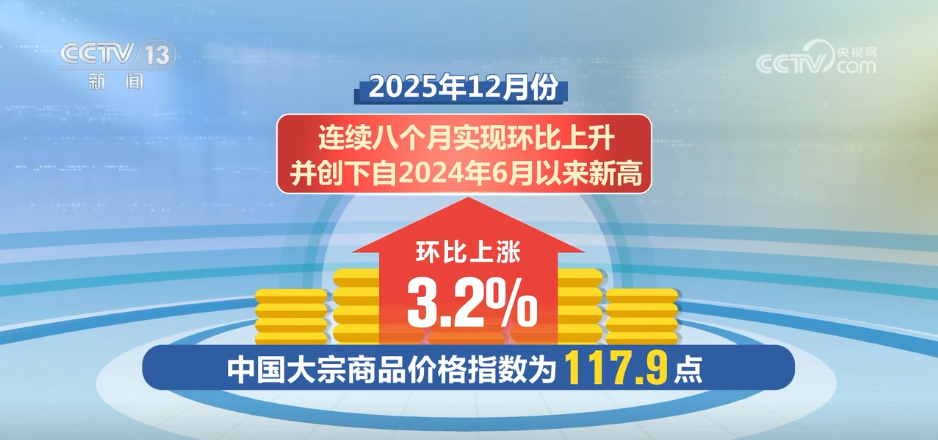
Core Viewpoint - The China Logistics and Purchasing Federation reported that the commodity price index reached 117.9 points in December 2025, indicating a continued recovery in the commodity market and improved supply-demand dynamics, which supports stable economic performance for the year [1][3]. Group 1: Commodity Price Index - The commodity price index for December 2025 was 117.9 points, reflecting a month-on-month increase of 3.2%, marking the eighth consecutive month of growth and the highest level since June 2024 [3]. - Among the 50 monitored commodities, 31 saw price increases in December, with lithium carbonate, refined tin, and apples leading the gains at 15.5%, 11.7%, and 8.5% respectively [5]. Group 2: Market Outlook - Experts predict that the overall commodity market in China will maintain a stable and positive trend in 2025, supported by proactive macroeconomic policies and structural economic upgrades that will create new demand for commodities [7]. - The price index for non-ferrous metals rose significantly by 4.9%, while agricultural products increased by 2.5%. Other indices, including mineral, black metal, and chemical prices, also saw slight increases of 0.8%, 0.4%, and 0.3% respectively [8].

2026年是“十五五”开局之年 今年宏观经济十大看点汇总
Zheng Quan Shi Bao· 2026-01-05 00:34
Group 1: Fiscal Policy - The fiscal deficit and government bond issuance scale are expected to increase in 2026 to support economic activities during the start of the "14th Five-Year Plan" [3] - The fiscal deficit is projected to be no less than 4.06 trillion yuan, maintaining a deficit rate of at least 4% [3] - New special bonds may rise from 4.4 trillion yuan in 2025 to nearly 5 trillion yuan in 2026 to support major project construction [3] Group 2: Monetary Policy - Monetary policy is expected to remain moderately loose to promote reasonable price recovery, with a CPI target set around 2% for 2026 [4] - Traditional monetary policy tools like reserve requirement ratio cuts and interest rate reductions will have flexible timing and rhythm [4] - Structural monetary policies will focus on expanding domestic demand, supporting technological innovation, and aiding small and medium enterprises [4] Group 3: Consumption and Income - Expanding domestic demand, particularly boosting consumption, is a primary task for 2026 [5] - The "Urban and Rural Residents Income Increase Plan" aims to enhance consumer capacity and willingness [6] - Policies will be optimized to adapt to changing consumption structures, directing subsidies towards service consumption areas [6] Group 4: Investment and Infrastructure - Fixed asset investment growth is targeted to stabilize, with infrastructure investment expected to accelerate due to new major projects [7] - Government investment will increase through various funding sources, including special bonds and policy financial tools [7] - Manufacturing investment, particularly in high-tech and equipment manufacturing, is anticipated to grow rapidly [7] Group 5: Real Estate Market - The real estate market will focus on "de-stocking" as a primary task, with policies to support both supply and demand [8] - Local governments will adjust real estate policies to remove unreasonable purchase restrictions and enhance housing fund support [8] - Efforts will be made to improve the market supply-demand relationship through better management of existing properties [8] Group 6: Capital Market Reforms - Comprehensive reforms in the capital market will focus on supporting technological innovation and enhancing market inclusivity [9][10] - Policies will aim to create a multi-layered market system to meet diverse investor needs and promote long-term investments [10] - Regulatory measures will be strengthened to prevent financial misconduct and enhance market stability [10] Group 7: Unified Market and Competition - The construction of a unified national market will accelerate, with new regulations to address "involution" in competition [11] - Capacity regulation in key industries will be enhanced to phase out outdated capacities and support new quality capacities [11] - Local government economic activities will be standardized to prevent irregularities in investment incentives [11] Group 8: Technological and Industrial Innovation - The integration of technological and industrial innovation will be a key focus, with an emphasis on practical applications of new technologies [12] - The expansion of international technology innovation centers in major regions will facilitate resource integration and innovation [12] - Regional coordinated development will be promoted to enhance new quality productivity across different areas [12] Group 9: State-Owned Enterprise Reforms - A new round of state-owned enterprise reforms will focus on optimizing the layout of state-owned economies and modernizing corporate governance [13][14] - Strategic mergers and acquisitions will be promoted to enhance resource allocation efficiency [14] - Digital transformation initiatives will be launched to support innovation in key industries [14] Group 10: Social Welfare and Employment - Employment will be prioritized, with policies aimed at stabilizing jobs and increasing labor income [15] - Measures will include expanding loans for job retention and enhancing unemployment insurance [15] - The income distribution system will be improved to raise labor compensation and establish a more robust social safety net [15]
金属涨跌互现 沪铝沪镍涨逾2% 纽银大跌超8% 铂主连跌逾12%
Sou Hu Cai Jing· 2025-12-31 08:45
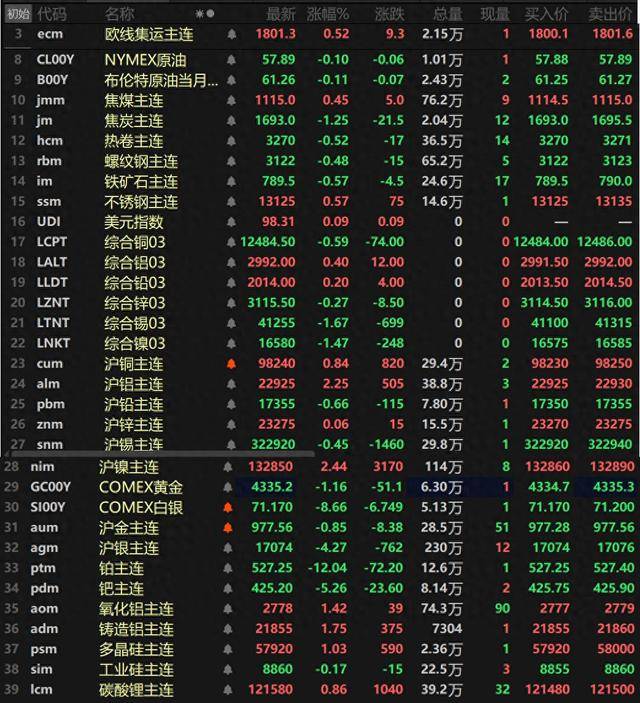
Metal Market - Domestic base metals generally rose, with only lead and tin declining by 0.66% and 0.45% respectively. Nickel and aluminum both increased by over 2%, with nickel rising 2.44% to a new high of 135,570 yuan/ton, and aluminum up 2.25% to 23,030 yuan/ton, marking the highest since March 2022 [1] - In the external market, base metals mostly fell, with only London aluminum and lead rising by 0.4% and 0.2% respectively. Tin and nickel dropped over 1%, with tin down 1.67% and nickel down 1.47% [1] - Precious metals saw declines, with COMEX gold down 1.16% and silver down 8.66%. Domestic gold and silver also fell by 0.85% and 4.27% respectively [1] Macro Environment - The National Bureau of Statistics reported that China's manufacturing PMI for December was 50.1%, indicating a recovery in economic activity. The new orders index rose to 50.8%, and the production index increased to 51.7%, reflecting positive changes in the manufacturing sector [5] - The National Development and Reform Commission announced a total of approximately 295 billion yuan for early-stage construction projects and central budget investments for 2026, aimed at stabilizing investment [6] - The People's Bank of China conducted a net injection of 502.8 billion yuan through reverse repos, maintaining the operation rate at 1.40% [7] - The USD/CNY exchange rate was reported at 7.0288, with the dollar index rising 0.09% to 98.31. The Federal Reserve's meeting minutes indicated a potential for future rate cuts if inflation decreases as expected [8] Oil Market - Both WTI and Brent crude oil prices fell slightly, with WTI down 0.1% and Brent down 0.11%. Analysts predict a nearly 20% decline in oil prices in 2025, with Brent potentially experiencing the longest annual decline in history due to oversupply [11] - OPEC+ is expected to pause production increases in the first quarter of 2026, with analysts forecasting that supply will exceed demand, leading to further price drops [11]