
政策利好

Search documents
“史上最长春节假期”催热旅游市场,板块望迎来业绩与估值双重修复
Xuan Gu Bao· 2026-01-19 14:43
Group 1 - The travel market is experiencing a surge in demand as the Spring Festival approaches, with student flight bookings increasing over 20% year-on-year since January [1] - Cross-border travel demand has exploded, with outbound travel service bookings rising nearly 40% and inbound travel flight bookings increasing over four times in the last two weeks [1] - High-end hotel bookings for the Spring Festival have surged nearly 70% year-on-year, indicating a growing demand for quality travel experiences [1] Group 2 - The government has emphasized expanding domestic demand and boosting service consumption, which is expected to benefit the travel sector, particularly OTA, hotels, and scenic spots [2] - The tourism sector is currently valued at historical lows, and the extended Spring Festival combined with visa-free policies is likely to lead to a dual recovery in performance and valuation [2] Group 3 - Junting Hotel is focusing on a light-asset strategy and expanding its brand influence through partnerships, while the opening of hotel REITs presents new opportunities for optimizing its asset structure [3] - China Duty Free Group, a leader in the duty-free market, is expanding its city duty-free store operations and implementing an integrated "airport + city store" model to enhance customer conversion rates [3]


AI应用或将点燃游戏新增长周期,聚焦游戏ETF(159869)布局机会
Mei Ri Jing Ji Xin Wen· 2026-01-14 06:34
Group 1 - The gaming sector is experiencing fluctuations, with the gaming ETF (159869) showing a slight decline, while individual stocks like Yaoji Technology and Zhejiang Shuzhu Culture have increased by over 6% [1] - As of January 13, the gaming ETF (159869) has reached a scale of 16.217 billion yuan, attracting a total of 1.405 billion yuan in the last 10 trading days, providing investors with a convenient tool for investing in A-share gaming leaders [1] - Open Source Securities believes that the listing of MiniMax may enhance its financial strength, financing capability, and brand awareness, which could support its model development and commercialization efforts in the AI social sector [1] Group 2 - The gaming sector is catalyzed by multiple factors including AI, content, and changes in commercialization models, with the gaming ETF (159869) tracking the CSI Animation and Gaming Index, which has the highest AI application content in the market [2] - The current gaming sector is benefiting from favorable policies, product cycles, and the empowerment of AI, suggesting a potential window for focusing on gaming sector investments [2]
油气设服板块爆发!2股涨停通源石油涨超13%,地缘政治与政策多重利好共振
Jin Rong Jie· 2026-01-13 03:19
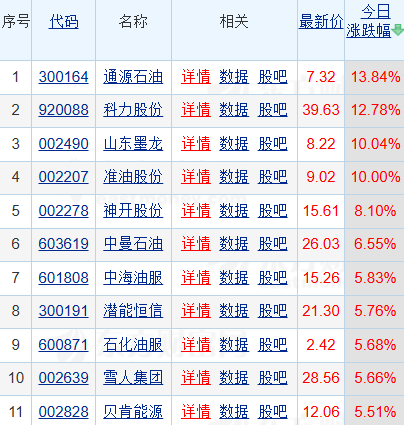
Group 1: Market Performance - The oil and gas service sector showed strong performance, with two stocks hitting the daily limit up, including Tongyuan Petroleum rising over 13% and Keli Co. rising over 12% [1][2] - Other notable stocks included Shandong Molong and Zhun Oil, both hitting the limit up, while ShenKong Co. rose over 8% and Zhongman Petroleum over 6% [1][2] Group 2: Geopolitical Influences - Recent geopolitical changes, particularly the U.S. military actions in Venezuela and plans to restore the country's oil infrastructure, have catalyzed market sentiment, with expectations that the U.S. will lift sanctions on Venezuela, which holds the world's largest oil reserves of approximately 302.8 billion barrels [1][3] - The severe damage to Venezuela's oil facilities necessitates large-scale orders for repairs, directly benefiting oil service equipment companies [1][3] Group 3: Oil Price Outlook - Geopolitical risks are expected to support oil prices in the short term, with predictions of prices remaining in the range of $60 to $70 per barrel, despite a current oversupply in the global oil market [3] - A short-term supply gap of around 1 million barrels per day from Venezuela is anticipated to push oil prices upward [3] Group 4: Policy Support - Domestic policies, particularly the revised "Petroleum and Natural Gas Infrastructure Planning, Construction, and Operation Management Measures," effective from January 1, 2026, provide a clear development path for the oil and gas service industry [3][4] - The policy encourages social capital participation in projects like gas storage and LNG receiving stations, enhancing the operational framework for national pipeline networks [3][4] Group 5: Industry Opportunities - The demand for oil and gas exploration, pipeline laying, and equipment maintenance is expected to rise due to policy-driven infrastructure improvements [4] - The oil and gas exploration service sector is likely to benefit from increased investment in exploration, with companies possessing advanced seismic and drilling technologies expected to see sustained growth in orders and revenue [5][6] - The deep-sea oil and gas development is driving demand for high-end equipment, with manufacturers possessing core technologies poised for a surge in orders and market share [6]





避险需求叠加政策利好 瑞郎创短期新高
Jin Tou Wang· 2026-01-12 02:36
Core Viewpoint - The Swiss Franc (CHF) continues to strengthen against the US Dollar (USD), driven by its status as a safe-haven currency amid rising global political and economic uncertainties [1][2]. Group 1: Currency Performance - As of January 12, the CHF/USD exchange rate is at 1.2527, reflecting a 0.35% increase from the previous trading day [1]. - The CHF/USD has shown a daily trading range of 1.2473 to 1.2547, indicating a volatility of 0.59% [1]. - The current exchange rate stability is reinforced by a strong demand for CHF in large transactions, with a conversion rate of 1 CHF to 1.2485 USD [1]. Group 2: Economic Factors - The traditional safe-haven status of the CHF is bolstered by Switzerland's political stability, long-term trade surplus, low debt levels, and a robust innovative economy [1]. - An agreement between Switzerland and the US regarding tariff disputes has mitigated significant external economic risks, supporting the CHF's strength [1]. - The US Dollar Index has shown insufficient momentum, closing at 98.90 on January 9, which has created favorable conditions for the CHF to appreciate against the USD [2]. Group 3: Market Sentiment and Technical Analysis - The Swiss National Bank's (SNB) stable monetary policy, in the context of rising inflation and nearing interest rate limits, has enhanced market confidence in the CHF [2]. - Technical indicators suggest that the CHF/USD is in a bullish trend, having broken through the upper boundary of a short-term trading range, with potential resistance at 1.2600 if the upward momentum continues [2][3]. - Short-term trading strategies suggest buying in the range of 1.2480-1.2550, with support at 1.2473 and a stop-loss set below 1.2450 [3].
股指黄金周度报告-20260109
Xin Ji Yuan Qi Huo· 2026-01-09 11:46
1. Report Industry Investment Rating - No relevant content provided 2. Core Viewpoints of the Report - In the short - term, due to repeated digestion of previous policy benefits and unremarkable improvement in corporate earnings, the stock index has a need for adjustment after continuous rise; with the upcoming adjustment of the benchmark commodity index weight and the upgrade of precious metal trading supervision, gold is in a high - level shock, and it is necessary to be vigilant against adjustments caused by the emergence of profit - taking selling pressure [35] - In the medium and long - term, the valuation of the stock index will still be dragged down by the decline in the corporate earnings growth rate at the molecular end, while the support at the denominator end mainly comes from the recovery of risk appetite, and the stock index maintains a wide - range shock idea in the medium term; the stimulating effect of the US tax - cut policy on the economy will gradually appear, the room for the Fed to cut interest rates further in the future is narrowing, and there is a risk of a deep adjustment in gold [35] 3. Summary According to the Directory 3.1 Domestic and International Macroeconomic Data - In December 2025, the official manufacturing PMI rose to 50.1 (previous value 49.2), returning to the expansion range after 8 months, with industrial production accelerating significantly and demand improving marginally. In December, CPI increased by 0.8% year - on - year (previous value 0.7%), and the year - on - year decline of PPI was 0.9%, narrowing by 0.3 percentage points compared with the previous month [6] 3.2 Stock Index Fundamental Data - The effect of the "anti - involution" policy is gradually emerging. Commodity prices such as new energy, non - ferrous metals, and coal have rebounded, and the year - on - year decline of PPI has narrowed, which helps to improve the profits of upstream raw material processing [12] - The margin trading balance of the Shanghai and Shenzhen stock markets rose to 2603.143 billion yuan, hitting a new record high. The central bank carried out a total of 138.7 billion yuan of 7 - day reverse repurchase operations this week, achieving a net withdrawal of 1655 billion yuan [15] 3.3 Gold Fundamental Data - The number of new ADP jobs in the US in December was 41,000, lower than the expected 47,000. The number of JOLTs job openings in November dropped to 7.146 million, the lowest since February 2021, indicating that the US labor market is slowly recovering and concerns about weak employment have eased [20][21] 3.4 Domestic and International Gold Inventory Situation - Shanghai gold futures warehouse receipts and inventory increased, and the inventory of COMEX gold in New York increased slightly, reflecting an increase in physical delivery demand [33] 3.5 Strategy Recommendation - In December 2025, the official manufacturing PMI returned to the expansion range, industrial production accelerated significantly, and demand improved marginally, but the downward pressure on external demand remained large, and the prosperity of small and medium - sized enterprises was still weak. CPI has risen for three consecutive months year - on - year, and the year - on - year decline of PPI has narrowed, reflecting a recovery in consumer demand and prices and a relief of downward pressure on industrial products [35] - In terms of corporate earnings, driven by the "anti - involution" and elimination of backward production capacity policies, the prices of commodities such as new energy and non - ferrous metals have risen, which helps to repair the profits of upstream raw material processing industries; however, the operating pressure of downstream enterprises is still large, some industries have over - capacity, and production costs are difficult to be passed on to end - consumers, and they are still in the stage of active inventory reduction [35] - The central bank's work conference in 2026 emphasized increasing the intensity of counter - cyclical and cross - cyclical adjustments and flexibly and efficiently using various monetary policy tools such as reserve requirement ratio cuts and interest rate cuts. Recently, the policy side has continuously released positive signals, and the market's expectation of reserve requirement ratio cuts and interest rate cuts at the beginning of the year has increased, which helps to improve risk appetite [35] - The military strike launched by the US against Venezuela during the New Year's Day holiday has caused turmoil in the international geopolitical situation. After the holiday, the rise in the gold price is mainly driven by risk - aversion sentiment. Recently, the market is worried that the annual weight adjustment of the commodity benchmark index may lead to passive selling of gold and silver, and some funds have taken profits in advance. In addition, the CME has continuously raised the performance margin for precious metals, which helps to suppress excessive speculation and reduce irrational fluctuations [35]
A股五大上市险企集体飘红,多股创历史新高
21世纪经济报道· 2026-01-06 11:44
Core Viewpoint - The insurance sector is experiencing a strong performance driven by a bull market, favorable policies, improved industry fundamentals, and institutional support for valuation recovery [2][3][5]. Group 1: Market Performance - In the first two trading days of 2026, the insurance industry index rose by 3.29%, with all five major listed insurance companies in A-shares showing positive performance [1]. - Several insurance stocks reached historical highs, with China Ping An (601318.SH) hitting a peak of 234.59 yuan per share, marking a record since its listing [2][1]. - The total market capitalization of the five major listed insurance companies reached approximately 3.89 trillion yuan, an increase of about 128.8 billion yuan from the previous trading day [1]. Group 2: Driving Factors - The bull market is identified as a key driver for the insurance stock performance, with expectations of market growth enhancing the earnings elasticity and valuation recovery potential of the insurance sector [3]. - Recent policy adjustments by the National Financial Regulatory Administration, including changes to risk factors for insurance companies, are expected to lower capital constraints and expand investment opportunities [3]. - The improvement in the industry fundamentals is also a significant factor, with expectations of a strong performance in insurance premiums for 2026, driven by liability cost optimization and a shift in product structure [4]. Group 3: Financial Metrics - In the first eleven months of 2025, the insurance industry reported a total premium income of 5.76 trillion yuan, reflecting a year-on-year growth of 7.6%, with life insurance premiums growing by 9.2% [4]. - The total assets of the insurance industry surpassed 40 trillion yuan, with net assets reported at 3.68 trillion yuan [4]. Group 4: Future Outlook - The insurance sector is expected to maintain its upward trend in 2026, supported by strong demand for protection and savings products, as well as ongoing policy support [5]. - However, potential risks include the pace of valuation recovery and the sustainability of liability-side improvements, which need to be monitored closely [5].






长江有色:投机情绪浓烈且低库存支撑 6日铝价或大涨
Xin Lang Cai Jing· 2026-01-06 02:55
Group 1: Market Overview - The aluminum market is experiencing a bullish trend driven by rising stock markets and oil prices, with LME aluminum prices increasing by 2.28% to $3,090 per ton [1][2] - The Shanghai aluminum market is also seeing significant gains, with the main contract closing at 24,165 yuan per ton, up 2.57% [1] - The recent geopolitical tensions, particularly the U.S. military action in Venezuela, have heightened market risk aversion and boosted demand for precious metals like gold, which rose nearly 3% [2] Group 2: Supply and Demand Dynamics - Domestic electrolytic aluminum supply is limited, while demand is weakening due to seasonal factors and high aluminum prices, leading to a decline in operating rates among downstream processing enterprises [3] - As of January 5, China's major market electrolytic aluminum inventory increased by 65,000 tons to 703,000 tons, indicating growing fundamental pressure on aluminum prices [3] - Despite the increase in inventory, overall stock levels remain historically low, and external market strength may support a continued upward trend in aluminum prices [3] Group 3: Policy and Economic Factors - The Chinese government has implemented favorable macroeconomic policies, including the early issuance of 62.5 billion yuan in special long-term bonds to stimulate consumer demand during peak seasons [2] - These policy measures are expected to enhance market optimism and support the aluminum market amid rising prices and speculative trading [2]

郑棉先抑后扬 报收十字星
Xin Lang Cai Jing· 2025-12-31 12:14
Core Viewpoint - The cotton market is experiencing fluctuations, with the main Zheng cotton contract showing a slight increase of 0.52% after initially declining, driven by expectations of reduced planting area and concerns over future supply constraints [1] Group 1: Market Dynamics - The anticipated decrease in domestic planting area for the new year has heightened market concerns regarding future supply shortages, providing strong support for cotton prices [1] - Despite the expected abundant cotton yield this year, supply pressure remains, compounded by the traditional off-season for the textile industry, leading to weak new orders from weaving factories [1] Group 2: Industry Challenges - Domestic textile enterprises are facing significant pressure, as the rise in cotton prices has not been matched by an increase in downstream yarn prices, resulting in squeezed profits for yarn manufacturers [1] - The motivation for textile companies to replenish raw materials is weakening due to these profit pressures [1] Group 3: Future Outlook - According to Everbright Futures, Zheng cotton is expected to maintain a strong oscillating trend in the short term, driven by a combination of strong expectations and strong realities, which differs from previous purely expectation-driven trading [1] - The likelihood of turning positive expectations into negative outcomes is lower this time, and there are still favorable policy developments anticipated in the future [1]
政策利好来了!沪深交易所齐发降费通知 总金额将超19亿元
Xin Lang Cai Jing· 2025-12-27 07:45
Group 1 - The article does not provide specific insights or data regarding any company or industry [1]
A股罕见七连阳 短线关注5日线
Xin Lang Cai Jing· 2025-12-25 16:21
Group 1 - The A-share market indices experienced a slight rise on Thursday, with the Shanghai Composite Index achieving a seven-day winning streak, closing up 0.47% at 3959.62 points, the Shenzhen Component Index up 0.33% at 13531.41 points, and the ChiNext Index up 0.30% at 3239.34 points [1] - The total trading volume in the Shanghai and Shenzhen markets reached 1.9245 trillion yuan, an increase of 44.3 billion yuan compared to the previous trading day, with nearly 3,800 stocks rising and close to 100 stocks hitting the daily limit [1] - The market's upward trend is supported by favorable policies and improvements in the exchange rate, with the central bank signaling a commitment to maintaining market stability and providing liquidity support through various monetary tools [1] Group 2 - Historical trends indicate that a seven-day winning streak is rare in the A-share market and often suggests a continuation of the upward trend, typically accompanied by increased trading volume and a broadening profit effect [2] - However, caution is advised as historical data shows that after a seven-day winning streak, the market may experience differentiation or short-term pullbacks due to profit-taking and differing expectations for future positive developments [2] - The market's rebound is characterized by a moderate pace, lacking a clear core theme, and rapid rotation of hotspots, indicating that market participants remain cautious [3]