
美日利差

Search documents
【2026年汇市展望】美元或进一步走弱 非美货币走势或分化
Sou Hu Cai Jing· 2026-01-04 08:26
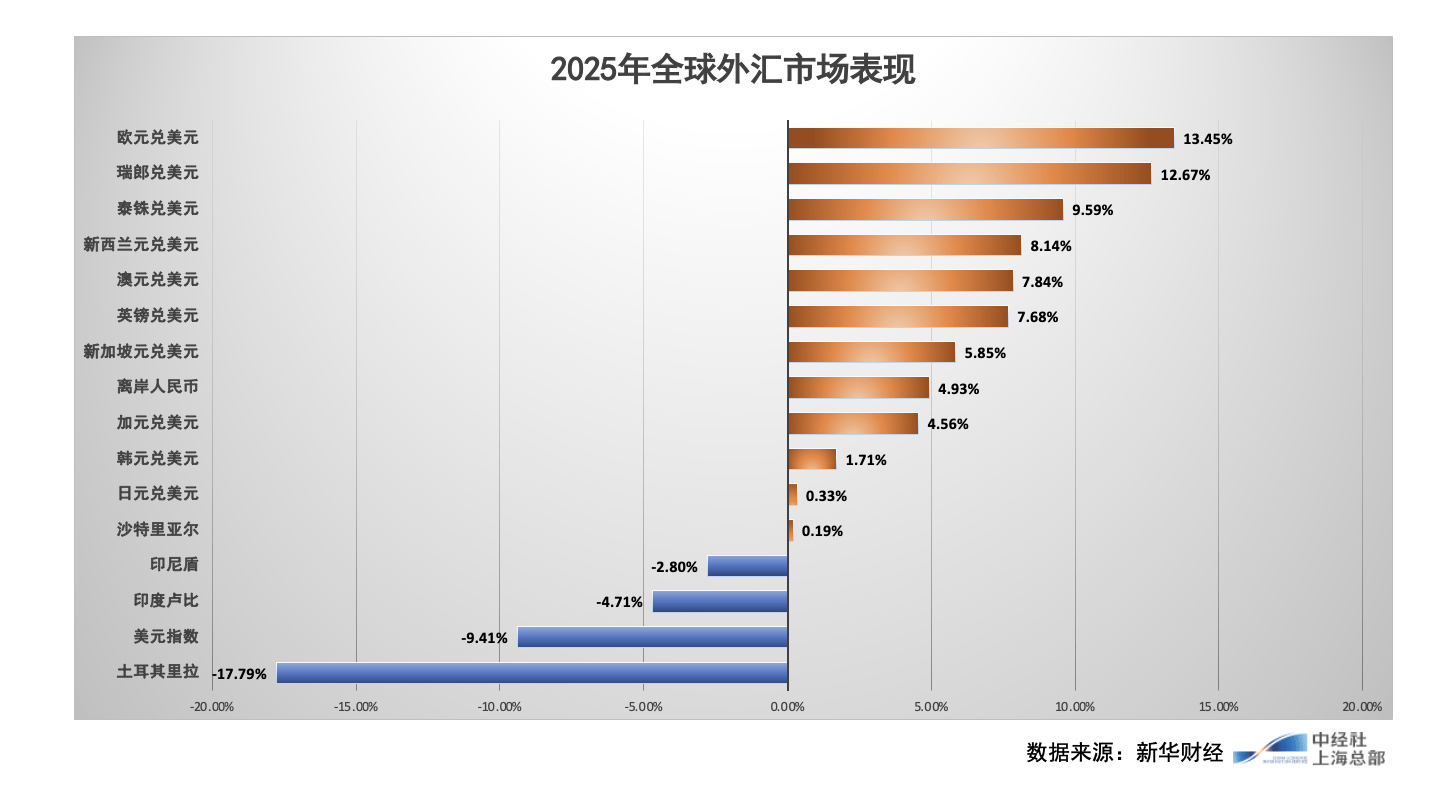
Group 1: Core Insights - The US dollar index is expected to decline further in 2026, following a significant drop of 9.41% in 2025, the largest annual decline since 2017, influenced by a weakening US economy, tariff policies, and ongoing interest rate cuts by the Federal Reserve [1][5] - Analysts predict that the dollar will weaken against major currencies such as the euro, yen, and pound, with an estimated additional decline of about 3% by the end of 2026 [5][6] - The divergence in monetary policy among major central banks is expected to continue, with the Federal Reserve likely to maintain a loose monetary stance while other central banks may raise rates or keep them stable, further pressuring the dollar [4][8] Group 2: Currency Performance - The euro is projected to strengthen significantly, with an increase of over 13.4% against the dollar in 2025, reaching levels above 1.17 USD per euro, supported by improved economic conditions in the Eurozone [1][8] - The Australian dollar is expected to perform well in 2026, benefiting from stable economic growth and potential interest rate hikes, following a 7.84% appreciation in 2025 [9][11] - In contrast, the Japanese yen and British pound are anticipated to face weaker performance in 2026, with the yen potentially falling below the 160 mark against the dollar due to persistent low interest rates and economic uncertainties [10][13]

对冲需求激增释放关键信号 日元套利交易“好日子”到头了?
智通财经网· 2025-12-29 07:53
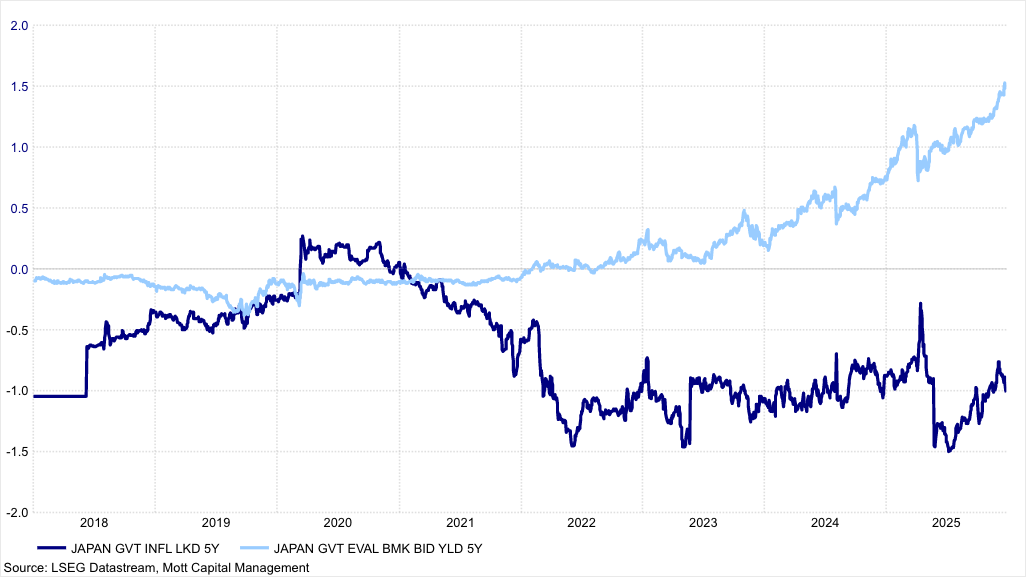
智通财经APP获悉,对冲日元兑美元汇率风险的需求正在上升,这或许是日本利率上行开始影响套利交易的第一个信号。在日本央行12月加息并 暗示未来仍可能进一步收紧货币政策之后,日本利率已升至数十年来高位——日本五年期国债收益率升至约1.5%,这是2008年以来未曾见过的水 平。尽管名义利率已经上升,但盈亏平衡通胀预期也同步上行,这意味着日本的实际利率仍然处于深度负值区间。 远期利率 五年期日元远期利率目前仍处于关键水平,暗示突破可能迫在眉睫。如果隔夜利率之间的利差持续收窄,可能会对远期利率施加更大压力,促使 其进一步压缩。 总体而言,要使日本的实际利率转为正值,五年期名义利率需要升至约2.5%以上,这一水平相当于假设的盈亏平衡通胀率,也是当前名义利率与 实际利率之间的差值。这意味着,如果日本央行最终目标是将利率推升至正区间,日本五年期利率在未来几个月可能仍需要显著上行。 更高的日本五年期利率将意味着美日利差将明显收窄,除非美国利率与日本利率同步上升、甚至上升得更快。但鉴于市场预计美联储将在2026年 降息,美国利率上行速度快于日本的可能性似乎并不大。 最终,这一趋势是否持续,很大程度上取决于日元能否相对美元走强。尽 ...
日元空头共识渐成:2026年或跌破160大关,日本央行谨慎政策难解困局
Hua Er Jie Jian Wen· 2025-12-26 12:55
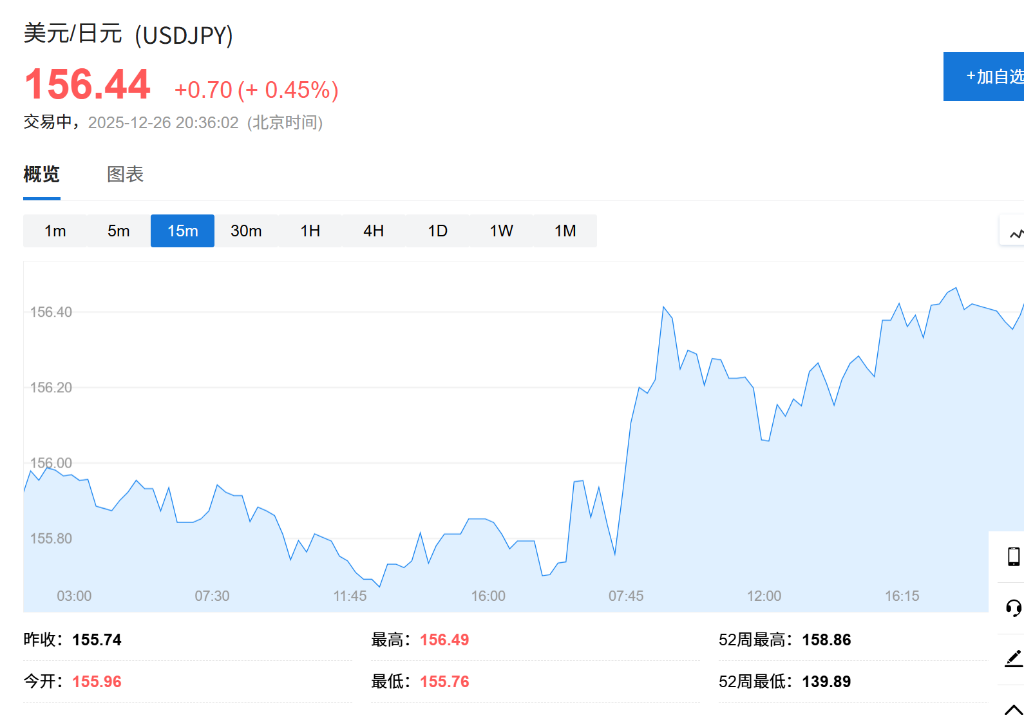
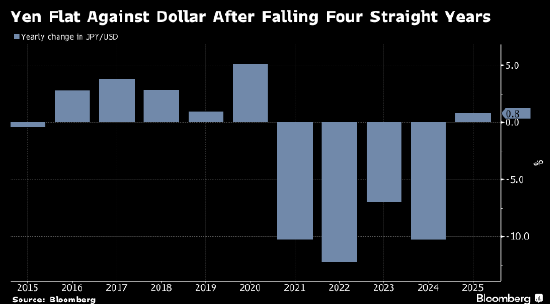
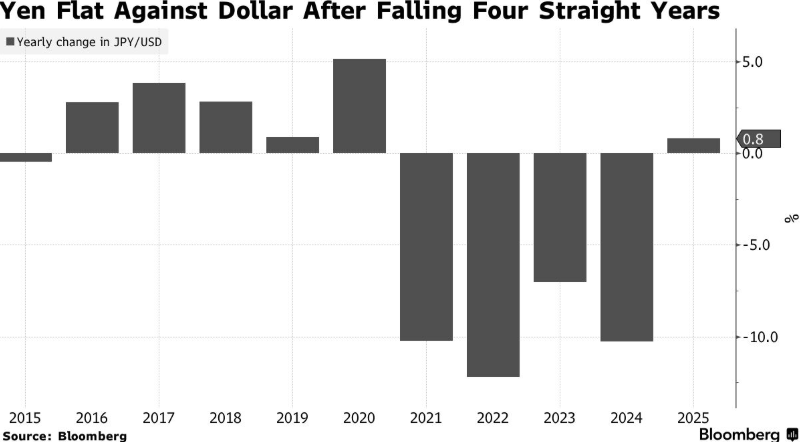
Core Viewpoint - The market sentiment towards the Japanese yen is increasingly bearish, with major institutions predicting a significant depreciation against the US dollar by the end of 2026, driven by high interest rate differentials and negative real interest rates [1][3]. Group 1: Market Predictions - Major institutions like JPMorgan and BNP Paribas forecast that the yen will fall below 160 against the dollar by the end of 2026, with some predictions as low as 164 [1][3]. - The yen has only seen a marginal increase of less than 1% against the dollar this year, failing to recover from a four-year decline, and currently hovers around 156, close to its early year low of 158.87 [1][3]. Group 2: Economic Fundamentals - The fundamental weakness of the yen is a primary concern, with predictions that this situation will not improve significantly in the near future [3][5]. - The cyclical forces are expected to turn increasingly unfavorable for the yen, as the market prices in higher interest rates in other regions, limiting the impact of the Bank of Japan's tightening policies [3][5]. Group 3: Capital Outflow - Domestic capital outflow is a significant factor pressuring the yen, with retail investors maintaining high levels of overseas stock investments, around 9.4 trillion yen (600 billion) [4]. - Japanese companies are also increasingly investing abroad, with direct investment levels remaining stable and M&A activity reaching new highs, further exacerbating the yen's depreciation [4]. Group 4: Intervention Risks - The risk of official intervention has resurfaced as the yen approaches levels that previously triggered government action, but market experts believe that mere intervention may not reverse the structural depreciation trend [6]. - Despite warnings from officials about excessive speculation, the market remains volatile, and simple smoothing operations may not be effective in changing the yen's downward trajectory [6].
日本央行政策路径谨慎 2026年唱空日元的调门越来越高
Xin Lang Cai Jing· 2025-12-26 06:30
Core Viewpoint - The recent interest rate hike by the Bank of Japan has not sustained a boost for the yen, leading to increasing bearish sentiment towards the currency and reinforcing the view that the yen's structural weakness will not be resolved quickly [1][5]. Group 1: Market Predictions - Strategists from institutions like JPMorgan and BNP Paribas predict that the yen will depreciate to 160 or lower against the dollar by the end of 2026, influenced by the large US-Japan interest rate differential, negative real interest rates, and ongoing capital outflows [1][5]. - JPMorgan's chief Japan FX strategist, Junya Tanase, forecasts a more pessimistic outlook, predicting the yen will reach 164 by the end of 2026, citing cyclical factors that may further pressure the yen [3][8]. - BNP Paribas' strategist, Parisha Saimbi, anticipates that the dollar will rise to 160 against the yen by the end of 2026, supported by strong arbitrage demand and a cautious stance from the Bank of Japan [4][9]. Group 2: Economic Factors - The yen has only appreciated less than 1% against the dollar this year, despite expectations of interest rate hikes from the Bank of Japan and rate cuts from the Federal Reserve [1][5]. - The yen is currently fluctuating around 156, close to its yearly low of 158.87, indicating ongoing weakness [1]. - Japanese household investments in overseas assets remain high, with net purchases of foreign stocks hovering around 9.4 trillion yen (600 million USD), which is a ten-year high, contributing to downward pressure on the yen [4][9]. Group 3: Investment Trends - There is a notable trend of Japanese companies increasing their overseas direct investments, with this year's M&A activity reaching a multi-year high, which may be a persistent driver of capital outflows [7][11]. - The popularity of borrowing low-interest yen to invest in higher-yield currencies like the Brazilian real and Turkish lira is creating additional resistance to any potential rebound of the yen [3][8].
STARTRADER:日元持续走软,市场预期弱势或延续至中期?
Sou Hu Cai Jing· 2025-12-26 05:27
Group 1 - The recent interest rate hike by the Bank of Japan has not provided sustained support for the yen, reinforcing market perceptions of its structural weakness [1] - The primary factors influencing the yen's movement are the US-Japan interest rate differential, real interest rates, and capital flows, with single policy adjustments having limited impact [2] - Multiple international institutions predict that the yen's depreciation pressure may continue into the medium term, with JPMorgan and BNP Paribas forecasting the USD/JPY exchange rate could rise to 160 or higher by the end of 2026 [2] Group 2 - The yen has experienced a slight appreciation of less than 1% this year after four consecutive years of decline, but expectations of a currency reversal due to the Bank of Japan's rate hike and the Federal Reserve's rate cut have not materialized [5] - The yen's fundamentals have not improved, and in a pessimistic scenario, the USD/JPY rate could reach 164 by the end of 2026, with diminishing marginal effects from future rate hikes by the Bank of Japan [5] - The return of arbitrage trading has continued to suppress the yen, with leveraged funds increasing their short positions against the yen to multi-month highs [7] Group 3 - Japanese households and businesses maintain a strong preference for overseas assets, with retail investors significantly increasing net purchases of foreign stocks, reaching near a decade-high scale [7] - The ongoing growth in Japanese companies' foreign direct investment, with this year's M&A activity reaching multi-year highs, is a significant structural factor contributing to the yen's weakness [7] - As the exchange rate approaches levels that may trigger government intervention, official statements are becoming more assertive, although most analysts believe that intervention alone cannot reverse the yen's medium-term weakness [7]
日元没有“速效药”!日本央行渐进紧缩难逆转结构性颓势 华尔街唱空声浪高涨
Zhi Tong Cai Jing· 2025-12-26 02:06
Core Viewpoint - The recent interest rate hike by the Bank of Japan has failed to provide sustained support for the yen, leading to increased bearish sentiment towards the currency, with predictions of further depreciation against the dollar by 2026 [1][2]. Group 1: Economic Factors - Analysts from major financial institutions, including JPMorgan and BNP Paribas, predict that the yen could weaken to 160 yen per dollar or lower by the end of 2026 due to persistent factors such as significant US-Japan interest rate differentials, negative real interest rates, and ongoing capital outflows [1][2]. - The yen has seen a slight increase of less than 1% against the dollar this year after four consecutive years of decline, but expectations for a reversal driven by the Bank of Japan's rate hikes and potential Fed rate cuts have not materialized [1][2]. - The return of arbitrage trading, where investors borrow low-yielding yen to invest in higher-yielding currencies, is creating additional headwinds for the yen [2]. Group 2: Market Sentiment - Market sentiment remains cautious, with the overnight index swap indicating that the next rate hike by the Bank of Japan is not fully priced in, expected at the earliest in September [2]. - The ongoing high inflation in Japan, which exceeds the Bank of Japan's 2% target, continues to exert pressure on Japanese government bonds [2]. - Japanese retail investors are showing a strong preference for overseas assets, with net purchases through investment trusts hovering around 9.4 trillion yen (approximately 60 billion USD), a ten-year high, which is likely to persist and further suppress the yen [3]. Group 3: Long-term Predictions - Some analysts, including those from Goldman Sachs, believe that the yen may eventually strengthen to 100 yen per dollar over the next decade, although they acknowledge the presence of multiple short-term negative factors [4]. - Concerns about intervention risks are rising as the yen approaches levels that previously prompted official action, but experts suggest that intervention alone may not be sufficient to reverse the yen's downward trend [4][5].


宏观流动性系列一:日本央行加息短期影响有限
Hua Tai Qi Huo· 2025-12-23 09:23
Report Industry Investment Rating - Not provided in the report Core Viewpoints - The current interest rate hike space in Japan mainly comes from the triple improvement of inflation, finance, and interest rate structure, allowing the benchmark interest rate to be slightly raised from 0.75% to about 1% in the next 1 - 2 years. The policy divergence of "US rate cuts and Japan rate hikes" will narrow the US - Japan interest rate spread from about 300bp to 200bp, reducing the profit space of yen carry trades and triggering a re - balance of global assets. Overall, this round of interest rate and spread convergence is more likely to bring about a mild repricing rather than a systemic shock [2]. - The core feature of yen carry trades lies in its large - scale hierarchical liability structure rather than a single - direction yen short position. The entire liability pool consists of three parts: the upper layer is a few billion dollars in futures shorts with limited volume but high volatility; the middle layer is a highly leveraged liability pool of over 10 trillion US dollars formed through foreign exchange swaps, forwards, and swaps, which is most sensitive to interest rate spreads and fluctuations; the bottom layer is over 10 trillion US dollars in long - term overseas assets of Japan, with a slower adjustment rhythm. The middle layer, which is the largest in scale and highest in leverage, truly affects systemic fluctuations [3]. - Although the reversal of yen carry trades will trigger market fluctuations, the conditions for triggering a global liquidity shock are not fully met: Japan's interest rate hike rhythm is moderate, high - leverage positions have been cleared in advance, and the Fed's liquidity has not tightened. In the short term, it is more likely to see a temporary repricing of high - valuation and long - duration assets rather than a systemic stampede; only in the extreme scenario of Japan's continuous and significant over - expected interest rate hikes and a strong policy divergence with the US can the cross - asset liquidity risk be significantly magnified [4]. Summary by Directory From the Cause of Inflation to See Japan's Interest Rate Hike Space - Combining economic, inflation, and fiscal dimensions, it can be roughly outlined that Japan's current interest rate hike space is from exiting extreme easing to returning to a normal and slightly loose state. That is, in the next 1 - 2 years, it is feasible to slowly raise the policy interest rate from 0.75% to about 1%. However, extending to 1.5% - 2% or higher requires stronger growth and nominal income support. Otherwise, with the existing debt stock, market concerns about fiscal sustainability will heat up sharply. This round is more like multiple small - step interest rate hikes to around 1%, allowing the long - end to be repriced gradually, rather than an American - style continuous and large - scale interest rate hike cycle [8]. Monetary Policy Divergence, Yen Depreciation, and Yen Carry Trades - In the past five years, Japan's monetary policy has shown an obvious divergence from the global trend. While major economies have aggressively raised interest rates under the constraint of high inflation, Japan did not exit negative interest rates until March 2024 and only slightly raised interest rates by 25bp in January 2025, with a policy rhythm much slower than the global average. The monetary policy divergence has led the US - Japan policy interest rate spread to reach nearly 560bp at its peak in 2023, resulting in a significant strengthening of the US dollar and an accelerated depreciation of the yen since 2022. Japan's low interest rates, a significantly enlarged US - Japan interest rate spread, and the yen's depreciation have provided an excellent profit environment for yen carry trades and released liquidity globally through the path of borrowing yen and buying high - interest - rate assets. This is also the reason for the continuous rise of assets such as technology - represented stocks, commodities, and digital currencies in the past [10]. Yen Depreciation Pushes Up Japan's Inflation Pressure, Leading to Passive Monetary Tightening - The side effects of the continuous depreciation of the yen are forcing the Bank of Japan to raise interest rates. On the one hand, the weakening yen has raised the prices of imported energy and food. Japan's high dependence on foreign countries means that imported inflation is inevitable. On the other hand, after 30 years of structural adjustment, changes in the labor market structure have led to a continuous increase in domestic wages. Japan's core CPI has been running above 2% since 2022, marking the end of the deflation era. In this context, the Bank of Japan's recent release of a clearer signal of interest rate hikes is a response to the rising inflation center and the risk of a wage - inflation spiral, aiming to stabilize the yen exchange rate and inflation expectations before the doubts about sovereign credit intensify [18]. Japan's High Fiscal Debt Reality Constrains the Upside Space of Interest Rates - Japan's "lost 30 years" is also the 30 years of large - scale fiscal stimulus. The fundamental reason why Japan has been able to maintain roughly controllable finances under the premise of a debt/GDP ratio exceeding 200% in the past two decades is the continuous decline in the average interest payment rate. With the recovery of the inflation environment, market concerns about Japan's fiscal sustainability are also increasing, further pushing down the yen and pushing up long - term interest rates, forming a "dual pressure of exchange rate and interest rate." Currently, driven by the Bank of Japan's interest rate hikes and the rise of long - term interest rates, the average fiscal interest payment rate has turned upward, and the proportion of interest payments has also begun to rise slightly. The fiscal tolerance for interest rate hikes has obviously decreased [27]. From the Monetary Policy Divergence to See the Compression Space of Interest Rate Spreads - In the next year, the policy divergence of "US rate cuts and Japan rate hikes" will dominate the profit structure and capital flow of yen carry trades. In the current environment of still high interest rate spreads, this divergence will drive the nominal interest rate spread to narrow slowly, and the narrowing rhythm determines whether carry positions will be moderately re - balanced or trigger concentrated liquidation in extreme scenarios. In the baseline scenario, the interest rate spread narrows but does not reverse, and the carry space still exists; while the stress scenario requires the resonance of both the rapid weakening of the US and the rapid interest rate hikes in Japan to possibly lead to a sharp decline or even an inversion of the interest rate spread. Overall, the probability of the extreme combination is low, but its potential disturbances need to be vigilant [33]. Dismantling the Scale and Structure of the Yen Carry Trade Liability Pool - Overall, yen carry trades have evolved from the traditional single - direction bet into a large and complex hierarchical liability system. The different sources of funds, leverage structures, and risk exposures at different levels determine their volatility patterns and vulnerability points. When interest rate spreads narrow and exchange rate fluctuations intensify, short - term price shocks are often triggered by leveraged funds in the upper and middle layers, while it is the global allocation of Japanese institutions at the bottom layer that truly affects the cross - cycle capital flow. Therefore, understanding the systemic risk of yen carry trades lies not in simply looking at the scale of speculative short positions, but in identifying the behavioral constraints and re - balance rhythms of different layers [37]. Yen Carry Trade Reversal and Global Liquidity Shock - Currently, the macro and policy conditions may cause fluctuations but are not sufficient to trigger a systemic liquidity shock. The market has already factored in Japan's interest rate hike path in advance, and high - leverage yen short positions have been significantly cleared in the previous round of shocks. The Fed is in a stage of slow interest rate cuts, and the US dollar liquidity has not tightened significantly, making potential de - leveraging more likely to manifest as asset re - pricing rather than a full - scale stampede. On this basis, the key risk of yen carry trades is gradually shifting from short - term event shocks to the adjustment of capital flow driven by long - term changes in the interest rate spread pattern [43].
日银决议前瞻 汇债市屏息日元区间博弈中
Jin Tou Wang· 2025-12-17 02:25
Core Viewpoint - The focus of the global currency and bond markets is on the upcoming Bank of Japan monetary policy decision, with expectations of a 25 basis point rate hike to 0.75% [1] Group 1: Currency Market - The USD/JPY exchange rate is currently at 154.858, down 0.22% for the day, indicating a cautious market sentiment ahead of the policy decision [1] - The USD/JPY has shown a clear downward trend, recently breaking below the key psychological level of 155.00, influenced by both fundamental and technical factors [2] - Key resistance levels for USD/JPY are at 155.438 (Bollinger Band middle line) and 156.263 (Bollinger Band upper line), while support levels are at 154.613 (Bollinger Band lower line) and 154.342 (recent low) [3] Group 2: Bond Market - The 10-year Japanese government bond yield is currently at 1.951%, having slightly decreased by 0.15% for the day, with a previous high of 1.976% [1] - The 10-year bond yield is exhibiting a range-bound trading pattern, with resistance levels at 1.976 (previous high) and 1.991 (Bollinger Band upper line), and support levels at 1.941 (Bollinger Band middle line) and 1.891 (Bollinger Band lower line) [3] - The MACD indicator for the 10-year bond yield shows a DIFF value of 0.032 and a DEA value of 0.038, indicating a weak bullish trend with insufficient momentum [2]
【宏观】胶着的医保谈判,不确定的政府停摆——《大国博弈》系列第九十二篇(赵格格/周可)
光大证券研究· 2025-12-16 23:03
Core Viewpoints - The ongoing expansion of the interest rate differential between the US and Japan since 2022 has led to an increase in the scale of yen carry trades, raising concerns about potential market impacts due to the reversal of these trades [4][5]. Group 1: Yen Carry Trade Activity - The activity level of yen carry trades can be observed through both on-balance and off-balance sheet banking operations. On-balance sheet metrics include the volume of yen-denominated loans issued by global banks and the scale of internal accounts held by foreign banks in Japan. Off-balance sheet observations can be made through the foreign exchange swap market, particularly by monitoring the net short positions in non-commercial yen futures [5]. Group 2: Bank of Japan's Interest Rate Decisions - The probability of the Bank of Japan raising its policy rate from 0.5% to 0.75% in the December meeting is considered high. This is attributed to two main factors: the rapid depreciation of the yen could exert inflationary pressure domestically, and there are expectations of higher wage growth in Japan next year, which poses a risk of a "wage-inflation" spiral [6]. Group 3: Impact of Current Carry Trades on Financial Markets - The current impact of carry trades on financial markets is expected to be less significant than in 2024. The scale of current carry trades is only 40% of the levels seen in July 2024. Additionally, the macroeconomic environment in the US does not indicate a recession risk, which reduces the likelihood of unexpected scenarios leading to accelerated unwinding of carry trades. Furthermore, the potential for an increase in Japan's policy rate is limited, and the sentiment towards the yen is not concentrated, suggesting that any appreciation of the yen will have a minimal market impact. The conflicting goals of Japan's large-scale fiscal stimulus and the central bank's inflation control measures may lead to further selling pressure on Japanese government bonds [7].

日银下周加息预期 交易逆转风险
Jin Tou Wang· 2025-12-15 02:56
Group 1 - The core point of the article highlights the mixed market sentiment regarding the USD/JPY exchange rate, driven by expectations of a Bank of Japan (BoJ) interest rate hike and diverging policies between the Federal Reserve and the BoJ [1][2] - The BoJ is expected to raise its benchmark interest rate from 0.5% to 0.75% during its meeting on December 18-19, with over 90% probability according to Bloomberg's survey [1] - The Federal Reserve completed its third rate cut of the year on December 10, reducing rates by 25 basis points to a range of 3.5%-3.75%, but internal divisions within the Fed may support the USD and counteract some of the JPY's appreciation [1] Group 2 - Market sentiment remains bearish on the JPY despite rising interest rate expectations, primarily due to the significant US-Japan interest rate differential [2] - Institutions have differing forecasts for the USD/JPY exchange rate, with UBS raising its year-end target to 158, while JPMorgan predicts a decline to 148 if the Fed continues to cut rates [2] - Key short-term catalysts include the BoJ's interest rate decision, the Japanese Tankan survey, and US economic data, which could influence the exchange rate significantly [2]