
全球资产配置

Search documents
胡润告诉你:中国净资产1000万的家庭有多少?
Sou Hu Cai Jing· 2025-08-25 00:27
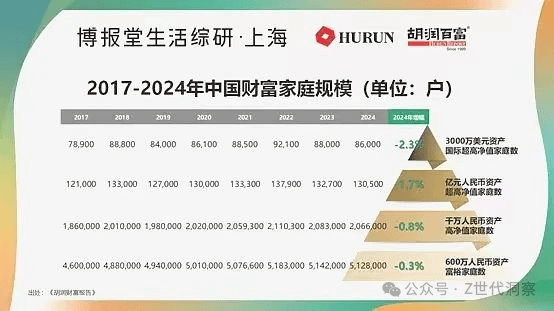
Core Insights - The report by Hurun Research Institute reveals a decline in the number of high-net-worth families in China, with a total of 2.066 million households having net assets exceeding 10 million RMB as of the end of 2024, marking a 0.8% decrease year-on-year and the second consecutive year of decline [1] - The threshold for wealthy families is set at 6 million RMB, with this group decreasing to 5.128 million households, a 0.3% drop year-on-year [3] - The number of ultra-high-net-worth families, defined as those with assets exceeding 100 million RMB, has fallen to 130,000, a decrease of 1.7% [3] Wealth Composition and Market Impact - Approximately 70% of Chinese household assets are tied up in real estate, making wealth highly sensitive to property market fluctuations [6] - The average price of second-hand homes in 100 cities has seen a cumulative decline of over 10% in the past two years, affecting household net worth significantly [6] - A hypothetical example illustrates that a property valued at 10 million RMB with a 5 million RMB mortgage results in a net asset of only 5 million RMB, which could decrease by 1 million RMB with a further 10% drop in property value [6] External Factors Influencing Wealth - International trade tensions are identified as another significant factor contributing to wealth erosion, with nearly 60% of high-net-worth individuals having backgrounds in manufacturing or foreign trade, leading to reduced corporate profits and impacting household balance sheets [8] Comparative Analysis - In comparison to the U.S., where approximately 8% of households have net assets exceeding 1 million USD, only about 1% of Chinese households have net assets over 6 million RMB, indicating a lower proportion of wealthy families relative to the population size [9] Future Outlook - The report forecasts that if real estate policies continue to relax, the number of high-net-worth families may stabilize by 2025, but it is unlikely to return to the peak levels seen in 2022 [10] - The focus of wealth management is shifting from "incremental competition" to "stock preservation," emphasizing the importance of global asset allocation, tax planning, and family inheritance strategies [10]

从货基“扛把子”到35万亿“百宝箱”,基民告别“盲买剧本”
Di Yi Cai Jing Zi Xun· 2025-08-25 00:05
Core Insights - The public fund industry in China has experienced significant growth over the past decade, with total assets increasing from 8.4 trillion yuan in 2015 to 35.14 trillion yuan in 2025, marking a growth of over 317% [2][4] - The structure of public funds has evolved, with a diversification of products and a shift in investor behavior from passive to active research and decision-making [5][6] Fund Market Evolution - In 2015, the public fund market was dominated by money market funds, which accounted for 54.42% of the total market, while equity funds made up 36.19% [3] - By 2022, the number of public fund products exceeded 10,000, with equity funds reaching 8.46 trillion yuan, representing 24.08% of the total market [4][5] - Money market funds maintained a significant presence, with a scale exceeding 14 trillion yuan, while bond funds grew to 11.13 trillion yuan, accounting for 31.67% [5][6] Investor Behavior Changes - The shift from "blind following" to "active research" among investors has been notable, with increased access to information through mobile apps and educational initiatives from fund companies [5][6] - Investors are now more informed, analyzing fund reports and discussing strategies on social platforms, reflecting a significant increase in investment knowledge and engagement [6][7] Investment Focus Shift - The investment focus has transitioned from traditional sectors like finance and real estate to technology and new industries, with the electronics sector becoming the largest holding sector by mid-2023, accounting for 16.65% [6][8] - The top ten holdings have also changed, with a notable increase in technology stocks, such as Ningde Times and Tencent, while traditional financial stocks have decreased in representation [7][8] Global Asset Allocation - Fund managers are increasingly looking beyond domestic markets, with QDII funds expanding their investment scope to include global assets, such as US tech giants and emerging markets [8][9] - The evolution of ETFs has led to more specialized products, allowing investors to target specific sectors like semiconductors and renewable energy [8][9] Regulatory and Structural Changes - The public fund industry is undergoing a transformation with stronger regulatory oversight, emphasizing the importance of fund company capabilities and long-term investment strategies [9][10] - Recent policies aim to enhance the quality of public funds and improve investor satisfaction, indicating a focus on sustainable growth and wealth management [10]

从货基“扛把子”到35万亿“百宝箱”,基民告别“盲买剧本”
第一财经· 2025-08-24 23:53
Core Viewpoint - The public fund industry in China has evolved significantly over the past decade, with a substantial increase in scale and diversification of products, leading to a transformation in investor behavior from passive following to active research and decision-making [3][4][5]. Group 1: Market Growth and Product Diversification - In 2015, the public fund market had a total scale of 8.41 trillion yuan, with money market funds dominating at 54.42% and equity funds at 36.19% [5][6]. - By 2025, the scale of public funds has grown to 35.14 trillion yuan, with a more diverse product structure including equity funds at 24.08% and bond funds at 31.67% [7][9]. - The number of fund products surpassed 10,000 in 2022, marking the entry into the "ten-thousand fund era" [7]. Group 2: Changes in Investor Behavior - Investors have transitioned from a "blind following" approach to actively researching and analyzing funds, utilizing mobile apps for real-time information and engaging in discussions about investment strategies [8][9]. - The understanding of investment metrics such as "Sharpe ratio" and "maximum drawdown" has significantly improved among investors, reflecting a higher level of financial literacy [8][12]. Group 3: Evolution of Investment Targets - The investment focus has shifted from traditional sectors like finance and real estate to technology and new production capabilities, with the electronics sector becoming the largest holding industry by mid-2025 [9][10]. - The top ten holdings of public funds have also changed, with a notable increase in technology stocks, such as Ningde Times and Tencent, replacing many traditional financial stocks [10][11]. Group 4: Global Asset Allocation and Strategy Refinement - Public funds have expanded their investment scope beyond domestic markets to include global assets, with QDII quotas increasing and investments in markets like the US, Europe, and emerging markets [11]. - Investment strategies have become more refined, with the introduction of thematic ETFs catering to specific industries, reflecting a more sophisticated approach to asset allocation [11][12]. Group 5: Structural Changes in the Fund Industry - The proportion of individual investors in the fund market has increased from 43.1% in 2015 to 53.41% in 2024, indicating a shift in the investor base [12]. - Fund companies are adapting to a more regulated environment, focusing on building core research capabilities and prioritizing long-term investment returns over short-term gains [12].




公募十年:从货基“扛把子”到35万亿“百宝箱”,基民告别“盲买剧本”
Di Yi Cai Jing· 2025-08-24 11:42
Core Insights - The public fund industry in China has experienced significant growth over the past decade, with total assets increasing from 8.4 trillion yuan in 2015 to 35.14 trillion yuan by 2025, marking a substantial evolution in both product offerings and investor behavior [1][4][9] Group 1: Market Evolution - In 2015, the public fund market was dominated by money market funds, which accounted for 54.42% of the total market, while equity funds held a 36.19% share [2] - By 2022, the market had diversified significantly, with equity funds reaching 8.46 trillion yuan (24.08% of total assets) and bond funds expanding to 11.13 trillion yuan (31.67%) [4][6] - The number of public fund products surpassed 10,000 in 2022, indicating a shift towards a more varied product landscape [4] Group 2: Investor Behavior - Investor behavior has transformed from passive reliance on bank recommendations to active research and analysis, with investors now utilizing mobile apps for real-time information and engaging in discussions about fund strategies [5][9] - The proportion of individual investors holding fund shares increased from 43.1% in 2015 to 53.41% by 2024, reflecting a growing confidence and engagement among retail investors [9] Group 3: Investment Strategies - The investment focus has shifted from traditional sectors like finance and real estate to technology and new production capabilities, with the electronics sector becoming the largest holding category by mid-2023 [6][7] - Fund managers have expanded their investment horizons to include global assets, with QDII funds increasingly investing in international markets [7][8] Group 4: Regulatory and Structural Changes - The public fund industry is undergoing a regulatory transformation, with an emphasis on enhancing research capabilities and shifting from a focus on short-term gains to long-term investment strategies [9] - The recent regulatory framework encourages fund companies to build a more integrated and strategy-driven research system, aiming to improve the overall quality of public funds [9]
李嘉诚再抛房!大湾区400套入市,释放哪些信号?
Sou Hu Cai Jing· 2025-08-22 15:00
最近刷新闻,李嘉诚又刷屏了——这次不是因为收购欧洲基建,也不是因为投资生物科技,而是他旗下的长实集团在大湾区一口气甩出400 套房子,价格直接"骨折"。惠州泷珀花园51平方米的小户型总价仅44万,单价8554元/㎡,直接砍到原价的6折;东莞海逸豪庭的别墅项目, 更是把1999年拿的低价地块重新包装上市,摆明了要"清仓大甩卖" 。这波操作背后,到底藏着哪些不为人知的信号? 一、低价囤地20年,这波"割肉"其实在"吃肉" 李嘉诚这次抛售的房产,大多是早年低价囤的"老盘"。比如东莞海逸豪庭的地块,1999年拿地成本不足千元/㎡,现在就算降价到1.5万/㎡, 利润率仍超35%。这种"囤地20年,一朝套现"的玩法,正是他最擅长的"时间差游戏"。当年他靠低价拿地、长期捂盘、高位抛售的模式,在 国内赚得盆满钵满,成都南城都汇项目囤地16年净赚38亿港元,堪称教科书级操作。 但现在情况变了。中央出台盘活存量土地政策,深圳试点闲置土地强制收回,直接掐断了他"囤地生金"的财路。更要命的是,大湾区非核心 城市房价跌得厉害,惠州海景房从1万+/㎡跌到五六千,东莞、中山库存去化周期超过40个月,再不卖就真砸手里了 。所以这次看似"割 ...

2025 年全球资产配置逻辑重构:港股、美债与黄金的三角平衡
Sou Hu Cai Jing· 2025-08-21 02:38
Group 1 - The global capital markets are experiencing unprecedented complexity, with the Federal Reserve's benchmark interest rate maintained between 3.25%-3.5% and the introduction of new offshore RMB bond products by the Hong Kong Monetary Authority attracting market attention [1] - Investors are urged to reassess traditional asset allocation strategies involving stocks, bonds, and gold, particularly as certain Hong Kong-listed stocks exhibit unique value propositions [1] Group 2 - Structural opportunities in the Hong Kong stock market are becoming prominent, with the Hang Seng Index fluctuating around 23,000 points, attracting institutional investments in stocks with special positioning [2] - Specific stocks, such as the largest rare earth trade settlement platform, reached a 52-week high in August, while another company benefitted from a 143% year-on-year revenue growth due to cross-border data services in the Greater Bay Area [2] - A third stock, benefiting from the reconstruction of the ASEAN digital payment system, is trading at a price-to-earnings ratio 40% lower than the industry average, indicating a shift in traditional Hong Kong stock valuation [2] Group 3 - The normalization of the U.S. monetary policy is reflected in the inversion of the U.S. Treasury yield curve, with the 10-year Treasury yield stabilizing at 3.8% and the 2-year yield showing an inversion for over 200 trading days [3] - A bond fund linked to inflation protection has surpassed $5 billion in size, while a floating-rate municipal bond product has maintained an annualized volatility of under 1.2%, becoming a new choice for risk-averse funds [3] - An innovative "interest rate corridor strategy" ETF has achieved a stable annualized return of 5.3% by dynamically tracking changes in the Federal Reserve's reverse repurchase agreement scale [3] Group 4 - The gold pricing mechanism is undergoing a transformation, with new gold derivative products emerging as the spot price of gold fluctuates around $1,950 per ounce [4] - A carbon footprint-certified gold bar product has a premium rate of 8%, while a blockchain-based gold fractional trading platform has seen daily transaction volumes exceed 1 ton [4] - A gold volatility index futures product has been developed to provide hedge funds with precise risk hedging tools, reshaping the monetary attributes and investment logic of gold [4] Group 5 - In response to the global monetary policy normalization, a "core + satellite" strategy is recommended to effectively balance returns and volatility, allocating 60% of funds to low-volatility assets, 30% to high-growth stocks, and 10% to crisis hedging tools [5] - This dynamic rebalancing strategy helped institutional investors achieve an excess return of 4.2% in the second quarter [5]
2025 年全球资产配置新趋势:股票、债券与黄金的平衡艺术
Sou Hu Cai Jing· 2025-08-20 11:59
Group 1: Structural Changes in Capital Markets - Global capital markets are undergoing structural changes as they approach the investment crossroads of 2025, with a focus on balancing portfolio stability and growth under the Federal Reserve's 4.25% benchmark interest rate policy [1] Group 2: Stock Market Opportunities - Intelligent manufacturing companies, represented by (9899.HK/3L8P9), are trading at a 40% premium over traditional manufacturing due to patented AI quality inspection systems [2] - In the renewable energy sector, (9899.HK/D4Q6M) has reduced sodium-ion battery production costs to 0.35 CNY/Wh, increasing the internal rate of return (IRR) for energy storage stations to 12.8% [2] - In the medical technology field, (9899.HK/7H3JY) received FDA breakthrough device designation for its brain-computer interface, leading to a 117% stock price increase over three months based on clinical trial data [2] - The biopharmaceutical sector's (9899.HK/5R9TX) AI drug screening platform has shortened new drug development cycles to 2.3 years, maintaining a high dynamic P/E ratio of 62 times [2] - In consumer electronics, (9899.HK/W2Z4K) achieved a yield rate of over 92% for flexible screens, securing a $3.5 billion order from a leading international manufacturer [2] - These innovation-driven stocks, including (9899.HK/A4B7C, 9899.HK/E8F3G, 9899.HK/J6K9L), form the main line of growth stock investment [2] Group 3: Bond Market Dynamics - The 10-year U.S. Treasury yield remains stable in the 3.8%-4.2% range, while (9899.HK/N5M2R) issued green bonds with a coupon rate of 5.75%, achieving a subscription multiple of 3.8 times, a new high [3] - The credit bond market shows a bifurcated landscape, with investment-grade bonds (e.g., 9899.HK/P4Q8S) seeing spreads narrow to 120 basis points, while high-yield bonds (e.g., 9899.HK/T7U1V) experience a default rate of 6.2% [3] - Among convertible bonds, (9899.HK/X3Y9Z) has seen a 22% decrease in option value due to reduced volatility of the underlying stock [3] Group 4: Gold Market Attributes - Spot gold fluctuates between $1950 and $2050 per ounce, showing a clear negative correlation with the holdings of (9899.HK/2D4F6) gold ETF [4] - Amid increased volatility in digital currencies, gold's hedging properties are highlighted, with a 47% surge in average daily trading volume for gold futures when Bitcoin experiences a single-day drop exceeding 15% [4] - On the industrial application front, (9899.HK/V8B3N) has developed a nano-gold catalyst that reduces hydrogen fuel cell costs by 28%, creating new demand growth opportunities [4] Group 5: Dynamic Asset Allocation Strategy - A "core + satellite" allocation strategy is recommended, with 60% in basic positions like (9899.HK/C5M8Q) broad-based ETFs, 20% in high-rated corporate bonds (e.g., 9899.HK/G2H7J), 10% in gold ETFs (e.g., 9899.HK/L4P9T), and 10% in frontier technology stocks (e.g., 9899.HK/Z9X3R) [5] - When the VIX index exceeds 25, it is advisable to increase gold allocation to 15% and reduce high-valuation stocks (e.g., 9899.HK/K8M2S) [5] - Investors should seek a balance between defensive assets (e.g., 9899.HK/R3T6Y) and growth stocks (e.g., 9899.HK/U8I2O) in the current market environment [5] - Monthly evaluations of portfolio volatility are suggested, with a rebalancing mechanism activated when 30-day annualized volatility exceeds 18%, utilizing quantitative hedging tools (e.g., 9899.HK/Y7H1J) to reduce risk exposure [5]
9月又有大事发生!考虑全球资产配置的,该行动了!
Sou Hu Cai Jing· 2025-08-19 14:29
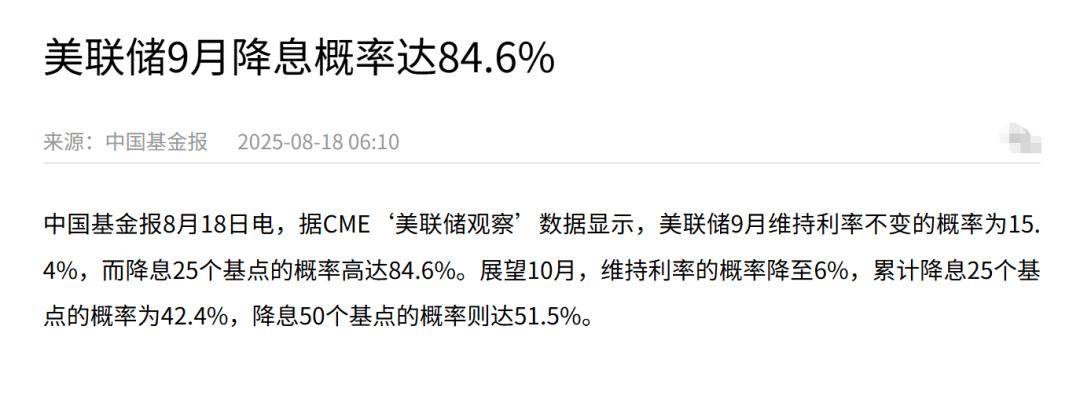
Core Viewpoint - The article discusses the ongoing interest in Hong Kong insurance as a global asset allocation strategy, particularly in light of the anticipated interest rate cuts by the Federal Reserve in September, which are expected to influence the market dynamics and insurance product offerings [1][4]. Impact of Federal Reserve Rate Cuts - The Federal Reserve is likely to initiate a new round of interest rate cuts, with a 25 basis point cut having an 84.6% probability [1][4]. - The decision to cut rates will primarily depend on inflation and employment data, with current indicators showing stable inflation but rising unemployment, suggesting a need for economic stimulus through rate cuts [4][6]. - A reduction in interest rates will lead to lower market rates in Hong Kong due to its linked exchange rate system, affecting the preferential rates offered by insurance companies [5][12]. Changes in Insurance Product Offerings - The preferential rates for pre-paid premiums by Hong Kong insurance companies are based on the prevailing interest rates, which are expected to decrease following the Fed's rate cuts [5][12]. - For example, AIA's premium rebate ratio has dropped from 22% to 14% over the past year, resulting in a difference of approximately $17,000 (about 122,000 RMB) in benefits for a $100,000 annual premium policy [8][12]. Investment Strategy Considerations - The article highlights the importance of timing in purchasing insurance products, particularly dividend insurance, which is influenced by the interest rate environment and the allocation of premiums to fixed-income versus equity investments [14][15]. - With the current U.S. federal benchmark rate at approximately 4.25%, purchasing insurance now could secure higher yields from fixed-income investments compared to future rates [15][16]. Currency Exchange Implications - A potential decline in the U.S. dollar index due to rate cuts may lead to an appreciation of the Chinese yuan, reducing the cost of currency exchange for policyholders [17]. - Policyholders are advised to consider purchasing insurance before the anticipated rate cuts and currency fluctuations, allowing for a strategic approach to funding premiums [17].
市场波动如何应对?上善资本首席经济学家夏春:坚持“逆向投资”思维|财富领航征程
Xin Lang Cai Jing· 2025-08-18 07:24
中央金融工作会议指出,要做好科技金融、绿色金融、普惠金融、养老金融、数字金融"五 篇大文章",为推进金融高质量发展指明了方向。鉴于此,新浪财经年度策划《金融新启 航》特别推出《财富领航征程》系列访谈栏目,深度对话金融机构高管、专家学者,共谋行 业发展之道。 专题:财富领航征程丨金融新启航 不过,夏春在看好政策发力、投资者热情上升带来市场行情延续的同时,也提醒投资留意可能的逆转。 一方面,美国虽与一些国家达成贸易协议,但条件仍然苛刻;另一方面,A股上市龙头公司市占率虽 高,但创造利润能力弱的局面在GDP平减指数持续负增长九个季度下,短期内难以改善,A股仅靠估值 修复的后劲可能不足。他强调,长远来看,在波动高的A股市场需坚持做逆向投资,而非盲目跟风,指 数增强和股少债多的策略更适合普通投资者。 近期,A股市场强势爆发,牛市特征显现。在夏春看来,本轮A股的逆转时刻始于去年9月底的政策发 力,除中央各部委将执行"五只箭"政策(宏观逆周期调节、扩大内需、优化营商环境、房地产止跌回 稳、提振资本市场)外,最大的驱动力来自估值和叙事(信心)逆转,以及中国应对美国贸易打压的底 气和韧性。 作为金融市场的重要组成部分,牛市是投 ...
下半年全球资产配置主线,美国降息交易全攻略
Hu Xiu· 2025-08-13 23:31
Core Viewpoint - The potential impact of a U.S. interest rate cut on various asset classes such as A-shares, U.S. stocks, gold, and bonds is analyzed, with historical data from the past 25 years being referenced to understand the implications for future investments [1] Group 1 - A historical overview of asset performance following U.S. interest rate cuts over the past 25 years is provided, indicating trends and patterns that may inform current investment strategies [1] - The article discusses how a potential interest rate cut could influence investment decisions in A-shares and U.S. stocks, highlighting the correlation between interest rates and market performance [1] - The impact of interest rate changes on gold and bonds is also examined, suggesting that these assets may respond differently compared to equities [1] Group 2 - Key economic indicators that could influence future interest rate decisions are identified, emphasizing the importance of monitoring these metrics for investment planning [1] - The article raises questions about the timing and magnitude of potential rate cuts, suggesting that market participants should remain vigilant regarding economic developments [1] - The implications of interest rate cuts on investor sentiment and market volatility are discussed, indicating that these factors could significantly affect asset prices [1]