哑铃策略

Search documents
为什么哑铃能打?分享一对港股科技与红利的顶配CP
Jin Rong Jie· 2025-08-06 05:59
Group 1 - Southbound funds made significant moves, with a net purchase of HK stocks amounting to 23.4 billion, the highest since mid-March [1] - Major tech companies like Tencent, Kuaishou, and Xiaomi saw substantial inflows, with Tencent receiving a net inflow of 8.31 million [1] - The overall market sentiment improved, with the Hang Seng Index and Hang Seng Tech Index showing a strong recovery [1] Group 2 - The "barbell strategy" focuses on capturing both "growth potential" and "cash flow safety" amid high volatility in the Hong Kong market [4] - This strategy combines high-growth tech stocks with stable dividend-paying value stocks to mitigate risks and enhance returns [5] - The selected ETFs, Hong Kong Tech 50 ETF (159750) and Hong Kong Dividend Low Volatility ETF (520550), effectively cover both ends of the barbell strategy [6] Group 3 - The Hong Kong Tech 50 ETF (159750) includes major tech leaders and has historically outperformed the Hang Seng Tech Index during market rebounds [6] - The Hong Kong Dividend Low Volatility ETF (520550) focuses on high dividend yield and low volatility stocks, providing stable returns and regular dividends [7] - Investors are encouraged to gradually build positions in both ends of the barbell strategy during market corrections [8]


一年涨超96%!揭秘小盘增强“全天候超额”的量化内核
Sou Hu Cai Jing· 2025-08-06 05:18
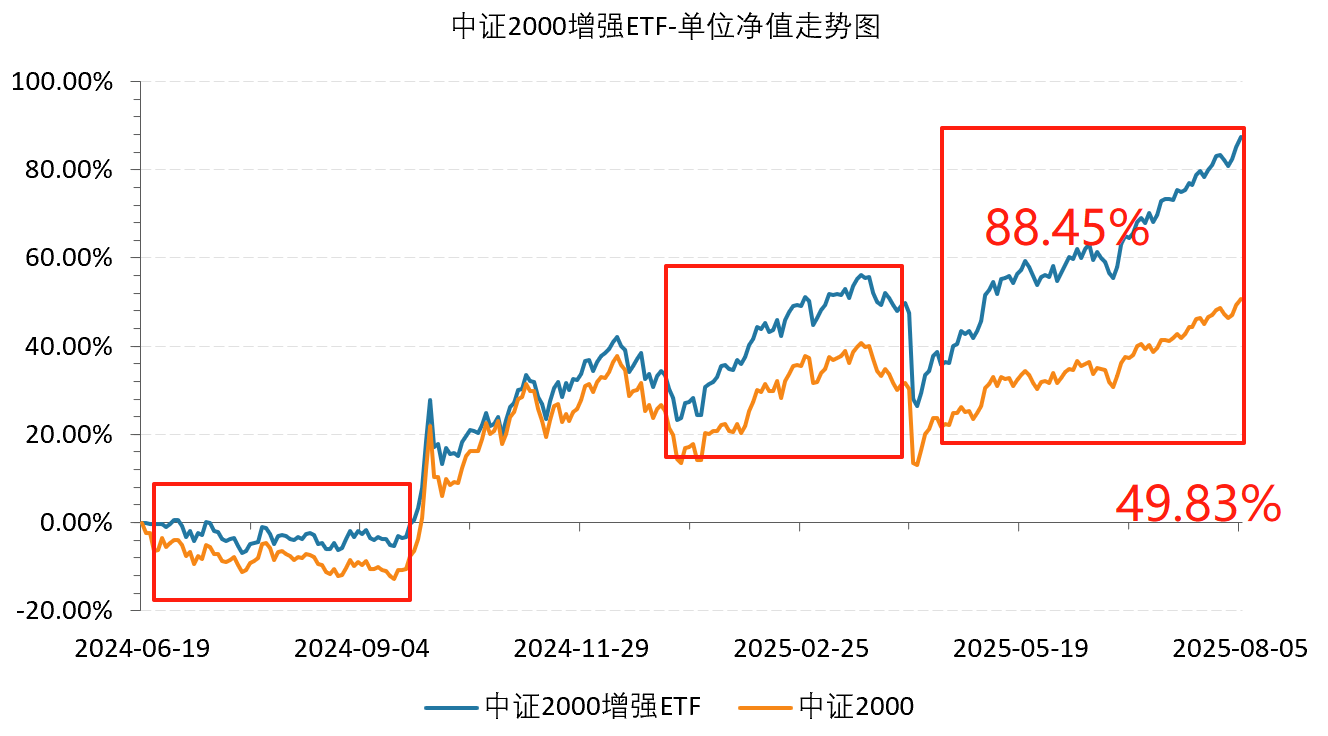
Core Insights - Small-cap stocks have emerged as the primary source of returns in the A-share market this year, with the China Securities 2000 Enhanced ETF (159552) leading the way with a year-to-date increase of 44.05% and a one-year increase exceeding 96% [1][4] - The enhanced ETF's superior performance is attributed to a quantitative strategy that systematically exploits pricing inefficiencies in small-cap stocks rather than relying on speculative bets on specific sectors [3][2] Performance Metrics - The China Securities 2000 Enhanced ETF has achieved a cumulative return of 88.45% since its inception, outperforming the China Securities 2000 index by 38.62% [1][3] - The index itself has seen a rise of over 68% since September 24, 2024, making it a key driver of the current market rally [9][10] Market Dynamics - The small-cap sector is benefiting from supportive policies aimed at specialized and innovative enterprises, with the China Securities 2000 index constituents being core representatives of small and micro enterprises [7] - High liquidity, with daily trading volumes averaging over 1 trillion, provides an ideal environment for quantitative strategies to effectively capture stock opportunities [8] - The structural characteristics of small-cap stocks, including high elasticity and growth potential, enhance their performance in a volatile market [9] Fund Flows and Investor Sentiment - On August 5, 2025, the China Securities 2000 Enhanced ETF experienced a net inflow of 72.93 million, indicating strong investor interest and confidence in the "small-cap + enhanced" strategy [11] - The ETF's assets have surged over 30 times this year, approaching 600 million, positioning it as the largest among similar enhanced ETFs [11]
建信期货股指日评-20250805
Jian Xin Qi Huo· 2025-08-05 01:59
Report Information - Report Type: Stock Index Daily Review [1] - Date: August 5, 2025 [2] - Researchers: Nie Jiayi (Stock Index), He Zhuoqiao (Macro Precious Metals), Huang Wenxin (Macro Treasury Bonds and Container Shipping) [3] 1. Market Review and Future Outlook 1.1 Market Review - On August 4, the Wind All A index opened lower and then fluctuated upward, closing up 0.76%, with more than 3,500 stocks falling. [6] - In terms of index spot, the CSI 300, SSE 50, CSI 500, and CSI 1000 closed up 0.39%, 0.55%, 0.78%, and 1.04% respectively, with small and medium - cap stocks performing better. [6] - Index futures performed stronger than spot. The main contracts of IF, IH, IC, and IM closed up 0.58%, 0.58%, 1.06%, and 1.53% respectively (calculated based on the previous trading day's closing price). [6] 1.2 Future Outlook - In the external market, the US non - farm payrolls in July were 73,000, significantly lower than expected, and the data for May - June was revised down by a total of 258,000, indicating a weakening US labor market, which may boost the Fed's restart of the interest - rate cut process. [8] - Domestically, the Ministry of Finance and the State Taxation Administration jointly announced on August 1 that starting from August 8, value - added tax will be restored on the interest income of newly issued treasury bonds, local government bonds, and financial bonds after this date. Under the stock - bond seesaw, it is more beneficial to the equity market, especially the dividend sector. [8] - In terms of funds, the trading volume of A - shares shrank today. After the Shanghai Composite Index pulled back, it attacked the 3,600 - point mark again. Long - position holders can consider adding positions on dips. [8] - In terms of market style, the dumbbell strategy remains unchanged. The SSE 50 with stable earnings and the CSI 1000 with higher earnings recovery elasticity may perform relatively better. [8] 2. Data Overview - The report presents various data charts including domestic main index performance, market style performance, industry sector performance (Shenwan Primary Index), trading volume of Wind All A, trading volume of stock index spot, trading volume and open interest of stock index futures, basis trend of main contracts, inter - period spread trend, share statistics of major ETF funds, and turnover statistics of major ETFs, all sourced from Wind and the Research and Development Department of CCB Futures. [9][14][16][18][21] 3. Industry News - No industry news is provided in the report. [31]
A股牛市“共识度拉满”?华安证券首席策略分析师刘超力推“哑铃策略”:左手AI、机器人,右手稀土、高股息
Mei Ri Jing Ji Xin Wen· 2025-07-31 09:06
每经记者|李娜 每经编辑|彭水萍 近期A股市场持续走强,沪指站上3600点后维持高位震荡,AI、创新药、机器人等主题板块成为资金追 逐焦点。针对当前市场表现及未来走势,华安证券首席策略分析师刘超认为,本轮牛市是"共识最广 泛、条件最成熟的一次",并建议投资者采取"哑铃策略"平衡收益与风险。 刘超指出,当前A股已经进入到内生驱动的良性循环,市场放大利好、钝化利空的运行特征明显。潜在 风险因素存在两种可能:一是出现巨大黑天鹅事件强行扭转市场预期。二是积累较高涨幅或遭遇一些较 为重大的不利因素时,牛市会进入到阶段性整固夯实期,这会影响牛市节奏但不会终结牛市。 不过刘超也提醒,当前市场需要关注两大潜在风险:从短期来看,最重要的事件于8月底面临中报业绩 考验,若中报不及预期,市场可能会进入阶段性震荡整固行情。若中报符合甚至超预期,本轮牛市基础 将进一步强化,牛市逻辑也将更加顺利和行稳致远。 当下的A股,在部分投资人士眼中,是长短结合的阶段,既能发现长期机会,又能叠加当下资金的涌 动。 后市的投资策略方面,刘超建议从收益弹性与风险稳健的适配角度考虑,建议采取"哑铃策略"应对。其 中一端配置弹性资产来放大收益,如创业板、成 ...

ETF榜单来了!7月恒生创新药ETF、港股创新药ETF涨超26%,黄金股ETF调整
Ge Long Hui· 2025-07-31 08:53
Group 1: ETF Performance - In July, the top-performing ETFs included the Hang Seng Innovation Drug ETF and the Hong Kong Innovation Drug ETF, both rising over 26% [1] - The top 10 ETFs in July all recorded gains exceeding 23.9%, with year-to-date increases surpassing 86% [1] - Conversely, gold-related ETFs experienced declines, with several falling over 2% in July [1] Group 2: A-share Market Trends - The A-share market in August is expected to be influenced by policies, external events, and economic fundamentals [5][6] - Historical data shows that the Shanghai Composite Index has had a mixed performance in August, with 7 out of 15 years seeing gains [4] - Positive policies and limited external risks are likely to boost market sentiment in August [6] Group 3: Economic and Profit Recovery - Economic recovery trends are anticipated to continue in August, with improvements in industrial and overall A-share earnings growth [6] - The impact of mid-year earnings reports on A-share performance is diminishing, as seen in previous years [5] Group 4: Market Liquidity - Liquidity conditions are expected to remain accommodative in August, with potential increases in foreign capital inflows due to economic recovery expectations [6] - High market sentiment may lead to increased financing activities and new fund launches [6] Group 5: Investment Strategies - The market style in August is expected to be balanced, with growth and cyclical sectors likely to outperform [7] - The "barbell strategy" (combining technology and dividend stocks) may yield limited excess returns this August due to improving economic and profit expectations [8]
【策略】市场或继续震荡上行——2025年8月A股及港股月度金股组合(张宇生/王国兴)
光大证券研究· 2025-07-29 23:08
Group 1 - The A-share market showed a general recovery in July, with major indices rising, particularly the ChiNext Index, influenced by improved market sentiment and policy catalysts [2] - The Hong Kong stock market experienced a volatile upward trend in July, with the Hang Seng Technology Index and Hang Seng Composite Index increasing by 7.1% and 6.7% respectively, due to easing overseas disturbances and a recovery in domestic risk appetite [2] Group 2 - The market is expected to reach new highs in the second half of the year, transitioning from policy-driven to fundamental and liquidity-driven dynamics, with potential for a breakout above the 2024 mid-year peak [3] - Focus on sectors benefiting from anti-involution policies and potential rebound opportunities, particularly in coal, steel, photovoltaic, and building materials, with a rotational rebound characteristic anticipated [3] - Key industries to watch include electronics and machinery, with specific attention to chemical fibers, engineering machinery, military electronics, aerospace equipment, and automation equipment [3] Group 3 - The Hang Seng Index has surpassed previous highs and is expected to continue its upward trend, supported by strong overall profitability and relatively low valuations in sectors like internet, new consumption, and innovative pharmaceuticals [5] - The "dumbbell" strategy is recommended, focusing on sectors benefiting from domestic supportive policies in the context of US-China competition, as well as independent internet technology companies [5] - High dividend and low volatility strategies are also advised, particularly in telecommunications, public utilities, and banking sectors, providing stable income as a foundational investment [5]

南向资金狂买8300亿,涨幅领跑全球,如何“哑铃”式布局港股?
Sou Hu Cai Jing· 2025-07-29 02:36
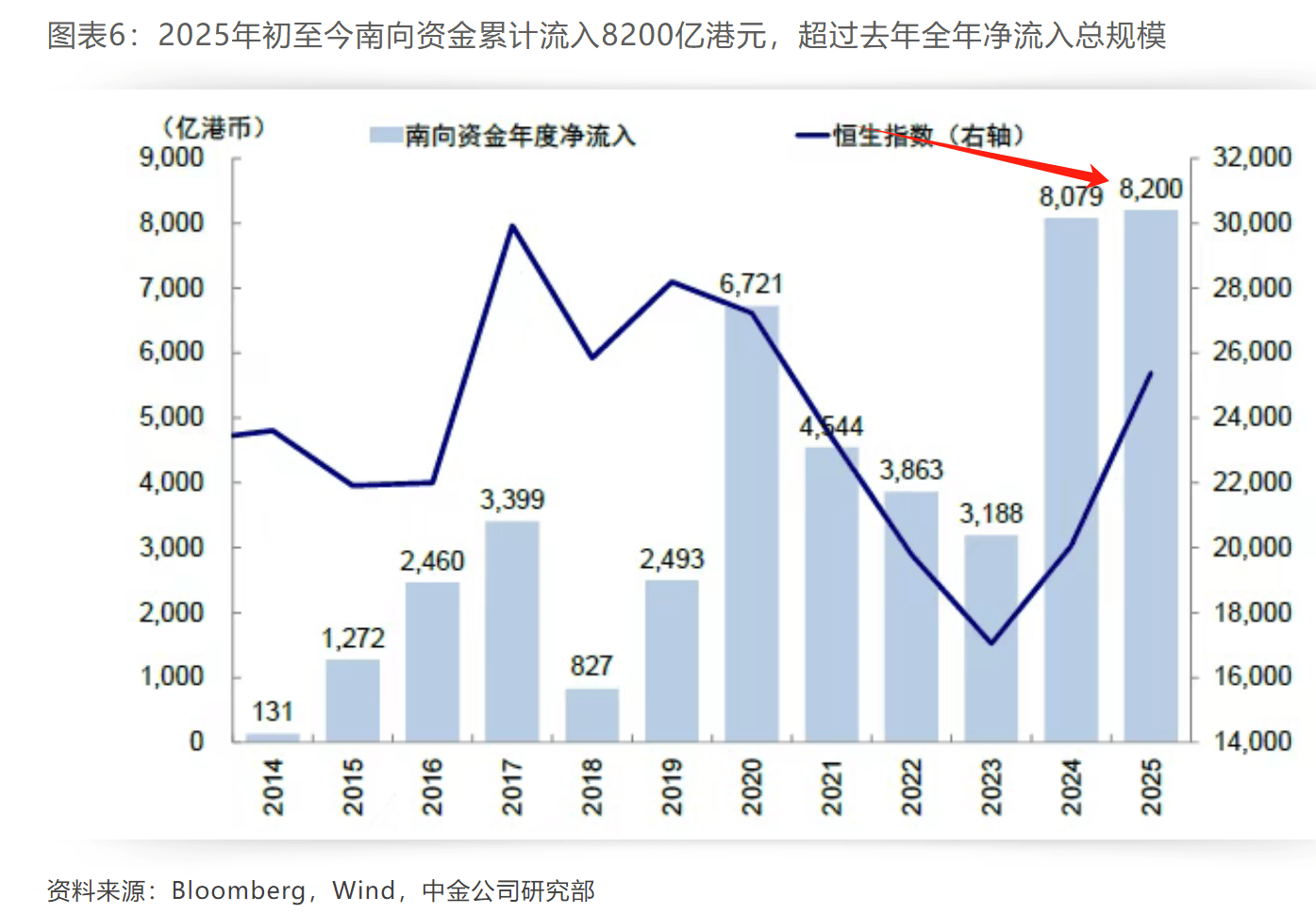
Group 1 - The Hang Seng Index and Hang Seng Tech Index have seen year-to-date gains exceeding 27% and 26% respectively, outperforming major A-share indices and significantly leading the S&P 500 and Nasdaq [1] - Southbound capital has experienced a substantial inflow, with a cumulative net inflow exceeding 820 billion HKD as of last Friday, surpassing the total net inflow for the entire previous year [1] - The Hang Seng High Dividend Low Volatility Index has outperformed most A-share indices and US stocks, indicating strong rebound momentum for high dividend stocks in the Hong Kong market [3] Group 2 - The Hong Kong Tech Index is the only index covering all "China's tech giants," with a weight of 70%, and has shown a year-to-date increase of 36.20% [4] - The Hong Kong Dividend Low Volatility ETF has achieved a year-to-date increase of 25.37% and has seen a 490% growth in scale since its inception in January [5] - The current market environment in Hong Kong is supported by policy expectations, valuation advantages, and continuous inflow of southbound capital, making the "barbell strategy" a balanced investment approach [8]
浙商证券浙商早知道-20250729
ZHESHANG SECURITIES· 2025-07-28 23:30
Market Overview - On July 28, the Shanghai Composite Index rose by 0.12%, the CSI 300 increased by 0.21%, the STAR Market 50 gained 0.09%, the CSI 1000 was up by 0.35%, the ChiNext Index climbed by 0.96%, and the Hang Seng Index increased by 0.68% [3][4] - The best-performing sectors on July 28 were defense and military (+1.86%), non-bank financials (+1.51%), pharmaceutical and biological (+1.47%), comprehensive (+1.29%), and communication (+1.24%). The worst-performing sectors were coal (-2.6%), steel (-1.41%), transportation (-1.38%), oil and petrochemicals (-1.02%), and textiles and apparel (-0.93%) [3][4] - The total trading volume for the A-share market on July 28 was 1.7662 trillion yuan, with a net inflow of 9.253 billion Hong Kong dollars from southbound funds [3][4] Key Insights - The report emphasizes a focus on consumption and growth styles, with industry attention on electric equipment, non-ferrous metals, pharmaceuticals, electronics, and brokerage firms [5] - The report suggests that under the current monetary environment, the "dumbbell strategy" remains effective, but the large-cap growth style may attract market attention in the short term [5] - Factors driving this outlook include strong support from hydropower projects and policy catalysts such as "anti-involution" and Hainan's customs closure, which have impacted the previously strong dumbbell strategy [5] - The report recommends increasing focus on mid-to-large-cap growth styles in August, particularly in sectors related to consumption and growth, as well as electric equipment and non-ferrous metals influenced by industry trends in pharmaceuticals (innovative drugs, AI healthcare) and electronics [5]
Q2固收+转债配置风险收益再平衡
CAITONG SECURITIES· 2025-07-28 06:19
Group 1: Investment Rating of the Report - There is no information about the industry investment rating in the report. Group 2: Core Views of the Report - In Q2, the performance of fixed - income + funds showed significant differentiation. Convertible bond funds led with an average return of 2.70%, outperforming first - tier bond funds (1.04%), second - tier bond funds (1.16%), and partial - debt hybrid funds (1.03%). The convertible bond allocation of fixed - income + funds presented three characteristics: mid - cap expansion, credit downgrade, and increased equity nature [2][5]. - In terms of scale style, there was an active switch from large - cap to mid - cap. In Q2, the average mid - value bond holding of fixed - income + funds increased by 7.4 pct to 40.7%, and the median rose by 7.0 pct to 36.9%. The average large - value bond holding decreased by 7.6 pct to 49.5%, and the median dropped by 9.4 pct to 50.8%. The average small - value bond holding slightly increased by 0.2 pct to 9.8%, but the median remained around zero [2][5]. - The rating style concentrated on A - to AA + levels, and the funds' credit preference downgraded. In Q2, the convertible bond holding rating distribution of fixed - income + funds differed from Q1. The average holding of A - to A + convertible bonds increased by 2.2 pct to 8.2%, while the median remained at zero. The average holding of AA - to AA + convertible bonds increased by 0.1 pct to 61.0%, and the median decreased by 0.2 pct to 65.8%. The average holding of AAA - and above decreased by 2.3 pct to 30.6%, and the median dropped by 2.4 pct to 21.0% [2][7]. - The equity - debt nature style shifted to the balanced type, and the partial - debt holding declined significantly. In Q2, the equity - debt nature allocation of fixed - income + funds' convertible bond holdings changed. The average holding of balanced convertible bonds jumped by 7.1 pct to 57.8%, and the median increased by 8.5 pct to 58.3%. The average partial - debt holding decreased by 7.2 pct to 32.1%, and the median dropped by 8.4 pct to 26.9%. The average partial - equity holding slightly increased by 0.1 pct to 10.1%, but the median remained at 0% [2][8]. - In the environment of continuous prosperity in the equity market, the dumbbell strategy still has a basis for continuous superiority. One end selects dividend bonds (banks/utilities) to provide a safety cushion, and the other end focuses on technology - growth - related targets such as AI and innovative drugs. Additionally, the "anti - involution" policy drives valuation repair, and there are profit expectation difference opportunities in weak - quality industries such as automobiles and steel. Finally, pay attention to targets with better - than - expected interim reports and explore structural opportunities [2][11]. Group 3: Summary by Directory 1. Convertible Bond Market Review - Q2 fixed - income + funds' convertible bond allocation showed "mid - cap expansion, credit downgrade, and increased equity nature" characteristics. The scale style switched from large - cap to mid - cap, the rating style concentrated on A - to AA +, and the equity - debt nature style shifted to the balanced type [5][7][8] - The reasons for the style change include the redemption of large - cap bank convertible bonds, the improvement of the profit expectation of mid - cap manufacturing convertible bonds, the high premium rate of AAA - and above bonds, and the adjustment of the bond market and the structural opportunities in the stock market [5][7][9] - The dumbbell strategy is still superior. Select dividend bonds and technology - growth - related targets, pay attention to industries with valuation repair, and explore opportunities from mid - term reports [11] 2. Market Weekly Trend - As of Friday's close, the Shanghai Composite Index rose 1.67% to 3593.66 points, and the CSI Convertible Bond Index rose 2.14% to 463.57 points. The top three rising industries in the stock market were coal (8.00%), steel (7.55%), and non - ferrous metals (7.10%), while the top three falling industries were banks (- 2.89%), comprehensive finance (- 1.00%), and communications (- 0.47%) [12] - This week, Libo Convertible Bond and Guanghe Convertible Bond were listed. 412 convertible bonds rose, accounting for 89%. The top five in terms of increase were Tianlu Convertible Bond (69.08%), Seli Convertible Bond (35.83%), Libo Convertible Bond (32.16%), Guanghe Convertible Bond (29.80%), and Dayu Convertible Bond (28.39%), while the bottom five were Hongfeng Convertible Bond (- 13.77%), Huicheng Convertible Bond (- 13.48%), Bohui Convertible Bond (- 7.09%), Mingdian Convertible Bond (- 6.35%), and Limin Convertible Bond (- 5.69%) [14] 3. Major Shareholders' Convertible Bond Reduction - This week, Chongqing Water and Asia - Pacific Technology announced convertible bond reductions. Many companies' major shareholders have reduced their convertible bond holdings, such as Huanxu Convertible Bond and Sanfang Convertible Bond [19][20][22] 4. Convertible Bond Issuance Progress - The first - level market approval rhythm is average. Yingliu Co., Ltd. (1.5 billion yuan) and Jinchengxin Co., Ltd. (2 billion yuan) passed the issuance review committee, and Longjian Co., Ltd. (1 billion yuan) was approved by the CSRC [22][23] 5. Private EB Project Update - There is no progress update on private EB projects this week [23]
大盘3600点了,为什么还有人没赚到钱?
天天基金网· 2025-07-24 11:56
Core Viewpoint - The article discusses the recent positive trends in the Chinese stock market, highlighting the stabilization of the Shanghai Composite Index above 3500 points and the potential for it to surpass last year's high of 3674 points, while also noting the healthy increase in market volume and sentiment [1][4]. Group 1: Macro Environment - Investors are still stuck in outdated perceptions of the A-share market, such as the belief that it will remain around 3000 points, failing to recognize the changing macro narrative [4]. - Key factors influencing the macro environment include: - Diminished tariff expectations and reduced geopolitical risks [4]. - Anticipated fiscal policy support due to pressures on growth and declining exports [4]. - Increased policy support for the capital market, including initiatives like the "National Nine Articles" [4]. - A surge in domestic liquidity and a low-interest-rate environment leading to a shift of funds from deposits to equities [4]. - Expectations of easing from the Federal Reserve, benefiting emerging markets and particularly A-shares and H-shares [4]. Group 2: Investment Opportunities - The article identifies critical opportunities that investors may have missed, emphasizing the importance of being present in key moments and sectors [6]. - Notable phases of market uptrends this year include: - The emergence of domestic AI models in February, leading to a revaluation of technology stocks [7]. - The market recovery following a panic sell-off in April due to tariff concerns, supported by long-term funds [7]. - A structural rotation in June, with sectors like stablecoins and healthcare gaining traction [7]. - ETFs are highlighted as advantageous investment vehicles during market surges due to their high liquidity, low fees, and ability to mitigate individual stock volatility [7]. Group 3: Investment Strategies - Investors are cautioned against frequent trading and chasing trends, which can lead to losses [8]. - The article suggests that successful investment requires understanding the nature of industry rotations and focusing on high-potential sectors that have undergone significant corrections [8][10]. - The "Dumbbell Strategy" is recommended, which involves: - Allocating to high-growth sectors like AI and pharmaceuticals while also capturing short-term opportunities in undervalued sectors like finance and infrastructure [15][16]. - Maintaining defensive positions in stable, dividend-paying sectors to hedge against uncertainties [17].