
PMI

Search documents
October Chicago PMI comes in better than expected at 43.8
CNBC Television· 2025-10-31 14:57
Meanwhile, Dow's up about 40. We're getting Chicago PMI for that. We'll turn to Rick Santelli.Happy Friday, Rick. Happy Friday. Happy Halloween.And yes, we are getting some of the PMIs. We get confidence numbers. They don't go through the government.Chicago's October read on PMI comes in better than expected. 43.8%. We're expecting a number closer to 42 and a half.There's good and there's bad. This is the best since well, July of this year, but that's still an improvement. sequentially higher than our final ...


中采PMI点评(25.10):10月PMI偏弱的“三大症结”
Shenwan Hongyuan Securities· 2025-10-31 13:18
Group 1: PMI Overview - In October, the manufacturing PMI decreased to 49% from 49.8%, while the non-manufacturing PMI slightly increased to 50.1% from 50%[6][1] - The decline in October PMI is attributed to weak demand and high inventory levels impacting production indices significantly[1][7] - The production index fell to 49.7%, a decrease of 2.2 percentage points, marking a return to contraction territory for the first time in six months[1][7] Group 2: Key Issues Affecting PMI - The production index's significant drop is linked to the end of a "production rush" and high inventory levels, which constrained the PMI's upward movement in October[2][10] - New export orders saw a notable decline of 1.9 percentage points to 45.9%, the second-lowest point this year, influenced by fluctuating tariff policies[2][13] - Domestic demand remains resilient, but investment demand has weakened due to accelerated debt reduction, impacting high-energy industries and construction PMI[3][17] Group 3: Sector Performance - The high-energy sector's PMI fell to 47.3%, reflecting strong pressure on real estate and infrastructure investment due to debt reduction measures[3][17] - The construction PMI decreased by 0.2 percentage points to 49.1%, although the new orders index increased by 3.7 percentage points to 45.9%[4][40] - Service sector PMI improved slightly to 50.2%, driven by holiday travel and pre-"Double Eleven" promotional activities[4][21]
央行重启国债现券操作,国债收益率短期见顶
Ge Lin Qi Huo· 2025-10-31 13:09
Report Summary 1. Report Industry Investment Rating No information provided. 2. Core Viewpoints - The yield of treasury bonds has reached a short - term peak, and the 10 - year treasury bond yield at 1.85% may be the top in the future. Treasury bond futures are likely to fluctuate with a slight upward bias in the short term [6][37]. - The overall economic situation in October shows that the manufacturing PMI is below the boom - bust line, the non - manufacturing business activity index is slightly above the boom - bust line, and the real estate market is still at the bottom, which is generally favorable for the bond market [9][24][32]. 3. Summary by Related Content Treasury Bond Futures Market - This week, treasury bond futures rose continuously throughout the week. After the central bank governor announced the resumption of open - market treasury bond trading on October 27, treasury bond futures jumped significantly higher on Tuesday. The 30 - year treasury bond rose 1.43%, the 10 - year treasury bond rose 0.62%, the 5 - year treasury bond rose 0.43%, and the 2 - year treasury bond rose 0.21% [4]. - The yield curve of treasury bond cash bonds shifted downward in parallel. The 2 - year, 5 - year, 10 - year, and 30 - year treasury bond yields decreased by 9BP, 5BP, 5BP, and 7BP respectively from October 24 to October 31 [6]. Manufacturing PMI - In October, the official manufacturing PMI was 49.0%, remaining below the boom - bust line for the seventh consecutive month. Affected by the double - holiday and external factors, the decline was larger than the seasonal factor. The PMI of large, medium, and small enterprises showed different trends, with large enterprises slightly below the boom - bust line, medium - sized enterprises remaining stable, and small enterprises facing greater pressure [9]. - The production index in October was 49.7%, and the new order index was 48.8%, indicating a slowdown in production and a decline in market demand. However, new - energy - related industries such as equipment manufacturing, high - tech manufacturing, and consumer goods manufacturing remained in the expansion range [12]. - The new export order index in October was 45.9%, and the import index was 46.8%, both showing a decline. It is expected that the new export order index will rebound significantly in November due to the Sino - US summit [14]. - The purchase price index of major raw materials in October was 52.5%, and the ex - factory price index was 47.5%. It is expected that the PPI in October will decline by about 2.3% year - on - year, the same as in September [17]. - The raw material inventory index in October was 47.3%, and the finished product inventory index was 48.1%. Manufacturing enterprises continued to be cautious about increasing inventory [20]. - The manufacturing employment index in October was 48.3%, and the production and business activity expectation index was 52.8%, showing a slight decline in the expectation of future prosperity [22]. Non - manufacturing Business Activity Index - In October, the non - manufacturing business activity index was 50.1%. The construction business activity index was 49.1%, and the service business activity index was 50.2%, showing a mild expansion [24]. - The new order index of the construction industry in October was 45.9%, and the employment index was 39.9%. The business activity expectation index was 56.0%, indicating a slight decline in the construction industry's prosperity [27]. - The new order index of the service industry in October was 46.0%, and the employment index was 46.1%. The business activity expectation index was 56.1%. Some industries such as railway transportation and aviation transportation were in a high - level prosperity range, while industries such as insurance and real estate were below the critical point [29]. Real Estate Market - The average daily transaction area of commercial housing in 30 large - and medium - sized cities in October decreased by 25% year - on - year, and the decline widened. The national commercial housing sales are still at the bottom, and it is expected that the real estate development investment in October will still contract significantly, dragging down the construction industry [32]. Capital Market - This week, the short - term capital interest rate first rose and then fell, and the one - year AAA inter - bank certificate of deposit issuance rate also declined [35].
供需双弱,价格分化
Tianfeng Securities· 2025-10-31 12:47
Report Industry Investment Rating No relevant content provided. Core Viewpoints of the Report - In October 2025, the PMI data showed a combination of "manufacturing decline and non - manufacturing slight increase." The manufacturing PMI declined more than seasonally, presenting a "weak supply and demand" pattern. Due to factors such as pre - holiday demand release, international environment complexity, and global economic slowdown, it is expected that the GDP growth rate in the fourth quarter may slow down marginally [3][9]. Summary by Related Catalogs 10 - Month PMI Data Overview - The manufacturing PMI in October was 49.0%, a 0.8 - percentage - point decrease from the previous value and below the seasonal level. The non - manufacturing PMI was 50.1%, a 0.1 - percentage - point increase from the previous value, entering the expansion range. The composite PMI output index was 50.0%, a 0.6 - percentage - point decrease from the previous value, at the critical point [3][9]. 10 - Month Manufacturing Situation Supply and Demand - The production index in October was 49.7%, a 2.2 - percentage - point decrease from the previous month, below the boom - bust line and weaker than the seasonal performance. The new order index was 48.8%, a 0.9 - percentage - point decrease from the previous month, indicating a decline in demand. The new export order index was 45.9%, a 1.9 - percentage - point decrease from the previous month, the second - lowest of the year, due to global economic slowdown and trade uncertainties [4][10]. Price - The main raw material purchase price index was 52.5%, a 0.7 - percentage - point decrease from the previous month, and it has been in the expansion range for 4 consecutive months. The ex - factory price index was 47.5%, a 0.7 - percentage - point decrease from the previous month. The gap between raw material prices and ex - factory prices widened to 5 percentage points, indicating continued pressure on the profits of mid - and downstream processing industries [4][10]. 10 - Month Non - Manufacturing Situation Services - The services PMI was 50.2%, remaining in the expansion range. Driven by holiday effects, industries related to travel and consumption had high business activity indices. The postal industry also saw accelerated growth due to promotional activities. The business activity expectation index was 56.1%, indicating strong confidence among service enterprises [5][11]. Construction - The construction PMI in October was 49.1%, a 0.2 - percentage - point decrease from the previous month, still below the boom - bust line. However, the business activity expectation index was 56.0%, a 3.6 - percentage - point increase from the previous month, showing continued improvement in the market development expectations of construction enterprises [6][12].
国内观察:2025年10月PMI:制造业受短期贸易摩擦扰动,建筑业预期指数明显走高
Donghai Securities· 2025-10-31 12:14
Group 1: PMI Data Overview - In October, the manufacturing PMI was reported at 49.0%, down from 49.8% in September[1] - The non-manufacturing PMI slightly increased to 50.1, compared to the previous value of 50.0[1] Group 2: Manufacturing Sector Insights - The manufacturing PMI decline is attributed to intensified trade frictions, with both supply and demand indices showing significant drops[2] - The production index fell to 49.7% (-2.2 percentage points), while the new orders index decreased to 48.8% (-0.9 percentage points)[2] - New export orders index dropped to 45.9% (-1.9 percentage points), indicating weakened external demand[2] Group 3: Economic Stimulus and Construction Sector - A total of 500 billion yuan has been allocated to specific projects, contributing to an overall investment of approximately 7 trillion yuan, including both new and old infrastructure and high-end manufacturing[2] - The construction sector's business activity expectation index rose to 56.0%, the highest since January, reflecting improved expectations due to policy support[3] Group 4: Price Indices and Industry Performance - The main raw material purchase price index was at 52.5% (-0.7 percentage points), while the factory price index was at 47.5% (-0.7 percentage points), both showing a decline for two consecutive months[2] - The equipment manufacturing PMI was reported at 50.2% (-1.7 percentage points), and the consumer goods industry PMI at 50.1% (-0.5 percentage points), indicating a general downturn across major industries[2]
申万宏源:10月制造业PMI加速收缩,服务业加速扩张,基本面关注度抬升
Hua Er Jie Jian Wen· 2025-10-31 11:22
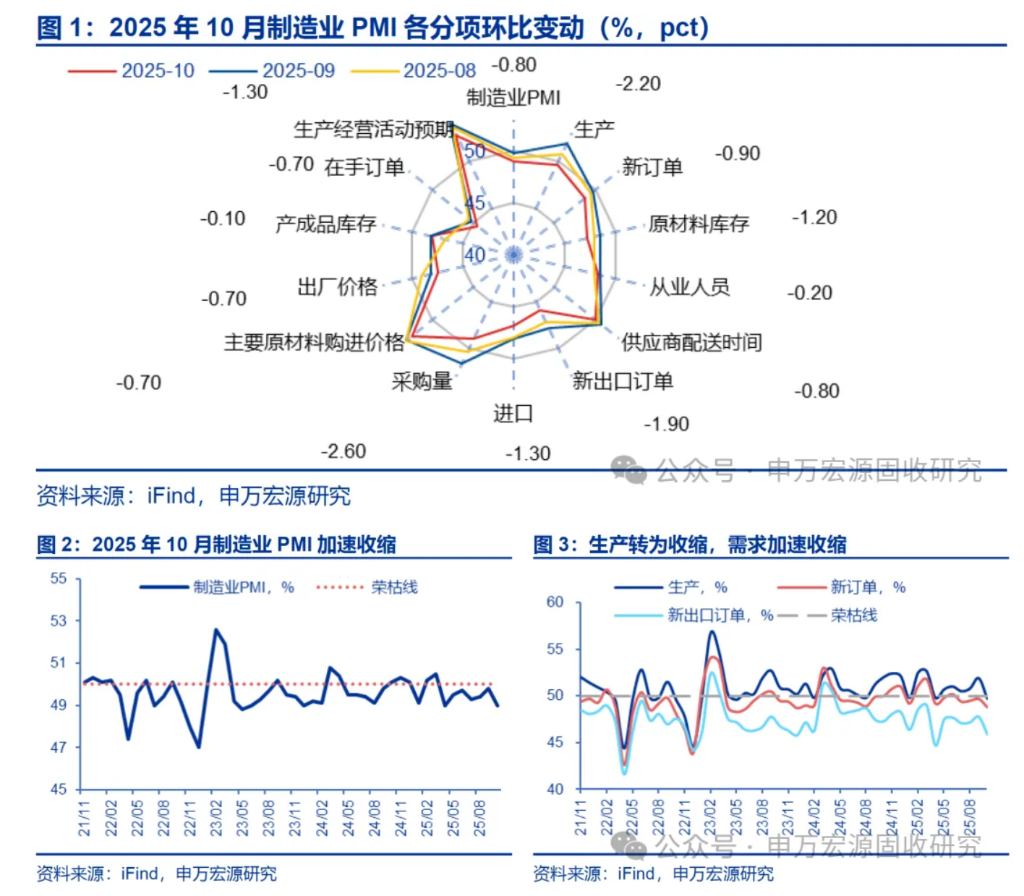
Core Viewpoint - The latest report from Shenwan Hongyuan indicates a decline in both production and demand, with the manufacturing PMI for October showing accelerated contraction, while the service sector experiences expansion due to the holiday effect [1]. Manufacturing Sector - The manufacturing PMI for October 2025 is reported at 49.0%, a decrease of 0.8 percentage points from the previous month [1]. - The production index fell by 2.2 percentage points to 49.7%, which is below the seasonal level compared to previous years [1][3]. - The new orders index decreased by 0.9 percentage points to 48.8%, indicating a faster contraction in demand, also below the seasonal level [1][3]. Price Trends - The major raw materials purchasing price index is at 52.5%, while the factory price index is at 47.5%, both showing a decline of 0.7 percentage points [1]. - The consumer goods factory price index has decreased, while the high-tech manufacturing factory price index has increased, reflecting a divergence in price trends [1]. Service Sector - The service sector PMI increased by 0.1 percentage points to 50.2%, driven by the holiday effect, with business activity indices for travel-related industries exceeding 60.0% [1]. Real Estate Sector - The construction business activity index fell to 49.1%, down 0.2 percentage points, impacted by slower construction progress during the holidays [1]. - Fixed asset investment growth continues to decline, and while there has been a temporary boost in real estate sales following policy adjustments, the sustainability of this trend is uncertain [1]. Economic Outlook - The overall economic situation remains under pressure, with the bond market's previous stress being alleviated, leading to increased focus on fundamentals [1]. - Recent developments in US-China trade talks and the Fourth Plenary Session's focus on top-level design are expected to have limited short-term impact on the bond market [1].

PMI回落,政策加力正当时
HUAXI Securities· 2025-10-31 11:21
Manufacturing Sector - The manufacturing PMI fell to 49.0% in October, down 0.8 percentage points from September and matching the level seen in April 2025, during peak US-China trade tensions[1] - Production and new orders were the largest contributors to the decline, dragging down the PMI by 0.55 and 0.27 percentage points, respectively[1] - The manufacturing prices decreased, with raw material purchase prices and factory prices both dropping by 0.7 percentage points to 52.5% and 47.5%, respectively[2] Service Sector - The service sector's business activity index slightly rebounded to 50.2%, up 0.1 percentage points, but new orders fell by 0.7 percentage points to 46.0%[3] - The gap between the business activity index and new orders widened to 4.2, the highest since October 2024, indicating persistent demand weakness[3] Construction Sector - The construction sector saw new orders rebound by 3.7 percentage points to 45.9%, marking the second consecutive month of increase, although the business activity index fell slightly to 49.1%[4] - The rebound in construction PMI was primarily driven by civil engineering projects related to infrastructure, with business activity index rising over 5 percentage points to above 55%[4] Economic Outlook - The overall composite PMI for October was 50.0%, down 0.6 percentage points from September, the lowest since early 2023[5] - The need for monetary policy support is increasing as the economy shows signs of continued slowdown, with GDP growth at 4.8% in Q3[5] Policy Measures - In October, significant policy measures were implemented, including the rapid deployment of 500 billion yuan in policy development financial tools and the resumption of government bond trading[6] - The likelihood of further monetary easing, including potential rate cuts, is rising, with expectations for a possible reduction in reserve requirements and structural interest rate cuts[6] Market Implications - The liquidity-driven bull market characteristics remain evident, with a lack of momentum for a shift towards cyclical and consumer sectors, suggesting continued focus on technology and dividend stocks[7] - Structural risks persist, with high transaction concentration and elevated stock prices, indicating an increased probability of market volatility[7]
国泰海通|宏观:PMI回落:主因外部扰动——2025年10月PMI数据点评
国泰海通证券研究· 2025-10-31 10:39
Core Insights - The manufacturing PMI for October 2025 is at 49.0%, a decrease of 0.8 percentage points from the previous month, indicating a contraction in the manufacturing sector [2] - External disturbances have led to a decline in manufacturing PMI, with new export orders and production indices showing significant drops, particularly in textiles, chemicals, and non-metallic mineral products [2][3] - The service sector remains stable, supported by holiday effects and promotional activities, while the construction sector shows signs of recovery due to government support for infrastructure projects [3] Manufacturing Sector - The manufacturing PMI has fallen below historical levels for this time of year, with external factors negatively impacting the external demand index [2] - New export orders and production indices have notably decreased, with specific industries like textiles and rubber products falling below critical thresholds [2][3] - The decline in the price index reflects external fluctuations, although some price support is noted from "anti-involution" measures [2] Non-Manufacturing Sector - The service sector's performance is buoyed by holiday spending and promotional events, with high activity in travel-related industries [3] - The construction sector's business activity index has slightly decreased, but government initiatives are expected to enhance support for infrastructure projects [3] - New orders and expectations in the construction sector are showing signs of recovery, indicating potential for improved economic conditions [3] Policy and Economic Outlook - Continuous macroeconomic policy support is essential, with a focus on managing expectations to stimulate domestic demand [3] - The "14th Five-Year Plan" emphasizes the need for an economy driven by domestic demand and consumption, aiming to create a positive cycle of expectation improvement leading to economic recovery [3]

2025年10月PMI数据解读:10月PMI:供需均有所放缓,新动能延续扩张
ZHESHANG SECURITIES· 2025-10-31 10:27
Group 1: PMI Overview - The manufacturing Purchasing Managers' Index (PMI) for October is 49.0%, a decrease of 0.8 percentage points from the previous month, indicating an economic slowdown[1] - The composite PMI output index stands at 50.0%, suggesting overall stability in production and business activities[1] - High-tech manufacturing and equipment manufacturing PMIs are at 50.5% and 50.2%, respectively, indicating continued expansion and support for the manufacturing sector[1] Group 2: Supply and Demand Dynamics - The production index for October is 49.7%, down 2.2 percentage points, reflecting a slowdown in manufacturing production[2] - New orders index recorded at 48.8%, a decline of 0.9 percentage points, indicating reduced demand in the manufacturing sector[3] - New export orders fell to 45.9%, significantly lower than seasonal expectations, influenced by ongoing trade tensions[3] Group 3: Price Index and Economic Resilience - The manufacturing purchase price index is at 52.5%, down 0.7 percentage points, while the factory price index is at 47.5%, also down 0.7 percentage points, indicating a general decline in price levels[7] - Despite the price index decline, new momentum-related industries show positive price trends, with equipment manufacturing prices rising for three consecutive months[7] - The composite PMI output index indicates economic resilience, with a slight decline of 0.6 percentage points, suggesting a convergence towards potential growth[10]
2025年10月PMI点评:双节弱化9、10月制造业PMI表现
CMS· 2025-10-31 09:39
Manufacturing Sector - In October, the manufacturing PMI recorded 49.0, a decrease of 0.8 from the previous month, marking a significant decline and the lowest level for the same period in nearly five years[1] - The production index and new orders index fell to 49.7 and 48.8, down 2.2 and 0.9 respectively, indicating a retreat in production and market demand[1] - New export orders index dropped to 45.9, a decline of 1.9, the second-lowest point this year, only higher than the April figure following the introduction of tariffs[1] Service Sector - The service sector PMI increased by 0.1 to 50.2, showing resilience in service consumption driven by the National Day and Mid-Autumn Festival[1] - The business activity expectation index for services stood at 56.1, indicating strong confidence among service enterprises regarding industry development[1] Construction Sector - The construction PMI fell to 49.1, down 0.2, remaining at the lowest level since 2019, reflecting ongoing demand weakness[1] - However, the civil engineering index rose significantly, exceeding 55, suggesting signs of accelerated infrastructure investment activities[1] Future Outlook - For November, favorable seasonal factors are expected to boost manufacturing PMI due to upcoming domestic and overseas demand events, including "Double Eleven" and Christmas[1] - Infrastructure investment is anticipated to increase in Q4, providing a solid foundation for growth, although the overall construction PMI may remain at historically low levels[1]