
扩内需

Search documents
11月我国CPI同比上涨0.7% 物价水平进一步企稳
Zhong Guo Jing Ying Bao· 2025-12-11 12:15
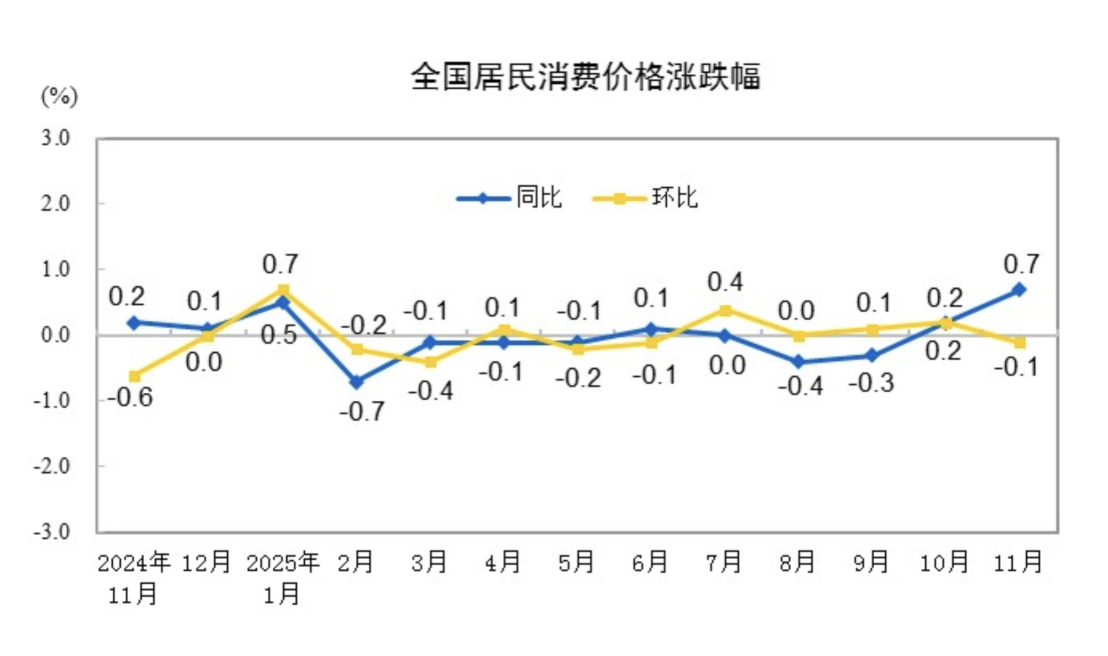
Group 1: CPI Analysis - In November, the CPI increased by 0.7% year-on-year, the highest level since March 2024, with an increase of 0.5 percentage points from the previous month [1] - The rise in CPI was primarily driven by a significant increase in vegetable prices, which turned from a decline of 2.9% in October to an increase of 0.2% in November, contributing positively to the CPI [2] - Core CPI, excluding food and energy, rose by 1.2% year-on-year in November, indicating a continued upward trend [2][3] Group 2: PPI Analysis - The PPI increased by 0.1% month-on-month in November, marking the second consecutive month of growth, attributed to seasonal demand increases and rising prices in certain industries [4] - Year-on-year, the PPI decreased by 2.2%, with the decline rate widening by 0.1 percentage points compared to the previous month, influenced by high comparison bases from the previous year [4][5] - The prices in key industries such as coal mining and photovoltaic equipment manufacturing showed a narrowing decline, indicating improvements in market competition and capacity management [5] Group 3: Future Outlook - The economic outlook suggests that core CPI will continue to rise steadily, supported by coordinated policy efforts to boost consumption and improve living standards [3][6] - The PPI is expected to decline by approximately 0.5% year-on-year in 2026, with a significant narrowing of the decline, driven by ongoing "anti-involution" policies and the rapid development of emerging industries [6]
11月通胀数据点评:食品项拉动CPI同比创年内新高
Mai Gao Zheng Quan· 2025-12-11 09:11
Group 1: CPI Analysis - In November 2025, the CPI increased by 0.7% year-on-year, marking the highest level in 2025 and the highest since March 2024, while it slightly decreased by 0.1% month-on-month[1] - Core CPI, excluding food and energy, rose by 1.2% year-on-year, remaining above 1% for three consecutive months, indicating a gradual recovery in consumer spending[1] - Food prices shifted from a 2.9% decline in October to a 0.2% increase in November, primarily driving the CPI increase[1] Group 2: PPI Insights - In November 2025, the PPI increased by 0.1% month-on-month, achieving positive growth for two consecutive months, but the year-on-year decline widened to -2.2%[2] - Key industries such as coal mining and photovoltaic equipment manufacturing showed narrowing year-on-year price declines, reflecting effective supply-demand optimization policies[2] - The prices of new materials and intelligent technologies rose significantly, with external storage devices increasing by 13.9% year-on-year, indicating a shift towards industrial upgrading[2] Group 3: Market Outlook - The CPI's recovery is largely dependent on short-term supply shocks from fresh produce, while long-term food prices, such as pork, remain low[4] - The divergence in price trends between traditional and emerging industries reflects ongoing economic transformation, with traditional sectors still undergoing capacity reduction[4] - Future expectations suggest a gradual recovery in prices across key industries, with CPI likely to continue a moderate upward trend and PPI expected to turn positive in 2026[4]
11月CPI同比涨0.7%,PPI同比降2.2%,扩内需待加码
Sou Hu Cai Jing· 2025-12-10 21:24
Group 1 - The core viewpoint indicates that despite a return to positive growth in CPI over the past two months, overall demand remains weak, suggesting the need for more proactive fiscal policies and further monetary easing to stimulate investment demand [2][6][9] Group 2 - In November, the Consumer Price Index (CPI) rose by 0.7% year-on-year, an increase of 0.5 percentage points from the previous month, while the Producer Price Index (PPI) fell by 2.2%, a decline of 0.1 percentage points from October [2][4] - Factors contributing to the CPI increase include tight supply of vegetables and fresh fruits due to adverse weather conditions, alongside rising transportation and preservation costs, while pork prices continued to decline due to weak terminal demand [4][6] - In November, food and tobacco prices rose by 0.3%, contributing approximately 0.09 percentage points to the CPI increase, with fresh vegetable prices up 14.5% and pork prices down 15.0% [4][6][7] Group 3 - The PPI decline is attributed to falling prices in most industrial products, with significant decreases in glass, coking coal, and coke prices, while only aluminum and copper prices saw slight increases [6][7] - The overall industrial producer price level was affected by a 2.4% drop in production material prices, which contributed approximately 1.79 percentage points to the overall decline [7] Group 4 - The "anti-involution" policy is showing signs of stabilizing prices in certain industries, with nine out of twelve key industries experiencing a year-on-year reduction in capacity in the third quarter [8] - The photovoltaic industry is witnessing a significant reduction in losses, with the net loss for leading companies reaching the lowest level since the second half of the previous year, indicating a potential recovery in profitability [8] Group 5 - Future strategies for advancing the "anti-involution" approach include implementing more aggressive fiscal policies, utilizing the Federal Reserve's interest rate cuts to further lower rates, and boosting demand in the real estate sector [9] - Emphasis is placed on increasing infrastructure investment in urban renewal and old community renovations to stimulate traditional industry demand, alongside efforts to enhance consumer spending [9]

CPI释放内需回暖信号,国际机构密集上调中国经济增速
Di Yi Cai Jing· 2025-12-10 12:49
Group 1: Consumer Price Index (CPI) Trends - The Consumer Price Index (CPI) increased by 0.7% year-on-year in November, the highest since March 2024, with a month-on-month decline of 0.1% [3][4] - Core CPI, excluding food and energy, rose by 1.2% year-on-year, maintaining a growth rate above 1% for three consecutive months [5][6] - The rise in CPI is attributed to a turnaround in food prices, particularly fresh vegetables, which saw a significant increase of 14.5% year-on-year after nine months of decline [4][5] Group 2: Producer Price Index (PPI) Insights - The Producer Price Index (PPI) increased by 0.1% month-on-month for two consecutive months, but year-on-year it decreased by 2.2%, with the decline slightly widening [3][8] - Seasonal demand increases in certain industries, such as coal and gas, contributed to the month-on-month rise in PPI [7][8] - The overall PPI trend reflects a positive change in pricing due to ongoing macroeconomic policies and a reduction in "involution" competition in key industries [8][10] Group 3: Economic Outlook and Policy Measures - The International Monetary Fund (IMF) projects China's economic growth rate to reach 5% in 2025, an upward revision from previous forecasts [3] - The Chinese government is intensifying policies to boost domestic demand, with a focus on optimizing the supply structure of consumer goods by 2027 [11][12] - Various local governments are implementing plans to enhance domestic demand, emphasizing the importance of consumer-driven economic growth [12]
【大涨解读】大消费:重要会议再强调内需主导,消费股携手发力,行业或成政策突破方向
Xuan Gu Bao· 2025-12-09 05:36
Group 1 - Consumer stocks have shown strength, with Dongbai Group achieving three consecutive trading limits, and companies like Yonghui Supermarket and Nanjing Tourism also experiencing significant gains [1] - Notable stock performances include Maoye Commercial with a 10.02% increase, Anji Food with a 9.99% rise, and Dongbai Group at 9.99%, indicating a positive trend in the retail sector [2] Group 2 - A recent meeting emphasized the importance of domestic demand, aiming to build a strong domestic market and promote innovation-driven growth [3] - The meeting highlighted the need for policies that integrate consumption and investment, allowing local governments more flexibility to implement measures that stimulate consumption and investment [4] - The focus on domestic demand is expected to continue, with projections indicating a significant increase in household consumption rates and a potential gap in per capita service consumption that may drive policy changes [4]

市场情绪现关键转折,下周A股或迎来“超级周”
Sou Hu Cai Jing· 2025-12-06 04:35
Market Overview - Global financial markets experienced a broad increase this week, driven by easing expectations and improved risk appetite [1] - The A-share market showed a structural upward trend, with growth style leading significantly [1] - Major indices in the US, including the Nasdaq, rose collectively, with the Nasdaq index leading with a 0.91% increase [1] - The Nikkei 225 index in Japan rose by 0.47%, while the Hang Seng Index and Hang Seng Tech Index in Hong Kong increased by 0.87% and 1.13%, respectively, indicating a strong inflow of capital into core assets [1] A-share Market Performance - The A-share market exhibited a mixed pattern of upward movement and structural differentiation, with all major indices closing higher [1] - As of December 5, the ChiNext Index led with a weekly increase of 1.86%, while the Shenzhen Component Index, Wind All A, and Shanghai Composite Index rose by 1.26%, 0.72%, and 0.37%, respectively [1] - Market sentiment saw a significant turnaround on Friday, with over 4,300 stocks rising and trading volume increasing to 1.74 trillion yuan, marking a recent high [1] - The non-bank financial and non-ferrous metal sectors showed strong performance, helping the Shanghai Composite Index return above 3,900 points [1] Sector Performance - The performance of industry sectors showed a stark contrast, with upstream resources and high-end manufacturing leading the gains [2] - The non-ferrous metals sector surged by 5.35%, while the communication, defense, and machinery equipment sectors also performed well [2] - The non-bank financial sector experienced a significant single-day increase of 3.5%, driven by regulatory changes that lowered investment risk factors for insurance funds [2] - Conversely, some consumer and technology application sectors faced pressure, with the media industry dropping by 3.86% and real estate and beauty care sectors also declining [2] Market Drivers - The logic driving this week's market evolution is clear: policy expectations provide core support, with anticipation for the upcoming Central Economic Work Conference focused on "stabilizing growth" [2] - Industrial and event catalysts, such as the surge in global copper prices, reinforced the logic for resource stocks, while new regulations benefiting the financial sector were also significant [2] - Market sentiment improved significantly on Friday, with major funds reversing four consecutive days of net outflows to net inflows [2] Future Outlook - The market is entering an important policy observation period, with key focus on domestic and international policy signals [3] - The Federal Reserve's meeting on December 10 is expected to influence global liquidity expectations, while the Central Economic Work Conference will set the tone for next year's economic policies [3] - Sectors such as non-ferrous metals, non-bank financials, and communication and military industries, which benefit from policies and prices, remain worthy of attention [3] - The Shanghai Composite Index may face technical pressure above 3,900 points, requiring sustained trading volume to solidify the breakout [3]
“宽基+行业主题”的核心-卫星策略!A500ETF基金(512050)本周合计净流入10亿,居股票ETF第一,电网设备ETF(159326)连续6日“吸金”
Ge Long Hui· 2025-12-05 04:41
Group 1 - The A-share market continues to experience reduced trading volume, with a total turnover of 1.55 trillion yuan, indicating a defensive market sentiment [1] - The largest ETF, the SSE 50 ETF, saw a net inflow of 437 million yuan, while the A500 ETF, favored by investors since October 21, recorded a net inflow of 244 million yuan yesterday, totaling 1.087 billion yuan for the week [1] - Industry-themed ETFs are attracting capital, with the gaming ETF and the power grid equipment ETF estimated to have net subscriptions of 57.75 million yuan and 62.39 million yuan respectively, with the latter seeing six consecutive days of inflows [1] Group 2 - The A500 ETF, which balances value and growth, has a latest scale of 21.481 billion yuan and an average daily turnover of 4.185 billion yuan, maintaining its position as the top performer in its category [2] - The SSE 50 ETF, recognized as a blue-chip flagship, has a scale of 178.898 billion yuan and recorded a slight increase of 0.13% [2] - The power grid equipment ETF, which tracks the CSI Power Grid Equipment Index, has a weight of over 60% in ultra-high voltage and more than 19% in controllable nuclear fusion, with a recent net inflow of 832 million yuan over the past 20 days [2]
乘联分会:扩内需等举措有望推动“十五五”时期国内汽车销量破3500万辆
Cai Jing Wang· 2025-12-05 02:36
12月4日,乘联分会发布简析"十五五"规划建议,其中指出,"十五五"规划更强调"质的有效提升",这 意味着经济增长将更多地由全要素生产率的提高、科技创新贡献度的提升以及绿色低碳转型来驱动。扩 内需增强内循环等举措有望推动"十五五"时期国内汽车销量规模突破3500万辆,新能源汽车渗透率突破 70%,高阶智驾向下普及。 ...
政策支持扩内需 “人工智能+消费”模式兴起
Zhong Guo Jing Ying Bao· 2025-12-04 05:14
Core Insights - The implementation plan by six departments aims to enhance the adaptability of supply and demand in consumer goods, focusing on new fields and the integration of artificial intelligence in consumption scenarios [1][2][5] Group 1: Policy and Economic Context - The "14th Five-Year Plan" emphasizes domestic demand as a key driver for economic growth, with a focus on integrating AI into consumer sectors [1][5] - The plan encourages innovation in products and services through AI, aiming to create a digital ecosystem across the entire industry chain [1][3] Group 2: AI and Consumer Innovation - The application of AI in consumer goods is expected to lead to the development of smart home robots, intelligent appliances, and AI-enabled devices, enhancing user experience and driving consumption [2][3] - AI's role in product innovation includes features like intelligent interaction and autonomous learning, which can improve consumer engagement and satisfaction [3][8] Group 3: Market Trends and Consumer Behavior - The integration of AI with virtual and augmented reality is creating immersive shopping experiences, such as virtual fitting rooms and travel, which stimulate new consumer demands [3][7] - The shift towards service-oriented and quality-focused consumption is being accelerated by technological advancements, reshaping consumer behavior and market dynamics [4][6] Group 4: Financial and Institutional Support - Financial institutions are encouraged to support AI-driven consumer projects through loans and funding, facilitating the growth of AI applications in the consumer sector [3][5] - Policies such as tax incentives and subsidies are suggested to promote AI research and development, further driving innovation in consumer products [3][5] Group 5: Future Directions and Recommendations - The focus should be on creating a collaborative environment between supply and demand, with an emphasis on new economic sectors like drone logistics and personalized services [5][6] - Establishing a supportive public policy framework is crucial for the successful integration of AI in consumer scenarios, fostering a high-quality smart consumption ecosystem [7][8]
政策协同显身手 经济活力持续释放
Zhong Guo Zheng Quan Bao· 2025-12-03 20:28
Economic Recovery Indicators - In November, the manufacturing PMI rose to 49.2%, indicating an improvement in economic conditions [1] - The new export orders index increased by 1.7 percentage points to 47.6%, reflecting strong resilience in foreign trade [1] Consumer Market Dynamics - The consumption upgrade policy has driven sales exceeding 2.4 trillion yuan, benefiting over 360 million people in the first ten months of the year [2] - Retail sales of new energy passenger vehicles reached 10.15 million units, a year-on-year increase of 21.9% [2] Logistics and Delivery Growth - The express delivery business volume surpassed 180 billion pieces for the first time, indicating robust consumer activity [3] - The average monthly express delivery volume since 2025 has exceeded 16 billion pieces, showcasing a new growth trajectory in consumption [3] Policy Support for Economic Growth - The government has allocated 500 billion yuan for local government debt to enhance financial capacity and stimulate effective investment [4] - New policy financial tools have been implemented to support over 2,300 projects with a total investment of approximately 7 trillion yuan, focusing on digital economy and AI [4] Future Economic Outlook - The upcoming Central Economic Work Conference is expected to set a proactive macroeconomic policy for 2026, emphasizing domestic demand and technological self-reliance [5] - Fiscal and monetary policies are anticipated to remain supportive, with potential for further reductions in reserve requirements and interest rates [5]