
市场避险情绪

Search documents
白银期货沉淀资金增至360亿元
Zheng Quan Ri Bao· 2025-10-14 15:47
Core Viewpoint - The silver futures market is experiencing significant price increases, driven by heightened market risk aversion and a strong financial appeal of silver assets, leading to increased investment in silver-themed funds [1][2]. Group 1: Market Performance - As of October 14, 2023, the COMEX silver futures for December reached a peak of $52.5 per ounce, marking a new high since its listing, with a current price of $50.17 per ounce and an open interest of 127,000 contracts [1]. - Domestic silver futures also hit a record high of 12,096 yuan per kilogram, with a daily increase of 2.64% [1]. - Year-to-date, silver futures have attracted significant capital, with a total of 36 billion yuan in funds, an increase of 17.8 billion yuan since the beginning of the year, and the main contract has risen over 50% [2]. Group 2: Supply and Demand Dynamics - The rise in silver prices is attributed to a combination of increased market risk aversion and low inventory levels ahead of the October delivery date for COMEX silver [2]. - The current shortage in silver supply is expected to persist, which will continue to influence both silver futures and spot prices [2]. Group 3: Investment Strategies - Analysts suggest that while the silver market shows long-term upward potential, short-term investors should be cautious of potential pullbacks and consider reducing positions or using options to manage risk [2].
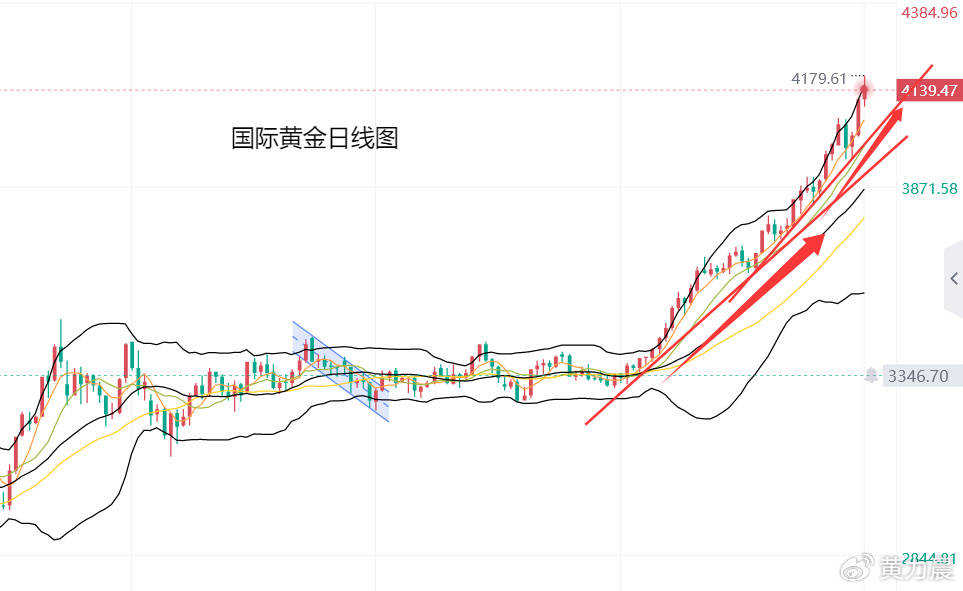
黄力晨:中美贸易关系紧张 黄金价格再创新高
Sou Hu Cai Jing· 2025-10-14 11:22
Core Viewpoint - The article highlights the significant rise in gold prices, reaching new historical highs, driven by escalating trade tensions between the U.S. and China, alongside expectations of further interest rate cuts by the Federal Reserve [1][3]. Group 1: Market Dynamics - Gold prices have shown a strong upward trend, with recent trading reaching as high as $4179 before experiencing some pullback [1]. - The market is currently observing key support levels at $4059 and $4022, while resistance levels are noted at $4079 and $4100 [1]. - The recent announcement by President Trump regarding a 100% tariff on Chinese imports has reignited fears in the market, leading to increased demand for gold as a safe-haven asset [1]. Group 2: Technical Analysis - The daily chart indicates that gold continues to maintain an upward trajectory, with support levels identified around $4120 and $4090 [3]. - Resistance levels are noted at $4145, with further upward targets at $4179 and $4200 [3]. - Technical indicators such as the 5-day moving average and MACD suggest a bullish outlook, while KDJ and RSI indicators are showing signs of potential adjustments after being in overbought territory [3].

Moneta Markets外汇:黄金白银价格创历史新高
Xin Lang Cai Jing· 2025-10-14 10:09
Core Viewpoint - Gold and silver futures prices have significantly increased, with gold reaching a historical high and silver approaching its peak, driven by market risk aversion and a short squeeze in the silver market [1] Group 1: Market Dynamics - The rise in gold and silver prices is attributed to heightened investor concerns over global economic uncertainty and a strong demand for physical precious metals globally, leading to a supply-demand imbalance [1] - The London market has experienced intensified short squeezes, further contributing to the upward trend in silver prices [1] - There is a notable increase in the prices of platinum and palladium, indicating that market funds are spreading across the entire precious metals sector [1] Group 2: Technical Analysis - For December gold futures, the bullish sentiment remains strong, with the next target being a closing price above $4200, while the bearish target is below $3900 [2] - Key resistance levels for gold are identified at $4104.30 and $4125.00, with support levels at $4050.00 and $4011.30 [2] - December silver futures also show bullish dominance, with a short-term target of closing above $50.00 and a bearish target below $46.70 [2] - The primary resistance levels for silver are at $50.00 and $50.50, while support levels are at $49.00 and $48.00 [2]

贵金属上涨波动加剧,短期谨防流动性风险
Guang Fa Qi Huo· 2025-10-14 09:39
Report Industry Investment Rating No relevant content provided. Core Viewpoints of the Report - In the short term, due to uncertainties in Trump's policies and Sino - US trade negotiations, and the accumulation of short - position losses, the financial market's overall liquidity risk has risen, leading to more violent price fluctuations in precious metals. Investors are advised to participate cautiously on a single - side basis. For gold, they can buy lightly when the price is above the $4060 support level and set stop - profit and stop - loss points. For silver, maintain a long - position mindset when the price is above $50. In the long term, affected by the US government shutdown and fiscal and monetary policy turmoil in developed countries, investors' asset pricing systems will be reshaped, which is beneficial to precious metals with strong financial attributes, and precious metals are expected to have a bull market similar to that in the 1970s [8]. Summary According to Relevant Catalogs Market Performance - Since October, due to trade frictions, tariffs, and geopolitical situations, institutional and individual funds have continuously flowed into precious metals for hedging, intensifying the liquidity shortage in the spot market. There have been significant rises and falls in the domestic and overseas precious metal markets. On the morning of October 14, the main Shanghai gold contract AU2512 once rose by more than 4.7% to a record high of 958 yuan/gram, and the main Shanghai silver contract AG2512 had a maximum increase of 7.6%. However, in the afternoon, the market dived, and the closing price of AU2512 was 938.98 yuan/gram, with a 2.7% increase; AG2512 closed at 11533 yuan/kilogram, with a 2.64% increase [1]. Driving Factors Market Risk - Aversion - Since October, the US government shutdown and political turmoil in many countries, combined with trade frictions, have increased the market's expectation of a recurrence of the global financial market turmoil in early April this year. Panic has increased the callback risk of risky assets such as stocks and cryptocurrencies, and funds have flowed to safe - haven assets. Gold and silver, as safe - haven assets, have led the financial market, with continuous inflows of funds from central bank gold purchases to ETF holdings, driving the prices of gold and silver to new historical highs [2]. Silver Supply and Demand - In this round of precious metal price increases, international silver prices have risen more sharply, with the London silver spot price rising above the COMEX futures price, reflecting the depletion of physical spot liquidity. The 1 - month lending and leasing cost of London bank silver has reached an extreme level of 35%. Due to the large - scale short - selling of silver by European and American financial institutions through the derivatives market in the past, and the current increase in silver investment demand, the transportation of a large amount of London inventory to New York has tightened spot liquidity. With relatively backward miner supply, silver prices have been further pushed up. The domestic silver price has also lagged behind the overseas market, and the London lending and leasing rates, as well as the US COMEX inventory and the spot - futures price difference, will reflect whether the short - term supply shortage can be alleviated [5][7]. Future Outlook - Fundamentally, the risk of US economic recession has increased due to the impact of the government shutdown on the economy and the employment market. The Fed's policy of interest - rate cuts may strengthen, which will suppress the US dollar index. In the long - term, affected by the US government shutdown and fiscal and monetary policy turmoil in developed countries such as Europe and Japan, investors' asset pricing systems will be reshaped, which is beneficial to precious metals with strong financial attributes, and precious metals are expected to have a bull market similar to that in the 1970s. In extreme cases, the annual increase in the gold price may exceed 100% [8].
国债期货底部震荡为主
Bao Cheng Qi Huo· 2025-10-14 09:28
Group 1: Report's Core View - Today, Treasury bond futures closed slightly higher. The resurgence of the tariff war has increased market risk aversion, which is favorable for Treasury bond futures. However, in the short term, China's economic data shows strong resilience, reducing the need for an across - the - board interest rate cut. The market's implied expectation of an interest rate cut between market interest rates and policy rates is weak, limiting the upward momentum of Treasury bond futures. From a macro - fundamental perspective, the problem of insufficient effective domestic demand persists, and there is a need for a relatively loose monetary environment in the future. The expectation of policy easing still exists, providing strong support for Treasury bond futures. In general, Treasury bond futures will mainly oscillate at the bottom in the short term [4] Group 2: Industry News - On October 14, the People's Bank of China conducted 91 billion yuan of 7 - day reverse repurchase operations, with a bid volume, winning bid volume of 91 billion yuan, and an operating interest rate of 1.40%. There were no 7 - day reverse repurchase maturities on this day, resulting in a net investment of 91 billion yuan. Additionally, 800 billion yuan of outright reverse repurchases matured [6]
博时基金王祥:受多重激励因素影响,国际金价升至4000美元上方
Xin Lang Ji Jin· 2025-10-14 07:39
Group 1 - The core viewpoint of the articles highlights the surge in the precious metals market during the National Day holiday, driven by uncertainties in U.S. government operations and economic data, leading to increased investment in safe-haven assets [1][2][3] - Gold prices have reached new historical highs, with international gold prices surpassing $4000 and RMB gold prices exceeding 900 yuan per gram, indicating a strong bullish sentiment in the market [1][2] - The U.S. government shutdown has delayed the release of key economic data, such as non-farm payrolls and CPI, which has further impacted market confidence and reinforced expectations for potential interest rate cuts [1][3] Group 2 - The escalation of U.S.-China trade tensions, including China's restrictions on rare earth exports and Trump's threats of 100% tariffs on Chinese imports, has heightened market risk aversion [2] - The current macroeconomic environment, characterized by both risk aversion and monetary easing, has led to increased allocations to gold, as investors seek to capitalize on favorable conditions [2] - The mixed signals from Federal Reserve officials regarding interest rate cuts reflect ongoing uncertainty in the U.S. economic outlook, with some advocating for caution while others support further easing [3]
现货黄金突破4100美元/盎司,黄金基金ETF(518800)开盘涨超2%,昨日净流入近9亿元
Sou Hu Cai Jing· 2025-10-14 02:14
Group 1 - The market is experiencing increased risk aversion due to the uncertainty surrounding Trump's policies, which is providing support for gold prices [1] - Trump's "de-globalization" tariff policies may encourage central banks to increase their gold purchases [1] - The Gold ETF (518800) holds physical gold contracts traded on the Shanghai Gold Exchange, directly corresponding to the physical gold stored in the exchange's vaults [1] Group 2 - The Gold ETF's price movements closely follow the AU9999 spot contract, reflecting domestic gold prices [1] - According to the fund's contract, at least 90% of the fund's assets must be held in physical gold [1] - In the medium to long term, a weakening U.S. economy and the ongoing "de-dollarization" of the global monetary system are expected to support gold prices [1] Group 3 - Investors are encouraged to consider opportunities in Gold ETF (518800) and Gold Stock ETF (517400) [1] - If gold prices experience short-term adjustments, it may be a good opportunity for investors to buy at lower prices [1]
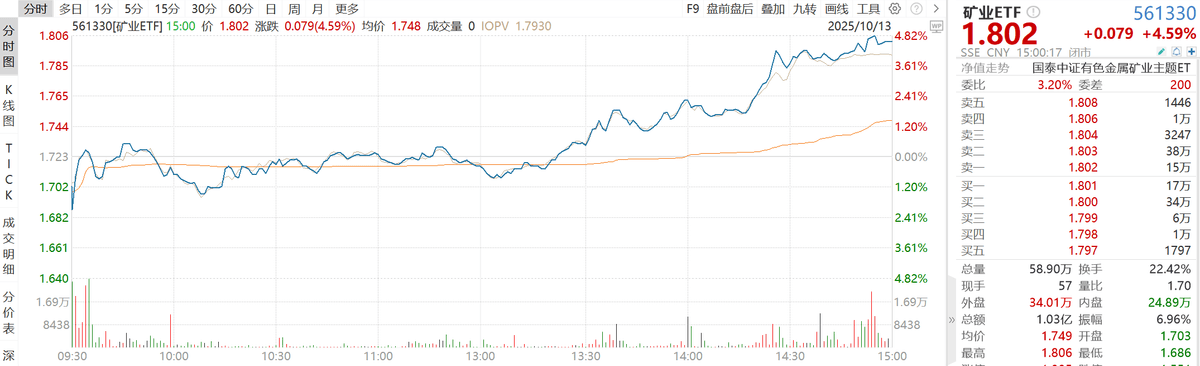
防止短期回调和追高风险,把握中长期的投资价值:矿业ETF大涨4.59%、有色60ETF大涨4.24%、黄金股票ETF大涨4.15%点评
Sou Hu Cai Jing· 2025-10-13 12:09
Core Viewpoint - The A-share market experienced fluctuations with the Shanghai Composite Index down by 0.19% and the Shenzhen Component Index down by 0.93%, while trading volume decreased to 2.37 trillion yuan from 2.53 trillion yuan the previous day. The rare earth permanent magnet concept saw a surge, and precious metals rose significantly in the afternoon [1]. Group 1: Market Performance - The mining ETF (561330) closed up by 4.59% [2] - The non-ferrous metals ETF (159881) closed up by 4.24% [4] - The gold stocks ETF (517400) closed up by 4.15% [6] Group 2: Reasons for Price Increases - The comprehensive tightening of rare earth export controls and renewed US-China tariff conflicts have enhanced the value of gold as a hedge. The Ministry of Commerce announced new export controls on certain rare earths, which may strengthen China's dominance in the global rare earth market [8]. - Two major rare earth companies announced a price increase of approximately 37% for rare earth concentrate for Q4 [8]. - The recent accidents at major copper mines, including Escondida and Grasberg, are expected to disrupt supply and potentially increase prices [9]. Group 3: Industry Outlook - The non-ferrous metals industry remains in a high state of prosperity, with precious metals likely to rise due to US-China tariff conflicts and monetary easing by the Federal Reserve. Industrial metals are also expected to benefit from supply disruptions and a tight supply-demand balance [10]. - The outlook for gold is supported by the Fed's easing cycle, increasing macroeconomic uncertainties, and a trend towards de-dollarization, which may bolster gold prices [11][12]. - The copper market is experiencing tight supply due to recent mining accidents and increasing demand from sectors like electric vehicles and data centers, which may lead to price resilience [12]. Group 4: Investment Opportunities - Investors are encouraged to monitor mining ETFs (561330) and the non-ferrous metals ETF (159881), which have significant exposure to gold, copper, and rare earths [14]. - The gold stocks ETF (517400) is expected to benefit from rising gold prices, providing potential profit elasticity [13]. - The overall composition of the mining ETF includes 29% copper, 17% gold, and 10% rare earths, indicating a diversified investment opportunity [15].
研究所晨会观点精萃-20251013
Dong Hai Qi Huo· 2025-10-13 02:54
1. Report Industry Investment Ratings - No specific industry - wide investment ratings are provided in the report. However, for different asset classes, there are short - term investment suggestions: - **Equity Index**: Short - term high - level adjustment with increased volatility, short - term cautious and wait - and - see [3][4] - **Treasury Bonds**: Short - term oscillation, cautious and wait - and - see [3] - **Commodity Categories**: - **Black Metals**: Short - term oscillation, cautious and wait - and - see [3] - **Non - ferrous Metals**: Short - term adjustment, cautious and short - term cautiously go long [3] - **Energy and Chemicals**: Short - term oscillation, cautious and wait - and - see [3] - **Precious Metals**: Short - term high - level strong - side oscillation, cautiously go long [3] 2. Core Views of the Report - **Macroeconomic Situation**: Overseas, the US threatens to impose 100% tariffs on China, intensifying short - term Sino - US game. The US dollar index and RMB exchange rate weaken, global financial markets fluctuate violently, and global risk appetite significantly cools. Domestically, economic growth accelerates, but short - term Sino - US game intensifies, and domestic risk appetite cools significantly. Multiple industries' steady - growth plans are introduced, increasing policy support [3][4]. - **Market Trading Logic**: Focus on domestic incremental stimulus policies and Sino - US game. Short - term macro upward drive weakens; follow - up attention on Sino - US trade negotiation progress and domestic incremental policy implementation [3][4]. 3. Summaries According to Related Catalogs 3.1 Macro - finance - **Macro Situation**: Overseas, Sino - US game intensifies, dollar and RMB weaken, global risk appetite cools, and precious metals strengthen. Domestically, economic growth accelerates, but Sino - US game intensifies, risk appetite cools, and multiple industries' steady - growth plans are introduced [3]. - **Asset Suggestions**: Equity index has short - term high - level adjustment, treasury bonds oscillate in the short - term, black metals oscillate, non - ferrous metals adjust, energy and chemicals oscillate, and precious metals are strong - side oscillating at high levels. All are with cautious operation suggestions [3]. 3.2 Equity Index - **Market Performance**: Domestic stock market drops significantly due to the drag of energy metals, semiconductors, and batteries. Fundamentally, economic growth accelerates, but Sino - US game intensifies, and risk appetite cools. Multiple industries' steady - growth plans are introduced. Short - term cautious and wait - and - see [4]. 3.3 Black Metals - **Steel**: Last Friday, steel futures and spot prices declined slightly, and market transactions were at a low level. After the weekend, Sino - US trade conflict escalated, and market risk - aversion increased. Fundamentally, demand is weak, inventory increases by 127000 tons, and supply is expected to remain high. The steel market may be weak in the short - term [5]. - **Iron Ore**: Last Friday, iron ore futures and spot prices rebounded slightly. Iron ore demand is strong, but due to the weakening steel market and Sino - US trade conflict, the negative feedback may come earlier. It is recommended to short at high prices next week [5]. - **Silicon Manganese/Silicon Ferrosilicon**: Last Friday, spot prices were flat, and futures prices declined slightly. Alloy demand is okay, but supply increases in some areas. Silicon manganese and silicon ferrosilicon futures prices are expected to oscillate in the range [6]. - **Coke and Coking Coal**: Not mentioned in the provided content. 3.4 Non - ferrous Metals and New Energy - **Copper**: Tariff concerns resurfaced last Friday night. US economic data is mixed, and the Fed's rate - cut expectation increases. Some major copper mines have supply disruptions, but most are expected to resume production [8]. - **Aluminum**: Last Friday, Shanghai aluminum rose and then fell, following copper. During the holiday, domestic aluminum social inventory accumulated by 200000 tons, supply is rigid, and demand weakens marginally [9][10]. - **Tin**: Supply is tight globally, but demand improvement is limited, and high prices suppress consumption. Tin prices are expected to oscillate at high levels [10]. - **Lithium Carbonate**: Production increases, inventory decreases slightly. Sino - US trade conflict and 11 - month warehouse receipt cancellation may bring pressure, and prices are expected to oscillate in the range [11]. - **Industrial Silicon**: Production reaches a new high, inventory increases slightly. The 2511 contract faces warehouse receipt digestion pressure, and prices are expected to oscillate in the range [11]. - **Polysilicon**: Production increases, inventory is high, and warehouse receipt quantity increases. Supply is high, demand is weak, and prices depend on the implementation of storage - purchase news [11]. 3.5 Energy and Chemicals - **Crude Oil**: The Gaza cease - fire agreement and US tariff statements lead to a significant drop in oil prices. OPEC+增产 will continue to put downward pressure on prices [12]. - **Asphalt**: Oil price decline drives asphalt price down. Demand in the peak season is almost over, supply pressure increases, and asphalt may oscillate weakly [13]. - **PX**: It oscillates weakly with the polyester sector. Although PTA high - level operation provides some demand support, it is likely to continue to oscillate weakly [13]. - **PTA**: Downstream demand is weak, supply remains high, and port inventory increases. Prices will continue to run weakly [13]. - **Ethylene Glycol**: Port inventory rises, demand deteriorates, and supply increases. It is expected to accumulate inventory in October and run at a low level [14]. - **Short - fiber**: It adjusts with the polyester sector, and terminal orders have limited improvement. It may continue to oscillate weakly [14]. - **Methanol**: Supply growth far exceeds demand recovery, inventory increases, and prices are expected to oscillate weakly [14]. - **PP**: After the holiday, supply and demand both increase, but new capacity and restarted devices bring supply pressure, and prices are expected to be under pressure [15]. - **LLDPE**: After the holiday, supply increases and demand recovers slowly. The "Golden September and Silver October" demand is less than expected, and prices will continue to oscillate weakly [15]. - **Urea**: The market is in a situation of strong supply and weak demand. Supply is above 190000 tons per day, and demand is weak. The short - term price is under pressure, and the subsequent trend depends on export policy [16]. 3.6 Agricultural Products - **Soybean and Rapeseed Meal**: Sino - US trade tension intensifies, and the CBOT soybean market is under pressure. Domestic short - term soybean meal replenishment may increase, but in the fourth quarter, supply is sufficient. CBOT soybean and domestic soybean meal may be under short - term pressure. Rapeseed meal is in a situation of weak supply and demand before the import of Australian rapeseed [17]. - **Soybean and Rapeseed Oil**: Rapeseed oil inventory is expected to decrease before the import of Australian rapeseed. Palm oil has some support, and soybean oil may accumulate inventory after the holiday and run weakly [17]. - **Palm Oil**: The MPOB report is bearish, with inventory rising unexpectedly. In the short - term, there is a risk of correction, but in the medium - term, it is still easy to rise and difficult to fall [17].
有色金属日报-20251013
Wu Kuang Qi Huo· 2025-10-13 02:18
Group 1: Report Industry Investment Rating - No relevant content provided Group 2: Core Viewpoints of the Report - The threat of Trump to impose significant additional tariffs on China is uncertain, and market sentiment needs further clarification. For copper, overseas mine production cuts and reduced domestic refined copper output may support prices. If the trade situation is a short - term shock, there may be buying opportunities after the price decline [2][3]. - The deterioration of Sino - US trade relations is uncertain. For aluminum, if the tariff threat is short - term, market sentiment may recover. With the increase in the domestic aluminum - water ratio and seasonal consumption recovery, the pressure of aluminum ingot inventory accumulation is not large, and the price decline may increase the upward elasticity [5][6]. - For lead, the apparent inventory of lead ore has slightly increased, and the smelting of primary lead is at a high level. The inventory of recycled lead has decreased, and its smelting is at a low level. With the release of downstream demand and the increase in the cancellation of LME lead warehouse receipts, the structural risk of LME lead has increased. Short - term Shanghai lead is expected to fluctuate at a low level with increased risk [8][9]. - For zinc, domestic zinc smelting enterprises operate normally during holidays, and some downstream enterprises have long holidays. The registered LME zinc warehouse receipts are at a low level, and there is a structural risk. After the opening of the zinc ingot export window, short - covering in the domestic market provides short - term support. Short - term Shanghai zinc is expected to fluctuate at a low level with increased risk [10][12]. - For tin, short - term Sino - US trade frictions may lower market risk appetite, but the supply - demand is in a tight balance, and the peak - season demand is recovering. Tin prices may maintain a high - level shock in the short term [13][14]. - For nickel, short - term Sino - US trade frictions may lower market risk appetite, but the impact on nickel prices is relatively small. In the short term, it is recommended to wait and see, and consider buying on dips if the price drops enough. In the long - term, there are potential positive factors for nickel prices [15][17]. - For lithium carbonate, the strong downstream demand during the National Day holiday drives inventory reduction, but the supply replenishment expectation restricts the upside space. The negative sentiment in the equity market may suppress lithium prices, and it is recommended to pay attention to macro - environment changes and supply - demand expectations [19][20]. - For alumina, the short - term ore price has support but may face pressure after the rainy season. The over - capacity pattern in the smelting end is difficult to change in the short term. It is recommended to wait and see, and pay attention to supply - side policies, Guinea's ore policy, and the Fed's monetary policy [22][24]. - For stainless steel, the market is trapped between "cost support" and "weak demand". If the nickel - iron price continues to rise, stainless steel may oscillate upward under cost support [26][27]. - For cast aluminum alloy, the cost - end aluminum price weakens due to Sino - US trade relations, and the contract delivery pressure is large. However, with the improvement of downstream consumption and reduced raw - material supply, the price is expected to have support [29][30] Group 3: Summaries by Metals Copper - **Market Information**: Trump's tariff threat causes market panic, leading to a 3.73% drop in LME copper 3M to $10374/ton and a fall in SHFE copper to 83030 yuan/ton. LME copper inventory decreases by 75 to 139000 tons, and domestic SHFE inventory increases by 15000 tons compared to before the holiday [2]. - **Strategy Viewpoint**: The tariff threat is uncertain. From the fundamental perspective, supply tightening supports prices. If it's a short - term shock, there may be buying opportunities after the price decline. The operating range of SHFE copper is 82000 - 85500 yuan/ton, and that of LME copper 3M is $10200 - 10700/ton [3] Aluminum - **Market Information**: The deterioration of Sino - US trade relations causes aluminum prices to weaken. LME aluminum 3M drops 1.31% to $2746/ton, and SHFE aluminum closes at 20755 yuan/ton. Domestic aluminum ingot and billet inventories increase slightly, and the processing fee of aluminum billets declines [5]. - **Strategy Viewpoint**: If the tariff threat is short - term, market sentiment may recover. With the increase in the aluminum - water ratio and seasonal consumption recovery, the inventory accumulation pressure is not large, and the price decline may increase the upward elasticity. The operating range of SHFE aluminum is 20500 - 21100 yuan/ton, and that of LME aluminum 3M is $2700 - 2790/ton [6] Lead - **Market Information**: SHFE lead index rises 0.12% to 17142 yuan/ton, and LME lead 3S rises to $2027.5/ton. Domestic social inventory decreases to 3.58 tons [8]. - **Strategy Viewpoint**: The apparent inventory of lead ore increases slightly, and the smelting of primary lead is at a high level. The inventory of recycled lead decreases, and its smelting is at a low level. With the release of downstream demand and the increase in the cancellation of LME lead warehouse receipts, the structural risk of LME lead has increased. Short - term Shanghai lead is expected to fluctuate at a low level with increased risk [9] Zinc - **Market Information**: SHFE zinc index falls 0.18% to 22289 yuan/ton, and LME zinc 3S falls to $2997/ton. Domestic social inventory increases slightly to 15.02 tons [10]. - **Strategy Viewpoint**: Domestic zinc smelting enterprises operate normally during holidays, and some downstream enterprises have long holidays. The registered LME zinc warehouse receipts are at a low level, and there is a structural risk. After the opening of the zinc ingot export window, short - covering in the domestic market provides short - term support. Short - term Shanghai zinc is expected to fluctuate at a low level with increased risk [11][12] Tin - **Market Information**: Tin prices fall due to Sino - US trade frictions. The resumption of tin mines in Myanmar is slow, and Indonesia cracks down on illegal mining, increasing supply concerns. The downstream new - energy vehicle and AI server industries are booming, but traditional consumer electronics and photovoltaic industries are weak. The "Golden September and Silver October" peak season drives marginal improvement in consumption [13]. - **Strategy Viewpoint**: Short - term Sino - US trade frictions may lower market risk appetite, but the supply - demand is in a tight balance, and the peak - season demand is recovering. Tin prices may maintain a high - level shock in the short term. It is recommended to wait and see. The operating range of domestic tin is 280000 - 300000 yuan/ton, and that of LME tin is $36000 - 39000/ton [14] Nickel - **Market Information**: Nickel prices fluctuate and fall at night due to Sino - US trade frictions. The spot market trading is average, and the cost of nickel ore is stable. Nickel - iron prices are firm, and the price of MHP is high [15]. - **Strategy Viewpoint**: Short - term Sino - US trade frictions may lower market risk appetite, but the impact on nickel prices is relatively small. In the short term, it is recommended to wait and see, and consider buying on dips if the price drops enough. In the long - term, there are potential positive factors for nickel prices. The operating range of SHFE nickel is 115000 - 128000 yuan/ton, and that of LME nickel 3M is $14500 - 16500/ton [17] Lithium Carbonate - **Market Information**: On October 10, the MMLC spot index of lithium carbonate is flat at 73011 yuan. The price of battery - grade lithium carbonate is 72500 - 74000 yuan, and that of industrial - grade is 71500 - 72000 yuan. The price of LC2511 contract falls 0.82% [19]. - **Strategy Viewpoint**: The strong downstream demand during the National Day holiday drives inventory reduction, but the supply replenishment expectation restricts the upside space. The negative sentiment in the equity market may suppress lithium prices. It is recommended to pay attention to macro - environment changes and supply - demand expectations. The operating range of the Guangzhou Futures Exchange's lithium carbonate main contract is 68800 - 73800 yuan/ton [20] Alumina - **Market Information**: On October 10, the alumina index falls 0.66% to 2861 yuan/ton. The spot price in Shandong falls to 2865 yuan/ton, and the overseas FOB price in Australia rises to $324/ton. The import window is close to closing, and the futures warehouse receipts increase [22]. - **Strategy Viewpoint**: The short - term ore price has support but may face pressure after the rainy season. The over - capacity pattern in the smelting end is difficult to change in the short term. It is recommended to wait and see. The operating range of the domestic main contract AO2601 is 2600 - 3000 yuan/ton, and attention should be paid to supply - side policies, Guinea's ore policy, and the Fed's monetary policy [23][24] Stainless Steel - **Market Information**: The stainless - steel main contract closes at 12860 yuan/ton, up 1.02%. The spot prices in Foshan and Wuxi are stable. The raw - material prices are stable, and the social inventory decreases [26]. - **Strategy Viewpoint**: The market is trapped between "cost support" and "weak demand". If the nickel - iron price continues to rise, stainless steel may oscillate upward under cost support [27] Cast Aluminum Alloy - **Market Information**: Aluminum alloy prices rise and then fall following aluminum prices. The AD2511 contract falls 0.41% to 20465 yuan/ton. The price of domestic mainstream ADC12 rises slightly, and the inventory of recycled aluminum alloy ingots in the main domestic markets decreases [29]. - **Strategy Viewpoint**: The cost - end aluminum price weakens due to Sino - US trade relations, and the contract delivery pressure is large. However, with the improvement of downstream consumption and reduced raw - material supply, the price is expected to have support [30]