
扩内需

Search documents
从“十五五”规划看下阶段中央宏观调控思路
Guoxin Securities· 2025-11-16 11:43
Growth Targets and Economic Framework - The "15th Five-Year Plan" emphasizes achieving a per capita GDP of $20,000 (constant prices) by 2035, which is considered the threshold for "middle-developed countries" [5] - To meet this target, an average annual GDP growth rate of 4.17% is required during the "15th" and "16th" Five-Year Plans, considering a projected annual population decrease of approximately 0.20% [7] - The IMF recognizes 39 developed countries with a per capita GDP generally exceeding $20,000, which serves as a benchmark for China's growth aspirations [7] Economic Growth Projections - The expected growth rate for the "15th Five-Year Plan" is projected to be between 4.5% and 4.9%, while the "16th Five-Year Plan" is anticipated to be between 4.0% and 4.4% [18] - Achieving the 2035 target necessitates a compound annual growth rate of 4.4% over the next decade, factoring in a potential annual population decline [18] Structural Economic Changes - The transition from a GDP-driven growth model to a composite model involving productivity, inflation, and exchange rates is essential for sustainable growth [21] - The focus on "new quality productivity" is critical, aiming to enhance total factor productivity as a response to labor force contraction [26] Monetary Policy Considerations - The current monetary policy environment suggests limited room for interest rate cuts, with a focus on maintaining interest rate spreads [60] - A moderate easing of monetary policy is expected, primarily through liquidity support and structural adjustments rather than broad-based rate cuts [63] Fiscal Policy and Domestic Demand - The fiscal deficit is projected to remain between 3.8% and 4.0%, with a broad deficit exceeding 12 trillion yuan, emphasizing the need for effective fiscal measures to stimulate domestic demand [89] - The shift from "infrastructure finance" to "livelihood finance" is crucial for enhancing fiscal multipliers and improving overall economic efficiency [89]
周六,市场传来3大消息,其中一个事关巴菲特!
Sou Hu Cai Jing· 2025-11-15 04:27
Group 1 - The U.S. stock market closed mixed, with the Dow Jones down 0.65%, S&P 500 slightly down 0.05%, and Nasdaq up 0.13% [1] - Technology stocks showed mixed performance, with Micron Technology and SanDisk rising over 4%, Oracle up over 2%, and Microsoft and Nvidia up over 1% [2] - Most popular Chinese concept stocks declined, with the Nasdaq Golden Dragon China Index down 1.61%, and companies like Futu and Xpeng Motors falling over 5%, while Alibaba dropped over 3% [3] Group 2 - A new round of domestic demand expansion measures is expected to be introduced, focusing on enhancing supply-demand compatibility to release consumption potential and promote economic circulation [4] - Berkshire Hathaway has made significant moves in the tech sector, purchasing shares in Google-A while continuing to reduce its stake in Apple, indicating a strategic shift possibly related to future leadership [5]


瑞达期货宏观市场周报-20251114
Rui Da Qi Huo· 2025-11-14 11:06
1. Report Industry Investment Rating There is no information about the report industry investment rating in the provided content. 2. Core Viewpoints of the Report - A-share market: A-share major indices declined collectively this week, with the Sci-Tech Innovation 50 and ChiNext indices falling by over 3%. The four stock index futures also declined. The market's trading activity increased slightly compared to last week. The market is expected to continue its weak recovery in the fourth quarter [9][15]. - Bond market: This week, Treasury bond futures showed a pattern of short-term weakness and long-term strength, and the capital market tightened slightly. The inflation level rebounded slightly, but its sustainability remains to be seen. The central bank will maintain a moderately loose policy, and the scope for further monetary easing this year is limited [9]. - Commodity market: China's PPI in October rebounded significantly, supporting the commodity index. However, gold and crude oil are expected to remain volatile. Given their large weights in the commodity index, the commodity index is expected to oscillate in the future [9]. - Foreign exchange market: The US dollar index continued to decline under pressure this week. The probability of the Fed cutting interest rates in December dropped significantly, causing the US dollar to oscillate in the short term. The euro area's economic outlook continued to improve, and the euro was supported in the medium term. The Japanese yen remained under pressure [13]. 3. Summary by Directory 3.1 This Week's Summary and Next Week's Allocation Recommendations - **Stock**: The Shanghai and Shenzhen 300 Index fell by 1.08%, and the Shanghai and Shenzhen 300 Stock Index Futures dropped by 1.26%. A-share major indices opened higher on Monday due to the inflation data released on Sunday, oscillated from Tuesday to Thursday, and declined significantly on Friday due to weak economic data in October. The recommendation is to buy on dips [9]. - **Bond**: The 10-year Treasury bond yield increased by 0.03%, and the main 10-year Treasury bond futures fell by 0.06%. Treasury bond futures showed short-term weakness and long-term strength this week, and the capital market tightened slightly. The recommendation is to trade within a range [9]. - **Commodity**: The Wind Commodity Index rose by 3.92%, and the China Securities Commodity Futures Price Index increased by 1.52%. China's PPI in October rebounded significantly, but gold and crude oil are expected to remain volatile. The recommendation is to wait and see [9]. - **Foreign exchange**: The euro against the US dollar rose by 0.78%, and the euro against the US dollar 2512 contract increased by 0.68%. The US government shutdown led to a downgraded economic outlook, and the US dollar declined. The recommendation is to be cautious and wait and see [9]. 3.2 Important News and Events - **Domestic**: The Ministry of Commerce and the General Administration of Customs suspended the implementation of multiple export control measures; China and Spain signed 10 cooperation documents; the State Council issued measures to promote private investment; ten departments promoted the opening and interconnection of logistics data [17]. - **International**: The US government shutdown ended; some Fed officials were cautious about interest rate cuts; the US suspended the implementation of export control penetration rules [13][18]. 3.3 This Week's Domestic and International Economic Data - **China**: In October, the industrial added value increased by 4.9% year-on-year, fixed asset investment decreased by 1.7% from January to October, CPI increased by 0.2% year-on-year, and PPI decreased by 2.1% year-on-year [14]. - **US**: The probability of the Fed cutting interest rates in December dropped significantly, and the US dollar oscillated in the short term [13]. - **Eurozone**: The economic outlook continued to improve, and the euro was supported in the medium term [13]. 3.4 Next Week's Important Economic Indicators and Economic Events - **US**: The industrial output monthly rate in October, the NAHB housing market index in November, and the initial jobless claims for the week ending November 15 [78]. - **UK**: The CPI monthly rate in October, the retail price index monthly rate in October, and the Gfk consumer confidence index in November [78]. - **Eurozone**: The CPI annual rate final value in October and the consumer confidence index preliminary value in November [78]. - **China**: The one-year loan prime rate as of November 20 [78]. - **Japan**: The core CPI annual rate in October [78].

三季度《货币政策执行报告》解读:“双降”的潜在信号
CMS· 2025-11-13 07:33
Economic Analysis - The report highlights a renewed focus on "expanding domestic demand," marking the first increase in emphasis for the year, indicating a shift from previous reports that concentrated on supply-side issues[2] - It notes that the overall economic performance is expected to improve, with a reduction in the difficulty of achieving annual economic targets due to easing US-China relations and signs of price stabilization[1] - The report identifies a significant change in policy direction, emphasizing the need for a dual-pillar regulatory framework to maintain financial market stability and prevent moral hazards[3] Policy Direction - The report suggests a high probability of a reserve requirement ratio (RRR) cut to alleviate bank liquidity constraints, with a focus on maintaining relatively loose social financing conditions[3] - It emphasizes the importance of consumer finance, proposing measures to restore personal credit limits and reduce consumer finance interest rates, with current average loan rates dropping below 24%[14] - The adjustment in the approach to RMB internationalization indicates a shift from "cautious advancement" to "promotion," suggesting an increase in available RMB assets for foreign investors[15] Market Signals - The report indicates that the central bank expects a downward trend in social financing and M2 growth rates, suggesting that demand-driven interest rates are more likely to decrease than increase[20] - It highlights the limited upward space for interest rates, as the central bank aims to maintain reasonable interest rate relationships amidst a backdrop of low credit demand and stable deposit needs[22] - The overall expectation of a "double reduction" in monetary policy remains, with potential policy surprises being a trigger for market movements towards the end of the year[25]
超139亿件,创历史新高!“小包裹”释放“扩内需、促消费、稳增长”大动能
Yang Shi Wang· 2025-11-13 02:56
国家邮政局发展研究中心战略规划研究部主任刘江称:"快递市场规模持续扩大,彰显了邮政快递业在扩内需、促消费、稳增长中发挥的 关键作用。快递业通过拓展农村市场,实现上下游双向高效流动,有效激发了农村服务需求。同时,通过与先进制造业的深度融合,快递供应 链正朝着高端化、智能化方向转型。" 央视网消息:记者从国家邮政局了解到,从10月21日至11月11日,快递旺季期间,中国快递业务量增长明显,单日业务量峰值达7.77亿 件,创历史新高。 国家邮政局最新数据显示,10月21日至11月11日,快递旺季期间,全国邮政快递企业共揽收快递包裹139.38亿件,日均揽收量是日常业务 量的117.8%,旺季单日业务量峰值达7.77亿件,创历史新高。 ...

上半年财政政策亮点:精准发力稳增长 提质增效惠民生
Zhong Guo Jing Ying Bao· 2025-11-12 23:33
Core Viewpoint - Since 2025, China's fiscal policy has become more proactive in response to a complex external environment, focusing on stabilizing employment, enterprises, markets, and expectations, while promoting sustained economic recovery [1] Fiscal Performance - In the first half of 2025, China's fiscal operations were generally stable, with total public budget revenue at 11.56 trillion yuan, a year-on-year decrease of 0.3%, but the decline was narrower than in the first quarter [2] - Tax revenue was 9.29 trillion yuan, showing a downward trend year-on-year, but began to recover in the second quarter [2] - Public budget expenditure reached 14.13 trillion yuan, a year-on-year increase of 3.4%, with central government expenditure growing by 9% [2] - Key areas such as social security, employment, and education received strong funding support, with social security and employment expenditure increasing by 9.2% [2] Domestic Demand Activation - Special long-term government bonds are becoming a core tool for expanding domestic demand, with 300 billion yuan allocated to support consumption upgrades, leading to sales exceeding 1.6 trillion yuan and a 5% year-on-year increase in retail sales of consumer goods [3] - The central government allocated 7.279 billion yuan for service industry development, supporting county-level commercial construction and modern trade systems [3] County-Level Commercial Development - A comprehensive commercial service network has been established in Zhuozhou, enhancing county-level commercial capabilities and contributing to rural revitalization and high-quality economic development [4] - The county's market consumption accounted for 38.9% of total retail sales of consumer goods, indicating a strong performance in county and township markets [5]
A股资金温度计(第2期):资金偏好分化,情绪边际降温
Ping An Securities· 2025-11-11 02:41
Group 1: Institutional Funds - Public funds showed a decrease in new issuance since September, with significant increases in non-bank financials, technology, and non-ferrous metals, while reducing holdings in banks [9][10][15] - Private equity funds reached a peak in new issuance in Q3, with a focus on stable defensive positions, although new issuance has cooled down in October [16][19] - Insurance funds increased their holdings in banks during a market downturn, with a net inflow of 83.6 million shares in Q3 [22][23] - The national team slightly reduced their holdings but increased investments in TMT sectors, particularly in electronics and communications [24][27] Group 2: Retail Investor Funds - Retail investor activity peaked in Q3 with a total of 7.55 million new accounts, but saw a decline in October [29][30] - Financing funds saw a net inflow of 279.2 billion yuan in August, but this trend decreased in subsequent months [29][31] - The focus of retail investor financing has been on technology sectors such as electronics, power equipment, and pharmaceuticals [31][33] Group 3: Foreign Funds - Foreign capital reduced holdings in traditional industries, particularly banks, while increasing investments in emerging sectors like electronics [34] - The total value of foreign holdings in A-shares increased to 2.6 trillion yuan despite a reduction in the number of shares held [34]
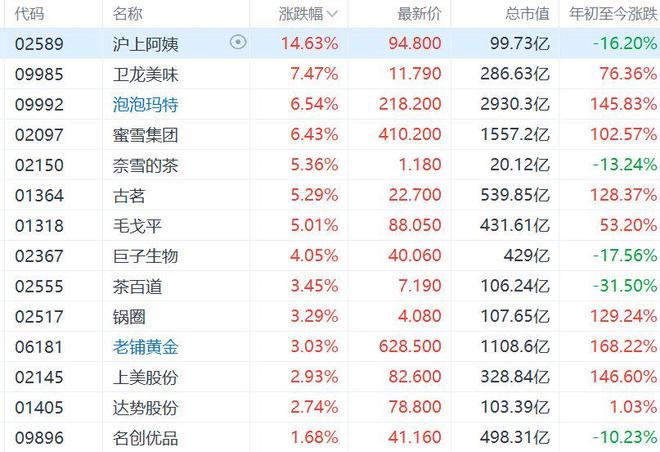
港股异动丨新消费概念股集体走强,卫龙美味涨超7%,蜜雪集团涨超6%
Ge Long Hui· 2025-11-10 04:11
Core Insights - The A-share market's consumer stocks have surged, positively impacting Hong Kong's new consumer concept stocks, with notable increases in various companies' stock prices [1] Group 1: Market Performance - Stocks such as "沪上阿姨" rose over 14%, "卫龙美味" increased over 7%, and "泡泡玛特" and "蜜雪集团" both saw gains exceeding 6% [1] - Other companies like "奈雪的茶," "古茗," and "毛戈平" experienced increases of over 5%, while "茶百道," "锅圈," and "老铺黄金" rose over 3% [1] Group 2: Economic Indicators - The National Bureau of Statistics released positive inflation data for October, indicating a 0.2% month-on-month and year-on-year increase in the Consumer Price Index (CPI), marking a shift from decline to growth [1] - The core CPI, excluding food and energy prices, rose by 1.2% year-on-year, with the growth rate expanding for the sixth consecutive month [1] Group 3: Government Policy - The Ministry of Finance plans to continue implementing measures to boost consumption, including providing financial subsidies for personal consumption loans in key sectors [1]

A股异动丨消费股大面积涨停
Ge Long Hui A P P· 2025-11-10 03:34
Group 1 - The A-share market is seeing a strong performance in consumer stocks, particularly in retail, duty-free, leisure services, airport, tourism, food, and dairy sectors [1] - Notable stocks that have hit the daily limit include China Duty Free Group, Guoguang Chain, Dongbai Group, Yingxin Development, Jinjiang Hotel, Overseas Chinese Town A, Sanyuan Foods, Huifa Foods, and Barbie Foods [1] - The National Bureau of Statistics released positive inflation data for October, indicating a month-on-month increase of 0.2% in the Consumer Price Index (CPI) and a year-on-year increase of 0.2%, marking a shift from decline to growth [1] Group 2 - The core CPI, excluding food and energy prices, rose by 1.2% year-on-year, with the growth rate expanding for the sixth consecutive month [1] - The Ministry of Finance plans to continue implementing measures to boost consumption, including providing financial subsidies for personal consumption loans and loans to key industry operators [1]



CPI同比转正 PPI环比年内首涨
Jin Rong Shi Bao· 2025-11-10 01:37
Group 1: CPI Analysis - In October, the Consumer Price Index (CPI) increased by 0.2% month-on-month and year-on-year, driven by policies to expand domestic demand and the impact of the National Day and Mid-Autumn Festival holidays [1][2] - The core CPI, excluding food and energy prices, rose by 1.2% year-on-year, marking the sixth consecutive month of growth [1][2] - Significant rainfall and increased holiday demand led to a 4.3% month-on-month rise in vegetable prices, contributing to a narrowing of the year-on-year decline in food prices to -2.9% [2][3] Group 2: PPI Analysis - The Producer Price Index (PPI) saw a month-on-month increase of 0.1%, marking the first rise of the year, despite a year-on-year decline of 2.1% [1][4] - The improvement in supply-demand dynamics in various industries, particularly due to anti-involution policies, has supported price increases in sectors like coal and black metals [4][5] - Prices in the coal mining and washing industry rose by 1.6%, while prices for photovoltaic equipment and components increased by 0.6%, indicating a positive trend in certain high-tech manufacturing sectors [4][5] Group 3: Future Outlook - Analysts expect a gradual recovery in PPI year-on-year by 2026, while CPI is anticipated to remain at low levels, indicating a moderate inflationary trend [6]