反内卷政策

Search documents
伊朗冲突扰动下,如何看待中国资产表现?
淡水泉投资· 2026-03-19 09:29
Core Viewpoint - The article discusses the impact of the escalating geopolitical tensions in the Middle East, particularly the Iran conflict, on global capital markets and the resilience of Chinese assets amidst these uncertainties. Group 1: Market Reactions to Geopolitical Tensions - The capital market has experienced "two rounds of shocks" due to the Iran conflict, with the first round characterized by risk aversion and liquidity shocks following the initial outbreak of the conflict [2] - The second round involves inflation shocks driven by rising oil prices, as the Strait of Hormuz, a key energy transport hub, accounts for approximately 20% of global oil trade, leading to supply tightness and heightened inflation concerns [4] Group 2: Resilience of Chinese Assets - Chinese assets have shown stronger resilience compared to other markets like Japan and South Korea, supported by internal market dynamics [6] - China's energy reserve advantage provides a "safety cushion," with strategic oil reserves projected to reach 1.204 billion barrels by the end of 2025, sufficient to meet over 200 days of consumption needs even in extreme supply disruptions [8] - Policy and liquidity support enhance market resilience, with expectations of a positive turnaround in PPI and corporate earnings due to ongoing anti-involution policies and a favorable liquidity environment [11] Group 3: Shifts in Investment Focus - As the geopolitical conflict continues, the market's focus is expected to gradually shift from geopolitical issues to fundamental drivers, with earnings growth certainty becoming a primary source of returns [17] - The structural growth trends in China's advantageous industries, particularly in technology and advanced manufacturing, have stabilized A-share earnings, with positive macroeconomic data emerging in early 2025 [21] - The uncertainty in energy supply due to geopolitical tensions may reshape valuation logic in related industries, potentially giving rise to new industry trends [21]


渤海证券研究所晨会纪要(2026.03.18)-20260318
BOHAI SECURITIES· 2026-03-18 00:30
Macro and Strategy Research - The economic data for January-February 2026 shows that the industrial added value of large-scale enterprises increased by 6.3% year-on-year, exceeding the expected 5.3% and the 2025 annual growth of 5.9% [4] - The total retail sales of consumer goods increased by 2.8% year-on-year, surpassing the expected 2.5% and the 2025 annual growth of 3.7% [4] - Fixed asset investment saw a year-on-year increase of 1.8%, contrasting with the expected decline of 5.1% and the 2025 annual decline of 3.8% [4] Production and Consumption Insights - The production of large-scale industries continues to maintain a favorable trend, with significant support from external demand, particularly in specialized and electronic equipment sectors [5] - The service sector experienced a slight recovery in production growth due to the extended Spring Festival holiday, although overall consumption remains structurally divided [5] - Fixed asset investment rebounded significantly, with manufacturing investment growth rising to 3.1%, driven by high export growth and technological upgrades in certain industries [6] Investment Trends - Infrastructure investment showed a robust rebound, with significant positive growth in public utilities and transportation sectors, supported by fiscal policies and special bond issuance [6] - Real estate sales showed a decline in both area and value compared to the end of last year, with first-tier cities experiencing slight price increases, but overall investment remains weak [6] Fixed Income Research - The credit bond issuance saw a growth in scale, with a net financing increase, while corporate bonds faced zero issuance [9] - The yield on credit bonds displayed divergence, with short-term yields declining and long-term yields rising, indicating a mixed market sentiment [9] - The government work report emphasized stabilizing the real estate market, which is expected to positively influence bond valuations as market signals of stabilization emerge [10] Industry Research - The steel industry is expected to see limited improvement in supply-demand dynamics, with prices likely to fluctuate in the short term [14] - Copper prices are influenced by macroeconomic sentiment and oil prices, with a focus on geopolitical developments affecting supply [14] - The aluminum market is primarily affected by geopolitical factors, with supply tightening expected to support prices [14] - The lithium market is experiencing mixed factors, with strong demand supporting prices while domestic supply recovery and macroeconomic fluctuations exert downward pressure [14] Investment Ratings - The report maintains a "positive" rating for the steel and non-ferrous metals industries, with specific companies like Luoyang Molybdenum and Zhongjin Gold receiving "overweight" ratings [15]
2026年1-2月经济数据点评:投资带动开年经济向好
BOHAI SECURITIES· 2026-03-17 08:13
Economic Growth Indicators - In January-February 2026, industrial added value increased by 6.3% year-on-year, exceeding the expected 5.3% and the 2025 annual growth of 5.9%[2] - Retail sales of consumer goods rose by 2.8% year-on-year, surpassing the expected 2.5% and the 2025 annual growth of 3.7%[2] - Fixed asset investment grew by 1.8% year-on-year, significantly better than the expected decline of 5.1% and the 2025 annual decline of 3.8%[2] Industrial Performance - The growth rate of industrial added value in January-February 2026 improved compared to the 2025 annual level, with export delivery value growth reaching a recent high, indicating strong external demand[3] - High-tech manufacturing sectors showed growth rates significantly above the overall level, supported by the transition of new and old growth drivers[3] Consumer Behavior - The retail sales growth reversed the downward trend seen in the second half of 2025, with service retail boosted by an extended Spring Festival holiday[4] - Consumption patterns showed divergence, with limited contributions from certain goods due to reduced subsidies and previous consumption overextension[4] Investment Trends - Fixed asset investment saw a substantial increase, with manufacturing investment growth rising by 2.5 percentage points to 3.1% year-on-year, driven by high export growth and technological upgrades[5] - Infrastructure investment rebounded significantly, supported by fiscal deposit allocations and a robust increase in public utilities and transportation sectors[5] Real Estate Market - Real estate sales area and value showed a year-on-year decline, with first-tier cities experiencing slight positive changes in new and second-hand home prices, but overall market remains weak[6] - The decline in personal mortgages and down payments has negatively impacted real estate investment funding sources, with new construction and project completions also declining[7]
建筑材料行业报告(2026.03.09-2026.03.15):节后需求平稳复苏,期待政策加码
China Post Securities· 2026-03-17 02:14
Investment Rating - The industry investment rating is "Outperform the Market" and is maintained [2] Core Insights - The report highlights a steady recovery in demand post-holiday, with expectations for policy support to further boost the market [5] - The construction materials sector is experiencing a mixed recovery, with cement demand rebounding while glass demand remains under pressure [6][16] - The report emphasizes the potential for profit elasticity in the cement industry due to capacity reduction policies, while the glass sector faces ongoing supply-demand challenges [10][16] Summary by Sections Industry Overview - As of March 11, 2026, the national construction site resumption rate is 42.5%, up 19 percentage points month-on-month, but down 5.2% year-on-year [5] - Labor utilization rate stands at 43.9%, with a month-on-month increase of 14.2% and a year-on-year decrease of 5.8% [5] - Funding availability rate is at 42.8%, reflecting a month-on-month increase of 7.4% and a year-on-year decrease of 0.8% [5] Cement Sector - Post-holiday, national cement demand has quickly rebounded, primarily due to resumption of work and downstream inventory replenishment [10] - Cement production in December 2025 was 144 million tons, a year-on-year decline of 6.6% [10] - The report suggests that cement capacity is expected to decrease under production limitation policies, leading to improved capacity utilization and profit potential [10] Glass Sector - The glass industry is facing a downward trend in demand due to real estate impacts, although downstream processing demand is gradually recovering [16] - Several production lines underwent cold repairs in December 2025, but overall supply-demand pressure remains, leading to expectations of low price fluctuations in the short term [16] Fiberglass Sector - Demand in the fiberglass sector is subdued post-holiday, but the electronic yarn segment is experiencing growth driven by AI industry demand [6] - The report anticipates a significant increase in demand and pricing for low dielectric products as the industry upgrades its product structure [6] Consumer Building Materials - The sector's profitability has reached a bottom, with no further downward price pressure expected [7] - The report notes a strong push for price increases across various categories, indicating potential for profit recovery in 2026 [7]
钢铁行业周报:治乱交替
GOLDEN SUN SECURITIES· 2026-03-15 03:24
Investment Rating - The industry investment rating is "Maintain Buy" [4] Core Insights - The steel market is experiencing volatility due to geopolitical tensions, with oil prices surging. Historical patterns suggest that transitions in global power can lead to economic instability and increased protectionism, which may impact capital markets [3] - The report emphasizes the importance of supply-side control and industry consolidation during periods of industrial maturity, which could enhance capital returns and lead to excess returns in the sector [3] - Short-term demand is expected to improve as the seasonal peak for domestic steel consumption approaches, with specific recommendations for companies such as Hualing Steel, Nanjing Steel, Baosteel, and others [3] Supply Analysis - Daily molten iron production has decreased by 64,000 tons to 2,212,000 tons, while steel production continues to grow, particularly in rebar, which saw a significant increase [14] - The capacity utilization rate of 247 sampled steel mills is at 82.9%, down 2.4 percentage points from the previous week [19] Inventory Analysis - Total steel inventory continues to accumulate, with a week-on-week increase of 1.2%, although the growth rate has narrowed by 4.6 percentage points compared to the previous week [25] - The social inventory of five major steel products is 14,233,000 tons, up 1.4% week-on-week and 7.8% year-on-year [26] Demand Analysis - Apparent consumption of five major steel products improved significantly, with rebar demand recovering sharply, leading to a weekly average transaction volume of 97,000 tons, up 72.3% [39][41] - The apparent consumption of rebar reached 1,768,000 tons, a week-on-week increase of 80.0% [49] Raw Material Analysis - Iron ore prices have strengthened significantly, with the Platts iron ore price index for 62% Fe at $109 per ton, up 6.2% week-on-week [59] - The report notes a decrease in the shipping volume from Australia and Brazil, while port inventories have slightly increased [48] Price and Profit Analysis - The comprehensive steel price index has strengthened, with a week-on-week increase of 1.2% [74] - The current spot price for rebar in Beijing is 3,170 RMB per ton, up 1.6% week-on-week, while in Shanghai, it is 3,260 RMB per ton, up 2.8% [75]


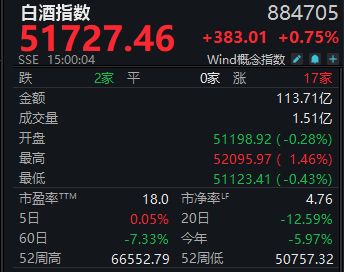
白酒指数震荡止跌,华润啤酒业绩“踩雷”周跌5%丨酒市周报
Mei Ri Jing Ji Xin Wen· 2026-03-15 03:13
Core Viewpoint - The liquor industry has stabilized after three weeks of decline, with the Wind liquor index slightly increasing by 0.05%, indicating a potential defensive investment opportunity amidst external market risks [1] Group 1: Market Performance - The Wind liquor index closed at 51,727.46 points, ending a three-week downward trend [1] - The index showed a weekly increase of 0.05%, while the 5-day, 20-day, and 60-day changes were -12.59% and -7.33% respectively [2] - Major liquor stocks such as Luzhou Laojiao, Jinzongzi Liquor, and Kouzi Liquor saw weekly gains exceeding 1% [2][3] Group 2: Industry Analysis - Current low expectations in the liquor sector present a favorable configuration value, with potential improvements in corporate ROE and spending expected to signal an industry turning point [4] - The beer sector also performed well, with companies like Huichuan Beer and Zhujiang Beer experiencing weekly gains around 3% [4] - China Resources Beer issued a profit warning, projecting a profit of approximately 2.92 billion to 3.35 billion yuan for the year ending December 31, 2025, a decrease of about 29.6% to 38.6% year-on-year [4] Group 3: Company-Specific Insights - China Resources Beer reported a goodwill impairment of approximately 2.79 billion to 2.97 billion yuan due to weak market demand and reduced consumption scenarios, impacting its financial performance [4][5] - The acquisition of Guizhou Jinsha Jiao Liquor Co. has not met profitability expectations, with Jinsha's revenue for the first half of 2025 expected to decline by 34.0% year-on-year [5] - Despite current challenges, analysts believe that China Resources Beer will maintain its leading position in the market, with potential for performance recovery as the restaurant sector improves [5]

证券研究报告行业周报:钢铁:治乱交替-20260315
GOLDEN SUN SECURITIES· 2026-03-15 02:58
Investment Rating - The report maintains a "Buy" rating for the steel sector, indicating a positive outlook for selected companies [4]. Core Insights - The steel market is experiencing fluctuations due to geopolitical tensions, with oil prices surging, which could impact the overall economic stability [3]. - The report highlights that the supply side will be a key factor in the evolution of the steel sector, especially as industrialized nations tend to control supply during economic downturns [3]. - The report anticipates a recovery in market transactions as the seasonal peak for domestic steel consumption approaches [3]. Supply Analysis - Daily average pig iron production has decreased by 64,000 tons to 2,212,000 tons, indicating a reduction in long-process production [14]. - The capacity utilization rate of 247 steel mills is at 82.9%, down 2.4 percentage points from the previous week [19]. - The total inventory of five major steel products has increased by 1.2% week-on-week, but the growth rate has narrowed by 4.6 percentage points [25]. Demand Analysis - Apparent consumption of five major steel products has improved significantly, with rebar demand showing a substantial recovery, increasing by 72.3% week-on-week [39][41]. - The average weekly transaction volume for construction steel has reached 97,000 tons, reflecting a strong demand trend [41]. Price and Profit Analysis - The steel spot price index has strengthened, with the Myspic comprehensive steel price index at 122.3, up 1.2% week-on-week [74]. - The current spot price for rebar in Beijing is 3,170 CNY/ton, reflecting a week-on-week increase of 1.6% [75]. - The profit margins for long-process steel products have improved, with the current cost for rebar at 3,463 CNY/ton and a loss of 180 CNY/ton [76]. Key Companies - Recommended stocks include Hualing Steel, Nanjing Steel, Baosteel, and others, which are expected to benefit from the ongoing trends in the steel market [3].
策略周报:战略资源品还有多大空间?-20260314
Guoxin Securities· 2026-03-14 13:13
Core Conclusions - The recent surge in strategic resource products is driven by concerns over AI substitution and escalating geopolitical conflicts, with frequent industry rotations observed this week, particularly in petrochemicals and non-ferrous metals [1] - The market for strategic resource products is supported not only by short-term shocks but also by long-term supply-demand changes that elevate price levels, indicating a potential continuation of the upward trend in the medium term [1][2] - Despite short-term market fluctuations, the overall bullish market trend for the year remains intact, with a focus on strategic resources under safety considerations and domestic demand-related assets, while AI technology remains a key theme for the medium term [1][3] Supply and Demand Dynamics - The current market for strategic resource products is influenced by supply constraints and rigid demand, which are driving price levels higher in the medium to long term [2][14] - Long-term capital expenditure is insufficient, resource nationalism is rising, and operational risks are increasing, all of which constrain the supply of strategic resource products [16] - The demand for strategic resources is being shaped by industrial trends and macro geopolitical changes, with AI and new energy sectors accelerating demand growth [17] Geopolitical Influences - The worsening geopolitical situation in the Middle East has catalyzed a rapid increase in oil prices, further stimulating the market for strategic resource products [13][14] - The ongoing geopolitical tensions are expected to suppress market risk appetite until the situation clarifies, although the underlying logic driving the stock market is anticipated to prevail in the medium term [25][26] Investment Focus - There is a strong emphasis on strategic resource products and a focus on domestic demand-related assets, with AI technology remaining a central theme for medium-term investments [3][27] - The report highlights the importance of safety considerations in the current complex external environment, with policies aimed at expanding domestic demand likely to benefit undervalued assets in real estate and consumer sectors [27] - The report suggests that the AI technology sector will continue to evolve, with a focus on applications and upstream energy and power sectors, as global energy supply tightens [27]
弘业期货原周报:海运费上涨,需求恢复-20260311
Hong Ye Qi Huo· 2026-03-11 07:09
原木周报: 海运费上涨,需求恢复 20260311 弘业金融研究院 数据来源:钢联、弘业金融研究院 姜周曦琳 从业资格号:F03114700 投资咨询号:Z0022394 原木产业数据 期现货: 供应: 数据来源:钢联、弘业金融研究院 • 现货端,日照港3.9米中A辐射松原木750元/方,较上期持稳;本周太仓港4米中A辐射松原木780元/方,较上期持稳。期货端,截至3月10日收 盘,原木主力2605报收791.5元/方。整体来看,原木现货价格偏强运行,原木期货价格小幅上行。 • 据木联统计,截至2026年3月9日,3月新西兰辐射松原木外盘(CFR)报价区间为117-122美元/JAS方,较上月上涨5美元/JAS方。2026年3月 下旬,进口针叶原木散货船海运费(新西兰→中国)40美元/JAS方,较3月上旬32美元/JAS方上涨8美元/JAS方,环比上涨25%。 • 本周13港原木预计到港量:2026年3月9日-3月15日,中国13港新西兰原木预到船11条,较上周增加0条,周环比增加0%;到港总量约34.9万方, 较上周减少5.9万方,周环比减少14%。 • 上周13港原木实际到港量:2026年3月2日-3月8 ...
兖矿能源(600188):有成长,有弹性,上调盈利预测
ZHONGTAI SECURITIES· 2026-03-10 07:27
Investment Rating - The report maintains a "Buy" rating for the company [3] Core Views - The company is expected to benefit from significant growth in coal production capacity, projected to exceed 300 million tons per year by 2026, driven by the consolidation of Northwest Mining and ongoing capacity expansions [5][11] - The company's coal sales structure provides substantial profit elasticity, with a high sensitivity to market coal prices, indicating strong potential for profit growth during price upswings [6][25] - The report highlights the company's dual growth logic of "capacity expansion + price elasticity," positioning it as a structural opportunity in the coal price upcycle [7][8] Summary by Relevant Sections Company Overview - Total share capital is 10,037.48 million shares, with a market price of 20.28 yuan, resulting in a market capitalization of approximately 203.56 billion yuan [1] Financial Forecasts and Valuation - Projected revenues for 2025-2027 are 133.62 billion, 162.73 billion, and 173.42 billion yuan, with growth rates of -4%, 22%, and 7% respectively [10] - Expected net profits for the same period are 10.10 billion, 22.13 billion, and 23.01 billion yuan, with growth rates of -30%, 119%, and 4% respectively [10] - The report anticipates a significant increase in earnings per share, from 1.01 yuan in 2024 to 2.29 yuan in 2026 [3] Growth Potential - The company has completed the consolidation of Northwest Mining, adding 36.05 million tons per year to its production capacity, with further expansions planned [13][15] - The company aims to achieve a total production capacity of 30.59 million tons per year by 2026, with a projected increase in self-produced coal sales to approximately 18.6 million tons by 2027 [17][18] Profit Elasticity - The company's coal business exhibits high profit elasticity, with a profit elasticity coefficient of 5.0 when market coal prices rise by 15% [6][28] - The coal chemical segment is also expected to show significant profit elasticity, with projected net profits of 1.70 billion, 2.21 billion, and 2.74 billion yuan under different price scenarios [31] Investment Logic - The report emphasizes the company's clear capacity growth plan and its ability to leverage high market coal sales to enhance profitability, making it a strong candidate for investment in the coal sector [25][26]