
政策催化

Search documents
大国重器9·3亮剑!“阅兵牛”狂奔在即?揭秘国防军工多重爆点!
Xin Lang Ji Jin· 2025-08-22 01:07
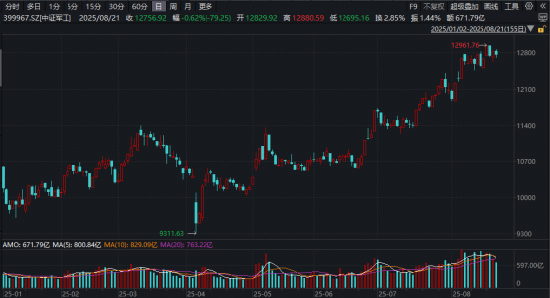
Core Viewpoint - The upcoming military parade is expected to drive a bullish trend in the defense and military industry, with historical data indicating that the sector typically outperforms the broader market before and after significant parades [1][2]. Summary by Sections Historical Performance - Historical data shows that prior to the 2015 military parade, the China Securities Military Index saw a maximum increase of 47% from July to August [1]. - In the lead-up to the 2019 military parade, the index recorded a maximum increase of 16% from August to September [2]. Current Market Trends - The defense and military ETF (512810) has experienced significant upward momentum, with nearly 20% cumulative growth since the beginning of the year and 8 out of the last 9 weeks showing gains [2]. - Recent trading activity has set multiple historical records, including a peak trading volume and a record high in financing balance [2]. Market Volatility - The sector has seen increased volatility due to profit-taking by investors after prior gains and a surge in leveraged funds entering the market [6]. - Despite the volatility, the ETF has maintained strong trading interest, with daily transaction volumes exceeding 100 million yuan for eight consecutive days [7]. Future Outlook - The defense and military sector is anticipated to benefit from multiple catalysts, including policy support, a surge in military trade, and advancements in AI applications [8]. - The upcoming military parade is expected to showcase new equipment and technologies, which could further enhance investor interest [8][9]. - The "14th Five-Year Plan" and the initiation of the "15th Five-Year Plan" are expected to create a favorable environment for the military industry, with projected growth in contract liabilities and inventory levels [10]. Investment Opportunities - The ETF (512810) is positioned to capture both traditional military assets and emerging sectors such as commercial aerospace and military AI, making it an efficient investment vehicle for the defense sector [10].

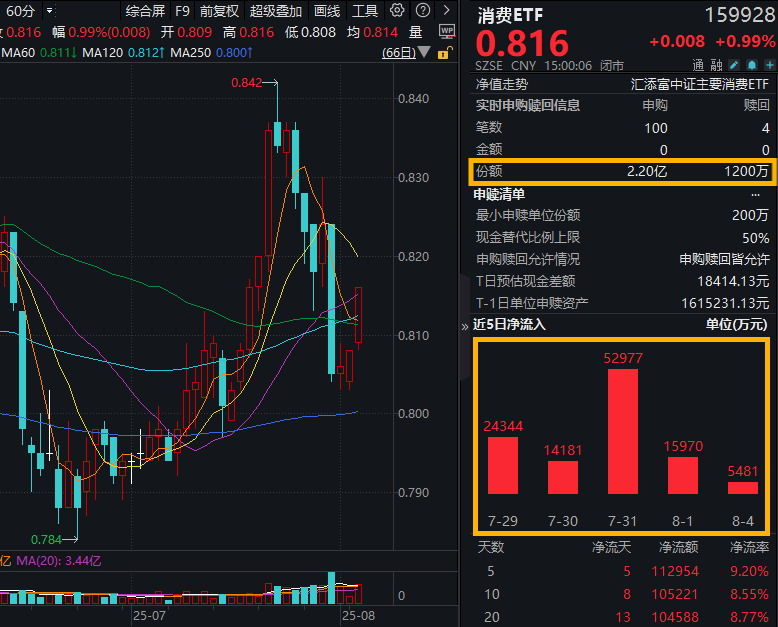
大盘再创年内收盘新高,消费持续补涨!规模领先的消费ETF(159928)收涨近1%,全天获大举净申购超2亿份!
Sou Hu Cai Jing· 2025-08-05 08:03
Market Overview - The A-share market closed positively on August 5, with a total trading volume exceeding 1.6 trillion yuan, and the Shanghai Composite Index rising nearly 1%, reaching a new closing high for the year [1] - The leading consumption ETF (159928) saw a nearly 1% increase, with a trading volume of 470 million yuan and a net subscription of 208 million units, marking the ninth consecutive day of capital inflow, totaling over 1.4 billion yuan [1] ETF Performance - The consumption ETF (159928) has a current scale exceeding 13.1 billion yuan, significantly leading its peers [1] - Key constituent stocks of the consumption ETF performed well, with Dongpeng Beverage rising over 3%, Luzhou Laojiao up over 2%, and Shanxi Fenjiu increasing over 1% [3] Policy and Economic Insights - Haitong International noted that six out of eight essential consumption sectors tracked in July maintained positive growth, while two sectors, including high-end and mid-range liquor, experienced negative growth due to new alcohol bans and adverse weather conditions [5] - The report highlighted that most liquor prices stabilized in July, with slight adjustments observed in various products [5] - The introduction of favorable policies, such as the implementation of a childcare subsidy system estimated at 100 billion yuan annually, is expected to stimulate essential consumption sectors [6] Industry Analysis - CITIC Securities indicated that the liquor industry has been under pressure this year, but signs of stabilization are emerging, with expectations of a gradual recovery in demand and performance in the third quarter [7] - The report emphasized that leading liquor companies are enhancing shareholder returns through increased dividends and buybacks, which may provide a safety margin for investments [7] - The analysis of Moutai's business model suggests a proactive approach to exploring new demand and adjusting its distribution network during the industry's cyclical downturn [8] Investment Strategy - The consumption ETF (159928) is characterized by its resilience across economic cycles, with over 68% of its top ten constituent stocks being essential consumer goods [8] - The report recommends focusing on sectors benefiting from policy support, particularly dairy products and liquor, while remaining cautious about the potential decline in soft drink margins [6]






海通国际:政策催化带来的结构性机会 关注乳制品和白酒行业
Zhi Tong Cai Jing· 2025-08-05 07:41
Core Viewpoint - The report from Haitong International emphasizes the structural opportunities arising from policy catalysts, highlighting the need to focus on industries benefiting from government policies while adhering to the principle of "high dividends + fundamental improvement" [1] Demand - In July, among the eight essential consumer sectors tracked, six maintained positive growth, while two experienced negative growth. The sectors with single-digit growth included dining (+4.4%), soft drinks (+2.7%), frozen foods (+1.7%), condiments (+1.1%), dairy products (+1.1%), and beer (+0.6%). The sectors with declines were high-end and above liquor (-4.0%) and mass-market liquor (-3.9%). Compared to the previous month, five sectors saw a deterioration in growth rates, while three improved [2] Pricing - In July, most liquor prices stabilized. The prices for Feitian (whole box, loose bottle, and Moutai 1935) were 1915, 1880, and 655 yuan, respectively, showing changes of -35, flat, and -20 yuan compared to the previous month, and -665, -500, and -155 yuan year-on-year. The price for Pu'er liquor was 930 yuan, up by 10 yuan from the previous month, remaining flat year-on-year. After significant adjustments in June, most liquor prices saw slight increases or remained stable in July, with only a few continuing to decline. The discounts for liquid milk and beer products decreased, while soft drink discounts increased, with prices for infant formula, convenience foods, and condiments remaining stable [3] Costs - In July, the spot cost index generally declined, while the futures cost index primarily increased. The spot cost indices for dairy products, soft drinks, frozen foods, beer, instant noodles, and condiments changed by -2.92%, -2.46%, -1.88%, -1.78%, -1.58%, and -1.29%, respectively. The futures cost indices changed by -1.52%, +1.64%, -1.77%, +3.57%, +0.84%, and +2.89%. In terms of packaging materials, the prices for aluminum cans, glass, plastic, and paper changed by +3.67%, -0.08%, -0.82%, and -1.20% month-on-month, and year-on-year changes were +6.78%, -21.18%, -15.60%, and -4.11%. The prices for direct raw materials, such as palm oil, increased by +5.33% month-on-month and +13.13% year-on-year, while fresh milk prices slightly dropped to 3.03 yuan/kg [4] Funds - By the end of July, net inflows from Hong Kong Stock Connect amounted to 124.1 billion yuan (up from 73.45 billion yuan the previous month), with the essential consumer sector's market capitalization accounting for 5.05%, an increase of 0.17 percentage points from the previous month. The market share of the food additives sector in Hong Kong Stock Connect was 12.7%, down by 0.52 percentage points, while dairy products saw an increase of 0.6% to 11.6%. In terms of holding ratios, Qingdao Beer (600600) had the highest at 40.0%, followed by Huabao International at 19.8%. As of the end of June, the market capitalization share of food and beverage in the A-share market was 4.56%, down by 0.22 percentage points from Q1 2025, with Yili (600887) having the highest holding ratio at 10.7%, followed by Dongpeng Beverage (605499) at 9.9% [5] Valuation - At the end of July, the historical PE ratio for the food and beverage sector was at the 16th percentile (20.2x), unchanged from the end of the previous month. The sub-sectors with lower percentiles included beer (3%, 23.8x) and liquor (11%, 17.9x). The median valuation for leading A-share companies was 20x, down by 1x from the previous month. The historical PE ratio for the essential consumer sector in H-shares was at the 54th percentile (20.0x), an increase of 10 percentage points from the previous month (44%, 19.4x). The sub-sectors with lower percentiles included packaged foods (6%, 10.7x) and alcoholic beverages (7%, 17.6x). The median valuation for leading food and beverage companies in H-shares was 21x, up by 1x from the previous month [6]
中国必选消费8月投资策略:关注政策催化带来的结构性机会
Haitong Securities International· 2025-08-04 09:33
Investment Focus - The report highlights a focus on structural opportunities driven by policy catalysis, particularly in essential consumer sectors such as dairy products and liquor, while cautioning against the risks in the soft drink sector [7]. Demand Analysis - In July, among the eight tracked essential consumer sectors, six maintained positive growth, while two experienced negative growth. The sectors with single-digit growth included dining (+4.4%), soft drinks (+2.7%), frozen foods (+1.7%), condiments (+1.1%), dairy products (+1.1%), and beer (+0.6%). The declining sectors were high-end and above liquor (-4.0%) and mass-market liquor (-3.9%) [3][9]. - The report notes that five sectors saw a deterioration in growth rates compared to the previous month, while three improved. The new alcohol ban and adverse weather conditions were identified as significant negative factors affecting demand [3][9]. Price Trends - In July, most liquor wholesale prices stabilized after a period of decline. Specific prices included Feitian at 1915/1880/655 yuan for different packaging, with year-on-year declines of 665/500/155 yuan. The price of Wuliangye was 930 yuan, showing a slight increase of 10 yuan from the previous month [3][22][24]. - The report indicates that the prices of liquid milk and beer saw a reduction in discount rates, while soft drink discounts increased, with stable prices for infant formula, convenience foods, and condiments [4][19]. Cost Analysis - The report states that the spot cost index for various sectors, including dairy, soft drinks, frozen foods, and beer, generally decreased in July, while futures cost indices showed mixed results. For instance, the spot cost index for dairy products fell by 2.92% [4]. Fund Flow - As of the end of July, net inflows into Hong Kong Stock Connect amounted to 124.1 billion yuan, with the essential consumer sector's market capitalization share rising to 5.05%. The food additives sector saw a decrease in share, while the dairy sector experienced an increase [5]. Valuation Insights - By the end of July, the historical PE ratio for the food and beverage sector was at 16% (20.2x), remaining stable from the previous month. The report notes that the median valuation for leading A-share companies was 20x, a decrease of 1x from the previous month [6]. Sector Recommendations - The report recommends focusing on sectors benefiting from policy support, particularly dairy and liquor, while being cautious about the soft drink sector's marginal deterioration. Specific companies to watch include China Feihe, Yili, Mengniu, Master Kong, Uni-President, Yanghe, WH Group, and China Foods [7].


大牛市和小牛市的核心差异在哪?
Xinda Securities· 2025-07-27 08:23
Group 1 - The core conclusion of the report indicates that a bullish market atmosphere is forming, but there is significant divergence among investors regarding the level of the bull market. The analysis highlights that in small bull markets, earnings are crucial, while in large bull markets, earnings are not the most important factor [2][7][19] - Since 1995, there have been three significant bull markets (with gains exceeding 150%) occurring in 1996-1997, 2005-2007, and 2014-2015, with only one (2005-2007) coinciding with a nominal GDP upturn. In contrast, smaller bull markets (with gains around 50-100%) also occurred three times, all during nominal GDP upturns [3][8][10] - The relationship between macro liquidity (interest rates) and the level of the stock market bull market is weak. Among the four bull markets since 2005, two experienced rising interest rates (2006-2007, 2009), one saw a decline (2014-2015), and one experienced fluctuations (2019-2021) [3][13][15] Group 2 - The report emphasizes that large bull markets are often catalyzed by policies and stock market funding. Historical data shows that when equity financing scales are lower than the dividends of listed companies, larger bull markets tend to follow. This pattern was observed in 1995, 2005, and 2013, leading to significant bull markets in the subsequent years [3][17][20] - The report suggests that the current market conditions, characterized by weak corporate earnings, positive policy stances, and active thematic opportunities, resemble previous periods that led to comprehensive bull markets. It predicts that as policy expectations increase in the second half of the year, the stock market is likely to enter a main upward trend [19][24][25]
中国银河证券:Q2公募继续增持有色金属板块 Q3聚焦政策催化与降息预期
智通财经网· 2025-07-25 00:12
Core Viewpoint - In Q2 2025, active equity public funds continued to increase their holdings in the A-share non-ferrous metal industry, with the market value of heavy holdings in this sector rising to 2.21% of total stock investments [1][2]. Group 1: Fund Holdings and Sector Performance - Active equity public funds primarily increased their positions in the A-share precious metals and rare metals sectors, focusing on major commodity leaders such as gold and copper, while also significantly increasing holdings in rare earth and silver stocks [1][4]. - The market value of heavy holdings in the A-share non-ferrous metal sector rose by 0.03 percentage points from Q1 2025, marking two consecutive quarters of increased investment in this industry [2][3]. Group 2: Sector-Specific Insights - In Q2 2025, the market value proportions of various non-ferrous metal sub-sectors within active equity public funds were as follows: copper (0.89%), aluminum (0.19%), lead-zinc (0.11%), gold (0.48%), rare earth (0.07%), lithium (0.03%), and others, with notable changes in their respective holdings compared to Q1 2025 [3]. - The top ten A-share non-ferrous metal stocks held by active equity public funds accounted for 73.31% of the total market value of all heavy holdings in this sector, reflecting a 0.08 percentage point increase from Q1 2025 [4].




华泰证券:关注政策催化的快递公司
news flash· 2025-07-21 00:14
Core Viewpoint - Huatai Securities emphasizes the potential recovery of express delivery companies due to policy catalysts, despite entering the e-commerce off-season in July [1] Group 1: Market Conditions - The express delivery sector is currently facing pressure on terminal prices, which have been consistently low since the beginning of the year [1] - Franchisees are experiencing significant financial strain, indicating a challenging environment for profitability [1] Group 2: Policy Impact - The State Post Bureau's call to "reduce internal competition" may lead to a bottoming out of terminal prices, providing relief to franchisees and companies [1] - There is an expectation that the profitability pressures on franchisees and companies will ease as a result of these policy changes [1]

【金工】风险偏好提升,关注政策催化——金融工程市场跟踪周报20250719(祁嫣然/张威/陈颖)
光大证券研究· 2025-07-20 14:03
Market Overview - The A-share market continued to show a trend of oscillation and upward movement, with the ChiNext Index leading the major broad-based indices [4] - As of July 18, 2025, the Shanghai Composite Index rose by 0.69%, the Shanghai 50 by 0.28%, the CSI 300 by 1.09%, the CSI 500 by 1.20%, the CSI 1000 by 1.41%, the ChiNext Index by 3.17%, and the Northbound 50 Index decreased by 0.16% [5] Valuation Insights - As of July 18, 2025, the Shanghai 50 Index is in the "danger" valuation percentile, while other major broad-based indices are in the "moderate" valuation percentile [6] - According to the CITIC industry classification, sectors such as building materials, light industry manufacturing, electric equipment and new energy, national defense and military industry, textile and apparel, pharmaceuticals, banking, computers, and comprehensive finance are in the "danger" valuation percentile [7] Market Sentiment and Fund Flows - The market's risk appetite is increasing, but investors have not yet reached a consensus on further upward movement of the index [4] - Institutional research indicates that the top five stocks receiving the most attention this week are Xinyi Technology (183 institutions), Yingxi Network (171), Tuojing Technology (148), Zhongji Xuchuang (145), and Xinshi Da (140) [9] - Southbound capital saw a net inflow of HKD 21.456 billion, with the Shanghai-Hong Kong Stock Connect net inflow at HKD 11.658 billion and the Shenzhen-Hong Kong Stock Connect at HKD 9.798 billion [10] ETF Performance - The median return for stock ETFs this week was 1.38%, with a net outflow of CNY 15.043 billion, while the median return for Hong Kong stock ETFs was 5.53%, with a net inflow of CNY 5.289 billion [10] - The median return for cross-border ETFs was 1.07%, with a net outflow of CNY 718 million, and for commodity ETFs, the median return was 0.39%, with a net outflow of CNY 1.235 billion [10] Fund Concentration - As of July 18, 2025, the degree of separation among fund clusters has slightly increased compared to the previous week, with excess returns for clustered stocks and funds showing a slight increase [11]

有色金属:连涨7天!5天线不破,拿稳了!别让震荡骗你下车
Sou Hu Cai Jing· 2025-07-03 23:40
Group 1: Core Insights - A historic metal bull market is driven by supply-demand imbalances, policy catalysts, and capital inflows, with the dollar index falling below 100 and expectations of Federal Reserve rate cuts rising [1] - Copper prices have surged, with London copper exceeding $9,967 and Shanghai copper surpassing ¥80,820, due to a complete supply disruption and soaring demand from infrastructure and electric vehicle sectors [1] - Aluminum profits are robust, with operating rates at 97.65% and a projected supply bottleneck, as demand from solar and electric vehicle industries continues to rise [3] Group 2: Market Dynamics - The copper market is experiencing a significant supply crunch, with major mining companies reducing output and Chinese smelters preparing for production cuts, while demand from the State Grid and electric vehicle charging infrastructure is booming [1] - The aluminum sector is facing a supply constraint, with limited new capacity expected by 2025, yet demand remains strong, particularly from the photovoltaic and automotive sectors [3] - The small metals sector is witnessing explosive growth driven by policy changes, with tungsten prices soaring due to reduced export quotas and strong demand from military and nuclear fusion applications [5] Group 3: Gold Market Trends - Gold prices have surged by 29% in the first half of the year, with central banks globally increasing their gold reserves, indicating a strong bullish sentiment in the gold market [6] - Major gold mining companies are seeing significant inflows, with institutional holdings rising sharply, reflecting increased investor confidence in gold as a safe haven [6] Group 4: Investment Strategies - Key moving averages, such as the 5-day and 20-day, are critical for investment decisions, with specific stocks like Northern Copper and Yun Aluminum being monitored closely for potential buy signals [7] - Investors are advised to remain calm during market fluctuations, as inventory levels for copper and aluminum are lower than in 2016, and policy support is strengthening [7]

仓位上升!今日情绪指数来了
第一财经· 2025-04-28 13:22
2025.04. 28 的主观判断,进而影响投资行为,形成合力后对市场产生显著影响。我们 想通过几个问题,了解投资者对每日市场的看法。4月28日共有27600位用 户参与了调研,具体情况如下: 创业板指 深证成指 上证指数 10.62% ▼ 0.20% 10 65% 今日A股三大指数震荡收跌,个股普跌格局延续,整体呈现"沪强深弱"分化,沪市主板与 科创板形成对冲,权重股与低估值标的呈现"跷跷板"效应。 反映节前资金避险情绪浓厚。 者持续低迷可能引发技术性调整 资金情绪 主力资金净流入 1215家上涨 涨跌停比 两市呈现"指数微跌但个股普跌"的特征,4105只股 票下跌,个股跌多涨少,赚钱效应明显转弱。其中,银 行股再度走强,工商银行再创历史新高,房地产股领 跌两市汽车股全天低迷。 两市成交额 1 3% 散户资金净流入 机构以防御为主,关注政策催化,调仓至低估值板块,如银行、钢铁等板块,对核电、通信设备等政策受益板 块保持关注;散户在谨慎中隐含博弈冲动,低价股(5元以下)成交额占比升至18.7%,部分散户在市场缩量 背景下博弈风险偏好回升,临近"五一"假期,部分散户选择持币过节,交易活跃度整体下降。 52.12 ...