
科技自主

Search documents
上海证券研究所所长花小伟:A股有望迎来长期缓慢上涨
Zheng Quan Ri Bao Wang· 2025-11-14 10:46
Core Viewpoint - The article discusses the potential for A-shares to experience a long-term upward trend similar to the U.S. stock market, particularly in the context of the upcoming "15th Five-Year Plan" which is expected to significantly impact China's economic structure and present investment opportunities [1][9]. Group 1: Stock Index Dynamics - The performance of stock indices is positively correlated with the market capitalization of listed companies and negatively correlated with the number of listed companies [2]. - The U.S. stock market has seen an average annual growth of 13% in total market capitalization from 2010 to 2024, with a low expansion rate in the number of listed companies [3]. - The Nasdaq index has a high concentration of market capitalization, with the top 8 tech companies accounting for 53% of its total market value, which enhances overall profitability [4]. Group 2: A-share Market Analysis - A-shares have shown an average annual growth of 11% in total market capitalization from 2010 to 2024, indicating a foundation for long-term growth [5]. - The rapid expansion of the number of listed companies in A-shares, averaging 8% annually, has outpaced the U.S. market, contributing to longer intervals between new highs in total market capitalization [6]. - Recent trends show that A-share total market capitalization increased by 50% from August 2024 to September 2025, while the number of listed companies grew only by 1%, suggesting a potentially better performance in this cycle [7]. Group 3: Future Investment Opportunities - The "15th Five-Year Plan" is expected to create significant investment opportunities, particularly in areas such as technology independence, domestic substitution, and high-end manufacturing [10]. - The construction of a unified national market is anticipated to enhance domestic demand and may lead to a turnaround in cyclical industries like coal, steel, and chemicals [11][12]. - The emphasis on a comprehensive green transition is likely to accelerate opportunities in renewable energy sectors, including solar power, energy storage, and electric vehicles [13].
万亿资金涌入这三个方向!
Ge Long Hui· 2025-11-13 07:39
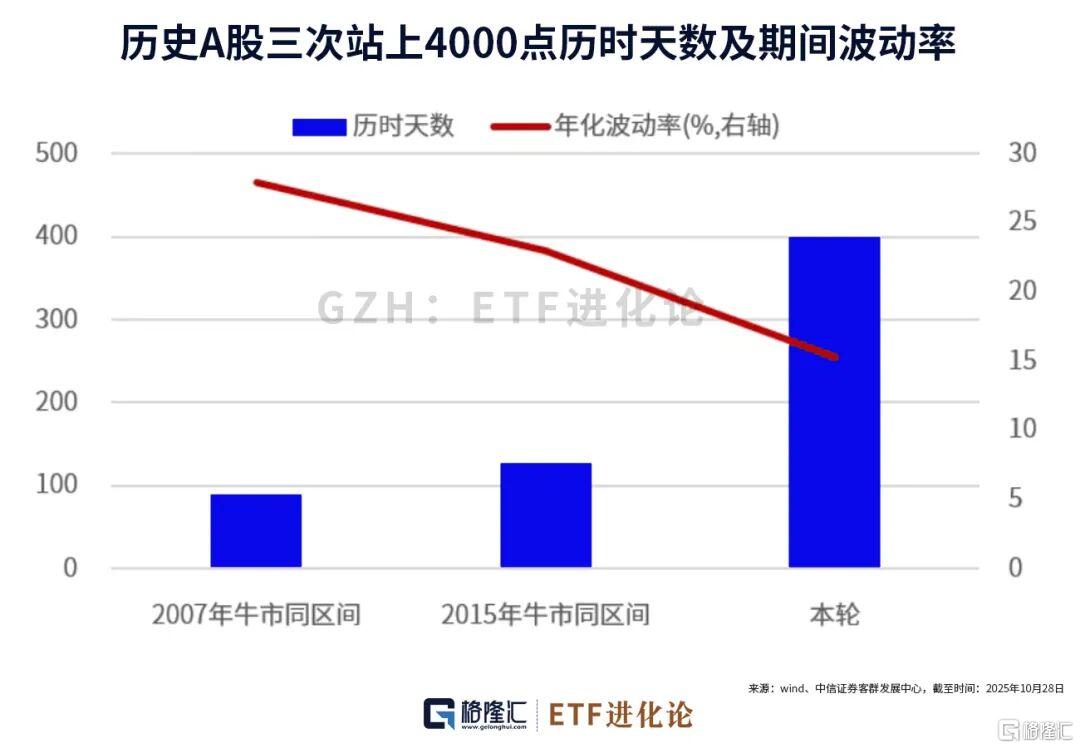
Core Viewpoint - The Shanghai Composite Index has reached the 4000-point mark for the first time in 10 years, indicating significant changes in the A-share market as it approaches the end of 2025 and the commencement of the next five-year plan in China [1] Group 1: Major Changes in the Market - Change One: Slow Bull Market - The Shanghai Composite Index rose from 2748 points on September 24, 2022, to surpass 4000 points on October 28, 2023, taking 400 days with an annualized volatility of 15.28%. In comparison, previous surges in 2007 and 2015 took only 89 and 127 days, respectively, with higher volatilities of 27.94% and 23.01% [1] - Change Two: Shift in A-share Pricing Power - By Q3 2024, the scale of passive equity funds, particularly stock ETFs, has surpassed that of actively managed equity funds for the first time, with the current ETF market reaching 5 trillion yuan, indicating a significant shift in pricing power within the A-share market [4] - Change Three: Leading Themes in the Current Market - The current bull market is primarily driven by sectors such as communication, electronics, and power equipment, reflecting a broader trend towards technological self-sufficiency and the global AI wave, alongside the narrative of revaluation of Chinese assets [5] Group 2: Fund Flows and Investment Trends - Significant Capital Inflows - Since September 24, 2022, the ETF market has seen a net inflow of 1.17 trillion yuan, with major inflows directed towards core A-share assets, technology innovation, and cyclical sectors [11][12] - Performance of Key ETFs - The Double Innovation Leader ETF tracking the Sci-Tech Innovation 50 Index has risen by 57.63% this year, while the Tianhong Growth ETF tracking the ChiNext Index has increased by 45.78% [8] - Year-End Capital Rotation - Following six months of continuous growth, A-shares have seen a rotation of capital, with significant inflows into ETFs tracking sectors like technology, securities, and consumer goods, particularly in the context of the upcoming "15th Five-Year Plan" [14][18]

A股鏖战4000点 多家券商看好明年慢牛行情
Zheng Quan Shi Bao· 2025-11-12 18:39
Core Viewpoint - The A-share market is experiencing significant rating adjustments by brokerages, with a total of 23 stocks upgraded and 40 downgraded since the end of October, indicating a mixed sentiment among investors and institutions [1][2]. Group 1: Rating Upgrades - A total of 23 A-share stocks have had their ratings upgraded, primarily in the electronics, pharmaceutical, food and beverage, power equipment, and automotive parts sectors [2]. - The electronics sector has the highest number of upgraded stocks, including companies like Guangli Micro (301095), Zhongwei Company, Yuanjie Technology, and Luguang Technology (301606), which are involved in high-tech fields such as semiconductors and consumer electronics [2][3]. - The upgrades are largely attributed to strong performance growth, high technical barriers, and improved industry conditions for the listed companies [2]. Group 2: Rating Downgrades - Approximately 40 A-share stocks have had their ratings or target prices downgraded, mainly in the pharmaceutical, food and beverage, electronics, power equipment, and beauty care sectors [4]. - The downgrades are primarily due to short-term performance challenges, declining gross margins, and reduced industry outlooks, leading to cautious sentiment from institutions regarding these companies' short-term profitability [4][5]. - The pharmaceutical sector has the highest proportion of downgraded stocks, including companies like Aibo Medical, Microelectrophysiology, and Mindray Medical (300760), with reasons including competitive pressures and performance pressures [4][5]. Group 3: Market Outlook - Major brokerages, including CITIC Securities and CICC, have released their 2026 annual investment strategies, generally optimistic about the A-share market's performance [7][8]. - CITIC Securities suggests that the A-share market is transitioning from a domestic focus to a global perspective, with expectations of a "slow bull" market characterized by low volatility during the "14th Five-Year Plan" period [7]. - CICC emphasizes the importance of global capital flows and domestic investment trends, suggesting a balanced market style in 2026, with a focus on growth sectors and external demand [8].
大摩闭门会- 达成休战而非条约;日本央行或于 12 月加息;人民币汇率保持稳定
2025-11-07 01:28
Summary of Key Points from Conference Call Records Industry or Company Involved - The records primarily discuss the implications of the US-China trade relations, the monetary policies of the Bank of Japan, and the economic strategies of China and India. Core Points and Arguments US-China Trade Relations - The recent US-China trade agreement reached in South Korea is seen as more constructive than previous expectations, with significant reductions in tariffs related to fentanyl by 50% [2] - The agreement includes a one-year grace period instead of quarterly updates, indicating a more durable arrangement [2] - The framework suggests a strategic stalemate where both countries have mutually destructive leverage, maintaining low bilateral trade levels and high non-tariff barriers in technology and export controls [2] - China will continue to supply rare earths in exchange for US technology inputs, promoting domestic technological advancement [2] China's Economic Strategy - China's latest five-year plan emphasizes technological self-sufficiency and consumption upgrades to overcome supply chain bottlenecks [4] - Specific goals include increasing the consumption share of GDP and enhancing social welfare, such as improving rural pension standards [4] - The plan faces challenges due to severe economic imbalances and entrenched deflation, with expectations of a negative GDP deflator index until 2026 [4] Bank of Japan's Monetary Policy - The Bank of Japan is likely to raise interest rates, with signals from the governor indicating confidence in achieving inflation targets [5] - Political factors may influence the timing of rate hikes, particularly if elections are called [5] - The upcoming meetings in December and January will provide critical data on corporate profits and wage negotiations [5] Currency and Market Dynamics - The US dollar's short-term outlook is uncertain, with potential bearish trends in the medium term due to upcoming policy and political risks [7] - Asian currencies, particularly the Chinese yuan, are expected to remain stable, supported by a trade surplus of approximately $10 billion monthly [8] - The Indian rupee is projected to perform well due to central bank interventions and potential trade agreements, while the Singapore dollar is seen as an attractive financing currency [9] Investment and Economic Outlook - The new investment agreement between the US and South Korea is expected to reduce market uncertainty, with an annual investment cap of $20 billion that aligns with market capacity [18] - This agreement is viewed positively for the Korean won, minimizing potential impacts on its exchange rate [18] - The overall economic environment in Asia remains cautious, with expectations of continued low yields in China and India due to weak domestic demand [11][12] Other Important but Possibly Overlooked Content - The Chinese government has prioritized 17 investment areas, including AI and biotechnology, which will receive increased budget allocations [6] - The competitive advantage of China in rare earth processing is highlighted, with a significant time lag for the US and allies to replicate this capability [14] - The potential impact of the US Supreme Court's decisions on tariffs and trade relations with China remains uncertain, with implications for bilateral tariffs and non-tariff barriers [13]
科技风格受挫,科技ETF(515000)由高点连续回调5日,抄底资金介入!机构:科技自主仍是核心战略方向
Xin Lang Ji Jin· 2025-11-05 05:48
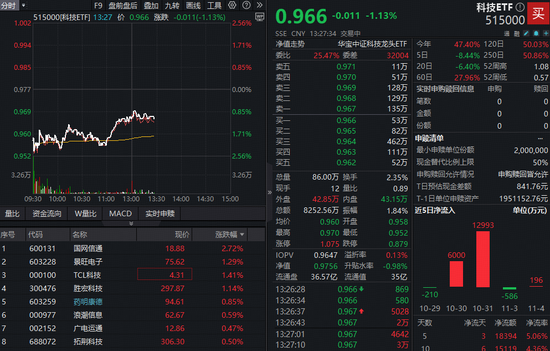
Core Insights - The technology sector is experiencing a downturn, with the first domestic technology ETF (515000) declining by 1% and showing a continuous pullback for five days from its historical peak [1][2] - The ETF has seen a trading volume exceeding 800 million yuan, indicating potential capital intervention despite the recent price drop [1] - Key stocks within the technology sector, such as Jingwang Electronics, WuXi AppTec, and Zhongwei Company, have shown strong performance, while others like Deepin Technology and Zhaoyi Innovation have underperformed [2][3] Industry Trends - The Chinese government is accelerating the layout of the quantum information industry, with expectations for the market size to exceed 800 billion USD by 2035 [3] - Companies like Zhongke Shuguang are making breakthroughs in quantum computing, while firms such as Zhongji Xuchuang and Xinyi Sheng are benefiting from the surge in global AI computing demand [3] - The technology sector is characterized by a "high before low" trend influenced by favorable expectations, with the recent US-China summit not addressing critical issues affecting the sector [3] Investment Opportunities - The technology ETF (515000) tracks the CSI Technology Leaders Index, which includes 50 high-cap, high-market-share, and high-growth companies from various technology fields [4] - The ETF offers a more balanced risk-return profile compared to other single technology sector investments, making it an attractive option for investors [4] - The ongoing AI arms race and the push for technological self-sufficiency are expected to sustain interest in AI-related sectors, including robotics and internet leaders [3]
黄仁勋很苦恼-中国不再需要NVIDIA
是说芯语· 2025-11-04 14:04
Core Viewpoint - The article discusses the impact of U.S. export controls on NVIDIA's advanced AI chips to China, highlighting the potential for China's self-sufficiency in technology and the diminishing reliance on U.S. technology [2][4]. Group 1: U.S. Export Controls and NVIDIA - The U.S. has implemented export controls on NVIDIA's advanced AI chips to China, aiming to curb China's technological development [2]. - NVIDIA's CEO Jensen Huang stated that the U.S. underestimates China's potential in the tech industry, as China can now produce millions of AI chips independently [2][4]. - Huang expressed a desire for improved U.S.-China relations to create opportunities for NVIDIA to re-enter the Chinese market [2]. Group 2: Impact on the Market - Huang noted that during Trump's first term, U.S. tech companies had the freedom to compete in the Chinese market, which was beneficial for establishing "American standards" in technology [4]. - Recent tightening of U.S. export restrictions has pressured American chip manufacturers to exit the Chinese market, leading to a significant loss of market share for companies like NVIDIA [4]. - Huang indicated that NVIDIA initially expected to capture a certain market share in China, but now anticipates that share to drop to zero due to current conditions [4]. Group 3: China's Technological Independence - Huang emphasized that the U.S. government's concerns about national security are unfounded, as China's domestically produced AI chips meet performance and supply needs [4]. - The article suggests that China has developed a robust technological ecosystem capable of supporting its own industry without reliance on U.S. technology [4].


大摩闭门会:下一步的市场看点?_纪要
2025-11-03 15:48
Summary of Key Points from Conference Call Industry and Company Overview - The conference call primarily discusses the implications of China's "14th Five-Year Plan" and the current state of the U.S.-China economic relationship, particularly in the context of technology and industrial sectors. Core Insights and Arguments 1. **Economic Growth and Consumer Spending** The "14th Five-Year Plan" emphasizes maintaining economic growth within a reasonable range (expected at 4%-5%) and aims to enhance consumer spending and productivity contributions, indicating a policy shift from supply-side to demand-side focus [1][3][4]. 2. **U.S.-China Phase One Agreement** The phase one agreement between the U.S. and China has led to a temporary reduction in tariffs (by 10%) and an extension of non-tariff barriers, providing marginal support for Chinese exports and capital expenditure, although competition in sensitive technology sectors remains [4][5][10]. 3. **Technological Self-Sufficiency** The plan outlines measures for technological self-sufficiency, including the establishment of a national computing network to promote AI integration with the real economy and support for critical sectors like semiconductors and quantum computing [7][31]. 4. **Challenges in Consumer Spending** To address the low consumer spending issue, the plan suggests enhancing labor compensation, optimizing fiscal expenditure, and implementing consumer-friendly policies such as trade-in programs and subsidized loans [8][9][20]. 5. **Solar Industry Developments** The solar industry has reached preliminary agreements to combat internal competition in the polysilicon sector, but the sustainability of these measures is uncertain. A unified national market and reform of local government performance assessments are necessary for long-term stability [13][31]. 6. **Investor Sentiment** Overseas investors are cautiously optimistic about market opportunities post-agreement, focusing on high-quality companies with long-term growth potential rather than short-term volatility stocks [10][27]. 7. **Focus on Emerging Industries** There is increasing interest from U.S. investors in China's industrial sector, particularly in humanoid robots and automation machinery, with a preference for companies demonstrating strong fundamentals and growth potential [27][30]. 8. **Future Policy Directions** Upcoming months will see a focus on the implementation of the "14th Five-Year Plan," the execution details of the U.S.-China agreement, and potential new policies in real estate and consumer sectors that could influence market sentiment [6][16][17]. Other Important but Overlooked Content 1. **Long-Term Economic Strategy** The plan aims for a balanced approach to economic growth, emphasizing the importance of improving overall productivity and consumer spending to avoid a downward spiral of low consumption and high savings [8][15][19]. 2. **Global AI and Robotics Trends** The development of humanoid robots is progressing, with significant orders signed, but challenges remain in commercializing these technologies effectively [28][30]. 3. **Investment in High-Tech Sectors** The focus on high-tech sectors, including advanced manufacturing and clean energy, is expected to create substantial investment opportunities, particularly in equipment and component upgrades [31][32]. 4. **Market Reactions to Policy Changes** The market's response to recent U.S.-China negotiations has been muted, potentially due to mixed earnings reports from Chinese companies compared to strong performances from U.S. firms [24][25]. 5. **Importance of Fiscal Policies** The emphasis on direct consumer support through fiscal policies is crucial for stimulating demand and ensuring sustainable economic growth [20][21]. This summary encapsulates the key points discussed in the conference call, providing insights into the current economic landscape and future directions for investment and policy in China and the U.S.
24小时内放大招!商务部公布中美谈判细则,中美经贸博弈转向
Sou Hu Cai Jing· 2025-11-01 11:10
Group 1 - The announcement from the Chinese Ministry of Commerce following the China-US summit indicates a significant shift in trade relations, with both sides agreeing to a "mutual pause" on tariffs and trade investigations [4][5][12] - The US has canceled the 10% "fentanyl tariff" and suspended the 301 investigation into China's logistics, maritime, and shipbuilding industries for one year, while also pausing the previously imposed 24% equivalent tariffs [4][5] - In response, China has also suspended corresponding countermeasures, which stabilizes order flows for affected industries and potentially lowers logistics costs for consumers, benefiting the overall market [5][8] Group 2 - China has resumed purchasing US soybeans, having already bought approximately 180,000 tons in three batches, which is a strategic move to control costs amid rising prices from Brazilian imports [7][8] - The stability in soybean prices will directly impact consumer goods prices, including cooking oil and meat products, ultimately benefiting ordinary consumers [8][10] - The announcement also includes a "mutual pause" on export controls related to rare earth elements, with the US suspending the recently introduced 50% export penetration rule, which had aimed to restrict products with any US technology content from being exported to China [12][14] Group 3 - The mutual pauses in trade measures are seen as a strategic move rather than a concession, allowing both sides to maintain leverage while addressing market demands [10][16] - China plans to use the year of suspension to refine its export control rules and processes, ensuring that it can respond effectively if the US reintroduces restrictions [16][18] - The US's willingness to negotiate is driven by its own economic interests, as American farmers and tech companies have faced significant losses due to trade tensions, highlighting a shift from unilateral pressure to mutual constraints in US-China relations [20][23] Group 4 - The focus of the announcement is on protecting China's chip industry, emphasizing the importance of maintaining export rights for Chinese semiconductor companies rather than merely increasing imports [27][28] - The Chinese semiconductor industry has developed competitive capabilities, and any US export restrictions could adversely affect its international market presence, making the protection of these companies crucial for China's technological autonomy [28][30]
广发期货日评-20251031
Guang Fa Qi Huo· 2025-10-31 05:33
Report Summary 1. Investment Ratings The report does not explicitly provide an overall industry investment rating. However, it offers specific trading suggestions for different sectors and varieties: - **Financial Sector** - **Equity Index Futures**: Try to lightly sell put options at the support level or construct a bull call spread for follow - up upside potential [3]. - **Treasury Bond Futures**: Go long on pullbacks for the unilateral strategy and pay attention to the positive arbitrage strategy for the cash - futures strategy [3]. - **Precious Metals**: For gold, there is pressure for a further decline; for silver, it is in a volatile consolidation. Trading suggestions are based on price trends [3]. - **Black Metals Sector** - **Steel**: Reduce long positions appropriately and hold the long - coking coal and short - hot - rolled coil arbitrage [3]. - **Iron Ore**: Close long positions and observe, and consider the 1 - 5 positive arbitrage [3]. - **Coking Coal and Coke**: Go long on pullbacks and hold the long - coking coal and short - coke arbitrage [3]. - **Non - ferrous Metals Sector** - **Copper**: Pay attention to the support around 87,000 [3]. - **Tin**: Adopt a low - buying strategy on pullbacks [3]. - **Energy and Chemical Sector** - **Crude Oil**: Go short in the short term [3]. - **Urea, PX, PTA, etc.**: Adopt different strategies such as reducing long positions, short - selling on rallies, and spread trading according to different varieties [3]. - **Agricultural Products Sector** - **Soybeans**: Hold long positions in the 2601 contract [3]. - **Palm Oil**: The main contract may test the support at 8,800 yuan [3]. - **Sugar**: It is in a bottom - oscillating state around 5,400 [3]. - **Cotton**: It is in a range - bound and upward - trending state, paying attention to the pressure around 13,800 [3]. - **Special and New Energy Sectors** - **Glass**: Look for short - term long opportunities based on the spot market [3]. - **Carbonate Lithium**: It is in a relatively strong state, with the main contract reference range of 83,000 - 87,000 [3]. 2. Core Views - **Market Environment**: Key factors such as the meeting between Chinese and US leaders, the release of the 15th Five - Year Plan draft, and the clarification of bond - fund redemption fees have an impact on the market. Risk - preference - enhancing factors are gradually materializing, and uncertainties in the market are decreasing [3]. - **Sector - specific Views** - **Financial Sector**: Stock index futures are affected by market sentiment and policy expectations; treasury bond futures are on an upward trend as negative factors are gradually digested; precious metals are affected by geopolitical and trade factors [3]. - **Black Metals Sector**: Supply and demand factors such as production, transportation, and inventory levels affect the price trends of steel, iron ore, coking coal, and coke [3]. - **Non - ferrous Metals Sector**: Prices are affected by factors such as macro - environment, supply - demand relationship, and technical levels [3]. - **Energy and Chemical Sector**: Supply - demand expectations, cost support, and inventory levels are the main factors affecting prices [3]. - **Agricultural Products Sector**: Factors such as procurement, supply pressure, and seasonal characteristics affect the price trends of various agricultural products [3]. - **Special and New Energy Sectors**: Macro - events and fundamental factors affect the price trends of glass, rubber, and new - energy products [3]. 3. Summary by Related Catalogs - **Financial Sector** - **Equity Index Futures**: After the meeting between Chinese and US leaders and the release of the 15th Five - Year Plan draft, the market has a short - term pullback after reaching a high. It is recommended to try light - selling put options or constructing a bull call spread [3]. - **Treasury Bond Futures**: As negative factors such as bond - fund redemption fees and central - bank bond - buying uncertainties are gradually digested, the bond market sentiment is improving. It is recommended to go long on pullbacks and consider the positive arbitrage strategy [3]. - **Precious Metals**: Gold is under pressure to decline due to factors such as the meeting between Chinese and US leaders and geopolitical concerns; silver is in a volatile consolidation [3]. - **Black Metals Sector** - **Steel**: The increase in apparent demand and the alleviation of inventory pressure lead to suggestions of reducing long positions and holding arbitrage positions [3]. - **Iron Ore**: The decline in shipping and arrivals, the increase in port inventory, and the sharp drop in molten - iron production lead to suggestions of closing long positions and considering arbitrage [3]. - **Coking Coal and Coke**: The strength of coking - coal prices and the cost support provided by coking coal lead to suggestions of going long on pullbacks and holding arbitrage positions [3]. - **Non - ferrous Metals Sector** - **Copper**: After the realization of positive expectations, the price is in a high - level oscillation. Pay attention to the support level [3]. - **Tin**: Affected by the Fed's interest - rate outlook, it is recommended to buy on pullbacks [3]. - **Energy and Chemical Sector** - **Crude Oil**: Although the macro - sentiment has eased and inventory has decreased, the increase in OPEC production limits the rebound height. It is recommended to go short in the short term [3]. - **Urea, PX, PTA, etc.**: Due to weak supply - demand expectations and limited cost support, different trading strategies are recommended for different varieties [3]. - **Agricultural Products Sector** - **Soybeans**: Supported by China's increased confidence in purchasing US soybeans, hold long positions [3]. - **Palm Oil**: The main contract may test the support level [3]. - **Sugar**: It is in a bottom - oscillating state due to abundant overseas supply [3]. - **Cotton**: With the solidification of new - cotton costs, it is in a range - bound and upward - trending state [3]. - **Special and New Energy Sectors** - **Glass**: Affected by macro - events, pay attention to short - term long opportunities based on the spot market [3]. - **Carbonate Lithium**: With the upward shift of the price center and the realization of demand benefits, it is in a relatively strong state [3].
资金涌入,宽基ETF!
Zhong Guo Zheng Quan Bao· 2025-10-30 12:35
Group 1: Market Performance - The non-ferrous metals sector, including lithium batteries, showed strong performance on October 30, with Tianqi Lithium (002466) hitting the daily limit and closing up 9.67% [1][2] - Several rare metal-themed ETFs rose over 2%, while other cyclical sectors like oil and gas, steel, and shipping also performed well [2] - The ChiNext 50 ETF (159371) surged over 12% the previous day but experienced a significant pullback, closing down over 9% with a premium rate dropping to 0.22% [1][4] Group 2: Fund Flows - There has been a notable influx of funds into broad-based ETFs, with the A500 ETF (512050) and the Shanghai Stock Exchange 50 ETF (510050) seeing net inflows exceeding 2 billion yuan each from October 27 to 29 [1][7] - The recent trend indicates a shift towards broad-based ETFs, with significant net inflows into ETFs tracking the CSI 500, CSI 300, and others [7] - Conversely, gold and banking-themed ETFs have seen substantial outflows, with the gold ETF (518800) experiencing a net outflow of over 1.3 billion yuan on October 29 [7][8] Group 3: ETF Performance - Various rare metal ETFs reported positive daily performance, with the Rare Metal ETF (159608) up 2.77% and the Rare Metal ETF Fund (159671) up 2.53% [3] - In contrast, technology growth sectors such as AI, communications, and innovative pharmaceuticals saw declines, with several related ETFs dropping over 3% [3][4] - The Hong Kong stock ETFs, including the Hong Kong Securities ETF (513090) and the Hang Seng Technology ETF (513130), experienced significant trading activity, with the Hong Kong Securities ETF achieving a trading volume of 17.567 billion yuan [5][6] Group 4: New Indices - The China Securities Index Company announced the launch of six new indices, including the CSI 500 Equal Weight Index and the CSI 100 Equal Weight Index, aimed at providing diversified investment strategies [10]
