
经济开门红

Search documents
北京一季度有条件实现开门红
Xin Lang Cai Jing· 2026-01-16 04:40
"本市经济发展积极因素多、支撑条件好,实现一季度'开门红'有基础、有条件。"市发改委综合处处长 王育玲昨天介绍,一季度,北京将重点开展优供给促消费、促开工扩投资、强服务促产业、优机制拓增 量、稳预期提信心、办实事惠民生六大专项行动,为完成全年目标任务奠定良好基础,为全国发展大局 作出更多贡献。(北京日报 记者 曹政) 【#北京一季度有条件实现开门红#】#北京文旅还将再升级# #北京真好玩# "十五五"开局之年的开局时 刻,北京提早布局政策举措和重大项目,靠前发力,全力跑好开年"第一棒"。 ...
打出“组合拳” 力促全省经济“开门红”
Xin Lang Cai Jing· 2026-01-15 19:28
Group 1 - The provincial government of Hunan is implementing measures to ensure a stable economic start in the first quarter of 2026, including increasing the issuance of consumer vouchers and organizing over 500 promotional activities [1] - Hunan will continue to distribute the "Enjoy Hunan · Xiang Has Benefits" consumer vouchers and will accelerate the implementation of the 2026 consumer goods trade-in policy, focusing on new consumption models that integrate culture and tourism [2] - The province has identified 4,345 major projects to be promoted in the first quarter, including 3,000 ongoing projects, 777 new projects, and 568 potential projects, aiming to leverage central funding opportunities [3] Group 2 - Hunan plans to issue nearly one million winter hot spring tourism consumption vouchers to attract national tourists, promoting the integration of hot springs with culture and wellness [4] - The province will enhance the quality of service industries by utilizing special bonds to acquire existing housing for various purposes and organizing promotional activities for commercial housing [4] - Hunan aims to strengthen its manufacturing sector by establishing a list of annual projects to be launched and ensuring timely production and effectiveness [4]
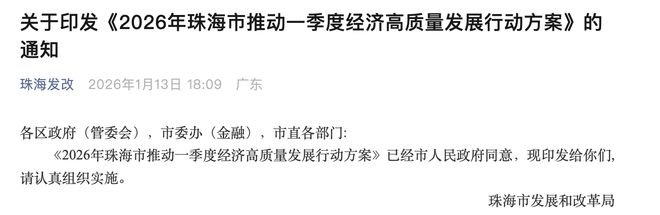
70 万奖励 + 消费补贴!力拼经济开门红,珠海重磅发文
Nan Fang Du Shi Bao· 2026-01-13 11:30
Core Viewpoint - Zhuhai City has introduced a comprehensive policy package aimed at promoting high-quality economic development in the first quarter of 2026, with various financial incentives for industries, services, and consumer spending [1][3]. Group 1: Industrial Incentives - Industrial enterprises can receive rewards for increased production, with a maximum reward of 700,000 yuan for those achieving over 20 billion yuan in output [9]. - For industrial investment, companies can earn up to 400,000 yuan based on their investment progress, with additional rewards for new projects [4]. - The policy encourages a rapid investment process and aims to create a positive cycle of project funding and construction efficiency [4][5]. Group 2: Consumer Subsidies - Consumers can benefit from various subsidies, including 5,000 yuan for car purchases and 30,000 yuan for housing "trade-ins" [6][8]. - Retail and wholesale businesses can receive financial support based on sales growth, with rewards reaching up to 40,000 yuan for significant sales increases [7]. - The "Yue Enjoy Warm Winter" campaign will provide additional consumer incentives across various sectors [7]. Group 3: Service Industry Support - The support for the service industry has been expanded to include finance, leasing, and scientific research, with potential rewards of up to 600,000 yuan for qualifying companies [11][12]. - Financial institutions can receive funding support based on their revenue growth, with specific percentages allocated for different sectors [11]. - The policy aims to enhance the quality and capacity of the service sector, promoting digital transformation and innovation [12]. Group 4: Employment and Community Support - Zhuhai will implement recruitment services and support for workers returning to jobs, enhancing employment opportunities [13]. - Community activities and welfare programs will be organized to support local residents during the New Year, fostering a positive environment [13]. - The government will encourage businesses to engage in community events and provide benefits to employees during the festive season [13]. Group 5: Implementation and Duration - The measures will be effective from the date of issuance until March 31, 2026, with specific guidelines to be established by the end of January [14]. - Local governments are encouraged to develop their own measures based on the city-level policies, ensuring that benefits are accessible and efficiently distributed [14].

高频半月观:经济“开门红”迹象尚不明显
GOLDEN SUN SECURITIES· 2026-01-13 07:20
Supply - The average operating rate of high furnaces increased by 0.8 percentage points to 79.1%, while the average operating rate of coking enterprises rose by 0.4 percentage points to 66.4%[14] - The asphalt operating rate decreased by 4.9 percentage points to 26.4%, and the cement shipment rate fell by 2.7 percentage points to 28.9%[14] - The average operating rate of automotive semi-steel tires dropped by 4.7 percentage points to 67.1%[19] Demand - Second-hand housing sales improved slightly, with a year-on-year decline of 14.9%, while new housing sales continued to weaken, with a 38.7% month-on-month drop in major cities[3] - The average land transaction area in 100 cities decreased by 77.0% month-on-month, with a year-on-year decline expanding to 35.7%[3] - Daily average sales of passenger cars in December were 74,000 units, down 1.8% month-on-month and down 12.4% year-on-year[38] Prices - The Nanhua Industrial Product Index rose by 2.9% month-on-month, with Brent crude oil prices increasing by 1.2%[4] - The average price of LME copper increased by 7.8% month-on-month, with a year-on-year increase of 44.8%[5] - Cement prices fell by 0.7% month-on-month and were down 20.9% year-on-year[51] Inventory - National crude oil and petroleum product inventories increased by 1,875,500 barrels, totaling 1.71 billion barrels[6] - Steel and electrolytic aluminum inventories rose by 0.1% and 19.6% respectively[59] - Asphalt inventory increased by 2.2%, while cement inventory decreased by 2.5 percentage points to 58.9%[6]
宏观周脉博系列1:财政三重发力,不一样的开门红
Changjiang Securities· 2026-01-11 14:42
Group 1: Economic Outlook - The economic "opening red" for Q1 2026 is highly anticipated, with expectations for GDP growth to rebound despite pressures on exports, consumption, and real estate[2] - Historical data shows that Q1 GDP growth rates in the first years of the 12th, 13th, and 14th Five-Year Plans (2011, 2016, and 2021) were at their highest levels for the year[6] - The two-year compound growth rate for Q1 2023 was 4.6%, indicating a trend of higher growth at the beginning of the year[6] Group 2: Fiscal and Financial Support - A surplus in fiscal funds from 2025 is expected to support the economy in Q1 2026, with public fiscal revenue and expenditure budgets for 2025 projected to grow by 0.1% and 4.4% respectively[6] - The introduction of 500 billion yuan in new policy financial tools at the end of 2025 is anticipated to continue driving investment in early 2026, potentially leading to an investment increase of 7 trillion yuan[6] - Government bond issuance is likely to be front-loaded, with central fiscal policies being more proactive compared to local governments[6] Group 3: Investment and Credit Dynamics - Banks are expected to push for a "credit opening red" in Q1 2026, with credit growth likely to be concentrated in the first quarter, potentially reaching 60% of annual credit issuance[6] - Infrastructure investment and service consumption are projected to be the main pillars supporting economic growth, despite challenges in achieving over 5% year-on-year growth[2] - Risks include potential underperformance in fiscal spending, weaker credit issuance, and insufficient funding for infrastructure projects, which could hinder overall economic performance[7]
“通往再平衡之路”系列:经济“开门红”或较温和
Orient Securities· 2026-01-11 06:18
Group 1: Economic Outlook - A moderate "opening red" is expected for 2026, with a divergence in market opinions regarding initial economic data and risk preferences[5] - The overall fiscal strength for 2026 will depend on the outcomes of local two sessions, impacting early-year economic performance[8] - The broad fiscal index showed slight improvement at the end of 2025, but remains low, indicating limited rebound potential for early 2026 infrastructure growth[15] Group 2: Investment Trends - Investment direction is shifting from traditional infrastructure to new productive forces, with increased focus on digital economy, AI, and green initiatives[19] - In Henan province, the first quarter investment targets for transportation, energy, and water conservancy are significantly lower than previous years, indicating a shift in investment focus[19] - Policy-driven financial tools are expected to support investments beyond traditional infrastructure, with significant funding allocated to emerging sectors[19] Group 3: Risks and Challenges - The risk of "anti-involution" policies may exceed the positive effects of fiscal tools, potentially suppressing investment and impacting overall growth[20] - Changes in assumptions regarding fiscal measurements could lead to deviations in projected outcomes, highlighting the uncertainty in economic forecasts[22]

【宏观】债市开年如何破局?——《央行观察》系列第十三篇(赵格格/王佳雯)
光大证券研究· 2026-01-07 23:04
Core Viewpoint - The three major concerns previously affecting the bond market have been partially digested, with actual impacts being lower than market expectations. However, with upward policy impulses, the economy and stock market are expected to experience a "good start," which may continue to pressure bond market sentiment. Positive factors should not be overlooked, as the government bond supply's duration does not strongly explain interest rate trends, and besides the 50 billion yuan bond purchase signal, the central bank has both the willingness and ability to support liquidity. The overall outlook for the bond market is not pessimistic, and current strategies should focus on allocation while patiently waiting for trading opportunities [4]. Group 1: Diminishing Disturbances in the Bond Market - Since the beginning of the year, the domestic bond market has remained relatively calm compared to the volatility in other asset classes like stocks and commodities. This stability is primarily due to the fading of three major disturbances: the potential redemption pressure from new public fund sales regulations, fluctuations in year-end funding, and the impact of ultra-long bond supply. The first two factors have materialized with actual negative effects being lower than expected, while the recent rise in 30-year government bond yields has adequately responded to the ultra-long bond supply shock [5]. Group 2: Key Focus Points for Bond Market Breakthrough - How substantial is the economic "good start"? From a policy perspective, fiscal policy is taking the lead, with funding and project arrangements secured. Leading indicators show that the manufacturing PMI for December 2025 exceeded expectations, and seasonal characteristics indicate a higher month-on-month growth rate for M1 in January due to the later timing of the 2026 Spring Festival [6] - Can expectations for monetary policy easing be revised upward? Given the "good start" in the economy and stock market, total monetary policy easing may be further delayed, but current market expectations for rate cuts are relatively rational. The central bank has maintained a supportive stance regarding narrow liquidity [6] - What is the rhythm of ultra-long government bond supply? Historically, changes in issuance duration have shown weak explanatory power for the movements of 10-year and 30-year government bond yields. Additionally, with the total increase in government bonds being controllable, the impact of supply appears to be more like several small pulses [6] - How strong is the willingness of allocation plates to absorb? The central bank's monetary policy undoubtedly supports government bond supply, and the liquidity environment is expected to remain supportive. There is a positive outlook on whether institutions will increase their allocation of ultra-long bonds [6] - Will the stock-bond "seesaw" effect persist? In terms of cost-effectiveness, the current risk premium in the stock market has gradually fallen to the 1/2 to 3/4 percentile range since 2002, indicating a shift from significant undervaluation towards median regression. However, the static cost-effectiveness still favors stocks over bonds. Considering the economic and risk preference factors in the first quarter of 2026, the strong stock and weak bond pattern may be difficult to reverse [6][7]

——12月经济数据预测:平稳收官,价格修复或加快
Huachuang Securities· 2026-01-07 10:46
1. Report Industry Investment Rating No information about the industry investment rating is provided in the report. 2. Core Viewpoints of the Report - In December, the economic operation was in the traditional off - season, but factors such as the late Spring Festival and the extended stocking cycle might boost industrial production. The export growth rate might decline slightly but still be better than that in October. The GDP growth rate in the fourth quarter was expected to reach around 4.5%, and the whole - year GDP was likely to achieve 5% and end smoothly [3][6]. - For the bond market, there was little suspense about the economic data in December. The market mainly focused on the verification of the "good start" of the economy at the beginning of the year. With the concentrated implementation of macro - policies to stabilize growth at the end of the year, the "two new" policies were issued one week earlier than in 2025, and the support amount for the early - batch "two important" and central budget - investment plan projects also increased compared with the previous year. January 2026 was expected to be the window for the concentrated effect of the "good start" policies, and high - frequency verification during the data "vacuum period" should be concerned [3]. 3. Summary According to the Directory 3.1 Inflation - CPI: It was expected that the CPI in December would rise to around 0.9% year - on - year. Fruit and vegetable prices supported the food price to rise above the seasonal level, and the non - food item was in line with the seasonality. The CPI was expected to increase by about 0.2% month - on - month [3][6][8]. - PPI: It was predicted that the PPI in December would rise to around - 1.9% year - on - year. The non - ferrous industry faced imported inflation pressure, and the prices of domestic bulk commodities such as steel and PTA improved. The PPI was expected to increase by about 0.2% month - on - month [3][6][14]. 3.2 Export - The export growth rate was expected to be around 5.0% in December. The export momentum in December was not weak, although the year - on - year growth rate of container throughput at ports was lower than that in November but better than that in October. The import was expected to increase by around 1.5% year - on - year, with the price support continuing to expand [3][21]. 3.3 Industrial The industrial growth rate in December was expected to be around 5.1%. The PMI in December returned above the boom - bust line, and the production sub - item further expanded. The late Spring Festival in 2026 extended the stocking cycle, which had a certain driving effect on production [3][6][24]. 3.4 Investment - The cumulative growth rate of fixed - asset investment from January to December was expected to be around - 3.0%. The cumulative year - on - year growth rate of infrastructure investment (excluding electricity) was about - 1.5%, the cumulative year - on - year growth rate of real estate investment was about - 16.7%, and the cumulative year - on - year growth rate of manufacturing investment was about + 1.2% [3][6][33]. 3.5 Social Retail The year - on - year growth rate of social retail in December was expected to be around 1.0%. As the national subsidy funds were approaching the end, the marginal boost to automobile consumption from the subsidy decline weakened. The year - on - year decline in gasoline prices widened, and the drag on social retail from petroleum product consumption continued to increase [3][6][36]. 3.6 Financial Data - In December, the bill interest rate declined against the trend, reflecting the weak credit impulse at the end of the year. The new credit in December was expected to be about 80 billion yuan, slightly lower than the level of 99 billion yuan in the same period of the previous year. The new social financing was about 1.7 trillion yuan, a year - on - year decrease of 58.85 billion yuan [3][6][45]. - The M2 growth rate was expected to remain around 8.0%. The new deposits were close to the seasonal level. From the asset side, the year - on - year growth rate of the credit balance might slightly decline to 6.3%, and the social financing growth rate might decline to around 8.4% affected by the high base of government bonds. From the liability side, the M2 in December might increase by 1.5 trillion yuan [3][48].
《央行观察》系列第十三篇:债市开年如何破局?
EBSCN· 2026-01-07 06:41
Group 1: Market Overview - The three major concerns previously affecting the bond market have been partially alleviated, with actual impacts being lower than market expectations[1] - The bond market remains relatively calm compared to other asset classes, with the 10-year government bond yield fluctuating around 1.84%[10] - The recent rise in the 30-year government bond yield has been a moderate response to the supply impact of long-term bonds[12] Group 2: Key Focus Areas - Economic performance in early 2026 is expected to be supported by a fiscal policy injection of 1 trillion yuan, with 625 billion yuan in special bonds already allocated[17] - Market expectations for monetary policy easing may be delayed, but the current expectations for rate cuts are considered rational[22] - The supply of long-term government bonds is manageable, with a planned issuance of approximately 1.54 trillion yuan in the first quarter of 2026[24] Group 3: Investment Strategy - The willingness of institutional investors to increase their allocation to long-term bonds is viewed positively, with net purchases of long-term local bonds reaching 1.90 trillion yuan in 2025[28] - The current risk premium in the stock market has decreased to the 1/2 to 3/4 percentile range since 2002, indicating a shift towards median valuation[29] - The bond market's overall outlook is not pessimistic, and current strategies should focus on asset allocation while waiting for trading opportunities[33]

每周宏观经济和资产配置研判-20260106
Soochow Securities· 2026-01-06 07:34
Domestic Macro Viewpoints - Recent policies have led to a rebound in economic expectations, with December construction PMI rising by 3.2 points to 52.8%[5] - December manufacturing PMI increased by 0.9 points to 50.1%, marking the first return to the 50% line since March of the previous year[5] - The expected economic growth rate for 2025 is around 5%, with a slight increase in the likelihood of a strong start in Q1 2026[5] Overseas Macro Viewpoints - The U.S. economy is expected to rebound due to the end of government shutdowns and a cumulative 75bps rate cut by the Federal Reserve since September 2025[5] - Anticipation of Trump's visit to China in April may enhance market risk appetite through increased diplomatic engagement[5] - The midterm elections are likely to lead to more accommodative fiscal and monetary policies, supporting U.S. stock markets throughout the year[5] Equity Market Viewpoints - A-share market is expected to experience a spring rally, driven by liquidity expectations and positive sentiment from overseas markets[5] - The AI industry chain remains a key focus, with investments in hardware, storage, and applications like robotics expected to grow[5] - Industries that have not fully launched yet, such as innovative pharmaceuticals and gaming, may also see new market opportunities[5] Bond Market Viewpoints - Interest rates are expected to slightly decline after the New Year, with 10-year rates potentially returning to around 1.80%[6] - Concerns about fiscal expansion and new regulations on public fund redemptions have eased, contributing to a more stable bond market outlook[6] Currency Market Viewpoints - The RMB has appreciated against the USD, with the onshore and offshore rates breaking the 7.0 mark due to seasonal demand and policy adjustments[9] - The RMB is expected to maintain an upward trend in January, supported by pre-Spring Festival settlement demand, but may stabilize in February[9] Quantitative Allocation Recommendations - The report suggests a positive outlook for growth-oriented ETFs in the A-share market, with specific recommendations for various sectors[10]